CHINA
Mr. Temple
CMS
Intro. to Geography
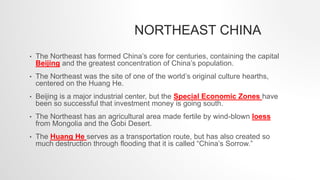
NORTHEAST CHINA
• The Northeast has formed China’s core for centuries, containing the capital
Beijing and the greatest concentration of China’s population.
• The Northeast was the site of one of the world’s original culture hearths,
centered on the Huang He.
• Beijing is a major industrial center, but the Special Economic Zones have
been so successful that investment money is going south.
• The Northeast has an agricultural area made fertile by wind-blown loess
from Mongolia and the Gobi Desert.
• The Huang He serves as a transportation route, but has also created so
much destruction through flooding that it is called “China’s Sorrow.”
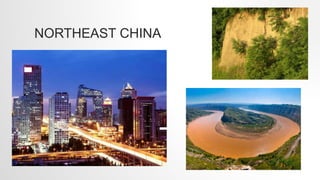
NORTHEAST CHINA
SOUTHEAST CHINA
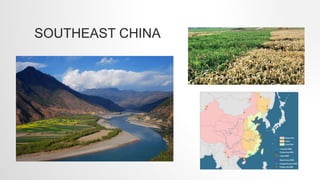
• The climate and fertile soil of the Southeast allow farmers in some
areas to practice double cropping, or growing more than one crop
a year on the same land.
• The Yangzi valley is the location of China’s most productive
farmland, and the river serves as an east-west highway connecting
the interior with the coast.
• The government has set up Special Economic Zones in this region
to lure foreign investment and technical expertise with low tax
rates.
• Many have migrated to the Southeast to benefit from the economic
boom the region is experiencing.
SOUTHEAST CHINA
NORTHWEST CHINA
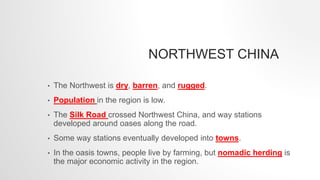
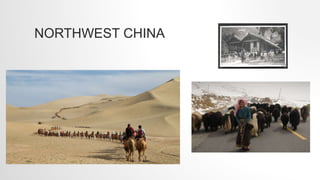
• The Northwest is dry, barren, and rugged.
• Population in the region is low.
• The Silk Road crossed Northwest China, and way stations
developed around oases along the road.
• Some way stations eventually developed into towns.
• In the oasis towns, people live by farming, but nomadic herding is
the major economic activity in the region.
NORTHWEST CHINA
SOUTHWEST CHINA
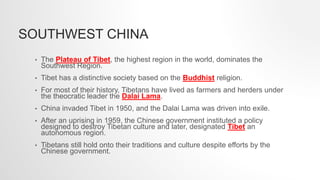
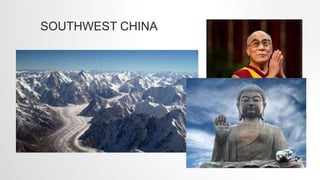
• The Plateau of Tibet, the highest region in the world, dominates the
Southwest Region.
• Tibet has a distinctive society based on the Buddhist religion.
• For most of their history, Tibetans have lived as farmers and herders under
the theocratic leader the Dalai Lama.
• China invaded Tibet in 1950, and the Dalai Lama was driven into exile.
• After an uprising in 1959, the Chinese government instituted a policy
designed to destroy Tibetan culture and later, designated Tibet an
autonomous region.
• Tibetans still hold onto their traditions and culture despite efforts by the
Chinese government.
SOUTHWEST CHINA
CHINA’S GOVERNMENT
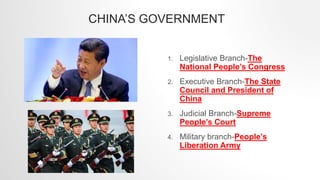
1. Legislative Branch-The
National People’s Congress
2. Executive Branch-The State
Council and President of
China
3. Judicial Branch-Supreme
People’s Court
4. Military branch-People’s
Liberation Army
NATURAL RESOURCES IN CHINA
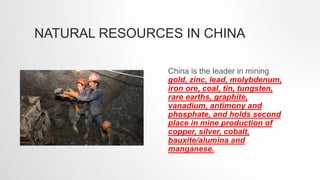
China is the leader in mining
gold, zinc, lead, molybdenum,
iron ore, coal, tin, tungsten,
rare earths, graphite,
vanadium, antimony and
phosphate, and holds second
place in mine production of
copper, silver, cobalt,
bauxite/alumina and
manganese.
A HUGE POPULATION
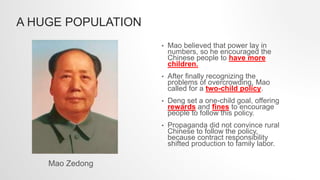
• Mao believed that power lay in
numbers, so he encouraged the
Chinese people to have more
children.
• After finally recognizing the
problems of overcrowding, Mao
called for a two-child policy.
• Deng set a one-child goal, offering
rewards and fines to encourage
people to follow this policy.
• Propaganda did not convince rural
Chinese to follow the policy,
because contract responsibility
shifted production to family labor.
Mao Zedong
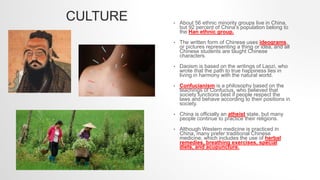
CULTURE • About 56 ethnic minority groups live in China,
but 92 percent of China’s population belong to
the Han ethnic group.
• The written form of Chinese uses ideograms,
or pictures representing a thing or idea, and all
Chinese students are taught Chinese
characters.
• Daoism is based on the writings of Laozi, who
wrote that the path to true happiness lies in
living in harmony with the natural world.
• Confucianism is a philosophy based on the
teachings of Confucius, who believed that
society functions best if people respect the
laws and behave according to their positions in
society.
• China is officially an atheist state, but many
people continue to practice their religions.
• Although Western medicine is practiced in
China, many prefer traditional Chinese
medicine, which includes the use of herbal
remedies, breathing exercises, special
diets, and acupuncture.
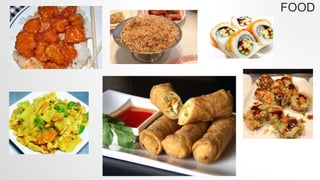
FOOD
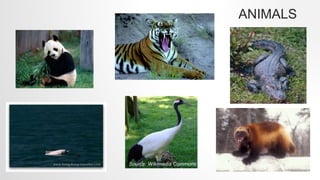
ANIMALS
SPORTS IN CHINA
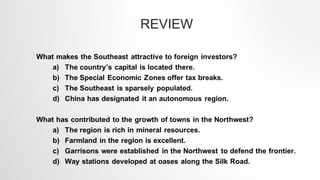
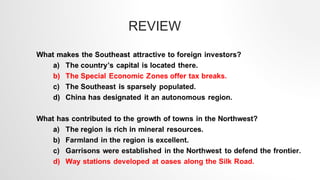
REVIEW
REVIEW

Mr. Temple's China PowerPoint

  • 1.
  • 2.
    NORTHEAST CHINA • TheNortheast has formed China’s core for centuries, containing the capital Beijing and the greatest concentration of China’s population. • The Northeast was the site of one of the world’s original culture hearths, centered on the Huang He. • Beijing is a major industrial center, but the Special Economic Zones have been so successful that investment money is going south. • The Northeast has an agricultural area made fertile by wind-blown loess from Mongolia and the Gobi Desert. • The Huang He serves as a transportation route, but has also created so much destruction through flooding that it is called “China’s Sorrow.”
  • 3.
  • 4.
    SOUTHEAST CHINA • Theclimate and fertile soil of the Southeast allow farmers in some areas to practice double cropping, or growing more than one crop a year on the same land. • The Yangzi valley is the location of China’s most productive farmland, and the river serves as an east-west highway connecting the interior with the coast. • The government has set up Special Economic Zones in this region to lure foreign investment and technical expertise with low tax rates. • Many have migrated to the Southeast to benefit from the economic boom the region is experiencing.
  • 5.
  • 6.
    NORTHWEST CHINA • TheNorthwest is dry, barren, and rugged. • Population in the region is low. • The Silk Road crossed Northwest China, and way stations developed around oases along the road. • Some way stations eventually developed into towns. • In the oasis towns, people live by farming, but nomadic herding is the major economic activity in the region.
  • 7.
  • 8.
    SOUTHWEST CHINA • ThePlateau of Tibet, the highest region in the world, dominates the Southwest Region. • Tibet has a distinctive society based on the Buddhist religion. • For most of their history, Tibetans have lived as farmers and herders under the theocratic leader the Dalai Lama. • China invaded Tibet in 1950, and the Dalai Lama was driven into exile. • After an uprising in 1959, the Chinese government instituted a policy designed to destroy Tibetan culture and later, designated Tibet an autonomous region. • Tibetans still hold onto their traditions and culture despite efforts by the Chinese government.
  • 9.
  • 10.
    CHINA’S GOVERNMENT 1. LegislativeBranch-The National People’s Congress 2. Executive Branch-The State Council and President of China 3. Judicial Branch-Supreme People’s Court 4. Military branch-People’s Liberation Army
  • 11.
    NATURAL RESOURCES INCHINA China is the leader in mining gold, zinc, lead, molybdenum, iron ore, coal, tin, tungsten, rare earths, graphite, vanadium, antimony and phosphate, and holds second place in mine production of copper, silver, cobalt, bauxite/alumina and manganese.
  • 12.
    A HUGE POPULATION •Mao believed that power lay in numbers, so he encouraged the Chinese people to have more children. • After finally recognizing the problems of overcrowding, Mao called for a two-child policy. • Deng set a one-child goal, offering rewards and fines to encourage people to follow this policy. • Propaganda did not convince rural Chinese to follow the policy, because contract responsibility shifted production to family labor. Mao Zedong
  • 13.
    CULTURE • About56 ethnic minority groups live in China, but 92 percent of China’s population belong to the Han ethnic group. • The written form of Chinese uses ideograms, or pictures representing a thing or idea, and all Chinese students are taught Chinese characters. • Daoism is based on the writings of Laozi, who wrote that the path to true happiness lies in living in harmony with the natural world. • Confucianism is a philosophy based on the teachings of Confucius, who believed that society functions best if people respect the laws and behave according to their positions in society. • China is officially an atheist state, but many people continue to practice their religions. • Although Western medicine is practiced in China, many prefer traditional Chinese medicine, which includes the use of herbal remedies, breathing exercises, special diets, and acupuncture.
  • 15.
  • 16.
  • 17.
  • 18.
  • 19.