Michael NewnsCountry Project
ChinaMichael Newns
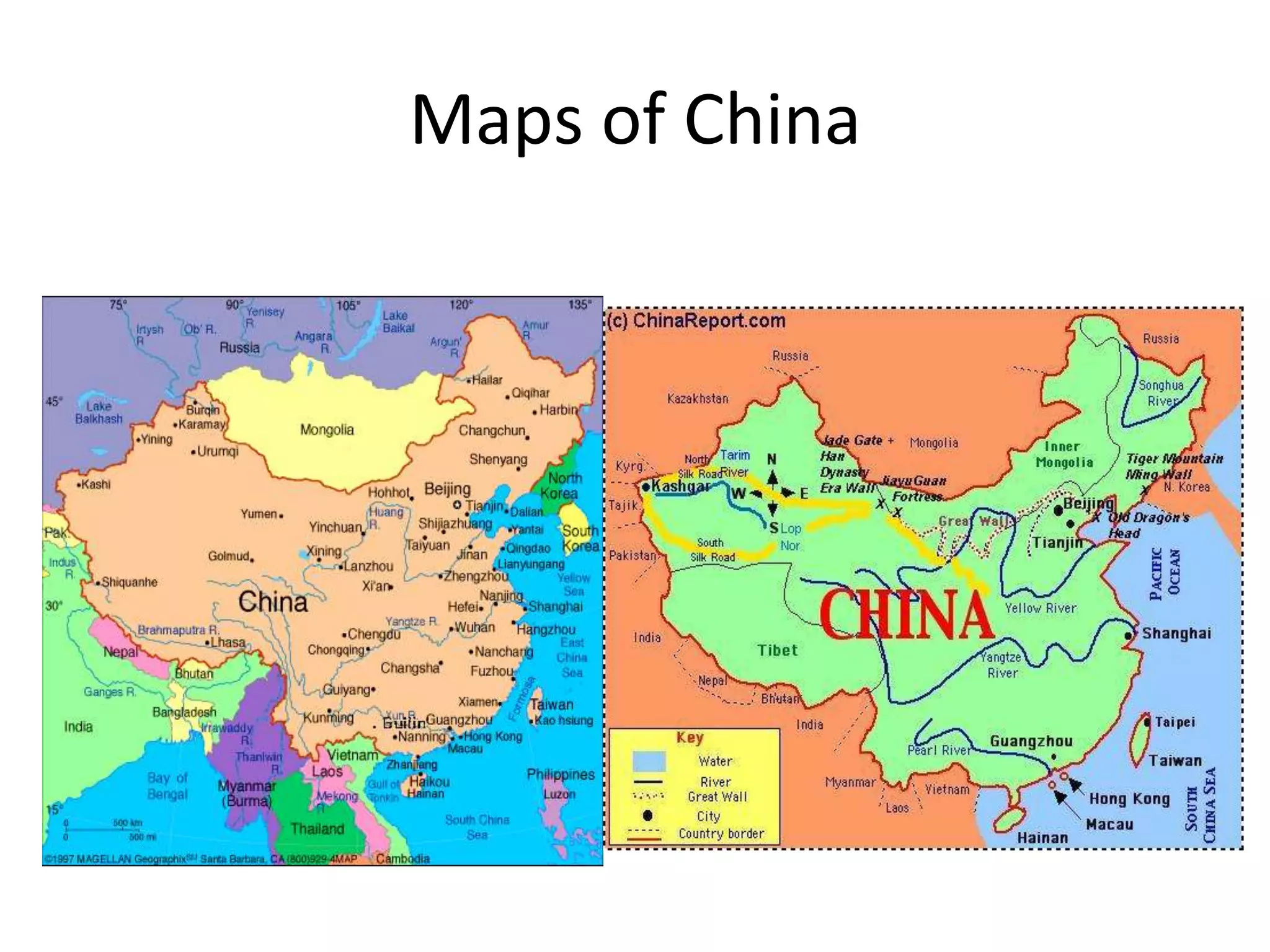
Maps of China
Country DescriptionTotal Area: 9,596,960(sq km)/ 3,705,386(sq mi)Land Area: 9,326,410(sq km)/ 3,600,927(sq mi)Water Area: 270,550(sq km)/ 104,459(sq mi)The climate varies greatly Northern China: summer temperatures reaching 90 degrees F and winters of Arctic severity. Rainey summers and dry winters.Central China: Very hot summers and cold wintersSouthern China: subtropical climate. Very hot summers and mild winters. Water pollution, erosion, and air pollution are concerns.
Country Description(continued)Geographical Coordinates: 35°00’ N; 105 °00’ ELocated in the North and Eastern hemispheresEast AsiaBordered by Afghanistan, Bhutan, Burma, India, Kazakhstan, North Korea, Kyrgyzstan, Laos, Mongolia, Nepal, Pakistan, Russia, andPopulation: 1,338,612,968Life Expectancy: 73 Years
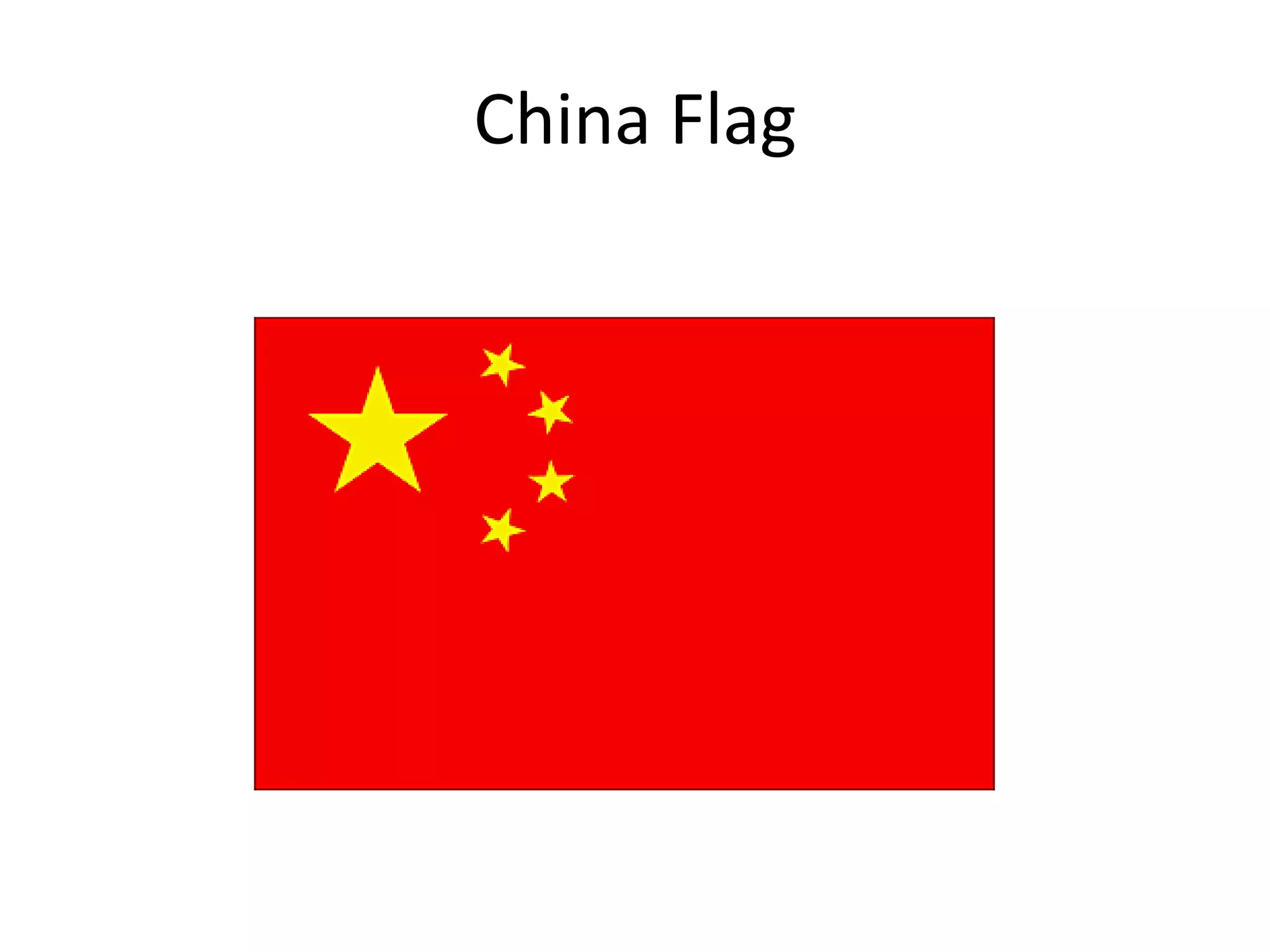
China Flag
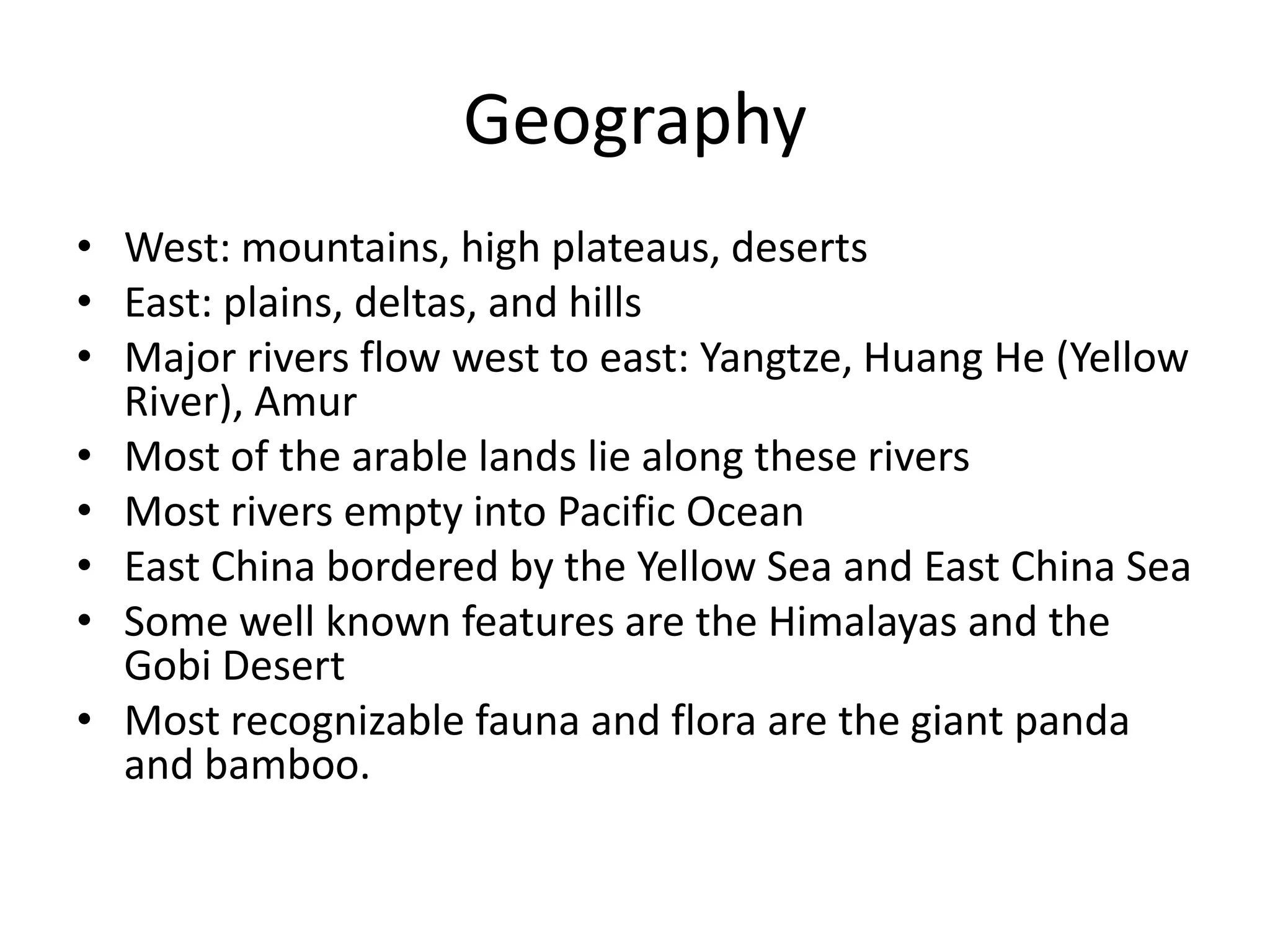
GeographyWest: mountains, high plateaus, desertsEast: plains, deltas, and hillsMajor rivers flow west to east: Yangtze, Huang He (Yellow River), AmurMost of the arable lands lie along these riversMost rivers empty into Pacific OceanEast China bordered by the Yellow Sea and East China SeaSome well known features are the Himalayas and the Gobi DesertMost recognizable fauna and flora are the giant panda and bamboo.
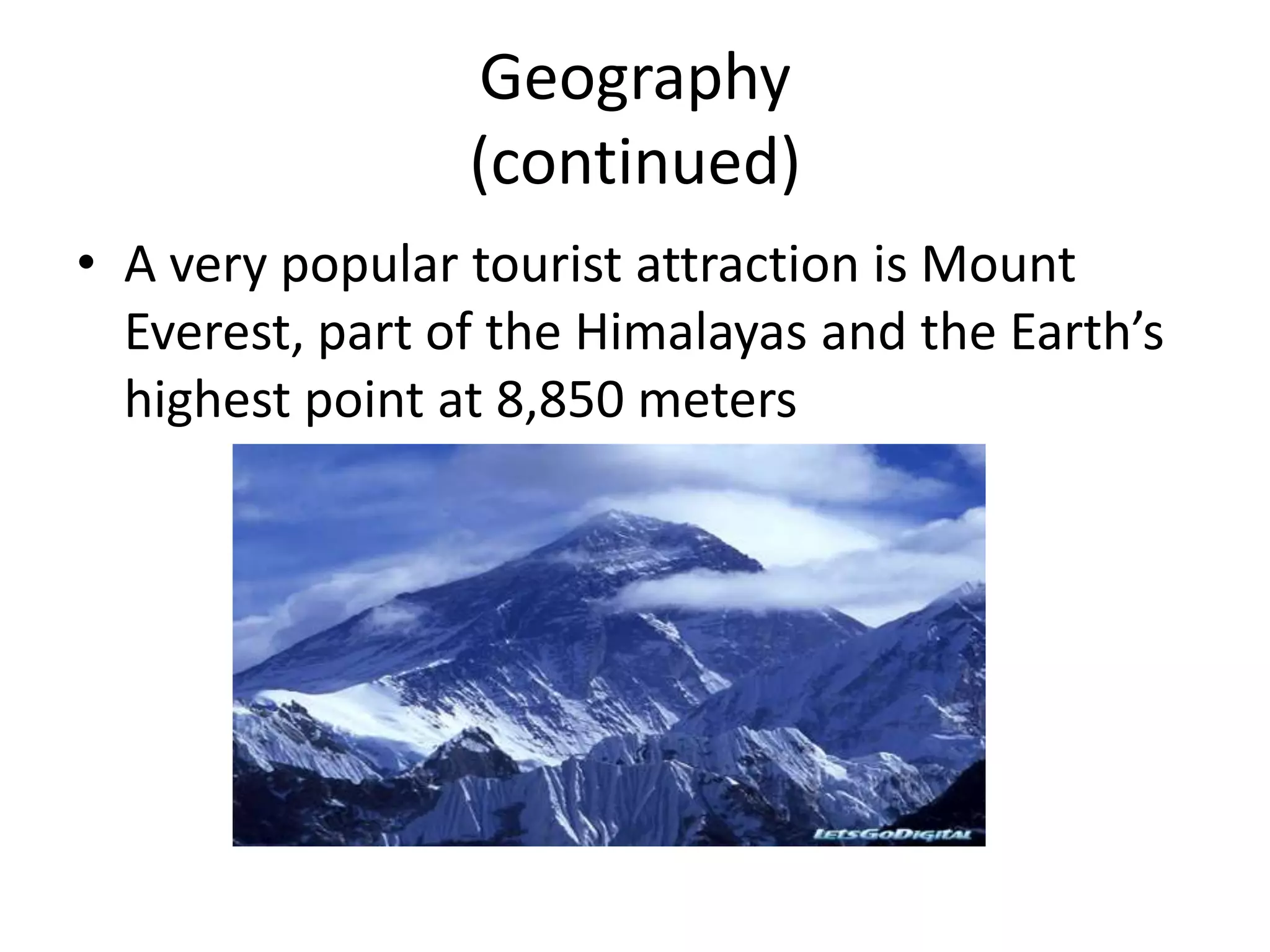
Geography(continued)A very popular tourist attraction is Mount Everest, part of the Himalayas and the Earth’s highest point at 8,850 meters
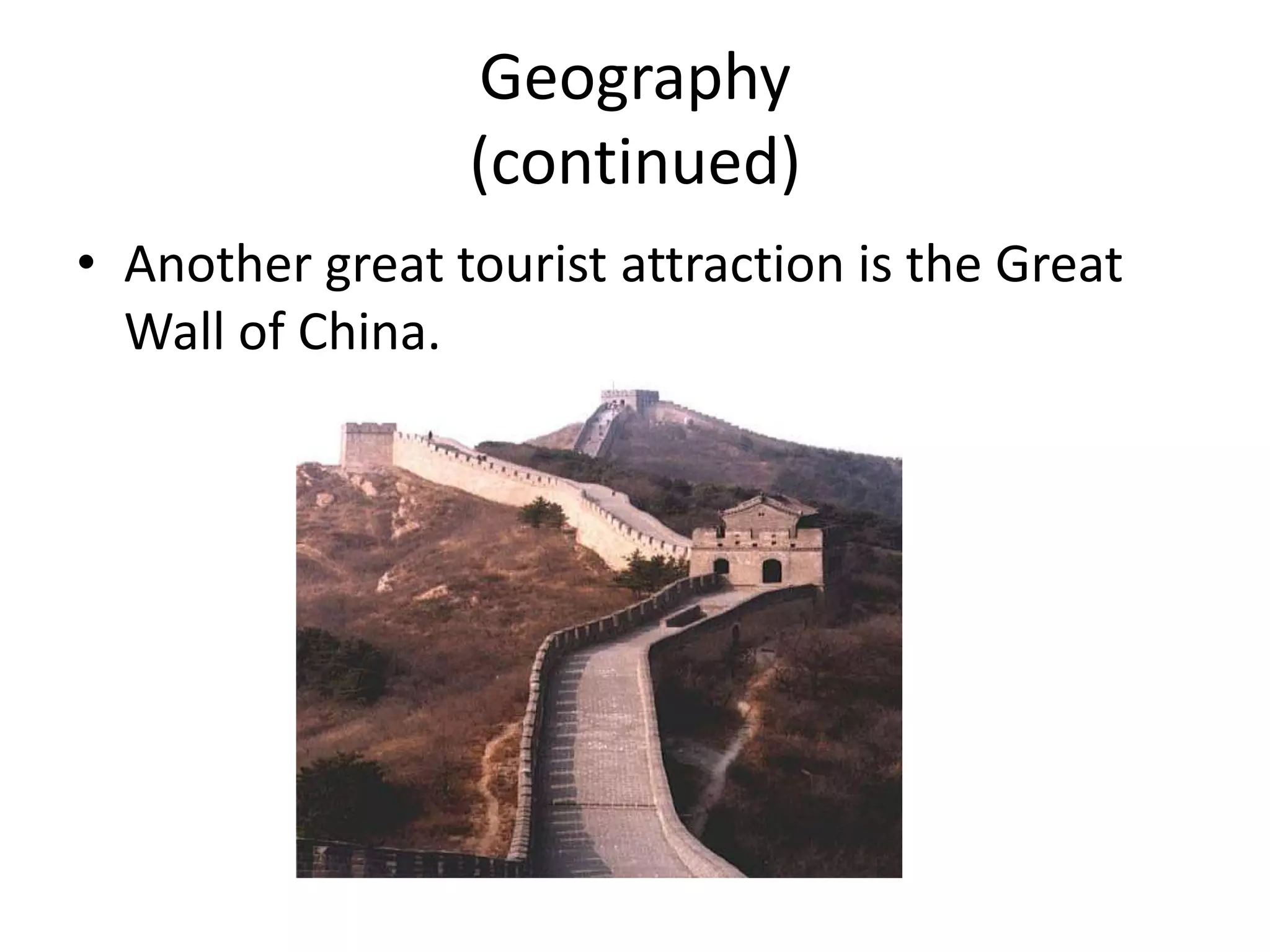
Geography(continued)Another great tourist attraction is the Great Wall of China.
HistoryChinese history dates back 4,000 years.Family dynasties ruled China for about 2,000 yearsThe last dynasty was the Qing and ended in 1911Many inventions have come from China, the most famous being paperThe Republic of China started in 1912 The government was weak and regional warlords looked to gain land and power.China fought Japan in the Sino- Japanese War, which was part of WWII. Japan surrendered in 1945.
History(continued)A civil war then started between the communists and the nationalists.The communist party led by Mao Zedong won the war and took control of the government. The nationalists retreated to Taiwan.Current Event: In 2008, Beijing hosted the Summer Olympics.
PoliticalThe People’s Republic of China is a communist governmentThe major party is the Chinese Communist Party (CCP) There are eight smaller parties that are all controlled by the CCPThe Chief of State is President HuJintaoThe Head of Government is Premier WEN Jiabao
EconomyThe Great Leap Forward: 1958- Mao Zedong pushed for a more modernized Chinese economyChina now has the third largest economy in the world behind the U.S. and Japan.China is the largest trading nation in the world and the largest exporter and second largest importer of goods.Industry counts for over half of China’s gross domestic product(GDP).
Economy (continued)Exports: machinery and equipment, textiles and clothing, footwear, toys and sporting goods, mineral fuels Imports: machinery and equipment, mineral fuels, plastics, iron and steel, chemicals Major trade partners: Japan, United States. Germany, South KoreaRestrictions: China recently stopped selling aircraft and some other military supplies to the U.S. after the U.S. agreed to supply Taiwan with money and military supplies.Trade Organizations: Ministry of Commerce of P.R.China, China International Economic and Trade Arbitration Commission, China Council for the Promotion of International Trade
Daily LifeThe Chinese standard of living as increased dramatically over the past decade.In 1949, the life expectancy was 32. It is now 73.91 % of total population is literate95 % of males are literate86 % of females are literateCommunist restriction on clothing are gone and Chinese fashion is developing. Adults are wearing more formal than casual. Teenagers like brand names and western clothing. Many children wear shirts with pictures of cartoon characters. Internet usage in China has risen from 0% in 1993 to 28 % in 2008.
CultureMost values of China come from Confucianism, Taoism, and Buddhism.Religion: 60% Buddhist, 4% Christian, 2% Muslim, 34% AtheistChopsticks are used for every meal in China.Tipping at restaurants is considered an insult. Noodles, small pieces of meat, rice, and fruit deserts are common.The Chinese food in America is nothing like the food in China. America’s Chinese food has greater potions, more fat, and better taste.
Culture (continued)Table Tennis, basketball, and soccer are the most popular sports in China.Martial arts has always been a popular activity and is believed to have originated in China.Various types of art are practiced in China like paper cutting.Some of the oldest music in the world has dated back to the time of Confucius. China takes great pride in the Great Wall.
Winter Olympics 2010China won 11 medals: 5 gold, 2 silver, 4 bronzeCame in 8th placeAll gold medals were in skating (speed and figure)Gold medalists: Wang Meng, Zhou Yang, ShenXeu, Zhao Hongbo, 90 participants
ConclusionChina is one of the oldest countries in the world and there is unlimited interesting information on it. The culture and history is fascinating. The one fact that I found the most interesting is that in China’s long history, it has always been independent.
MoroccoMichael Newns
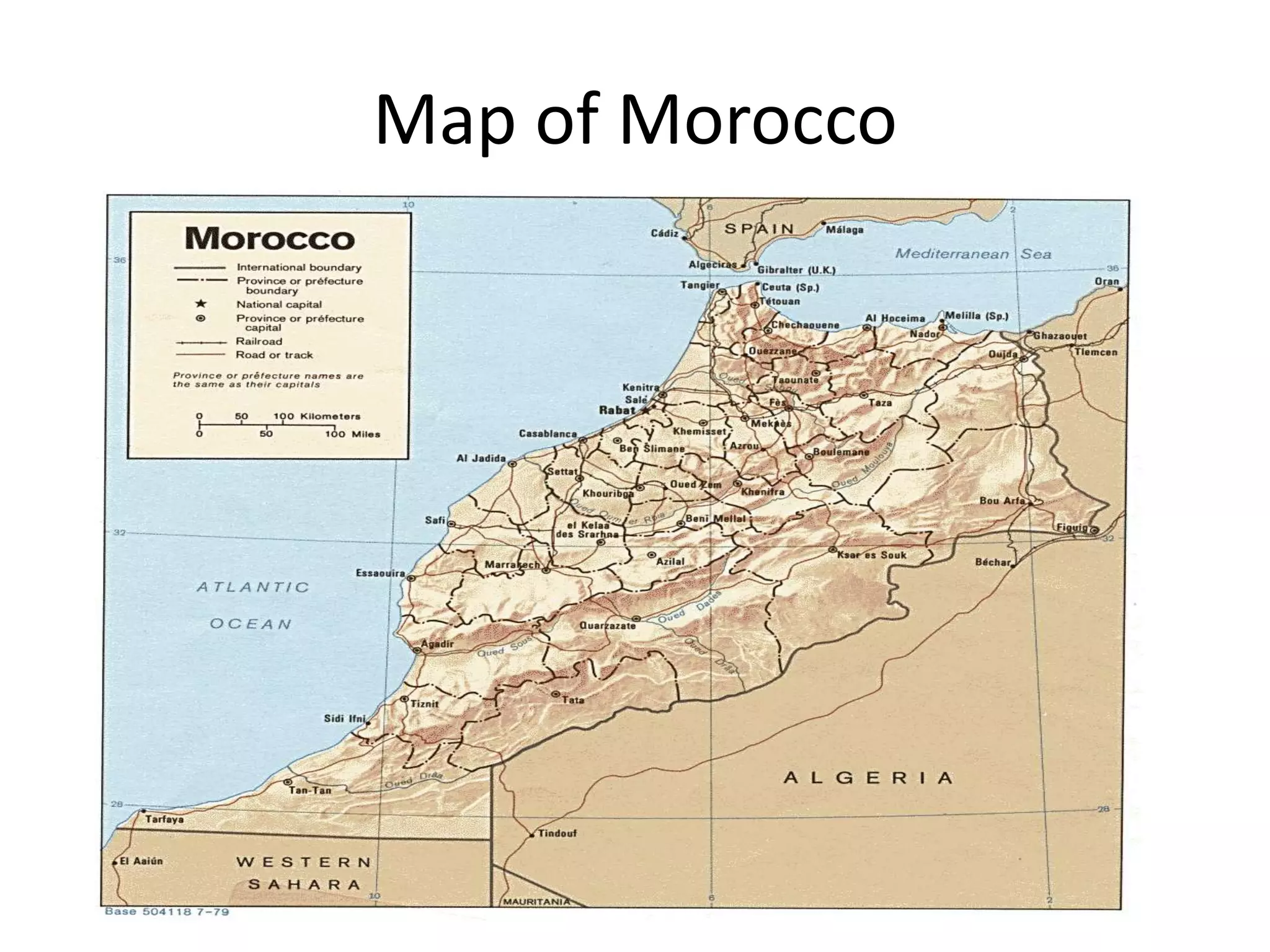
Map of Morocco
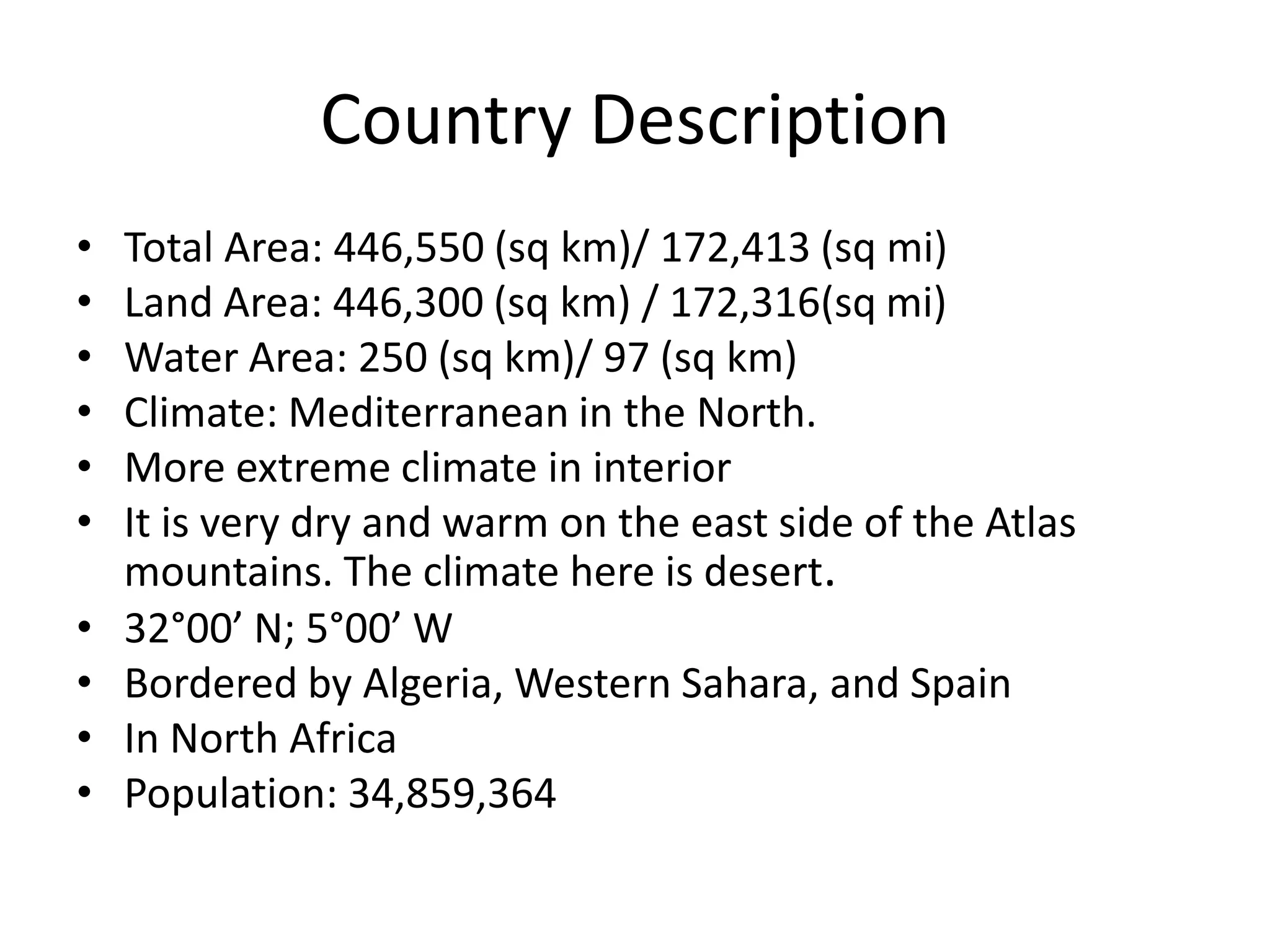
Country DescriptionTotal Area: 446,550 (sq km)/ 172,413 (sq mi)Land Area: 446,300 (sq km) / 172,316(sq mi)Water Area: 250 (sq km)/ 97 (sq km)Climate: Mediterranean in the North. More extreme climate in interiorIt is very dry and warm on the east side of the Atlas mountains. The climate here is desert.32°00’ N; 5°00’ WBordered by Algeria, Western Sahara, and SpainIn North AfricaPopulation: 34,859,364
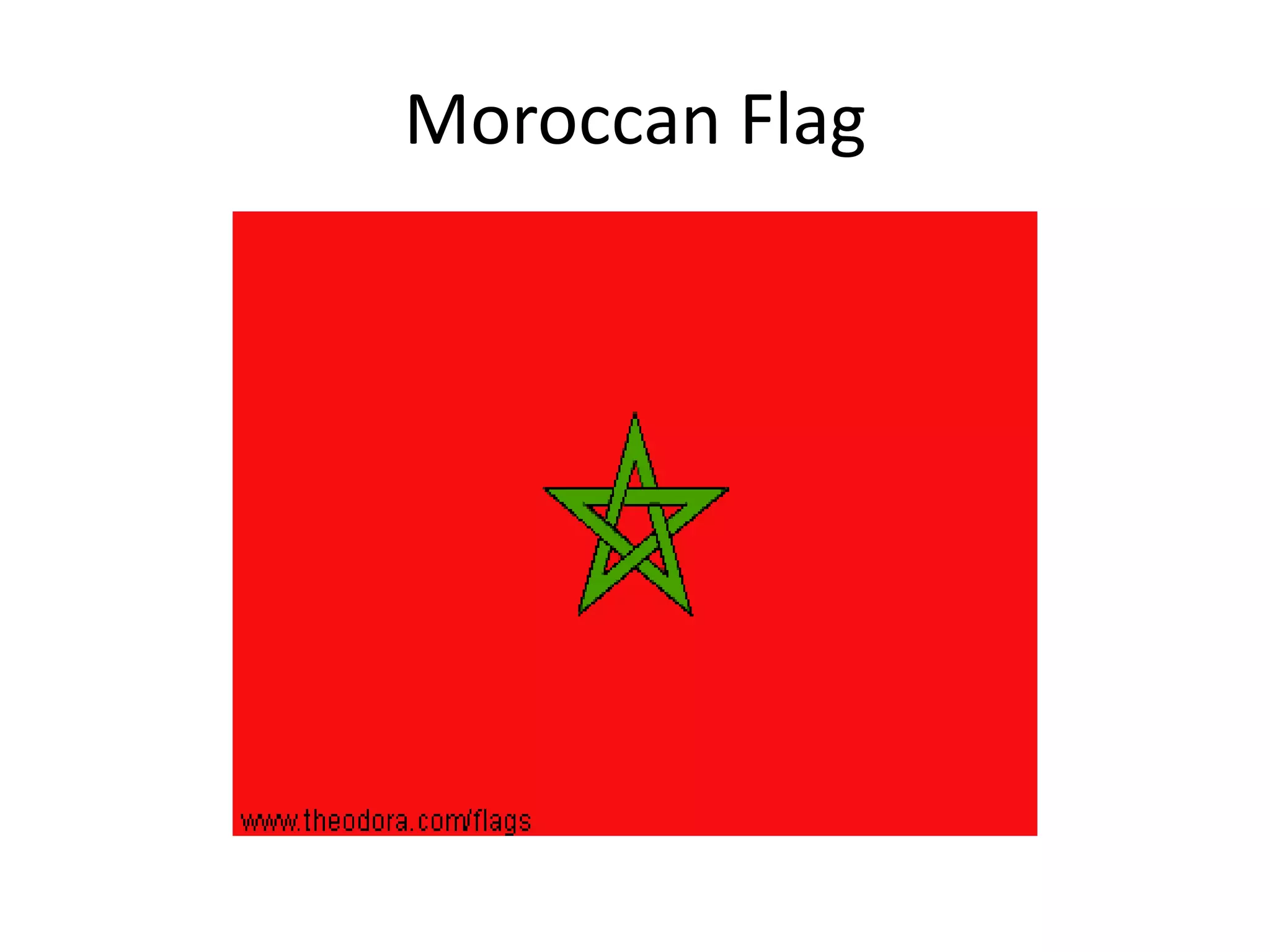
Moroccan Flag
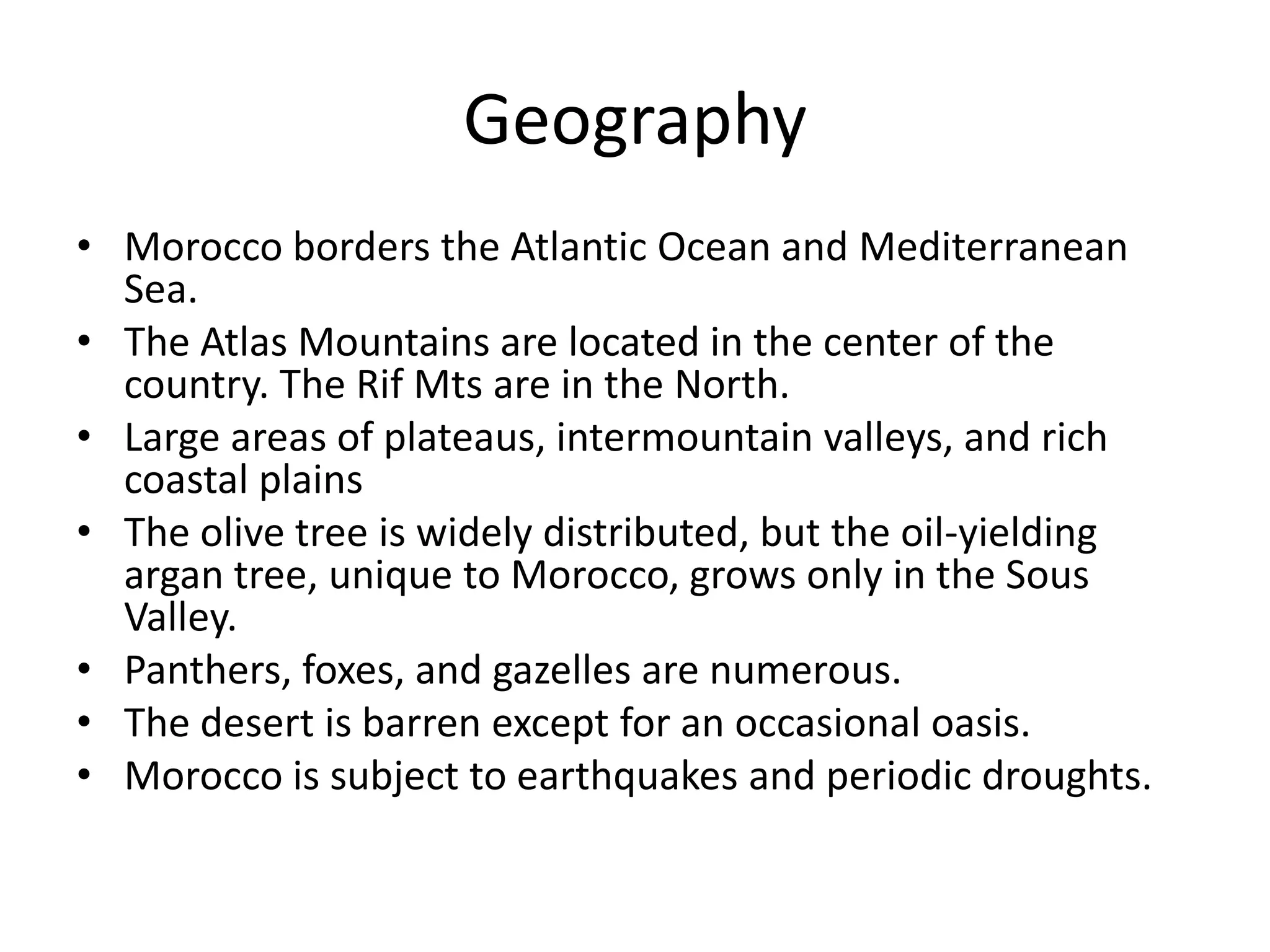
GeographyMorocco borders the Atlantic Ocean and Mediterranean Sea.The Atlas Mountains are located in the center of the country. The Rif Mts are in the North. Large areas of plateaus, intermountain valleys, and rich coastal plainsThe olive tree is widely distributed, but the oil-yielding argan tree, unique to Morocco, grows only in the Sous Valley.Panthers, foxes, and gazelles are numerous.The desert is barren except for an occasional oasis.Morocco is subject to earthquakes and periodic droughts.
HistoryIn the early years of the first century, Morocco was under Roman rule. Muslims then started to inhabit and take control of Morocco. Became independent state in 1062Several dynasties ruled Morocco until the middle of the nineteenth century. Spain declares war on the Moors in Morocco in 1859.Became a French protectorate in 1912.Independent again in 1956.First democratic elections in1997Current Events: Tourists are afraid to fly to Muslim countries so Morocco’s tourism is hurting. Also, the dispute over the Western Sahara is continuing.
PoliticalThe Kingdom of Morocco is a constitutional monarchy.Capital : RabatBicameral legislatureKing Mohammad VIPrime Minister Abbas El FassiCouncil members appointed by monarchMonarch is hereditary
EconomyMorocco relies less on industry and more on agriculture and fishing. Its main trading partner and investor is France. It also trades with Spain, Britain, Germany, Italy, and U.S.Exports: clothing, fish, inorganic chemicals, transistors, crude minerals, fertilizers (including phosphates), petroleum products, fruits, vegetables Imports: crude petroleum, textile fabric, telecommunications equipment, wheat, gas and electricity, transistors, plastics The economy is growing steadily.Trade Associations: Morocco-US Free Trade Agreement
Daily Life Moroccan standard of living is low, but not drastically low. 20% the population us below the poverty line.Life expectancy is 72 years.Literacy rate:52%Literacy in men:64%Literacy in women:39%The national garment is the djelleba, a hooded caftan worn by both men and women, although Western-style clothing is becoming more common.Internet usage went from 0% in 1995 to 33% in 2008.
Culture99% of Morocco is Muslim. 1% Christian.Barley and wheat are the main diet.Lamb, beef, and chicken are the main meats.Mint tea is the national drink.They don’t eat pork or drink alcohol.Married sons and their wives live with the father and mother. When the father dies, then the sons go and make their own household.Soccer is the most popular sport.Moroccan music is a blend of Arab, Berber and classical styles-  Dancing in Morocco is a must during various ceremonies and festival like marriage, harvest festival, religious gatherings
Winter Olympics 2010Morocco had 1 participant.AzzimaniSamir competed in the Alpine Skiing.
ConclusionMorocco is a highly Muslim country where family and religion are the most important values, two values that have been lost in America.
FinlandMichael Newns
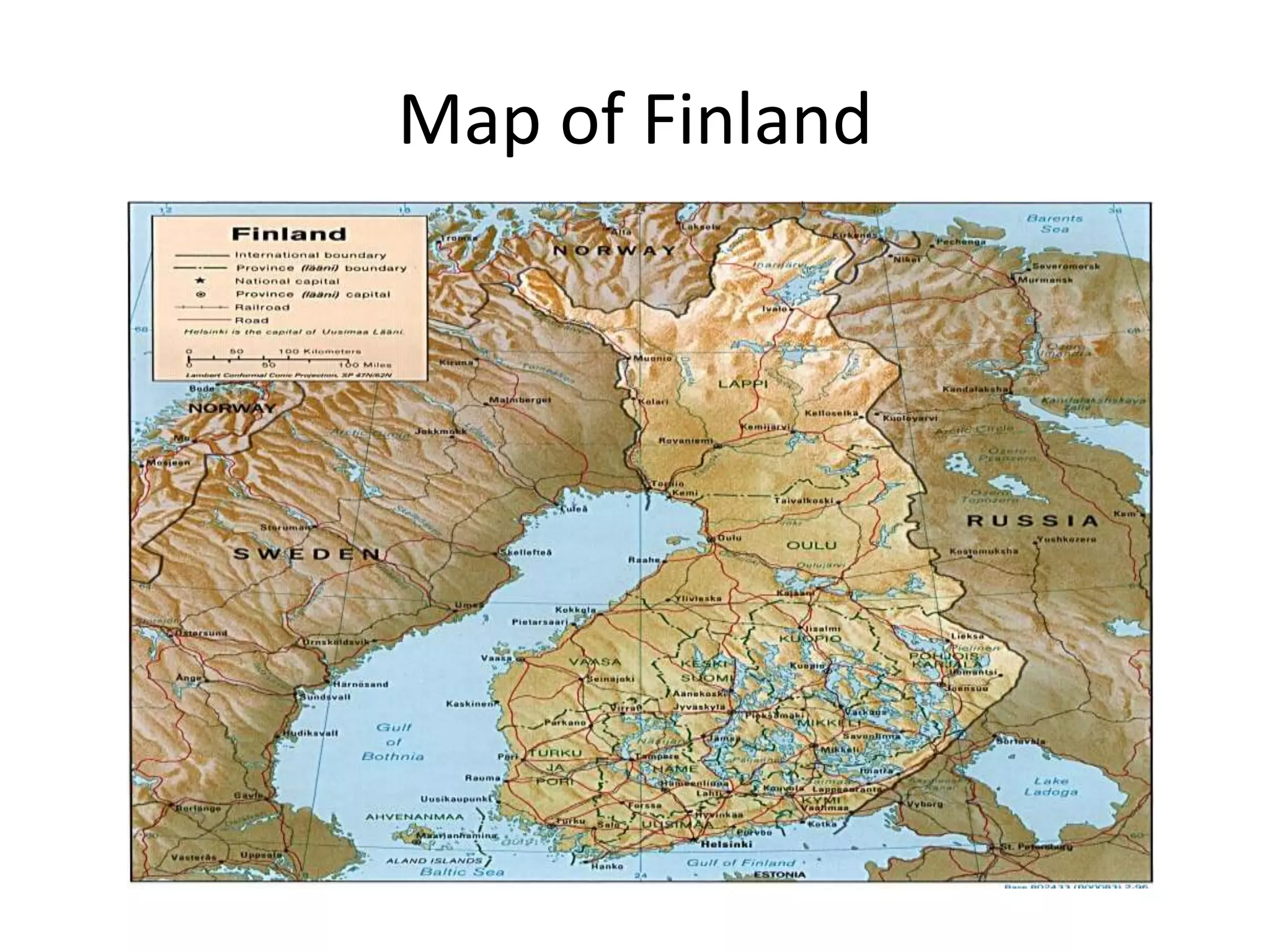
Map of Finland
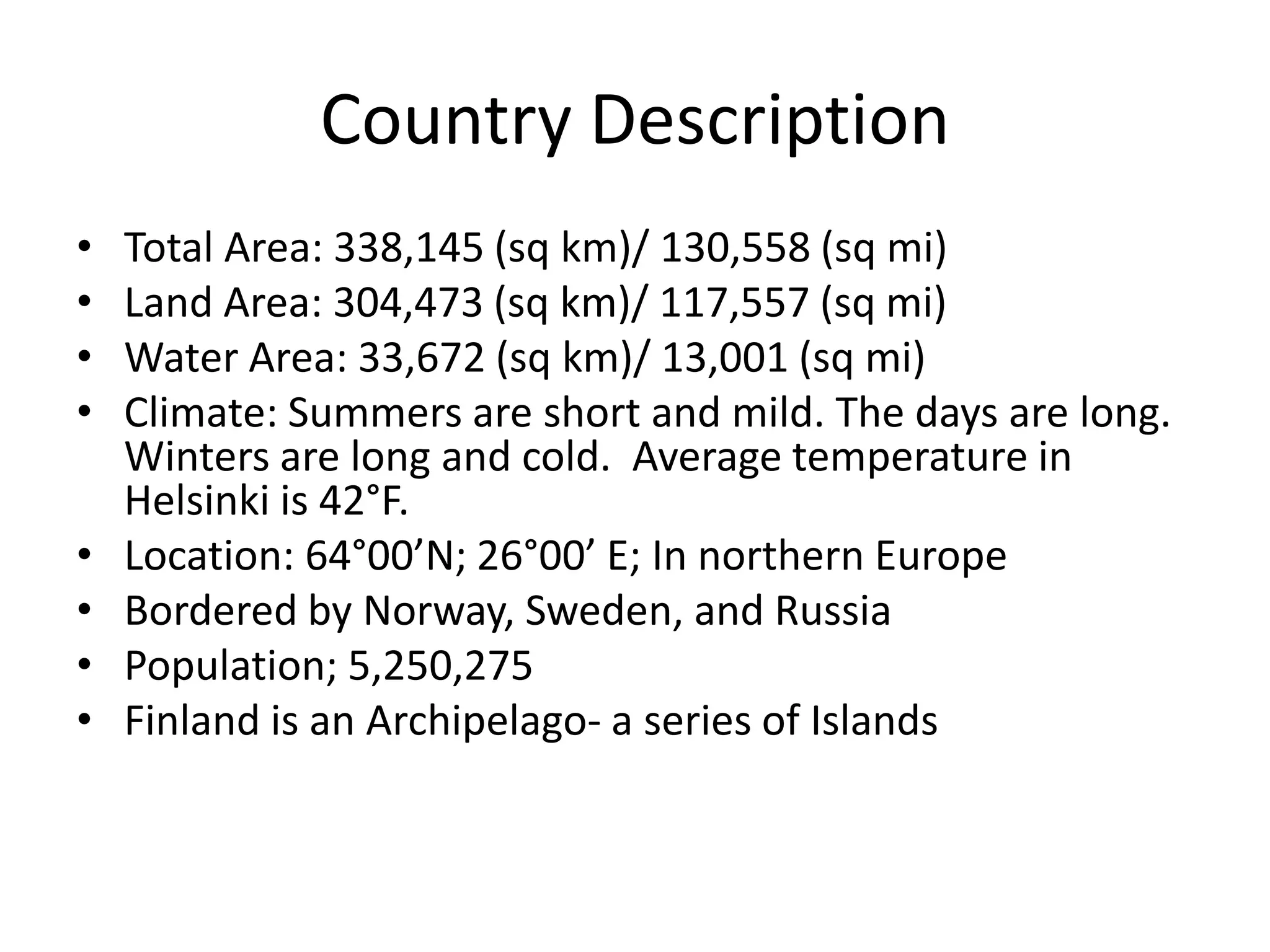
Country DescriptionTotal Area: 338,145 (sq km)/ 130,558 (sq mi) Land Area: 304,473 (sq km)/ 117,557 (sq mi)Water Area: 33,672 (sq km)/ 13,001 (sq mi)Climate: Summers are short and mild. The days are long. Winters are long and cold.  Average temperature in Helsinki is 42°F.Location: 64°00’N; 26°00’ E; In northern EuropeBordered by Norway, Sweden, and RussiaPopulation; 5,250,275Finland is an Archipelago- a series of Islands
Finland Flag
Geographymostly low, flat to rolling plains interspersed with lakes and low hillsMany of the islands are on the Archipelago Sea, and Finland also boarders the Gulf of Finland. Finland has lots of lakes such as Lake Saimaa in Southern Finland.There are rine, spruce, and birch forests in Finland. 75% of the fauna are insects. Some of the non-insects are otters, elk, foxes, and birds.One of Finland’s most famous tourist attractions is a church built into solid rock.
HistoryFinland has always been bullied by other nations.1713- Russia invades Finland1808- Russia invades Finland again1907- Finland is the first country to give women the right to vote.1917- Finland declares its independence during the Russian Civil War.During WWII, Finland declared neutrality but had an alliance with Germany from 1918.The Soviet Union invaded and Finland gave up 10% of its land.
History(continued)Germany invaded the Soviet Union, and so did Finland. In response, Britain declared war on Finland.Finland conceded even more land and paid millions of dollars to the Soviet Union in 1944.1948- Finland and Soviet Union signed Treaty of Friendship, Cooperation and Mutual Assistance.1973- Finland signed free-trade agreement with European Economic Community (EEC) .Finland became a member of the European Union in 1995.Current Event: A fox broke into a zoo in Finland and killed 16 flamingoes.
PoliticalFinland is a republicCapital city is HelsinkiPresident TarjaHalownenPrime Minister MattaVanhanenCouncil members appointed by president
EconomyIndustry has replaced agriculture as the leading sector in Finland’s economy.Industry accounted for 34% of Finland’s GDP.Some industries include metal products, electronics, shipbuilding, pulp and paper, copper refining, foodstuffs, chemicals, textiles, clothingExports: machinery and equipment, chemicals, metals; timber, paper, pulpImports: foodstuffs, petroleum and petroleum products, chemicals, transport equipment, iron and steel, machinery, textile yarn and fabrics, grainsMajor trade partners: Germany, Sweden, Russia, Britain, France, DenmarkTrade Associations: Finnish Foreign Trade Association, European Free Trade Association.
Daily LifeHigh level of health care and standard of livingLife expectancy is 79 years.Literacy rate:100%Fairly casual dressed. Teens follow trends. Formal dress worn on special occasions. The men wear a peaked cap, woolen cap or felt hat. Internet usage went from 0% in 1990 to 79% in 2007
CultureReligion: 89% Evangelical Lutheran, 1% Russian Orthodox, 1 % other, 9% noneFinns are more reserved and care about respect and privacySalmon, reindeer, berries, and soup are common.The national sport in Finland is pesapallo. It is played much like baseball.Folk, rock, opera, and pop are poplar genres of music.
Winter Olympics 2010Finland won 5 medals: 1 silver and 4 bronzeThe silver medal was won by PiiroinenPeetu in the Men’s Snowboarding Halfpipe.
ConclusionFinland is a fairly modern country not very different from the U.S.A very interesting fact that I learned is that in June and July, the night only lasts for 2-3 hours. In the extreme north, there is a period of 73 days that the sun does not set.
SurinameMichael Newns
Map of Suriname
Country DescriptionTotal Area: 163,270(sq km)/ 63,039(sq mi)Land Area: 161,470 (sq km)/ 62,344(sq mi)Water Area: 1,800(sq km)/ 695(sq mi)Climate: tropical, hot, and humid year-round. average 75°F to 90°F.There is rain year round, amounts differing with the seasons. Flooding is a cause for concern.Location:4°00’N; 56°00’WBordered by Brazil, French Guina, and GuyanaIn Northern Latin AmericaPopulation: 481,267
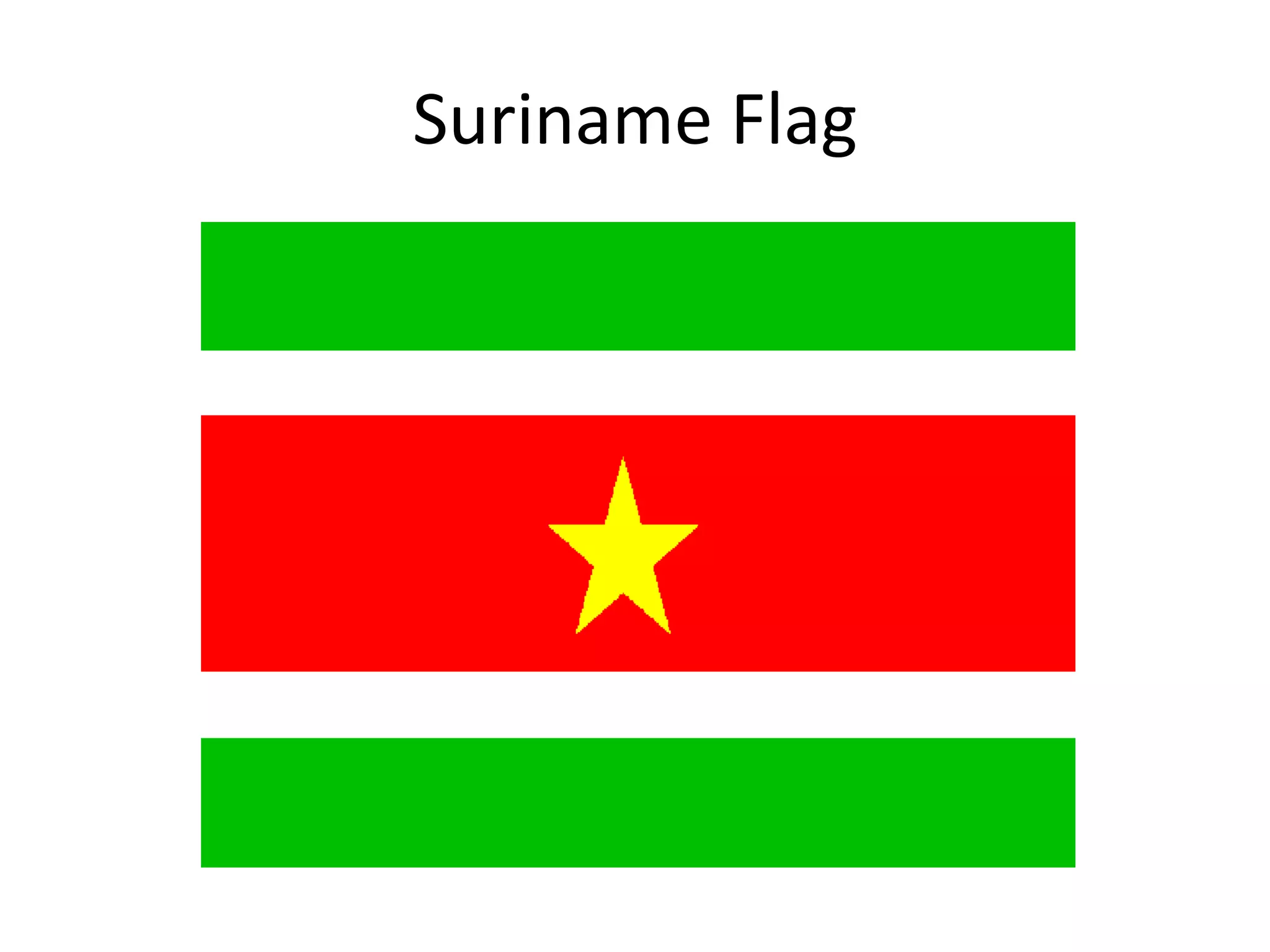
Suriname Flag
Geographymostly rolling hills; narrow coastal plain with swampsBorders the Atlantic OceanFlora: water lilies, orchids, tropical shrubsFauna: iguanas, snakes, white egretMany tourists come to explore the tropical rain forest that makes up about 80% of Suriname
HistoryThe Dutch acquired Suriname from England in the 1500’s. It was turned into a plantation colony an slaves were brought there. Slavery was abolished in 1863, but labor was still needed. Contract laborers from the south came to Suriname and worked on the plantation. Suriname gained full independence in 1975Current Event: This past January, Suriname’s first president died at the age of 99.
PoliticalThe Republic of Suriname is a constitutional democracyIts capital is ParamariboChief of State: Runaldo Ronald VENETIAAN Head of Government: Runaldo Ronald VENETIAAN Cabinet members are appointed by the president
EconomySuriname’s industry in growing, but is still relatively low.Some industries:  bauxite and gold mining, alumina production, oil, lumbering, food processing, fishingExports: alumina, crude oil, lumber, shrimp and fish, rice, bananasImports: capital equipment, petroleum, foodstuffs, cotton, consumer goodsMajor Trading Partners: US, Netherlands, Trinidad and Tobago, China, France, and JapanTrade Associations: Suriname Trade & Industry Association
Daily LifeLife expectancy is 73 yearsLiteracy rate:89%Literacy in males:92%Literacy in females:84%The Javanese women wear sarongs as they would in Indonesia. The Creole women wear the traditional kotomisse, with an angisa or  handkerchief. Internet usage in Suriname rose from 0% in 1995 to 8% in 2007.
CultureReligion: Hindu 27%, Protestant 25%, Roman Catholic 23%,Muslim 20%, indigenous beliefs 5%Rice, potatoes, chicken, beans, and peppers are very common.Soccer and swimming are the most popular sports. The music of Suriname is well-known for kaseko music, and for having an Indo-Caribbean tradition.Many tourist come to Suriname to observe the beauty of the rain forest.
Winter Olympics 2010Suriname did not participate in the 2010 Winter Olympics.
ConclusionSuriname is a beautiful, tropical country which I would love to visit one day.I found the diversity of religions practiced in Suriname interesting.
NamibiaMichael Newns
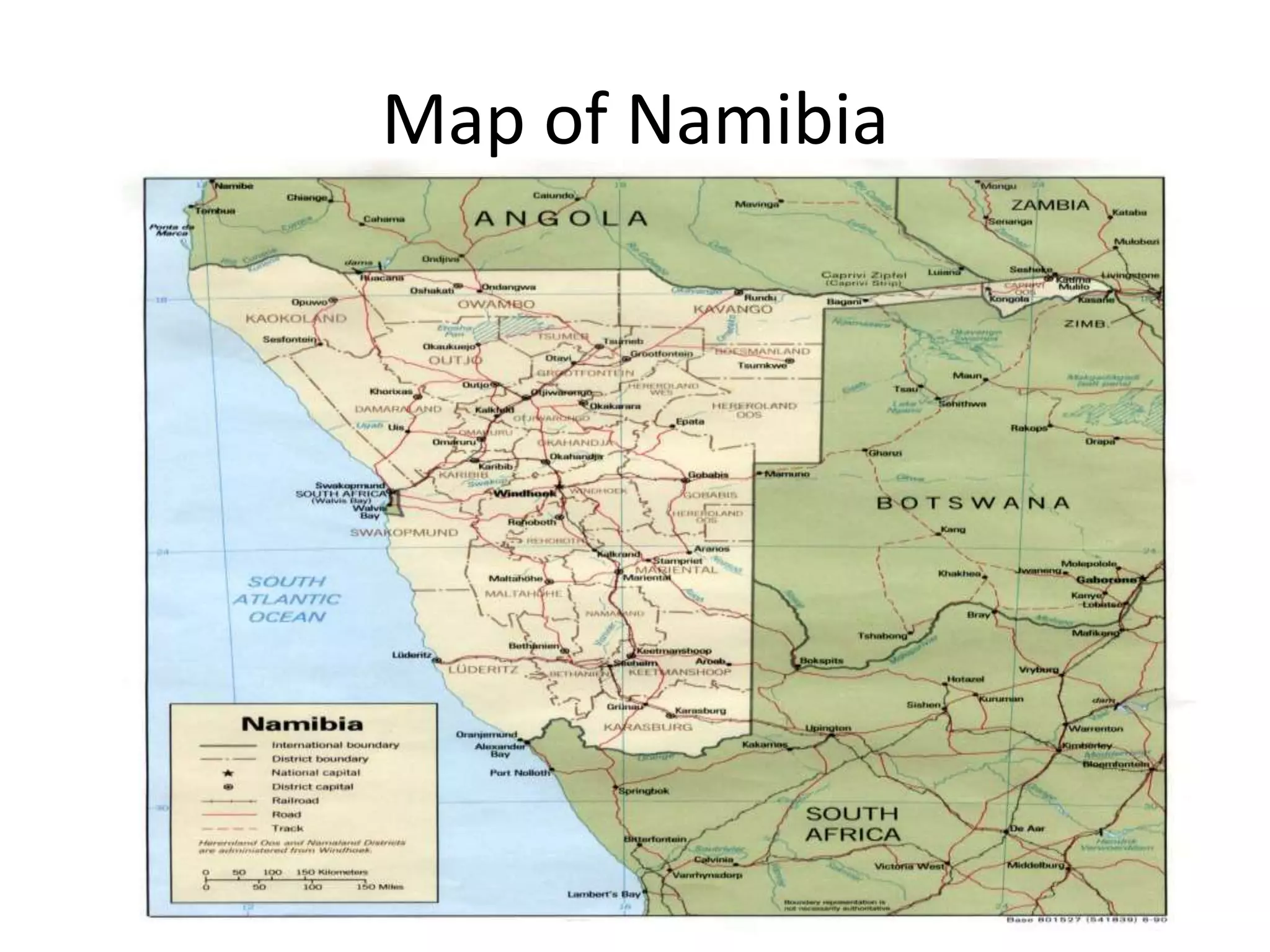
Map of Namibia
Country DescriptionTotal Area:825,418 (sq km)/318,694 (sq mi)Land Area:825,418(sq km)/ 318,694(sq mi)Water Area:0 (sq km)Climate: semi-desert. Hot days and cool nightsSummer, days can reach 100°FRain from December to March, unrelenting dryness for rest of yearLocation: 22°00’S, 17°00’ ESouthern AfricaBordered by Angola, Botswana, South Africa, Zambia Population:2,108,665
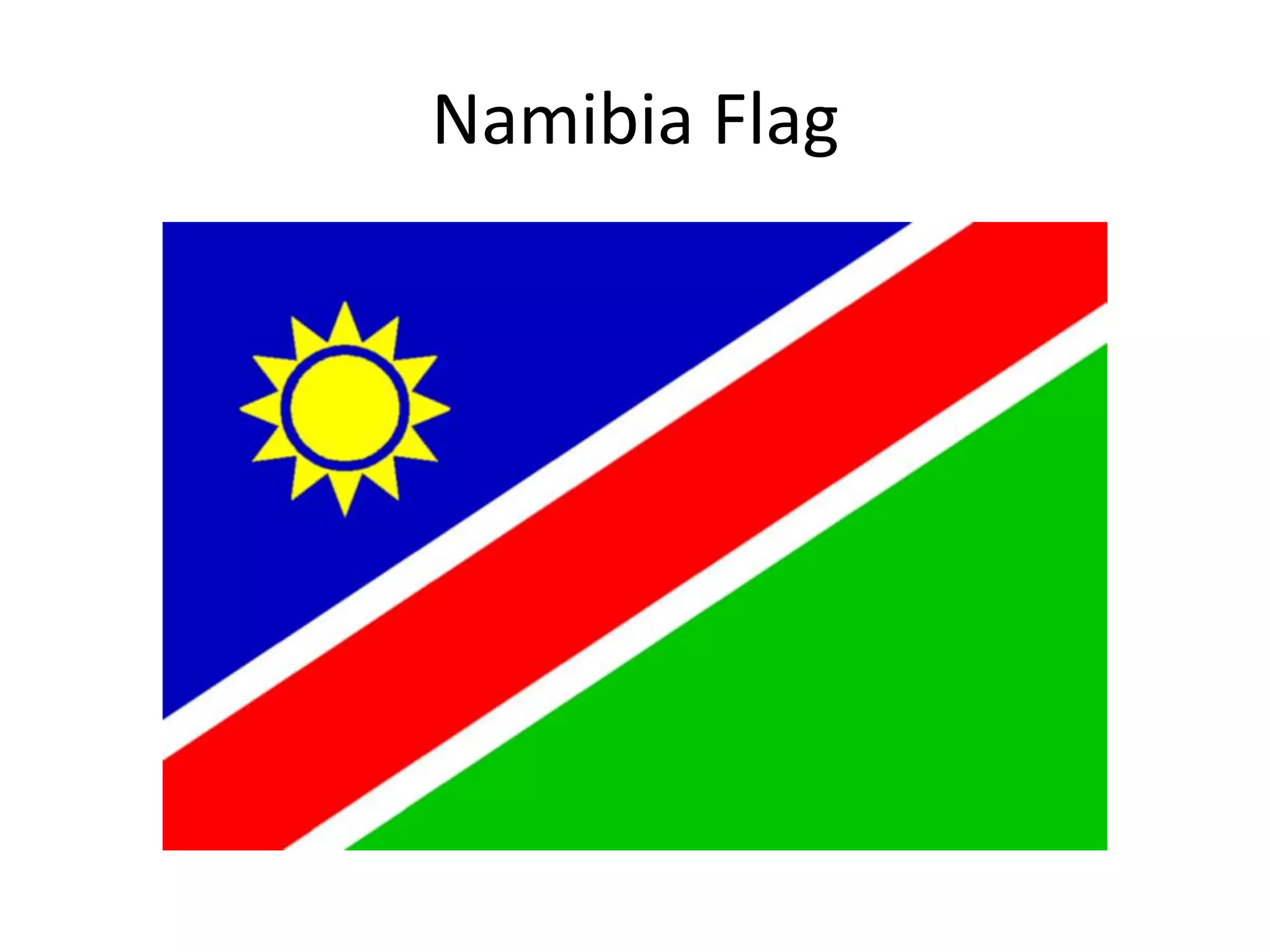
Namibia Flag
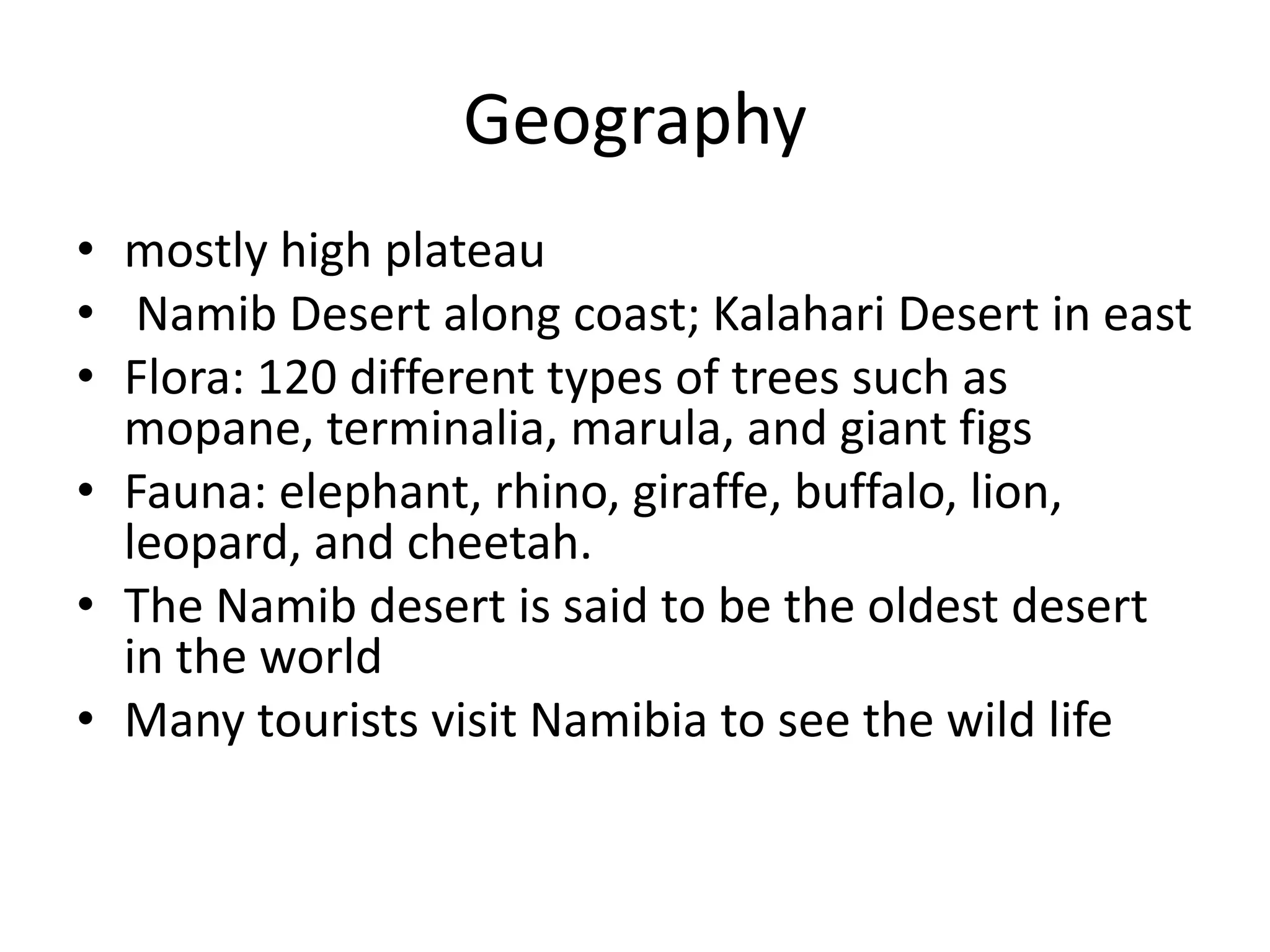
Geographymostly high plateau Namib Desert along coast; Kalahari Desert in eastFlora: 120 different types of trees such as mopane, terminalia, marula, and giant figsFauna: elephant, rhino, giraffe, buffalo, lion, leopard, and cheetah.The Namib desert is said to be the oldest desert in the worldMany tourists visit Namibia to see the wild life
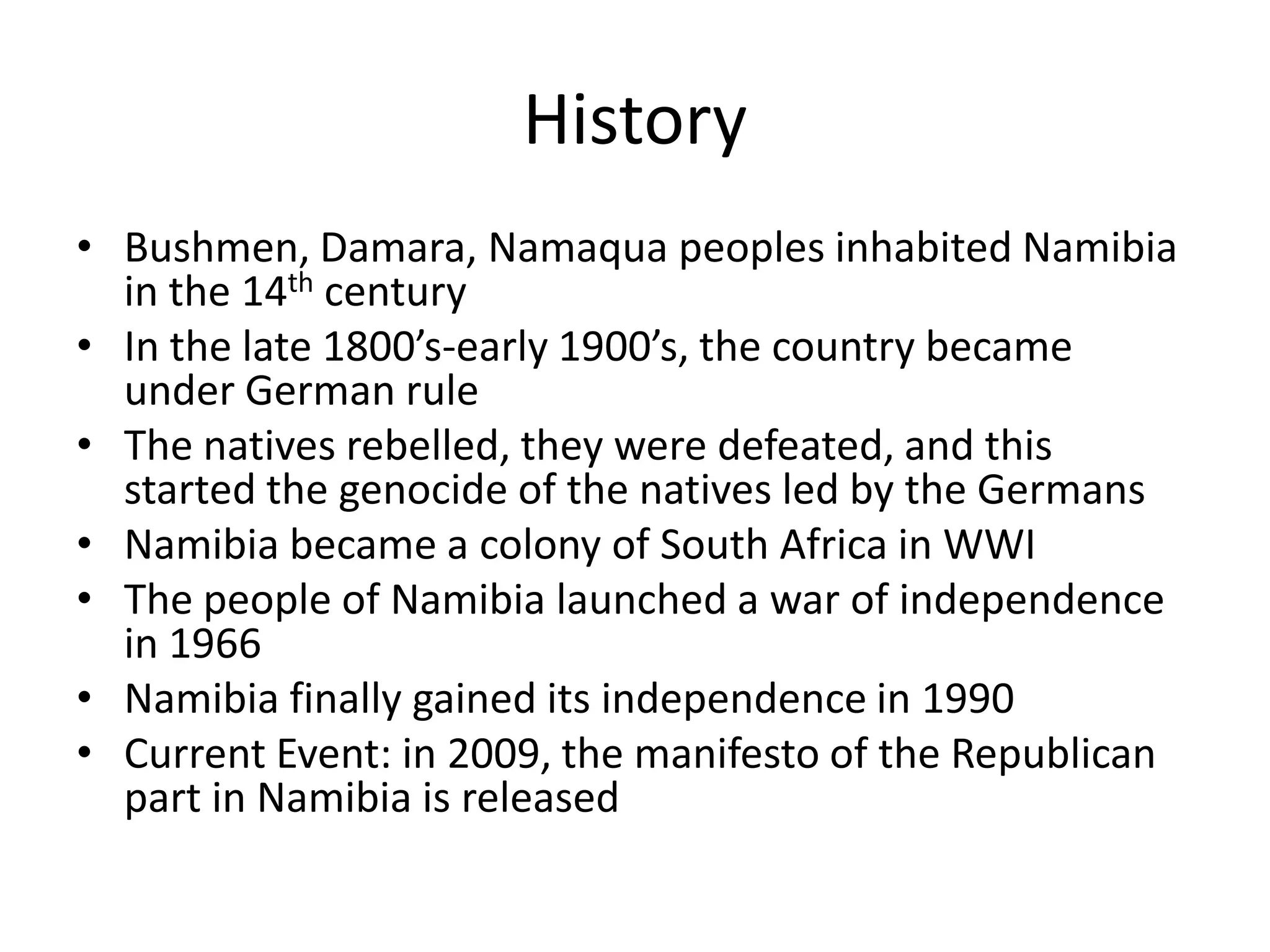
HistoryBushmen, Damara, Namaqua peoples inhabited Namibia in the 14th centuryIn the late 1800’s-early 1900’s, the country became under German ruleThe natives rebelled, they were defeated, and this started the genocide of the natives led by the GermansNamibia became a colony of South Africa in WWIThe people of Namibia launched a war of independence in 1966Namibia finally gained its independence in 1990Current Event: in 2009, the manifesto of the Republican part in Namibia is released
PoliticalNamibia is a republicThe capital of Namibia is WindhoekBicameral legislaturePresident Hifikepunye POHAMBAPrime Minister Nahas ANGULA
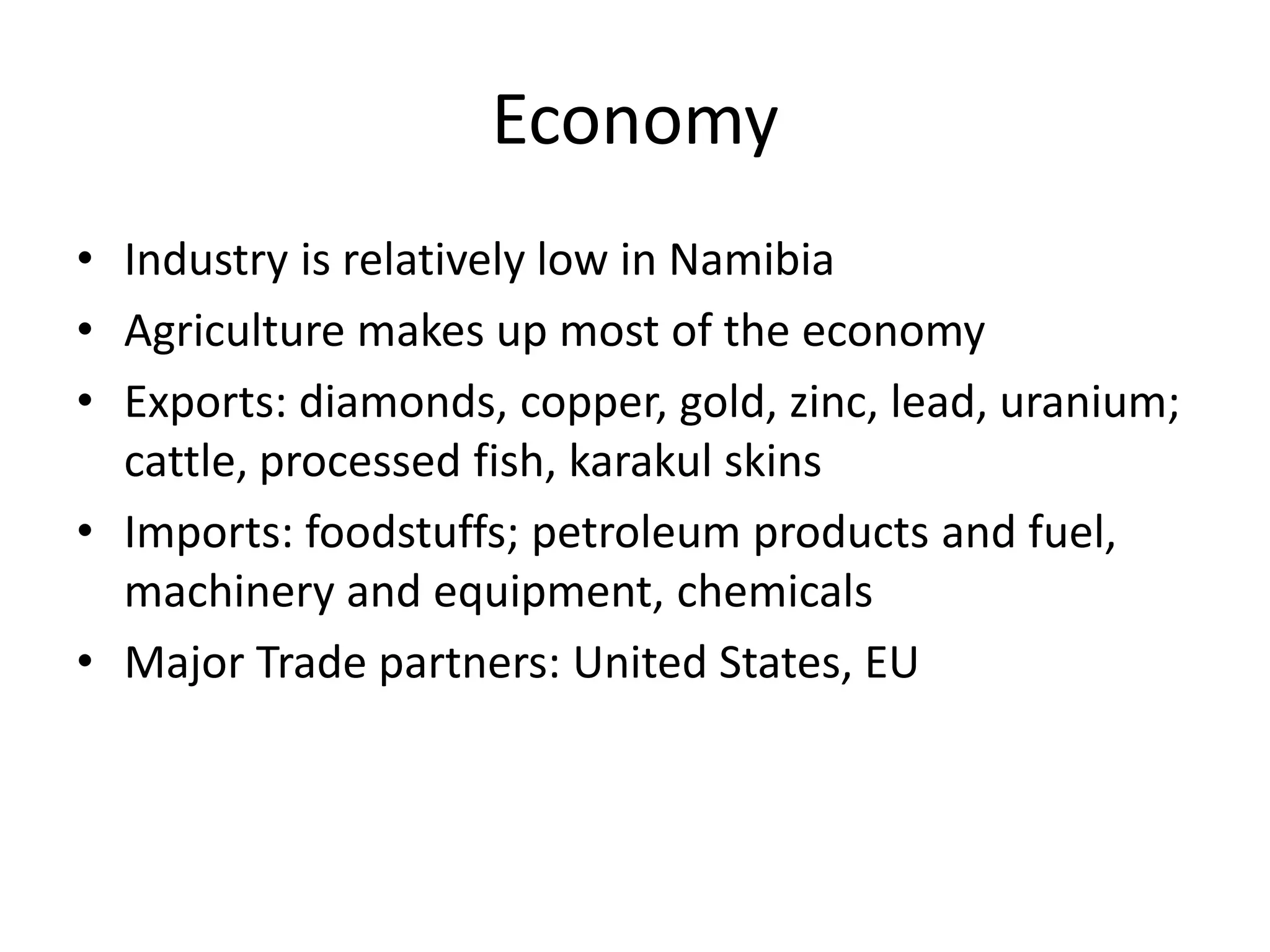
EconomyIndustry is relatively low in NamibiaAgriculture makes up most of the economyExports: diamonds, copper, gold, zinc, lead, uranium; cattle, processed fish, karakul skins Imports: foodstuffs; petroleum products and fuel, machinery and equipment, chemicals Major Trade partners: United States, EU
Daily LifeStandard of living is bad in NamibiaThe life expectancy is very low at 51 yearsLiteracy Rate:85%Literacy in Men:84%Literacy in Women:83%many urban people dress in Western style clothing some rural tribes maintain their traditional dress. Thehimbafor example wear leather thongs or skirts. Only 5% of people in Namibia use the internet
CultureWhen a man dies, his sibling inherit the propertyWhites account for 7% of population and they live in urban areasReligion: Christian 50%, Lutheran 40%, indigenous beliefs 10%Mealie, or corn, is the main food in NamibiaOther popular foods include beef, mutton, millet, peanuts, and melonsFish is a big export but not a common part of the Namibian dietMa/gaisa is mainly sang in Khoekhoegowab or Nama/Damara, and it is the most popular dance music in Namibia
Winter Olympics 2010Namibia did not participate in the 2010 winter Olympics
ConclusionNamibia is a developing country with lots of natural beauty. They are making a great effort to try to catch up with the industry and technology with the rest of the world.You can see this effort through Namibia’s announcement that they are trying to build a nuclear power plant within the next 20 years.
TanzaniaMichael Newns
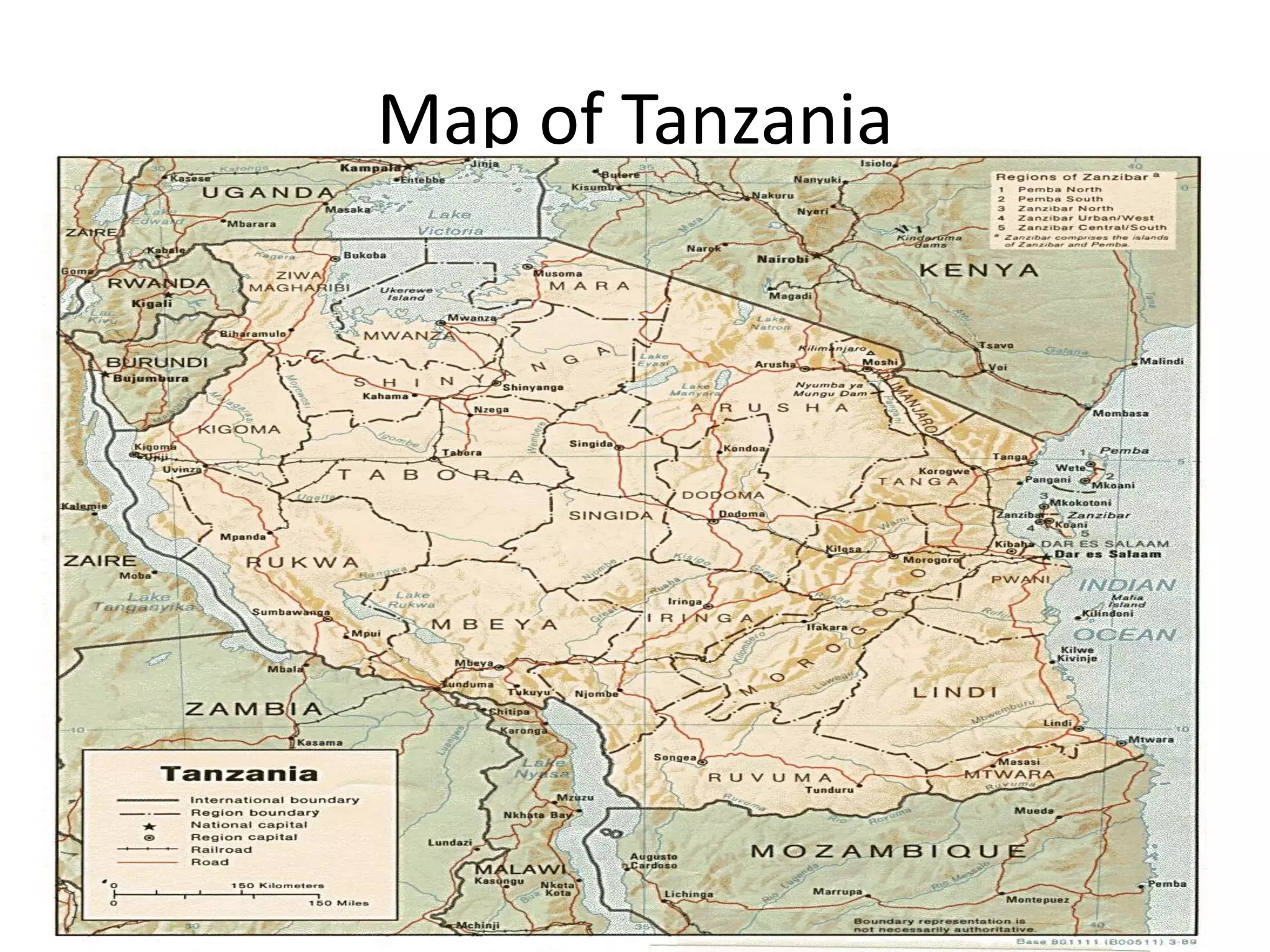
Map of Tanzania
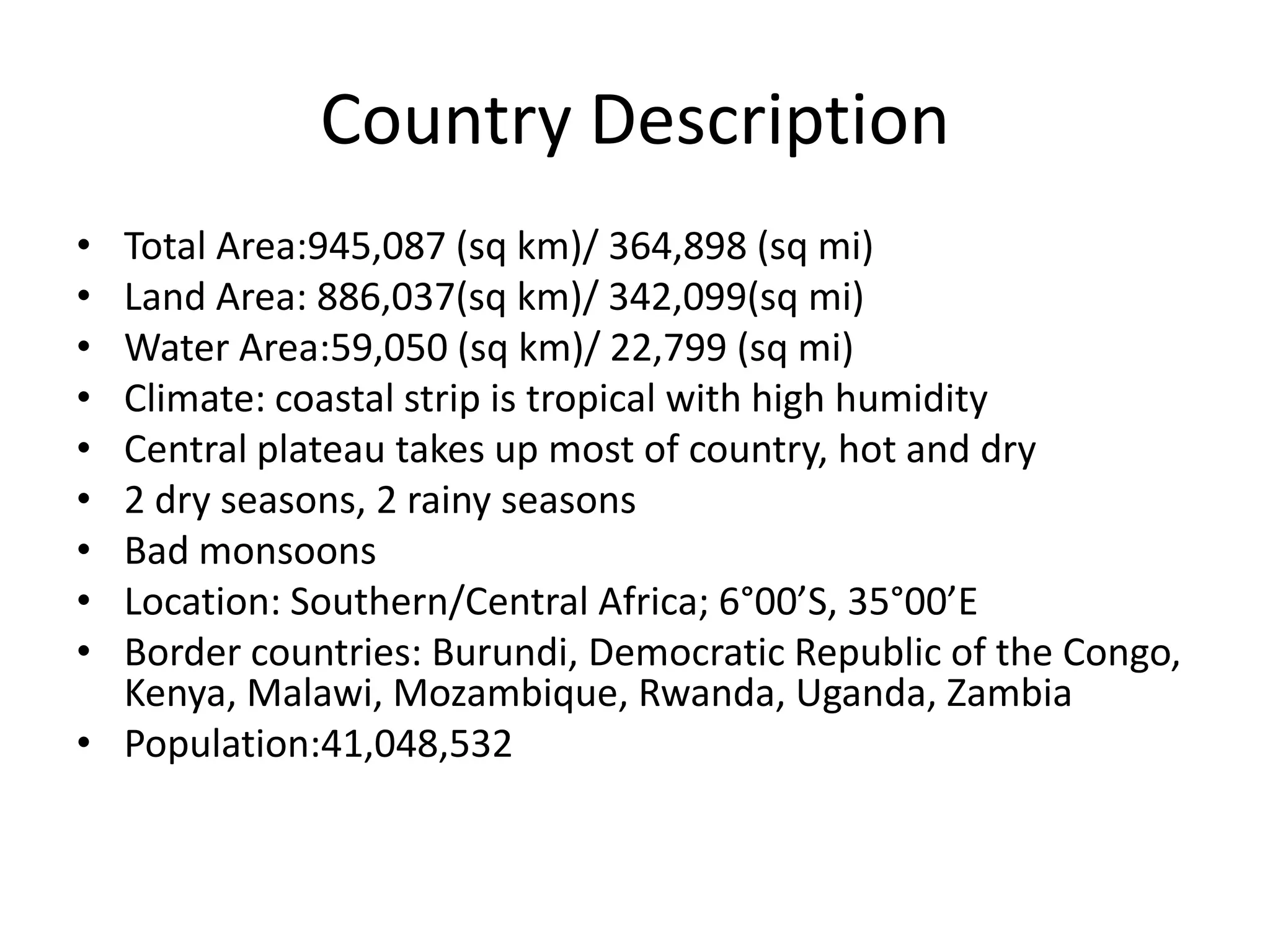
Country DescriptionTotal Area:945,087 (sq km)/ 364,898 (sq mi)Land Area: 886,037(sq km)/ 342,099(sq mi)Water Area:59,050 (sq km)/ 22,799 (sq mi)Climate: coastal strip is tropical with high humidityCentral plateau takes up most of country, hot and dry2 dry seasons, 2 rainy seasonsBad monsoonsLocation: Southern/Central Africa; 6°00’S, 35°00’EBorder countries: Burundi, Democratic Republic of the Congo, Kenya, Malawi, Mozambique, Rwanda, Uganda, Zambia Population:41,048,532
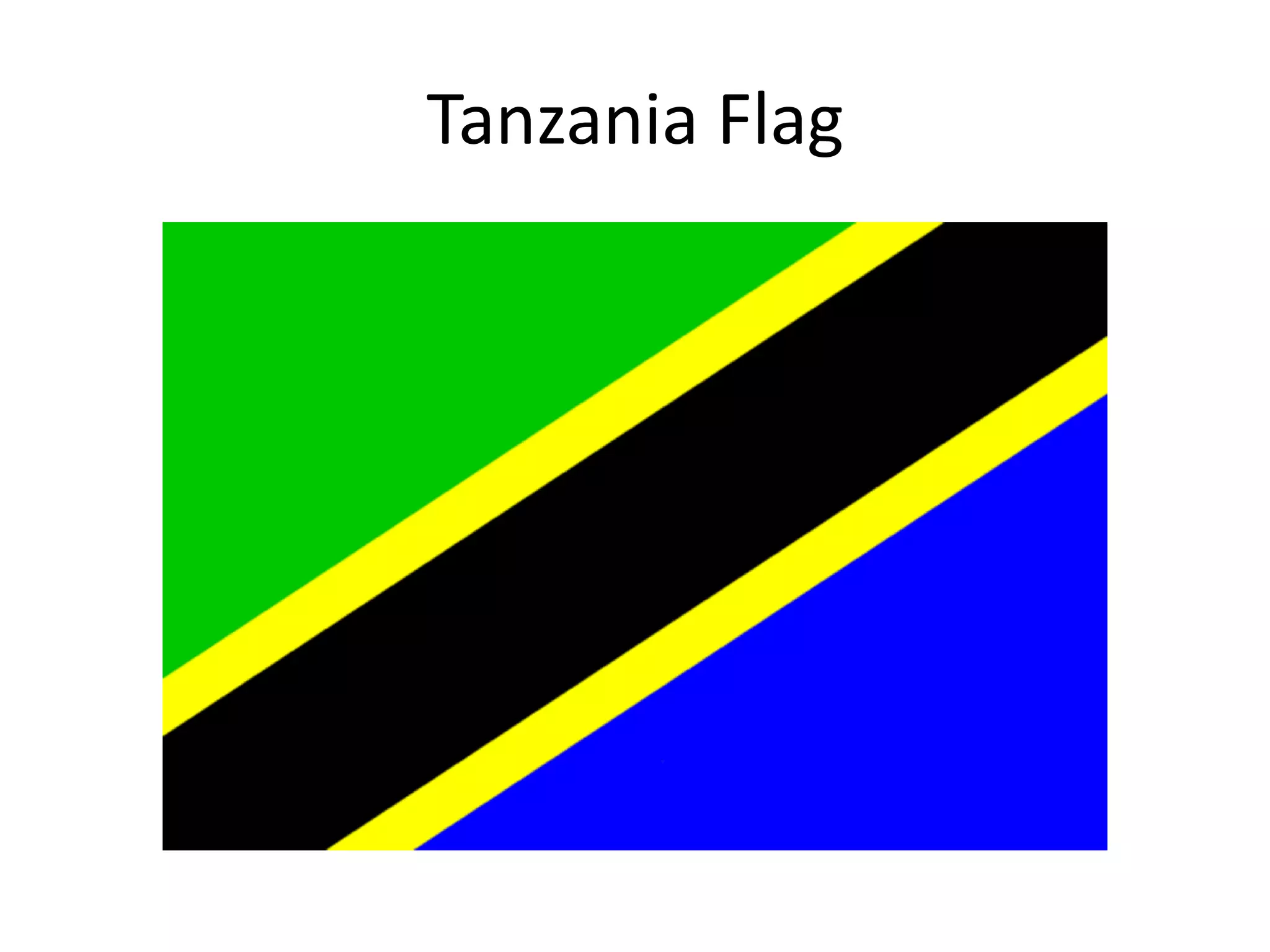
Tanzania Flag
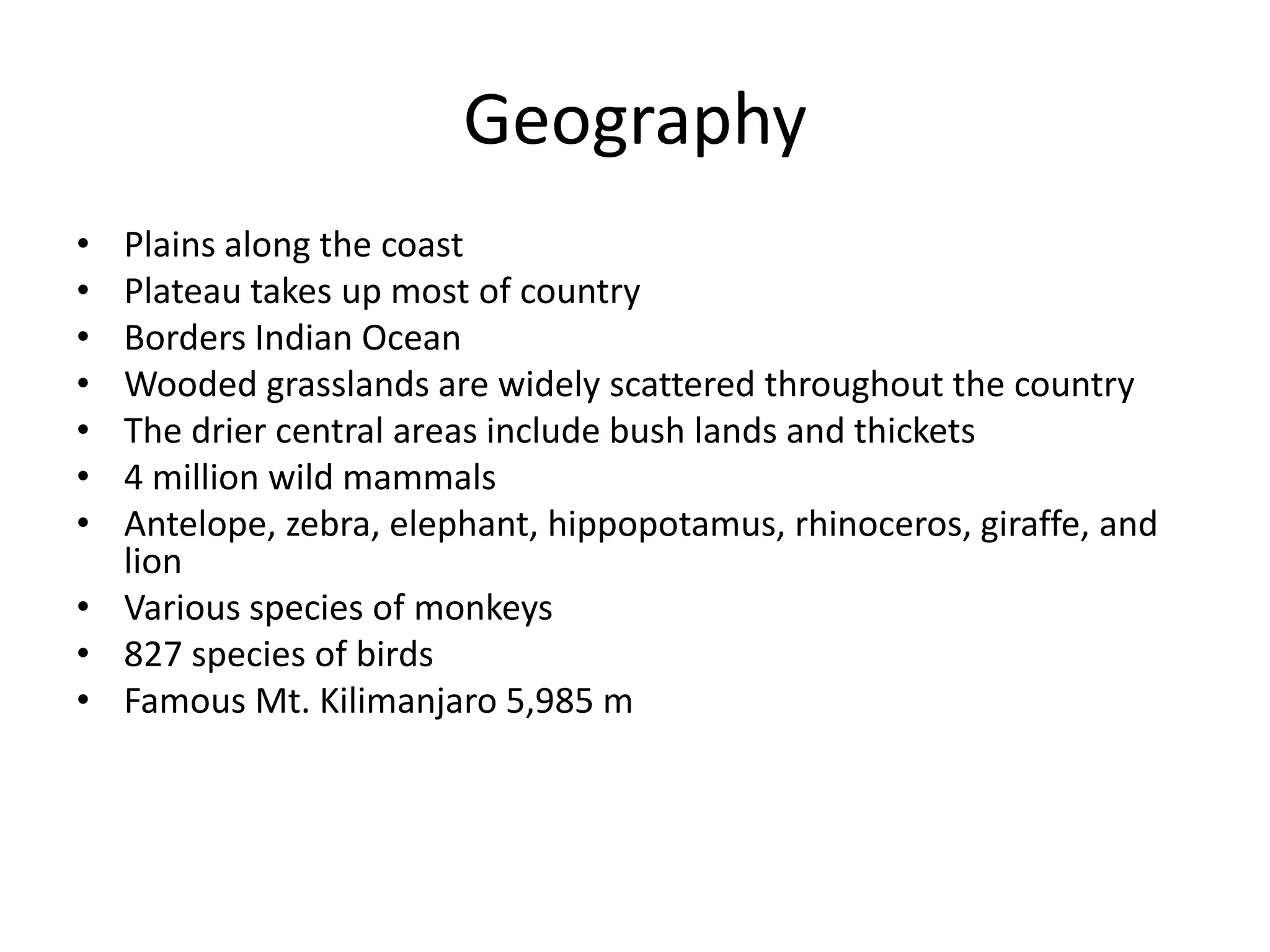
GeographyPlains along the coastPlateau takes up most of countryBorders Indian OceanWooded grasslands are widely scattered throughout the countryThe drier central areas include bush lands and thickets4 million wild mammals Antelope, zebra, elephant, hippopotamus, rhinoceros, giraffe, and lionVarious species of monkeys827 species of birdsFamous Mt. Kilimanjaro 5,985 m
History1498-Portuguese explorer Vasco da Gama visits Tanzanian coast.1884-German Colonization Society begins to acquire territory on the mainland.1919- Germany loses WWI, Tanzania given to Britain1961- Tanzania becomes independent2001- a new goldmine opens, making Tanzania the third largest gold producer in the world
PoliticalTanzania is a republicCapital is Dar es SalaamChief of state: Jakaya KIKWETEHead of government :Jakaya KIKWETE Five year termsCabinet members appointed by president
EconomyTanzania’s industry is very smallMost of it is centered around agricultureExports: gold, coffee, cashew nuts, manufactures, cotton Imports: consumer goods, machinery and transportation equipment, industrial raw materials, crude oil Major Trade partners: UK, South Africa, Japan, France, and IndiaTrade Sanctions: Tanzania has a trade sanction on Burundi which will be lifted when Burundi returns to democracy.
Daily LifeStandard of living is lowLife expectancy is only 52 yearsLiteracy rate:69%Literacy in Men:85%Literacy in Women:70%Clothing: khanga and kitengeclothes for womenToga-like garment for menWomen wear a lot of bead jewelryOnly 1% of the people in Tanzania use the internet
CultureWomen marry in early to mid teens Groom offers a price for the brideMuslim 35%, indigenous beliefs 35%, Christian 30%Right hand considered “clean”, left hand is “unclean”2 main meals per dayA dish known as ugali, made from cassava, corn, sorghum or millet flour, is very commonFish stew, vegetables, and meatSoccer and “netball” (like basketball)are poplarA game similar to capture the flag is also commonThe music of Tanzania stretches from traditional African music to the string-based taarab to a distinctive hip hop known as bongo flava.The Serengeti is known as one of the best wildlife sanctuary in the world
Winter Olympics 2010Tanzania did not participate in the 2010 Winter Olympics.
ConclusionTanzania is a beautiful country with majestic wildlife.Tanzania is probably one of the oldest known continuously inhabited areas on Earth; fossil remains of humans and pre-human hominids have been found dating back over two million years.
KazakhstanMichael Newns
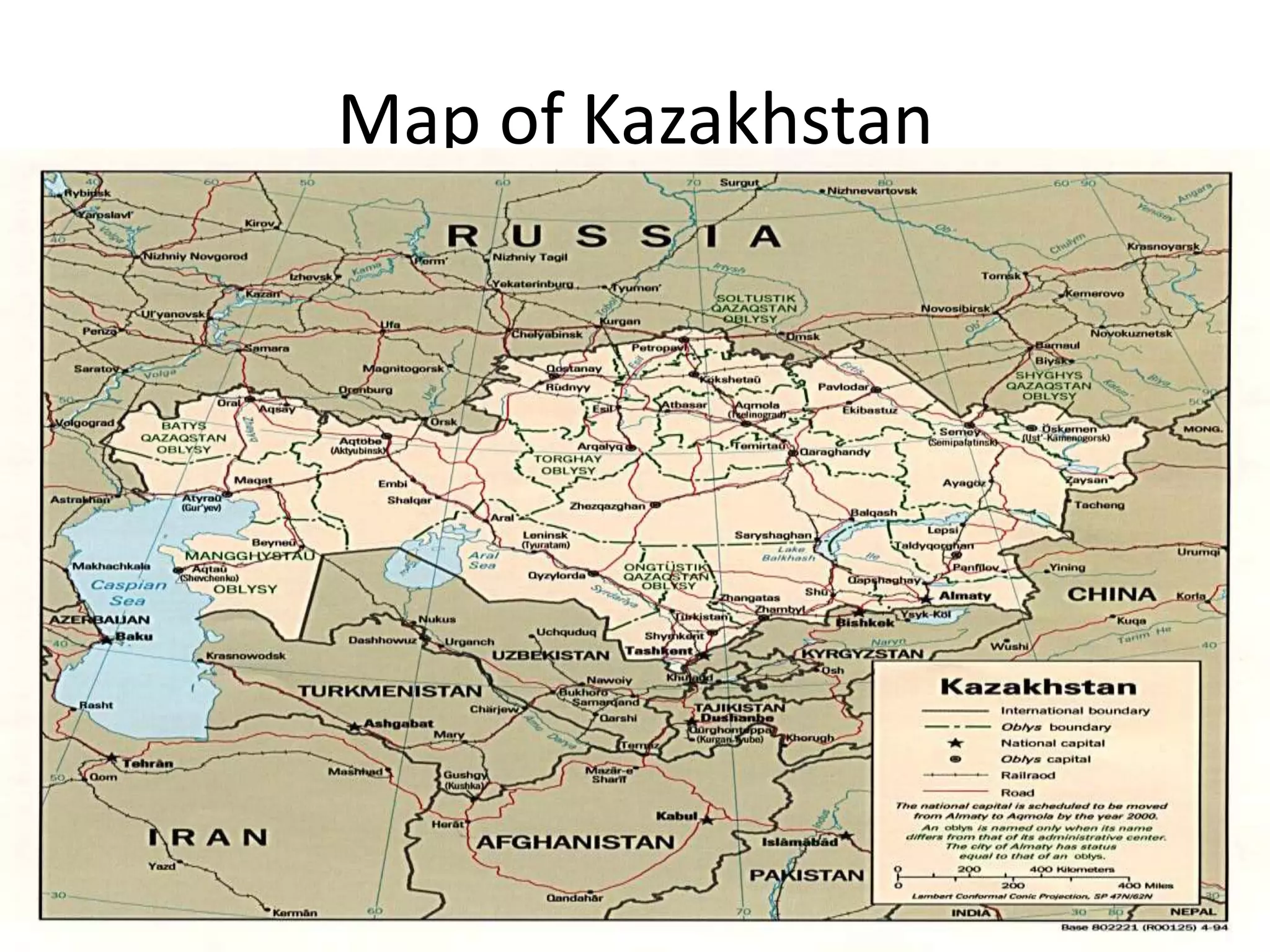
Map of Kazakhstan
Country DescriptionTotal Area:2,717,300 (sq km)/ 1,049,150 (sq mi)Land Area:2,669,800 (sq km)/1,030,810 (sq mi)Water Area:47,500 (sq km)/18,340 (sq mi)Climate: Continental and dry. Winter temperatures and snowfall are rarely extreme and wind is light, summers are pleasant with 80 degree temps. Location: Asia; 48°00’N, 68°00’EBordered by China, Kyrgyzstan, Russia, Turkmenistan, Uzbekistan Population: 15,399,437
Kazakhstan Flag
Geographyextends from the Volga to the Altai Mountains and from the plains in western Siberia to oases and desert in Central AsiaLandlocked, does not touch any oceansSome fauna: brown bear, Caspian sea wolf, Caspian tiger, eagle, snow lepardSome flora: steppes and desertsTourist Attraction: Almaty-a beautiful setting between mountains and plains
History1868- Thousands of Russian and Ukrainian peasants are brought in to settle Kazakh lands1917-Civil war breaks out following the Bolshevik revolution in Russia1936-Kazakhstan becomes a full union republic of the USSR.1940-Hundreds of thousands of Koreans, Crimean Tatars, Germans and others forcibly moved to Kazakhstan1949-The first nuclear test explosion is carried out at the Semipalatinsk nuclear test ground in eastern Kazakhstan1961-The first manned spacecraft launched from the Baikonur space launch site in central Kazakhstan1991-Kazakhstan established independence.1992- Kazakhstan admitted to the United NationsKazakhstanis being viewed as a nuclear threat because of the levels of uranium it harvests
PoliticalKazakhstan is a republicCapital is AstanaBicameral parliamentChief of State: President Nursultan A. NAZARBAYEVHead of Government: Prime Minister Karim MASIMOVCouncil of ministers appointed by president
EconomyBig industries are oil, coal, and iron oreExports: oil and oil products, ferrous metals, chemicals, machinery, grain, wool, meat, coalImports: machinery and equipment, metal products, foodstuffsMajor Trade partners: Russia, Germany, US, ChinaTrade Associations: The U.S.-Kazakhstan Business Association (USKBA)
Daily LifeStandard of living is goodLife expectancy is 68 yearsLiteracy Rate:99%Literacy in Men:99%Literacy in Women:97%Clothing: Urban Kazaks wear Western style clothesTraditionally Kazaks liked to wear boots with with a pair of felt stockings in the winterInternet usage rose from 0% in 1994 to 12% in 2008
CultureReligion: Muslim 47%, Russian Orthodox 44%, other, 7%, Protestant 2%There is a housing shortage and many people live in urban apartmentsMany games that involve horses are playedKuirdak, is a dish prepared from freshly slaughtered meat and consists of the animal's liver, heart, kidneys and other organs cut into pieces, boiled in oil and served with onions and pepper. YUM!Folk orchestras are popular in Kazakhstan
Winter Olympics 2010Kazakhstan had 38 participants in the 2010 winter OlympicsKazakhstan won one medal: silverThe winner of the medal was Elena Khrusttaleva in the women’s biathlon
ConclusionKazakhstan is a fairly modern country that is catching up with the other Asian countries. I think that it is interesting that Kazakhstan has to rely on industry so much because there is not much water to have farming.
CubaMichael Newns
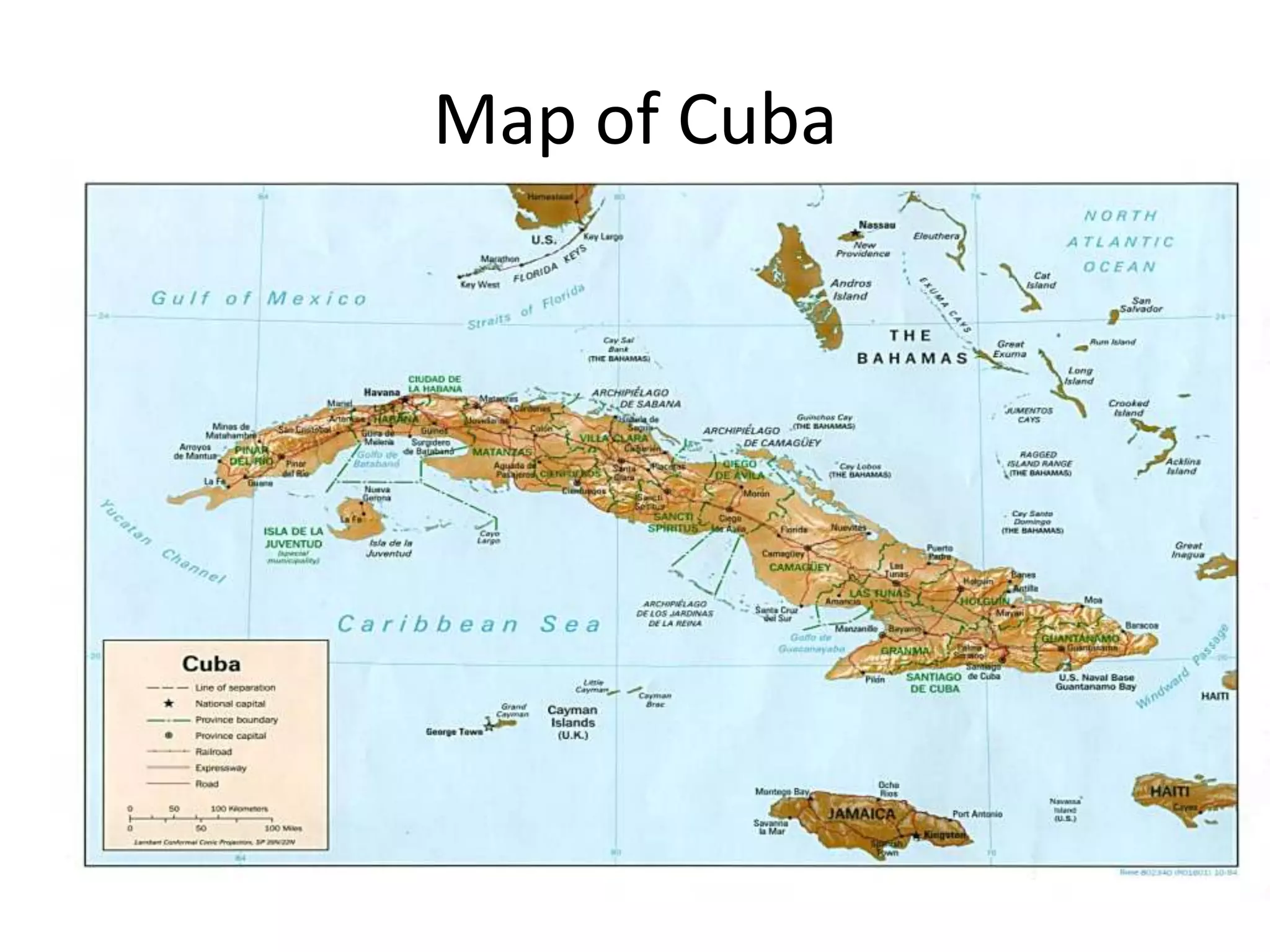
Map of Cuba
Country DescriptionTotal Area:110,860 (sq km)/ 42,803 (sq mi)Land Area:110,860 (sq km)/42,803 (sq mi)Water Area:0 (sq km)/ 0 )(sq mi)Climate: mild subtropical climate cause by trade winds and warm surrounding watersAverage temperature is 77°FIn the Caribbean;  21°30’N, 80°00’ WPopulation:11,451,652
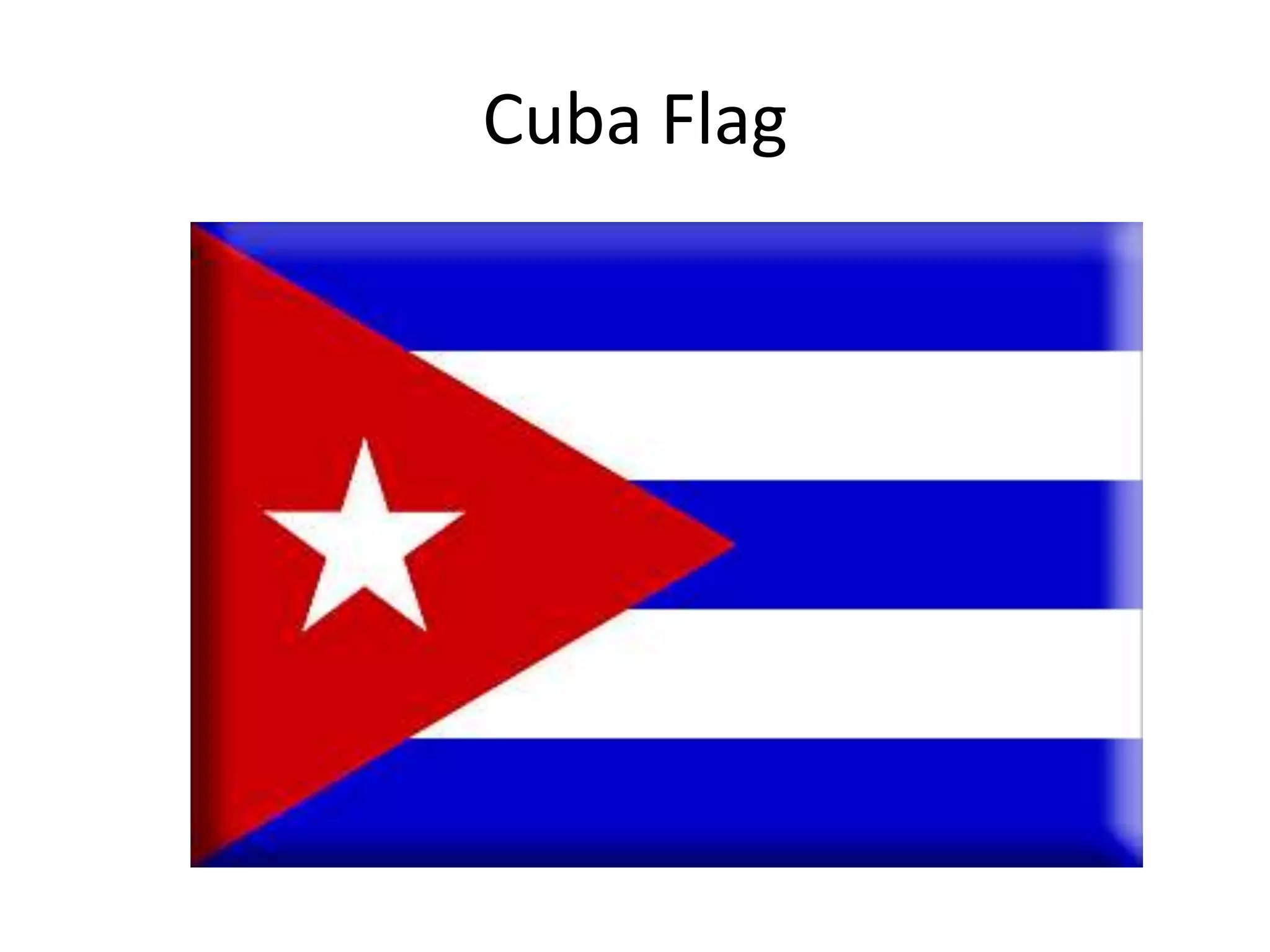
Cuba Flag
Geographymostly flat to rolling plains, with rugged hills and mountains in the southeastbordered on the south by the Caribbean Sea and on the north by the Gulf of Mexico and the Straits of FloridaAn islandFlora: cactus, mango, pomegranate, avocado, bananaFauna: woodpecker, jutia, snakes, Tourist attractions: immaculate beaches bring in thousands of tourists
History1492-The navigator Christopher Columbus claims Cuba for Spain.1511-Spanish colonization of the island begins under the direction of Diego Velazquez.1607-Havana is officially named the capital of Cuba.1868-War of independence lasts for ten years between Cuban colonials wanting independence from what they see as unjust rule from Spain. The War ends in a treaty and promise of greater autonomy for Cuba.1895-Jose Marti leads a second war of independence; US declares war on Spain.1898-US defeats Spain, which gives up all claims to Cuba and cedes it to the US.1898-Cuba becomes independent with Tomas Estrada Palma as its president; however, the Platt Amendment keeps the island under US protection and gives the US the right to intervene in Cuban affairs.1906-Cuban President Tomas Estrada resigns and the United States invades and occupies Cuba after a rebellion led by Jose Miguel Gomez.1925-Socialist Party founded, forming the basis of the Communist Party.
History(continued)1959-Fidel Castro led a Communist revolution and the rebel army overthrew the Cuban president Fulgencio Batista.1962-Cuban missile crisis occurs when Castro allows the USSR to deploy nuclear missiles in Cuba. The crisis was solved when the USSR agreed to take back the missiles in exchange for the US withdrawing their missiles from Turkey.1965-Cuba’s sole political party renamed the Cuban Communist Party.1976-Cuban Communist Party approves a new socialist constitution; Castro elected president.1980-More than 100,000 Cubans flee to the US.2008-Raul Castro takes over as president, days after Fidel announces his retirement.
PoliticalCuba is communistCapital is HavanaPresident Raul CastroSecondary head of state: Gen. Jose Ramon Machado Ventura
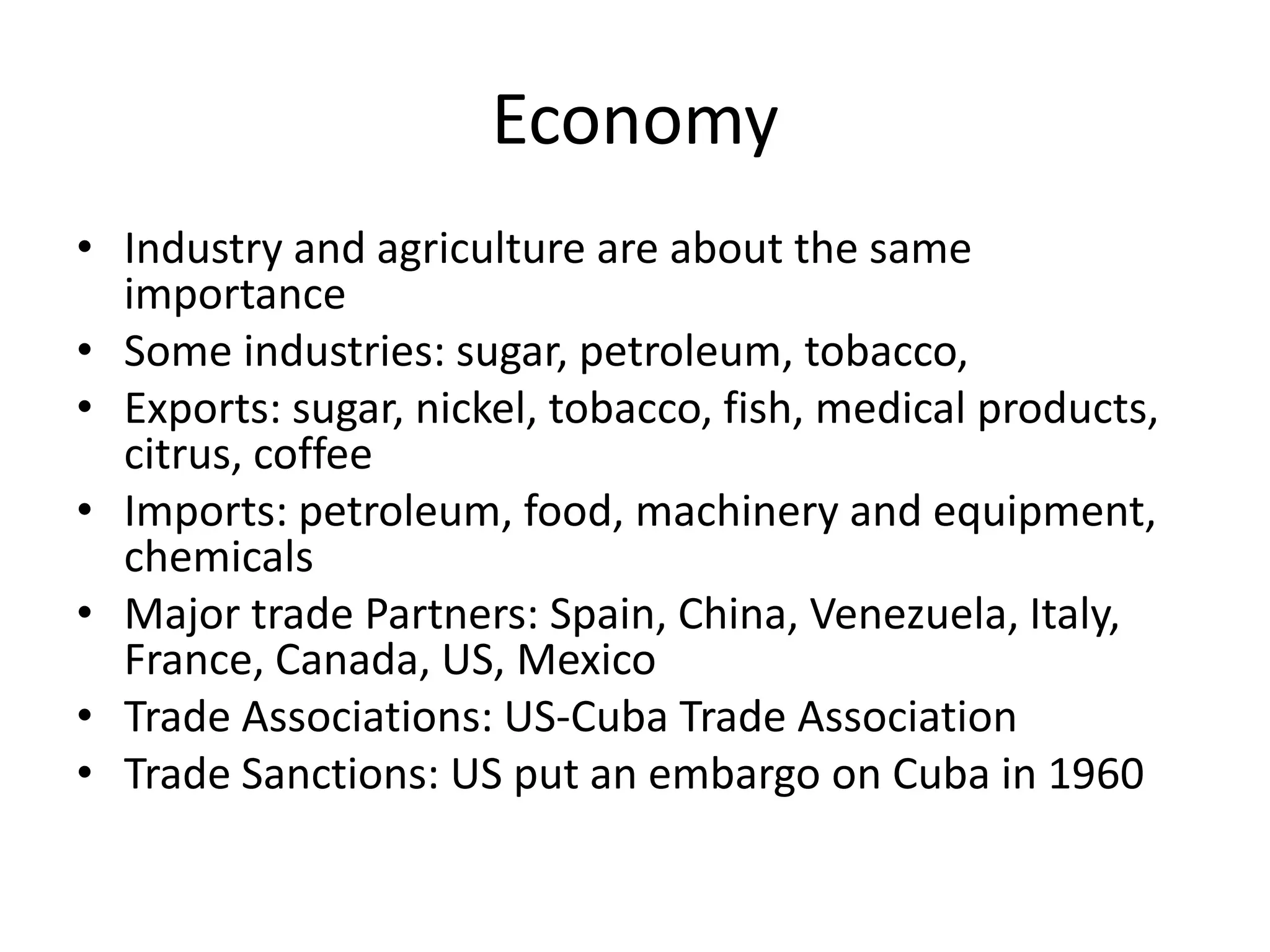
EconomyIndustry and agriculture are about the same importanceSome industries: sugar, petroleum, tobacco, Exports: sugar, nickel, tobacco, fish, medical products, citrus, coffeeImports: petroleum, food, machinery and equipment, chemicalsMajor trade Partners: Spain, China, Venezuela, Italy, France, Canada, US, MexicoTrade Associations: US-Cuba Trade AssociationTrade Sanctions: US put an embargo on Cuba in 1960
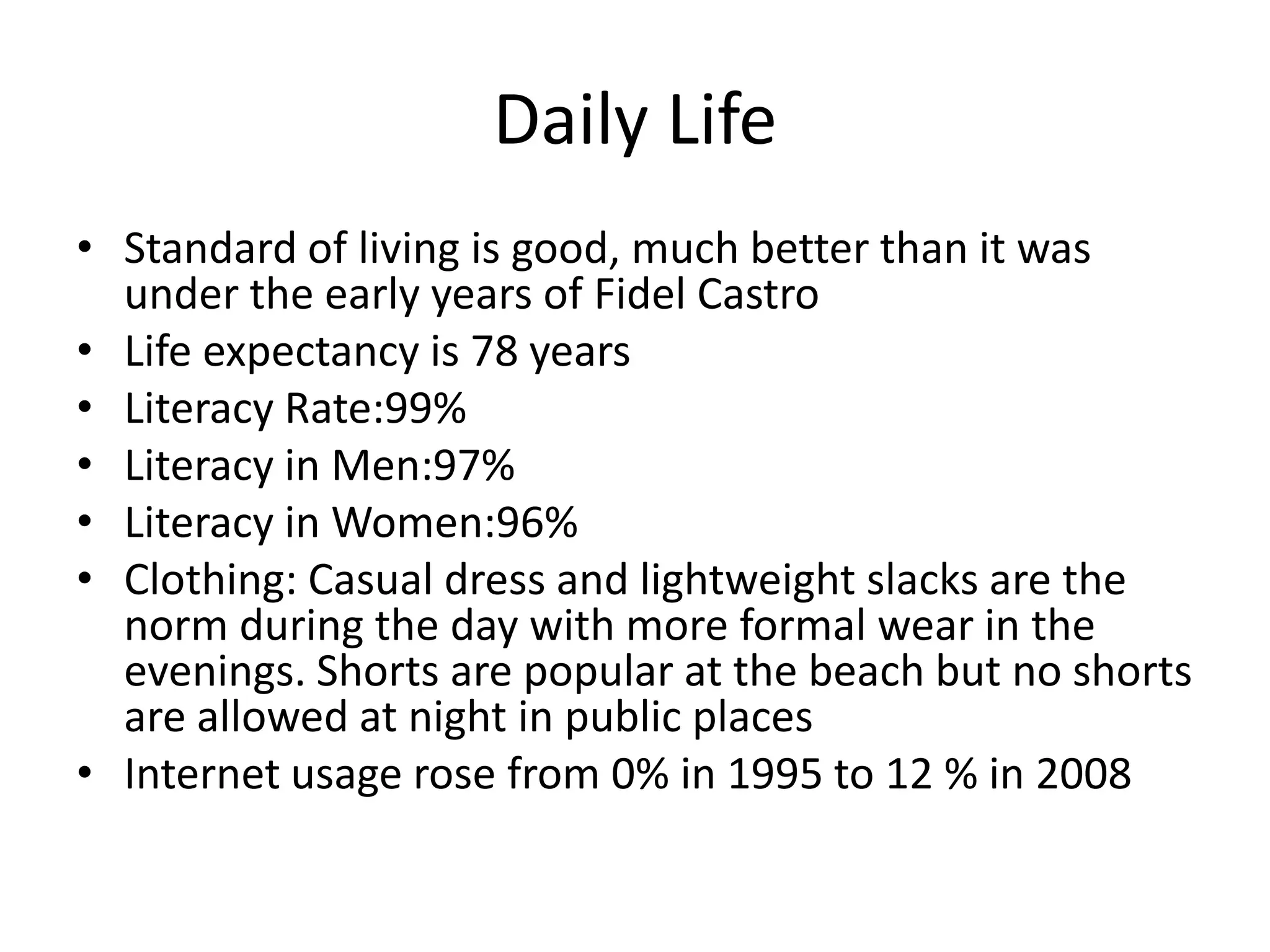
Daily LifeStandard of living is good, much better than it was under the early years of Fidel CastroLife expectancy is 78 yearsLiteracy Rate:99%Literacy in Men:97%Literacy in Women:96%Clothing: Casual dress and lightweight slacks are the norm during the day with more formal wear in the evenings. Shorts are popular at the beach but no shorts are allowed at night in public placesInternet usage rose from 0% in 1995 to 12 % in 2008
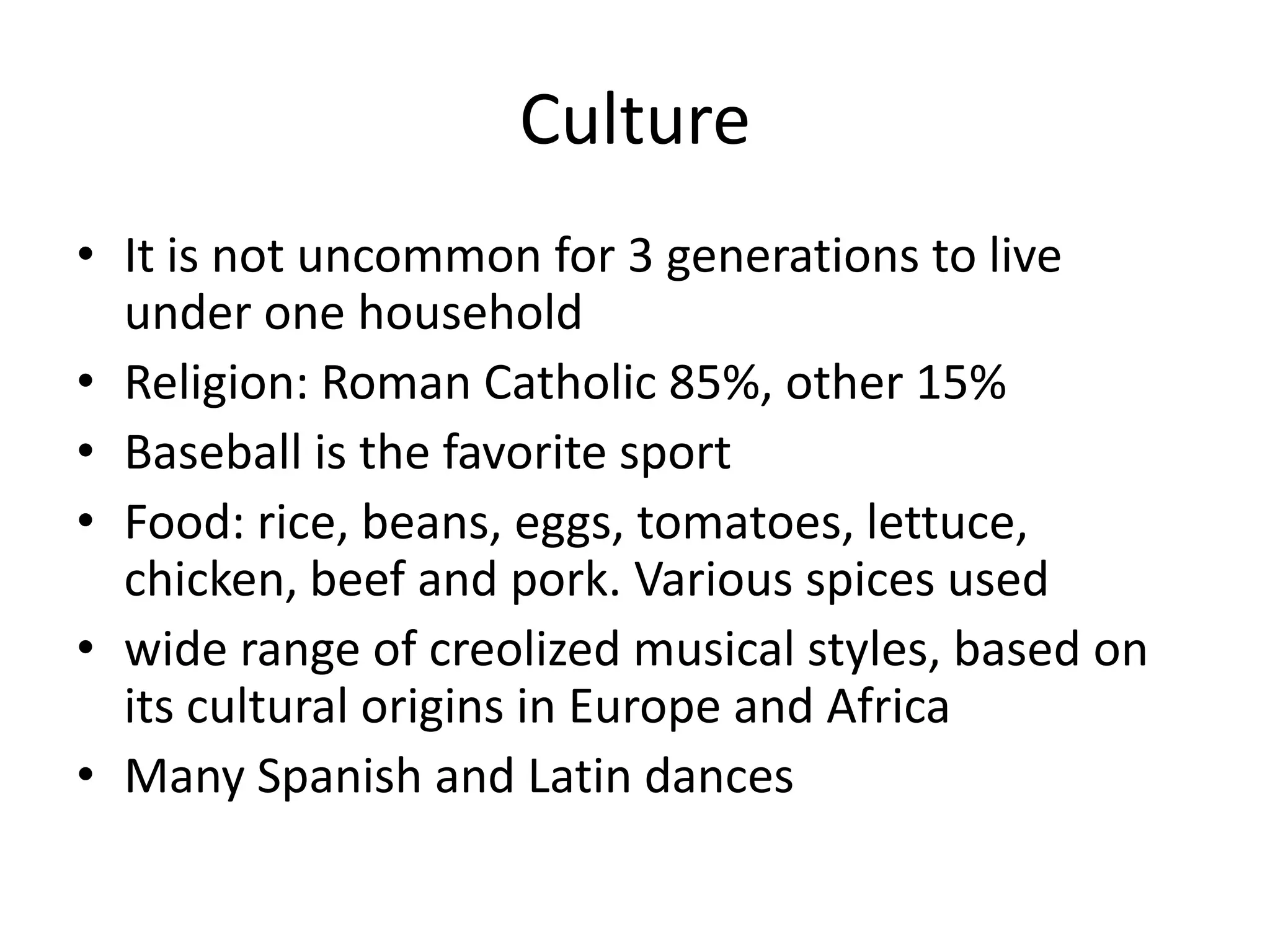
CultureIt is not uncommon for 3 generations to live under one householdReligion: Roman Catholic 85%, other 15%Baseball is the favorite sportFood: rice, beans, eggs, tomatoes, lettuce, chicken, beef and pork. Various spices usedwide range of creolized musical styles, based on its cultural origins in Europe and AfricaMany Spanish and Latin dances
Winter Olympics 2010Cuba did not participate in the 2010 Winter Olympics.
ConclusionCuba is a fascinating country with rich culture but still is recovering from the oppressive communist government and rule of Fidel Castro.
IranMichael Newns
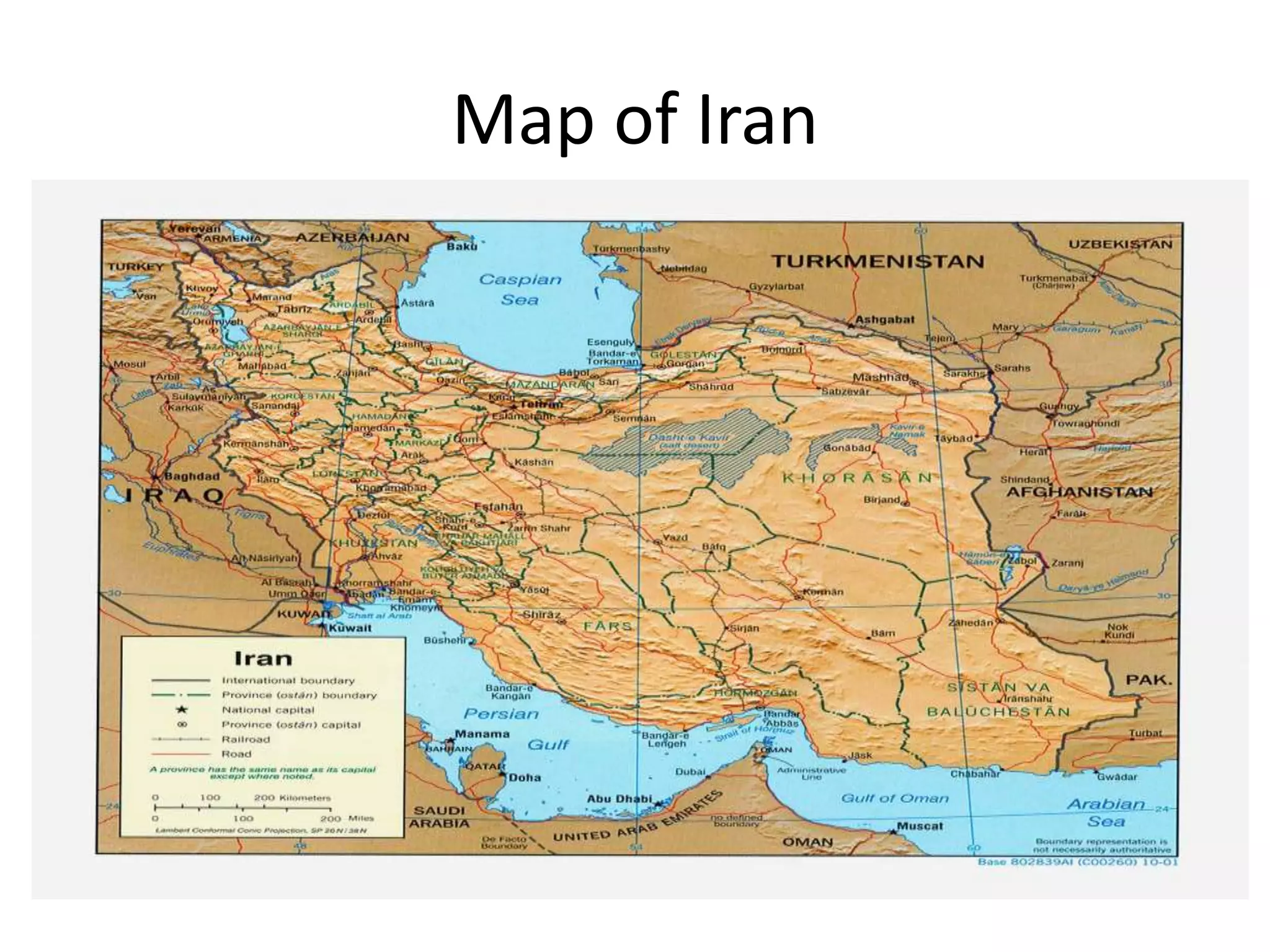
Map of Iran
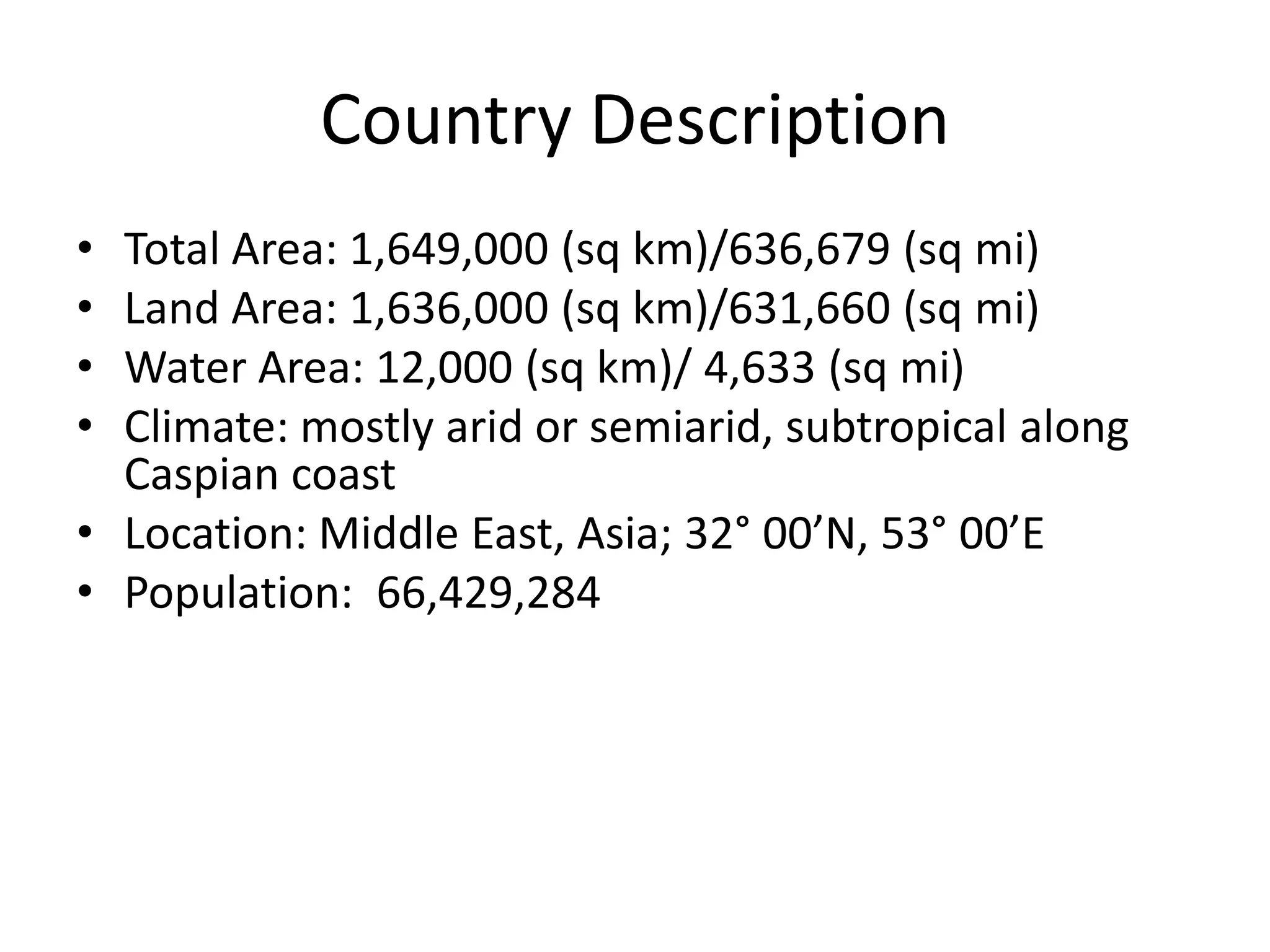
Country DescriptionTotal Area: 1,649,000 (sq km)/636,679 (sq mi)Land Area: 1,636,000 (sq km)/631,660 (sq mi)Water Area: 12,000 (sq km)/ 4,633 (sq mi)Climate: mostly arid or semiarid, subtropical along Caspian coastLocation: Middle East, Asia; 32° 00’N, 53° 00’EPopulation:  66,429,284
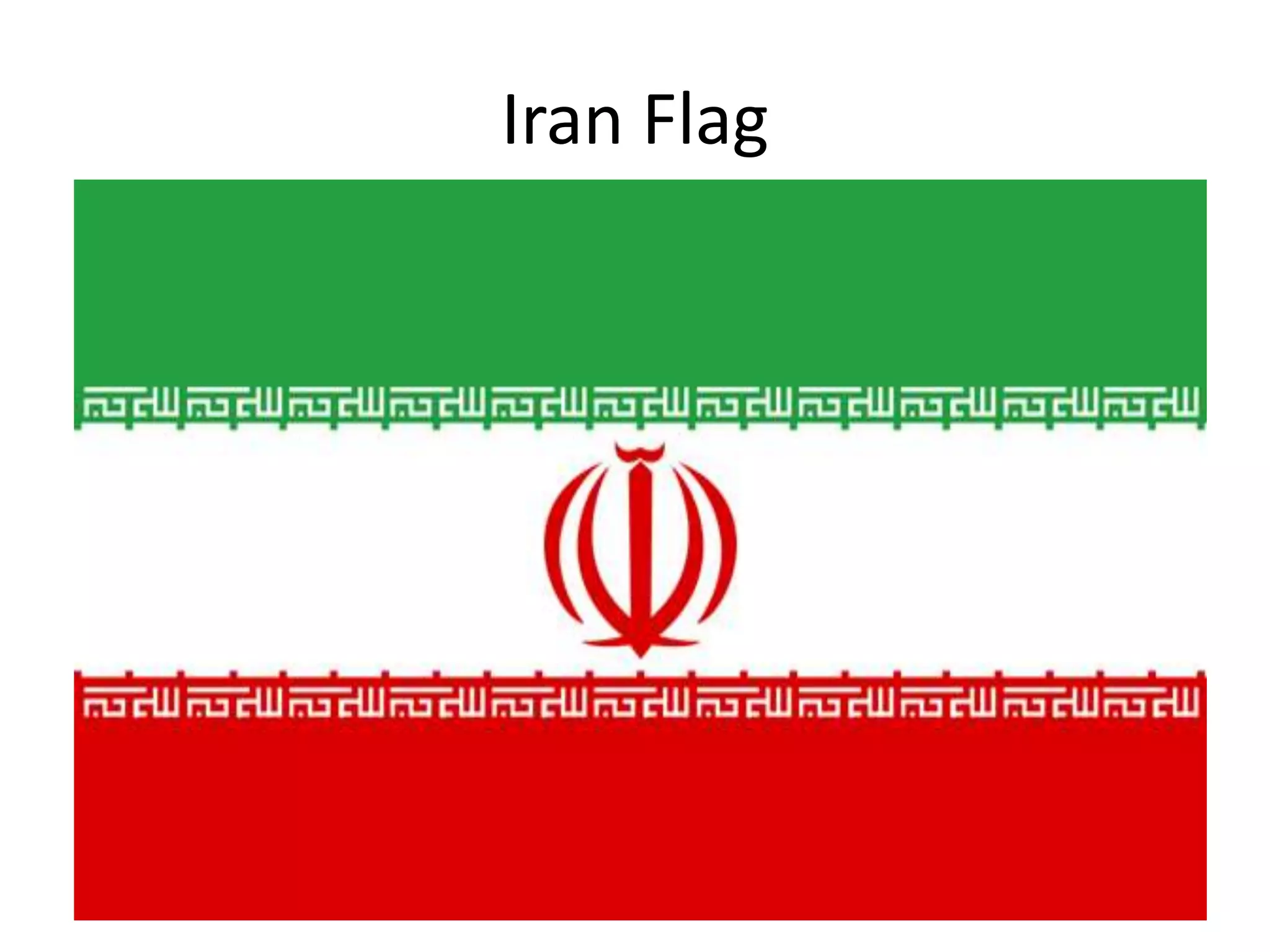
Iran Flag
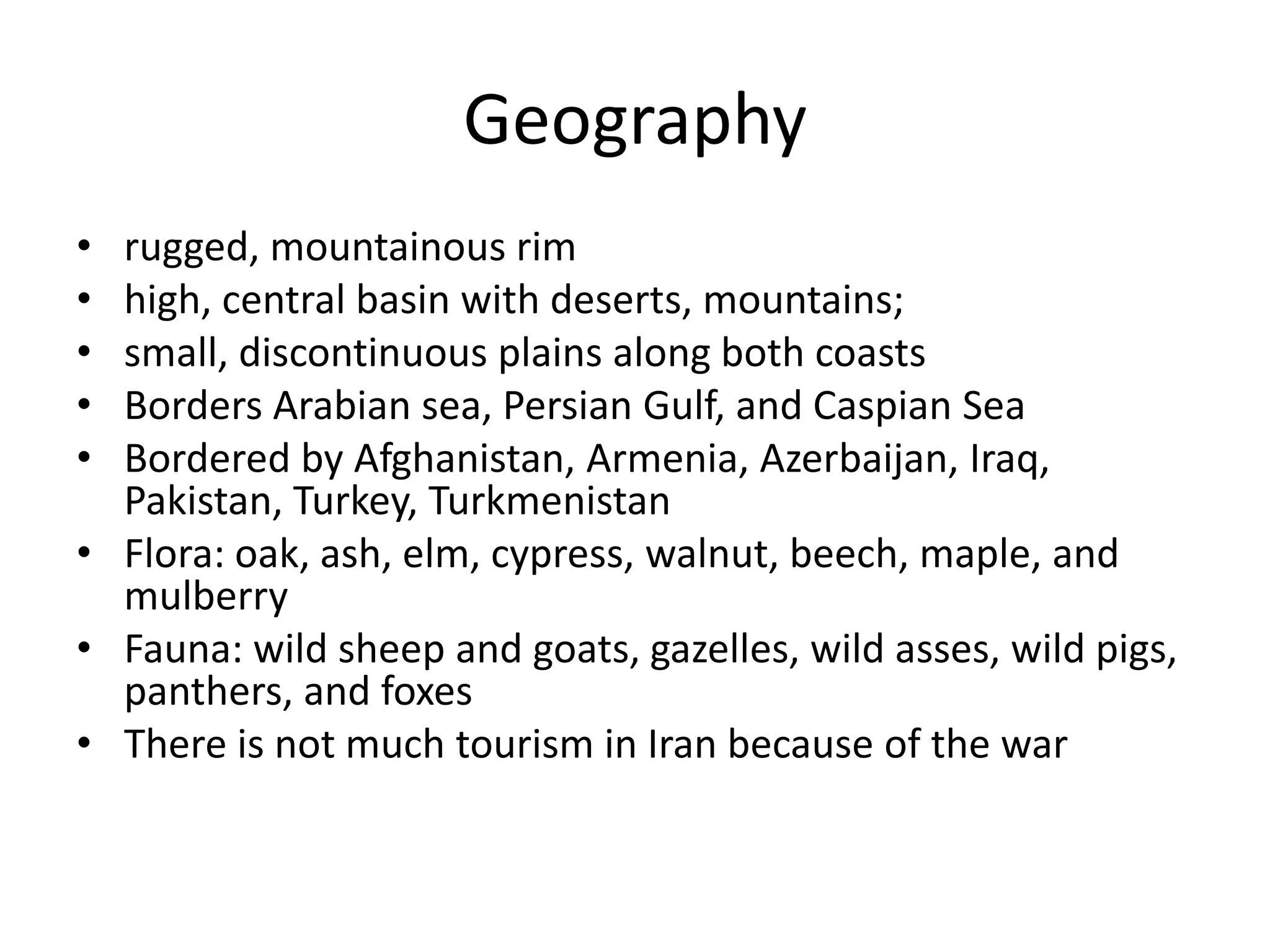
Geographyrugged, mountainous rimhigh, central basin with deserts, mountains; small, discontinuous plains along both coastsBorders Arabian sea, Persian Gulf, and Caspian SeaBordered by Afghanistan, Armenia, Azerbaijan, Iraq, Pakistan, Turkey, Turkmenistan Flora: oak, ash, elm, cypress, walnut, beech, maple, and mulberryFauna: wild sheep and goats, gazelles, wild asses, wild pigs, panthers, and foxesThere is not much tourism in Iran because of the war
HistoryRuled by Muslim dynasties1907-ntroduction of constitution which limits the absolutist powers of rulers.1914-Iran declares neutrality but is scene of heavy fighting during World War I.1935-Formerly known as Persia, Iran is adopted as the country’s official name.1941-Reza Shah, who sides with Germans in the war, forced to abdicate by Allies. His son, Reza Pahlavi, named Shah.1979-The Shah was overthrown by the Islamic Revolution ending 2,500 years of monarchy.1979-Islamic republic set up. 1980-Start of Iran-Iraq war which lasts for eight years.
History(continued)1981-The American hostages are released ending 444 days in captivity.1990-A major earthquake strikes Iran, killing approximately 40,000 people.1990-Iran remains neutral following Iraq’s invasion of Kuwait.1995-US imposes oil and trade sanctions over Iran’s alleged sponsorship of “terrorism”, seeking to acquire nuclear arms and hostility to the Middle East process. Iran denies the charges.2003-40,000 people are killed in an earthquake in south-east Iran; the city of Bam is devastated.Current Event: American troops remain stationed in Iran
PoliticalIran is a theocratic republicCapital is TehranSupreme Leader Ali Hoseini-KHAMENEIPresident Mahmud AHMADI-NEJAD First Vice President Parviz DAVUDI Cabinet members picked by president with legislature approval
EconomyIndustry and agriculture are both big40% of population below poverty lineExports: petroleum, chemical and petrochemical products, fruits and nuts, carpetsImports: industrial raw materials and intermediate goods, capital goods, foodstuffs and other consumer goods, technical services, military supplies Major Trade Partners: Germany, Japan, Switzerland, France, ItalyTrade Associations: Iranian Trade Association Trade Sanctions: The US does not sell any aircraft or military materials to Iran
Daily LifeStandard of living is not good, but not bad40% of population below poverty lineLife Expectancy is 71 yearsLiteracy rate:77%Literacy in Men:85%Literacy in Women:73%Clothing: dress formally and conservatively in publicMen wear western clothes or robes and traditional turbansWomen must be covered from head to foot in publicInternet usage rose from 0% in 1994 to 325 in 2008
CultureReligion: Shi a Muslim 89%, Sunni Muslim 9%, other 2%Large families favoredMen can have up to 4 wivesMany say that chess was invented in IranOther popular games are wrestling, weightlifting, squash, and horse racingMidday meal is most importantMuslims do not eat anything from dusk to dawn during RamadanReligion is extremely important; so is fasting and praying
Winter Olympics 2010Iran had 4 athletes in the 2010 winter Olympics.They competed in alpine skiing and cross country skiing.They did not win any medals.
ConclusionIran is a founding member of the UN, NAM, OIC and OPEC.It is a powerful country struggling to set up a strong government while dealing with radical Muslims.
TaiwanMichael Newns
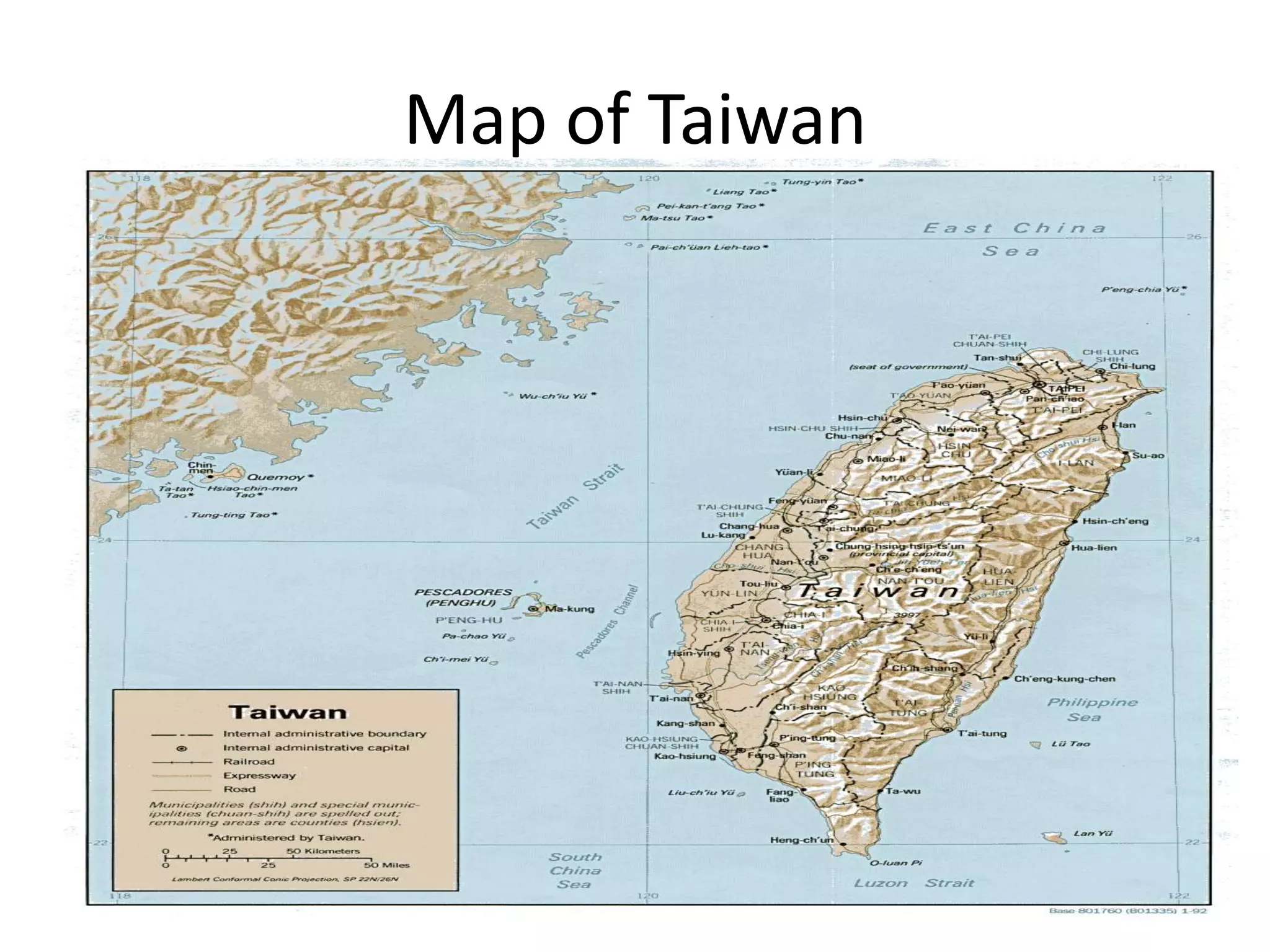
Map of Taiwan
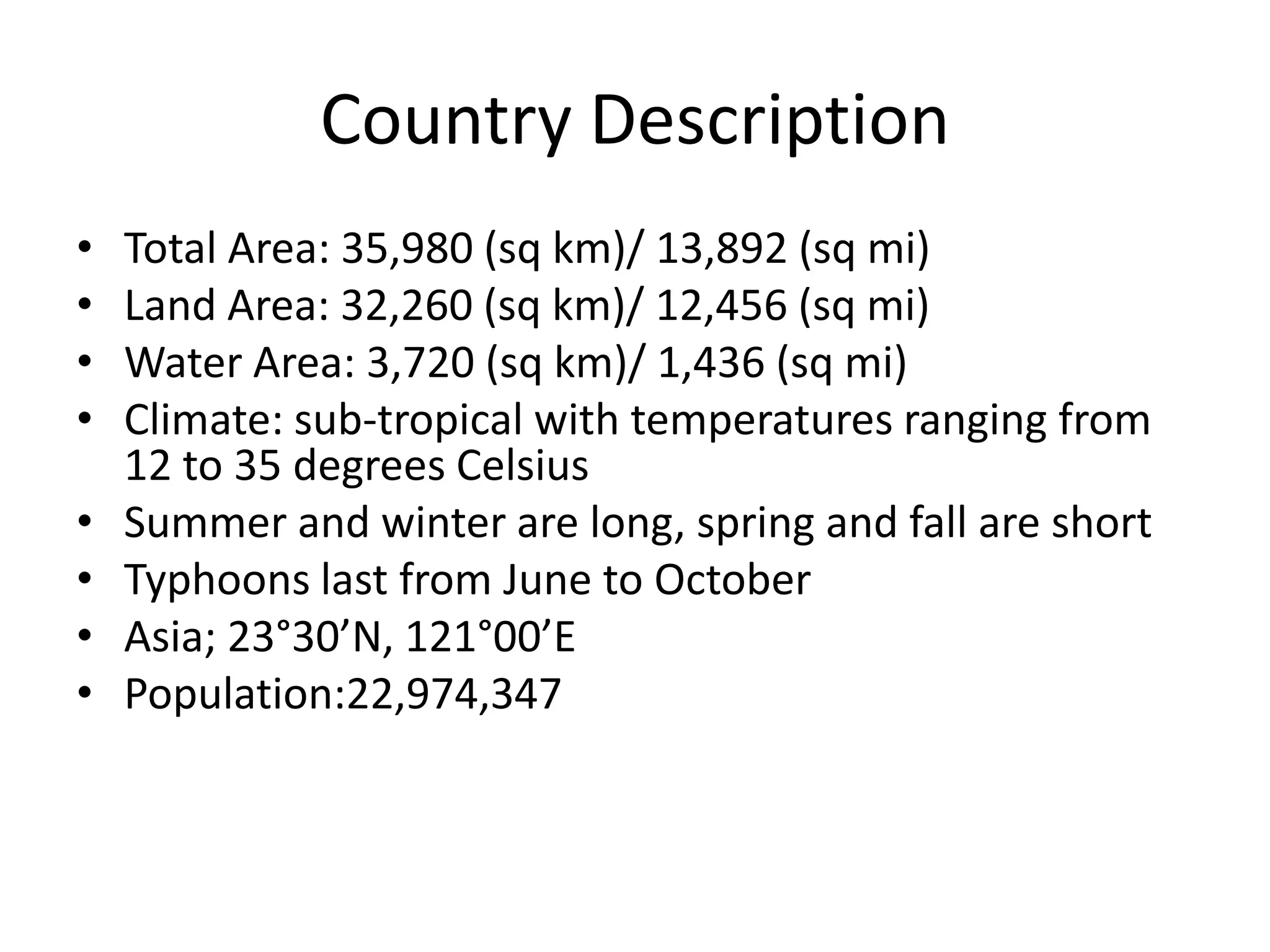
Country DescriptionTotal Area: 35,980 (sq km)/ 13,892 (sq mi)Land Area: 32,260 (sq km)/ 12,456 (sq mi)Water Area: 3,720 (sq km)/ 1,436 (sq mi)Climate: sub-tropical with temperatures ranging from 12 to 35 degrees Celsius Summer and winter are long, spring and fall are shortTyphoons last from June to OctoberAsia; 23°30’N, 121°00’EPopulation:22,974,347
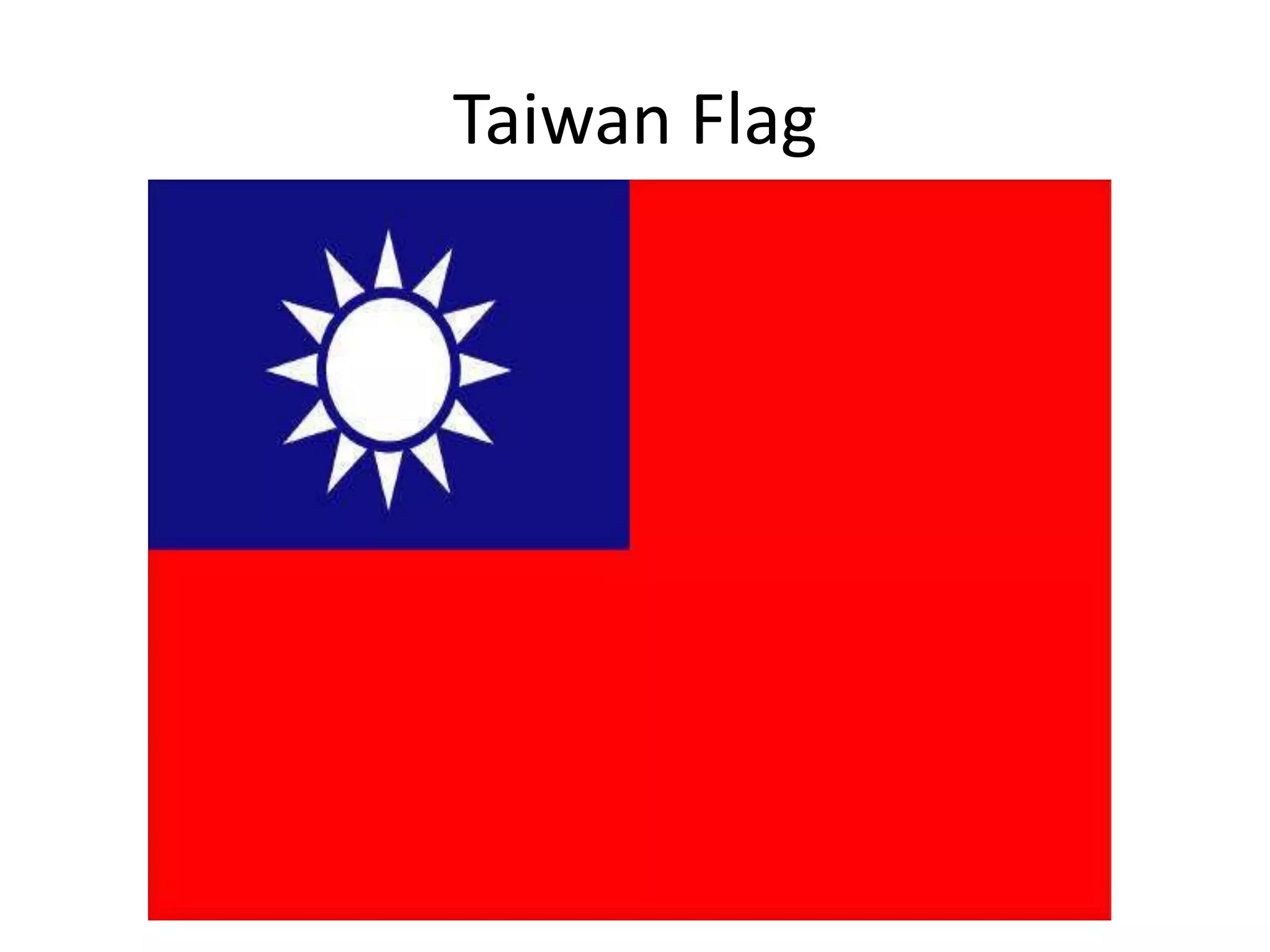
Taiwan Flag
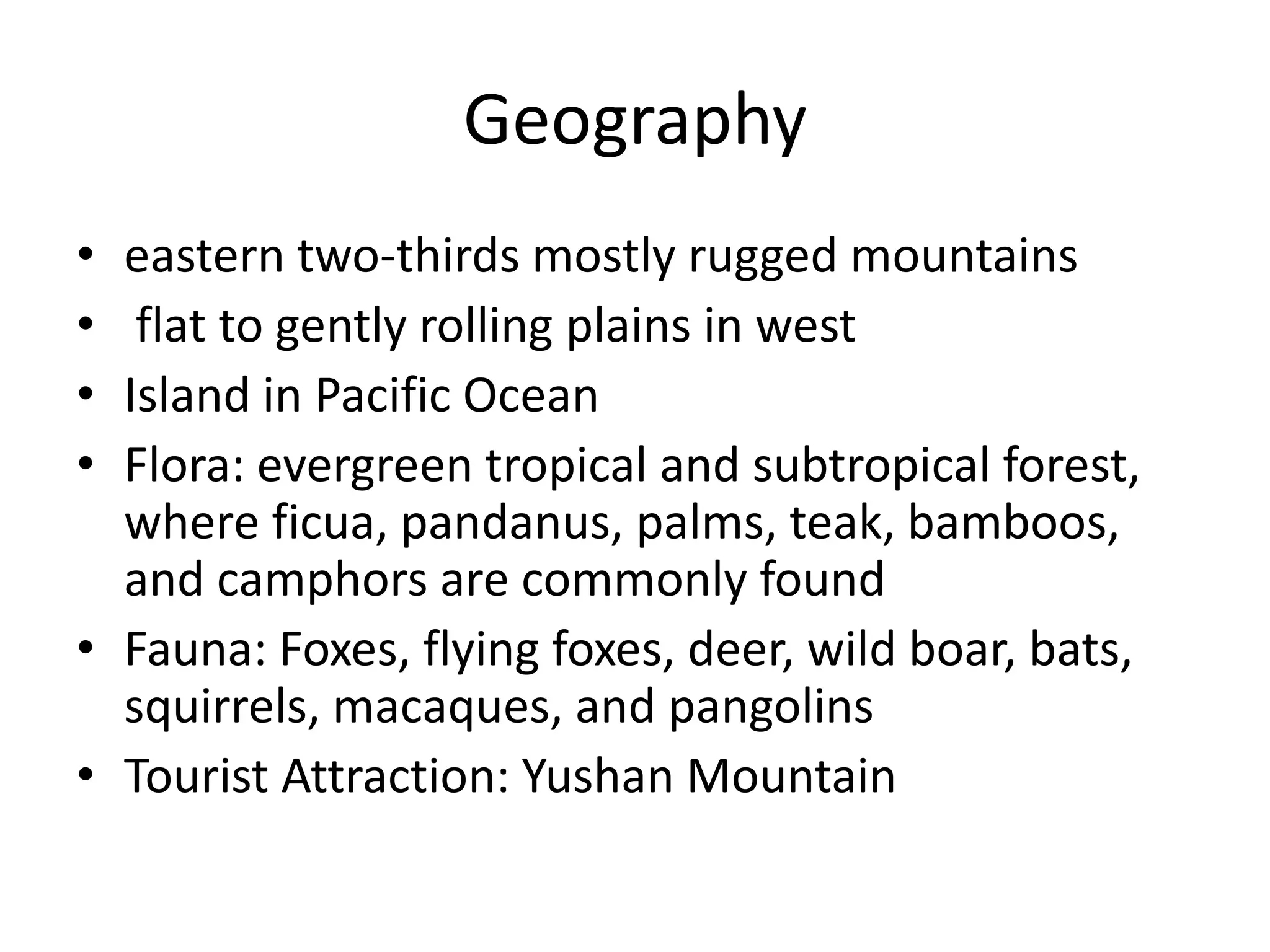
Geographyeastern two-thirds mostly rugged mountains flat to gently rolling plains in westIsland in Pacific OceanFlora: evergreen tropical and subtropical forest, where ficua, pandanus, palms, teak, bamboos, and camphors are commonly foundFauna: Foxes, flying foxes, deer, wild boar, bats, squirrels, macaques, and pangolinsTourist Attraction: Yushan Mountain
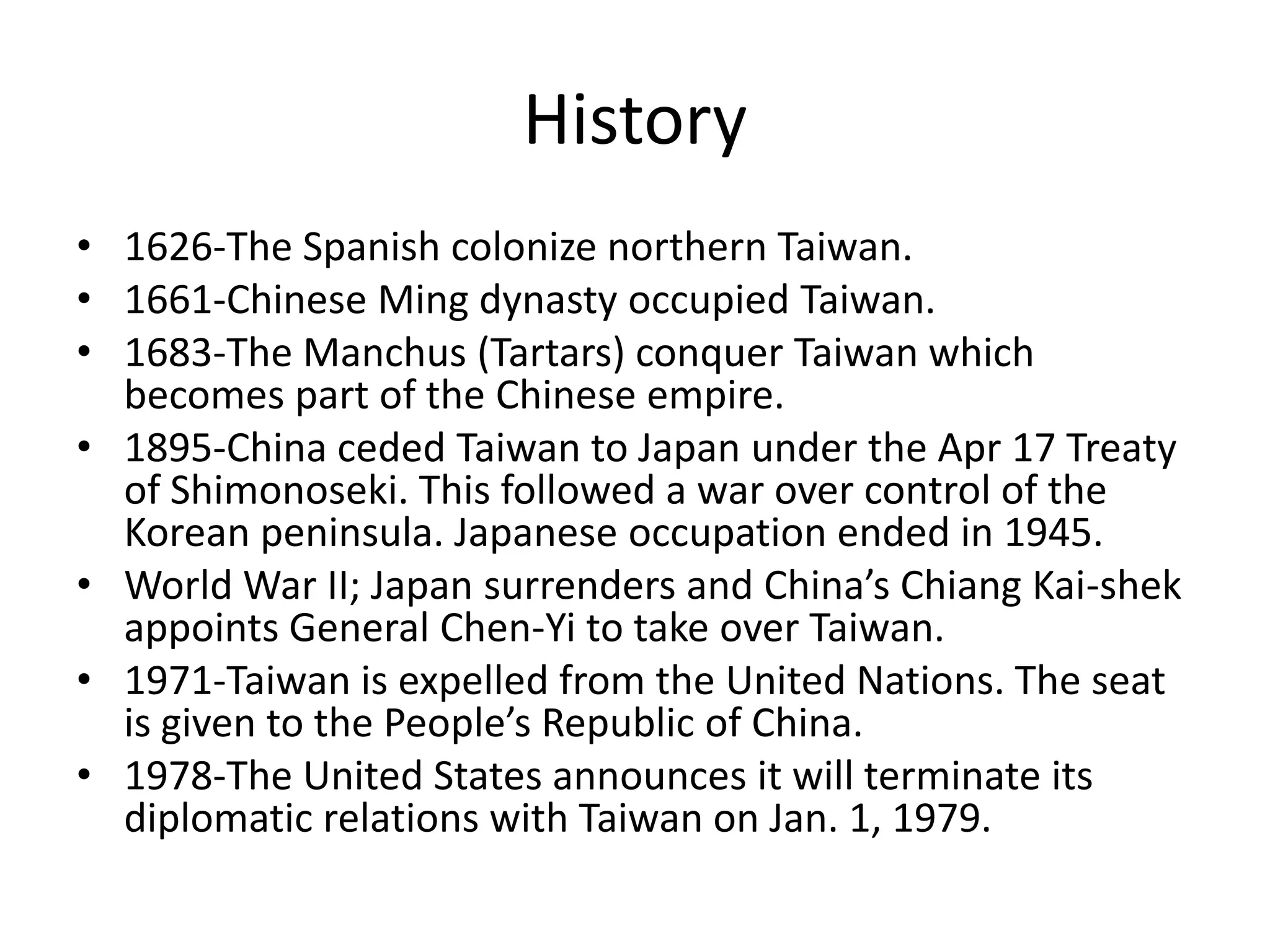
History1626-The Spanish colonize northern Taiwan.1661-Chinese Ming dynasty occupied Taiwan.1683-The Manchus (Tartars) conquer Taiwan which becomes part of the Chinese empire.1895-China ceded Taiwan to Japan under the Apr 17 Treaty of Shimonoseki. This followed a war over control of the Korean peninsula. Japanese occupation ended in 1945.World War II; Japan surrenders and China’s Chiang Kai-shek appoints General Chen-Yi to take over Taiwan.1971-Taiwan is expelled from the United Nations. The seat is given to the People’s Republic of China.1978-The United States announces it will terminate its diplomatic relations with Taiwan on Jan. 1, 1979.
History(continued)2001-Taipei lifts a 50-year ban on direct trade and investment with China.2002-Taiwan officially enters the World Trade Organization, only a few weeks after China.2005-Tension between China and Taiwan intensifies, when China passes an anti-secession law that says the country can use force if Taiwan moves toward achieving independence.2007-The country attempts to join the UN for the first time under the name Taiwan, rather than the official title of Republic of China. The application is rejected.2009-The leaders of China and Taiwan exchange direct messages for the first time in more than 60 years, in a sign of warming ties.
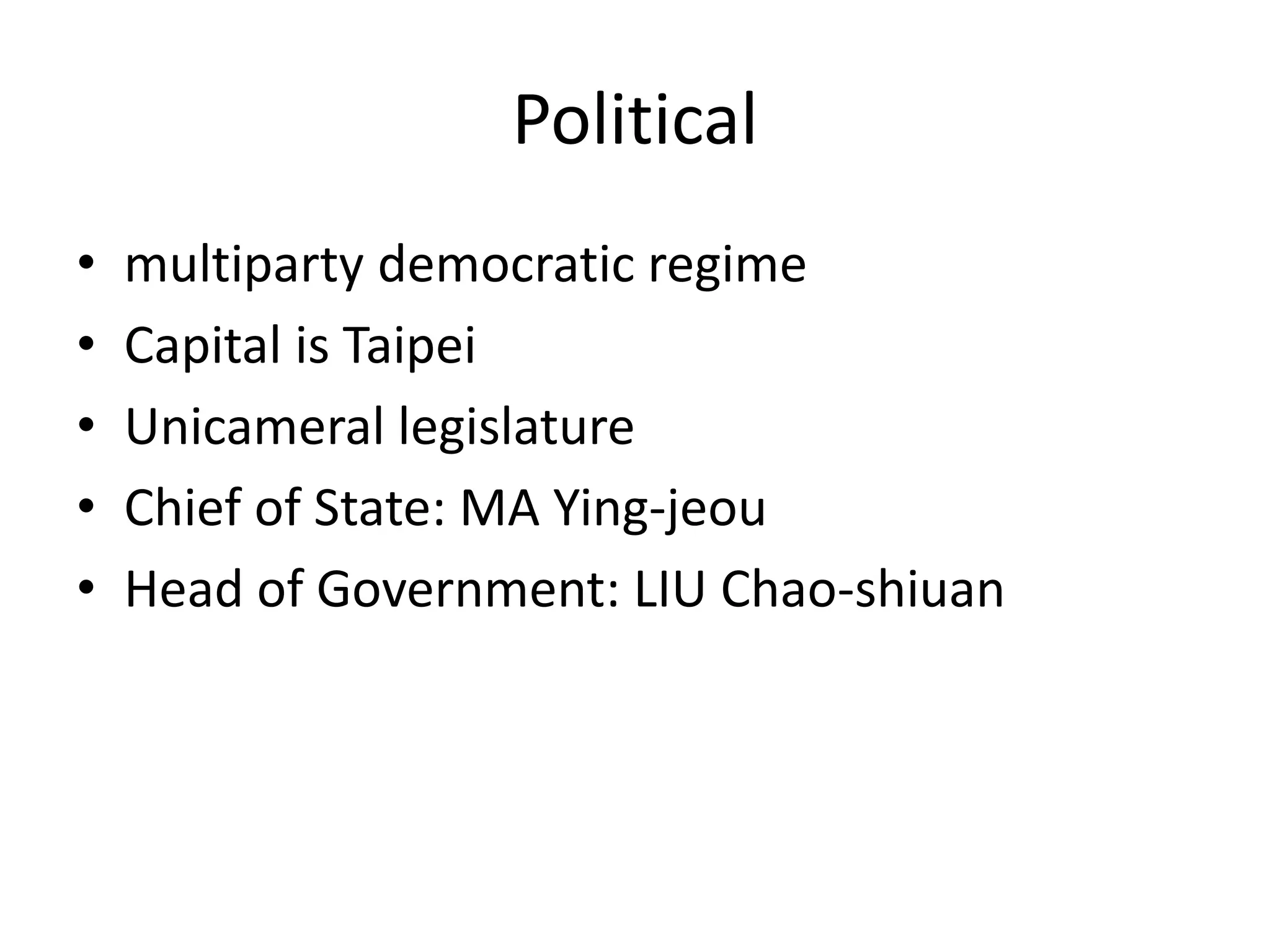
Politicalmultiparty democratic regime Capital is TaipeiUnicameral legislatureChief of State: MA Ying-jeouHead of Government: LIU Chao-shiuan
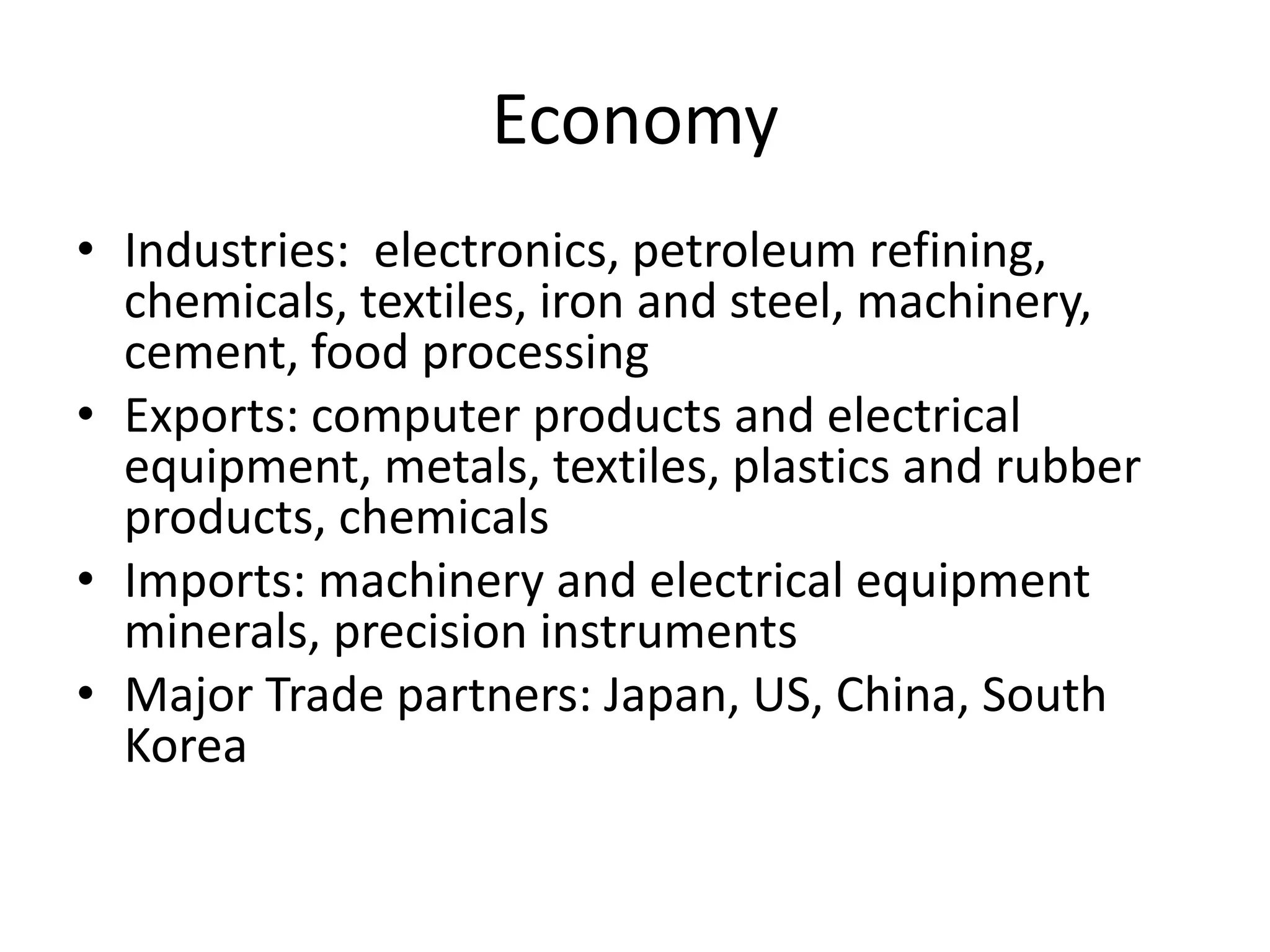
EconomyIndustries:  electronics, petroleum refining, chemicals, textiles, iron and steel, machinery, cement, food processingExports: computer products and electrical equipment, metals, textiles, plastics and rubber products, chemicals Imports: machinery and electrical equipment minerals, precision instruments Major Trade partners: Japan, US, China, South Korea
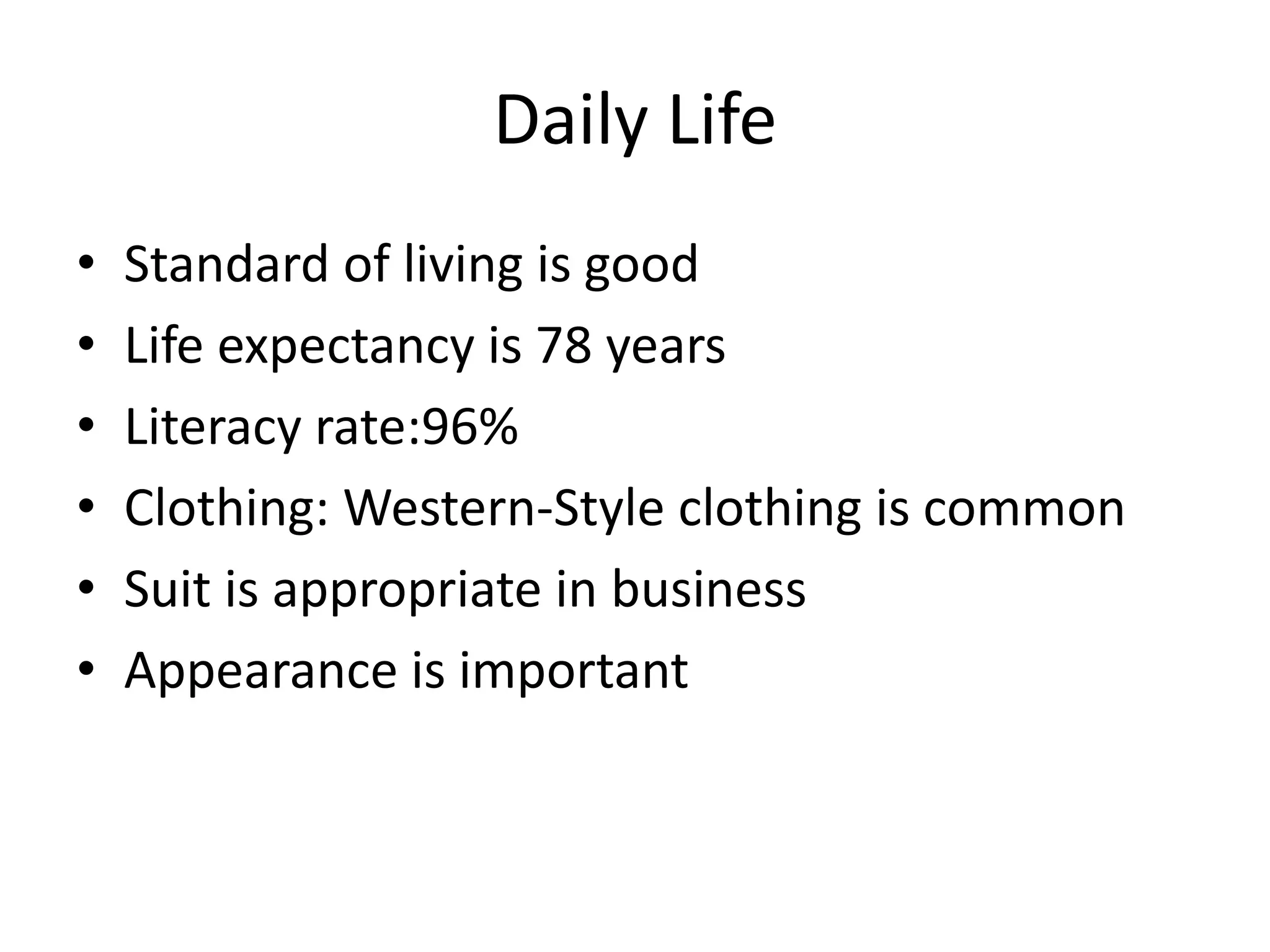
Daily LifeStandard of living is goodLife expectancy is 78 yearsLiteracy rate:96%Clothing: Western-Style clothing is commonSuit is appropriate in businessAppearance is important
CultureReligion: Confucian 93%, Christian 5%, other 2%Live in crowded conditionsMen's primary duty is to be a good son, husband and father are secondaryNever put chopsticks in rice bowl, looks like sticks of incense at a funeralPopular sports: golf, ping-pong, basketball, soccer, softball, and badmintonInstrumental music includes multiple genres, such as beiguan and nanguan.
Winter Olympics 2010Taiwan did not participate in the 2010 Winter Olympics.
ConclusionTaiwan is a very young developing country that is still fighting for international recognition. Although US has helped out its economy tremendously.  Also China wants it in the worst way!

MNChina&etc

  • 1.
  • 2.
  • 3.
  • 4.
    Country DescriptionTotal Area:9,596,960(sq km)/ 3,705,386(sq mi)Land Area: 9,326,410(sq km)/ 3,600,927(sq mi)Water Area: 270,550(sq km)/ 104,459(sq mi)The climate varies greatly Northern China: summer temperatures reaching 90 degrees F and winters of Arctic severity. Rainey summers and dry winters.Central China: Very hot summers and cold wintersSouthern China: subtropical climate. Very hot summers and mild winters. Water pollution, erosion, and air pollution are concerns.
  • 5.
    Country Description(continued)Geographical Coordinates:35°00’ N; 105 °00’ ELocated in the North and Eastern hemispheresEast AsiaBordered by Afghanistan, Bhutan, Burma, India, Kazakhstan, North Korea, Kyrgyzstan, Laos, Mongolia, Nepal, Pakistan, Russia, andPopulation: 1,338,612,968Life Expectancy: 73 Years
  • 6.
  • 7.
    GeographyWest: mountains, highplateaus, desertsEast: plains, deltas, and hillsMajor rivers flow west to east: Yangtze, Huang He (Yellow River), AmurMost of the arable lands lie along these riversMost rivers empty into Pacific OceanEast China bordered by the Yellow Sea and East China SeaSome well known features are the Himalayas and the Gobi DesertMost recognizable fauna and flora are the giant panda and bamboo.
  • 8.
    Geography(continued)A very populartourist attraction is Mount Everest, part of the Himalayas and the Earth’s highest point at 8,850 meters
  • 9.
    Geography(continued)Another great touristattraction is the Great Wall of China.
  • 10.
    HistoryChinese history datesback 4,000 years.Family dynasties ruled China for about 2,000 yearsThe last dynasty was the Qing and ended in 1911Many inventions have come from China, the most famous being paperThe Republic of China started in 1912 The government was weak and regional warlords looked to gain land and power.China fought Japan in the Sino- Japanese War, which was part of WWII. Japan surrendered in 1945.
  • 11.
    History(continued)A civil warthen started between the communists and the nationalists.The communist party led by Mao Zedong won the war and took control of the government. The nationalists retreated to Taiwan.Current Event: In 2008, Beijing hosted the Summer Olympics.
  • 12.
    PoliticalThe People’s Republicof China is a communist governmentThe major party is the Chinese Communist Party (CCP) There are eight smaller parties that are all controlled by the CCPThe Chief of State is President HuJintaoThe Head of Government is Premier WEN Jiabao
  • 13.
    EconomyThe Great LeapForward: 1958- Mao Zedong pushed for a more modernized Chinese economyChina now has the third largest economy in the world behind the U.S. and Japan.China is the largest trading nation in the world and the largest exporter and second largest importer of goods.Industry counts for over half of China’s gross domestic product(GDP).
  • 14.
    Economy (continued)Exports: machineryand equipment, textiles and clothing, footwear, toys and sporting goods, mineral fuels Imports: machinery and equipment, mineral fuels, plastics, iron and steel, chemicals Major trade partners: Japan, United States. Germany, South KoreaRestrictions: China recently stopped selling aircraft and some other military supplies to the U.S. after the U.S. agreed to supply Taiwan with money and military supplies.Trade Organizations: Ministry of Commerce of P.R.China, China International Economic and Trade Arbitration Commission, China Council for the Promotion of International Trade
  • 15.
    Daily LifeThe Chinesestandard of living as increased dramatically over the past decade.In 1949, the life expectancy was 32. It is now 73.91 % of total population is literate95 % of males are literate86 % of females are literateCommunist restriction on clothing are gone and Chinese fashion is developing. Adults are wearing more formal than casual. Teenagers like brand names and western clothing. Many children wear shirts with pictures of cartoon characters. Internet usage in China has risen from 0% in 1993 to 28 % in 2008.
  • 16.
    CultureMost values ofChina come from Confucianism, Taoism, and Buddhism.Religion: 60% Buddhist, 4% Christian, 2% Muslim, 34% AtheistChopsticks are used for every meal in China.Tipping at restaurants is considered an insult. Noodles, small pieces of meat, rice, and fruit deserts are common.The Chinese food in America is nothing like the food in China. America’s Chinese food has greater potions, more fat, and better taste.
  • 17.
    Culture (continued)Table Tennis,basketball, and soccer are the most popular sports in China.Martial arts has always been a popular activity and is believed to have originated in China.Various types of art are practiced in China like paper cutting.Some of the oldest music in the world has dated back to the time of Confucius. China takes great pride in the Great Wall.
  • 18.
    Winter Olympics 2010Chinawon 11 medals: 5 gold, 2 silver, 4 bronzeCame in 8th placeAll gold medals were in skating (speed and figure)Gold medalists: Wang Meng, Zhou Yang, ShenXeu, Zhao Hongbo, 90 participants
  • 19.
    ConclusionChina is oneof the oldest countries in the world and there is unlimited interesting information on it. The culture and history is fascinating. The one fact that I found the most interesting is that in China’s long history, it has always been independent.
  • 20.
  • 21.
  • 22.
    Country DescriptionTotal Area:446,550 (sq km)/ 172,413 (sq mi)Land Area: 446,300 (sq km) / 172,316(sq mi)Water Area: 250 (sq km)/ 97 (sq km)Climate: Mediterranean in the North. More extreme climate in interiorIt is very dry and warm on the east side of the Atlas mountains. The climate here is desert.32°00’ N; 5°00’ WBordered by Algeria, Western Sahara, and SpainIn North AfricaPopulation: 34,859,364
  • 23.
  • 24.
    GeographyMorocco borders theAtlantic Ocean and Mediterranean Sea.The Atlas Mountains are located in the center of the country. The Rif Mts are in the North. Large areas of plateaus, intermountain valleys, and rich coastal plainsThe olive tree is widely distributed, but the oil-yielding argan tree, unique to Morocco, grows only in the Sous Valley.Panthers, foxes, and gazelles are numerous.The desert is barren except for an occasional oasis.Morocco is subject to earthquakes and periodic droughts.
  • 25.
    HistoryIn the earlyyears of the first century, Morocco was under Roman rule. Muslims then started to inhabit and take control of Morocco. Became independent state in 1062Several dynasties ruled Morocco until the middle of the nineteenth century. Spain declares war on the Moors in Morocco in 1859.Became a French protectorate in 1912.Independent again in 1956.First democratic elections in1997Current Events: Tourists are afraid to fly to Muslim countries so Morocco’s tourism is hurting. Also, the dispute over the Western Sahara is continuing.
  • 26.
    PoliticalThe Kingdom ofMorocco is a constitutional monarchy.Capital : RabatBicameral legislatureKing Mohammad VIPrime Minister Abbas El FassiCouncil members appointed by monarchMonarch is hereditary
  • 27.
    EconomyMorocco relies lesson industry and more on agriculture and fishing. Its main trading partner and investor is France. It also trades with Spain, Britain, Germany, Italy, and U.S.Exports: clothing, fish, inorganic chemicals, transistors, crude minerals, fertilizers (including phosphates), petroleum products, fruits, vegetables Imports: crude petroleum, textile fabric, telecommunications equipment, wheat, gas and electricity, transistors, plastics The economy is growing steadily.Trade Associations: Morocco-US Free Trade Agreement
  • 28.
    Daily Life Moroccanstandard of living is low, but not drastically low. 20% the population us below the poverty line.Life expectancy is 72 years.Literacy rate:52%Literacy in men:64%Literacy in women:39%The national garment is the djelleba, a hooded caftan worn by both men and women, although Western-style clothing is becoming more common.Internet usage went from 0% in 1995 to 33% in 2008.
  • 29.
    Culture99% of Moroccois Muslim. 1% Christian.Barley and wheat are the main diet.Lamb, beef, and chicken are the main meats.Mint tea is the national drink.They don’t eat pork or drink alcohol.Married sons and their wives live with the father and mother. When the father dies, then the sons go and make their own household.Soccer is the most popular sport.Moroccan music is a blend of Arab, Berber and classical styles-  Dancing in Morocco is a must during various ceremonies and festival like marriage, harvest festival, religious gatherings
  • 30.
    Winter Olympics 2010Moroccohad 1 participant.AzzimaniSamir competed in the Alpine Skiing.
  • 31.
    ConclusionMorocco is ahighly Muslim country where family and religion are the most important values, two values that have been lost in America.
  • 32.
  • 33.
  • 34.
    Country DescriptionTotal Area:338,145 (sq km)/ 130,558 (sq mi) Land Area: 304,473 (sq km)/ 117,557 (sq mi)Water Area: 33,672 (sq km)/ 13,001 (sq mi)Climate: Summers are short and mild. The days are long. Winters are long and cold. Average temperature in Helsinki is 42°F.Location: 64°00’N; 26°00’ E; In northern EuropeBordered by Norway, Sweden, and RussiaPopulation; 5,250,275Finland is an Archipelago- a series of Islands
  • 35.
  • 36.
    Geographymostly low, flatto rolling plains interspersed with lakes and low hillsMany of the islands are on the Archipelago Sea, and Finland also boarders the Gulf of Finland. Finland has lots of lakes such as Lake Saimaa in Southern Finland.There are rine, spruce, and birch forests in Finland. 75% of the fauna are insects. Some of the non-insects are otters, elk, foxes, and birds.One of Finland’s most famous tourist attractions is a church built into solid rock.
  • 37.
    HistoryFinland has alwaysbeen bullied by other nations.1713- Russia invades Finland1808- Russia invades Finland again1907- Finland is the first country to give women the right to vote.1917- Finland declares its independence during the Russian Civil War.During WWII, Finland declared neutrality but had an alliance with Germany from 1918.The Soviet Union invaded and Finland gave up 10% of its land.
  • 38.
    History(continued)Germany invaded theSoviet Union, and so did Finland. In response, Britain declared war on Finland.Finland conceded even more land and paid millions of dollars to the Soviet Union in 1944.1948- Finland and Soviet Union signed Treaty of Friendship, Cooperation and Mutual Assistance.1973- Finland signed free-trade agreement with European Economic Community (EEC) .Finland became a member of the European Union in 1995.Current Event: A fox broke into a zoo in Finland and killed 16 flamingoes.
  • 39.
    PoliticalFinland is arepublicCapital city is HelsinkiPresident TarjaHalownenPrime Minister MattaVanhanenCouncil members appointed by president
  • 40.
    EconomyIndustry has replacedagriculture as the leading sector in Finland’s economy.Industry accounted for 34% of Finland’s GDP.Some industries include metal products, electronics, shipbuilding, pulp and paper, copper refining, foodstuffs, chemicals, textiles, clothingExports: machinery and equipment, chemicals, metals; timber, paper, pulpImports: foodstuffs, petroleum and petroleum products, chemicals, transport equipment, iron and steel, machinery, textile yarn and fabrics, grainsMajor trade partners: Germany, Sweden, Russia, Britain, France, DenmarkTrade Associations: Finnish Foreign Trade Association, European Free Trade Association.
  • 41.
    Daily LifeHigh levelof health care and standard of livingLife expectancy is 79 years.Literacy rate:100%Fairly casual dressed. Teens follow trends. Formal dress worn on special occasions. The men wear a peaked cap, woolen cap or felt hat. Internet usage went from 0% in 1990 to 79% in 2007
  • 42.
    CultureReligion: 89% EvangelicalLutheran, 1% Russian Orthodox, 1 % other, 9% noneFinns are more reserved and care about respect and privacySalmon, reindeer, berries, and soup are common.The national sport in Finland is pesapallo. It is played much like baseball.Folk, rock, opera, and pop are poplar genres of music.
  • 43.
    Winter Olympics 2010Finlandwon 5 medals: 1 silver and 4 bronzeThe silver medal was won by PiiroinenPeetu in the Men’s Snowboarding Halfpipe.
  • 44.
    ConclusionFinland is afairly modern country not very different from the U.S.A very interesting fact that I learned is that in June and July, the night only lasts for 2-3 hours. In the extreme north, there is a period of 73 days that the sun does not set.
  • 45.
  • 46.
  • 47.
    Country DescriptionTotal Area:163,270(sq km)/ 63,039(sq mi)Land Area: 161,470 (sq km)/ 62,344(sq mi)Water Area: 1,800(sq km)/ 695(sq mi)Climate: tropical, hot, and humid year-round. average 75°F to 90°F.There is rain year round, amounts differing with the seasons. Flooding is a cause for concern.Location:4°00’N; 56°00’WBordered by Brazil, French Guina, and GuyanaIn Northern Latin AmericaPopulation: 481,267
  • 48.
  • 49.
    Geographymostly rolling hills;narrow coastal plain with swampsBorders the Atlantic OceanFlora: water lilies, orchids, tropical shrubsFauna: iguanas, snakes, white egretMany tourists come to explore the tropical rain forest that makes up about 80% of Suriname
  • 50.
    HistoryThe Dutch acquiredSuriname from England in the 1500’s. It was turned into a plantation colony an slaves were brought there. Slavery was abolished in 1863, but labor was still needed. Contract laborers from the south came to Suriname and worked on the plantation. Suriname gained full independence in 1975Current Event: This past January, Suriname’s first president died at the age of 99.
  • 51.
    PoliticalThe Republic ofSuriname is a constitutional democracyIts capital is ParamariboChief of State: Runaldo Ronald VENETIAAN Head of Government: Runaldo Ronald VENETIAAN Cabinet members are appointed by the president
  • 52.
    EconomySuriname’s industry ingrowing, but is still relatively low.Some industries:  bauxite and gold mining, alumina production, oil, lumbering, food processing, fishingExports: alumina, crude oil, lumber, shrimp and fish, rice, bananasImports: capital equipment, petroleum, foodstuffs, cotton, consumer goodsMajor Trading Partners: US, Netherlands, Trinidad and Tobago, China, France, and JapanTrade Associations: Suriname Trade & Industry Association
  • 53.
    Daily LifeLife expectancyis 73 yearsLiteracy rate:89%Literacy in males:92%Literacy in females:84%The Javanese women wear sarongs as they would in Indonesia. The Creole women wear the traditional kotomisse, with an angisa or  handkerchief. Internet usage in Suriname rose from 0% in 1995 to 8% in 2007.
  • 54.
    CultureReligion: Hindu 27%,Protestant 25%, Roman Catholic 23%,Muslim 20%, indigenous beliefs 5%Rice, potatoes, chicken, beans, and peppers are very common.Soccer and swimming are the most popular sports. The music of Suriname is well-known for kaseko music, and for having an Indo-Caribbean tradition.Many tourist come to Suriname to observe the beauty of the rain forest.
  • 55.
    Winter Olympics 2010Surinamedid not participate in the 2010 Winter Olympics.
  • 56.
    ConclusionSuriname is abeautiful, tropical country which I would love to visit one day.I found the diversity of religions practiced in Suriname interesting.
  • 57.
  • 58.
  • 59.
    Country DescriptionTotal Area:825,418(sq km)/318,694 (sq mi)Land Area:825,418(sq km)/ 318,694(sq mi)Water Area:0 (sq km)Climate: semi-desert. Hot days and cool nightsSummer, days can reach 100°FRain from December to March, unrelenting dryness for rest of yearLocation: 22°00’S, 17°00’ ESouthern AfricaBordered by Angola, Botswana, South Africa, Zambia Population:2,108,665
  • 60.
  • 61.
    Geographymostly high plateauNamib Desert along coast; Kalahari Desert in eastFlora: 120 different types of trees such as mopane, terminalia, marula, and giant figsFauna: elephant, rhino, giraffe, buffalo, lion, leopard, and cheetah.The Namib desert is said to be the oldest desert in the worldMany tourists visit Namibia to see the wild life
  • 62.
    HistoryBushmen, Damara, Namaquapeoples inhabited Namibia in the 14th centuryIn the late 1800’s-early 1900’s, the country became under German ruleThe natives rebelled, they were defeated, and this started the genocide of the natives led by the GermansNamibia became a colony of South Africa in WWIThe people of Namibia launched a war of independence in 1966Namibia finally gained its independence in 1990Current Event: in 2009, the manifesto of the Republican part in Namibia is released
  • 63.
    PoliticalNamibia is arepublicThe capital of Namibia is WindhoekBicameral legislaturePresident Hifikepunye POHAMBAPrime Minister Nahas ANGULA
  • 64.
    EconomyIndustry is relativelylow in NamibiaAgriculture makes up most of the economyExports: diamonds, copper, gold, zinc, lead, uranium; cattle, processed fish, karakul skins Imports: foodstuffs; petroleum products and fuel, machinery and equipment, chemicals Major Trade partners: United States, EU
  • 65.
    Daily LifeStandard ofliving is bad in NamibiaThe life expectancy is very low at 51 yearsLiteracy Rate:85%Literacy in Men:84%Literacy in Women:83%many urban people dress in Western style clothing some rural tribes maintain their traditional dress. Thehimbafor example wear leather thongs or skirts. Only 5% of people in Namibia use the internet
  • 66.
    CultureWhen a mandies, his sibling inherit the propertyWhites account for 7% of population and they live in urban areasReligion: Christian 50%, Lutheran 40%, indigenous beliefs 10%Mealie, or corn, is the main food in NamibiaOther popular foods include beef, mutton, millet, peanuts, and melonsFish is a big export but not a common part of the Namibian dietMa/gaisa is mainly sang in Khoekhoegowab or Nama/Damara, and it is the most popular dance music in Namibia
  • 67.
    Winter Olympics 2010Namibiadid not participate in the 2010 winter Olympics
  • 68.
    ConclusionNamibia is adeveloping country with lots of natural beauty. They are making a great effort to try to catch up with the industry and technology with the rest of the world.You can see this effort through Namibia’s announcement that they are trying to build a nuclear power plant within the next 20 years.
  • 69.
  • 70.
  • 71.
    Country DescriptionTotal Area:945,087(sq km)/ 364,898 (sq mi)Land Area: 886,037(sq km)/ 342,099(sq mi)Water Area:59,050 (sq km)/ 22,799 (sq mi)Climate: coastal strip is tropical with high humidityCentral plateau takes up most of country, hot and dry2 dry seasons, 2 rainy seasonsBad monsoonsLocation: Southern/Central Africa; 6°00’S, 35°00’EBorder countries: Burundi, Democratic Republic of the Congo, Kenya, Malawi, Mozambique, Rwanda, Uganda, Zambia Population:41,048,532
  • 72.
  • 73.
    GeographyPlains along thecoastPlateau takes up most of countryBorders Indian OceanWooded grasslands are widely scattered throughout the countryThe drier central areas include bush lands and thickets4 million wild mammals Antelope, zebra, elephant, hippopotamus, rhinoceros, giraffe, and lionVarious species of monkeys827 species of birdsFamous Mt. Kilimanjaro 5,985 m
  • 74.
    History1498-Portuguese explorer Vascoda Gama visits Tanzanian coast.1884-German Colonization Society begins to acquire territory on the mainland.1919- Germany loses WWI, Tanzania given to Britain1961- Tanzania becomes independent2001- a new goldmine opens, making Tanzania the third largest gold producer in the world
  • 75.
    PoliticalTanzania is arepublicCapital is Dar es SalaamChief of state: Jakaya KIKWETEHead of government :Jakaya KIKWETE Five year termsCabinet members appointed by president
  • 76.
    EconomyTanzania’s industry isvery smallMost of it is centered around agricultureExports: gold, coffee, cashew nuts, manufactures, cotton Imports: consumer goods, machinery and transportation equipment, industrial raw materials, crude oil Major Trade partners: UK, South Africa, Japan, France, and IndiaTrade Sanctions: Tanzania has a trade sanction on Burundi which will be lifted when Burundi returns to democracy.
  • 77.
    Daily LifeStandard ofliving is lowLife expectancy is only 52 yearsLiteracy rate:69%Literacy in Men:85%Literacy in Women:70%Clothing: khanga and kitengeclothes for womenToga-like garment for menWomen wear a lot of bead jewelryOnly 1% of the people in Tanzania use the internet
  • 78.
    CultureWomen marry inearly to mid teens Groom offers a price for the brideMuslim 35%, indigenous beliefs 35%, Christian 30%Right hand considered “clean”, left hand is “unclean”2 main meals per dayA dish known as ugali, made from cassava, corn, sorghum or millet flour, is very commonFish stew, vegetables, and meatSoccer and “netball” (like basketball)are poplarA game similar to capture the flag is also commonThe music of Tanzania stretches from traditional African music to the string-based taarab to a distinctive hip hop known as bongo flava.The Serengeti is known as one of the best wildlife sanctuary in the world
  • 79.
    Winter Olympics 2010Tanzaniadid not participate in the 2010 Winter Olympics.
  • 80.
    ConclusionTanzania is abeautiful country with majestic wildlife.Tanzania is probably one of the oldest known continuously inhabited areas on Earth; fossil remains of humans and pre-human hominids have been found dating back over two million years.
  • 81.
  • 82.
  • 83.
    Country DescriptionTotal Area:2,717,300(sq km)/ 1,049,150 (sq mi)Land Area:2,669,800 (sq km)/1,030,810 (sq mi)Water Area:47,500 (sq km)/18,340 (sq mi)Climate: Continental and dry. Winter temperatures and snowfall are rarely extreme and wind is light, summers are pleasant with 80 degree temps. Location: Asia; 48°00’N, 68°00’EBordered by China, Kyrgyzstan, Russia, Turkmenistan, Uzbekistan Population: 15,399,437
  • 84.
  • 85.
    Geographyextends from theVolga to the Altai Mountains and from the plains in western Siberia to oases and desert in Central AsiaLandlocked, does not touch any oceansSome fauna: brown bear, Caspian sea wolf, Caspian tiger, eagle, snow lepardSome flora: steppes and desertsTourist Attraction: Almaty-a beautiful setting between mountains and plains
  • 86.
    History1868- Thousands ofRussian and Ukrainian peasants are brought in to settle Kazakh lands1917-Civil war breaks out following the Bolshevik revolution in Russia1936-Kazakhstan becomes a full union republic of the USSR.1940-Hundreds of thousands of Koreans, Crimean Tatars, Germans and others forcibly moved to Kazakhstan1949-The first nuclear test explosion is carried out at the Semipalatinsk nuclear test ground in eastern Kazakhstan1961-The first manned spacecraft launched from the Baikonur space launch site in central Kazakhstan1991-Kazakhstan established independence.1992- Kazakhstan admitted to the United NationsKazakhstanis being viewed as a nuclear threat because of the levels of uranium it harvests
  • 87.
    PoliticalKazakhstan is arepublicCapital is AstanaBicameral parliamentChief of State: President Nursultan A. NAZARBAYEVHead of Government: Prime Minister Karim MASIMOVCouncil of ministers appointed by president
  • 88.
    EconomyBig industries areoil, coal, and iron oreExports: oil and oil products, ferrous metals, chemicals, machinery, grain, wool, meat, coalImports: machinery and equipment, metal products, foodstuffsMajor Trade partners: Russia, Germany, US, ChinaTrade Associations: The U.S.-Kazakhstan Business Association (USKBA)
  • 89.
    Daily LifeStandard ofliving is goodLife expectancy is 68 yearsLiteracy Rate:99%Literacy in Men:99%Literacy in Women:97%Clothing: Urban Kazaks wear Western style clothesTraditionally Kazaks liked to wear boots with with a pair of felt stockings in the winterInternet usage rose from 0% in 1994 to 12% in 2008
  • 90.
    CultureReligion: Muslim 47%,Russian Orthodox 44%, other, 7%, Protestant 2%There is a housing shortage and many people live in urban apartmentsMany games that involve horses are playedKuirdak, is a dish prepared from freshly slaughtered meat and consists of the animal's liver, heart, kidneys and other organs cut into pieces, boiled in oil and served with onions and pepper. YUM!Folk orchestras are popular in Kazakhstan
  • 91.
    Winter Olympics 2010Kazakhstanhad 38 participants in the 2010 winter OlympicsKazakhstan won one medal: silverThe winner of the medal was Elena Khrusttaleva in the women’s biathlon
  • 92.
    ConclusionKazakhstan is afairly modern country that is catching up with the other Asian countries. I think that it is interesting that Kazakhstan has to rely on industry so much because there is not much water to have farming.
  • 93.
  • 94.
  • 95.
    Country DescriptionTotal Area:110,860(sq km)/ 42,803 (sq mi)Land Area:110,860 (sq km)/42,803 (sq mi)Water Area:0 (sq km)/ 0 )(sq mi)Climate: mild subtropical climate cause by trade winds and warm surrounding watersAverage temperature is 77°FIn the Caribbean;  21°30’N, 80°00’ WPopulation:11,451,652
  • 96.
  • 97.
    Geographymostly flat torolling plains, with rugged hills and mountains in the southeastbordered on the south by the Caribbean Sea and on the north by the Gulf of Mexico and the Straits of FloridaAn islandFlora: cactus, mango, pomegranate, avocado, bananaFauna: woodpecker, jutia, snakes, Tourist attractions: immaculate beaches bring in thousands of tourists
  • 98.
    History1492-The navigator ChristopherColumbus claims Cuba for Spain.1511-Spanish colonization of the island begins under the direction of Diego Velazquez.1607-Havana is officially named the capital of Cuba.1868-War of independence lasts for ten years between Cuban colonials wanting independence from what they see as unjust rule from Spain. The War ends in a treaty and promise of greater autonomy for Cuba.1895-Jose Marti leads a second war of independence; US declares war on Spain.1898-US defeats Spain, which gives up all claims to Cuba and cedes it to the US.1898-Cuba becomes independent with Tomas Estrada Palma as its president; however, the Platt Amendment keeps the island under US protection and gives the US the right to intervene in Cuban affairs.1906-Cuban President Tomas Estrada resigns and the United States invades and occupies Cuba after a rebellion led by Jose Miguel Gomez.1925-Socialist Party founded, forming the basis of the Communist Party.
  • 99.
    History(continued)1959-Fidel Castro leda Communist revolution and the rebel army overthrew the Cuban president Fulgencio Batista.1962-Cuban missile crisis occurs when Castro allows the USSR to deploy nuclear missiles in Cuba. The crisis was solved when the USSR agreed to take back the missiles in exchange for the US withdrawing their missiles from Turkey.1965-Cuba’s sole political party renamed the Cuban Communist Party.1976-Cuban Communist Party approves a new socialist constitution; Castro elected president.1980-More than 100,000 Cubans flee to the US.2008-Raul Castro takes over as president, days after Fidel announces his retirement.
  • 100.
    PoliticalCuba is communistCapitalis HavanaPresident Raul CastroSecondary head of state: Gen. Jose Ramon Machado Ventura
  • 101.
    EconomyIndustry and agricultureare about the same importanceSome industries: sugar, petroleum, tobacco, Exports: sugar, nickel, tobacco, fish, medical products, citrus, coffeeImports: petroleum, food, machinery and equipment, chemicalsMajor trade Partners: Spain, China, Venezuela, Italy, France, Canada, US, MexicoTrade Associations: US-Cuba Trade AssociationTrade Sanctions: US put an embargo on Cuba in 1960
  • 102.
    Daily LifeStandard ofliving is good, much better than it was under the early years of Fidel CastroLife expectancy is 78 yearsLiteracy Rate:99%Literacy in Men:97%Literacy in Women:96%Clothing: Casual dress and lightweight slacks are the norm during the day with more formal wear in the evenings. Shorts are popular at the beach but no shorts are allowed at night in public placesInternet usage rose from 0% in 1995 to 12 % in 2008
  • 103.
    CultureIt is notuncommon for 3 generations to live under one householdReligion: Roman Catholic 85%, other 15%Baseball is the favorite sportFood: rice, beans, eggs, tomatoes, lettuce, chicken, beef and pork. Various spices usedwide range of creolized musical styles, based on its cultural origins in Europe and AfricaMany Spanish and Latin dances
  • 104.
    Winter Olympics 2010Cubadid not participate in the 2010 Winter Olympics.
  • 105.
    ConclusionCuba is afascinating country with rich culture but still is recovering from the oppressive communist government and rule of Fidel Castro.
  • 106.
  • 107.
  • 108.
    Country DescriptionTotal Area:1,649,000 (sq km)/636,679 (sq mi)Land Area: 1,636,000 (sq km)/631,660 (sq mi)Water Area: 12,000 (sq km)/ 4,633 (sq mi)Climate: mostly arid or semiarid, subtropical along Caspian coastLocation: Middle East, Asia; 32° 00’N, 53° 00’EPopulation:  66,429,284
  • 109.
  • 110.
    Geographyrugged, mountainous rimhigh,central basin with deserts, mountains; small, discontinuous plains along both coastsBorders Arabian sea, Persian Gulf, and Caspian SeaBordered by Afghanistan, Armenia, Azerbaijan, Iraq, Pakistan, Turkey, Turkmenistan Flora: oak, ash, elm, cypress, walnut, beech, maple, and mulberryFauna: wild sheep and goats, gazelles, wild asses, wild pigs, panthers, and foxesThere is not much tourism in Iran because of the war
  • 111.
    HistoryRuled by Muslimdynasties1907-ntroduction of constitution which limits the absolutist powers of rulers.1914-Iran declares neutrality but is scene of heavy fighting during World War I.1935-Formerly known as Persia, Iran is adopted as the country’s official name.1941-Reza Shah, who sides with Germans in the war, forced to abdicate by Allies. His son, Reza Pahlavi, named Shah.1979-The Shah was overthrown by the Islamic Revolution ending 2,500 years of monarchy.1979-Islamic republic set up. 1980-Start of Iran-Iraq war which lasts for eight years.
  • 112.
    History(continued)1981-The American hostagesare released ending 444 days in captivity.1990-A major earthquake strikes Iran, killing approximately 40,000 people.1990-Iran remains neutral following Iraq’s invasion of Kuwait.1995-US imposes oil and trade sanctions over Iran’s alleged sponsorship of “terrorism”, seeking to acquire nuclear arms and hostility to the Middle East process. Iran denies the charges.2003-40,000 people are killed in an earthquake in south-east Iran; the city of Bam is devastated.Current Event: American troops remain stationed in Iran
  • 113.
    PoliticalIran is atheocratic republicCapital is TehranSupreme Leader Ali Hoseini-KHAMENEIPresident Mahmud AHMADI-NEJAD First Vice President Parviz DAVUDI Cabinet members picked by president with legislature approval
  • 114.
    EconomyIndustry and agricultureare both big40% of population below poverty lineExports: petroleum, chemical and petrochemical products, fruits and nuts, carpetsImports: industrial raw materials and intermediate goods, capital goods, foodstuffs and other consumer goods, technical services, military supplies Major Trade Partners: Germany, Japan, Switzerland, France, ItalyTrade Associations: Iranian Trade Association Trade Sanctions: The US does not sell any aircraft or military materials to Iran
  • 115.
    Daily LifeStandard ofliving is not good, but not bad40% of population below poverty lineLife Expectancy is 71 yearsLiteracy rate:77%Literacy in Men:85%Literacy in Women:73%Clothing: dress formally and conservatively in publicMen wear western clothes or robes and traditional turbansWomen must be covered from head to foot in publicInternet usage rose from 0% in 1994 to 325 in 2008
  • 116.
    CultureReligion: Shi aMuslim 89%, Sunni Muslim 9%, other 2%Large families favoredMen can have up to 4 wivesMany say that chess was invented in IranOther popular games are wrestling, weightlifting, squash, and horse racingMidday meal is most importantMuslims do not eat anything from dusk to dawn during RamadanReligion is extremely important; so is fasting and praying
  • 117.
    Winter Olympics 2010Iranhad 4 athletes in the 2010 winter Olympics.They competed in alpine skiing and cross country skiing.They did not win any medals.
  • 118.
    ConclusionIran is afounding member of the UN, NAM, OIC and OPEC.It is a powerful country struggling to set up a strong government while dealing with radical Muslims.
  • 119.
  • 120.
  • 121.
    Country DescriptionTotal Area:35,980 (sq km)/ 13,892 (sq mi)Land Area: 32,260 (sq km)/ 12,456 (sq mi)Water Area: 3,720 (sq km)/ 1,436 (sq mi)Climate: sub-tropical with temperatures ranging from 12 to 35 degrees Celsius Summer and winter are long, spring and fall are shortTyphoons last from June to OctoberAsia; 23°30’N, 121°00’EPopulation:22,974,347
  • 122.
  • 123.
    Geographyeastern two-thirds mostlyrugged mountains flat to gently rolling plains in westIsland in Pacific OceanFlora: evergreen tropical and subtropical forest, where ficua, pandanus, palms, teak, bamboos, and camphors are commonly foundFauna: Foxes, flying foxes, deer, wild boar, bats, squirrels, macaques, and pangolinsTourist Attraction: Yushan Mountain
  • 124.
    History1626-The Spanish colonizenorthern Taiwan.1661-Chinese Ming dynasty occupied Taiwan.1683-The Manchus (Tartars) conquer Taiwan which becomes part of the Chinese empire.1895-China ceded Taiwan to Japan under the Apr 17 Treaty of Shimonoseki. This followed a war over control of the Korean peninsula. Japanese occupation ended in 1945.World War II; Japan surrenders and China’s Chiang Kai-shek appoints General Chen-Yi to take over Taiwan.1971-Taiwan is expelled from the United Nations. The seat is given to the People’s Republic of China.1978-The United States announces it will terminate its diplomatic relations with Taiwan on Jan. 1, 1979.
  • 125.
    History(continued)2001-Taipei lifts a50-year ban on direct trade and investment with China.2002-Taiwan officially enters the World Trade Organization, only a few weeks after China.2005-Tension between China and Taiwan intensifies, when China passes an anti-secession law that says the country can use force if Taiwan moves toward achieving independence.2007-The country attempts to join the UN for the first time under the name Taiwan, rather than the official title of Republic of China. The application is rejected.2009-The leaders of China and Taiwan exchange direct messages for the first time in more than 60 years, in a sign of warming ties.
  • 126.
    Politicalmultiparty democratic regimeCapital is TaipeiUnicameral legislatureChief of State: MA Ying-jeouHead of Government: LIU Chao-shiuan
  • 127.
    EconomyIndustries:  electronics, petroleum refining,chemicals, textiles, iron and steel, machinery, cement, food processingExports: computer products and electrical equipment, metals, textiles, plastics and rubber products, chemicals Imports: machinery and electrical equipment minerals, precision instruments Major Trade partners: Japan, US, China, South Korea
  • 128.
    Daily LifeStandard ofliving is goodLife expectancy is 78 yearsLiteracy rate:96%Clothing: Western-Style clothing is commonSuit is appropriate in businessAppearance is important
  • 129.
    CultureReligion: Confucian 93%,Christian 5%, other 2%Live in crowded conditionsMen's primary duty is to be a good son, husband and father are secondaryNever put chopsticks in rice bowl, looks like sticks of incense at a funeralPopular sports: golf, ping-pong, basketball, soccer, softball, and badmintonInstrumental music includes multiple genres, such as beiguan and nanguan.
  • 130.
    Winter Olympics 2010Taiwandid not participate in the 2010 Winter Olympics.
  • 131.
    ConclusionTaiwan is avery young developing country that is still fighting for international recognition. Although US has helped out its economy tremendously. Also China wants it in the worst way!