Topic 1
Factors affecting Second
Language Acquisition
Part 1
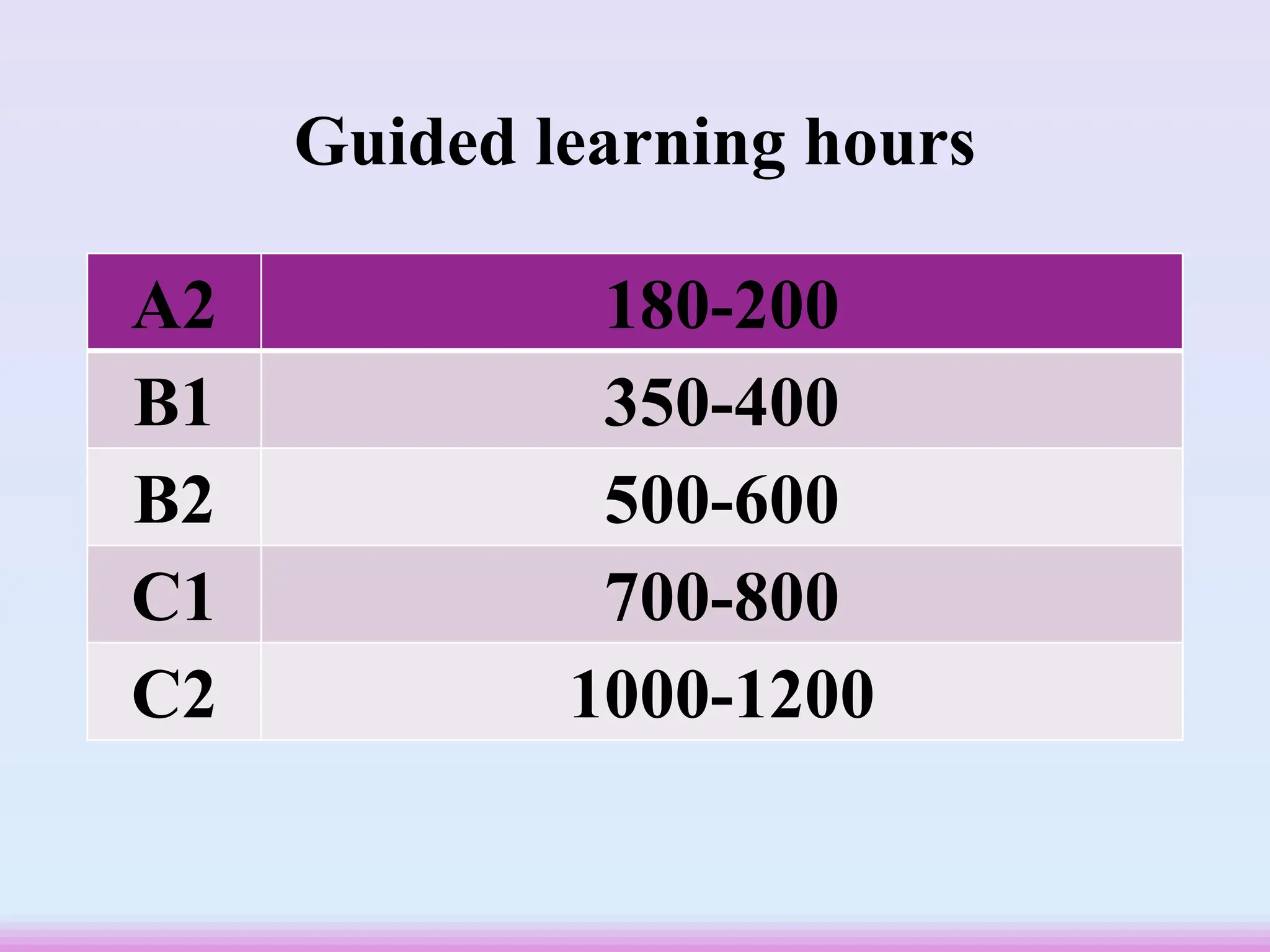
Guided learning hours
A2 180-200
B1 350-400
B2 500-600
C1 700-800
C2 1000-1200
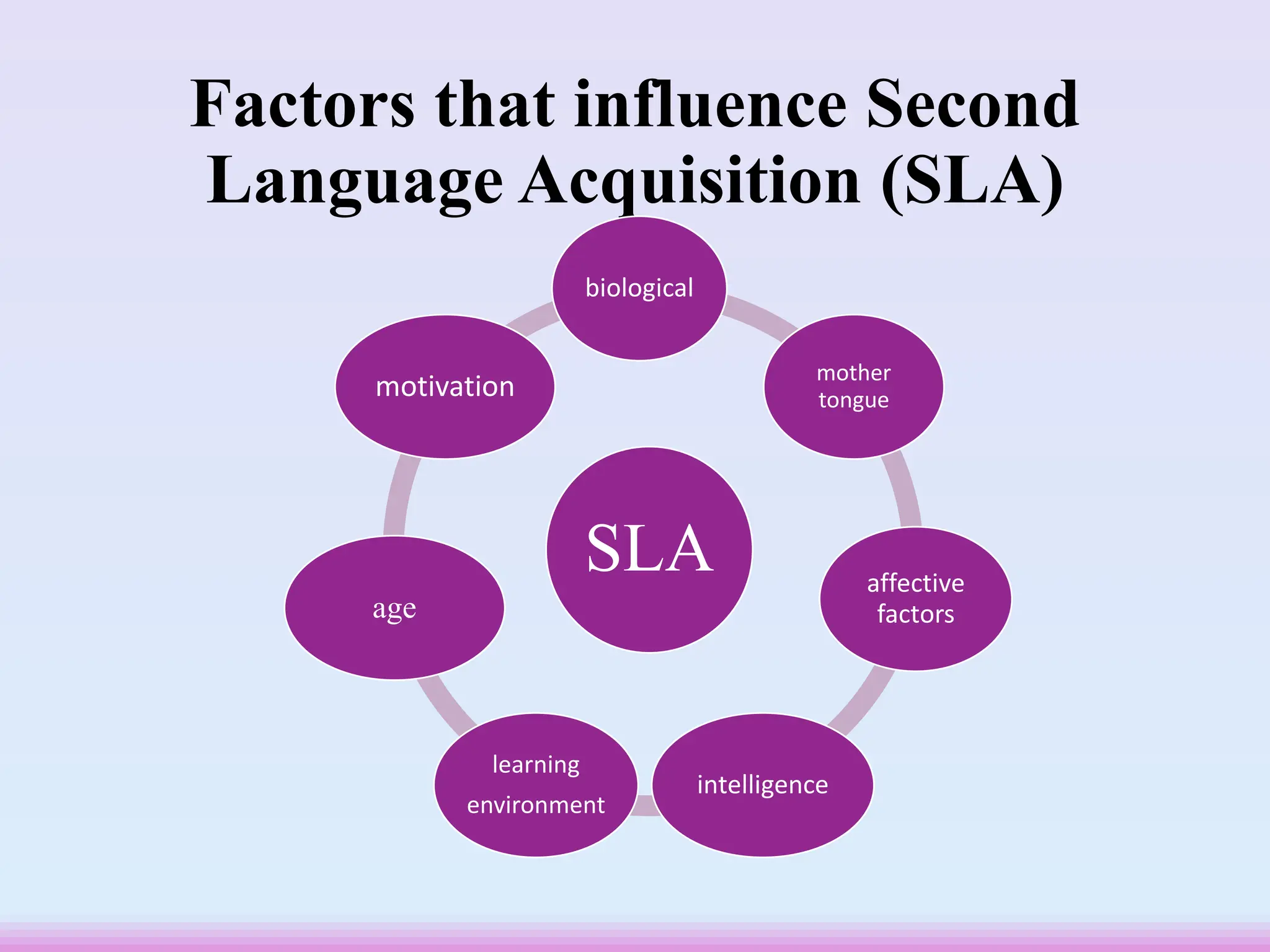
Factors that influence Second
Language Acquisition (SLA)
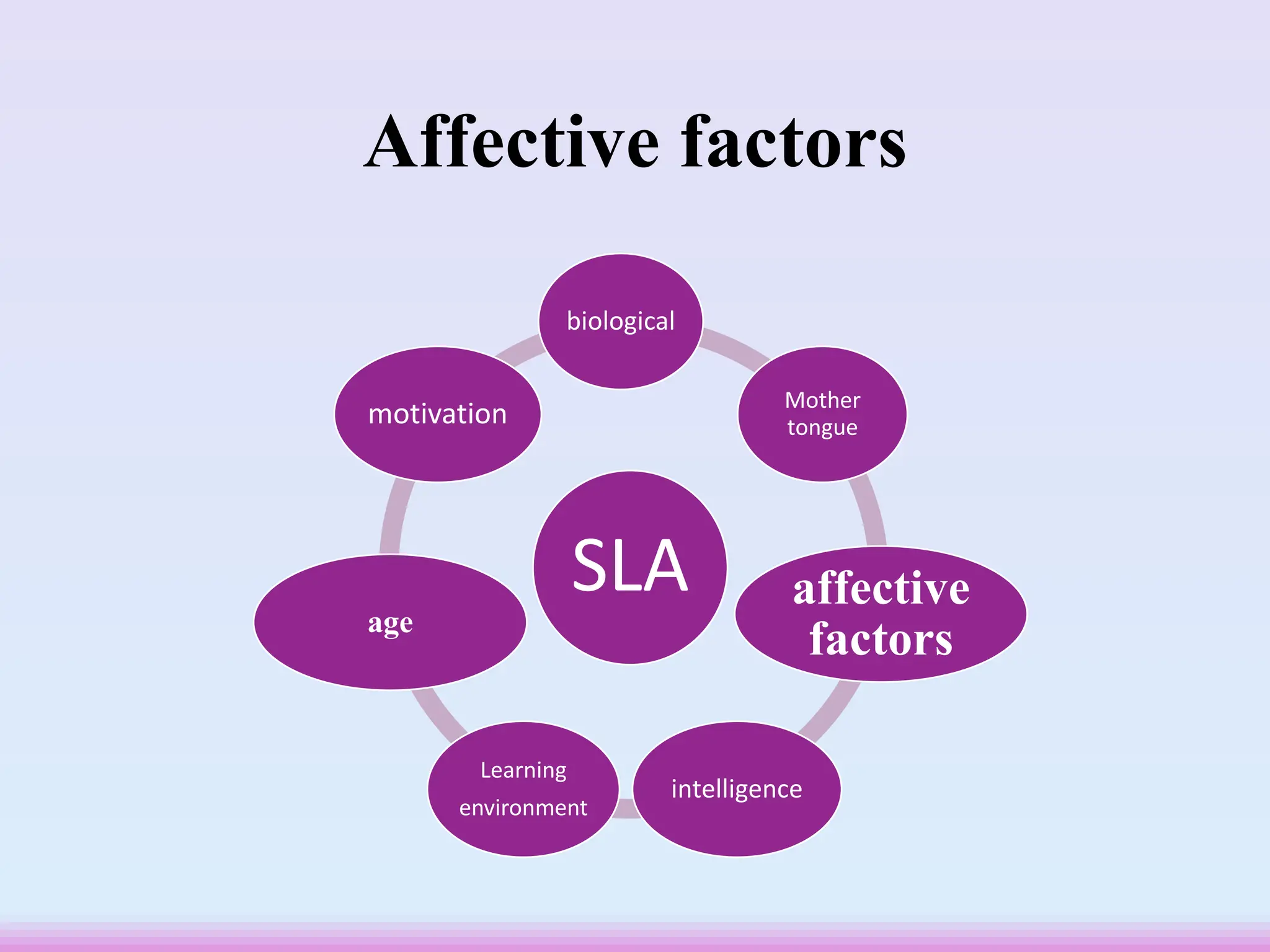
SLA
biological
mother
tongue
affective
factors
intelligence
learning
environment
age
motivation
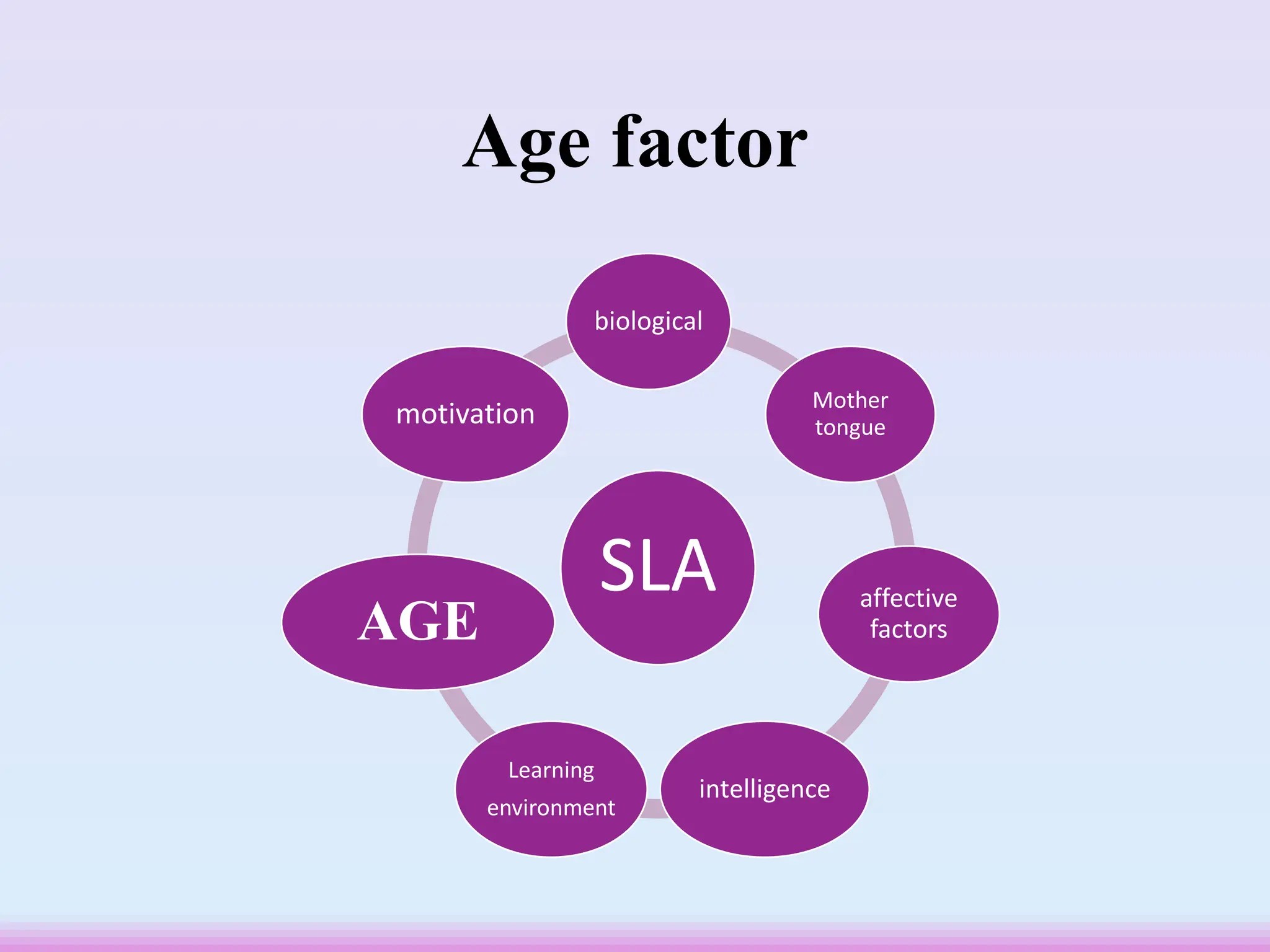
Age factor
SLA
biological
Mother
tongue
affective
factors
intelligence
Learning
environment
AGE
motivation
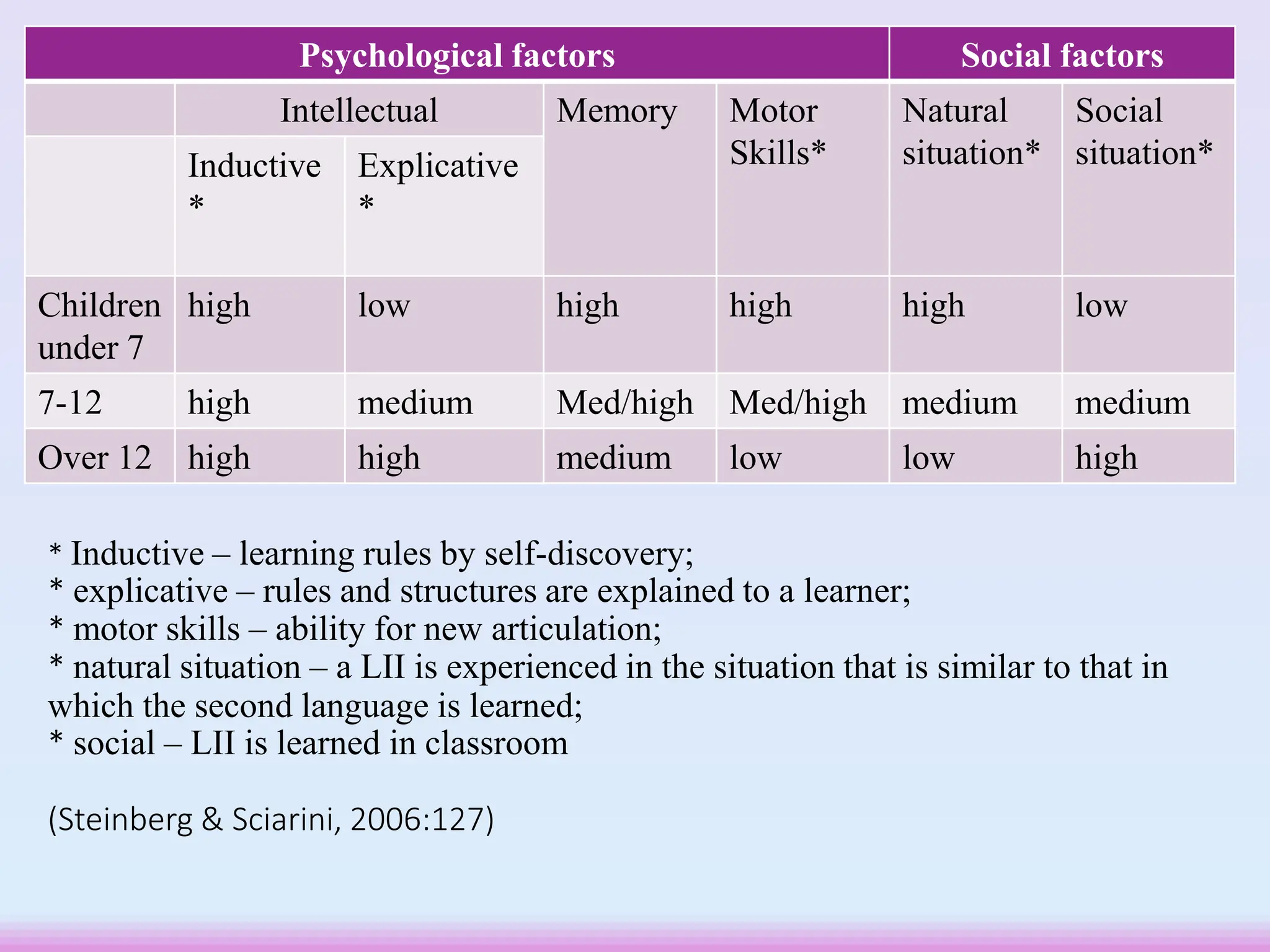
Psychological factors Social factors
Intellectual Memory Motor
Skills*
Natural
situation*
Social
situation*
Inductive
*
Explicative
*
Children
under 7
high low high high high low
7-12 high medium Med/high Med/high medium medium
Over 12 high high medium low low high
* Inductive – learning rules by self-discovery;
* explicative – rules and structures are explained to a learner;
* motor skills – ability for new articulation;
* natural situation – a LII is experienced in the situation that is similar to that in
which the second language is learned;
* social – LII is learned in classroom
(Steinberg & Sciarini, 2006:127)
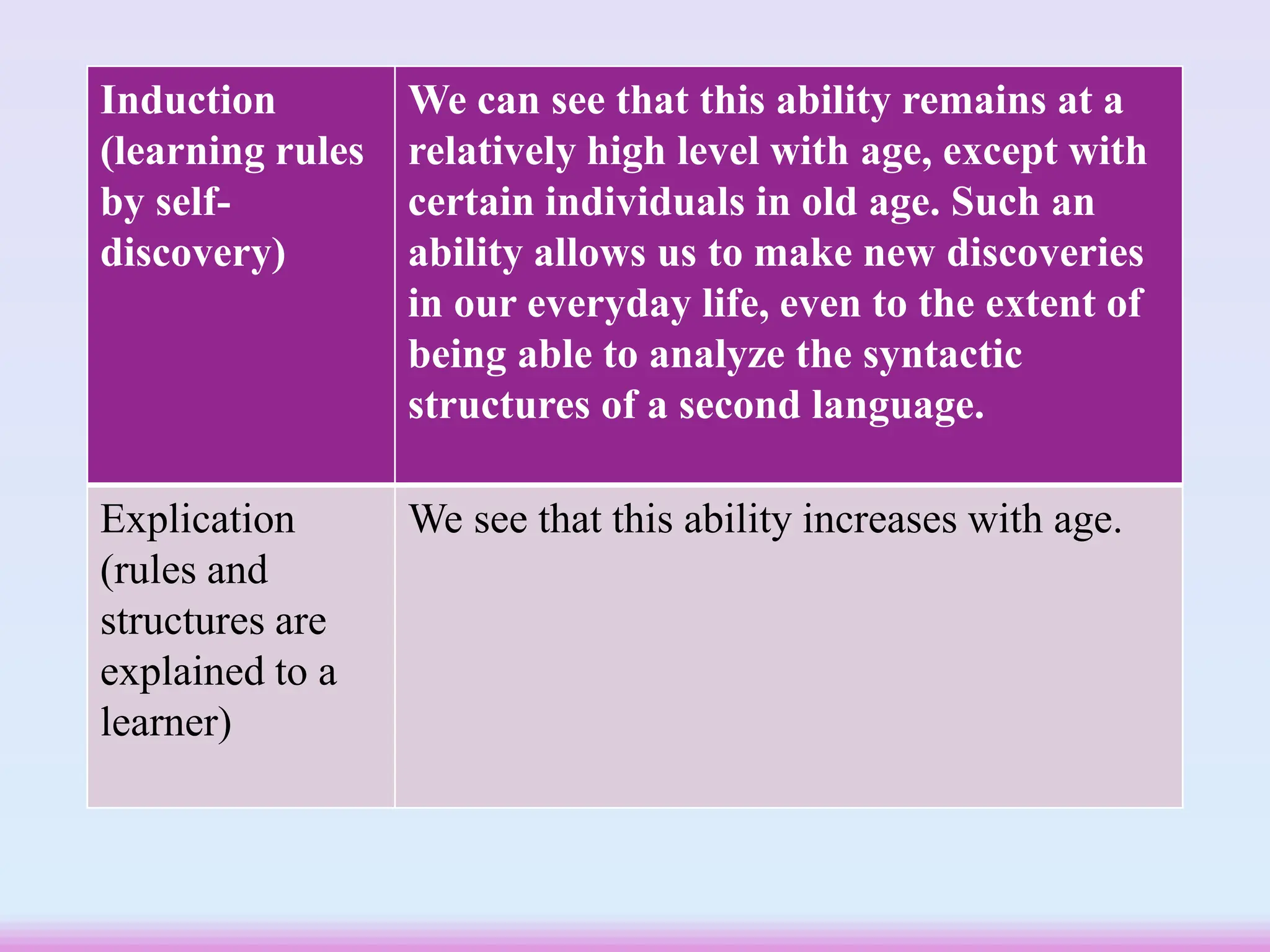
Induction
(learning rules
by self-
discovery)
We can see that this ability remains at a
relatively high level with age, except with
certain individuals in old age. Such an
ability allows us to make new discoveries
in our everyday life, even to the extent of
being able to analyze the syntactic
structures of a second language.
Explication
(rules and
structures are
explained to a
learner)
We see that this ability increases with age.
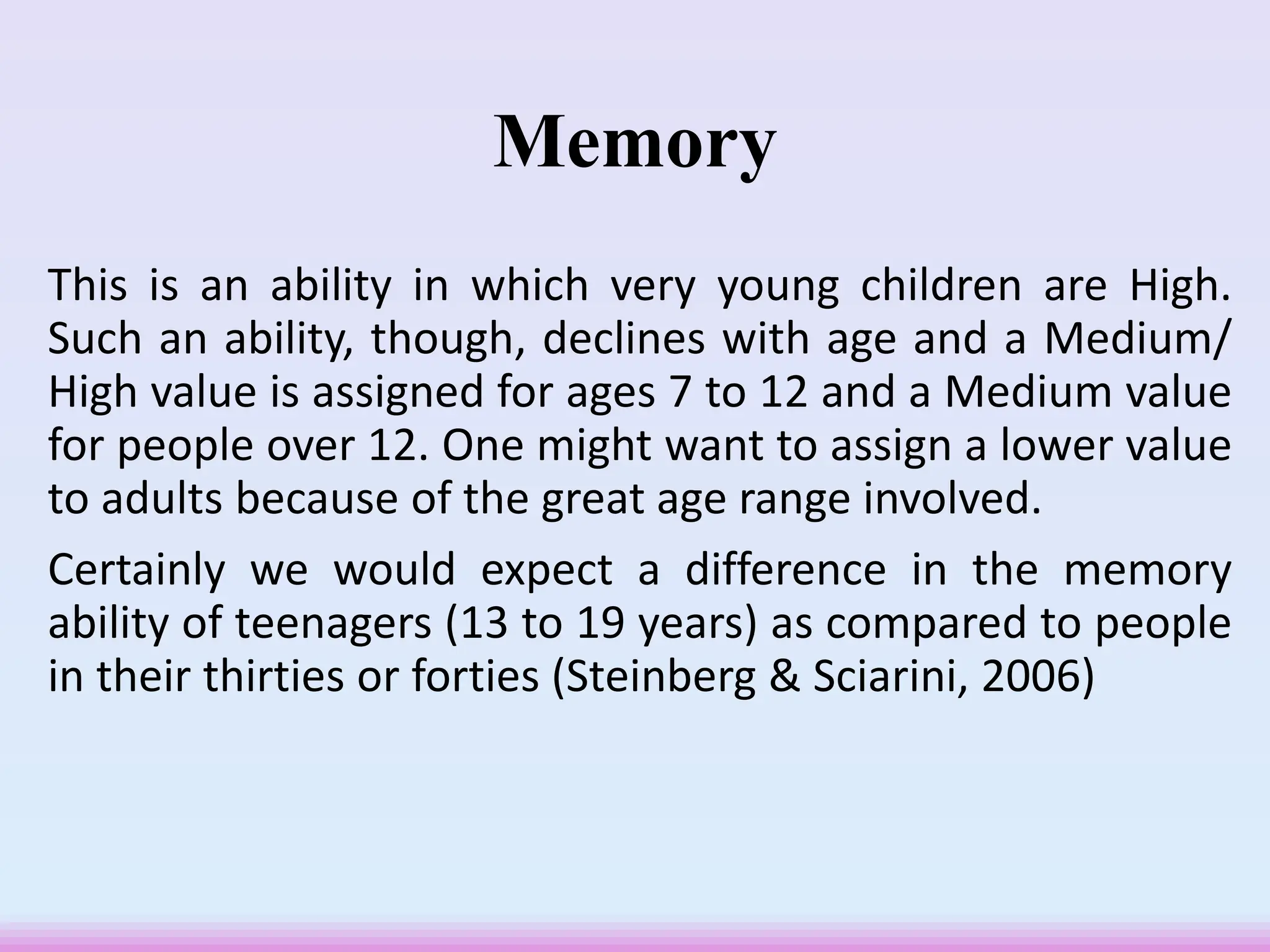
Memory
This is an ability in which very young children are High.
Such an ability, though, declines with age and a Medium/
High value is assigned for ages 7 to 12 and a Medium value
for people over 12. One might want to assign a lower value
to adults because of the great age range involved.
Certainly we would expect a difference in the memory
ability of teenagers (13 to 19 years) as compared to people
in their thirties or forties (Steinberg & Sciarini, 2006)
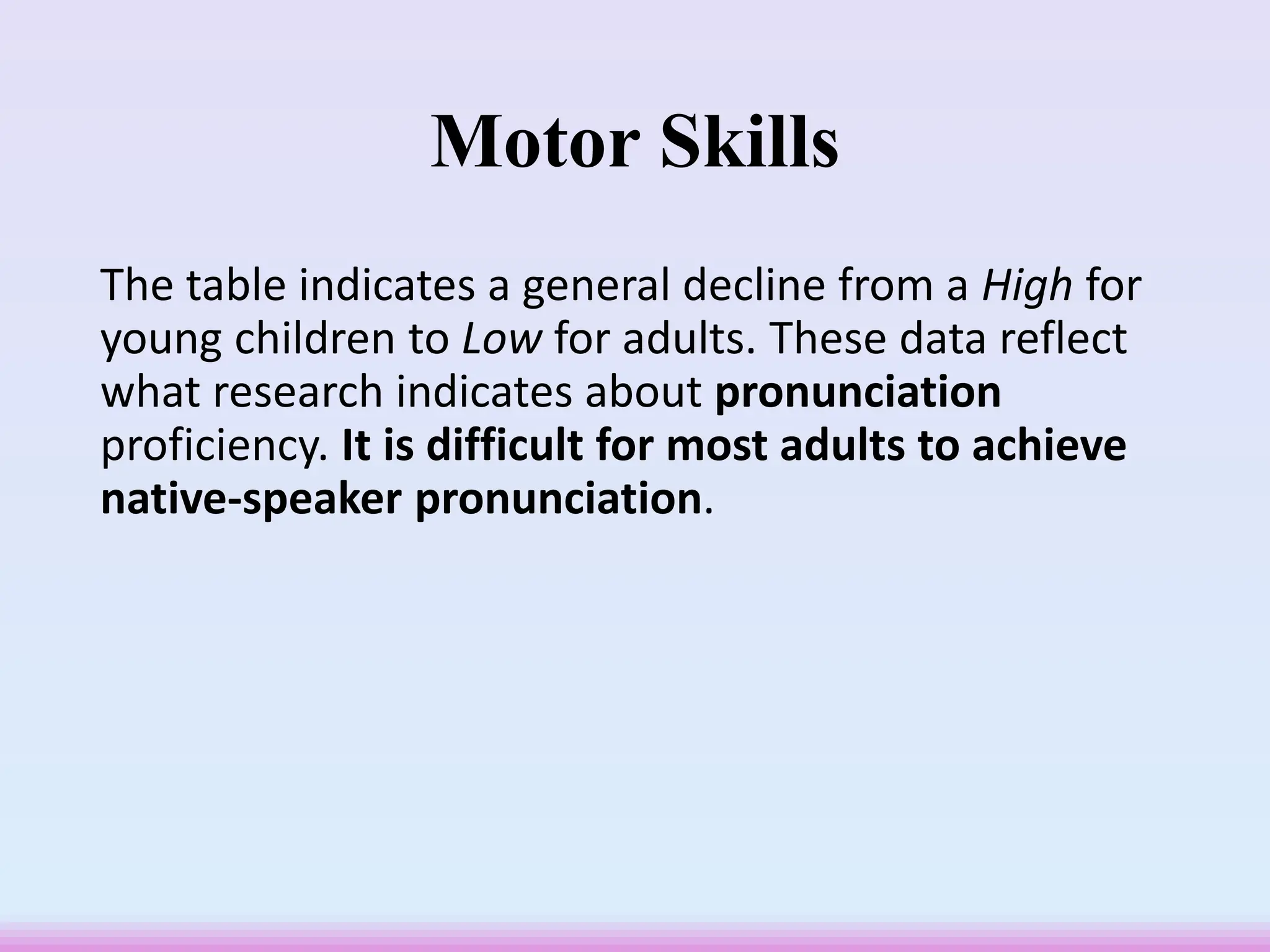
Motor Skills
The table indicates a general decline from a High for
young children to Low for adults. These data reflect
what research indicates about pronunciation
proficiency. It is difficult for most adults to achieve
native-speaker pronunciation.
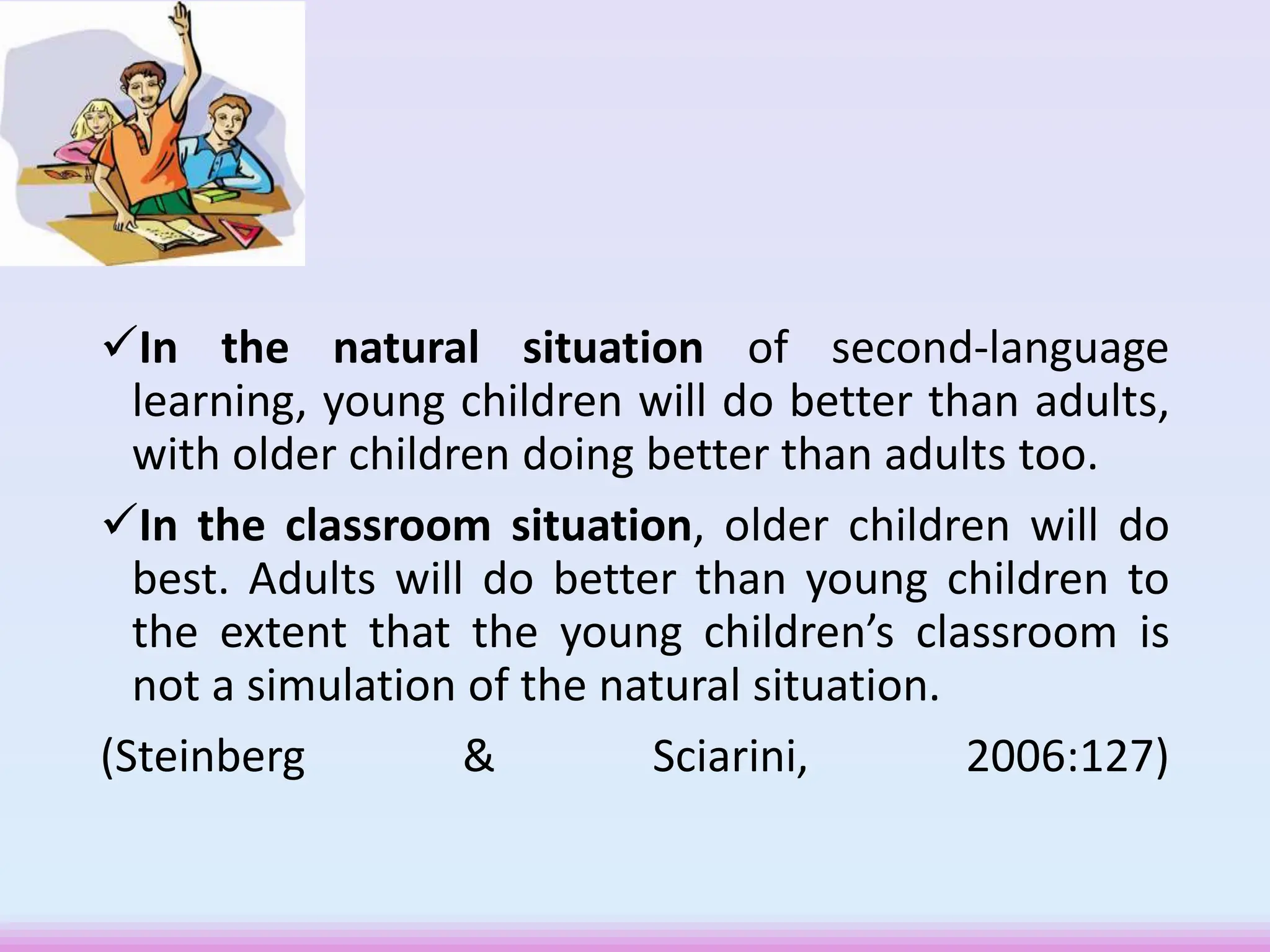
In the natural situation of second-language
learning, young children will do better than adults,
with older children doing better than adults too.
In the classroom situation, older children will do
best. Adults will do better than young children to
the extent that the young children’s classroom is
not a simulation of the natural situation.
(Steinberg & Sciarini, 2006:127)
Teenagers and adult learners
learn at a faster pace (cognitive maturity)
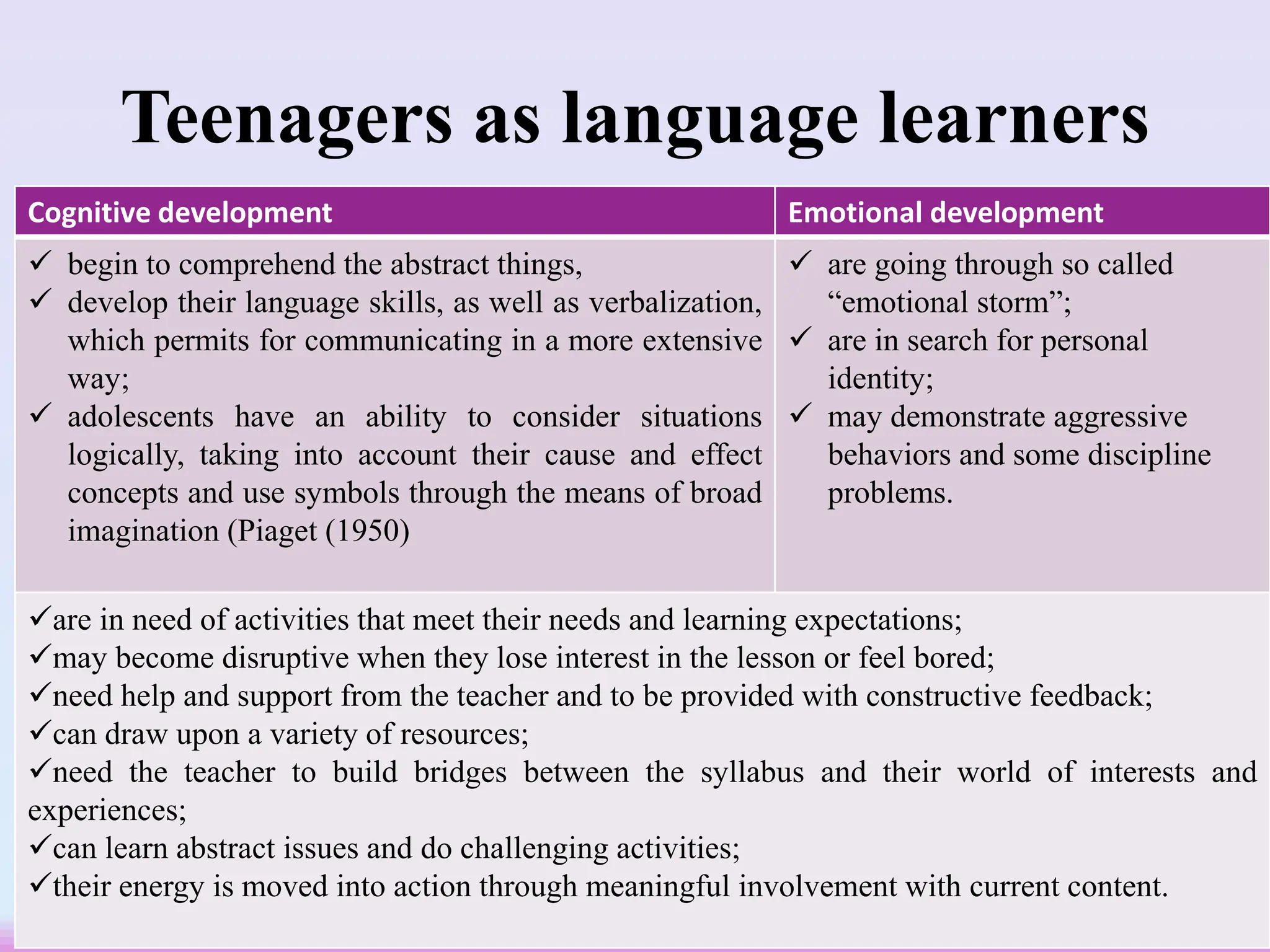
Teenagers as language learners
Cognitive development Emotional development
 begin to comprehend the abstract things,
 develop their language skills, as well as verbalization,
which permits for communicating in a more extensive
way;
 adolescents have an ability to consider situations
logically, taking into account their cause and effect
concepts and use symbols through the means of broad
imagination (Piaget (1950)
 are going through so called
“emotional storm”;
 are in search for personal
identity;
 may demonstrate aggressive
behaviors and some discipline
problems.
are in need of activities that meet their needs and learning expectations;
may become disruptive when they lose interest in the lesson or feel bored;
need help and support from the teacher and to be provided with constructive feedback;
can draw upon a variety of resources;
need the teacher to build bridges between the syllabus and their world of interests and
experiences;
can learn abstract issues and do challenging activities;
their energy is moved into action through meaningful involvement with current content.
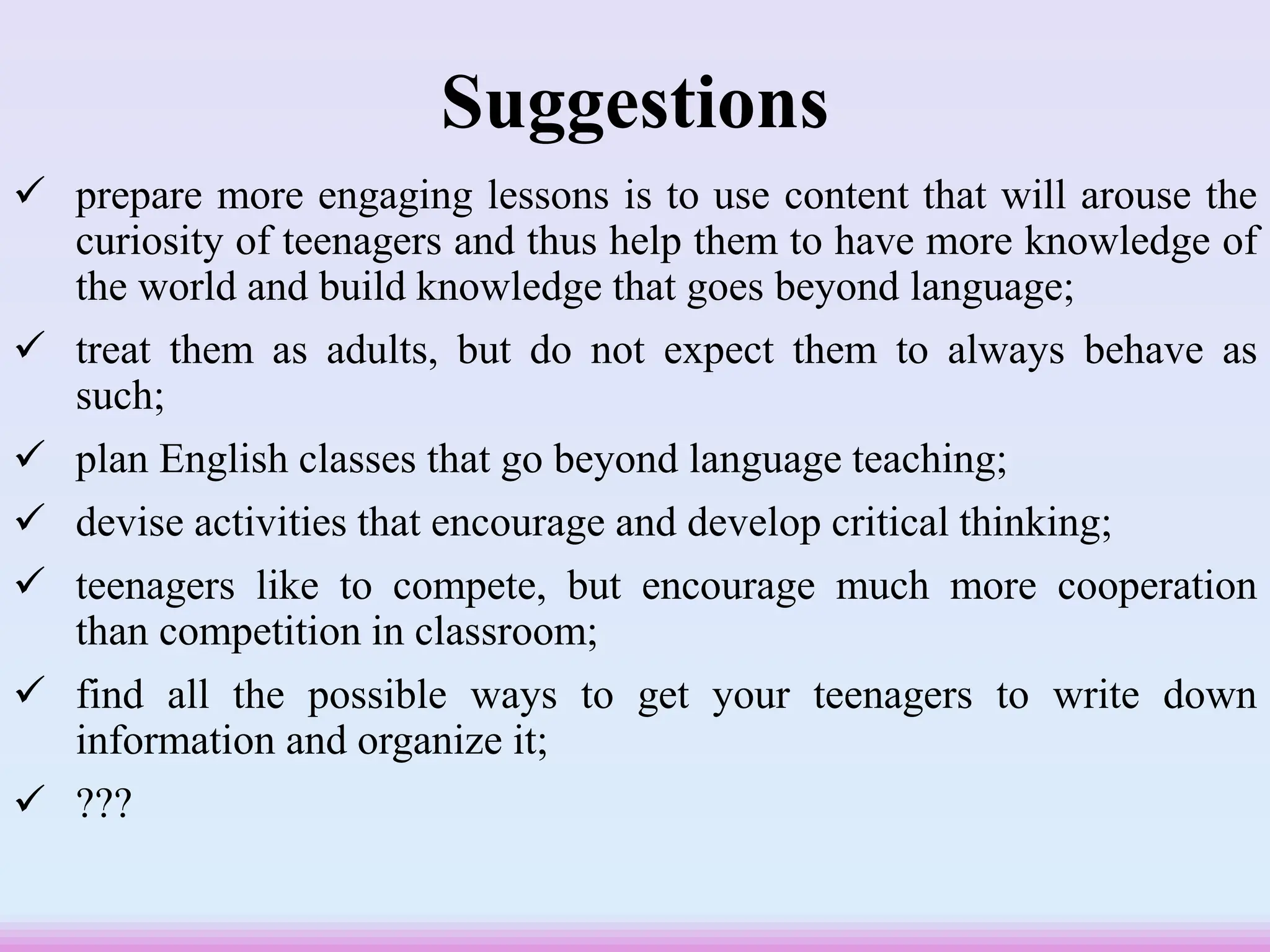
Suggestions
 prepare more engaging lessons is to use content that will arouse the
curiosity of teenagers and thus help them to have more knowledge of
the world and build knowledge that goes beyond language;
 treat them as adults, but do not expect them to always behave as
such;
 plan English classes that go beyond language teaching;
 devise activities that encourage and develop critical thinking;
 teenagers like to compete, but encourage much more cooperation
than competition in classroom;
 find all the possible ways to get your teenagers to write down
information and organize it;
 ???
“…teenage students are in fact
overall the best language learners”
(Harmer, 2001: 38).
Adults
The fact that there are important cognitive and
developmental differences between children and
adults does not by any means imply that language
should be presented devoid of any meaning as a
rigid set of rules and patterns which are essential to
master.
Adults as language learners
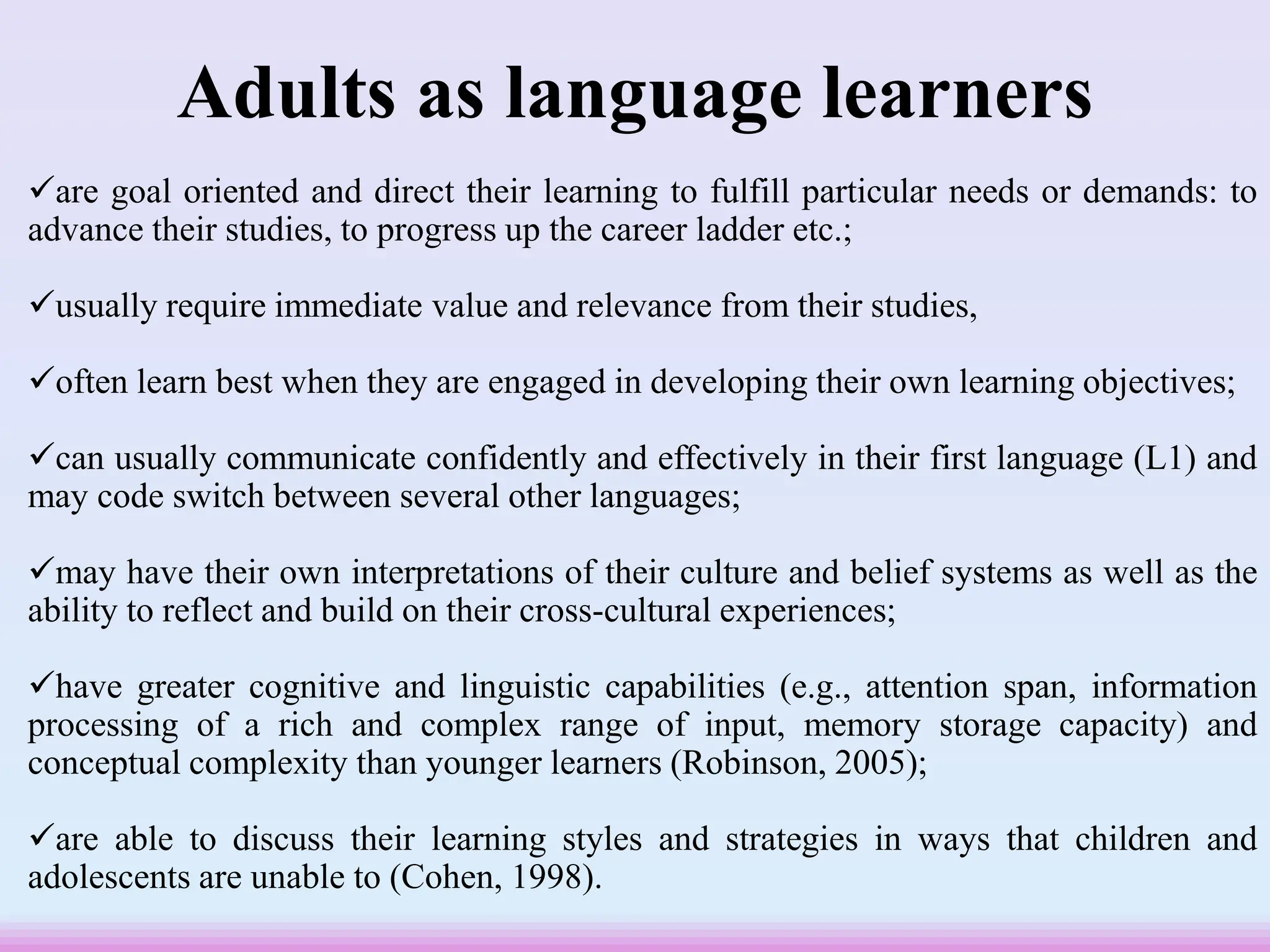
are goal oriented and direct their learning to fulfill particular needs or demands: to
advance their studies, to progress up the career ladder etc.;
usually require immediate value and relevance from their studies,
often learn best when they are engaged in developing their own learning objectives;
can usually communicate confidently and effectively in their first language (L1) and
may code switch between several other languages;
may have their own interpretations of their culture and belief systems as well as the
ability to reflect and build on their cross-cultural experiences;
have greater cognitive and linguistic capabilities (e.g., attention span, information
processing of a rich and complex range of input, memory storage capacity) and
conceptual complexity than younger learners (Robinson, 2005);
are able to discuss their learning styles and strategies in ways that children and
adolescents are unable to (Cohen, 1998).
Suggestions
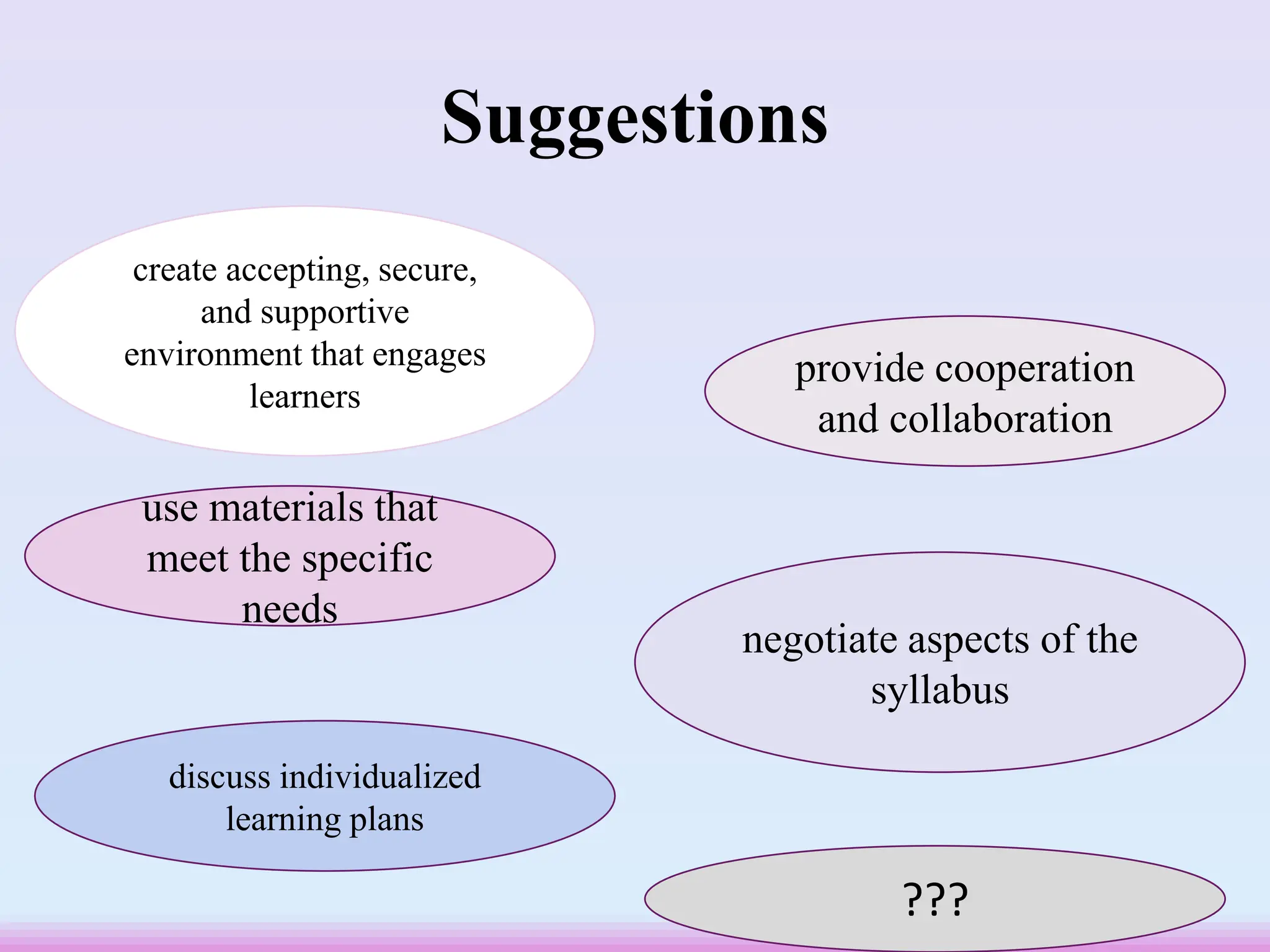
create accepting, secure,
and supportive
environment that engages
learners
provide cooperation
and collaboration
use materials that
meet the specific
needs
negotiate aspects of the
syllabus
discuss individualized
learning plans
???
Affective factors
SLA
biological
Mother
tongue
affective
factors
intelligence
Learning
environment
age
motivation
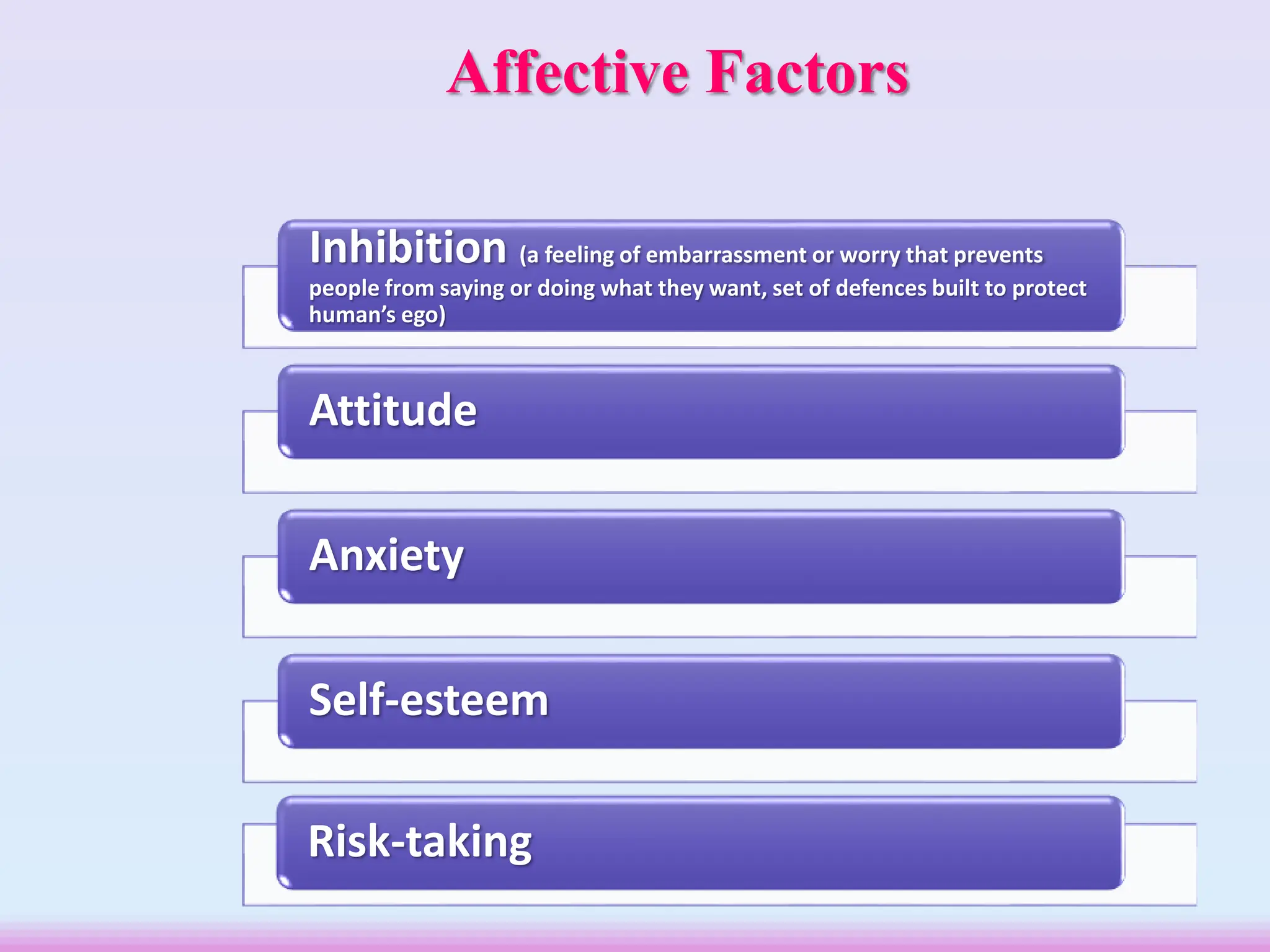
Inhibition (a feeling of embarrassment or worry that prevents
people from saying or doing what they want, set of defences built to protect
human’s ego)
Attitude
Anxiety
Self-esteem
Risk-taking
Affective Factors
Questions?
Topic 1.1. Age Factors and Affective Factors.ppt

Topic 1.1. Age Factors and Affective Factors.ppt

  • 1.
    Topic 1 Factors affectingSecond Language Acquisition Part 1
  • 3.
    Guided learning hours A2180-200 B1 350-400 B2 500-600 C1 700-800 C2 1000-1200
  • 4.
    Factors that influenceSecond Language Acquisition (SLA) SLA biological mother tongue affective factors intelligence learning environment age motivation
  • 5.
  • 6.
    Psychological factors Socialfactors Intellectual Memory Motor Skills* Natural situation* Social situation* Inductive * Explicative * Children under 7 high low high high high low 7-12 high medium Med/high Med/high medium medium Over 12 high high medium low low high * Inductive – learning rules by self-discovery; * explicative – rules and structures are explained to a learner; * motor skills – ability for new articulation; * natural situation – a LII is experienced in the situation that is similar to that in which the second language is learned; * social – LII is learned in classroom (Steinberg & Sciarini, 2006:127)
  • 7.
    Induction (learning rules by self- discovery) Wecan see that this ability remains at a relatively high level with age, except with certain individuals in old age. Such an ability allows us to make new discoveries in our everyday life, even to the extent of being able to analyze the syntactic structures of a second language. Explication (rules and structures are explained to a learner) We see that this ability increases with age.
  • 8.
    Memory This is anability in which very young children are High. Such an ability, though, declines with age and a Medium/ High value is assigned for ages 7 to 12 and a Medium value for people over 12. One might want to assign a lower value to adults because of the great age range involved. Certainly we would expect a difference in the memory ability of teenagers (13 to 19 years) as compared to people in their thirties or forties (Steinberg & Sciarini, 2006)
  • 9.
    Motor Skills The tableindicates a general decline from a High for young children to Low for adults. These data reflect what research indicates about pronunciation proficiency. It is difficult for most adults to achieve native-speaker pronunciation.
  • 10.
    In the naturalsituation of second-language learning, young children will do better than adults, with older children doing better than adults too. In the classroom situation, older children will do best. Adults will do better than young children to the extent that the young children’s classroom is not a simulation of the natural situation. (Steinberg & Sciarini, 2006:127)
  • 11.
    Teenagers and adultlearners learn at a faster pace (cognitive maturity)
  • 12.
    Teenagers as languagelearners Cognitive development Emotional development  begin to comprehend the abstract things,  develop their language skills, as well as verbalization, which permits for communicating in a more extensive way;  adolescents have an ability to consider situations logically, taking into account their cause and effect concepts and use symbols through the means of broad imagination (Piaget (1950)  are going through so called “emotional storm”;  are in search for personal identity;  may demonstrate aggressive behaviors and some discipline problems. are in need of activities that meet their needs and learning expectations; may become disruptive when they lose interest in the lesson or feel bored; need help and support from the teacher and to be provided with constructive feedback; can draw upon a variety of resources; need the teacher to build bridges between the syllabus and their world of interests and experiences; can learn abstract issues and do challenging activities; their energy is moved into action through meaningful involvement with current content.
  • 13.
    Suggestions  prepare moreengaging lessons is to use content that will arouse the curiosity of teenagers and thus help them to have more knowledge of the world and build knowledge that goes beyond language;  treat them as adults, but do not expect them to always behave as such;  plan English classes that go beyond language teaching;  devise activities that encourage and develop critical thinking;  teenagers like to compete, but encourage much more cooperation than competition in classroom;  find all the possible ways to get your teenagers to write down information and organize it;  ???
  • 14.
    “…teenage students arein fact overall the best language learners” (Harmer, 2001: 38).
  • 15.
    Adults The fact thatthere are important cognitive and developmental differences between children and adults does not by any means imply that language should be presented devoid of any meaning as a rigid set of rules and patterns which are essential to master.
  • 16.
    Adults as languagelearners are goal oriented and direct their learning to fulfill particular needs or demands: to advance their studies, to progress up the career ladder etc.; usually require immediate value and relevance from their studies, often learn best when they are engaged in developing their own learning objectives; can usually communicate confidently and effectively in their first language (L1) and may code switch between several other languages; may have their own interpretations of their culture and belief systems as well as the ability to reflect and build on their cross-cultural experiences; have greater cognitive and linguistic capabilities (e.g., attention span, information processing of a rich and complex range of input, memory storage capacity) and conceptual complexity than younger learners (Robinson, 2005); are able to discuss their learning styles and strategies in ways that children and adolescents are unable to (Cohen, 1998).
  • 17.
    Suggestions create accepting, secure, andsupportive environment that engages learners provide cooperation and collaboration use materials that meet the specific needs negotiate aspects of the syllabus discuss individualized learning plans ???
  • 18.
  • 19.
    Inhibition (a feelingof embarrassment or worry that prevents people from saying or doing what they want, set of defences built to protect human’s ego) Attitude Anxiety Self-esteem Risk-taking Affective Factors
  • 20.