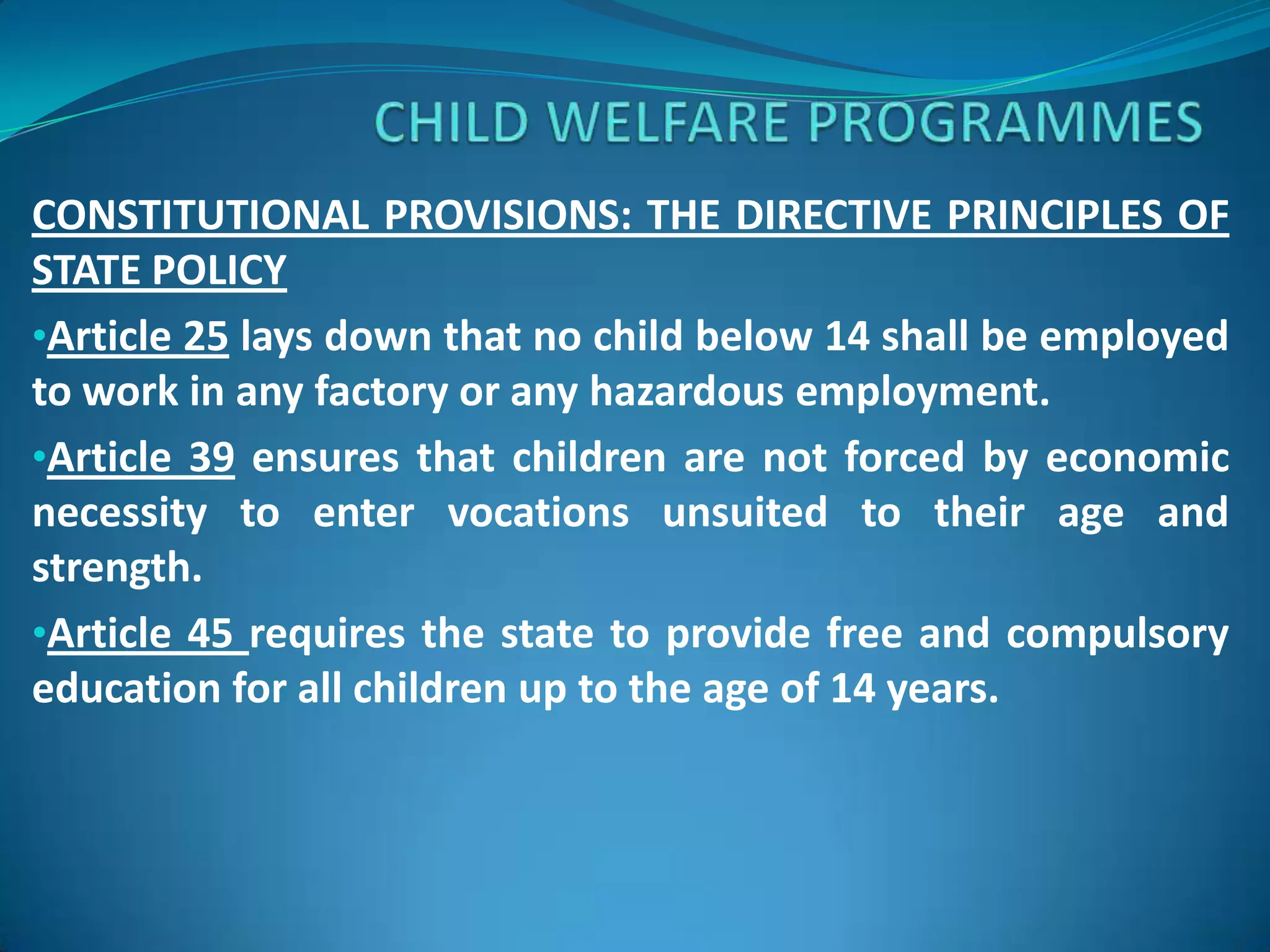
CONSTITUTIONAL PROVISIONS: THE DIRECTIVE PRINCIPLES OF
STATE POLICY
•Article 25 lays down that no child below 14 shall be employed
to work in any factory or any hazardous employment.
•Article 39 ensures that children are not forced by economic
necessity to enter vocations unsuited to their age and
strength.
•Article 45 requires the state to provide free and compulsory
education for all children up to the age of 14 years.
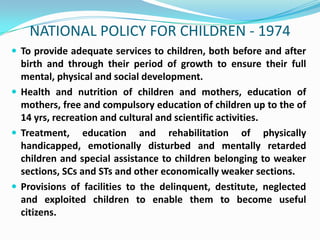
NATIONAL POLICY FOR CHILDREN - 1974
 To provide adequate services to children, both before and after

birth and through their period of growth to ensure their full
mental, physical and social development.
 Health and nutrition of children and mothers, education of
mothers, free and compulsory education of children up to the of
14 yrs, recreation and cultural and scientific activities.
 Treatment, education and rehabilitation of physically
handicapped, emotionally disturbed and mentally retarded
children and special assistance to children belonging to weaker
sections, SCs and STs and other economically weaker sections.
 Provisions of facilities to the delinquent, destitute, neglected
and exploited children to enable them to become useful
citizens.
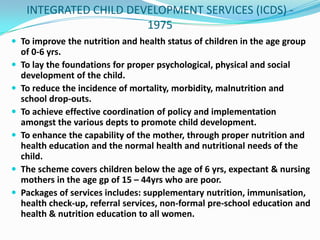
INTEGRATED CHILD DEVELOPMENT SERVICES (ICDS) 1975
 To improve the nutrition and health status of children in the age group










of 0-6 yrs.
To lay the foundations for proper psychological, physical and social
development of the child.
To reduce the incidence of mortality, morbidity, malnutrition and
school drop-outs.
To achieve effective coordination of policy and implementation
amongst the various depts to promote child development.
To enhance the capability of the mother, through proper nutrition and
health education and the normal health and nutritional needs of the
child.
The scheme covers children below the age of 6 yrs, expectant & nursing
mothers in the age gp of 15 – 44yrs who are poor.
Packages of services includes: supplementary nutrition, immunisation,
health check-up, referral services, non-formal pre-school education and
health & nutrition education to all women.
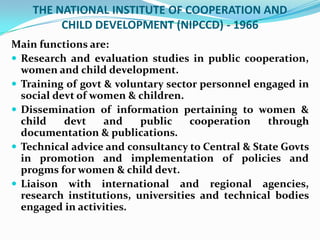
THE NATIONAL INSTITUTE OF COOPERATION AND
CHILD DEVELOPMENT (NIPCCD) - 1966
Main functions are:
 Research and evaluation studies in public cooperation,
women and child development.
 Training of govt & voluntary sector personnel engaged in
social devt of women & children.
 Dissemination of information pertaining to women &
child
devt
and
public
cooperation
through
documentation & publications.
 Technical advice and consultancy to Central & State Govts
in promotion and implementation of policies and
progms for women & child devt.
 Liaison with international and regional agencies,
research institutions, universities and technical bodies
engaged in activities.
WOMEN WELFARE PROGRAMMES
LEGAL PROVISIONS:
 The Pre-natal Diagnostic Techniques (Regulation
and Prevention of Misuse) Act 1994.
 The Equal Remuneration Act 1976.
 The Hindu marriage Act 1955 & The Special
Marriage Act1956.
 The Dowry Prohibition Act 1961.
 The Maternity Benefit Act 1961.
DEPARTMENT OF WOMEN & CHILD DEVT
 Hostels for working women.

 Employment and income generating production
progm – 1982-83.
 Short stay homes for women and girls.
 Support to training and employment progm for
women.
 National Commission on women.
HEALTH AND FAMILY WELFARE
 National surveillance Progm for Communicable Diseases










– 1997-98.
National Anti Malaria Programme.
AIDS Control Programme.
National TB Control Programme.
Active Programme for Control of Blindness – 2002-07.
National Cancer Control Programme.
National Mental Health Programme – 1982.
Prohibition of smoking in public places.
Prohibition of advertisement of cigarette and other
tobacco products.
Prohibition of sale of cigarette and other tobacco
products to a person below the age of 18 yrs.

Child welfare programme

  • 1.
    CONSTITUTIONAL PROVISIONS: THEDIRECTIVE PRINCIPLES OF STATE POLICY •Article 25 lays down that no child below 14 shall be employed to work in any factory or any hazardous employment. •Article 39 ensures that children are not forced by economic necessity to enter vocations unsuited to their age and strength. •Article 45 requires the state to provide free and compulsory education for all children up to the age of 14 years.
  • 2.
    NATIONAL POLICY FORCHILDREN - 1974  To provide adequate services to children, both before and after birth and through their period of growth to ensure their full mental, physical and social development.  Health and nutrition of children and mothers, education of mothers, free and compulsory education of children up to the of 14 yrs, recreation and cultural and scientific activities.  Treatment, education and rehabilitation of physically handicapped, emotionally disturbed and mentally retarded children and special assistance to children belonging to weaker sections, SCs and STs and other economically weaker sections.  Provisions of facilities to the delinquent, destitute, neglected and exploited children to enable them to become useful citizens.
  • 3.
    INTEGRATED CHILD DEVELOPMENTSERVICES (ICDS) 1975  To improve the nutrition and health status of children in the age group       of 0-6 yrs. To lay the foundations for proper psychological, physical and social development of the child. To reduce the incidence of mortality, morbidity, malnutrition and school drop-outs. To achieve effective coordination of policy and implementation amongst the various depts to promote child development. To enhance the capability of the mother, through proper nutrition and health education and the normal health and nutritional needs of the child. The scheme covers children below the age of 6 yrs, expectant & nursing mothers in the age gp of 15 – 44yrs who are poor. Packages of services includes: supplementary nutrition, immunisation, health check-up, referral services, non-formal pre-school education and health & nutrition education to all women.
  • 4.
    THE NATIONAL INSTITUTEOF COOPERATION AND CHILD DEVELOPMENT (NIPCCD) - 1966 Main functions are:  Research and evaluation studies in public cooperation, women and child development.  Training of govt & voluntary sector personnel engaged in social devt of women & children.  Dissemination of information pertaining to women & child devt and public cooperation through documentation & publications.  Technical advice and consultancy to Central & State Govts in promotion and implementation of policies and progms for women & child devt.  Liaison with international and regional agencies, research institutions, universities and technical bodies engaged in activities.
  • 5.
    WOMEN WELFARE PROGRAMMES LEGALPROVISIONS:  The Pre-natal Diagnostic Techniques (Regulation and Prevention of Misuse) Act 1994.  The Equal Remuneration Act 1976.  The Hindu marriage Act 1955 & The Special Marriage Act1956.  The Dowry Prohibition Act 1961.  The Maternity Benefit Act 1961.
  • 6.
    DEPARTMENT OF WOMEN& CHILD DEVT  Hostels for working women.  Employment and income generating production progm – 1982-83.  Short stay homes for women and girls.  Support to training and employment progm for women.  National Commission on women.
  • 7.
    HEALTH AND FAMILYWELFARE  National surveillance Progm for Communicable Diseases          – 1997-98. National Anti Malaria Programme. AIDS Control Programme. National TB Control Programme. Active Programme for Control of Blindness – 2002-07. National Cancer Control Programme. National Mental Health Programme – 1982. Prohibition of smoking in public places. Prohibition of advertisement of cigarette and other tobacco products. Prohibition of sale of cigarette and other tobacco products to a person below the age of 18 yrs.