Social problems
 Definition: A social problem is any deviant behaviour
in a disapproved direction of such a degree that it
exceeds the tolerance limit of the community
Social problem: Criteria
Types of
Social
problems
Economic
Poverty
Unemployment
Dependency
Biological
Diseases
Disabilities
Psychological
Neurosis
Psychosis
Suicide
Alcoholism
Epilepsy
Cultural
Problems of Aged
Homelessness
Crime
Juvenile
delinquency
POVERTY
 Poverty – The insufficient supply of those things
which are requisite for an individual to maintain
himself and those dependent upon him in health
&vigour(Goddard JG)
 Man is rich or poor according to the degree in which
he can afford to enjoy the necessaries, the
conveniences & amusements of life
-Adam Smith
Types & Causes
 Types-Urban & Rural
 Rural poverty- high population growth, unequal
distribution of wealth, large families, caste system
 Urban poverty-improper training, slow job growth
 Other causes- illiteracy, epidemics, laziness,
physical health problems
 By Gillin- incapacity of individual, unfavorable
physical conditions, unequal distribution of
wealth & income
 By Marx-Exploitation of workers by capitalists
 By Henry George- personal ownership, monopoly
of the individual
Steps to control poverty
Steps taken by Government:
For Rural:
1. Small farmers development programme
2. Drought area development programme
3. Minimum needs programme
4. National Rural employment programme
5. Assurance on employment
For Urban:
1. Nehru Rozgar Yojna
2. Prime Minister Rozgar Yojna
3. Urban Basic Services For The Poor Programme
4. National Social Assistance Programme
Emphasis should be on educating the people related to causes of poverty,
how to improvise and eradicate habits which hinder growth
Housing
 Building where people live
 Physical structure which provides protection against
storm, lightning, snowfall, rain, etc
 Housing standards vary by area, country, due to factors
such as culture, traditions, & climate
 Other factors- income of family, size of family, living
standards & education of individual and family
Family health survey (2001)carried out by Indian
Government found that only 19% of rural live in pucca
houses , remaining live in semi-pucca, kacha house
with mud walls & thatched roofs
Interventions under National Housing policy
 Promoting savings & investments in housing
 Creating an environment conducive to investment in
housing for rental purpose
 Making available standardised building materials and
component at reasonable prices
 Improving & upgrading construction skills
LITERACY
 Literacy in India is key for socio-economic progress
 India’s effective literacy rate has recorded a 9.2 per cent rise to reach 74.04 per
cent in 2011
 Literacy rate improved among females as compared to males. Males is 82.14
%(rise of 6.9%), females is 65.46%, (rise of11.8 %)
 Kerala is the most literate state in India, with 93.9% literacy, followed closely
by Lakshadweep at 92.28%.
 Bihar is the least literate state in India with 63.82% literacy, followed by
Arunachal Pradesh at 66.95.
 Haryana has the lowest female literacy rate in India.
Illiteracy
 Illiteracy means the inability to read and write
 Leads to the problem of child labour, female foeticide,
& growth of population
 Ignorance –person loses opportunity to know about
the various schemes of government
 Causes – poverty, unemployment, lack of awareness
about means of education
Measures to eradicate illiteracy
 University Education Commission-1948-49- use of mother tongue as
the medium of instruction
 Education policy-1968-uniform pattern: 10+2+3 education all over the
country
 1991- Professor Dave’s Education Commission- minimum level of
learning(MLL) to improve primary education
 National education policy-1992 –Op Blackboard to provide basic
facilities in schools
 National education policy-1986- compulsory primary education to
reduce dropouts
 National literacy mission-importance to adult education
 SSA-2003 elementary education by community ownership of schools
 1990- UNO – International Literacy year, 8th Sep world literacy day
Prostitution
 Serious problem in India
 Causes – poverty, unemployment, lack of proper
reintegration services, lack of options, stigma &
adverse social attitudes, family expectations &
pressure, acclimation to lifestyle
 Due to necessity-after breakup of marriage, being
disowned or thrown out of homes by their families
Elimination of prostitution
 Changing social set-up- which would respect women’s
identity as human being
 Education
 Economic independence
 Laws dealing with status of sex workers- “The Immoral
Traffic (Suppression) Act-1956 –SITA- law forbids a sex
worker to carry on her profession
 The Immoral Traffic (Prevention) Act-PITA
Rights of Women & Children
Introduction
 Both are linked to each other
 Government is committed to children’s and women’s
rights according to constitution
 Situation of India’s women and children- marked by
persistent disparities, two centuries of colonialisation,
centuries of rigid caste system
Rights of children
 Declaration of Geneva-given by League of Nations-1924
1. Child must be given means needed for its normal
development, both materially & spiritually
2. Hungry child should be fed, sick child should be helped,
erring child should be reclaimed(win back from vice),
orphans & homeless child should be sheltered
3. Child must be first to receive relief in times of distress
4. Child must be put in a position to earn a livelihood & must
be protected against every form of exploitation
5. Child must be brought up in the consciousness that its best
qualities are to be used in the service of its fellowmen
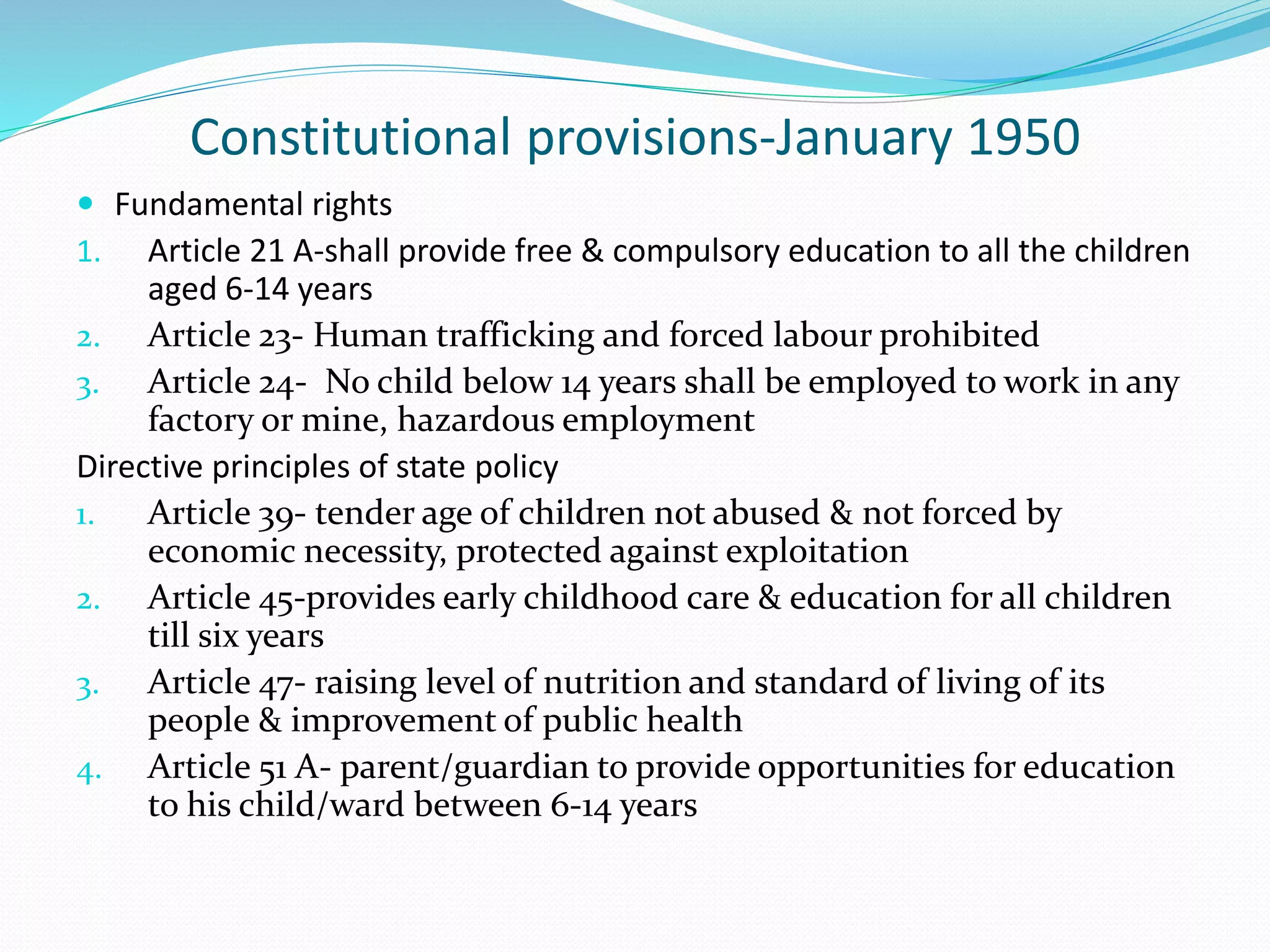
Constitutional provisions-January 1950
 Fundamental rights
1. Article 21 A-shall provide free & compulsory education to all the children
aged 6-14 years
2. Article 23- Human trafficking and forced labour prohibited
3. Article 24- No child below 14 years shall be employed to work in any
factory or mine, hazardous employment
Directive principles of state policy
1. Article 39- tender age of children not abused & not forced by
economic necessity, protected against exploitation
2. Article 45-provides early childhood care & education for all children
till six years
3. Article 47- raising level of nutrition and standard of living of its
people & improvement of public health
4. Article 51 A- parent/guardian to provide opportunities for education
to his child/ward between 6-14 years
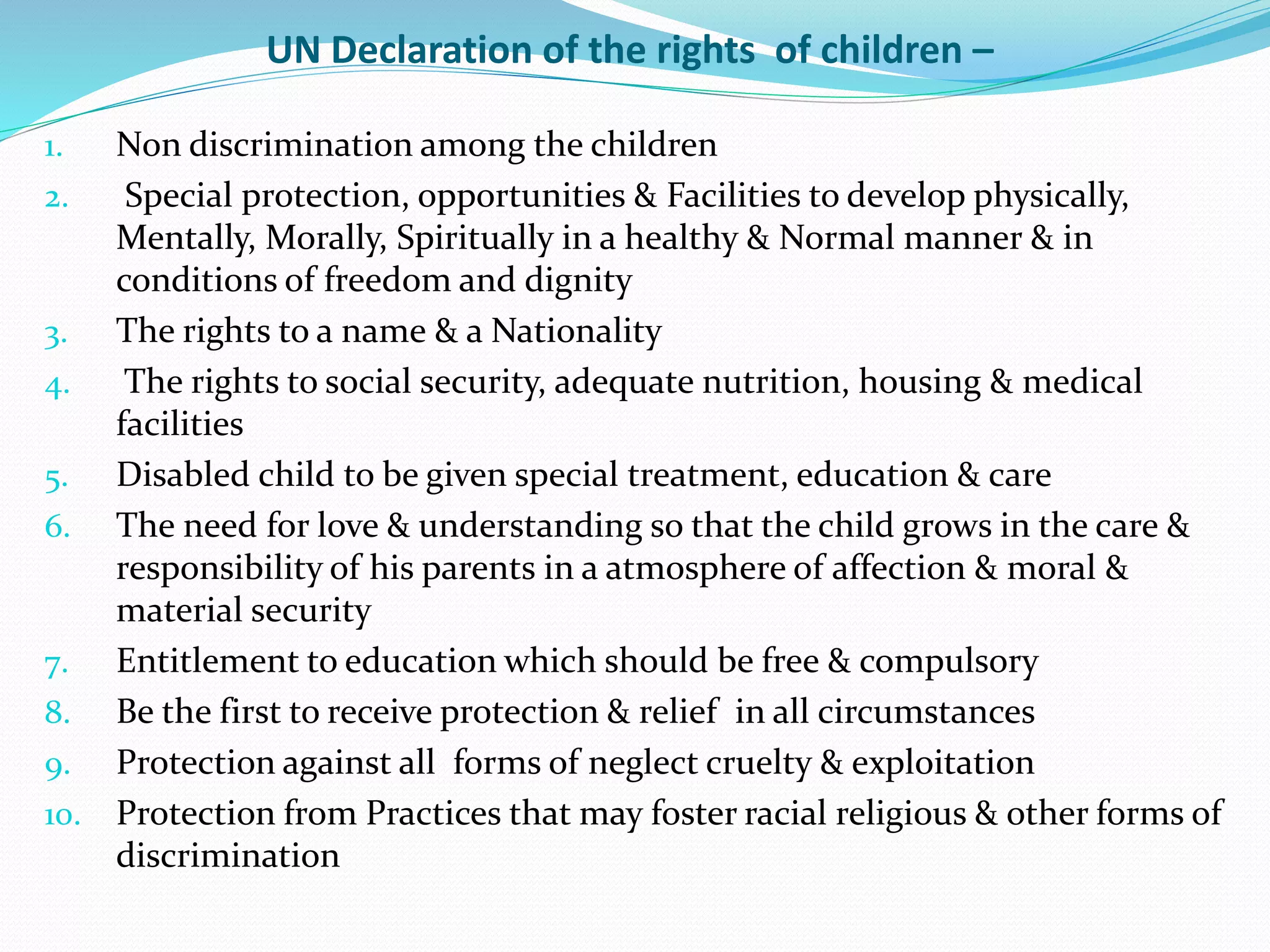
UN Declaration of the rights of children –
1. Non discrimination among the children
2. Special protection, opportunities & Facilities to develop physically,
Mentally, Morally, Spiritually in a healthy & Normal manner & in
conditions of freedom and dignity
3. The rights to a name & a Nationality
4. The rights to social security, adequate nutrition, housing & medical
facilities
5. Disabled child to be given special treatment, education & care
6. The need for love & understanding so that the child grows in the care &
responsibility of his parents in a atmosphere of affection & moral &
material security
7. Entitlement to education which should be free & compulsory
8. Be the first to receive protection & relief in all circumstances
9. Protection against all forms of neglect cruelty & exploitation
10. Protection from Practices that may foster racial religious & other forms of
discrimination
Govt. Health Programs
 First Five year Plan ( 1951 – 1956 )
Health, nutrition, & education were considered special
areas of concern
 Second Five year Plan-1956-61
In 1956-SITA, schemes & programmes for destitutes and
delinquents under the Childrens act 1960.
 Third Five Year plan 1961 to 1966- increased
emphasis on intersectoral co-ordination of services for
children
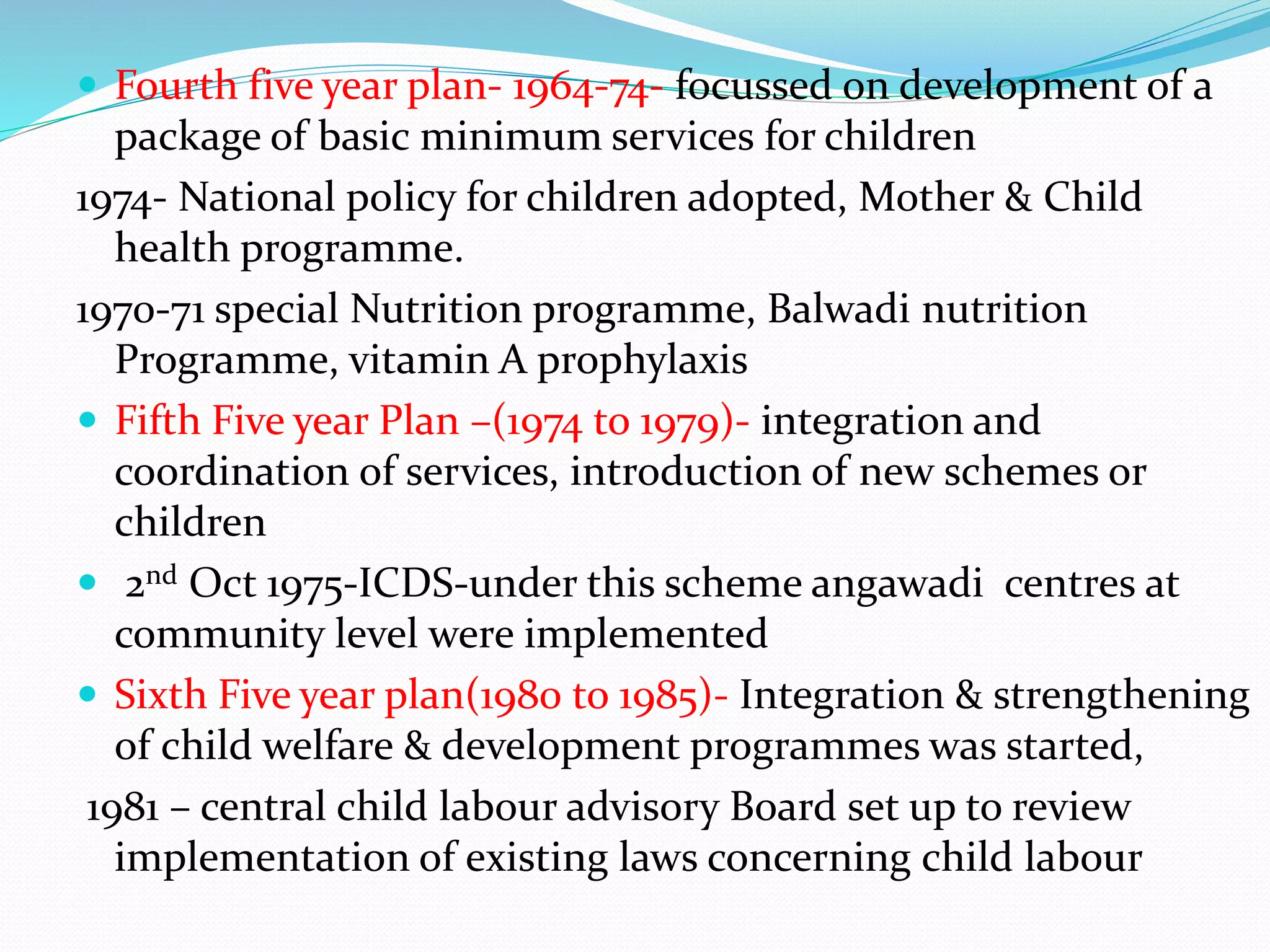
 Fourth five year plan- 1964-74- focussed on development of a
package of basic minimum services for children
1974- National policy for children adopted, Mother & Child
health programme.
1970-71 special Nutrition programme, Balwadi nutrition
Programme, vitamin A prophylaxis
 Fifth Five year Plan –(1974 to 1979)- integration and
coordination of services, introduction of new schemes or
children
 2nd Oct 1975-ICDS-under this scheme angawadi centres at
community level were implemented
 Sixth Five year plan(1980 to 1985)- Integration & strengthening
of child welfare & development programmes was started,
1981 – central child labour advisory Board set up to review
implementation of existing laws concerning child labour
 1982 – early childhood education to reduce
dropouts, national health policy was formulated
 Seventh Five year plan 1985-90
Sep 1985-separate dept of women & child
development was setup in Ministry of Human
Resource Development,
2006-independent Ministry of Women & Child
Development
1986 –Juvenile justice act was implemented, GOI
enacted the Child labour(prohibition and
regulation Act 1986
1987 – National Policy on child labour announced
 Eighth Five Year Plan 1992 – 1997 – Emphasis on Survival
& development of Children
1993 – 1994 – National Creche Fund was set up to meet the
growing demand for creches
Efforts towards tackling the problems of social deviance,
juvenile delinquency, & juvenile crime through
preventive, correctional, & rehabilitated services
1992-Child survival & Safe Motherhood Program(CSSM)
1993 – National Nutrition Policy to combat malnutrition
1995- Pulse Polio immunisation program, emphasis on
development of girl child
 Ninth Five year plan 1997 to 2002 –
1997- Balika Samridhi Yojana was launched to ensure all
female children go to schools living below poverty line.
1998 – GOI-Plan of action to combat trafficking &
commercial sexual exploitation of women & children
2001 – National commission for children to safeguard the
rights of children,
2001-2002- Sarva Shiksha Abhiyan with aim of providing
elementary education to all children of 6-14 yrs by 2010
 Tenth five year plan-2002-2007
1994- Prenatal Diagnostic Technique Act
2002-National Nutrition Mission was set up to reduce
/eliminate macro & micro nutrient deficiencies in the
country
2003- (Prohibition of sex selection) Preconception & prenatal
diagnostic technique act,
Focus on health education & Nutrition of deprived groups
New approach –goal of universalisation of elementary
education
Welfare for Children & Women
 1954- creation of Balwadis & Mahila mandals in rural
areas to reach women & children
 Special programmes to meet needs of delinquents,
destitutes, handicapped & other groups of children
 1983- Central Social Welfare Board-assisting voluntary
Agencies in organising welfare programmes for children,
women, & handicapped
Vulnerable groups

Social problem

  • 2.
    Social problems  Definition:A social problem is any deviant behaviour in a disapproved direction of such a degree that it exceeds the tolerance limit of the community
  • 3.
  • 4.
  • 5.
    POVERTY  Poverty –The insufficient supply of those things which are requisite for an individual to maintain himself and those dependent upon him in health &vigour(Goddard JG)  Man is rich or poor according to the degree in which he can afford to enjoy the necessaries, the conveniences & amusements of life -Adam Smith
  • 6.
    Types & Causes Types-Urban & Rural  Rural poverty- high population growth, unequal distribution of wealth, large families, caste system  Urban poverty-improper training, slow job growth  Other causes- illiteracy, epidemics, laziness, physical health problems  By Gillin- incapacity of individual, unfavorable physical conditions, unequal distribution of wealth & income  By Marx-Exploitation of workers by capitalists  By Henry George- personal ownership, monopoly of the individual
  • 7.
    Steps to controlpoverty Steps taken by Government: For Rural: 1. Small farmers development programme 2. Drought area development programme 3. Minimum needs programme 4. National Rural employment programme 5. Assurance on employment For Urban: 1. Nehru Rozgar Yojna 2. Prime Minister Rozgar Yojna 3. Urban Basic Services For The Poor Programme 4. National Social Assistance Programme Emphasis should be on educating the people related to causes of poverty, how to improvise and eradicate habits which hinder growth
  • 8.
    Housing  Building wherepeople live  Physical structure which provides protection against storm, lightning, snowfall, rain, etc  Housing standards vary by area, country, due to factors such as culture, traditions, & climate  Other factors- income of family, size of family, living standards & education of individual and family
  • 9.
    Family health survey(2001)carried out by Indian Government found that only 19% of rural live in pucca houses , remaining live in semi-pucca, kacha house with mud walls & thatched roofs Interventions under National Housing policy  Promoting savings & investments in housing  Creating an environment conducive to investment in housing for rental purpose  Making available standardised building materials and component at reasonable prices  Improving & upgrading construction skills
  • 10.
    LITERACY  Literacy inIndia is key for socio-economic progress  India’s effective literacy rate has recorded a 9.2 per cent rise to reach 74.04 per cent in 2011  Literacy rate improved among females as compared to males. Males is 82.14 %(rise of 6.9%), females is 65.46%, (rise of11.8 %)  Kerala is the most literate state in India, with 93.9% literacy, followed closely by Lakshadweep at 92.28%.  Bihar is the least literate state in India with 63.82% literacy, followed by Arunachal Pradesh at 66.95.  Haryana has the lowest female literacy rate in India.
  • 11.
    Illiteracy  Illiteracy meansthe inability to read and write  Leads to the problem of child labour, female foeticide, & growth of population  Ignorance –person loses opportunity to know about the various schemes of government  Causes – poverty, unemployment, lack of awareness about means of education
  • 12.
    Measures to eradicateilliteracy  University Education Commission-1948-49- use of mother tongue as the medium of instruction  Education policy-1968-uniform pattern: 10+2+3 education all over the country  1991- Professor Dave’s Education Commission- minimum level of learning(MLL) to improve primary education  National education policy-1992 –Op Blackboard to provide basic facilities in schools  National education policy-1986- compulsory primary education to reduce dropouts  National literacy mission-importance to adult education  SSA-2003 elementary education by community ownership of schools  1990- UNO – International Literacy year, 8th Sep world literacy day
  • 13.
    Prostitution  Serious problemin India  Causes – poverty, unemployment, lack of proper reintegration services, lack of options, stigma & adverse social attitudes, family expectations & pressure, acclimation to lifestyle  Due to necessity-after breakup of marriage, being disowned or thrown out of homes by their families
  • 14.
    Elimination of prostitution Changing social set-up- which would respect women’s identity as human being  Education  Economic independence  Laws dealing with status of sex workers- “The Immoral Traffic (Suppression) Act-1956 –SITA- law forbids a sex worker to carry on her profession  The Immoral Traffic (Prevention) Act-PITA
  • 15.
    Rights of Women& Children Introduction  Both are linked to each other  Government is committed to children’s and women’s rights according to constitution  Situation of India’s women and children- marked by persistent disparities, two centuries of colonialisation, centuries of rigid caste system
  • 16.
    Rights of children Declaration of Geneva-given by League of Nations-1924 1. Child must be given means needed for its normal development, both materially & spiritually 2. Hungry child should be fed, sick child should be helped, erring child should be reclaimed(win back from vice), orphans & homeless child should be sheltered 3. Child must be first to receive relief in times of distress 4. Child must be put in a position to earn a livelihood & must be protected against every form of exploitation 5. Child must be brought up in the consciousness that its best qualities are to be used in the service of its fellowmen
  • 17.
    Constitutional provisions-January 1950 Fundamental rights 1. Article 21 A-shall provide free & compulsory education to all the children aged 6-14 years 2. Article 23- Human trafficking and forced labour prohibited 3. Article 24- No child below 14 years shall be employed to work in any factory or mine, hazardous employment Directive principles of state policy 1. Article 39- tender age of children not abused & not forced by economic necessity, protected against exploitation 2. Article 45-provides early childhood care & education for all children till six years 3. Article 47- raising level of nutrition and standard of living of its people & improvement of public health 4. Article 51 A- parent/guardian to provide opportunities for education to his child/ward between 6-14 years
  • 18.
    UN Declaration ofthe rights of children – 1. Non discrimination among the children 2. Special protection, opportunities & Facilities to develop physically, Mentally, Morally, Spiritually in a healthy & Normal manner & in conditions of freedom and dignity 3. The rights to a name & a Nationality 4. The rights to social security, adequate nutrition, housing & medical facilities 5. Disabled child to be given special treatment, education & care 6. The need for love & understanding so that the child grows in the care & responsibility of his parents in a atmosphere of affection & moral & material security 7. Entitlement to education which should be free & compulsory 8. Be the first to receive protection & relief in all circumstances 9. Protection against all forms of neglect cruelty & exploitation 10. Protection from Practices that may foster racial religious & other forms of discrimination
  • 19.
    Govt. Health Programs First Five year Plan ( 1951 – 1956 ) Health, nutrition, & education were considered special areas of concern  Second Five year Plan-1956-61 In 1956-SITA, schemes & programmes for destitutes and delinquents under the Childrens act 1960.  Third Five Year plan 1961 to 1966- increased emphasis on intersectoral co-ordination of services for children
  • 20.
     Fourth fiveyear plan- 1964-74- focussed on development of a package of basic minimum services for children 1974- National policy for children adopted, Mother & Child health programme. 1970-71 special Nutrition programme, Balwadi nutrition Programme, vitamin A prophylaxis  Fifth Five year Plan –(1974 to 1979)- integration and coordination of services, introduction of new schemes or children  2nd Oct 1975-ICDS-under this scheme angawadi centres at community level were implemented  Sixth Five year plan(1980 to 1985)- Integration & strengthening of child welfare & development programmes was started, 1981 – central child labour advisory Board set up to review implementation of existing laws concerning child labour
  • 21.
     1982 –early childhood education to reduce dropouts, national health policy was formulated  Seventh Five year plan 1985-90 Sep 1985-separate dept of women & child development was setup in Ministry of Human Resource Development, 2006-independent Ministry of Women & Child Development 1986 –Juvenile justice act was implemented, GOI enacted the Child labour(prohibition and regulation Act 1986 1987 – National Policy on child labour announced
  • 22.
     Eighth FiveYear Plan 1992 – 1997 – Emphasis on Survival & development of Children 1993 – 1994 – National Creche Fund was set up to meet the growing demand for creches Efforts towards tackling the problems of social deviance, juvenile delinquency, & juvenile crime through preventive, correctional, & rehabilitated services 1992-Child survival & Safe Motherhood Program(CSSM) 1993 – National Nutrition Policy to combat malnutrition 1995- Pulse Polio immunisation program, emphasis on development of girl child  Ninth Five year plan 1997 to 2002 – 1997- Balika Samridhi Yojana was launched to ensure all female children go to schools living below poverty line.
  • 23.
    1998 – GOI-Planof action to combat trafficking & commercial sexual exploitation of women & children 2001 – National commission for children to safeguard the rights of children, 2001-2002- Sarva Shiksha Abhiyan with aim of providing elementary education to all children of 6-14 yrs by 2010  Tenth five year plan-2002-2007 1994- Prenatal Diagnostic Technique Act 2002-National Nutrition Mission was set up to reduce /eliminate macro & micro nutrient deficiencies in the country 2003- (Prohibition of sex selection) Preconception & prenatal diagnostic technique act, Focus on health education & Nutrition of deprived groups New approach –goal of universalisation of elementary education
  • 24.
    Welfare for Children& Women  1954- creation of Balwadis & Mahila mandals in rural areas to reach women & children  Special programmes to meet needs of delinquents, destitutes, handicapped & other groups of children  1983- Central Social Welfare Board-assisting voluntary Agencies in organising welfare programmes for children, women, & handicapped
  • 25.