Downloaded 78 times


![These are some of the factors that militate against the effective
abolition of child labour.[1] They are;
Poverty-Income insecurity with large families
Lack of Education-Access to education is limited
Immoral employers seeking low labour
Globalization-The quest to expand and acquire
investment encourages governments and corporations
to seek cheap labour.
[1] Free the Child, 'Child Labour’ <http://www.freethechildren.com/getinvolved/geteducated/childlabour.htm>
accessed on 27 October 2010
4](https://image.slidesharecdn.com/childlabourpowerpoint-101110113556-phpapp02/85/Child-labour-powerpoint-4-320.jpg)
![ Law problems[2]
◦ Lack of enforcement
◦ Violations
◦ Exemptions
[2] ‘Child Labour Public Education Project’
<http://www.continuetolearn.uiowa.edu/laborctr/child_labor/about/causes.html>
Existing laws are not being
enforced and where they are
violated, offenders are not
punished.
Some national laws
exempt agricultural
and domestic works.
Eg. Kenya prohibit
children under 16
from Industrial work
but not agriculture.
5](https://image.slidesharecdn.com/childlabourpowerpoint-101110113556-phpapp02/85/Child-labour-powerpoint-5-320.jpg)
![ Child Labour Regulations has recorded some
successes among which are:
o Education (Children out of School): 2002-115million 2007-101million.
[3]
o Number of child labourers globally is 28 million fewer now than it was in
2002.[4]
[3] The number of children out of school in 2007 has fallen compared to 2002. UNICEF <http://
www.unicef.org/rightsite/sowc/photopanelprogress.php
[4] As at the time of the report, child labourers has decreased unlike in 2002. IPEC, ‘Towards A World Without Child
Labour’ http://www.ilo.org/ipec/campaignandadvocacy/Globalchildlabourconference/lang--en/index.htm
6](https://image.slidesharecdn.com/childlabourpowerpoint-101110113556-phpapp02/85/Child-labour-powerpoint-6-320.jpg)
![7
but
there is still plenty work to be done in order to
achieve the objectives for which the regulations
were established:
o Fight against poverty should be intensified[5]
o Enforcement of existing Child Labour Legislations[6]
[5] IPEC, ‘Towards A World Without Child Labour’
http://www.ilo.org/ipec/campaignandadvocacy/Globalchildlabourconference/lang--
en/index.htm
[6] ‘Child Labour Public Education Project’
<http://www.continuetolearn.uiowa.edu/laborctr/child_labor/about/causes.html](https://image.slidesharecdn.com/childlabourpowerpoint-101110113556-phpapp02/85/Child-labour-powerpoint-7-320.jpg)

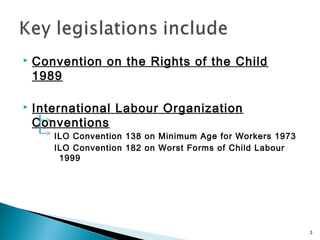
The document summarizes key international regulations governing the prohibition of child labour, including the ILO Convention 138 on minimum age, ILO Convention 182 on worst forms of child labour, and the UN Convention on the Rights of the Child. It also discusses factors that allow child labour to continue, such as poverty, lack of education, employers seeking cheap labour, and issues with enforcement of existing laws. While some progress has been made in reducing child labour and increasing school attendance, much work still needs to be done, including stronger enforcement of laws and further efforts to reduce poverty.


