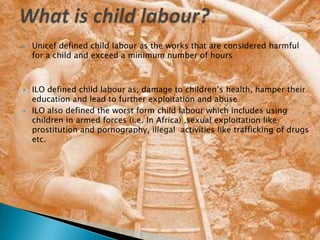
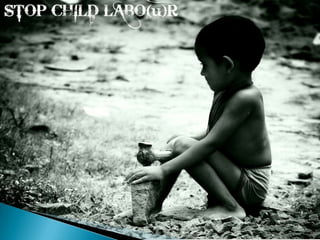
   Unicef defined child labour as the works that are considered harmful
    for a child and exceed a minimum number of hours


   ILO defined child labour as, damage to children’s health, hamper their
    education and lead to further exploitation and abuse
   ILO also defined the worst form child labour which includes using
    children in armed forces (i.e. In Africa) ,sexual exploitation like
    prostitution and pornography, illegal activities like trafficking of drugs
    etc.

    Over exploitation of population.
   Decrease of resources.
   Decrease in literacy.
   Increase of poverty.
   Increase of unemployment.
   Lack of schooling and daily care.
   Limited choices for women.
   The Child Labour (Prohibition and Regulation)
    Act, 1986:
   The Factories Act, 1948:
   The Mines Act, 1952
   The Juvenile Justice (Care and Protection) of
    Children Act, 2000
   The Minimum Wages Act, 1948
   The Right of Children to Free and Compulsory
    Education Act, 2009
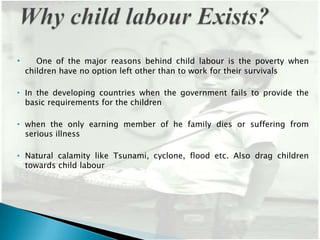
•      One of the major reasons behind child labour is the poverty when
    children have no option left other than to work for their survivals

• In the developing countries when the government fails to provide the
  basic requirements for the children

• when the only earning member of he family dies or suffering from
  serious illness

• Natural calamity like Tsunami, cyclone, flood etc. Also drag children
  towards child labour
The UN published the children’s rights in the Convention
 on the Rights of the Child, which was adopted in 1989.

   Article 32 stated that government need to recognise: the right of the child to
    be protected from economic exploitation, likely to interfere with the child’s
    education, or to be harmful to the child’s health or physical, mental, spiritual,
    moral or social development.


   Article 28 Every child’s right to education


   Article 34 Governments must protect children from sexual exploitation
    and abuse.
   European Union (EU) also decided in the meeting of council of Europe that
    the children rights should be protected in the EU policy and action.


   EU emphasises that Child Labour is a legal obligation based in international
    treaties and conventions like convention on the Rights of the Child and ILO
    convention 138 and 182.
   DRAWBACKS

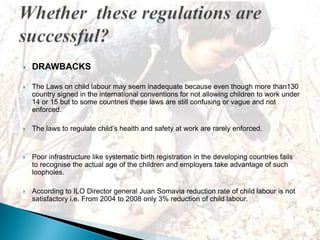
   The Laws on child labour may seem inadequate because even though more than130
    country signed in the international conventions for not allowing children to work under
    14 or 15 but to some countries these laws are still confusing or vague and not
    enforced.

   The laws to regulate child’s health and safety at work are rarely enforced.


   Poor infrastructure like systematic birth registration in the developing countries fails
    to recognise the actual age of the children and employers take advantage of such
    loopholes.

   According to ILO Director general Juan Somavia reduction rate of child labour is not
    satisfactory i.e. From 2004 to 2008 only 3% reduction of child labour.
Achievements

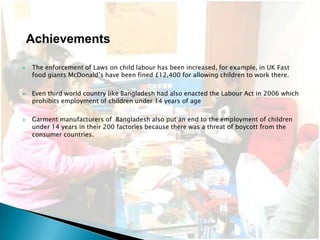
   The enforcement of Laws on child labour has been increased, for example, in UK Fast
    food giants McDonald’s have been fined £12,400 for allowing children to work there.

   Even third world country like Bangladesh had also enacted the Labour Act in 2006 which
    prohibits employment of children under 14 years of age

   Garment manufacturers of Bangladesh also put an end to the employment of children
    under 14 years in their 200 factories because there was a threat of boycott from the
    consumer countries.
What is the current
            situation?

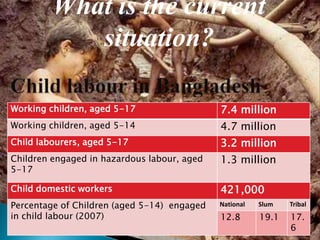
Working children, aged 5-17                  7.4 million
Working children, aged 5-14                  4.7 million
Child labourers, aged 5-17                   3.2 million
Children engaged in hazardous labour, aged   1.3 million
5-17

Child domestic workers                       421,000
Percentage of Children (aged 5-14) engaged   National   Slum   Tribal
in child labour (2007)                       12.8       19.1   17.
                                                               6
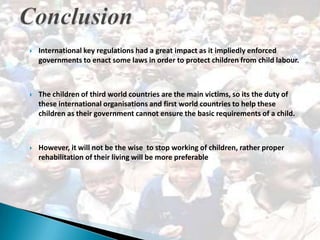
   International key regulations had a great impact as it impliedly enforced
    governments to enact some laws in order to protect children from child labour.


   The children of third world countries are the main victims, so its the duty of
    these international organisations and first world countries to help these
    children as their government cannot ensure the basic requirements of a child.


   However, it will not be the wise to stop working of children, rather proper
    rehabilitation of their living will be more preferable
Presentation on child labor

Presentation on child labor

  • 2.
    Unicef defined child labour as the works that are considered harmful for a child and exceed a minimum number of hours  ILO defined child labour as, damage to children’s health, hamper their education and lead to further exploitation and abuse  ILO also defined the worst form child labour which includes using children in armed forces (i.e. In Africa) ,sexual exploitation like prostitution and pornography, illegal activities like trafficking of drugs etc.
  • 3.
  • 4.
    Over exploitation of population.  Decrease of resources.  Decrease in literacy.  Increase of poverty.  Increase of unemployment.  Lack of schooling and daily care.  Limited choices for women.
  • 5.
    The Child Labour (Prohibition and Regulation) Act, 1986:  The Factories Act, 1948:  The Mines Act, 1952  The Juvenile Justice (Care and Protection) of Children Act, 2000  The Minimum Wages Act, 1948  The Right of Children to Free and Compulsory Education Act, 2009
  • 6.
    One of the major reasons behind child labour is the poverty when children have no option left other than to work for their survivals • In the developing countries when the government fails to provide the basic requirements for the children • when the only earning member of he family dies or suffering from serious illness • Natural calamity like Tsunami, cyclone, flood etc. Also drag children towards child labour
  • 7.
    The UN publishedthe children’s rights in the Convention on the Rights of the Child, which was adopted in 1989.  Article 32 stated that government need to recognise: the right of the child to be protected from economic exploitation, likely to interfere with the child’s education, or to be harmful to the child’s health or physical, mental, spiritual, moral or social development.  Article 28 Every child’s right to education  Article 34 Governments must protect children from sexual exploitation and abuse.
  • 8.
    European Union (EU) also decided in the meeting of council of Europe that the children rights should be protected in the EU policy and action.  EU emphasises that Child Labour is a legal obligation based in international treaties and conventions like convention on the Rights of the Child and ILO convention 138 and 182.
  • 9.
    DRAWBACKS  The Laws on child labour may seem inadequate because even though more than130 country signed in the international conventions for not allowing children to work under 14 or 15 but to some countries these laws are still confusing or vague and not enforced.  The laws to regulate child’s health and safety at work are rarely enforced.  Poor infrastructure like systematic birth registration in the developing countries fails to recognise the actual age of the children and employers take advantage of such loopholes.  According to ILO Director general Juan Somavia reduction rate of child labour is not satisfactory i.e. From 2004 to 2008 only 3% reduction of child labour.
  • 10.
    Achievements  The enforcement of Laws on child labour has been increased, for example, in UK Fast food giants McDonald’s have been fined £12,400 for allowing children to work there.  Even third world country like Bangladesh had also enacted the Labour Act in 2006 which prohibits employment of children under 14 years of age  Garment manufacturers of Bangladesh also put an end to the employment of children under 14 years in their 200 factories because there was a threat of boycott from the consumer countries.
  • 11.
    What is thecurrent situation? Working children, aged 5-17 7.4 million Working children, aged 5-14 4.7 million Child labourers, aged 5-17 3.2 million Children engaged in hazardous labour, aged 1.3 million 5-17 Child domestic workers 421,000 Percentage of Children (aged 5-14) engaged National Slum Tribal in child labour (2007) 12.8 19.1 17. 6
  • 13.
    International key regulations had a great impact as it impliedly enforced governments to enact some laws in order to protect children from child labour.  The children of third world countries are the main victims, so its the duty of these international organisations and first world countries to help these children as their government cannot ensure the basic requirements of a child.  However, it will not be the wise to stop working of children, rather proper rehabilitation of their living will be more preferable

Editor's Notes

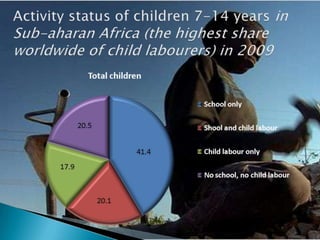
  • #13 The following graph plots the child labour and school attendance rates in 18 African countries38 per cent of all children engaged in work can be considered harmful to their development school attendance still tends to be low