Introduction
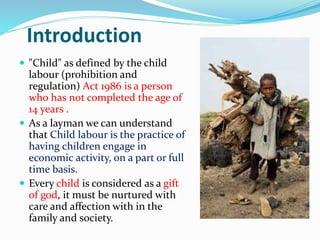
 "Child" as defined by the child
labour (prohibition and
regulation) Act 1986 is a person
who has not completed the age of
14 years .
 As a layman we can understand
that Child labour is the practice of
having children engage in
economic activity, on a part or full
time basis.
 Every child is considered as a gift
of god, it must be nurtured with
care and affection with in the
family and society.
 But unfortunately due to the socio
economic problems children were
forced to work in industries,
leather factories, hotels and
eatery.
 The child labour is not an isolated
phenomenon it is coupled with
socio economic problem of the
society so in order to eliminate
child labour first we should focus
on socio economic issues of the
society.
 It is in the hands of
administrative .It should bring
effective measures to eliminate
child labour
Causes of Child Labour
Rights of Children Under International Law
 Universal declaration of human
rights 1948 - stipulates under article
25 para 2 that childhood is entitled
to special care and assistance.
 The above principles along with
other principles of universal
declaration concerning child were
incorporated in the declaration of
the rights of the child of 1959.
 International covenant on civil and
political rights under articles 23 and
24 and international covenant on
economic, social and cultural rights
- under article 10 made provision for
the care of the child .
Rights of Children Under National Laws
 India has also taken effective measure under national level.
In order to eliminate child labour,
 India has brought constitutional, statutory development
measures.
 The Indian constitution has consciously incorporated
provisions to secure compulsory elementary education as
well as the labour protection for the children.
 Labour commission in India have gone into the problems
of child labour and have made extensive recommendations.
The constitution of India, too provides certain rights to
children and prohibits child labour
Acts
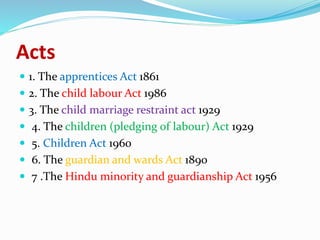
 1. The apprentices Act 1861
 2. The child labour Act 1986
 3. The child marriage restraint act 1929
 4. The children (pledging of labour) Act 1929
 5. Children Act 1960
 6. The guardian and wards Act 1890
 7 .The Hindu minority and guardianship Act 1956
Current Scenerio of Child Labour
 India is one of the leading countries in Asia has a 33
million children employed in various forms of child
labour .It is shocking that world's largest democracy is
yet to ratify the Minimum age convention 1973 (No
138) of the International labour organisation (ILO)
that lays down ground rules for employment of minors
across the globe.
 world day against child labour on June 12 is an ILO
sanctioned holiday first launched in 2002 with the
objective to raise awareness and activism to prevent
child labour under the above convention .An
estimated 150 million children are involved in child
labour worldwide as per UNICEF data.
Remedies
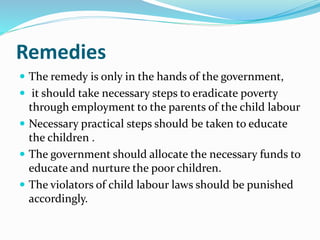
 The remedy is only in the hands of the government,
 it should take necessary steps to eradicate poverty
through employment to the parents of the child labour
 Necessary practical steps should be taken to educate
the children .
 The government should allocate the necessary funds to
educate and nurture the poor children.
 The violators of child labour laws should be punished
accordingly.
Conclusion:
 There are many laws and regulatory departments for
child labour, yet it is ineffective in controlling ongoing
child labour.
 This is possible only when there is a cooperation of all
the sections of the society and the law enforcement
agencies and by removing or minimizing the causes of
child labour.
 The main thrust should be on controlling the
population of the country, education of the children
and providing sufficient funds for its removal from the
gross domestic product of India.
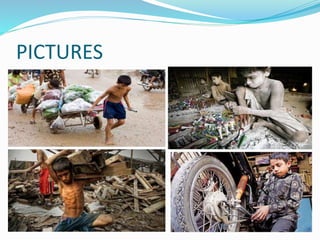
PICTURES
Newspaperclippings
Child labour

Child labour

  • 2.
    Introduction  "Child" asdefined by the child labour (prohibition and regulation) Act 1986 is a person who has not completed the age of 14 years .  As a layman we can understand that Child labour is the practice of having children engage in economic activity, on a part or full time basis.  Every child is considered as a gift of god, it must be nurtured with care and affection with in the family and society.
  • 3.
     But unfortunatelydue to the socio economic problems children were forced to work in industries, leather factories, hotels and eatery.  The child labour is not an isolated phenomenon it is coupled with socio economic problem of the society so in order to eliminate child labour first we should focus on socio economic issues of the society.  It is in the hands of administrative .It should bring effective measures to eliminate child labour
  • 4.
  • 5.
    Rights of ChildrenUnder International Law  Universal declaration of human rights 1948 - stipulates under article 25 para 2 that childhood is entitled to special care and assistance.  The above principles along with other principles of universal declaration concerning child were incorporated in the declaration of the rights of the child of 1959.  International covenant on civil and political rights under articles 23 and 24 and international covenant on economic, social and cultural rights - under article 10 made provision for the care of the child .
  • 6.
    Rights of ChildrenUnder National Laws  India has also taken effective measure under national level. In order to eliminate child labour,  India has brought constitutional, statutory development measures.  The Indian constitution has consciously incorporated provisions to secure compulsory elementary education as well as the labour protection for the children.  Labour commission in India have gone into the problems of child labour and have made extensive recommendations. The constitution of India, too provides certain rights to children and prohibits child labour
  • 7.
    Acts  1. Theapprentices Act 1861  2. The child labour Act 1986  3. The child marriage restraint act 1929  4. The children (pledging of labour) Act 1929  5. Children Act 1960  6. The guardian and wards Act 1890  7 .The Hindu minority and guardianship Act 1956
  • 8.
    Current Scenerio ofChild Labour  India is one of the leading countries in Asia has a 33 million children employed in various forms of child labour .It is shocking that world's largest democracy is yet to ratify the Minimum age convention 1973 (No 138) of the International labour organisation (ILO) that lays down ground rules for employment of minors across the globe.  world day against child labour on June 12 is an ILO sanctioned holiday first launched in 2002 with the objective to raise awareness and activism to prevent child labour under the above convention .An estimated 150 million children are involved in child labour worldwide as per UNICEF data.
  • 9.
    Remedies  The remedyis only in the hands of the government,  it should take necessary steps to eradicate poverty through employment to the parents of the child labour  Necessary practical steps should be taken to educate the children .  The government should allocate the necessary funds to educate and nurture the poor children.  The violators of child labour laws should be punished accordingly.
  • 10.
    Conclusion:  There aremany laws and regulatory departments for child labour, yet it is ineffective in controlling ongoing child labour.  This is possible only when there is a cooperation of all the sections of the society and the law enforcement agencies and by removing or minimizing the causes of child labour.  The main thrust should be on controlling the population of the country, education of the children and providing sufficient funds for its removal from the gross domestic product of India.
  • 11.
  • 12.