12/2/2013
ANALYSIS
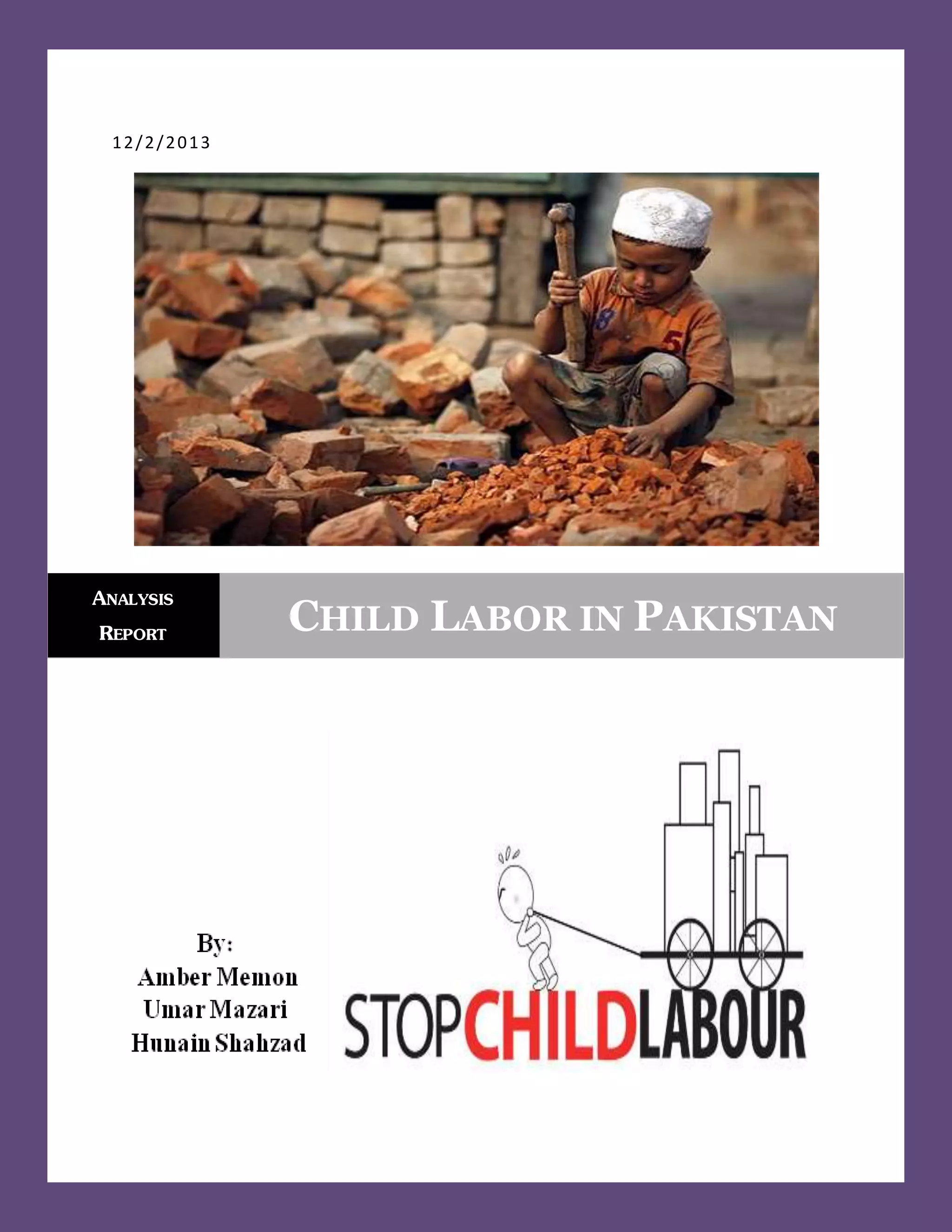
REPORT CHILD LABOR IN PAKISTAN
Child Labor in Pakistan
Analysis Repo rt Page 2
Acknowledgement
First of all we would like to thank the ALMIGHTY ALLAH for granting us the courage to
accomplish this report, and special thanks to our Teacher and resources that helped us
out in completion of this report; this has helped us to explore knowledge. The process for
working on this report was very interesting. We gathered useful and important information
about the causes of the child labor. We are also thankful to those who provide us their precious
time and thus help us in conducting this research report.
Child Labor in Pakistan
Analysis Repo rt Page 3
Abstract
Our research is all about child labor in Pakistan. What is child labor? And what is the rate of
child labor in Pakistan. Mainly children work in small age because their families have poor
economic condition. Also there is no concept of education. As the child grows, their parents
think that he should work for some money, so that they can live and eat. Also according to
government research, there are average 8 persons in the homes of child who is working as
labor. There is also no concept of improving standard of living. They usually live below the
poverty line.
Child Labor in Pakistan
Analysis Repo rt Page 4
Contents
Ackno wledg emen t ............................................................................ 2
Abs tract .......................................................................................... 3
Executive Summary ........................................................................... 5
Introd uction .................................................................................... 6
Who is a C hild? ............................................................................. 6
C hild Labor ................................................................................... 6
C aus es of C hild Labor ....................................................................... 7
Pro vincial Graph of C hild Labor in Pakis tan ......................................... 9
C hild Labor is Mos tly Foun d In: ....................................................... 9
Myt hs on C hild Labor ...................................................................... 10
Facts & Fig ures of C hild Labor in As ia & Worldwide ............................ 10
Effects of C hild Labor ..................................................................... 12
Policy Approaches to tackle C hild Labor ............................................ 12
Impact o n Econo my ........................................................................ 13
Solutio ns to End C hild Labor ............................................................ 13
C onclus ion .................................................................................... 14
Recomme ndatio ns .......................................................................... 14
References .................................................................................... 15
Child Labor in Pakistan
Analysis Repo rt Page 5
Executive Summary
The project is about a very controversial issue child labor. They reporttalks about world-
wide problem of child labor and how differentcountries are exploiting children by making them
work for longer hours and gaining benefit more out of it.Child labor is a multi-
dimensional issue and the organizationsinvolved in condemning it have their own perspectives,
objectives and interests. With no intentions of demystifying this complex, one would
focus on the difference between child labor and child work, and possible consequences of
deliberate or unapprised exercise of the two terms interchangeably. Child labor reflects the
violation of child rightsleading to exploitation and deprivations of all kinds. Child work reflects
social inequity and insecurity, dearth of social safety networks,
magnitude of poverty, paucity of opportunities for health and
education, and financial independence. The report also states the reasons behind child labor
like a very common reason is poverty and lack of education. It further talks about different
ways to stop this problem. In the end the report is concluded that child labor is a curse and it
should be finished from its root to make this world a happy place to live.
Child Labor in Pakistan
Analysis Repo rt Page 6
Introduction
Who is a Child?
International conventions define children as aged 18 and under. Individual governments may
define "child" according to different ages or other criteria."Child" and "childhood"
are also defined differently by different cultures. A “child" is not necessarily
delineated by a fixed age. Social scientists point out that child’s abilities and maturities
vary so much that defining a child's maturity by calendar age can be misleading.
Child Labor
Child labor is the employment of children at regular and sustained labor. "Child labor" is;
generally speaking, work for children that harm them or exploits them in some way physically,
mentally, morally, or by blocking access to education. UNICEF defines child labor as work
that exceeds a minimum number of hours, depending on the age of a child and on the type of
work. Such work is considered harmful to the child and should therefore be eliminated. There
is no universally accepted definition of child labor. Varying definitions
of the term are used by international organizations, non-governmentalorganizations, trade
unions and other interest groups. Writers and speakers don't always speak what definition they
are using and that often leads to confusion.
Child Labor in Pakistan
Analysis Repo rt Page 7
Causes of Child Labor
Children start work when they are too young, or take on work that is hazardous, for many
reasons. Children in developing countries do so because they and their families need the extra
income. Indeed, many end up working unpaid for their employers in exchange for their board
and lodging. In contrast, children in
industrialized countries, seek work for quite different reasons, usually toestablish financial
independence from their parents. Here we focus on children who are driven into the world of
work by poverty. However, even for poor families there are decisions to make about what
work children should take on.
Parents rarely wish to expose their children to danger, but may see no alternative. All too often,
both parents and young people are unaware of the risks involved.
The main causes or reasons for creating child labor are:
Over Population:
Most of the Asian and African countries are overpopulated. Due to limited resources and more
mouths to feed, Children are employed in various forms of work.
Illiteracy:
Illiterate parents do not realize the need for a proper physical, emotional and cognitive
development of a child. As they are uneducated, they do not realize the importance of
education for their children.
Poverty:
Many a time poverty forces parents to send their children to hazardous jobs. Although they
know it is wrong; they have no other alternative as they need the money.
Urbanization:
The Industrial Revolution has its own negative side. Many a time MNC's and export industries in
the developing world employ while workers, particularly in the garment industry.
Unemployment of Elders:
Elders often find it difficult to get jobs. The industrialists and factory owners find it profitable to
employ children. This is so because they can pay less and extract more work. They will also not
create union problem.
Child Labor in Pakistan
Analysis Repo rt Page 8
Orphans:
Children born out of wedlock, children with no parents and relatives, often don’t find anyone to
support them. Thus they are forced to work for their own living.
Willingness to Exploit Children:
This is at the root of the problem Even if a family is very poor; the incidence of child labor will
be very low unless there are people willing to exploit these children.
Family Background:
Families break down for many reasons, leaving the household short of income. Sometimes
divorce leaves one parent looking after more children than she or he can afford to feed. Divorce
is sometimes brought about by domestic violence, which also directly drives children to leave
home when they are still young. The death of either parent precipitates economic disaster for
many households. Families also lose their livelihood as a result of natural disasters and human
crises that leave people destitute and force children to start earning.
Child Labor in Pakistan
Analysis Repo rt Page 9
Provincial Graph of Child Labor in Pakistan
Child Labor is Mostly Found In:
P r ovi nc e -wi s e Compar i s on of Chi l d Labor
P r ovi nc e Total No. of
Chi l dr e n i n ag e
g r oup of 5 -1 4 ye ar s
(mi l l i ons )
Total No. of
Ec onomi c al l y Ac ti ve
Chi l dr e n i n Ag e
g r oup of 5 -1 4 ye ar s
(mi l l i ons )
Rati o of Chi l d
Labor
P unjab 2 2 .6 3 1 .9 4 8 .6 %
S i ndh 8 .6 2 0 .3 0 3 .5 %
NW FP 6 .7 1 1 .0 6 1 5 .8 %
B al oc hi s tan 2 .0 7 0 .0 1 0 .5 %
Total 4 0 .0 3 3 .3 1 8 .3 %
Child Labor in Pakistan
Analysis Repo rt Page 10
Myths on Child Labor
According to UNICEF (1997), there are four myths that surround the issue of child labor and
these are the followings:
 Child Labor is only a problem of developing countries found in the region of Africa, Asia
and Latin America. This may be expected due to the prevailing economic conditions of
these countries, still pockets of child labor can be found in highly industrialized countries
such as US etc.
 Child Labor will never be eliminated until poverty disappears. UNICEF points out that
child labor should be eliminated interdependently
of poverty. Even the poorest countries should do their best so as todecrease the
number of child labor cases.
 Child laborers only work on export industries. Only a small portion of child labor cases
work in export industries, only about 9%. Most child workers can be found in the
informal sectors of society, out in the streets, work in agriculture or hidden in every
home – far from the eyes of labor inspectors.
 The only way to eliminate child labor is for the government and consumers to pose
sanctions and boycotts. This will not really help at all and will just make the problem
worst. Likewise, it doesn’t give a huge impact since portions of child labor cases are
found in that sector. A comprehensive strategy that supports and develops local
initiatives and provides alternatives is the only proper seen by UNICEF should be done in
order to combat child labor.
Facts & Figures of Child Labor in Asia & Worldwide
According to estimates by the International Labor Organization (ILO) in their report of June
2006, the numbers of children working aged 5 to 14 is:
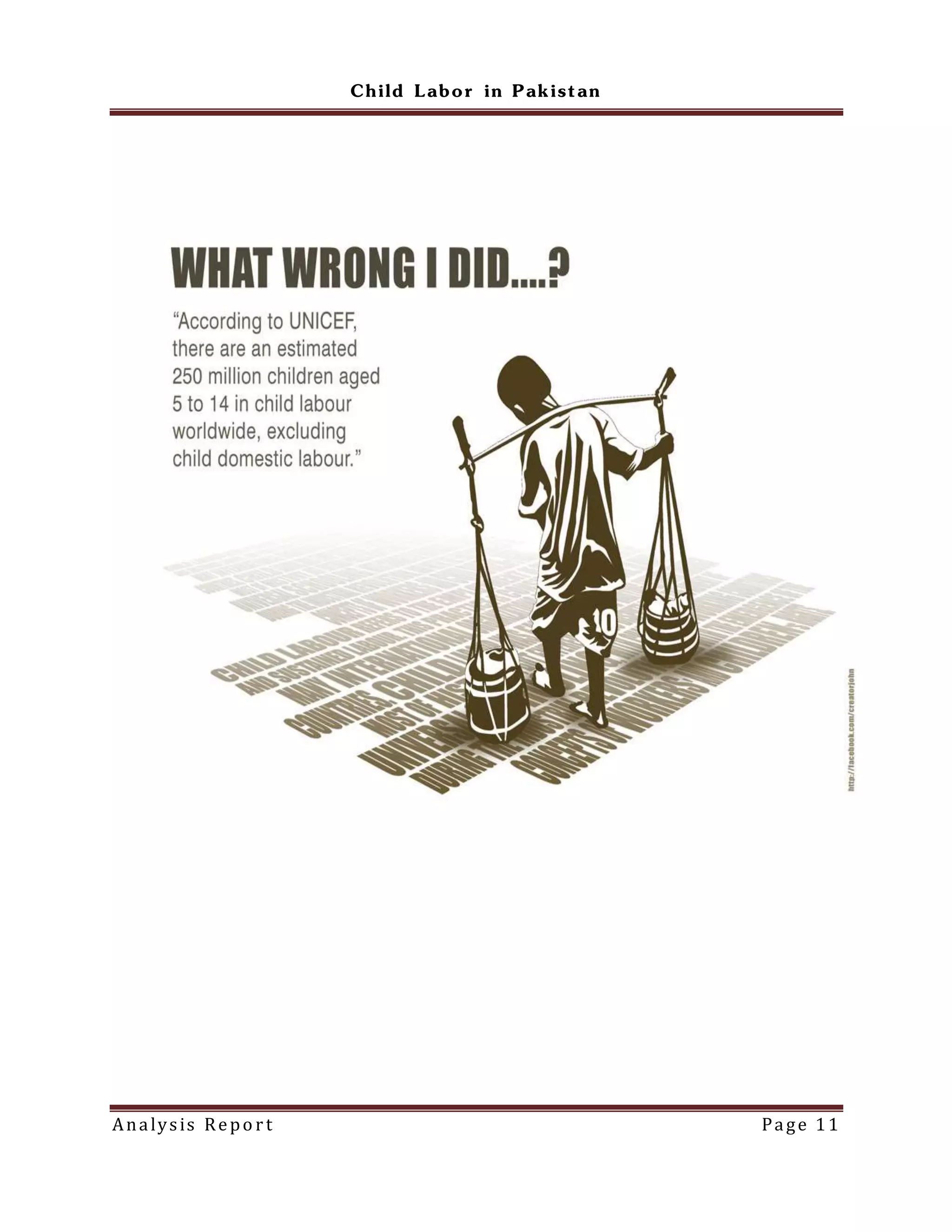
 Globally 190 million
 In Asia 122 million
 In sub-Saharan Africa 50 million. In fact 26 percent of all children work here.
 In Latin America 5 million.
 In the rest of the world 13 million.
 Across Africa, there are an estimated 80 million child workers, a number that could rise
to 100 million by 2015.
Child Labor in Pakistan
Analysis Repo rt Page 11
Child Labor in Pakistan
Analysis Repo rt Page 12
Effects of Child Labor
1. Childlabordeprivesachildof a properchildhood.
2. He suffersphysical andmental torture.
3. He becomesmentallyand emotionallymature toofast whichisadangeroussign.
4. Childlaborcreatesand perpetuatespoverty.
5. It condemnsthe childtoa life of unskilled,badlypaidwork.
6. Ultimatelythisleadstochildlaborwitheachgeneration.
Policy Approaches to tackle Child Labor
Improve Incentives
 Make school attendance more accessible—more schools, flexible schooling
 Reduce or eliminate school fees
 Eliminate discrimination against girls in school
 Improve educational quality—teaching, materials
 Improve basic services—for example, access to clean water
Remove Constraints
 Reduce poverty
 Social safety nets
 Cash or food linked to participation in education
 Improve access to credit
 Better labor market functioning
Protection and Rehabilitation Services
 Remove children from hazardous and worst forms of child labor
 Enforce health and safety and other employment standards
 Provide access to education and health services
 Offer vocational training and other rehabilitation
Legislation
 Introduce and enforce child labor laws
 Introduce and enforce compulsory education laws
Child Labor in Pakistan
Analysis Repo rt Page 13
Impact on Economy
Solutions to End Child Labor
 Awareness must be raised and parents should pay attention to the education of their
children.
 Child Labor Laws should be strictly put into practice
 If we want success then we have to act upon these principles and then our country can
easily get rid of this problem.
 We have to distribute the education free of coast, give flame to the candle of education
and distribute the light of knowledge among the people as our Holy prophet (PBUH) also
says that
“get knowledge and distribute among others.”
Child Labor in Pakistan
Analysis Repo rt Page 14
Conclusion
The children are workingasa laborinschool goingage forthe survival of theirfamiliesandtofull fill the
basicnecessities. Peopledon’tknow the importance of education. That’swhy mostof children remain
illiterate. Itisnotjustresponsibility of governmentwe are alsoresponsibleforthat.
 Childlaboriscurse to our societyas well asoureconomy.
 The future of the communityisinthe well beingof itschildren.
 It isrequiredtosave childrenforsocial injusticeandeducational deprivation.
Recommendations
 Awareness raising activities should be arranged so that people are informed about
children’s rights to education and leisure.
 Microfinance programs so that families have sufficient income and can keep their
children out of paid work.
 Provision of health and educational services for working children should be ensured.
 Ensuring that children orphaned by AIDS are still accorded their rights and are equipped
with skills that will help them as adults
 Plan works to raise awareness of the Convention on the Rights of the Child.
 Poor people should provide such opportunities to get themselves out of poverty, and
prevent and stop all types of exploitation of children.
 Providing all children with access to education is every government’sresponsibility, as
well as a practical response to preventing child labor. Free, compulsory, relevant and
good-quality education services should be given.
 Laws and regulations against child labor must be in place and rigorously enforced by
governments should be in manner.
 Civil society and media engagement can change attitudes and it can condemn child
labor. It can also helps in raising awareness of its harmful effects on health and
development will help alleviate children’s vulnerability to abuse.
 Relevant school curricula and vocational training programs can be adapted to students’
circumstances and will increase their school attendance.
 Social programs to support families in need and help them find alternative income to
replace their child’s employment will help prevent child labor. Such support is also
needed for child-headed households, orphans and children’s.
 To create awareness on the different aspects of child labor issue and start campaigns on
children’s for the implementation of children's rights.
Child Labor in Pakistan
Analysis Repo rt Page 15
 Family size should be small because Poor households tend to have morechildren,
and with large families there is a greater likelihood that children will work and have
lower school attendance and completion.
 Governments need to devote resources for Schooling and to provide good quality and
relevance atmosphere with no cost to poor families.
 Base programming on children’s own perception of what constitutes safe /harmful / age
appropriate / educational labor.
 Target and focus integrated packages of basic services on urban poor families.
 Disabled children must receive priority attention due to their particular vulnerability to
exploitation in the worst forms of child labor on the streets.
 Expand education services to make them accessible to working children.
 To give priority attention to immediately eliminating the worst forms of child labor with
appropriate programs.
References
www.unicef.org.com
Society for the Protection of the Rights of the Child “The State of Pakistan’s Children 2006″
http://www.sparcpk.org/publications/sopc_2006.pdf
YesPakistan.com staff writer “Policy considerations for ending child labor
inPakistan”http://www.yespakistan.com/people/child_labor.asp
http://images.google.com.pk/imgres?imgurl=http://www.hamariweb.com/Images/Articles/Lab
our3%252013-
http://www.minnpost.com/globalpost/2009/05/15/8833/hope_for_pakistans_child_workers
http://www.sparcpk.org/news_june_need.php
Society for the Protection of the Rights of the Child “The State of Pakistan’s Children 2006″
http://www.sparcpk.org/publications/sopc_2006.pdf
Child Labor in Pakistan
Analysis Repo rt Page 16

Child labor in the pakistan report

  • 1.
  • 2.
    Child Labor inPakistan Analysis Repo rt Page 2 Acknowledgement First of all we would like to thank the ALMIGHTY ALLAH for granting us the courage to accomplish this report, and special thanks to our Teacher and resources that helped us out in completion of this report; this has helped us to explore knowledge. The process for working on this report was very interesting. We gathered useful and important information about the causes of the child labor. We are also thankful to those who provide us their precious time and thus help us in conducting this research report.
  • 3.
    Child Labor inPakistan Analysis Repo rt Page 3 Abstract Our research is all about child labor in Pakistan. What is child labor? And what is the rate of child labor in Pakistan. Mainly children work in small age because their families have poor economic condition. Also there is no concept of education. As the child grows, their parents think that he should work for some money, so that they can live and eat. Also according to government research, there are average 8 persons in the homes of child who is working as labor. There is also no concept of improving standard of living. They usually live below the poverty line.
  • 4.
    Child Labor inPakistan Analysis Repo rt Page 4 Contents Ackno wledg emen t ............................................................................ 2 Abs tract .......................................................................................... 3 Executive Summary ........................................................................... 5 Introd uction .................................................................................... 6 Who is a C hild? ............................................................................. 6 C hild Labor ................................................................................... 6 C aus es of C hild Labor ....................................................................... 7 Pro vincial Graph of C hild Labor in Pakis tan ......................................... 9 C hild Labor is Mos tly Foun d In: ....................................................... 9 Myt hs on C hild Labor ...................................................................... 10 Facts & Fig ures of C hild Labor in As ia & Worldwide ............................ 10 Effects of C hild Labor ..................................................................... 12 Policy Approaches to tackle C hild Labor ............................................ 12 Impact o n Econo my ........................................................................ 13 Solutio ns to End C hild Labor ............................................................ 13 C onclus ion .................................................................................... 14 Recomme ndatio ns .......................................................................... 14 References .................................................................................... 15
  • 5.
    Child Labor inPakistan Analysis Repo rt Page 5 Executive Summary The project is about a very controversial issue child labor. They reporttalks about world- wide problem of child labor and how differentcountries are exploiting children by making them work for longer hours and gaining benefit more out of it.Child labor is a multi- dimensional issue and the organizationsinvolved in condemning it have their own perspectives, objectives and interests. With no intentions of demystifying this complex, one would focus on the difference between child labor and child work, and possible consequences of deliberate or unapprised exercise of the two terms interchangeably. Child labor reflects the violation of child rightsleading to exploitation and deprivations of all kinds. Child work reflects social inequity and insecurity, dearth of social safety networks, magnitude of poverty, paucity of opportunities for health and education, and financial independence. The report also states the reasons behind child labor like a very common reason is poverty and lack of education. It further talks about different ways to stop this problem. In the end the report is concluded that child labor is a curse and it should be finished from its root to make this world a happy place to live.
  • 6.
    Child Labor inPakistan Analysis Repo rt Page 6 Introduction Who is a Child? International conventions define children as aged 18 and under. Individual governments may define "child" according to different ages or other criteria."Child" and "childhood" are also defined differently by different cultures. A “child" is not necessarily delineated by a fixed age. Social scientists point out that child’s abilities and maturities vary so much that defining a child's maturity by calendar age can be misleading. Child Labor Child labor is the employment of children at regular and sustained labor. "Child labor" is; generally speaking, work for children that harm them or exploits them in some way physically, mentally, morally, or by blocking access to education. UNICEF defines child labor as work that exceeds a minimum number of hours, depending on the age of a child and on the type of work. Such work is considered harmful to the child and should therefore be eliminated. There is no universally accepted definition of child labor. Varying definitions of the term are used by international organizations, non-governmentalorganizations, trade unions and other interest groups. Writers and speakers don't always speak what definition they are using and that often leads to confusion.
  • 7.
    Child Labor inPakistan Analysis Repo rt Page 7 Causes of Child Labor Children start work when they are too young, or take on work that is hazardous, for many reasons. Children in developing countries do so because they and their families need the extra income. Indeed, many end up working unpaid for their employers in exchange for their board and lodging. In contrast, children in industrialized countries, seek work for quite different reasons, usually toestablish financial independence from their parents. Here we focus on children who are driven into the world of work by poverty. However, even for poor families there are decisions to make about what work children should take on. Parents rarely wish to expose their children to danger, but may see no alternative. All too often, both parents and young people are unaware of the risks involved. The main causes or reasons for creating child labor are: Over Population: Most of the Asian and African countries are overpopulated. Due to limited resources and more mouths to feed, Children are employed in various forms of work. Illiteracy: Illiterate parents do not realize the need for a proper physical, emotional and cognitive development of a child. As they are uneducated, they do not realize the importance of education for their children. Poverty: Many a time poverty forces parents to send their children to hazardous jobs. Although they know it is wrong; they have no other alternative as they need the money. Urbanization: The Industrial Revolution has its own negative side. Many a time MNC's and export industries in the developing world employ while workers, particularly in the garment industry. Unemployment of Elders: Elders often find it difficult to get jobs. The industrialists and factory owners find it profitable to employ children. This is so because they can pay less and extract more work. They will also not create union problem.
  • 8.
    Child Labor inPakistan Analysis Repo rt Page 8 Orphans: Children born out of wedlock, children with no parents and relatives, often don’t find anyone to support them. Thus they are forced to work for their own living. Willingness to Exploit Children: This is at the root of the problem Even if a family is very poor; the incidence of child labor will be very low unless there are people willing to exploit these children. Family Background: Families break down for many reasons, leaving the household short of income. Sometimes divorce leaves one parent looking after more children than she or he can afford to feed. Divorce is sometimes brought about by domestic violence, which also directly drives children to leave home when they are still young. The death of either parent precipitates economic disaster for many households. Families also lose their livelihood as a result of natural disasters and human crises that leave people destitute and force children to start earning.
  • 9.
    Child Labor inPakistan Analysis Repo rt Page 9 Provincial Graph of Child Labor in Pakistan Child Labor is Mostly Found In: P r ovi nc e -wi s e Compar i s on of Chi l d Labor P r ovi nc e Total No. of Chi l dr e n i n ag e g r oup of 5 -1 4 ye ar s (mi l l i ons ) Total No. of Ec onomi c al l y Ac ti ve Chi l dr e n i n Ag e g r oup of 5 -1 4 ye ar s (mi l l i ons ) Rati o of Chi l d Labor P unjab 2 2 .6 3 1 .9 4 8 .6 % S i ndh 8 .6 2 0 .3 0 3 .5 % NW FP 6 .7 1 1 .0 6 1 5 .8 % B al oc hi s tan 2 .0 7 0 .0 1 0 .5 % Total 4 0 .0 3 3 .3 1 8 .3 %
  • 10.
    Child Labor inPakistan Analysis Repo rt Page 10 Myths on Child Labor According to UNICEF (1997), there are four myths that surround the issue of child labor and these are the followings:  Child Labor is only a problem of developing countries found in the region of Africa, Asia and Latin America. This may be expected due to the prevailing economic conditions of these countries, still pockets of child labor can be found in highly industrialized countries such as US etc.  Child Labor will never be eliminated until poverty disappears. UNICEF points out that child labor should be eliminated interdependently of poverty. Even the poorest countries should do their best so as todecrease the number of child labor cases.  Child laborers only work on export industries. Only a small portion of child labor cases work in export industries, only about 9%. Most child workers can be found in the informal sectors of society, out in the streets, work in agriculture or hidden in every home – far from the eyes of labor inspectors.  The only way to eliminate child labor is for the government and consumers to pose sanctions and boycotts. This will not really help at all and will just make the problem worst. Likewise, it doesn’t give a huge impact since portions of child labor cases are found in that sector. A comprehensive strategy that supports and develops local initiatives and provides alternatives is the only proper seen by UNICEF should be done in order to combat child labor. Facts & Figures of Child Labor in Asia & Worldwide According to estimates by the International Labor Organization (ILO) in their report of June 2006, the numbers of children working aged 5 to 14 is:  Globally 190 million  In Asia 122 million  In sub-Saharan Africa 50 million. In fact 26 percent of all children work here.  In Latin America 5 million.  In the rest of the world 13 million.  Across Africa, there are an estimated 80 million child workers, a number that could rise to 100 million by 2015.
  • 11.
    Child Labor inPakistan Analysis Repo rt Page 11
  • 12.
    Child Labor inPakistan Analysis Repo rt Page 12 Effects of Child Labor 1. Childlabordeprivesachildof a properchildhood. 2. He suffersphysical andmental torture. 3. He becomesmentallyand emotionallymature toofast whichisadangeroussign. 4. Childlaborcreatesand perpetuatespoverty. 5. It condemnsthe childtoa life of unskilled,badlypaidwork. 6. Ultimatelythisleadstochildlaborwitheachgeneration. Policy Approaches to tackle Child Labor Improve Incentives  Make school attendance more accessible—more schools, flexible schooling  Reduce or eliminate school fees  Eliminate discrimination against girls in school  Improve educational quality—teaching, materials  Improve basic services—for example, access to clean water Remove Constraints  Reduce poverty  Social safety nets  Cash or food linked to participation in education  Improve access to credit  Better labor market functioning Protection and Rehabilitation Services  Remove children from hazardous and worst forms of child labor  Enforce health and safety and other employment standards  Provide access to education and health services  Offer vocational training and other rehabilitation Legislation  Introduce and enforce child labor laws  Introduce and enforce compulsory education laws
  • 13.
    Child Labor inPakistan Analysis Repo rt Page 13 Impact on Economy Solutions to End Child Labor  Awareness must be raised and parents should pay attention to the education of their children.  Child Labor Laws should be strictly put into practice  If we want success then we have to act upon these principles and then our country can easily get rid of this problem.  We have to distribute the education free of coast, give flame to the candle of education and distribute the light of knowledge among the people as our Holy prophet (PBUH) also says that “get knowledge and distribute among others.”
  • 14.
    Child Labor inPakistan Analysis Repo rt Page 14 Conclusion The children are workingasa laborinschool goingage forthe survival of theirfamiliesandtofull fill the basicnecessities. Peopledon’tknow the importance of education. That’swhy mostof children remain illiterate. Itisnotjustresponsibility of governmentwe are alsoresponsibleforthat.  Childlaboriscurse to our societyas well asoureconomy.  The future of the communityisinthe well beingof itschildren.  It isrequiredtosave childrenforsocial injusticeandeducational deprivation. Recommendations  Awareness raising activities should be arranged so that people are informed about children’s rights to education and leisure.  Microfinance programs so that families have sufficient income and can keep their children out of paid work.  Provision of health and educational services for working children should be ensured.  Ensuring that children orphaned by AIDS are still accorded their rights and are equipped with skills that will help them as adults  Plan works to raise awareness of the Convention on the Rights of the Child.  Poor people should provide such opportunities to get themselves out of poverty, and prevent and stop all types of exploitation of children.  Providing all children with access to education is every government’sresponsibility, as well as a practical response to preventing child labor. Free, compulsory, relevant and good-quality education services should be given.  Laws and regulations against child labor must be in place and rigorously enforced by governments should be in manner.  Civil society and media engagement can change attitudes and it can condemn child labor. It can also helps in raising awareness of its harmful effects on health and development will help alleviate children’s vulnerability to abuse.  Relevant school curricula and vocational training programs can be adapted to students’ circumstances and will increase their school attendance.  Social programs to support families in need and help them find alternative income to replace their child’s employment will help prevent child labor. Such support is also needed for child-headed households, orphans and children’s.  To create awareness on the different aspects of child labor issue and start campaigns on children’s for the implementation of children's rights.
  • 15.
    Child Labor inPakistan Analysis Repo rt Page 15  Family size should be small because Poor households tend to have morechildren, and with large families there is a greater likelihood that children will work and have lower school attendance and completion.  Governments need to devote resources for Schooling and to provide good quality and relevance atmosphere with no cost to poor families.  Base programming on children’s own perception of what constitutes safe /harmful / age appropriate / educational labor.  Target and focus integrated packages of basic services on urban poor families.  Disabled children must receive priority attention due to their particular vulnerability to exploitation in the worst forms of child labor on the streets.  Expand education services to make them accessible to working children.  To give priority attention to immediately eliminating the worst forms of child labor with appropriate programs. References www.unicef.org.com Society for the Protection of the Rights of the Child “The State of Pakistan’s Children 2006″ http://www.sparcpk.org/publications/sopc_2006.pdf YesPakistan.com staff writer “Policy considerations for ending child labor inPakistan”http://www.yespakistan.com/people/child_labor.asp http://images.google.com.pk/imgres?imgurl=http://www.hamariweb.com/Images/Articles/Lab our3%252013- http://www.minnpost.com/globalpost/2009/05/15/8833/hope_for_pakistans_child_workers http://www.sparcpk.org/news_june_need.php Society for the Protection of the Rights of the Child “The State of Pakistan’s Children 2006″ http://www.sparcpk.org/publications/sopc_2006.pdf
  • 16.
    Child Labor inPakistan Analysis Repo rt Page 16