CHEMISTRY
Did you know that chemistry is associated to
everyday activities of human?
 Fluoride in a toothpaste, that prevents tooth decay.
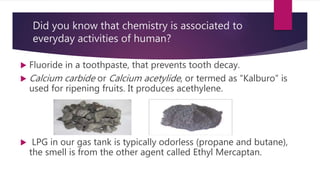
 Calcium carbide or Calcium acetylide, or termed as “Kalburo” is
used for ripening fruits. It produces acethylene.
 LPG in our gas tank is typically odorless (propane and butane),
the smell is from the other agent called Ethyl Mercaptan.
Chemistry History
3000 BC
• Chemistry is known as art not science.
1000 BC
• Smelting or extraction of metals from ore.
Pre-alchemy period
• Thales introduced conversion of substance from other substance.
Chemistry History
• Empedocer suggested the Four basic elements – air, water, fire and Earth.
• Aristotle suggested heavenly ether that is added to the 4 basic elements introduced
by Empedocer..
• Democritus suggested that matter is composed of atoms.
Chemistry History
4th BC to Middle
Ages
• Alchemy started. Paracelsus is a common alchemist.
Modern Chemistry
• Idea of chemical investigation
Mid- 17th Century
• Johann Joachim Becher and Georg Ernst Stahl introduced theory of Phlogiston.
Chemistry History
• Joseph Priestly supported the Theory of Phlogiston and even do an experiment.
• Antoine Lavoisier suggested that oxygen gas is absorbed from the air instead of
phlogiston.
What is Chemistry?
 It deals with the study of matter, its composition, its properties, changes it
undergoes, and the energy associated with these changes.
 It is connected to other field of Science – Biology, pharmacology, Geology,
Astronomy, Physiology, Medicine, Meteorology, electronics, Ecology,
Psychology, Metallurgy, Engineering, Toxicology, and Physics.
Investigatory Process
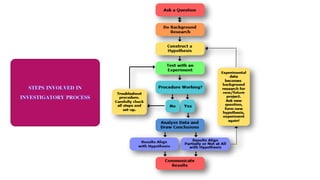
 Studying science is based on making keen
observations and formulating intelligence guesses
based on the observed phenomenon.
 It is also termed as Scientific Method.
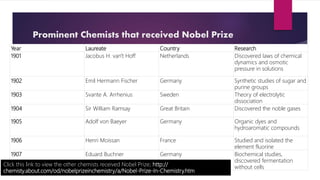
Prominent Chemists that received Nobel Prize
Year Laureate Country Research
1901 Jacobus H. van't Hoff Netherlands Discovered laws of chemical
dynamics and osmotic
pressure in solutions
1902 Emil Hermann Fischer Germany Synthetic studies of sugar and
purine groups
1903 Svante A. Arrhenius Sweden Theory of electrolytic
dissociation
1904 Sir William Ramsay Great Britain Discovered the noble gases
1905 Adolf von Baeyer Germany Organic dyes and
hydroaromatic compounds
1906 Henri Moissan France Studied and isolated the
element fluorine
1907 Eduard Buchner Germany Biochemical studies,
discovered fermentation
without cellsClick this link to view the other chemists received Nobel Prize; http://
chemisty.about.com/od/nobelprizeinchemistry/a/Nobel-Prize-In-Chemistry.htm
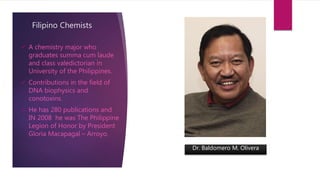
Filipino Chemists
 A chemistry major who
graduates summa cum laude
and class valedictorian in
University of the Philippines.
 Contributions in the field of
DNA biophysics and
conotoxins.
 He has 280 publications and
IN 2008 he was The Philippine
Legion of Honor by President
Gloria Macapagal – Arroyo.
Dr. Baldomero M. Olivera
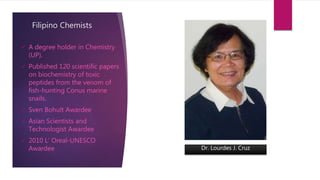
Filipino Chemists
 A degree holder in Chemistry
(UP).
 Published 120 scientific papers
on biochemistry of toxic
peptides from the venom of
fish-hunting Conus marine
snails.
 Sven Bohult Awardee
 Asian Scientists and
Technologist Awardee
 2010 L’ Oreal-UNESCO
Awardee Dr. Lourdes J. Cruz

Chemistry

  • 1.
  • 2.
    Did you knowthat chemistry is associated to everyday activities of human?  Fluoride in a toothpaste, that prevents tooth decay.  Calcium carbide or Calcium acetylide, or termed as “Kalburo” is used for ripening fruits. It produces acethylene.  LPG in our gas tank is typically odorless (propane and butane), the smell is from the other agent called Ethyl Mercaptan.
  • 3.
    Chemistry History 3000 BC •Chemistry is known as art not science. 1000 BC • Smelting or extraction of metals from ore. Pre-alchemy period • Thales introduced conversion of substance from other substance.
  • 4.
    Chemistry History • Empedocersuggested the Four basic elements – air, water, fire and Earth. • Aristotle suggested heavenly ether that is added to the 4 basic elements introduced by Empedocer.. • Democritus suggested that matter is composed of atoms.
  • 5.
    Chemistry History 4th BCto Middle Ages • Alchemy started. Paracelsus is a common alchemist. Modern Chemistry • Idea of chemical investigation Mid- 17th Century • Johann Joachim Becher and Georg Ernst Stahl introduced theory of Phlogiston.
  • 6.
    Chemistry History • JosephPriestly supported the Theory of Phlogiston and even do an experiment. • Antoine Lavoisier suggested that oxygen gas is absorbed from the air instead of phlogiston.
  • 7.
    What is Chemistry? It deals with the study of matter, its composition, its properties, changes it undergoes, and the energy associated with these changes.  It is connected to other field of Science – Biology, pharmacology, Geology, Astronomy, Physiology, Medicine, Meteorology, electronics, Ecology, Psychology, Metallurgy, Engineering, Toxicology, and Physics.
  • 9.
    Investigatory Process  Studyingscience is based on making keen observations and formulating intelligence guesses based on the observed phenomenon.  It is also termed as Scientific Method.
  • 11.
    Prominent Chemists thatreceived Nobel Prize Year Laureate Country Research 1901 Jacobus H. van't Hoff Netherlands Discovered laws of chemical dynamics and osmotic pressure in solutions 1902 Emil Hermann Fischer Germany Synthetic studies of sugar and purine groups 1903 Svante A. Arrhenius Sweden Theory of electrolytic dissociation 1904 Sir William Ramsay Great Britain Discovered the noble gases 1905 Adolf von Baeyer Germany Organic dyes and hydroaromatic compounds 1906 Henri Moissan France Studied and isolated the element fluorine 1907 Eduard Buchner Germany Biochemical studies, discovered fermentation without cellsClick this link to view the other chemists received Nobel Prize; http:// chemisty.about.com/od/nobelprizeinchemistry/a/Nobel-Prize-In-Chemistry.htm
  • 12.
    Filipino Chemists  Achemistry major who graduates summa cum laude and class valedictorian in University of the Philippines.  Contributions in the field of DNA biophysics and conotoxins.  He has 280 publications and IN 2008 he was The Philippine Legion of Honor by President Gloria Macapagal – Arroyo. Dr. Baldomero M. Olivera
  • 13.
    Filipino Chemists  Adegree holder in Chemistry (UP).  Published 120 scientific papers on biochemistry of toxic peptides from the venom of fish-hunting Conus marine snails.  Sven Bohult Awardee  Asian Scientists and Technologist Awardee  2010 L’ Oreal-UNESCO Awardee Dr. Lourdes J. Cruz