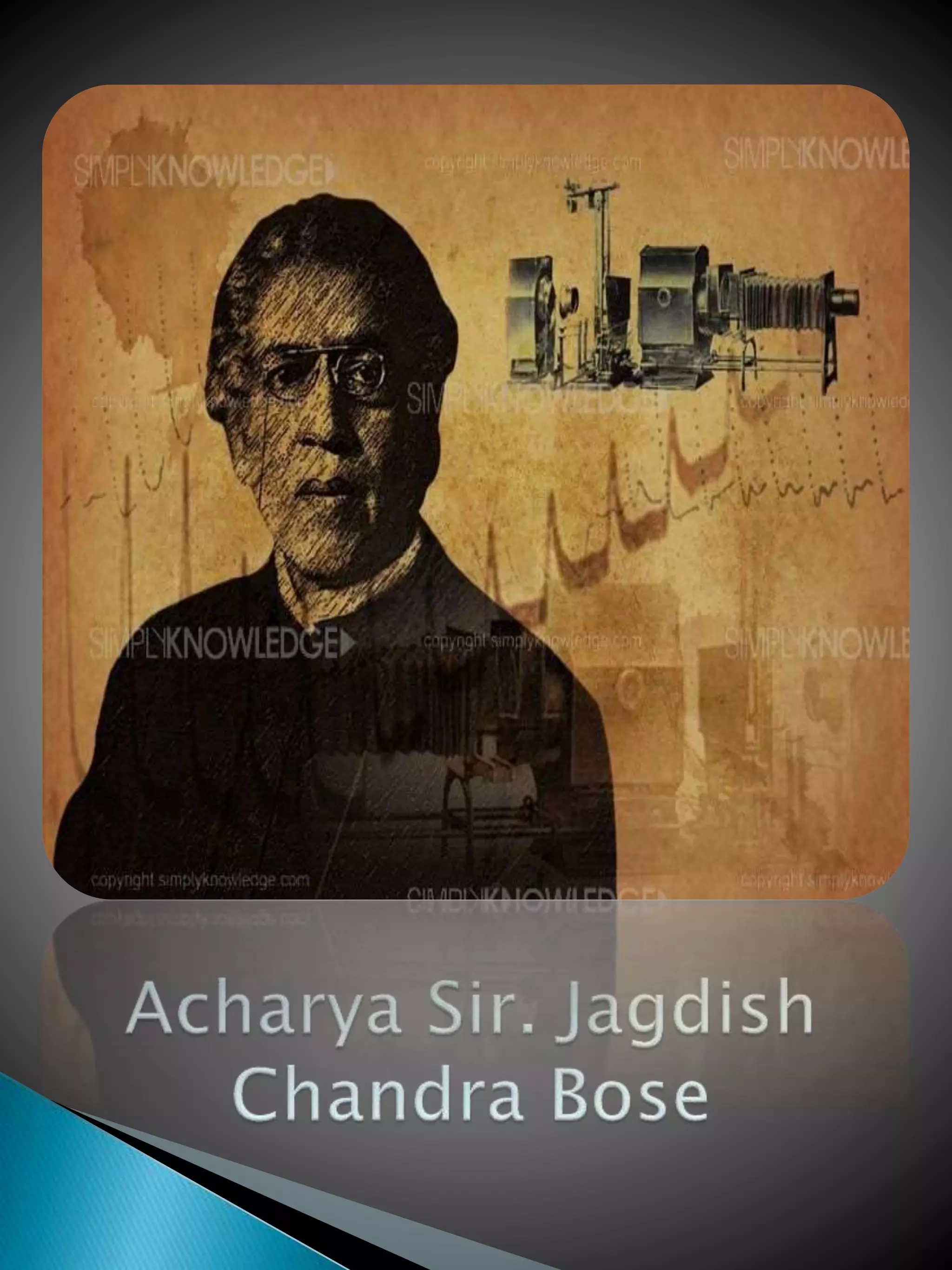
Sir Jagadish Chandra Bose was born
in Bikrampur, Bengal, (now Munshiganj
District of Bangladesh) on 30 November
1858. His father, Bhagawan Chandra Bose,
was a Brahmo and leader of the Brahmo
Samaj and worked as a deputy magistrate/
assistant commissioner
in Faridpur, Bardhaman and other places. His
family hailed from the village
Rarikhal, Bikrampur, in the current
day Munshiganj District of Bangladesh. Bose
joined the Hare School in 1869 and then St.
Xavier's School at Kolkata. In 1875, he passed
the Entrance Examination (equivalent to
school graduation) of University of
Calcutta and was admitted to St. Xavier's
College, Calcutta.
At St. Xavier's, Bose came in contact
with Jesuit Father Eugene Lafont, who played
a significant role in developing his interest to
natural science. He received a bachelor's
degree from University of Calcutta in 1879.
Bose wanted to go to England to compete for
the Indian Civil Service. However, his father, a
civil servant himself, cancelled the plan. He
wished his son to be a scholar, who would
“rule nobody but himself. Bose went to
England to study Medicine at the University of
London. However, he had to quit because of ill
health. The odour in the dissection rooms is
also said to have exacerbated his illness.
Through the recommendation
of Anandamohan Bose, his brother-in-law
(sister's husband) and the first
Indian wrangler, he secured admission
in Christ's College, Cambridge to study
Natural Science. He received the Natural
Science Tripos from the University of
Cambridge and a BSc from the University of
London in 1884. Among Bose's teachers at
Cambridge were Lord Rayleigh, Michael
Foster, James Dewar, Francis Darwin, Francis
Balfour, and Sidney Vines. At the time when
Bose was a student at Cambridge, Prafulla
Chandra Roy was a student at Edinburgh.
They met in London and became intimate
friends.
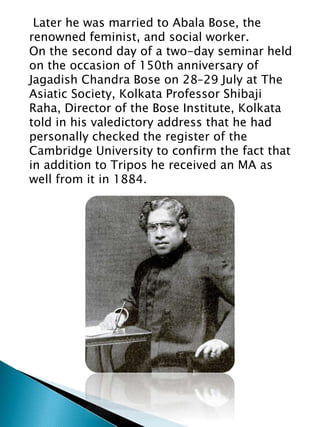
Later he was married to Abala Bose, the
renowned feminist, and social worker.
On the second day of a two-day seminar held
on the occasion of 150th anniversary of
Jagadish Chandra Bose on 28–29 July at The
Asiatic Society, Kolkata Professor Shibaji
Raha, Director of the Bose Institute, Kolkata
told in his valedictory address that he had
personally checked the register of the
Cambridge University to confirm the fact that
in addition to Tripos he received an MA as
well from it in 1884.
Bose returned to India in 1885, carrying a
letter from Fawcett, the economist to Lord
Ripon, Viceroy of India. On Lord Ripon's
request, Sir Alfred Croft, the Director of
Public Instruction, appointed Bose officiating
professor of physics in Presidency College.
The principal, C. H. Tawney, protested
against the appointment but had to accept it.
Bose was not provided with facilities for
research. On the contrary, he was a 'victim of
racialism' with regard to his salary. In those
days, an Indian professor was paid Rs. 200
per month, while his European counterpart
received Rs. 300 per month. Since Bose was
officiating, he was offered a salary of only
Rs. 100 per month. As a form of protest,
Bose refused to accept the salary cheque and
continued his teaching assignment for three
years without accepting any salary. After
time, the Director of Public Instruction and
the Principal of the Presidency College
relented, and Bose's appointment was made
permanent with retrospective effect. He was
given the full salary for the previous three
years in a lump sum.
Presidency College lacked a proper
laboratory. Bose had to conduct his research
in a small 24-square-foot (2.2 m2) room. He
devised equipment for the research with the
help of one untrained tinsmith. After his
daily grind, he carried out his research far
into the night, in a small room in his
college.
Moreover, the policy of the British
government for its colonies was not
conducive to attempts at original research.
Bose spent his own money for making
experimental equipment.
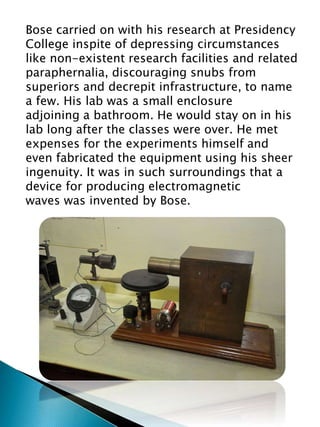
Bose carried on with his research at Presidency
College inspite of depressing circumstances
like non-existent research facilities and related
paraphernalia, discouraging snubs from
superiors and decrepit infrastructure, to name
a few. His lab was a small enclosure
adjoining a bathroom. He would stay on in his
lab long after the classes were over. He met
expenses for the experiments himself and
even fabricated the equipment using his sheer
ingenuity. It was in such surroundings that a
device for producing electromagnetic
waves was invented by Bose.
In 1894, Bose rang a bell and exploded a
small charge of gunpowder using
electromagnetic waves demonstrating to
general public how the electromagnetic
waves could be used for many useful
applications. His invention was appreciated
by the science community for the compact
nature of the apparatus and sheer
resourcefulness with which the equipment
was designed. It became a favourite
content for many textbooks of the
contemporary period. Bose also developed
the use of Galena crystals for making
receivers, both for shortwave length radio
waves and for white and ultraviolet light.
Sir Neville Mott, 1977 Nobel Prize winner
admitted, “… J. C. Bose was at least sixty
years ahead of his time.... In fact, he had
anticipated the existence of P-type and N-
type semiconductors.” Bose also worked on
the polarization of electric waves by double
refraction.
London University conferred on him D. Sc.
Degree in 1896 for his thesis on “Measurements
of Electric Rays”. Bose also speculated on the
existence of electromagnetic radiation from the
sun. Two years later, Bose demonstrated
another invention—the Mercury Coherer with
the telephone detector. Bose can also be
considered a pioneer in the field of
‘investigation of the properties of
photoconductivity’ and ‘contact rectification
shown by this class of semi-conductors’. His
subsequent study of the fatigue phenomena
exhibited by these substances led Bose to
postulate his theory of the similarity of
response in the living and the nonliving. He
found that the sensitivity of the coherer
decreased when it was used for a long period,
i.e. it became tired. When he gave the device
some rest, it regained its sensitivity which, in
his view, indicated that metals had
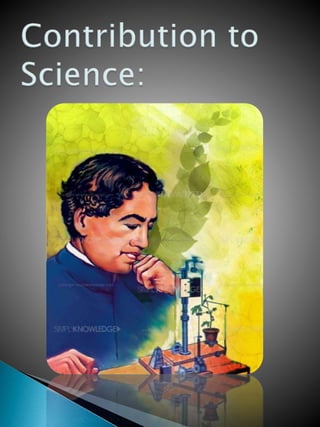
feelings and memory! During 1897-1900, Bose
turned his interest to Comparative Physiology,
Plant Physiology in particular.
The main focus of his investigations was to
establish that all the characteristics of response
exhibited by animal tissues were equally
exhibited by plant tissues. Bose’s highly original
research on ‘Electric Response of Inorganic
Substances’ was initially rejected due to
opposition of Sir John Burdon Sanderson, the
leading electro-physiologist of the time.
However, Bose’s interest in Physiology gave an
impetus to his inventive genius, leading to
invention of an optical lever in plant physiology
to magnify and photographically record the
minute movements of plants.
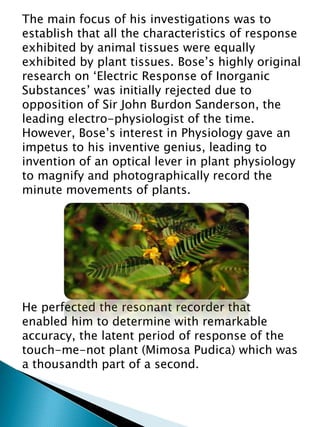
He perfected the resonant recorder that
enabled him to determine with remarkable
accuracy, the latent period of response of the
touch-me-not plant (Mimosa Pudica) which was
a thousandth part of a second.
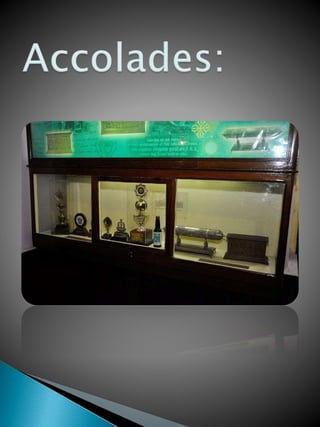
Companion of the Order of the Indian
Empire (CIE,1903)
Companion of the Order of the Star of India
(CSI,1912)
Knight Bachelor (1917)
Fellow of the Royal Society (FRS, 1920)
Member of the Vienna Academy of Sciences, 1928
President of the 14th session of the Indian Science
Congress in 1927.
Member of Finnish Society of Sciences and Letters in
1929.
Member of the League of Nations' Committee for
Intellectual Cooperation
Founding fellow of the National Institute of Sciences
of India (now the Indian National Science Academy)
The Indian Botanic Garden was renamed as
the Acharya Jagadish Chandra Bose Indian Botanic
Garden on 25 June 2009 in honor of Jagadish Chandra
Bose.
jagdish chandra bose

jagdish chandra bose

  • 3.
    Sir Jagadish ChandraBose was born in Bikrampur, Bengal, (now Munshiganj District of Bangladesh) on 30 November 1858. His father, Bhagawan Chandra Bose, was a Brahmo and leader of the Brahmo Samaj and worked as a deputy magistrate/ assistant commissioner in Faridpur, Bardhaman and other places. His family hailed from the village Rarikhal, Bikrampur, in the current day Munshiganj District of Bangladesh. Bose joined the Hare School in 1869 and then St. Xavier's School at Kolkata. In 1875, he passed the Entrance Examination (equivalent to school graduation) of University of Calcutta and was admitted to St. Xavier's College, Calcutta. At St. Xavier's, Bose came in contact with Jesuit Father Eugene Lafont, who played a significant role in developing his interest to natural science. He received a bachelor's degree from University of Calcutta in 1879.
  • 4.
    Bose wanted togo to England to compete for the Indian Civil Service. However, his father, a civil servant himself, cancelled the plan. He wished his son to be a scholar, who would “rule nobody but himself. Bose went to England to study Medicine at the University of London. However, he had to quit because of ill health. The odour in the dissection rooms is also said to have exacerbated his illness. Through the recommendation of Anandamohan Bose, his brother-in-law (sister's husband) and the first Indian wrangler, he secured admission in Christ's College, Cambridge to study Natural Science. He received the Natural Science Tripos from the University of Cambridge and a BSc from the University of London in 1884. Among Bose's teachers at Cambridge were Lord Rayleigh, Michael Foster, James Dewar, Francis Darwin, Francis Balfour, and Sidney Vines. At the time when Bose was a student at Cambridge, Prafulla Chandra Roy was a student at Edinburgh. They met in London and became intimate friends.
  • 5.
    Later he wasmarried to Abala Bose, the renowned feminist, and social worker. On the second day of a two-day seminar held on the occasion of 150th anniversary of Jagadish Chandra Bose on 28–29 July at The Asiatic Society, Kolkata Professor Shibaji Raha, Director of the Bose Institute, Kolkata told in his valedictory address that he had personally checked the register of the Cambridge University to confirm the fact that in addition to Tripos he received an MA as well from it in 1884.
  • 6.
    Bose returned toIndia in 1885, carrying a letter from Fawcett, the economist to Lord Ripon, Viceroy of India. On Lord Ripon's request, Sir Alfred Croft, the Director of Public Instruction, appointed Bose officiating professor of physics in Presidency College. The principal, C. H. Tawney, protested against the appointment but had to accept it. Bose was not provided with facilities for research. On the contrary, he was a 'victim of racialism' with regard to his salary. In those days, an Indian professor was paid Rs. 200 per month, while his European counterpart received Rs. 300 per month. Since Bose was officiating, he was offered a salary of only Rs. 100 per month. As a form of protest, Bose refused to accept the salary cheque and continued his teaching assignment for three years without accepting any salary. After time, the Director of Public Instruction and the Principal of the Presidency College relented, and Bose's appointment was made permanent with retrospective effect. He was given the full salary for the previous three years in a lump sum.
  • 7.
    Presidency College lackeda proper laboratory. Bose had to conduct his research in a small 24-square-foot (2.2 m2) room. He devised equipment for the research with the help of one untrained tinsmith. After his daily grind, he carried out his research far into the night, in a small room in his college. Moreover, the policy of the British government for its colonies was not conducive to attempts at original research. Bose spent his own money for making experimental equipment.
  • 9.
    Bose carried onwith his research at Presidency College inspite of depressing circumstances like non-existent research facilities and related paraphernalia, discouraging snubs from superiors and decrepit infrastructure, to name a few. His lab was a small enclosure adjoining a bathroom. He would stay on in his lab long after the classes were over. He met expenses for the experiments himself and even fabricated the equipment using his sheer ingenuity. It was in such surroundings that a device for producing electromagnetic waves was invented by Bose.
  • 10.
    In 1894, Boserang a bell and exploded a small charge of gunpowder using electromagnetic waves demonstrating to general public how the electromagnetic waves could be used for many useful applications. His invention was appreciated by the science community for the compact nature of the apparatus and sheer resourcefulness with which the equipment was designed. It became a favourite content for many textbooks of the contemporary period. Bose also developed the use of Galena crystals for making receivers, both for shortwave length radio waves and for white and ultraviolet light. Sir Neville Mott, 1977 Nobel Prize winner admitted, “… J. C. Bose was at least sixty years ahead of his time.... In fact, he had anticipated the existence of P-type and N- type semiconductors.” Bose also worked on the polarization of electric waves by double refraction.
  • 11.
    London University conferredon him D. Sc. Degree in 1896 for his thesis on “Measurements of Electric Rays”. Bose also speculated on the existence of electromagnetic radiation from the sun. Two years later, Bose demonstrated another invention—the Mercury Coherer with the telephone detector. Bose can also be considered a pioneer in the field of ‘investigation of the properties of photoconductivity’ and ‘contact rectification shown by this class of semi-conductors’. His subsequent study of the fatigue phenomena exhibited by these substances led Bose to postulate his theory of the similarity of response in the living and the nonliving. He found that the sensitivity of the coherer decreased when it was used for a long period, i.e. it became tired. When he gave the device some rest, it regained its sensitivity which, in his view, indicated that metals had feelings and memory! During 1897-1900, Bose turned his interest to Comparative Physiology, Plant Physiology in particular.
  • 12.
    The main focusof his investigations was to establish that all the characteristics of response exhibited by animal tissues were equally exhibited by plant tissues. Bose’s highly original research on ‘Electric Response of Inorganic Substances’ was initially rejected due to opposition of Sir John Burdon Sanderson, the leading electro-physiologist of the time. However, Bose’s interest in Physiology gave an impetus to his inventive genius, leading to invention of an optical lever in plant physiology to magnify and photographically record the minute movements of plants. He perfected the resonant recorder that enabled him to determine with remarkable accuracy, the latent period of response of the touch-me-not plant (Mimosa Pudica) which was a thousandth part of a second.
  • 14.
    Companion of theOrder of the Indian Empire (CIE,1903) Companion of the Order of the Star of India (CSI,1912) Knight Bachelor (1917) Fellow of the Royal Society (FRS, 1920) Member of the Vienna Academy of Sciences, 1928 President of the 14th session of the Indian Science Congress in 1927. Member of Finnish Society of Sciences and Letters in 1929. Member of the League of Nations' Committee for Intellectual Cooperation Founding fellow of the National Institute of Sciences of India (now the Indian National Science Academy) The Indian Botanic Garden was renamed as the Acharya Jagadish Chandra Bose Indian Botanic Garden on 25 June 2009 in honor of Jagadish Chandra Bose.