Chemical Reaction Definition:  a process in which one or more substances are converted into new substances with different physical and chemical properties.
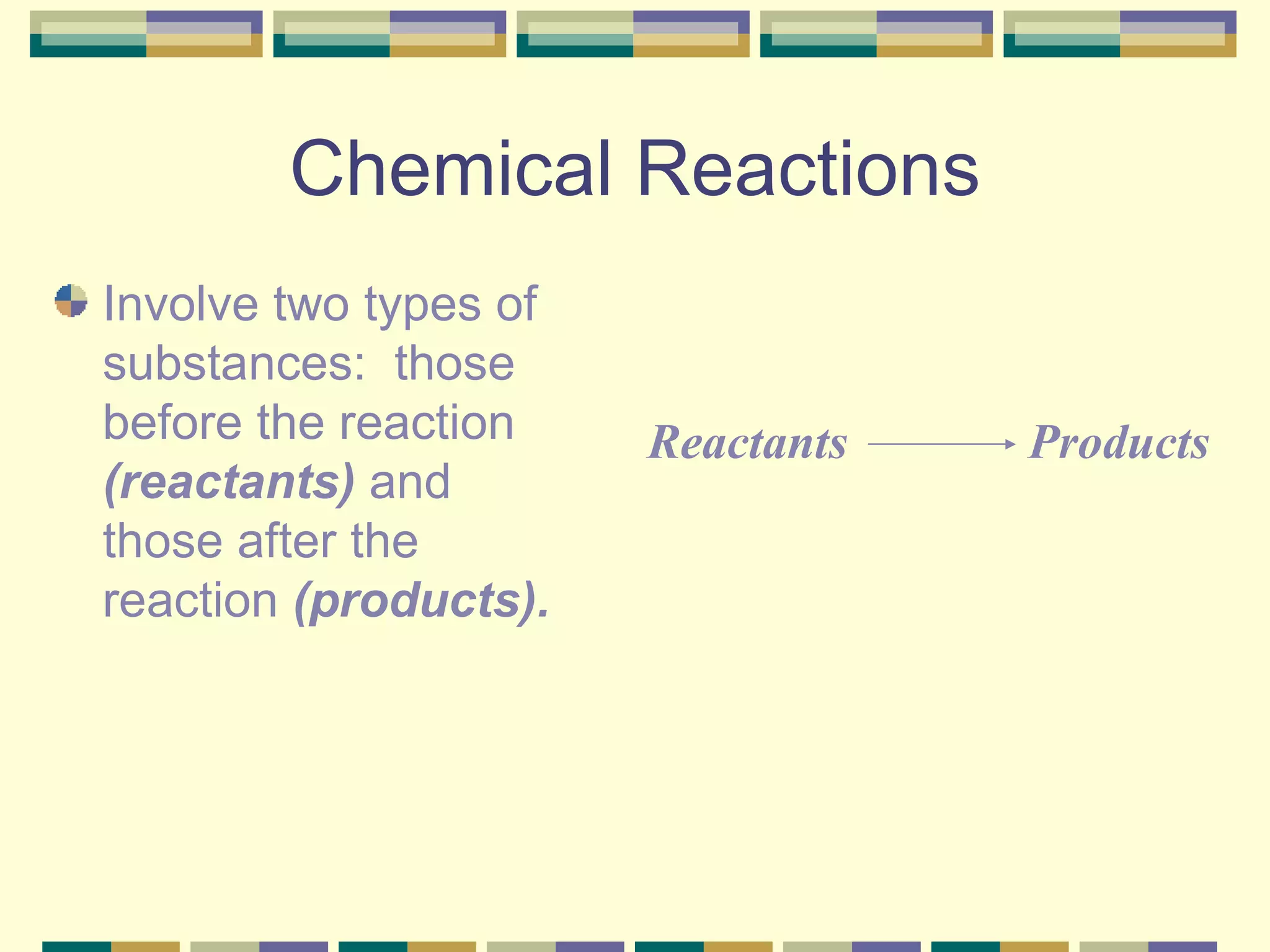
Chemical Reactions Involve two types of substances:  those before the reaction  (reactants)  and those after the reaction  (products). Reactants   Products
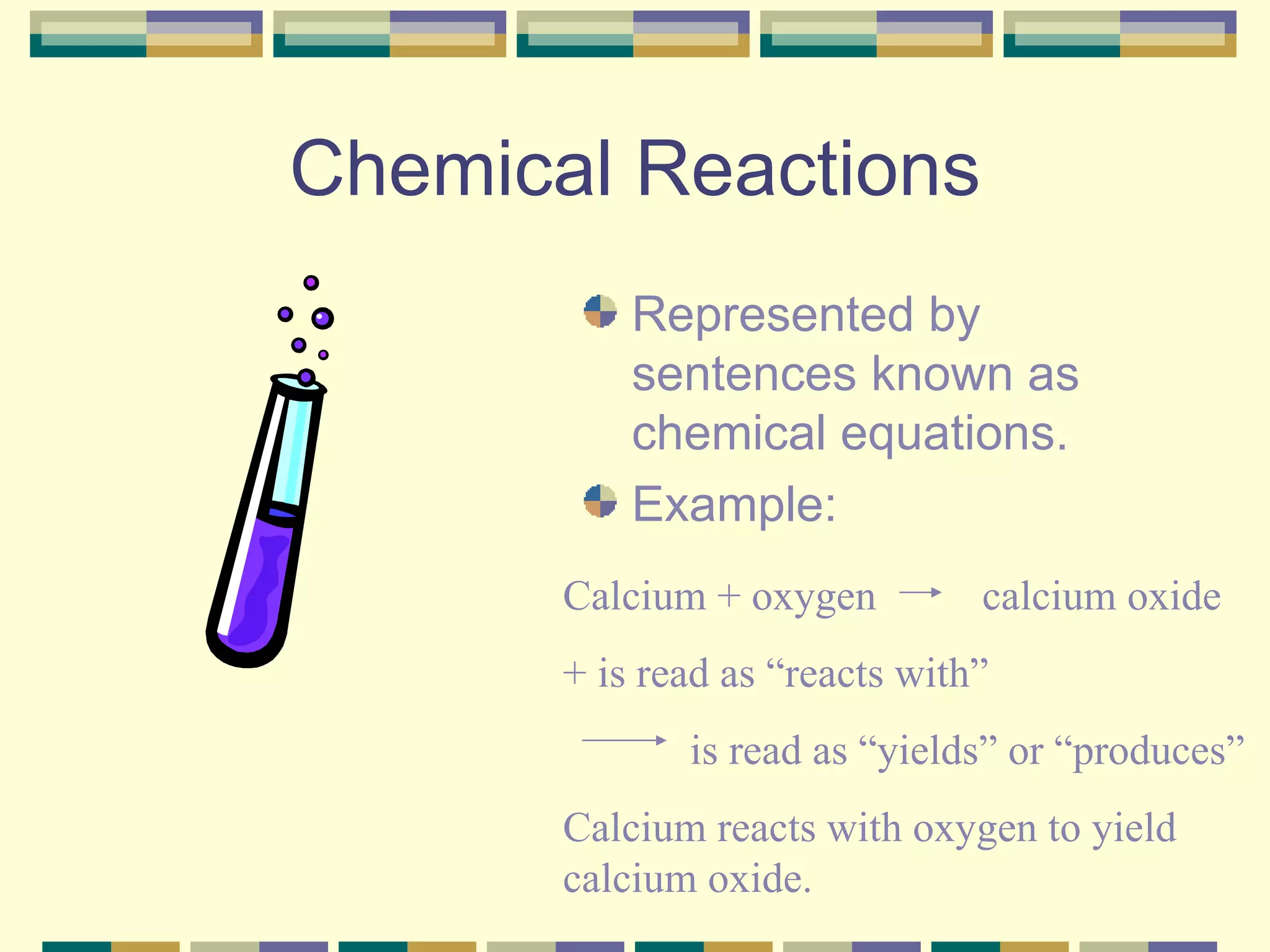
Chemical Reactions Represented by sentences known as chemical equations. Example: Calcium + oxygen  calcium oxide + is read as “reacts with” is read as “yields” or “produces” Calcium reacts with oxygen to yield calcium oxide.
Chemical Reactions To show that mass is conserved in a reaction,  the number of atoms of each element must be the same before and after a chemical reaction Called a balanced equation To balance a chemical equation, use  coefficients,  whole numbers written before the formulas of reactants and products. Example:  2 H 2  + O 2  2 H 2 O
Types of Chemical Reactions Direct combination (synthesis) Example:  2Na + Cl 2   2NaCl Decomposition Example:  CaCO 3   CaO + CO 2 Single-Replacement Example:  Mg + CuSO 4   MgSO 4   + Cu Double-Replacement Example:  CaCO 3   + 2HCl  CaCl 2   +  H 2 CO 3

Chemical Reactions

  • 1.
    Chemical Reaction Definition: a process in which one or more substances are converted into new substances with different physical and chemical properties.
  • 2.
    Chemical Reactions Involvetwo types of substances: those before the reaction (reactants) and those after the reaction (products). Reactants Products
  • 3.
    Chemical Reactions Representedby sentences known as chemical equations. Example: Calcium + oxygen calcium oxide + is read as “reacts with” is read as “yields” or “produces” Calcium reacts with oxygen to yield calcium oxide.
  • 4.
    Chemical Reactions Toshow that mass is conserved in a reaction, the number of atoms of each element must be the same before and after a chemical reaction Called a balanced equation To balance a chemical equation, use coefficients, whole numbers written before the formulas of reactants and products. Example: 2 H 2 + O 2 2 H 2 O
  • 5.
    Types of ChemicalReactions Direct combination (synthesis) Example: 2Na + Cl 2 2NaCl Decomposition Example: CaCO 3 CaO + CO 2 Single-Replacement Example: Mg + CuSO 4 MgSO 4 + Cu Double-Replacement Example: CaCO 3 + 2HCl CaCl 2 + H 2 CO 3