FLUID MECHANICS
Ih. Moha,mmeil H S Zangana
Email: moha,mmeil"zaagana@koyauniversity.org
"Lectures in Elementary Fluid Dynamics", By, J.
M. McDonough, 2009.
Importance of n'luiils
Fluids are involved in our transportation systems in many
ways;
. They have an effect on our recreation (e.9., basketballs
and footballs are inflated with air).
. Entertainment (the sound from the speakers of a TV
would not reach our ears in the absence of air).
13
Importance of Fluitl,s
Importance of fluids can be classified in two main
categories:
re i) Physical and natural science.
re ii) Technology.
Clearly, the second of these is often of more interest to an
engineering student
Definition of a fluiil
A fluid is a substance that deforms continuously when
subjected to a shear stress, no matter how small that
shear stress may be.
A shear force is the force component tangent to a
surface, and this force divided by the area of the
surface is the average shear stress over the area. Shear
stress at a point is the limiting value of shear force to
area as the area is reduced to the point.
Definition of a fluiil
Figure l.l Deformation resulting from application of constant shear foroe.
ln Figure 1.1 a substance is placed between two closely spaced parallel plates
so large that conditions at their edges may be neglected. The lower plate is
fixed, and a force F is applied to the upper plate, which exerts a shear stress
F/A on any substance between the plates, A is the area of the upper plate, if
the force F causes the upper plate to move with a steady (no zero) velocity, no
matter how small the magnitude of F, then the substance between the two
plates is a fluid.
Definition of afluiil
c The fluid in immediate contact with a solid
boundary has the same velocity as the boundary
GD.
x The fluid in the area abcd flows to the new
position ab'c'd.
ffi Each fluid particle moving parallel to tl,re plate
and the velobity u varying from zero at the
stationary plate to U at the upper plate.
Definition of a fluid
In Equation l.I, F is directly proportional to A and to U and is inversely
proportional to thickness t:
(1 .1)
(1.2)
Then: (1.3)
Where:-
El = shear stress (N/m2)
H = Viscosity of the Fluid (N.s/m2)
It = the rate of deformation (s-1)
4
Newtonian antl non- Newtonian Fluitl
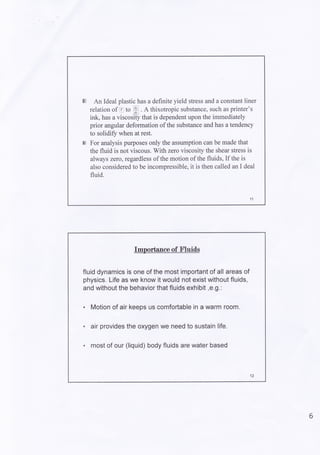
Equation 1".3 is Newton's law of viscosity, based on that;
fluids are classified as Newtonian or non-Newtonian. In
Newtonian fluid there is a linear relation between the
magnitude of applied shear stress and the resulting rate of
deformation ( IIt is constant), however in non-Newtonian fluid
there is a nonlinear relation between the magnitude of applied
shear stress and the resulting rate of deformation (See Figure
L.2). Gases and most common liquids tend to be Newtonian
fluids, while thick, long chained hydrocarbons may be non-
Newtonian.
n'igure 1.2
An Ideal plastic has a definite yield stress and a constant liner
relation of E to ffi . e thixotropic substance, such as printer's
ink, has a viscosi-ty that is dependent upon the immediately
prior angular deformation of the substance and has a tendency
to solidiSz when at rest.
For analysis pu{poses only the assumption can be made that
the fluid is not viscous. With zero viscosity the shear stress is
always zero,regardless of the motion of the fluids, If the is
also considered to be incompressible, it is then called an I deal
fluid.
Importance of n'luitls
fluid dynamics is one of the most important of all areas of
physics. Life as we know it would not exist without fluids,
and without the behavior that fluids exhibit ,e.9.:
. Motion of air keeps us comfortable in a warm room.
. air provides the oxygen we need to sustain life.
. most of our (liquid) body fluids are water based
6
Importance of I'luids
Fluids are involved in our transportation systems in many
ways;
. They have an effect on our recreation (e.9., basketballs
and footballs are inflated with air).
. Entertainment (the sound from the speakers of a TV
would not reach our ears in the absence of air),
Importance of nluitls
lmportance of fluids can be classified in two main
categories:
m, i) Physical and natural science.
&l ii) Technology.
Clearly, the second of these is often of more interest to an
engineering student
Units anil Dimensions
Mass, Length and Time are commonly used as primary units,
other units being derived from them. Their dimensions are
written as M, L and T respectively" Sometimes force is used as
a primary unit and its dimension is written as F.
The dimensions of velocity, which is a rate of increase of
distance with time, may be written as LT-I, and those of
acceleration, the rate of increase of velocity. are LT-2. An area
has dimensions L2 and a volume has the dimensions L3.
The volume of a body does not completely define the amount
of material which it contains, and therefore it is usual to define
a third basic quantity, the amount of matter in the body, that is
its mass M. Thus the density of the material, its mass per unit
volume, has the dimensions ML3. However, in the British
Engineering System force F is used as the third fundamental
and mass then becomes a derived dimension.
B
'etrole..r (r1r|^<sr
Students of most areas of engineering soon discover that the
data used are expressed in a great variety of different units, so
that quantities must be converted into a common system before
proceeding with calculations. Most of the physical properties
determined in the laboratory will originally have been
expressed in the cgs system, whereas the dimensions of the
full-scale plant, its throughput, design, and operating
characteristics appear either in some form of general
engineering units or in special units which have their origin in
the history of the particular industry.
17
Familiarity with the various systems of units and an ability to
convert from one to another are therefore essential, as it will
frequently be necessary to access literature in which the SI
system has not been used.
18
9
SYSTEMS OE UNITS
Although in scientific work mass is taken as the third
fundamental quantity and in engineering force is sometimes
used as mentioned above, the fundamental quantities L, M, F,
T may be used interchangeably. A summary of the various
systems of units, and the quantities associated with them, is
given in Table 1.1.
Tab1e 1.1
(h*$ {P * ti*
fls tffi *rFh lMd
ts** *fl9*r* ts* t$
1iM sed Md *Mi
&&1 iy* &ce W#
Ss$f w (e 16* ldB.| kb t*Fhn&t
lms {s4*{@ a'tu *5edq r*su sd:tqBm t*
&F$ cd*B tk! W'WI&Eeld
urlr*ii c.rrlxm't h{tutt,&$*rr x relBu*l4ks'{' I :T }, i r;*5dri6't
trr.vr*stF. S-iir"lgrryft&"(' $)nr&NN ..*!n@d*&rd C tI ll.)I'rr' r,&,ltrk&6d
10
The centimeter- gra,m- seconil (cgs) system
In this system the basic units are of length L, mass M, and time T with the nomenclature:
&
YS
Length:
Mass:
Time:
Dimension L:
Dimension M:
Dimension T:
Unit I centimetre
Unit i gram
Unit I second
(1 cm)
(l e)
(1S)
The unit of force is that force which will give a mass of I g an acceleration of I cm/s2 and is
&;
6
known as the dyne:
Force:
Energy:
Power:
Dimension F = MLT-2:
Dimensions ML2T-2
Dimensions ML2T-3
Unit 1 dyre
Unit I erg
Unit 1 ergls
(1 dyn)
21
S.usterue
It temati on aI d' Uni tes (SD
These systems are in essence modifications ofthe cgs system but employ larger units.
The basic dimensions are again of L, M, and T.
ffi Length:
14 Mass:
m Time:
Dimension L:
Dimension M:
Dimension T:
Unit 1 metre
Unit 1 kilogram
ljnit I second
(1m)
(1 ke)
(1 s)The
unit of force, known as the Newton, is that force which will give an acceleration of I m/s2 to a
mass of one kilogram. Thus 1 N = I kg m/s2 with dimensions MLT-2, and one Newton equals
105 dynes. The energy unit, theNewton-metre, is 10i ergs and is called the Joule;andlhe
power unit, equal to one Joule per second, is known as the WatL
E
E
}i
Thus:
Force:
Energy:
Power:
Dimensions MLT'2:
Dimensions ML2T-2:
Dimensions ML2T-3:
Unit l Newton (IN) or l kgm/s2
Unit 1 Joule (1 J) or 1 kgm2/s2
Unit 1 Watt (l W) or 1 kg m2ls3
22
11
The basic units in this system are:
Length: Dimension L: Unit 1 foot (1 ft)
Mass: Dimension M: Unit I Pound (l Ib)
Time: Dimension T: Unit I second (l s)
The unit offorce gives that which a mass of I Ib an aoceleration of I ff/s2 is known
as the poundal (pdl). The unit of energy (or work) is the foot-poundal, and the unit of power is
the foot poundal per second.
Thus:
Force Dimensions MLT-2 Unit I poundal (1 pdl)
Energy Dimensions ML2T-2 Unit I ft-poundal
Power Dimensions ML2T-3 Unit I foot-poundal/s
The British engineering system
In an alternative form of the fps system (Engineering
system) the units of length (ft) and time (s) are
unchanged, but the third fundamental is a unit of
force (F) instead of mass and is known as the pound
force (Ibfl. This is defined as the force which gives a
mass of 1 Ib an acceleration of 32J740 ft.1s2, the
"standard" value of the acceleration due to gravity.
t2
The British engineering system
It is therefore a fixed quantity and must not be confused with
the pound weight which is the force exerted by the earth's
gravitational field on a mass of one pound and which varies
from place to place as g varies. It will be noted therefore that
the pound force and the pound weight have the same value
only when gis32.1740 ft21s. The unit of mass in this system is
known as the slug, and is the mass which is given an
acceleration of I ff/s2 by a one pound force:
1 slug= 1 lbf ft-1s2
Ihe British engineerfug system
Misunderstanding often arises from the fact that the pound
which is the unit of mass in the fps system has the same name
as the unit of force in the engineering system. To avoid
confusion the pound mass should be written as Ib or even lbm
and the unit of force always as lbf. It will be noted that:
1 slug :32.1740Ib mass and 1 lbf : 32.1740 pdl
26
13
h To summarise:
The basic units are:
x Length Dimension L Unit 1 foot (1 ft)
6 Force DimensionF Unit 1 pound-force (1 Ibl)
si Time Dimension T Unit 1 second (1 s)
m The derived units are:
B Mass Dimensions FL-1T2 Unit
6 Energy Dimensions FL Unit
$i Power Dimensions FLT-I Unit
stug (= 32.1 740 pounds)
footpound-force (l ftlbfl
foot-pound force/s (1 ft-1b17,
6,
g: Note: t horsepower is defined as 550 ft-lbfls.
I{on-coherent system employing pounal mass antl pounil
force simultaneously
Two units which have never been popular in the last two
systems of units are the poundal (for force) and the slug (for
mass). As a result, many writers, particularly in America, use
both.the pound mass and pound force as basic units in the
same equAtion because theyare the units in common use. This
is an essentially incoherent system and requires great care in
its use.
L4
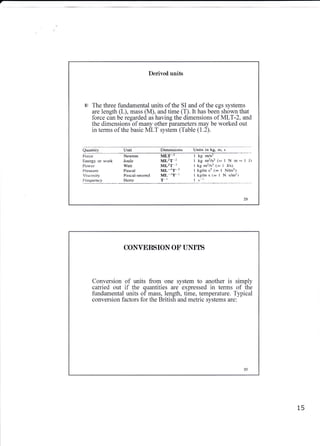
Derivetl units
h: The three fundamental units of the SI and of the cgs systems
are length (L), mass (M), and time (T). It has been shown that
force can be regarded as having the dimensions of MLT-2, and
the dimensions of many other parameters may be worked out
in terms of the basic MLT system (Table (1.2),
Qu{rl}ti{} Unit Shnerrsion* Llnits in kg, m, r
Newt+n kg m/s?
.kg m?ls? 1*
kg rnllss 1*
kglrn *3 1- I
kg/rn s (* I
s'
Etergy *r r+ork J<:ule M[,3T*;
ML2"r".j
ML*1T.
1N m*l.ll
t J/$)
l,#m:1
N xlmri
P+tt er
Pre*gure
Visc:r.rsity
.F:requency
W$:t
Pascal-second lVft.- lT
?le*t 't't
CONVERSION OF'UNfTfi
Conversion of units from one system to another is simply
camied out if the quantities are expressed in terms of the
fundamental units of mass, length, time, temperature. Typical
conversion factors for the British and metric systems are:
15
;
Thank you
CONVERSION OX'IINfNi
Mffis
Leirgth
1fime
T*mpemt*re
diff*renee
Force
, * * (*) s)ug* 453.6 s = *'4535 ks
1 tf * 30.48 cm * 0.3{J48 nr
'..-(#)h
,'r* (*) *- i*) K (ordqs.K)
t pourd fur*e * I2.? pourrdal * 4.44 x Itri tty*re * 4.44 N
16

Fluid mechanics chapter one

  • 1.
    FLUID MECHANICS Ih. Moha,mmeilH S Zangana Email: moha,mmeil"zaagana@koyauniversity.org "Lectures in Elementary Fluid Dynamics", By, J. M. McDonough, 2009.
  • 2.
    Importance of n'luiils Fluidsare involved in our transportation systems in many ways; . They have an effect on our recreation (e.9., basketballs and footballs are inflated with air). . Entertainment (the sound from the speakers of a TV would not reach our ears in the absence of air). 13 Importance of Fluitl,s Importance of fluids can be classified in two main categories: re i) Physical and natural science. re ii) Technology. Clearly, the second of these is often of more interest to an engineering student
  • 3.
    Definition of afluiil A fluid is a substance that deforms continuously when subjected to a shear stress, no matter how small that shear stress may be. A shear force is the force component tangent to a surface, and this force divided by the area of the surface is the average shear stress over the area. Shear stress at a point is the limiting value of shear force to area as the area is reduced to the point. Definition of a fluiil Figure l.l Deformation resulting from application of constant shear foroe. ln Figure 1.1 a substance is placed between two closely spaced parallel plates so large that conditions at their edges may be neglected. The lower plate is fixed, and a force F is applied to the upper plate, which exerts a shear stress F/A on any substance between the plates, A is the area of the upper plate, if the force F causes the upper plate to move with a steady (no zero) velocity, no matter how small the magnitude of F, then the substance between the two plates is a fluid.
  • 4.
    Definition of afluiil cThe fluid in immediate contact with a solid boundary has the same velocity as the boundary GD. x The fluid in the area abcd flows to the new position ab'c'd. ffi Each fluid particle moving parallel to tl,re plate and the velobity u varying from zero at the stationary plate to U at the upper plate. Definition of a fluid In Equation l.I, F is directly proportional to A and to U and is inversely proportional to thickness t: (1 .1) (1.2) Then: (1.3) Where:- El = shear stress (N/m2) H = Viscosity of the Fluid (N.s/m2) It = the rate of deformation (s-1) 4
  • 5.
    Newtonian antl non-Newtonian Fluitl Equation 1".3 is Newton's law of viscosity, based on that; fluids are classified as Newtonian or non-Newtonian. In Newtonian fluid there is a linear relation between the magnitude of applied shear stress and the resulting rate of deformation ( IIt is constant), however in non-Newtonian fluid there is a nonlinear relation between the magnitude of applied shear stress and the resulting rate of deformation (See Figure L.2). Gases and most common liquids tend to be Newtonian fluids, while thick, long chained hydrocarbons may be non- Newtonian. n'igure 1.2
  • 6.
    An Ideal plastichas a definite yield stress and a constant liner relation of E to ffi . e thixotropic substance, such as printer's ink, has a viscosi-ty that is dependent upon the immediately prior angular deformation of the substance and has a tendency to solidiSz when at rest. For analysis pu{poses only the assumption can be made that the fluid is not viscous. With zero viscosity the shear stress is always zero,regardless of the motion of the fluids, If the is also considered to be incompressible, it is then called an I deal fluid. Importance of n'luitls fluid dynamics is one of the most important of all areas of physics. Life as we know it would not exist without fluids, and without the behavior that fluids exhibit ,e.9.: . Motion of air keeps us comfortable in a warm room. . air provides the oxygen we need to sustain life. . most of our (liquid) body fluids are water based 6
  • 7.
    Importance of I'luids Fluidsare involved in our transportation systems in many ways; . They have an effect on our recreation (e.9., basketballs and footballs are inflated with air). . Entertainment (the sound from the speakers of a TV would not reach our ears in the absence of air), Importance of nluitls lmportance of fluids can be classified in two main categories: m, i) Physical and natural science. &l ii) Technology. Clearly, the second of these is often of more interest to an engineering student
  • 8.
    Units anil Dimensions Mass,Length and Time are commonly used as primary units, other units being derived from them. Their dimensions are written as M, L and T respectively" Sometimes force is used as a primary unit and its dimension is written as F. The dimensions of velocity, which is a rate of increase of distance with time, may be written as LT-I, and those of acceleration, the rate of increase of velocity. are LT-2. An area has dimensions L2 and a volume has the dimensions L3. The volume of a body does not completely define the amount of material which it contains, and therefore it is usual to define a third basic quantity, the amount of matter in the body, that is its mass M. Thus the density of the material, its mass per unit volume, has the dimensions ML3. However, in the British Engineering System force F is used as the third fundamental and mass then becomes a derived dimension. B
  • 9.
    'etrole..r (r1r|^<sr Students ofmost areas of engineering soon discover that the data used are expressed in a great variety of different units, so that quantities must be converted into a common system before proceeding with calculations. Most of the physical properties determined in the laboratory will originally have been expressed in the cgs system, whereas the dimensions of the full-scale plant, its throughput, design, and operating characteristics appear either in some form of general engineering units or in special units which have their origin in the history of the particular industry. 17 Familiarity with the various systems of units and an ability to convert from one to another are therefore essential, as it will frequently be necessary to access literature in which the SI system has not been used. 18 9
  • 10.
    SYSTEMS OE UNITS Althoughin scientific work mass is taken as the third fundamental quantity and in engineering force is sometimes used as mentioned above, the fundamental quantities L, M, F, T may be used interchangeably. A summary of the various systems of units, and the quantities associated with them, is given in Table 1.1. Tab1e 1.1 (h*$ {P * ti* fls tffi *rFh lMd ts** *fl9*r* ts* t$ 1iM sed Md *Mi &&1 iy* &ce W# Ss$f w (e 16* ldB.| kb t*Fhn&t lms {s4*{@ a'tu *5edq r*su sd:tqBm t* &F$ cd*B tk! W'WI&Eeld urlr*ii c.rrlxm't h{tutt,&$*rr x relBu*l4ks'{' I :T }, i r;*5dri6't trr.vr*stF. S-iir"lgrryft&"(' $)nr&NN ..*!n@d*&rd C tI ll.)I'rr' r,&,ltrk&6d 10
  • 11.
    The centimeter- gra,m-seconil (cgs) system In this system the basic units are of length L, mass M, and time T with the nomenclature: & YS Length: Mass: Time: Dimension L: Dimension M: Dimension T: Unit I centimetre Unit i gram Unit I second (1 cm) (l e) (1S) The unit of force is that force which will give a mass of I g an acceleration of I cm/s2 and is &; 6 known as the dyne: Force: Energy: Power: Dimension F = MLT-2: Dimensions ML2T-2 Dimensions ML2T-3 Unit 1 dyre Unit I erg Unit 1 ergls (1 dyn) 21 S.usterue It temati on aI d' Uni tes (SD These systems are in essence modifications ofthe cgs system but employ larger units. The basic dimensions are again of L, M, and T. ffi Length: 14 Mass: m Time: Dimension L: Dimension M: Dimension T: Unit 1 metre Unit 1 kilogram ljnit I second (1m) (1 ke) (1 s)The unit of force, known as the Newton, is that force which will give an acceleration of I m/s2 to a mass of one kilogram. Thus 1 N = I kg m/s2 with dimensions MLT-2, and one Newton equals 105 dynes. The energy unit, theNewton-metre, is 10i ergs and is called the Joule;andlhe power unit, equal to one Joule per second, is known as the WatL E E }i Thus: Force: Energy: Power: Dimensions MLT'2: Dimensions ML2T-2: Dimensions ML2T-3: Unit l Newton (IN) or l kgm/s2 Unit 1 Joule (1 J) or 1 kgm2/s2 Unit 1 Watt (l W) or 1 kg m2ls3 22 11
  • 12.
    The basic unitsin this system are: Length: Dimension L: Unit 1 foot (1 ft) Mass: Dimension M: Unit I Pound (l Ib) Time: Dimension T: Unit I second (l s) The unit offorce gives that which a mass of I Ib an aoceleration of I ff/s2 is known as the poundal (pdl). The unit of energy (or work) is the foot-poundal, and the unit of power is the foot poundal per second. Thus: Force Dimensions MLT-2 Unit I poundal (1 pdl) Energy Dimensions ML2T-2 Unit I ft-poundal Power Dimensions ML2T-3 Unit I foot-poundal/s The British engineering system In an alternative form of the fps system (Engineering system) the units of length (ft) and time (s) are unchanged, but the third fundamental is a unit of force (F) instead of mass and is known as the pound force (Ibfl. This is defined as the force which gives a mass of 1 Ib an acceleration of 32J740 ft.1s2, the "standard" value of the acceleration due to gravity. t2
  • 13.
    The British engineeringsystem It is therefore a fixed quantity and must not be confused with the pound weight which is the force exerted by the earth's gravitational field on a mass of one pound and which varies from place to place as g varies. It will be noted therefore that the pound force and the pound weight have the same value only when gis32.1740 ft21s. The unit of mass in this system is known as the slug, and is the mass which is given an acceleration of I ff/s2 by a one pound force: 1 slug= 1 lbf ft-1s2 Ihe British engineerfug system Misunderstanding often arises from the fact that the pound which is the unit of mass in the fps system has the same name as the unit of force in the engineering system. To avoid confusion the pound mass should be written as Ib or even lbm and the unit of force always as lbf. It will be noted that: 1 slug :32.1740Ib mass and 1 lbf : 32.1740 pdl 26 13
  • 14.
    h To summarise: Thebasic units are: x Length Dimension L Unit 1 foot (1 ft) 6 Force DimensionF Unit 1 pound-force (1 Ibl) si Time Dimension T Unit 1 second (1 s) m The derived units are: B Mass Dimensions FL-1T2 Unit 6 Energy Dimensions FL Unit $i Power Dimensions FLT-I Unit stug (= 32.1 740 pounds) footpound-force (l ftlbfl foot-pound force/s (1 ft-1b17, 6, g: Note: t horsepower is defined as 550 ft-lbfls. I{on-coherent system employing pounal mass antl pounil force simultaneously Two units which have never been popular in the last two systems of units are the poundal (for force) and the slug (for mass). As a result, many writers, particularly in America, use both.the pound mass and pound force as basic units in the same equAtion because theyare the units in common use. This is an essentially incoherent system and requires great care in its use. L4
  • 15.
    Derivetl units h: Thethree fundamental units of the SI and of the cgs systems are length (L), mass (M), and time (T). It has been shown that force can be regarded as having the dimensions of MLT-2, and the dimensions of many other parameters may be worked out in terms of the basic MLT system (Table (1.2), Qu{rl}ti{} Unit Shnerrsion* Llnits in kg, m, r Newt+n kg m/s? .kg m?ls? 1* kg rnllss 1* kglrn *3 1- I kg/rn s (* I s' Etergy *r r+ork J<:ule M[,3T*; ML2"r".j ML*1T. 1N m*l.ll t J/$) l,#m:1 N xlmri P+tt er Pre*gure Visc:r.rsity .F:requency W$:t Pascal-second lVft.- lT ?le*t 't't CONVERSION OF'UNfTfi Conversion of units from one system to another is simply camied out if the quantities are expressed in terms of the fundamental units of mass, length, time, temperature. Typical conversion factors for the British and metric systems are: 15
  • 16.
    ; Thank you CONVERSION OX'IINfNi Mffis Leirgth 1fime T*mpemt*re diff*renee Force ,* * (*) s)ug* 453.6 s = *'4535 ks 1 tf * 30.48 cm * 0.3{J48 nr '..-(#)h ,'r* (*) *- i*) K (ordqs.K) t pourd fur*e * I2.? pourrdal * 4.44 x Itri tty*re * 4.44 N 16