Wellcome to our presentation
DHAKA INTERNATIONAL
UNIVERSITY
8/16/2023
1
CHEMICAL BONDS
Presented By:
A. Zubayer Ahmad -29
B. Shohel Rana -13
C. Raiyan Hossain -24
D. Jihadul Islam -10
8/16/2023 2
Introduction to Chemical Bonds
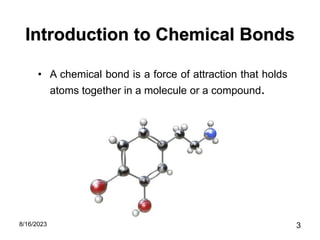
• A chemical bond is a force of attraction that holds
atoms together in a molecule or a compound.
8/16/2023 3
8/16/2023 4
Ionic Bond
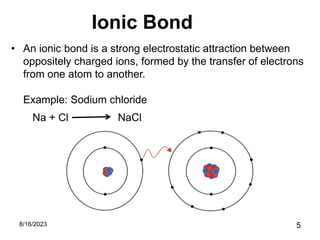
• An ionic bond is a strong electrostatic attraction between
oppositely charged ions, formed by the transfer of electrons
from one atom to another.
Example: Sodium chloride
Na + Cl NaCl
8/16/2023 5
Covalent Bond
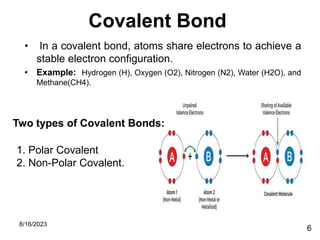
• In a covalent bond, atoms share electrons to achieve a
stable electron configuration.
• Example: Hydrogen (H), Oxygen (O2), Nitrogen (N2), Water (H2O), and
Methane(CH4).
8/16/2023
6
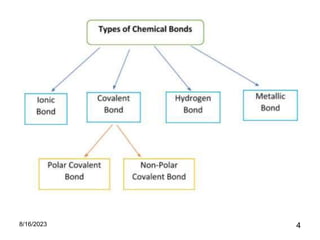
Two types of Covalent Bonds:
1. Polar Covalent
2. Non-Polar Covalent.
Metallic Bond
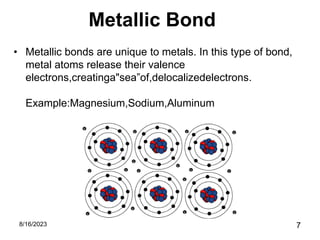
• Metallic bonds are unique to metals. In this type of bond,
metal atoms release their valence
electrons,creatinga"sea”of,delocalizedelectrons.
Example:Magnesium,Sodium,Aluminum
8/16/2023 7
Hydrogen bond
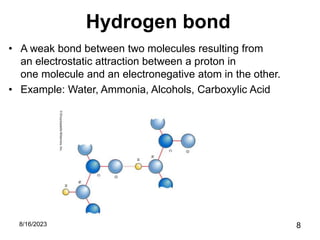
• A weak bond between two molecules resulting from
an electrostatic attraction between a proton in
one molecule and an electronegative atom in the other.
• Example: Water, Ammonia, Alcohols, Carboxylic Acid
8/16/2023 8
Importance of Chemical bonds
Chemical bonds are of paramount importance in
various aspects of chemistry and the natural world
• Stability of Matter: Chemical bonds are
responsible for holding atoms together to form
molecules and compounds.
• Formation of Compounds: Chemical bonds allow
elements to combine and form an immense
variety of compounds with unique properties and
functionalities.
8/16/2023 9
Real-world Applications
• Pharmaceutials: Understanding chemical bonds aids in drug
design, where molecules with specific bonding patterns can
target and interact with biological receptors to treat diseases
effectively.
8/16/2023 10
Electrochemistry: The study of chemical bonds is crucial in
designing and optimizing batteries and supercapacitors,
enhancing energy storage technologies.
8/16/2023 11
Agriculture: Chemical bonding principles are employed
in designing fertilizers, pesticides, and herbicides that
improve crop yield and minimize environmental impact.
8/16/2023 12
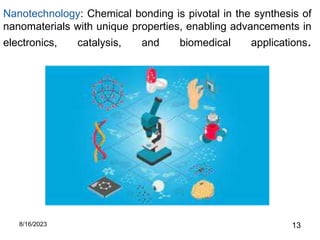
Nanotechnology: Chemical bonding is pivotal in the synthesis of
nanomaterials with unique properties, enabling advancements in
electronics, catalysis, and biomedical applications.
8/16/2023 13
Thank You
8/16/2023 14

Chemical Bonds.pptx

  • 1.
    Wellcome to ourpresentation DHAKA INTERNATIONAL UNIVERSITY 8/16/2023 1
  • 2.
    CHEMICAL BONDS Presented By: A.Zubayer Ahmad -29 B. Shohel Rana -13 C. Raiyan Hossain -24 D. Jihadul Islam -10 8/16/2023 2
  • 3.
    Introduction to ChemicalBonds • A chemical bond is a force of attraction that holds atoms together in a molecule or a compound. 8/16/2023 3
  • 4.
  • 5.
    Ionic Bond • Anionic bond is a strong electrostatic attraction between oppositely charged ions, formed by the transfer of electrons from one atom to another. Example: Sodium chloride Na + Cl NaCl 8/16/2023 5
  • 6.
    Covalent Bond • Ina covalent bond, atoms share electrons to achieve a stable electron configuration. • Example: Hydrogen (H), Oxygen (O2), Nitrogen (N2), Water (H2O), and Methane(CH4). 8/16/2023 6 Two types of Covalent Bonds: 1. Polar Covalent 2. Non-Polar Covalent.
  • 7.
    Metallic Bond • Metallicbonds are unique to metals. In this type of bond, metal atoms release their valence electrons,creatinga"sea”of,delocalizedelectrons. Example:Magnesium,Sodium,Aluminum 8/16/2023 7
  • 8.
    Hydrogen bond • Aweak bond between two molecules resulting from an electrostatic attraction between a proton in one molecule and an electronegative atom in the other. • Example: Water, Ammonia, Alcohols, Carboxylic Acid 8/16/2023 8
  • 9.
    Importance of Chemicalbonds Chemical bonds are of paramount importance in various aspects of chemistry and the natural world • Stability of Matter: Chemical bonds are responsible for holding atoms together to form molecules and compounds. • Formation of Compounds: Chemical bonds allow elements to combine and form an immense variety of compounds with unique properties and functionalities. 8/16/2023 9
  • 10.
    Real-world Applications • Pharmaceutials:Understanding chemical bonds aids in drug design, where molecules with specific bonding patterns can target and interact with biological receptors to treat diseases effectively. 8/16/2023 10
  • 11.
    Electrochemistry: The studyof chemical bonds is crucial in designing and optimizing batteries and supercapacitors, enhancing energy storage technologies. 8/16/2023 11
  • 12.
    Agriculture: Chemical bondingprinciples are employed in designing fertilizers, pesticides, and herbicides that improve crop yield and minimize environmental impact. 8/16/2023 12
  • 13.
    Nanotechnology: Chemical bondingis pivotal in the synthesis of nanomaterials with unique properties, enabling advancements in electronics, catalysis, and biomedical applications. 8/16/2023 13
  • 14.