Solids, Liquids, and Gases
Ch. 2
Lesson 1
States of Matter
How many states of matter can
you spot in the picture?
Solid
Liquid
Gas
Solids, Liquids, and Gases: Which is which?
Describing Solids
•Solid: Has a definite shape
and a definite volume
•What does volume mean
again? (The amount of space
an object fills)
•Particles are tightly packed
•Particles may vibrate in place
but will not move around
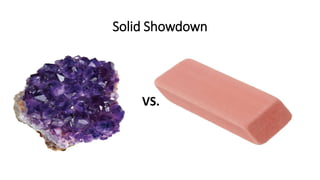
Solid Showdown
VS.
Types of Solids
Amorphous Solids
• Particles are not arranged in a
particular order
• Do not melt at a particular
temperature
Crystalline Solids
• Particles are all uniformly
organized
• Melt at a certain temperature
Describing Liquids
• Liquid: Has no definite shape
but does have a definite
volume
• Particles all touch but are not
as tightly packed as solids
• Freely moving particles
Characteristics of Liquids
• Surface tension: An inward force that
pulls particles closer together
• Due to high attraction between water
molecules
• Allows some insects to walk on the
surface of water
• Viscosity: Resistance to flowing
• Depends on the size and and shape of
particles
• Highly viscous = flow slower
• Low viscosity = flow quickly
Describing Gases
• Gas: Has no definite shape
or volume
• Particles do not touch each
other
• Particles expand to fill a
container
Lesson 2
Changes of State
Energy
• The two main types of energy:
1. Potential: Stored energy
2. Kinetic: Energy in motion
Temperature
Temperature: How hot or cold something is (measure of kinetic energy)
Thermal Energy
• Thermal Energy: The total energy of the motion of all the particles in
an object (kinetic and potential energy)
• When matter changes, thermal energy is usually released or
absorbed.
Changes of State Between Solid and Liquid
• Melting: When solid changes to liquid
• Melting Point: The temperature at which a substance’s particles vibrate so much
that they break free from their fixed position.
• Water’s melting point is 0℃
Changes of State Between Solid and Liquid
• Freezing Point: The temperature at which a liquid changes to a solid
• Water’s freezing point is 0℃
Changes of State Between Liquid and Gas
Evaporation
• Vaporization that takes place
only at the surface of a liquid
• Evaporation can occur at varying
temperatures
Boiling
• Vaporization that takes place
both below and at the surface of
a liquid
• Boiling Point: The temperature
at which a liquid begins to boil
• Boiling point of water is 100℃
Vaporization: The change in state from a liquid to a gas…two types: evaporation & boiling
The Effect of Pressure
Pressure = Force / Area
Atmospheric Pressure
•Atmospheric Pressure: The air that surrounds us that is always
applying pressure
•As altitude increases, atmospheric pressure and air density
decrease
•Less dense air will have less atmospheric pressure (like on top
of a mountain!)….this means water will boil quicker
•Boiling point is reached easier when less pressure is being
applied
Condensation
• Condensation: The change in state from a gas to a liquid
• In other words, it is the opposite of vaporization
• This is how clouds are formed! Tiny water droplets become suspended in the air
Changing State from Solid to Gas
• Sublimation: Occurs when the surface particles of a solid fain enough energy that
they form a gas
• Particles do not first become a liquid…they just go from solid to gas
• Example: Dry ice changes directly from a solid to a gas

Sci 6.2

  • 1.
  • 2.
  • 3.
    How many statesof matter can you spot in the picture? Solid Liquid Gas
  • 4.
    Solids, Liquids, andGases: Which is which?
  • 5.
    Describing Solids •Solid: Hasa definite shape and a definite volume •What does volume mean again? (The amount of space an object fills) •Particles are tightly packed •Particles may vibrate in place but will not move around
  • 6.
  • 7.
    Types of Solids AmorphousSolids • Particles are not arranged in a particular order • Do not melt at a particular temperature Crystalline Solids • Particles are all uniformly organized • Melt at a certain temperature
  • 9.
    Describing Liquids • Liquid:Has no definite shape but does have a definite volume • Particles all touch but are not as tightly packed as solids • Freely moving particles
  • 10.
    Characteristics of Liquids •Surface tension: An inward force that pulls particles closer together • Due to high attraction between water molecules • Allows some insects to walk on the surface of water • Viscosity: Resistance to flowing • Depends on the size and and shape of particles • Highly viscous = flow slower • Low viscosity = flow quickly
  • 11.
    Describing Gases • Gas:Has no definite shape or volume • Particles do not touch each other • Particles expand to fill a container
  • 12.
  • 13.
    Energy • The twomain types of energy: 1. Potential: Stored energy 2. Kinetic: Energy in motion
  • 14.
    Temperature Temperature: How hotor cold something is (measure of kinetic energy)
  • 15.
    Thermal Energy • ThermalEnergy: The total energy of the motion of all the particles in an object (kinetic and potential energy) • When matter changes, thermal energy is usually released or absorbed.
  • 16.
    Changes of StateBetween Solid and Liquid • Melting: When solid changes to liquid • Melting Point: The temperature at which a substance’s particles vibrate so much that they break free from their fixed position. • Water’s melting point is 0℃
  • 17.
    Changes of StateBetween Solid and Liquid • Freezing Point: The temperature at which a liquid changes to a solid • Water’s freezing point is 0℃
  • 18.
    Changes of StateBetween Liquid and Gas Evaporation • Vaporization that takes place only at the surface of a liquid • Evaporation can occur at varying temperatures Boiling • Vaporization that takes place both below and at the surface of a liquid • Boiling Point: The temperature at which a liquid begins to boil • Boiling point of water is 100℃ Vaporization: The change in state from a liquid to a gas…two types: evaporation & boiling
  • 19.
    The Effect ofPressure Pressure = Force / Area
  • 20.
    Atmospheric Pressure •Atmospheric Pressure:The air that surrounds us that is always applying pressure •As altitude increases, atmospheric pressure and air density decrease •Less dense air will have less atmospheric pressure (like on top of a mountain!)….this means water will boil quicker •Boiling point is reached easier when less pressure is being applied
  • 22.
    Condensation • Condensation: Thechange in state from a gas to a liquid • In other words, it is the opposite of vaporization • This is how clouds are formed! Tiny water droplets become suspended in the air
  • 23.
    Changing State fromSolid to Gas • Sublimation: Occurs when the surface particles of a solid fain enough energy that they form a gas • Particles do not first become a liquid…they just go from solid to gas • Example: Dry ice changes directly from a solid to a gas