Checklists
Checklists
 Checklists contain standard steps we don't want to forget. They
deal with recurring processes. They contain important checkpoints
in processes. They are How to Do type.
 Examples of common checklists
 New Client Checklist,
 New Employee Checklist,
 Surgery Preparation Checklist,
 Airplane Takeoff Checklist,
 Daily Store Opening Checklist
 Business Trip Checklist,
 Camping Checklist, etc.
What is Checklist?
 To-do lists deal only with ad hoc situations.
 Once an item is done, it is over.
 To-do lists are not standardized processes.
What is To-do list?
 Years of evolution, advancement in science and technology.
 The volume and complexity of our knowledge have exceeded our
abilities to apply them.
 Simply put, we cannot remember everything we learned.
Why Checklist?
 Two main reasons of failure
• Ignorance (Don’t know or know partially)
• Ineptitude (Know but fail to apply)
 What do you do when expertise is not enough?
 What do you do when super-specialists fail?
 A simple yet effective way to address this is by using checklists.
Why Checklist?
 Helps in Memory Recall
 Helps in Organising tasks
 Essential for complex tasks
 Helps in decision making process
 Inculcates discipline into the process
 Keeps process into focus
 Promotes team work
What Checklist does?
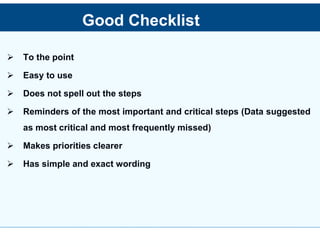
 To the point
 Easy to use
 Does not spell out the steps
 Reminders of the most important and critical steps (Data suggested
as most critical and most frequently missed)
 Makes priorities clearer
 Has simple and exact wording
Good Checklist
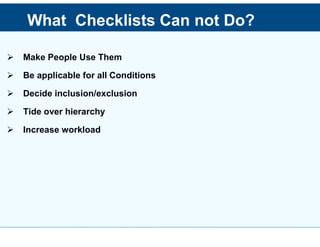
 Make People Use Them
 Be applicable for all Conditions
 Decide inclusion/exclusion
 Tide over hierarchy
 Increase workload
What Checklists Can not Do?
 Push from the top Management
 Flexibility of Customisation without changing the approach
 Use of checklist should show positive results
 Mandatory use of checklist for critical tasks
 Use of checklist may change and improve the existing processes
Implementation of Checklists

Checklist for CSR.pdf

  • 1.
  • 2.
     Checklists containstandard steps we don't want to forget. They deal with recurring processes. They contain important checkpoints in processes. They are How to Do type.  Examples of common checklists  New Client Checklist,  New Employee Checklist,  Surgery Preparation Checklist,  Airplane Takeoff Checklist,  Daily Store Opening Checklist  Business Trip Checklist,  Camping Checklist, etc. What is Checklist?
  • 3.
     To-do listsdeal only with ad hoc situations.  Once an item is done, it is over.  To-do lists are not standardized processes. What is To-do list?
  • 4.
     Years ofevolution, advancement in science and technology.  The volume and complexity of our knowledge have exceeded our abilities to apply them.  Simply put, we cannot remember everything we learned. Why Checklist?
  • 5.
     Two mainreasons of failure • Ignorance (Don’t know or know partially) • Ineptitude (Know but fail to apply)  What do you do when expertise is not enough?  What do you do when super-specialists fail?  A simple yet effective way to address this is by using checklists. Why Checklist?
  • 6.
     Helps inMemory Recall  Helps in Organising tasks  Essential for complex tasks  Helps in decision making process  Inculcates discipline into the process  Keeps process into focus  Promotes team work What Checklist does?
  • 7.
     To thepoint  Easy to use  Does not spell out the steps  Reminders of the most important and critical steps (Data suggested as most critical and most frequently missed)  Makes priorities clearer  Has simple and exact wording Good Checklist
  • 8.
     Make PeopleUse Them  Be applicable for all Conditions  Decide inclusion/exclusion  Tide over hierarchy  Increase workload What Checklists Can not Do?
  • 9.
     Push fromthe top Management  Flexibility of Customisation without changing the approach  Use of checklist should show positive results  Mandatory use of checklist for critical tasks  Use of checklist may change and improve the existing processes Implementation of Checklists