Copyright © AQA and its licensors. All rights reserved.
GCSE Geography
Geographical Association conference
Follow us on Twitter
@AQACPD.
New specification:
Aims, structure and distinctive
features
Structure
Copyright © AQA and its licensors. All rights reserved.
1. What are the new requirements for GCSE Geography?
2. What is the AQA approach?
3. What are some of the important features of each unit in the new
GCSE Geography?
4. What do the new examination papers look like?
5. What are the practical benefits of the new specification?
6. How can you plan to teach the new GCSE Geography?
7. How will AQA support you teaching the new specification?
Essential features of any new specification
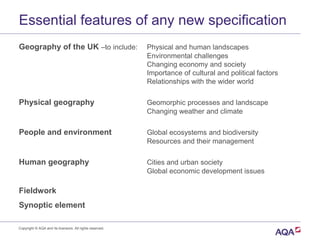
Geography of the UK –to include: Physical and human landscapes
Environmental challenges
Changing economy and society
Importance of cultural and political factors
Relationships with the wider world
Physical geography Geomorphic processes and landscape
Changing weather and climate
People and environment Global ecosystems and biodiversity
Resources and their management
Human geography Cities and urban society
Global economic development issues
Fieldwork
Synoptic element
Copyright © AQA and its licensors. All rights reserved.
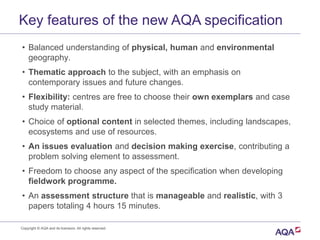
Key features of the new AQA specification
• Balanced understanding of physical, human and environmental
geography.
• Thematic approach to the subject, with an emphasis on
contemporary issues and future changes.
• Flexibility: centres are free to choose their own exemplars and case
study material.
• Choice of optional content in selected themes, including landscapes,
ecosystems and use of resources.
• An issues evaluation and decision making exercise, contributing a
problem solving element to assessment.
• Freedom to choose any aspect of the specification when developing
fieldwork programme.
• An assessment structure that is manageable and realistic, with 3
papers totaling 4 hours 15 minutes.
Copyright © AQA and its licensors. All rights reserved.
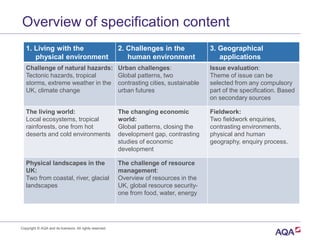
Overview of specification content
Copyright © AQA and its licensors. All rights reserved.
1. Living with the
physical environment
2. Challenges in the
human environment
3. Geographical
applications
Challenge of natural hazards:
Tectonic hazards, tropical
storms, extreme weather in the
UK, climate change
Urban challenges:
Global patterns, two
contrasting cities, sustainable
urban futures
Issue evaluation:
Theme of issue can be
selected from any compulsory
part of the specification. Based
on secondary sources
The living world:
Local ecosystems, tropical
rainforests, one from hot
deserts and cold environments
The changing economic
world:
Global patterns, closing the
development gap, contrasting
studies of economic
development
Fieldwork:
Two fieldwork enquiries,
contrasting environments,
physical and human
geography, enquiry process.
Physical landscapes in the
UK:
Two from coastal, river, glacial
landscapes
The challenge of resource
management:
Overview of resources in the
UK, global resource security-
one from food, water, energy
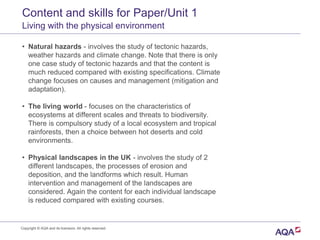
Content and skills for Paper/Unit 1
Living with the physical environment
• Natural hazards - involves the study of tectonic hazards,
weather hazards and climate change. Note that there is only
one case study of tectonic hazards and that the content is
much reduced compared with existing specifications. Climate
change focuses on causes and management (mitigation and
adaptation).
• The living world - focuses on the characteristics of
ecosystems at different scales and threats to biodiversity.
There is compulsory study of a local ecosystem and tropical
rainforests, then a choice between hot deserts and cold
environments.
• Physical landscapes in the UK - involves the study of 2
different landscapes, the processes of erosion and
deposition, and the landforms which result. Human
intervention and management of the landscapes are
considered. Again the content for each individual landscape
is reduced compared with existing courses.
Copyright © AQA and its licensors. All rights reserved.
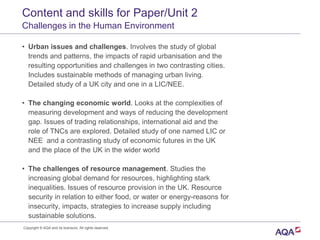
Content and skills for Paper/Unit 2
Challenges in the Human Environment
• Urban issues and challenges. Involves the study of global
trends and patterns, the impacts of rapid urbanisation and the
resulting opportunities and challenges in two contrasting cities.
Includes sustainable methods of managing urban living.
Detailed study of a UK city and one in a LIC/NEE.
• The changing economic world. Looks at the complexities of
measuring development and ways of reducing the development
gap. Issues of trading relationships, international aid and the
role of TNCs are explored. Detailed study of one named LIC or
NEE and a contrasting study of economic futures in the UK
and the place of the UK in the wider world
• The challenges of resource management. Studies the
increasing global demand for resources, highlighting stark
inequalities. Issues of resource provision in the UK. Resource
security in relation to either food, or water or energy-reasons for
insecurity, impacts, strategies to increase supply including
sustainable solutions.
Copyright © AQA and its licensors. All rights reserved.
Underlying principles
AQA’s approach to the new demands
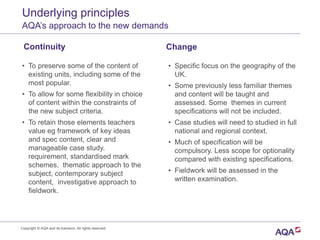
Continuity
• To preserve some of the content of
existing units, including some of the
most popular.
• To allow for some flexibility in choice
of content within the constraints of
the new subject criteria.
• To retain those elements teachers
value eg framework of key ideas
and spec content, clear and
manageable case study.
requirement, standardised mark
schemes, thematic approach to the
subject, contemporary subject
content, investigative approach to
fieldwork.
Change
• Specific focus on the geography of the
UK.
• Some previously less familiar themes
and content will be taught and
assessed. Some themes in current
specifications will not be included.
• Case studies will need to studied in full
national and regional context.
• Much of specification will be
compulsory. Less scope for optionality
compared with existing specifications.
• Fieldwork will be assessed in the
written examination.
Copyright © AQA and its licensors. All rights reserved.
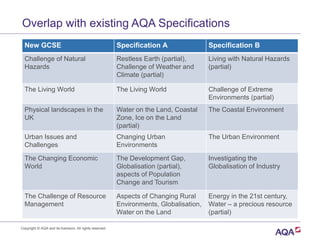
Overlap with existing AQA Specifications
New GCSE Specification A Specification B
Challenge of Natural
Hazards
Restless Earth (partial),
Challenge of Weather and
Climate (partial)
Living with Natural Hazards
(partial)
The Living World The Living World Challenge of Extreme
Environments (partial)
Physical landscapes in the
UK
Water on the Land, Coastal
Zone, Ice on the Land
(partial)
The Coastal Environment
Urban Issues and
Challenges
Changing Urban
Environments
The Urban Environment
The Changing Economic
World
The Development Gap,
Globalisation (partial),
aspects of Population
Change and Tourism
Investigating the
Globalisation of Industry
The Challenge of Resource
Management
Aspects of Changing Rural
Environments, Globalisation,
Water on the Land
Energy in the 21st century,
Water – a precious resource
(partial)
Copyright © AQA and its licensors. All rights reserved.
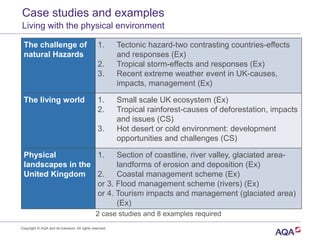
The challenge of
natural Hazards
1. Tectonic hazard-two contrasting countries-effects
and responses (Ex)
2. Tropical storm-effects and responses (Ex)
3. Recent extreme weather event in UK-causes,
impacts, management (Ex)
The living world 1. Small scale UK ecosystem (Ex)
2. Tropical rainforest-causes of deforestation, impacts
and issues (CS)
3. Hot desert or cold environment: development
opportunities and challenges (CS)
Physical
landscapes in the
United Kingdom
1. Section of coastline, river valley, glaciated area-
landforms of erosion and deposition (Ex)
2. Coastal management scheme (Ex)
or 3. Flood management scheme (rivers) (Ex)
or 4. Tourism impacts and management (glaciated area)
(Ex)
2 case studies and 8 examples required
Copyright © AQA and its licensors. All rights reserved.
Case studies and examples
Living with the physical environment
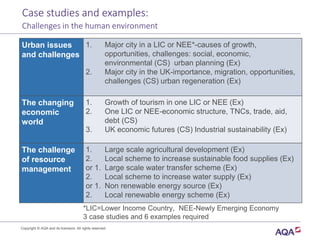
Case studies and examples:
Challenges in the human environment
Urban issues
and challenges
1. Major city in a LIC or NEE*-causes of growth,
opportunities, challenges: social, economic,
environmental (CS) urban planning (Ex)
2. Major city in the UK-importance, migration, opportunities,
challenges (CS) urban regeneration (Ex)
The changing
economic
world
1. Growth of tourism in one LIC or NEE (Ex)
2. One LIC or NEE-economic structure, TNCs, trade, aid,
debt (CS)
3. UK economic futures (CS) Industrial sustainability (Ex)
The challenge
of resource
management
1. Large scale agricultural development (Ex)
2. Local scheme to increase sustainable food supplies (Ex)
or 1. Large scale water transfer scheme (Ex)
2. Local scheme to increase water supply (Ex)
or 1. Non renewable energy source (Ex)
2. Local renewable energy scheme (Ex)
*LIC=Lower Income Country, NEE-Newly Emerging Economy
3 case studies and 6 examples required
Copyright © AQA and its licensors. All rights reserved.
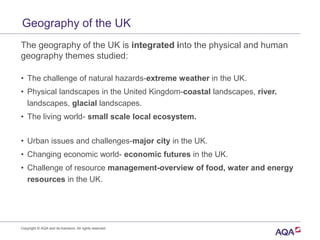
Geography of the UK
The geography of the UK is integrated into the physical and human
geography themes studied:
• The challenge of natural hazards-extreme weather in the UK.
• Physical landscapes in the United Kingdom-coastal landscapes, river.
landscapes, glacial landscapes.
• The living world- small scale local ecosystem.
• Urban issues and challenges-major city in the UK.
• Changing economic world- economic futures in the UK.
• Challenge of resource management-overview of food, water and energy
resources in the UK.
Copyright © AQA and its licensors. All rights reserved.
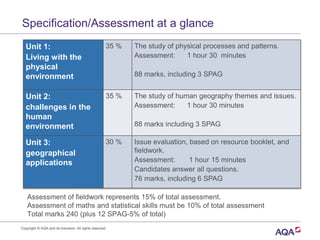
Specification/Assessment at a glance
Unit 1:
Living with the
physical
environment
35 % The study of physical processes and patterns.
Assessment: 1 hour 30 minutes
88 marks, including 3 SPAG
Unit 2:
challenges in the
human
environment
35 % The study of human geography themes and issues.
Assessment: 1 hour 30 minutes
88 marks including 3 SPAG
Unit 3:
geographical
applications
30 % Issue evaluation, based on resource booklet, and
fieldwork.
Assessment: 1 hour 15 minutes
Candidates answer all questions.
76 marks, including 6 SPAG
Assessment of fieldwork represents 15% of total assessment.
Assessment of maths and statistical skills must be 10% of total assessment
Total marks 240 (plus 12 SPAG-5% of total)
Copyright © AQA and its licensors. All rights reserved.
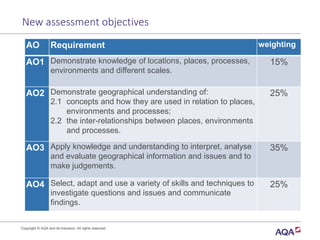
New assessment objectives
AO Requirement weighting
AO1 Demonstrate knowledge of locations, places, processes,
environments and different scales.
15%
AO2 Demonstrate geographical understanding of:
2.1 concepts and how they are used in relation to places,
environments and processes;
2.2 the inter-relationships between places, environments
and processes.
25%
AO3 Apply knowledge and understanding to interpret, analyse
and evaluate geographical information and issues and to
make judgements.
35%
AO4 Select, adapt and use a variety of skills and techniques to
investigate questions and issues and communicate
findings.
25%
Copyright © AQA and its licensors. All rights reserved.
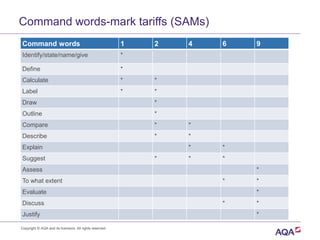
Command words-mark tariffs (SAMs)
Command words 1 2 4 6 9
Identify/state/name/give *
Define *
Calculate * *
Label * *
Draw *
Outline *
Compare * *
Describe * *
Explain * *
Suggest * * *
Assess *
To what extent * *
Evaluate *
Discuss * *
Justify *
Copyright © AQA and its licensors. All rights reserved.
Paper/Unit 1
Copyright © AQA and its licensors. All rights reserved.
Summary of assessment
• Unit 1 – Living with the physical environment
35% of the assessment
1 hour 30 minutes
Candidates answer questions on:
• The challenge of natural hazards - tectonic hazards, tropical storms,
extreme weather in the UK, climate change. (30 marks +3 SPAG)
• The living world - ecosystems, tropical rainforests, 2 from hot deserts and
cold environments. (25 marks)
• Physical landscapes in the United Kingdom - 2 from coastal landscapes,
river landscapes, glacial landscapes. (30 marks)
Question types in each section - multiple choice, short structured questions,
cloze exercises, photo interpretation/description, interpretation of maps on
different scales, data response, longer extended writing responses.
Approximately 60% Levels marked questions. 4 mark questions are marked at
2 levels of response. 6 and 9 mark questions are marked at 3 levels of
response.
Point marked questions
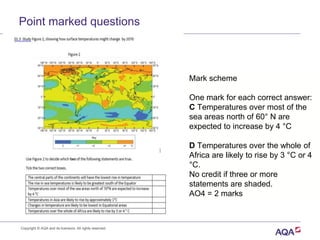
Mark scheme
One mark for each correct answer:
C Temperatures over most of the
sea areas north of 60° N are
expected to increase by 4 °C
D Temperatures over the whole of
Africa are likely to rise by 3 °C or 4
°C.
No credit if three or more
statements are shaded.
AO4 = 2 marks
Copyright © AQA and its licensors. All rights reserved.
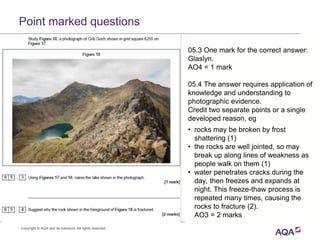
05.3 One mark for the correct answer:
Glaslyn.
AO4 = 1 mark
05.4 The answer requires application of
knowledge and understanding to
photographic evidence.
Credit two separate points or a single
developed reason, eg
• rocks may be broken by frost
shattering (1)
• the rocks are well jointed, so may
break up along lines of weakness as
people walk on them (1)
• water penetrates cracks during the
day, then freezes and expands at
night. This freeze-thaw process is
repeated many times, causing the
rocks to fracture (2).
AO3 = 2 marks
Point marked questions
Copyright © AQA and its licensors. All rights reserved.
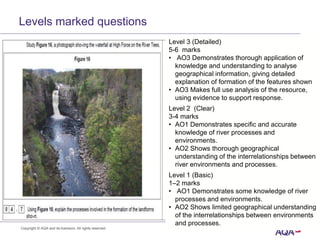
Levels marked questions
Copyright © AQA and its licensors. All rights reserved.
Level 3 (Detailed)
5-6 marks
• AO3 Demonstrates thorough application of
knowledge and understanding to analyse
geographical information, giving detailed
explanation of formation of the features shown
• AO3 Makes full use analysis of the resource,
using evidence to support response.
Level 2 (Clear)
3-4 marks
• AO1 Demonstrates specific and accurate
knowledge of river processes and
environments.
• AO2 Shows thorough geographical
understanding of the interrelationships between
river environments and processes.
Level 1 (Basic)
1–2 marks
• AO1 Demonstrates some knowledge of river
processes and environments.
• AO2 Shows limited geographical understanding
of the interrelationships between environments
and processes.
Levels marked questions
Copyright © AQA and its licensors. All rights reserved.
Study Figure 5a, a photograph showing an area affected
by an earthquake in 2010, and Figure 5b, a photograph
showing an area affected by a volcanic eruption in 2006.
Choose either an earthquake or a volcanic eruption.
Assess the extent to which primary effects are more
significant than secondary effects.
Use Figure 5a or 5b and an example you have
studied. [9 marks][+ 3 SPaG marks]
Mark scheme Level 3 (Detailed)
7–9 marks
• AO1 Demonstrates detailed knowledge of the primary and
secondary effects of a tectonic hazard on people and the
environment.
• AO2 Shows thorough geographical understanding of the
interrelationships between places, environments and processes
in the context of a tectonic hazard.
• AO3 Demonstrates application of knowledge and understanding
in a coherent and reasoned way in evaluating the relative
significance of primary and secondary effects on people and the
environment.
Levels marked questions
Copyright © AQA and its licensors. All rights reserved.
Features of Paper 1
1. Familiar command words. Hierarchy of terms ranging from
give/name/state/identify, complete,… to suggest, outline, compare,
describe, explain, evaluate, to what extent, justify and discuss.
2. Wide mix of question types with mark tariffs ranging from 1-9 marks
aimed at all levels of ability.
3. Broad coverage of specification content eg Question 1 assesses
aspects of climate change, extreme weather in the UK, tropical storms,
tectonic hazards.
4. Clear emphasis on physical geography processes and features, but
every question gives consideration to human interactions and/or
responses.
5. Clear direction to use case study information in some extended writing
questions. Potential to use case studies and examples elsewhere.
6. Wide range of stimulus materials - 19 Figures comprising photographs,
OS maps, world maps, graphs, diagrams. All require some interpretation.
No credit for direct lifts.
Copyright © AQA and its licensors. All rights reserved.
Paper/Unit 2
Copyright © AQA and its licensors. All rights reserved.
Summary of assessment
Unit 2: Challenges in the human environment
35% of the assessment
Candidates answer questions on:
• Urban issues and challenges (30 marks+ 3 SPAG)
• The changing economic world (30 marks)
• The challenge of resource management-general overview, one from
food, water and energy. (25 marks)
Question types in each section - multiple choice, short structured questions,
closed exercises, photo interpretation/description, interpretation of maps on
different scales, data response, longer extended writing responses.
Copyright © AQA and its licensors. All rights reserved.
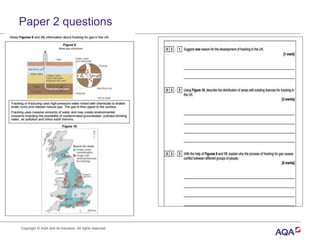
Paper 2 questions
Copyright © AQA and its licensors. All rights reserved.
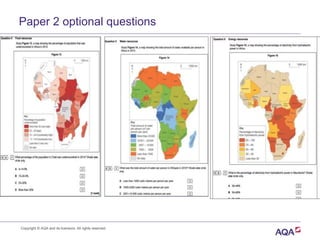
Paper 2 optional questions
Copyright © AQA and its licensors. All rights reserved.
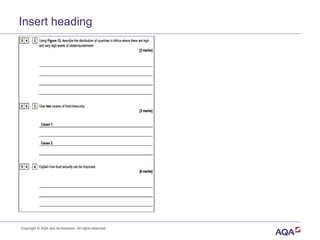
Insert heading
Copyright © AQA and its licensors. All rights reserved.
‘Transnational corporations (TNCs) only bring advantages
to the host country.’
Do you agree with this statement? Yes……. No ……..
Justify your decision (9 marks)
To what extent do urban areas in lower income countries
(LICs) or newly emerging economies (NEEs) provide
social and economic opportunities for people.
[6 marks]
Insert heading
Copyright © AQA and its licensors. All rights reserved.
Features of Paper 2
• Similar command words to Paper 1.
• Mark tariffs range from 1-9 marks aimed at all levels of ability.
• Assessment covers topical issues such as fracking, water transfer
problems, resource insecurity, Fairtrade, urban congestion
management.
• Several opportunities to use case study information in extended
writing questions. 4 questions will require the use of examples/case
studies.
• Wide range of stimulus materials - 15 Figures comprising
photographs, OS map, world/UK/Africa maps, graphs, table of
statistics, diagrams.
Copyright © AQA and its licensors. All rights reserved.
Paper/Unit 3
Copyright © AQA and its licensors. All rights reserved.
Summary of assessment
Unit 3: Geographical applications
30% of the assessment
Section A - Issue Evaluation
Compulsory structured questions on a theme – leading up to an extended
writing task based on a pre-release Sources Booklet – to be issued to students
in advance. The theme will arise from the subject content of Units 1 or 2 but
may extend beyond it through the use of the resources. The theme could
combine human and physical aspects. (34 marks +3 SPAG)
Section B - Fieldwork
Compulsory questions based on candidates’ enquiry work and the use of
fieldwork materials in an unfamiliar context. (36 marks +3 SPAG)
Copyright © AQA and its licensors. All rights reserved.
Content and skills for Paper/Unit 3
Geographical applications
Section A: Issue evaluation
• Assessment is synoptic, requiring students to use their learning across
the specification so they can analyse an issue, consider and select
proposed solutions and justify choices.
• The issue can be selected from any part of the core specification and can
cover more than one topic.
• A resource booklet will be sent to centres 12 weeks prior to the examination
in June, so students can become familiar with the source materials.
• A fresh copy of these materials will be issued at the start of the
examination.
Copyright © AQA and its licensors. All rights reserved.
Issue evaluation
• Students learn about an issue, study options to solve it and make a decision.
They consider the points of view of the stakeholders involved, make an
appraisal of the advantages and disadvantages, and evaluate the
alternatives.
• Resource sheet will consist of a mix of geographical sources such as maps
on different scales, photographs, satellite images, fact files, statistics,
graphs, newspaper extracts, quotes from different interest groups.
• Assessment will consist of a series of shorter questions related to the
contemporary geographical issue, based on the interpretation of the
resources. These lead to a more extended piece of writing (9 marks),
involving a decision with some justification.
Copyright © AQA and its licensors. All rights reserved.
Paper 3 Section A
• Issue evaluation theme – Specimen = Development project in Kolkata
(from Urban Issues and Challenges). Could be tropical rainforests, weather
or tectonic hazards, climate change, development issues, energy resources
etc.
• Resource booklet (pre-release) - maps, tables of statistics, news cuttings,
graphs, photos, background to the issue, quotes.
• Sources provided in the examination – details of possible schemes.
• Examination: series of short skills questions (2-3 marks), and more extended
writing questions based on sources (6 marks), leading to decision making
exercise. (9 marks)
• At least one question will be synoptic ie drawing on content from more than
one theme.
• Assessment Objectives targeted - mainly AO3 and AO4 - showing ability to
apply knowledge and understanding in different contexts to analyse,
interpret, evaluate and make judgements.
Copyright © AQA and its licensors. All rights reserved.
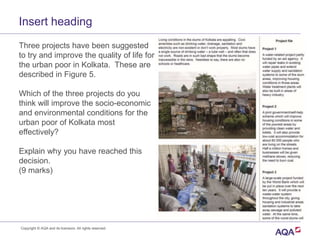
Three projects have been suggested
to try and improve the quality of life for
the urban poor in Kolkata. These are
described in Figure 5.
Which of the three projects do you
think will improve the socio-economic
and environmental conditions for the
urban poor of Kolkata most
effectively?
Explain why you have reached this
decision.
(9 marks)
Insert heading
Copyright © AQA and its licensors. All rights reserved.
Fieldwork
• Students need to undertake two geographical enquiries, each of which must
include the use of primary data, collected as part of a fieldwork exercise.
• The two enquiries must be carried out in contrasting environments and show
an understanding of both physical and human geography.
• In at least one of the enquiries students are expected to show an
understanding about the interaction between physical and human
geography.
Copyright © AQA and its licensors. All rights reserved.
Planning
Effective planning in the classroom before carrying out fieldwork can
make data collection efficient, saving a lot of time.
Candidates must be very clear about how they will collect and record
the data required before leaving the school.
Copyright © AQA and its licensors. All rights reserved.
Contrasting environments
Contrasting environments will have to be visited for candidates to
undertake the physical and human geography enquiries, but the
locations need not be far apart.
Looking at beach processes and then going into the seaside town
nearby would satisfy all requirements.
Investigating river processes and then carrying out an urban
investigation nearby would also be appropriate.
Planning to reduce travelling would maximise time for practical
fieldwork.
Copyright © AQA and its licensors. All rights reserved.
Fieldwork assessment
Students’ understanding of the enquiry process will be assessed by:
• Questions based on the use of fieldwork materials from an unfamiliar
context.
• Questions based on candidates’ individual enquiry work. (For these
questions candidates will have to identify the titles of their individual
enquiries).
Written statement from centres, providing the date, location, numbers of
students participating, the main issues/questions investigated during fieldwork,
and the relationship of the fieldwork to the specification content
There will no longer be Controlled Assessment in GCSE Geography
Copyright © AQA and its licensors. All rights reserved.
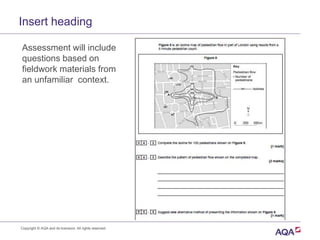
Assessment will include
questions based on
fieldwork materials from
an unfamiliar context.
Insert heading
Copyright © AQA and its licensors. All rights reserved.
Using the data in Figure 9 calculate the interquartile range of the pebble size data.
Show your working in the space below.
[2 marks]
Interquartile range = cm
Describe the pebble size data shown on the dispersion graph in Question 04.6.
[4 marks]
0 4 . 9
Copyright © AQA and its licensors. All rights reserved.
Insert heading
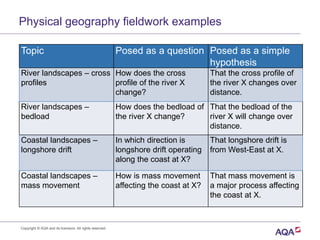
Physical geography fieldwork examples
Topic Posed as a question Posed as a simple
hypothesis
River landscapes – cross
profiles
How does the cross
profile of the river X
change?
That the cross profile of
the river X changes over
distance.
River landscapes –
bedload
How does the bedload of
the river X change?
That the bedload of the
river X will change over
distance.
Coastal landscapes –
longshore drift
In which direction is
longshore drift operating
along the coast at X?
That longshore drift is
from West-East at X.
Coastal landscapes –
mass movement
How is mass movement
affecting the coast at X?
That mass movement is
a major process affecting
the coast at X.
Copyright © AQA and its licensors. All rights reserved.
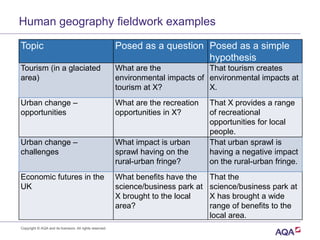
Human geography fieldwork examples
Topic Posed as a question Posed as a simple
hypothesis
Tourism (in a glaciated
area)
What are the
environmental impacts of
tourism at X?
That tourism creates
environmental impacts at
X.
Urban change –
opportunities
What are the recreation
opportunities in X?
That X provides a range
of recreational
opportunities for local
people.
Urban change –
challenges
What impact is urban
sprawl having on the
rural-urban fringe?
That urban sprawl is
having a negative impact
on the rural-urban fringe.
Economic futures in the
UK
What benefits have the
science/business park at
X brought to the local
area?
That the
science/business park at
X has brought a wide
range of benefits to the
local area.
Copyright © AQA and its licensors. All rights reserved.
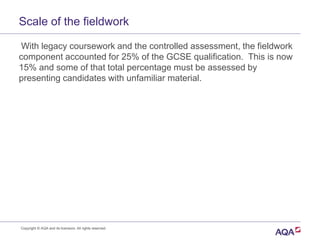
With legacy coursework and the controlled assessment, the fieldwork
component accounted for 25% of the GCSE qualification. This is now
15% and some of that total percentage must be assessed by
presenting candidates with unfamiliar material.
Copyright © AQA and its licensors. All rights reserved.
Scale of the fieldwork
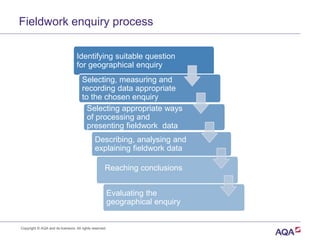
Fieldwork enquiry process
Identifying suitable question
for geographical enquiry
Selecting, measuring and
recording data appropriate
to the chosen enquiry
Selecting appropriate ways
of processing and
presenting fieldwork data
Describing, analysing and
explaining fieldwork data
Evaluating the
geographical enquiry
Reaching conclusions
Copyright © AQA and its licensors. All rights reserved.
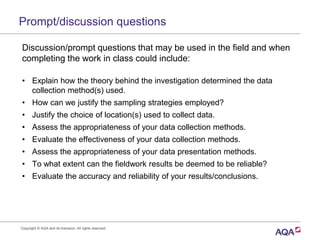
Discussion/prompt questions that may be used in the field and when
completing the work in class could include:
• Explain how the theory behind the investigation determined the data
collection method(s) used.
• How can we justify the sampling strategies employed?
• Justify the choice of location(s) used to collect data.
• Assess the appropriateness of your data collection methods.
• Evaluate the effectiveness of your data collection methods.
• Assess the appropriateness of your data presentation methods.
• To what extent can the fieldwork results be deemed to be reliable?
• Evaluate the accuracy and reliability of your results/conclusions.
Prompt/discussion questions
Copyright © AQA and its licensors. All rights reserved.
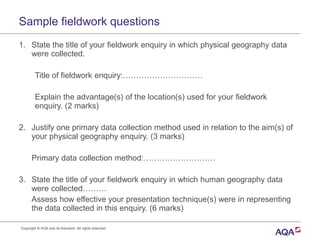
Sample fieldwork questions
1. State the title of your fieldwork enquiry in which physical geography data
were collected.
Title of fieldwork enquiry:…………………………
Explain the advantage(s) of the location(s) used for your fieldwork
enquiry. (2 marks)
2. Justify one primary data collection method used in relation to the aim(s) of
your physical geography enquiry. (3 marks)
Primary data collection method:………………………
3. State the title of your fieldwork enquiry in which human geography data
were collected………
Assess how effective your presentation technique(s) were in representing
the data collected in this enquiry. (6 marks)
Copyright © AQA and its licensors. All rights reserved.
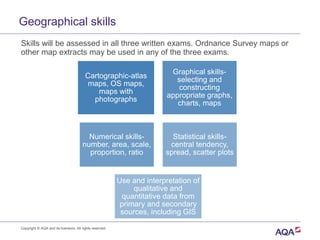
Geographical skills
Skills will be assessed in all three written exams. Ordnance Survey maps or
other map extracts may be used in any of the three exams.
Cartographic-atlas
maps, OS maps,
maps with
photographs
Graphical skills-
selecting and
constructing
appropriate graphs,
charts, maps
Numerical skills-
number, area, scale,
proportion, ratio
Statistical skills-
central tendency,
spread, scatter plots
Use and interpretation of
qualitative and
quantitative data from
primary and secondary
sources, including GIS
Copyright © AQA and its licensors. All rights reserved.
The use of mathematics and statistics in Geography
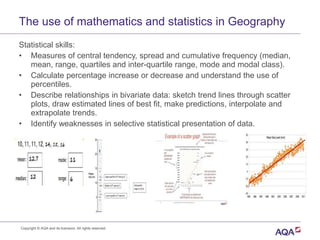
Statistical skills:
• Measures of central tendency, spread and cumulative frequency (median,
mean, range, quartiles and inter-quartile range, mode and modal class).
• Calculate percentage increase or decrease and understand the use of
percentiles.
• Describe relationships in bivariate data: sketch trend lines through scatter
plots, draw estimated lines of best fit, make predictions, interpolate and
extrapolate trends.
• Identify weaknesses in selective statistical presentation of data.
Copyright © AQA and its licensors. All rights reserved.
Managing and planning the course
Curriculum requirements
• 6 themes (3 physical geography, 3 human geography).
• Some have slightly more content than others: The Living World and
Resource Management are shorter units.
• Fieldwork planning, data collection and follow up.
• Planning for Issue Evaluation. General skills and scrutiny of pre-release.
• Geographical skills, including maths and statistics. Integrated or separate
coverage?
• Examination practice, revision.
Copyright © AQA and its licensors. All rights reserved.
Planning the course
• Choice of options eg 2 out of 3 physical landscapes in the UK; cold
environment or hot deserts; food, water or energy?
• Selection of suitable case studies, especially 2 contrasting cities (urban
challenges) and the LIC/NEE (changing economic world). There are 5 case
studies and 14 examples throughout the specification, which focus on the UK
and other global examples of your choice. They allow for an in-depth study of
physical and human environments.
• Sequence of units/themes.
• All physical, then human geography? (or vice versa)
• Mixture of topics-physical, human, physical etc?
• Separate coverage of UK themes, then more global issues?
• Where does fieldwork fit in?
• Available resources for teaching the course, particularly less familiar aspects
eg UK geography, resource management, weather hazards.
• Assessment objectives. Consider the implications of the assessment
structure for planning and teaching, particularly the requirements of AO3.
Copyright © AQA and its licensors. All rights reserved.
Timings/curriculum structure
AQA GCSE Geography
Basic assumptions:
67 week course (Year 1: 38 weeks, Year 2: 29 weeks)
Key Stage 4 contact time 2x1hour per week
Total teaching time: 134 hours (DfE GLH -120-140 hours)
Copyright © AQA and its licensors. All rights reserved.
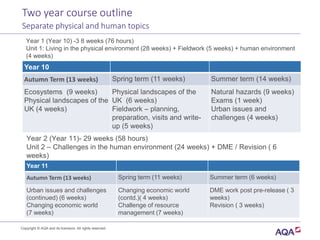
Year 10
Autumn Term (13 weeks) Spring term (11 weeks) Summer term (14 weeks)
Ecosystems (9 weeks)
Physical landscapes of the
UK (4 weeks)
Physical landscapes of the
UK (6 weeks)
Fieldwork – planning,
preparation, visits and write-
up (5 weeks)
Natural hazards (9 weeks)
Exams (1 week)
Urban issues and
challenges (4 weeks)
Year 11
Autumn Term (13 weeks) Spring term (11 weeks) Summer term (6 weeks)
Urban issues and challenges
(continued) (6 weeks)
Changing economic world
(7 weeks)
Changing economic world
(contd.)( 4 weeks)
Challenge of resource
management (7 weeks)
DME work post pre-release ( 3
weeks)
Revision ( 3 weeks)
Year 2 (Year 11)- 29 weeks (58 hours)
Unit 2 – Challenges in the human environment (24 weeks) + DME / Revision ( 6
weeks)
Year 1 (Year 10) -3 8 weeks (76 hours)
Unit 1: Living in the physical environment (28 weeks) + Fieldwork (5 weeks) + human environment
(4 weeks)
Two year course outline
Separate physical and human topics
Copyright © AQA and its licensors. All rights reserved.
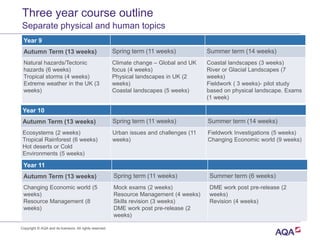
Year 9
Autumn Term (13 weeks) Spring term (11 weeks) Summer term (14 weeks)
Natural hazards/Tectonic
hazards (6 weeks)
Tropical storms (4 weeks)
Extreme weather in the UK (3
weeks)
Climate change – Global and UK
focus (4 weeks)
Physical landscapes in UK (2
weeks)
Coastal landscapes (5 weeks)
Coastal landscapes (3 weeks)
River or Glacial Landscapes (7
weeks)
Fieldwork ( 3 weeks)- pilot study
based on physical landscape. Exams
(1 week)
Year 10
Autumn Term (13 weeks) Spring term (11 weeks) Summer term (14 weeks)
Ecosystems (2 weeks)
Tropical Rainforest (6 weeks)
Hot deserts or Cold
Environments (5 weeks)
Urban issues and challenges (11
weeks)
Fieldwork Investigations (5 weeks)
Changing Economic world (9 weeks)
Year 11
Autumn Term (13 weeks) Spring term (11 weeks) Summer term (6 weeks)
Changing Economic world (5
weeks)
Resource Management (8
weeks)
Mock exams (2 weeks)
Resource Management (4 weeks)
Skills revision (3 weeks)
DME work post pre-release (2
weeks)
DME work post pre-release (2
weeks)
Revision (4 weeks)
Copyright © AQA and its licensors. All rights reserved.
Three year course outline
Separate physical and human topics
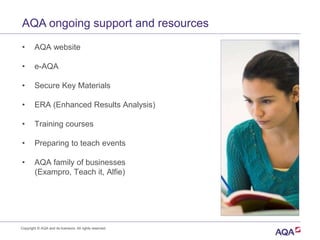
AQA ongoing support and resources
• AQA website
• e-AQA
• Secure Key Materials
• ERA (Enhanced Results Analysis)
• Training courses
• Preparing to teach events
• AQA family of businesses
(Exampro, Teach it, Alfie)
Copyright © AQA and its licensors. All rights reserved.
Key features
• Flexibility within topics allows centres to select specific content and
learning experiences.
• The course encourages a enquiry based approach to learning.
• A decision making exercise based on pre-released sources.
• No Controlled Assessment means there is more time for teaching, less
administration and fewer logistical issues. Opportunities for fieldwork are
highlighted and encouraged where relevant.
• Specific guidance on the selection of fieldwork tasks will be provided
• A variety of assessment techniques, ranging from short structured and
stimulus/data response questions to extended writing mini essays.
• Examination papers that are targeted at the full range of ability, with
opportunities for higher ability candidates to be challenged.
Copyright © AQA and its licensors. All rights reserved.

ga_conf16-aqa-gcse.ppt

  • 1.
    Copyright © AQAand its licensors. All rights reserved. GCSE Geography Geographical Association conference Follow us on Twitter @AQACPD. New specification: Aims, structure and distinctive features
  • 2.
    Structure Copyright © AQAand its licensors. All rights reserved. 1. What are the new requirements for GCSE Geography? 2. What is the AQA approach? 3. What are some of the important features of each unit in the new GCSE Geography? 4. What do the new examination papers look like? 5. What are the practical benefits of the new specification? 6. How can you plan to teach the new GCSE Geography? 7. How will AQA support you teaching the new specification?
  • 3.
    Essential features ofany new specification Geography of the UK –to include: Physical and human landscapes Environmental challenges Changing economy and society Importance of cultural and political factors Relationships with the wider world Physical geography Geomorphic processes and landscape Changing weather and climate People and environment Global ecosystems and biodiversity Resources and their management Human geography Cities and urban society Global economic development issues Fieldwork Synoptic element Copyright © AQA and its licensors. All rights reserved.
  • 4.
    Key features ofthe new AQA specification • Balanced understanding of physical, human and environmental geography. • Thematic approach to the subject, with an emphasis on contemporary issues and future changes. • Flexibility: centres are free to choose their own exemplars and case study material. • Choice of optional content in selected themes, including landscapes, ecosystems and use of resources. • An issues evaluation and decision making exercise, contributing a problem solving element to assessment. • Freedom to choose any aspect of the specification when developing fieldwork programme. • An assessment structure that is manageable and realistic, with 3 papers totaling 4 hours 15 minutes. Copyright © AQA and its licensors. All rights reserved.
  • 5.
    Overview of specificationcontent Copyright © AQA and its licensors. All rights reserved. 1. Living with the physical environment 2. Challenges in the human environment 3. Geographical applications Challenge of natural hazards: Tectonic hazards, tropical storms, extreme weather in the UK, climate change Urban challenges: Global patterns, two contrasting cities, sustainable urban futures Issue evaluation: Theme of issue can be selected from any compulsory part of the specification. Based on secondary sources The living world: Local ecosystems, tropical rainforests, one from hot deserts and cold environments The changing economic world: Global patterns, closing the development gap, contrasting studies of economic development Fieldwork: Two fieldwork enquiries, contrasting environments, physical and human geography, enquiry process. Physical landscapes in the UK: Two from coastal, river, glacial landscapes The challenge of resource management: Overview of resources in the UK, global resource security- one from food, water, energy
  • 6.
    Content and skillsfor Paper/Unit 1 Living with the physical environment • Natural hazards - involves the study of tectonic hazards, weather hazards and climate change. Note that there is only one case study of tectonic hazards and that the content is much reduced compared with existing specifications. Climate change focuses on causes and management (mitigation and adaptation). • The living world - focuses on the characteristics of ecosystems at different scales and threats to biodiversity. There is compulsory study of a local ecosystem and tropical rainforests, then a choice between hot deserts and cold environments. • Physical landscapes in the UK - involves the study of 2 different landscapes, the processes of erosion and deposition, and the landforms which result. Human intervention and management of the landscapes are considered. Again the content for each individual landscape is reduced compared with existing courses. Copyright © AQA and its licensors. All rights reserved.
  • 7.
    Content and skillsfor Paper/Unit 2 Challenges in the Human Environment • Urban issues and challenges. Involves the study of global trends and patterns, the impacts of rapid urbanisation and the resulting opportunities and challenges in two contrasting cities. Includes sustainable methods of managing urban living. Detailed study of a UK city and one in a LIC/NEE. • The changing economic world. Looks at the complexities of measuring development and ways of reducing the development gap. Issues of trading relationships, international aid and the role of TNCs are explored. Detailed study of one named LIC or NEE and a contrasting study of economic futures in the UK and the place of the UK in the wider world • The challenges of resource management. Studies the increasing global demand for resources, highlighting stark inequalities. Issues of resource provision in the UK. Resource security in relation to either food, or water or energy-reasons for insecurity, impacts, strategies to increase supply including sustainable solutions. Copyright © AQA and its licensors. All rights reserved.
  • 8.
    Underlying principles AQA’s approachto the new demands Continuity • To preserve some of the content of existing units, including some of the most popular. • To allow for some flexibility in choice of content within the constraints of the new subject criteria. • To retain those elements teachers value eg framework of key ideas and spec content, clear and manageable case study. requirement, standardised mark schemes, thematic approach to the subject, contemporary subject content, investigative approach to fieldwork. Change • Specific focus on the geography of the UK. • Some previously less familiar themes and content will be taught and assessed. Some themes in current specifications will not be included. • Case studies will need to studied in full national and regional context. • Much of specification will be compulsory. Less scope for optionality compared with existing specifications. • Fieldwork will be assessed in the written examination. Copyright © AQA and its licensors. All rights reserved.
  • 9.
    Overlap with existingAQA Specifications New GCSE Specification A Specification B Challenge of Natural Hazards Restless Earth (partial), Challenge of Weather and Climate (partial) Living with Natural Hazards (partial) The Living World The Living World Challenge of Extreme Environments (partial) Physical landscapes in the UK Water on the Land, Coastal Zone, Ice on the Land (partial) The Coastal Environment Urban Issues and Challenges Changing Urban Environments The Urban Environment The Changing Economic World The Development Gap, Globalisation (partial), aspects of Population Change and Tourism Investigating the Globalisation of Industry The Challenge of Resource Management Aspects of Changing Rural Environments, Globalisation, Water on the Land Energy in the 21st century, Water – a precious resource (partial) Copyright © AQA and its licensors. All rights reserved.
  • 10.
    The challenge of naturalHazards 1. Tectonic hazard-two contrasting countries-effects and responses (Ex) 2. Tropical storm-effects and responses (Ex) 3. Recent extreme weather event in UK-causes, impacts, management (Ex) The living world 1. Small scale UK ecosystem (Ex) 2. Tropical rainforest-causes of deforestation, impacts and issues (CS) 3. Hot desert or cold environment: development opportunities and challenges (CS) Physical landscapes in the United Kingdom 1. Section of coastline, river valley, glaciated area- landforms of erosion and deposition (Ex) 2. Coastal management scheme (Ex) or 3. Flood management scheme (rivers) (Ex) or 4. Tourism impacts and management (glaciated area) (Ex) 2 case studies and 8 examples required Copyright © AQA and its licensors. All rights reserved. Case studies and examples Living with the physical environment
  • 11.
    Case studies andexamples: Challenges in the human environment Urban issues and challenges 1. Major city in a LIC or NEE*-causes of growth, opportunities, challenges: social, economic, environmental (CS) urban planning (Ex) 2. Major city in the UK-importance, migration, opportunities, challenges (CS) urban regeneration (Ex) The changing economic world 1. Growth of tourism in one LIC or NEE (Ex) 2. One LIC or NEE-economic structure, TNCs, trade, aid, debt (CS) 3. UK economic futures (CS) Industrial sustainability (Ex) The challenge of resource management 1. Large scale agricultural development (Ex) 2. Local scheme to increase sustainable food supplies (Ex) or 1. Large scale water transfer scheme (Ex) 2. Local scheme to increase water supply (Ex) or 1. Non renewable energy source (Ex) 2. Local renewable energy scheme (Ex) *LIC=Lower Income Country, NEE-Newly Emerging Economy 3 case studies and 6 examples required Copyright © AQA and its licensors. All rights reserved.
  • 12.
    Geography of theUK The geography of the UK is integrated into the physical and human geography themes studied: • The challenge of natural hazards-extreme weather in the UK. • Physical landscapes in the United Kingdom-coastal landscapes, river. landscapes, glacial landscapes. • The living world- small scale local ecosystem. • Urban issues and challenges-major city in the UK. • Changing economic world- economic futures in the UK. • Challenge of resource management-overview of food, water and energy resources in the UK. Copyright © AQA and its licensors. All rights reserved.
  • 13.
    Specification/Assessment at aglance Unit 1: Living with the physical environment 35 % The study of physical processes and patterns. Assessment: 1 hour 30 minutes 88 marks, including 3 SPAG Unit 2: challenges in the human environment 35 % The study of human geography themes and issues. Assessment: 1 hour 30 minutes 88 marks including 3 SPAG Unit 3: geographical applications 30 % Issue evaluation, based on resource booklet, and fieldwork. Assessment: 1 hour 15 minutes Candidates answer all questions. 76 marks, including 6 SPAG Assessment of fieldwork represents 15% of total assessment. Assessment of maths and statistical skills must be 10% of total assessment Total marks 240 (plus 12 SPAG-5% of total) Copyright © AQA and its licensors. All rights reserved.
  • 14.
    New assessment objectives AORequirement weighting AO1 Demonstrate knowledge of locations, places, processes, environments and different scales. 15% AO2 Demonstrate geographical understanding of: 2.1 concepts and how they are used in relation to places, environments and processes; 2.2 the inter-relationships between places, environments and processes. 25% AO3 Apply knowledge and understanding to interpret, analyse and evaluate geographical information and issues and to make judgements. 35% AO4 Select, adapt and use a variety of skills and techniques to investigate questions and issues and communicate findings. 25% Copyright © AQA and its licensors. All rights reserved.
  • 15.
    Command words-mark tariffs(SAMs) Command words 1 2 4 6 9 Identify/state/name/give * Define * Calculate * * Label * * Draw * Outline * Compare * * Describe * * Explain * * Suggest * * * Assess * To what extent * * Evaluate * Discuss * * Justify * Copyright © AQA and its licensors. All rights reserved.
  • 16.
    Paper/Unit 1 Copyright ©AQA and its licensors. All rights reserved.
  • 17.
    Copyright © AQAand its licensors. All rights reserved. Summary of assessment • Unit 1 – Living with the physical environment 35% of the assessment 1 hour 30 minutes Candidates answer questions on: • The challenge of natural hazards - tectonic hazards, tropical storms, extreme weather in the UK, climate change. (30 marks +3 SPAG) • The living world - ecosystems, tropical rainforests, 2 from hot deserts and cold environments. (25 marks) • Physical landscapes in the United Kingdom - 2 from coastal landscapes, river landscapes, glacial landscapes. (30 marks) Question types in each section - multiple choice, short structured questions, cloze exercises, photo interpretation/description, interpretation of maps on different scales, data response, longer extended writing responses. Approximately 60% Levels marked questions. 4 mark questions are marked at 2 levels of response. 6 and 9 mark questions are marked at 3 levels of response.
  • 18.
    Point marked questions Markscheme One mark for each correct answer: C Temperatures over most of the sea areas north of 60° N are expected to increase by 4 °C D Temperatures over the whole of Africa are likely to rise by 3 °C or 4 °C. No credit if three or more statements are shaded. AO4 = 2 marks Copyright © AQA and its licensors. All rights reserved.
  • 19.
    05.3 One markfor the correct answer: Glaslyn. AO4 = 1 mark 05.4 The answer requires application of knowledge and understanding to photographic evidence. Credit two separate points or a single developed reason, eg • rocks may be broken by frost shattering (1) • the rocks are well jointed, so may break up along lines of weakness as people walk on them (1) • water penetrates cracks during the day, then freezes and expands at night. This freeze-thaw process is repeated many times, causing the rocks to fracture (2). AO3 = 2 marks Point marked questions Copyright © AQA and its licensors. All rights reserved.
  • 20.
    Levels marked questions Copyright© AQA and its licensors. All rights reserved.
  • 21.
    Level 3 (Detailed) 5-6marks • AO3 Demonstrates thorough application of knowledge and understanding to analyse geographical information, giving detailed explanation of formation of the features shown • AO3 Makes full use analysis of the resource, using evidence to support response. Level 2 (Clear) 3-4 marks • AO1 Demonstrates specific and accurate knowledge of river processes and environments. • AO2 Shows thorough geographical understanding of the interrelationships between river environments and processes. Level 1 (Basic) 1–2 marks • AO1 Demonstrates some knowledge of river processes and environments. • AO2 Shows limited geographical understanding of the interrelationships between environments and processes. Levels marked questions Copyright © AQA and its licensors. All rights reserved.
  • 22.
    Study Figure 5a,a photograph showing an area affected by an earthquake in 2010, and Figure 5b, a photograph showing an area affected by a volcanic eruption in 2006. Choose either an earthquake or a volcanic eruption. Assess the extent to which primary effects are more significant than secondary effects. Use Figure 5a or 5b and an example you have studied. [9 marks][+ 3 SPaG marks] Mark scheme Level 3 (Detailed) 7–9 marks • AO1 Demonstrates detailed knowledge of the primary and secondary effects of a tectonic hazard on people and the environment. • AO2 Shows thorough geographical understanding of the interrelationships between places, environments and processes in the context of a tectonic hazard. • AO3 Demonstrates application of knowledge and understanding in a coherent and reasoned way in evaluating the relative significance of primary and secondary effects on people and the environment. Levels marked questions Copyright © AQA and its licensors. All rights reserved.
  • 23.
    Features of Paper1 1. Familiar command words. Hierarchy of terms ranging from give/name/state/identify, complete,… to suggest, outline, compare, describe, explain, evaluate, to what extent, justify and discuss. 2. Wide mix of question types with mark tariffs ranging from 1-9 marks aimed at all levels of ability. 3. Broad coverage of specification content eg Question 1 assesses aspects of climate change, extreme weather in the UK, tropical storms, tectonic hazards. 4. Clear emphasis on physical geography processes and features, but every question gives consideration to human interactions and/or responses. 5. Clear direction to use case study information in some extended writing questions. Potential to use case studies and examples elsewhere. 6. Wide range of stimulus materials - 19 Figures comprising photographs, OS maps, world maps, graphs, diagrams. All require some interpretation. No credit for direct lifts. Copyright © AQA and its licensors. All rights reserved.
  • 24.
    Paper/Unit 2 Copyright ©AQA and its licensors. All rights reserved.
  • 25.
    Summary of assessment Unit2: Challenges in the human environment 35% of the assessment Candidates answer questions on: • Urban issues and challenges (30 marks+ 3 SPAG) • The changing economic world (30 marks) • The challenge of resource management-general overview, one from food, water and energy. (25 marks) Question types in each section - multiple choice, short structured questions, closed exercises, photo interpretation/description, interpretation of maps on different scales, data response, longer extended writing responses. Copyright © AQA and its licensors. All rights reserved.
  • 26.
    Paper 2 questions Copyright© AQA and its licensors. All rights reserved.
  • 27.
    Paper 2 optionalquestions Copyright © AQA and its licensors. All rights reserved.
  • 28.
    Insert heading Copyright ©AQA and its licensors. All rights reserved.
  • 29.
    ‘Transnational corporations (TNCs)only bring advantages to the host country.’ Do you agree with this statement? Yes……. No …….. Justify your decision (9 marks) To what extent do urban areas in lower income countries (LICs) or newly emerging economies (NEEs) provide social and economic opportunities for people. [6 marks] Insert heading Copyright © AQA and its licensors. All rights reserved.
  • 30.
    Features of Paper2 • Similar command words to Paper 1. • Mark tariffs range from 1-9 marks aimed at all levels of ability. • Assessment covers topical issues such as fracking, water transfer problems, resource insecurity, Fairtrade, urban congestion management. • Several opportunities to use case study information in extended writing questions. 4 questions will require the use of examples/case studies. • Wide range of stimulus materials - 15 Figures comprising photographs, OS map, world/UK/Africa maps, graphs, table of statistics, diagrams. Copyright © AQA and its licensors. All rights reserved.
  • 31.
    Paper/Unit 3 Copyright ©AQA and its licensors. All rights reserved.
  • 32.
    Summary of assessment Unit3: Geographical applications 30% of the assessment Section A - Issue Evaluation Compulsory structured questions on a theme – leading up to an extended writing task based on a pre-release Sources Booklet – to be issued to students in advance. The theme will arise from the subject content of Units 1 or 2 but may extend beyond it through the use of the resources. The theme could combine human and physical aspects. (34 marks +3 SPAG) Section B - Fieldwork Compulsory questions based on candidates’ enquiry work and the use of fieldwork materials in an unfamiliar context. (36 marks +3 SPAG) Copyright © AQA and its licensors. All rights reserved.
  • 33.
    Content and skillsfor Paper/Unit 3 Geographical applications Section A: Issue evaluation • Assessment is synoptic, requiring students to use their learning across the specification so they can analyse an issue, consider and select proposed solutions and justify choices. • The issue can be selected from any part of the core specification and can cover more than one topic. • A resource booklet will be sent to centres 12 weeks prior to the examination in June, so students can become familiar with the source materials. • A fresh copy of these materials will be issued at the start of the examination. Copyright © AQA and its licensors. All rights reserved.
  • 34.
    Issue evaluation • Studentslearn about an issue, study options to solve it and make a decision. They consider the points of view of the stakeholders involved, make an appraisal of the advantages and disadvantages, and evaluate the alternatives. • Resource sheet will consist of a mix of geographical sources such as maps on different scales, photographs, satellite images, fact files, statistics, graphs, newspaper extracts, quotes from different interest groups. • Assessment will consist of a series of shorter questions related to the contemporary geographical issue, based on the interpretation of the resources. These lead to a more extended piece of writing (9 marks), involving a decision with some justification. Copyright © AQA and its licensors. All rights reserved.
  • 35.
    Paper 3 SectionA • Issue evaluation theme – Specimen = Development project in Kolkata (from Urban Issues and Challenges). Could be tropical rainforests, weather or tectonic hazards, climate change, development issues, energy resources etc. • Resource booklet (pre-release) - maps, tables of statistics, news cuttings, graphs, photos, background to the issue, quotes. • Sources provided in the examination – details of possible schemes. • Examination: series of short skills questions (2-3 marks), and more extended writing questions based on sources (6 marks), leading to decision making exercise. (9 marks) • At least one question will be synoptic ie drawing on content from more than one theme. • Assessment Objectives targeted - mainly AO3 and AO4 - showing ability to apply knowledge and understanding in different contexts to analyse, interpret, evaluate and make judgements. Copyright © AQA and its licensors. All rights reserved.
  • 36.
    Three projects havebeen suggested to try and improve the quality of life for the urban poor in Kolkata. These are described in Figure 5. Which of the three projects do you think will improve the socio-economic and environmental conditions for the urban poor of Kolkata most effectively? Explain why you have reached this decision. (9 marks) Insert heading Copyright © AQA and its licensors. All rights reserved.
  • 37.
    Fieldwork • Students needto undertake two geographical enquiries, each of which must include the use of primary data, collected as part of a fieldwork exercise. • The two enquiries must be carried out in contrasting environments and show an understanding of both physical and human geography. • In at least one of the enquiries students are expected to show an understanding about the interaction between physical and human geography. Copyright © AQA and its licensors. All rights reserved.
  • 38.
    Planning Effective planning inthe classroom before carrying out fieldwork can make data collection efficient, saving a lot of time. Candidates must be very clear about how they will collect and record the data required before leaving the school. Copyright © AQA and its licensors. All rights reserved.
  • 39.
    Contrasting environments Contrasting environmentswill have to be visited for candidates to undertake the physical and human geography enquiries, but the locations need not be far apart. Looking at beach processes and then going into the seaside town nearby would satisfy all requirements. Investigating river processes and then carrying out an urban investigation nearby would also be appropriate. Planning to reduce travelling would maximise time for practical fieldwork. Copyright © AQA and its licensors. All rights reserved.
  • 40.
    Fieldwork assessment Students’ understandingof the enquiry process will be assessed by: • Questions based on the use of fieldwork materials from an unfamiliar context. • Questions based on candidates’ individual enquiry work. (For these questions candidates will have to identify the titles of their individual enquiries). Written statement from centres, providing the date, location, numbers of students participating, the main issues/questions investigated during fieldwork, and the relationship of the fieldwork to the specification content There will no longer be Controlled Assessment in GCSE Geography Copyright © AQA and its licensors. All rights reserved.
  • 41.
    Assessment will include questionsbased on fieldwork materials from an unfamiliar context. Insert heading Copyright © AQA and its licensors. All rights reserved.
  • 42.
    Using the datain Figure 9 calculate the interquartile range of the pebble size data. Show your working in the space below. [2 marks] Interquartile range = cm Describe the pebble size data shown on the dispersion graph in Question 04.6. [4 marks] 0 4 . 9 Copyright © AQA and its licensors. All rights reserved. Insert heading
  • 43.
    Physical geography fieldworkexamples Topic Posed as a question Posed as a simple hypothesis River landscapes – cross profiles How does the cross profile of the river X change? That the cross profile of the river X changes over distance. River landscapes – bedload How does the bedload of the river X change? That the bedload of the river X will change over distance. Coastal landscapes – longshore drift In which direction is longshore drift operating along the coast at X? That longshore drift is from West-East at X. Coastal landscapes – mass movement How is mass movement affecting the coast at X? That mass movement is a major process affecting the coast at X. Copyright © AQA and its licensors. All rights reserved.
  • 44.
    Human geography fieldworkexamples Topic Posed as a question Posed as a simple hypothesis Tourism (in a glaciated area) What are the environmental impacts of tourism at X? That tourism creates environmental impacts at X. Urban change – opportunities What are the recreation opportunities in X? That X provides a range of recreational opportunities for local people. Urban change – challenges What impact is urban sprawl having on the rural-urban fringe? That urban sprawl is having a negative impact on the rural-urban fringe. Economic futures in the UK What benefits have the science/business park at X brought to the local area? That the science/business park at X has brought a wide range of benefits to the local area. Copyright © AQA and its licensors. All rights reserved.
  • 45.
    With legacy courseworkand the controlled assessment, the fieldwork component accounted for 25% of the GCSE qualification. This is now 15% and some of that total percentage must be assessed by presenting candidates with unfamiliar material. Copyright © AQA and its licensors. All rights reserved. Scale of the fieldwork
  • 46.
    Fieldwork enquiry process Identifyingsuitable question for geographical enquiry Selecting, measuring and recording data appropriate to the chosen enquiry Selecting appropriate ways of processing and presenting fieldwork data Describing, analysing and explaining fieldwork data Evaluating the geographical enquiry Reaching conclusions Copyright © AQA and its licensors. All rights reserved.
  • 47.
    Discussion/prompt questions thatmay be used in the field and when completing the work in class could include: • Explain how the theory behind the investigation determined the data collection method(s) used. • How can we justify the sampling strategies employed? • Justify the choice of location(s) used to collect data. • Assess the appropriateness of your data collection methods. • Evaluate the effectiveness of your data collection methods. • Assess the appropriateness of your data presentation methods. • To what extent can the fieldwork results be deemed to be reliable? • Evaluate the accuracy and reliability of your results/conclusions. Prompt/discussion questions Copyright © AQA and its licensors. All rights reserved.
  • 48.
    Sample fieldwork questions 1.State the title of your fieldwork enquiry in which physical geography data were collected. Title of fieldwork enquiry:………………………… Explain the advantage(s) of the location(s) used for your fieldwork enquiry. (2 marks) 2. Justify one primary data collection method used in relation to the aim(s) of your physical geography enquiry. (3 marks) Primary data collection method:……………………… 3. State the title of your fieldwork enquiry in which human geography data were collected……… Assess how effective your presentation technique(s) were in representing the data collected in this enquiry. (6 marks) Copyright © AQA and its licensors. All rights reserved.
  • 49.
    Geographical skills Skills willbe assessed in all three written exams. Ordnance Survey maps or other map extracts may be used in any of the three exams. Cartographic-atlas maps, OS maps, maps with photographs Graphical skills- selecting and constructing appropriate graphs, charts, maps Numerical skills- number, area, scale, proportion, ratio Statistical skills- central tendency, spread, scatter plots Use and interpretation of qualitative and quantitative data from primary and secondary sources, including GIS Copyright © AQA and its licensors. All rights reserved.
  • 50.
    The use ofmathematics and statistics in Geography Statistical skills: • Measures of central tendency, spread and cumulative frequency (median, mean, range, quartiles and inter-quartile range, mode and modal class). • Calculate percentage increase or decrease and understand the use of percentiles. • Describe relationships in bivariate data: sketch trend lines through scatter plots, draw estimated lines of best fit, make predictions, interpolate and extrapolate trends. • Identify weaknesses in selective statistical presentation of data. Copyright © AQA and its licensors. All rights reserved.
  • 51.
    Managing and planningthe course Curriculum requirements • 6 themes (3 physical geography, 3 human geography). • Some have slightly more content than others: The Living World and Resource Management are shorter units. • Fieldwork planning, data collection and follow up. • Planning for Issue Evaluation. General skills and scrutiny of pre-release. • Geographical skills, including maths and statistics. Integrated or separate coverage? • Examination practice, revision. Copyright © AQA and its licensors. All rights reserved.
  • 52.
    Planning the course •Choice of options eg 2 out of 3 physical landscapes in the UK; cold environment or hot deserts; food, water or energy? • Selection of suitable case studies, especially 2 contrasting cities (urban challenges) and the LIC/NEE (changing economic world). There are 5 case studies and 14 examples throughout the specification, which focus on the UK and other global examples of your choice. They allow for an in-depth study of physical and human environments. • Sequence of units/themes. • All physical, then human geography? (or vice versa) • Mixture of topics-physical, human, physical etc? • Separate coverage of UK themes, then more global issues? • Where does fieldwork fit in? • Available resources for teaching the course, particularly less familiar aspects eg UK geography, resource management, weather hazards. • Assessment objectives. Consider the implications of the assessment structure for planning and teaching, particularly the requirements of AO3. Copyright © AQA and its licensors. All rights reserved.
  • 53.
    Timings/curriculum structure AQA GCSEGeography Basic assumptions: 67 week course (Year 1: 38 weeks, Year 2: 29 weeks) Key Stage 4 contact time 2x1hour per week Total teaching time: 134 hours (DfE GLH -120-140 hours) Copyright © AQA and its licensors. All rights reserved.
  • 54.
    Year 10 Autumn Term(13 weeks) Spring term (11 weeks) Summer term (14 weeks) Ecosystems (9 weeks) Physical landscapes of the UK (4 weeks) Physical landscapes of the UK (6 weeks) Fieldwork – planning, preparation, visits and write- up (5 weeks) Natural hazards (9 weeks) Exams (1 week) Urban issues and challenges (4 weeks) Year 11 Autumn Term (13 weeks) Spring term (11 weeks) Summer term (6 weeks) Urban issues and challenges (continued) (6 weeks) Changing economic world (7 weeks) Changing economic world (contd.)( 4 weeks) Challenge of resource management (7 weeks) DME work post pre-release ( 3 weeks) Revision ( 3 weeks) Year 2 (Year 11)- 29 weeks (58 hours) Unit 2 – Challenges in the human environment (24 weeks) + DME / Revision ( 6 weeks) Year 1 (Year 10) -3 8 weeks (76 hours) Unit 1: Living in the physical environment (28 weeks) + Fieldwork (5 weeks) + human environment (4 weeks) Two year course outline Separate physical and human topics Copyright © AQA and its licensors. All rights reserved.
  • 55.
    Year 9 Autumn Term(13 weeks) Spring term (11 weeks) Summer term (14 weeks) Natural hazards/Tectonic hazards (6 weeks) Tropical storms (4 weeks) Extreme weather in the UK (3 weeks) Climate change – Global and UK focus (4 weeks) Physical landscapes in UK (2 weeks) Coastal landscapes (5 weeks) Coastal landscapes (3 weeks) River or Glacial Landscapes (7 weeks) Fieldwork ( 3 weeks)- pilot study based on physical landscape. Exams (1 week) Year 10 Autumn Term (13 weeks) Spring term (11 weeks) Summer term (14 weeks) Ecosystems (2 weeks) Tropical Rainforest (6 weeks) Hot deserts or Cold Environments (5 weeks) Urban issues and challenges (11 weeks) Fieldwork Investigations (5 weeks) Changing Economic world (9 weeks) Year 11 Autumn Term (13 weeks) Spring term (11 weeks) Summer term (6 weeks) Changing Economic world (5 weeks) Resource Management (8 weeks) Mock exams (2 weeks) Resource Management (4 weeks) Skills revision (3 weeks) DME work post pre-release (2 weeks) DME work post pre-release (2 weeks) Revision (4 weeks) Copyright © AQA and its licensors. All rights reserved. Three year course outline Separate physical and human topics
  • 56.
    AQA ongoing supportand resources • AQA website • e-AQA • Secure Key Materials • ERA (Enhanced Results Analysis) • Training courses • Preparing to teach events • AQA family of businesses (Exampro, Teach it, Alfie) Copyright © AQA and its licensors. All rights reserved.
  • 57.
    Key features • Flexibilitywithin topics allows centres to select specific content and learning experiences. • The course encourages a enquiry based approach to learning. • A decision making exercise based on pre-released sources. • No Controlled Assessment means there is more time for teaching, less administration and fewer logistical issues. Opportunities for fieldwork are highlighted and encouraged where relevant. • Specific guidance on the selection of fieldwork tasks will be provided • A variety of assessment techniques, ranging from short structured and stimulus/data response questions to extended writing mini essays. • Examination papers that are targeted at the full range of ability, with opportunities for higher ability candidates to be challenged. Copyright © AQA and its licensors. All rights reserved.