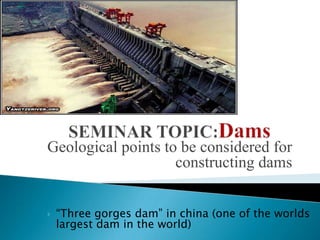
SEMINAR TOPIC:DamsGeological points to be considered for constructing dams“Three gorges dam” in china (one of the worlds largest dam in the world)
Power generationWater supplyIrrigationFlood preventionLand reclamationWater diversionNavigationRecreation & aquatic beautyDam creationcommon purposes
LocationOf damOne of the best places for building a dam is a narrow part of a deep river valley;
the valley sides can then act as natural walls.
The primary function of the dam's structure is to fill the gap in the natural reservoir line left by the stream channel.
The sites are usually those where the gap becomes a minimum for the required storage capacity.
The most economical arrangement is often a composite structure such as a masonry dam flanked by earth embankments.
The current use of the land to be flooded should be dispensableEngineering Geology of DamsWhat Geological Input is required for the engineering of a large dam? • The stability and safety of the dam on its foundations; • The water-tightness of the reservoir basin; • The slope stability of the reservoir perimeter• The availability of suitable local materials for its construction.
Stability is obviously the major factor.  This involves -                      The Dam • The dam must function safely• The water pressure acting on the face of the dam may cause sliding and / or trigger earthquakes • The water pressure acting in any discontinuities, cracks or voids  in the foundations may cause uplift.  Treatment may involve  grout and / or drainage curtains
Engineering  and Engineering Geology considerations when building a dam include:permeability of the surrounding rock or soil
earthquake faults
landslides and slope stability
water table
peak flood flows
reservoir silting
environmental impacts on river fisheries, forests and wildlife (see also fish ladder)
impacts on human habitations
compensation for land being flooded as well as population resettlement
removal of toxic materials and buildings from the proposed reservoir areaA measure of the ability of soil, sediments, and rock to transport water horizontally and vertically. Permeability is dependent on the porosity of the medium the water is flowing through. Some rocks like granite have very poor permeability, while rocks like shale are actually quite pervious. As for soils, sand is the most pervious, while clay has the lowest permeability. Silt usually is somewhere in the middle. PERMEABILITY OF THE SURROUNDING ROCK
CURTAIN GROUTING IS DESIGN TO CREATE A THIN BARRIER (OR CURTAIN) THOUGH AN AREA OF HIGH PERMEABILITY.the purpose of the grout curtains are used under dams where the foundation would otherwise pass too much seepage, reduce the seepage erosion potential and reduce leakage through the dam foundation. Grout curtain is restrict seepage to such an amount that it does not cause too much loss of storage, and does not dislodge the foundation downstream or erode the base of the dam.
When the size of the dam has been determined, the type of dam envisaged requires certain geological and topographical conditions which, for the main types of dams,Based on that dams are of two types1.Concrete dams2.Embakement dams
Concrete damsGravity DamsButtress DamsMultiple Arch DamsThick Arch DamsThin Arch Dams
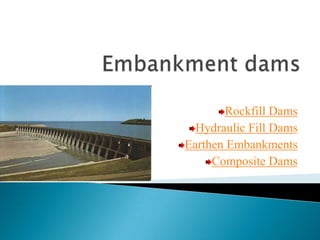
Embankment damsRockfill DamsHydraulic Fill DamsEarthen EmbankmentsComposite Dams
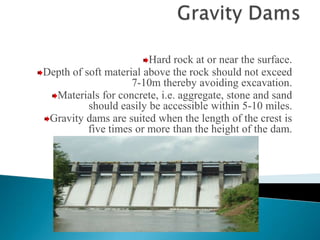
Gravity DamsHard rock at or near the surface.Depth of soft material above the rock should not exceed 7-10m thereby avoiding excavation.Materials for concrete, i.e. aggregate, stone and sand should easily be accessible within 5-10 miles.Gravity dams are suited when the length of the crest is five times or more than the height of the dam.
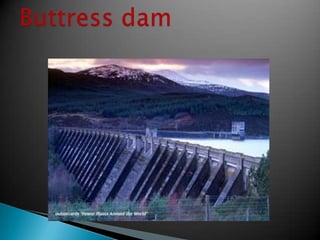
Buttress DamsThe buttress dam is suitable where the rock is capable of bearing pressures of 2 - 3 MPa.Buttress dams require between a half and two thirds of the concrete required for a gravity section, hence making it more economical for dams over 14m.Additional skilled labour is required to create the formwork.Threat of deterioration of concrete from the impounded water is more likely than from a thick gravity section.There is also an elimination of a good deal of uplift pressure, the pressure resulting from the water in the reservoir and possibly of water from the hillside rocks gaining access through or under any grout curtain and exerting upwards underneath the mass concrete dam.
Multiple Arch DamsThe multiple arch concrete dam is a variety of buttress dam.The chief geological criterion is that the rock must be absolutely reliable to bear 2-3 MPa or more without any appreciable settlement (<8mm)There is some saving in concrete compared with buttress dams.In respect of uplift, corrosion and economy the two types are very similar.
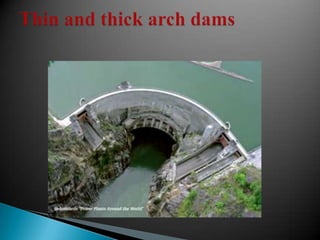
Thick Arch DamsThe thick arch dam can be built where the crest chord-height ratio is between 3 and 5.The chief geological criterion is that the rock must be absolutely reliable to bear 3.5 MPa or more without any appreciable settlement.A substantial saving in material compared with that of gravity dams.Thick arch dams are difficult to design on paper but are well determined from trials on models
Thin Arch DamsThin arch dams require valleys to have a crest chord-height ratio of under 3, with a radius of under 150m.The pressure exerted on the valley sides is between 5.5 - 8 MpaWhere there is a vertical radius of curvature as well as a horizontal, this is known as a cupola or dome type.Used where cement is expensive and labour is cheap.
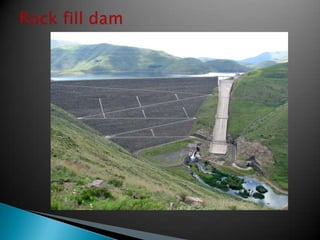
Rockfill DamsRockfill dams can be built where the following conditions exist -Uncertain or variable foundation which is unreliable for sustaining the pressure necessary for any form of concrete dam.Suitable rock in the vicinity which is hard and will stand up to variations of weather.An adequate amount of clay in the region which may be inserted in the dam either as a vertical core or as a sloping core.Accessibility of the site and the width of the valley is suitable for the manipulation of heavy earth-moving machinery, caterpillar scrapers, sheepfoot rollers and large bulldozers.

Dams

  • 1.
    SEMINAR TOPIC:DamsGeological pointsto be considered for constructing dams“Three gorges dam” in china (one of the worlds largest dam in the world)
  • 2.
    Power generationWater supplyIrrigationFloodpreventionLand reclamationWater diversionNavigationRecreation & aquatic beautyDam creationcommon purposes
  • 3.
    LocationOf damOne ofthe best places for building a dam is a narrow part of a deep river valley;
  • 4.
    the valley sidescan then act as natural walls.
  • 5.
    The primary functionof the dam's structure is to fill the gap in the natural reservoir line left by the stream channel.
  • 6.
    The sites areusually those where the gap becomes a minimum for the required storage capacity.
  • 7.
    The most economicalarrangement is often a composite structure such as a masonry dam flanked by earth embankments.
  • 8.
    The current useof the land to be flooded should be dispensableEngineering Geology of DamsWhat Geological Input is required for the engineering of a large dam? • The stability and safety of the dam on its foundations; • The water-tightness of the reservoir basin; • The slope stability of the reservoir perimeter• The availability of suitable local materials for its construction.
  • 9.
    Stability is obviouslythe major factor. This involves - The Dam • The dam must function safely• The water pressure acting on the face of the dam may cause sliding and / or trigger earthquakes • The water pressure acting in any discontinuities, cracks or voids in the foundations may cause uplift. Treatment may involve grout and / or drainage curtains
  • 10.
    Engineering  and Engineering Geology considerationswhen building a dam include:permeability of the surrounding rock or soil
  • 11.
  • 12.
  • 13.
  • 14.
  • 15.
  • 16.
    environmental impacts on riverfisheries, forests and wildlife (see also fish ladder)
  • 17.
    impacts on humanhabitations
  • 18.
    compensation for landbeing flooded as well as population resettlement
  • 19.
    removal of toxicmaterials and buildings from the proposed reservoir areaA measure of the ability of soil, sediments, and rock to transport water horizontally and vertically. Permeability is dependent on the porosity of the medium the water is flowing through. Some rocks like granite have very poor permeability, while rocks like shale are actually quite pervious. As for soils, sand is the most pervious, while clay has the lowest permeability. Silt usually is somewhere in the middle. PERMEABILITY OF THE SURROUNDING ROCK
  • 20.
    CURTAIN GROUTING ISDESIGN TO CREATE A THIN BARRIER (OR CURTAIN) THOUGH AN AREA OF HIGH PERMEABILITY.the purpose of the grout curtains are used under dams where the foundation would otherwise pass too much seepage, reduce the seepage erosion potential and reduce leakage through the dam foundation. Grout curtain is restrict seepage to such an amount that it does not cause too much loss of storage, and does not dislodge the foundation downstream or erode the base of the dam.
  • 21.
    When the sizeof the dam has been determined, the type of dam envisaged requires certain geological and topographical conditions which, for the main types of dams,Based on that dams are of two types1.Concrete dams2.Embakement dams
  • 22.
    Concrete damsGravity DamsButtressDamsMultiple Arch DamsThick Arch DamsThin Arch Dams
  • 23.
    Embankment damsRockfill DamsHydraulicFill DamsEarthen EmbankmentsComposite Dams
  • 24.
    Gravity DamsHard rockat or near the surface.Depth of soft material above the rock should not exceed 7-10m thereby avoiding excavation.Materials for concrete, i.e. aggregate, stone and sand should easily be accessible within 5-10 miles.Gravity dams are suited when the length of the crest is five times or more than the height of the dam.
  • 25.
    Buttress DamsThe buttressdam is suitable where the rock is capable of bearing pressures of 2 - 3 MPa.Buttress dams require between a half and two thirds of the concrete required for a gravity section, hence making it more economical for dams over 14m.Additional skilled labour is required to create the formwork.Threat of deterioration of concrete from the impounded water is more likely than from a thick gravity section.There is also an elimination of a good deal of uplift pressure, the pressure resulting from the water in the reservoir and possibly of water from the hillside rocks gaining access through or under any grout curtain and exerting upwards underneath the mass concrete dam.
  • 26.
    Multiple Arch DamsThemultiple arch concrete dam is a variety of buttress dam.The chief geological criterion is that the rock must be absolutely reliable to bear 2-3 MPa or more without any appreciable settlement (<8mm)There is some saving in concrete compared with buttress dams.In respect of uplift, corrosion and economy the two types are very similar.
  • 27.
    Thick Arch DamsThethick arch dam can be built where the crest chord-height ratio is between 3 and 5.The chief geological criterion is that the rock must be absolutely reliable to bear 3.5 MPa or more without any appreciable settlement.A substantial saving in material compared with that of gravity dams.Thick arch dams are difficult to design on paper but are well determined from trials on models
  • 28.
    Thin Arch DamsThinarch dams require valleys to have a crest chord-height ratio of under 3, with a radius of under 150m.The pressure exerted on the valley sides is between 5.5 - 8 MpaWhere there is a vertical radius of curvature as well as a horizontal, this is known as a cupola or dome type.Used where cement is expensive and labour is cheap.
  • 29.
    Rockfill DamsRockfill damscan be built where the following conditions exist -Uncertain or variable foundation which is unreliable for sustaining the pressure necessary for any form of concrete dam.Suitable rock in the vicinity which is hard and will stand up to variations of weather.An adequate amount of clay in the region which may be inserted in the dam either as a vertical core or as a sloping core.Accessibility of the site and the width of the valley is suitable for the manipulation of heavy earth-moving machinery, caterpillar scrapers, sheepfoot rollers and large bulldozers.