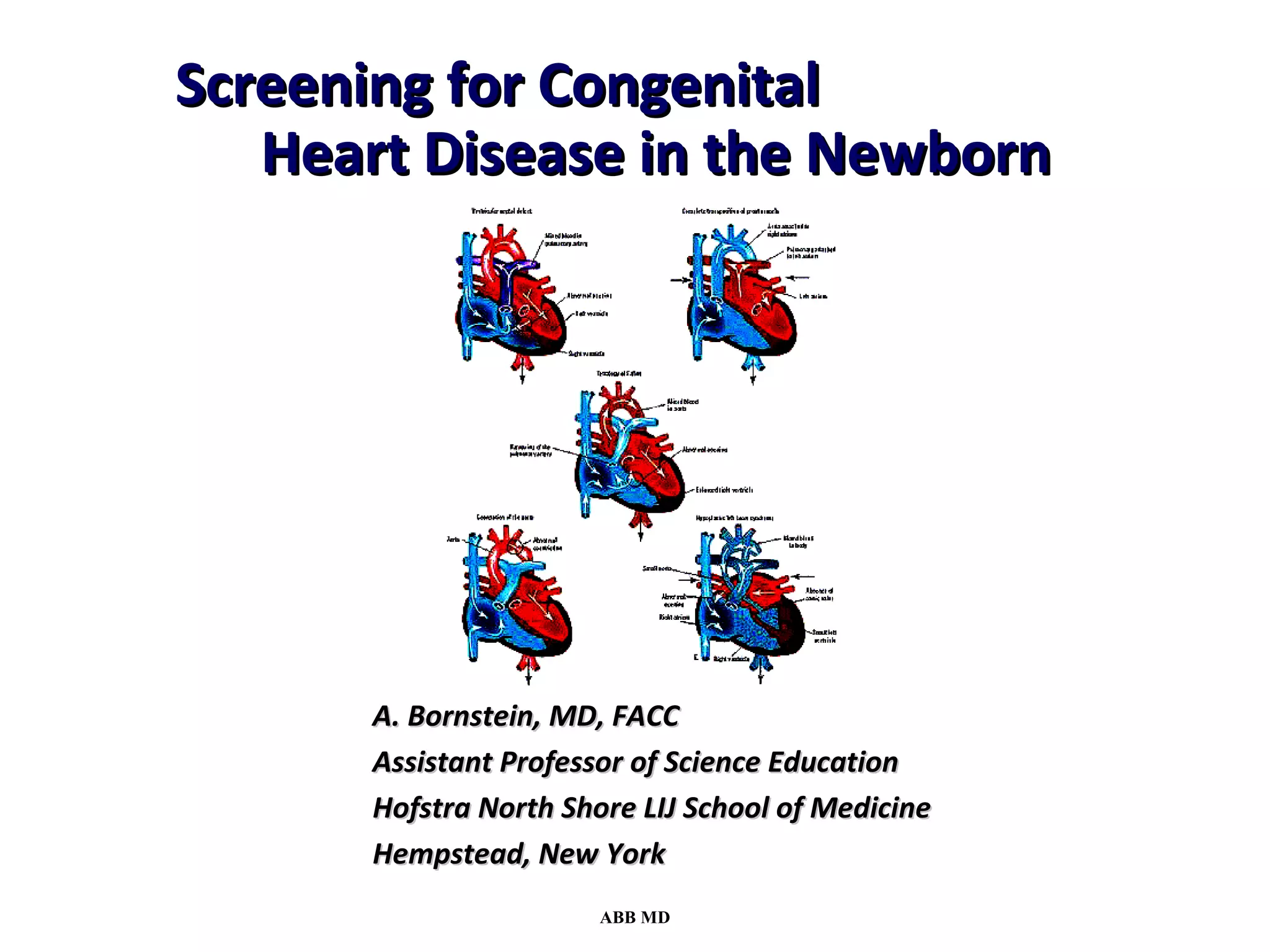
Screening for Congenital
   Heart Disease in the Newborn


      A. Bornstein, MD, FACC
      Assistant Professor of Science Education
      Hofstra North Shore LIJ School of Medicine
      Hempstead, New York
                       ABB MD
Goals of the Presentation

Provide pathophysiologic framework to:

      • Enhance understanding of the various ways in which congenital
        heart disease can present in the neonate


      • Simplify the approach to congenital heart defects
        by organizing them into categories


      • Decrease the dependence upon rote memory

      • Facilitate management of affected patients


                                  ABB MD
Prevalence


• Fertility rate in the USA as of 2007 is 1.7-2.6
• Birth rate in the USA as of 2007 is 14.16/1000 population

• For every 1,000,000 population there are ~14,160 births
     ~142 with congenital heart disease

          ~71 (50%) with ‘clinically significant’ problems

              ~35 (~50%) of these problems are critical and

                        will need help in the 1st 30 days

                   ~28 (~80%) will need help in the 1st week


                                     ABB MD
Background
60 - 65 varieties of CHD
<1% of all live-born neonates (40,000 infants/year)
~33-50% have ‘critical heart disease’


                       ABB MD
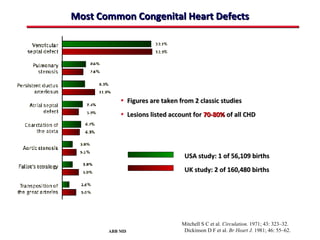
Most Common Congenital Heart Defects


           • Figures are taken from 2 classic studies
           • Lesions listed account for 70-80% of all CHD


                                 USA study: 1 of 56,109 births
                                 UK study: 2 of 160,480 births


                                Mitchell S C et al. Circulation. 1971; 43: 323–32.
       ABB MD                    Dickinson D F et al. Br Heart J. 1981; 46: 55–62.
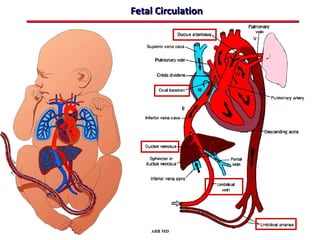
Fetal Circulation


    ABB MD
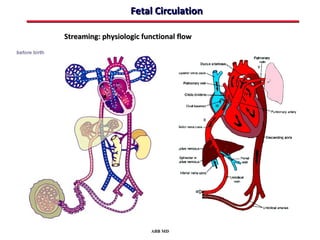
Fetal Circulation

Streaming: physiologic functional flow


                         ABB MD
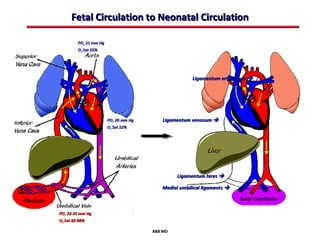
Fetal Circulation to Neonatal Circulation

         PO2 21 mm Hg
         O2 Sat 55%


                                                      Ligamentum arteriosum 


                        PO2 20 mm Hg      Ligamentum venosum 
                        O2 Sat 52%


                                                Ligamentum teres 

                                          Medial umbilical ligaments 


PO2 32-35 mm Hg
O2 Sat 82-88%

                                       ABB MD
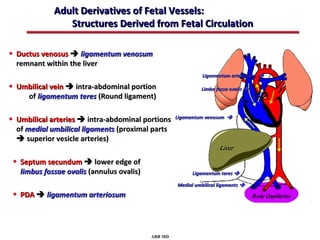
Adult Derivatives of Fetal Vessels:
                Structures Derived from Fetal Circulation

• Ductus venosus  ligamentum venosum
  remnant within the liver
                                                              Ligamentum arteriosum 

• Umbilical vein  intra-abdominal portion                   Limba fossa ovalis 
     of ligamentum teres (Round ligament)

• Umbilical arteries  intra-abdominal portions     Ligamentum venosum 

  of medial umbilical ligaments (proximal parts
   superior vesicle arteries)

 • Septum secundum  lower edge of
   limbus fossae ovalis (annulus ovalis)                  Ligamentum teres 

                                                    Medial umbilical ligaments 
 • PDA  ligamentum arteriosum


                                           ABB MD
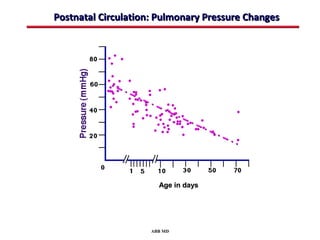
Postnatal Circulation: Pulmonary Pressure Changes


                       Age in days


                     ABB MD
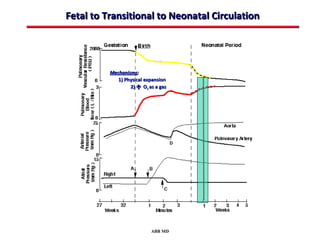
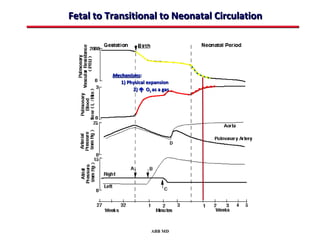
Fetal to Transitional to Neonatal Circulation


          Mechanisms:
             1) Physical expansion
                  2)  O2 as a gas


                           ABB MD
Fetal to Transitional to Neonatal Circulation


          Mechanisms:
             1) Physical expansion
                  2)  O2 as a gas


                          ABB MD
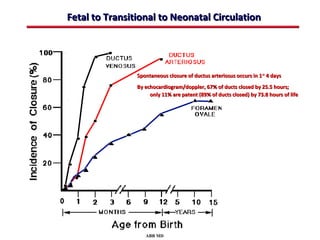
Fetal to Transitional to Neonatal Circulation


                Spontaneous closure of ductus arteriosus occurs in 1st 4 days
                By echocardiogram/doppler, 67% of ducts closed by 25.5 hours;
                     only 11% are patent (89% of ducts closed) by 73.8 hours of life


                   ABB MD
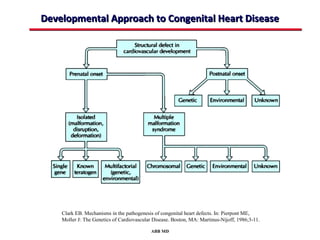
Developmental Approach to Congenital Heart Disease


    Clark EB. Mechanisms in the pathogenesis of congenital heart defects. In: Pierpont ME,
    Moller J: The Genetics of Cardiovascular Disease. Boston, MA: Martinus-Nijoff, 1986;3-11.

                                            ABB MD
Congenital Heart Disease: Genomics

• Incidence of CHD is 7-8/1000 live births (<1%)
     (10% of spontaneously aborted fetus)

• Etiology of congenital heart defects generally multifactorial (90%)
             (2% due to environmental teratogens)


• 7-8% are associated with heritable syndromes; 1% nonheritable syndromes

• Chromosomal defects occur in 8-13 %
    i.e., Trisomy 21 (Down syndrome); Chromosome 22q11.2 microdeletion
            (DiGeorge syndrome, Velocardiofacial syndrome)

• Single gene disorders can occur (i.e., fibrillin defect in Marfan’s Syndrome)

• 5% are associated with other organ system defects
                                      ABB MD
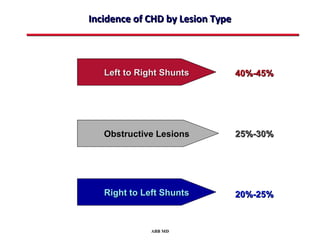
Incidence of CHD by Lesion Type


   Left to Right Shunts           40%-45%


   Obstructive Lesions            25%-30%


   Right to Left Shunts           20%-25%


              ABB MD
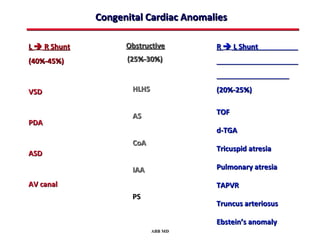
Congenital Cardiac Anomalies

L  R Shunt         Obstructive        R  L Shunt
(40%-45%)           (25%-30%)


VSD                  HLHS              (20%-25%)


                     AS                TOF
PDA
                                       d-TGA
                     CoA
                                       Tricuspid atresia
ASD

                     IAA               Pulmonary atresia

AV canal                               TAPVR
                     PS
                                       Truncus arteriosus

                                       Ebstein’s anomaly
                            ABB MD
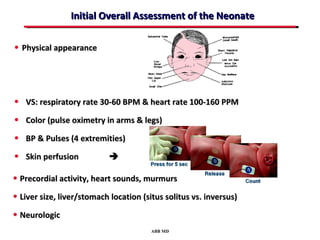
Initial Overall Assessment of the Neonate

• Physical appearance


• VS: respiratory rate 30-60 BPM & heart rate 100-160 PPM
• Color (pulse oximetry in arms & legs)
• BP & Pulses (4 extremities)
• Skin perfusion           

• Precordial activity, heart sounds, murmurs
• Liver size, liver/stomach location (situs solitus vs. inversus)
• Neurologic
                                        ABB MD
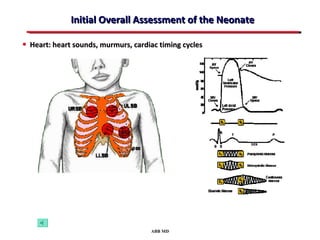
Initial Overall Assessment of the Neonate

• Heart: heart sounds, murmurs, cardiac timing cycles


                                     ABB MD
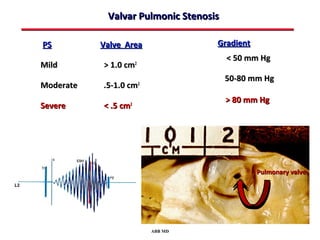
Valvar Pulmonic Stenosis

PS         Valve Area                  Gradient
                                         < 50 mm Hg
Mild       > 1.0 cm   2


                                        50-80 mm Hg
Moderate   .5-1.0 cm      2


                                        > 80 mm Hg
Severe     < .5 cm2


                                                  Pulmonary valve


                              ABB MD
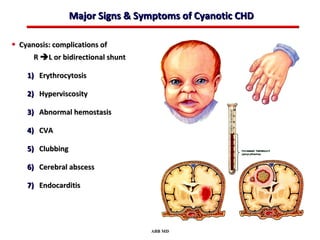
Major Signs & Symptoms of Cyanotic CHD

• Cyanosis: complications of
      R  L or bidirectional shunt

    1) Erythrocytosis

    2) Hyperviscosity

    3) Abnormal hemostasis

    4) CVA

    5) Clubbing

    6) Cerebral abscess

    7) Endocarditis


                                     ABB MD
Initial Overall Assessment of the Neonate

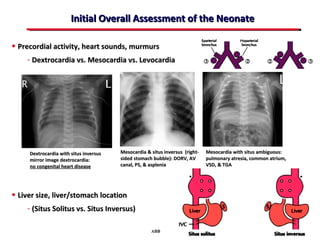
• Precordial activity, heart sounds, murmurs
     - Dextrocardia vs. Mesocardia vs. Levocardia


      Dextrocardia with situs inversus   Mesocardia & situs inversus (right-   Mesocardia with situs ambiguous:
      mirror image dextrocardia:         sided stomach bubble): DORV, AV       pulmonary atresia, common atrium,
      no congenital heart disease        canal, PS, & asplenia                 VSD, & TGA


• Liver size, liver/stomach location
     - (Situs Solitus vs. Situs Inversus)

                                                      ABB MD
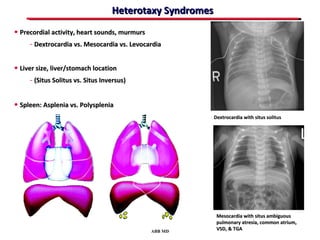
Heterotaxy Syndromes

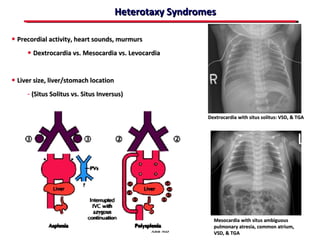
• Precordial activity, heart sounds, murmurs
     • Dextrocardia vs. Mesocardia vs. Levocardia


• Liver size, liver/stomach location
     - (Situs Solitus vs. Situs Inversus)

                                                         Dextrocardia with situs solitus: VSD, & TGA


                                                           Mesocardia with situs ambiguous
                                                           pulmonary atresia, common atrium,
                                               ABB MD      VSD, & TGA
Heterotaxy Syndromes
• Precordial activity, heart sounds, murmurs
     - Dextrocardia vs. Mesocardia vs. Levocardia

• Liver size, liver/stomach location
      - (Situs Solitus vs. Situs Inversus)

• Spleen: Asplenia vs. Polysplenia
                                                           Dextrocardia with situs solitus


                                                            Mesocardia with situs ambiguous
                                                            pulmonary atresia, common atrium,
                                             ABB MD
                                                            VSD, & TGA
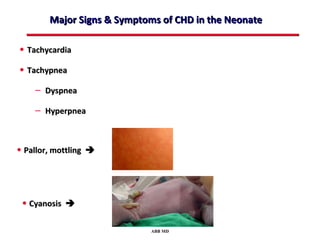
Major Signs & Symptoms of CHD in the Neonate

• Tachycardia
• Tachypnea
    – Dyspnea
    – Hyperpnea


• Pallor, mottling 


 • Cyanosis 

                            ABB MD
The Dyspneic/Tachypneic Neonate


• Rapid breathing (>60 breaths/minute)
    – Shallow
         Maintain minute ventilation


• Increased work of breathing
    – Lung/chest compliance 
         Frequently related to  interstitial lung fluid
            – Lymphatic fluid 
                 Micro/macro atelectasis
                 Small airway obstruction

                                   ABB MD
The Dyspneic/Tachypneic Neonate

• Rapid breathing (>60 breaths/minute)

• Increased work of breathing

• Expiratory grunting

• Nasal flaring

• Intercostal and sternal retractions (recession)

• Central cyanosis while breathing room air

• Aeration (ventilation) of lungs  with or without crackles or crepitations

                                      ABB MD
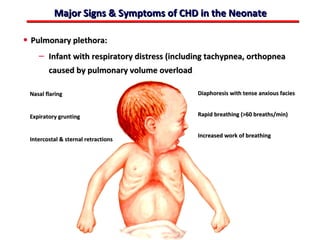
Major Signs & Symptoms of CHD in the Neonate

• Pulmonary plethora:
    – Infant with respiratory distress (including tachypnea, orthopnea
        caused by pulmonary volume overload

 Nasal flaring                                Diaphoresis with tense anxious facies


 Expiratory grunting                          Rapid breathing (>60 breaths/min)


                                              Increased work of breathing
 Intercostal & sternal retractions


                                     ABB MD
The Hyperpneic/Tachypneic Neonate

• Rapid breathing


• Hyperventilation
    – Deep

    – Hypoxic drive

    – Compensation for metabolic acidosis
      (e.g., Kussmaul respirations)
    – Compliant lung/chest

         ‘Dry’ lungs


                                 ABB MD
Disasters in the Delivery Room

Most dramatic delivery room resuscitations related to
cardiovascular or pulmonary anomalies are secondary to:

 1) TAPVR with obstruction
 2) HLHS with restrictive ASD
 3) Airway obstruction
       TOF & absent PV syndrome (to & fro murmur)
 1) Pulmonary hypoplasia
       Ebstein’s Anomaly; Congenital diaphragmatic hernia
 1) Cardiomyopathy or sustained dysrhythmia
       Frequently seen in nonimmune hydrops fetalis

                                  ABB MD
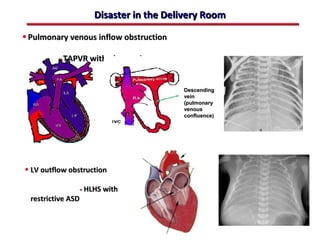
Disaster in the Delivery Room

• Pulmonary venous inflow obstruction

          - TAPVR with obstruction


                                          Descending
                                          vein
                                          (pulmonary
                                          venous
                                          confluence)


• LV outflow obstruction

                 - HLHS with
  restrictive ASD


                                 ABB MD
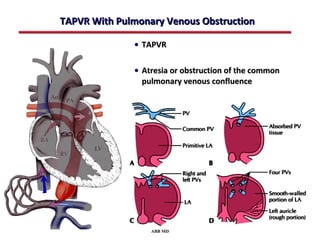
TAPVR With Pulmonary Venous Obstruction

              • TAPVR

              • Atresia or obstruction of the common
                pulmonary venous confluence


                  ABB MD
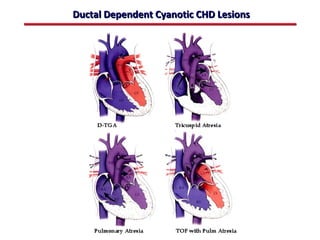
Ductal Dependent Cyanotic CHD Lesions


                ABB MD
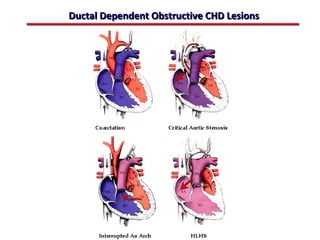
Ductal Dependent Obstructive CHD Lesions


                 ABB MD
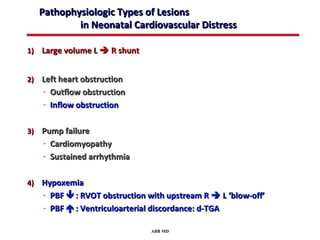
Pathophysiologic Types of Lesions
           in Neonatal Cardiovascular Distress

1) Large volume L  R shunt


2) Left heart obstruction
    - Outflow obstruction
    - Inflow obstruction

3) Pump failure
    - Cardiomyopathy
    - Sustained arrhythmia

4) Hypoxemia
    - PBF  : RVOT obstruction with upstream R  L ‘blow-off’
    - PBF  : Ventriculoarterial discordance: d-TGA

                               ABB MD
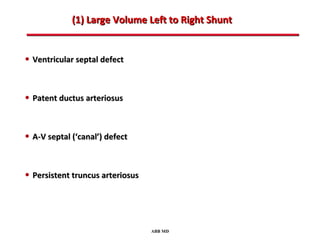
(1) Large Volume Left to Right Shunt


• Ventricular septal defect


• Patent ductus arteriosus


• A-V septal (‘canal’) defect


• Persistent truncus arteriosus


                                  ABB MD
Evaluation of the Acyanotic Shunt Lesions


               Acyanotic:
                             PBF


                   Left to Right Shunt


                            LVH              LVH & RVH
      RVH


ASD             VSD                                  A-V Canal Defect
                PDA
                                                     VSD (Late)
  PAPVD               A-P Window
                                                     PDA (Late)
                                    ABB MD
‘Dependent’ Shunts: VSD, PDA


           ABB MD
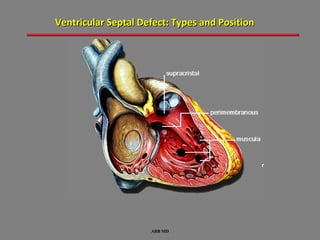
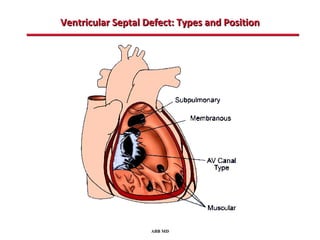
Ventricular Septal Defect: Types and Position


                                                r


                     ABB MD
Ventricular Septal Defect: Types and Position


                    ABB MD
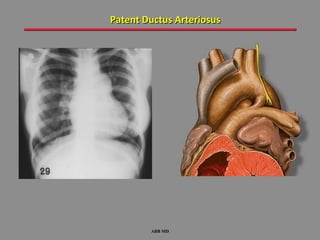
Patent Ductus Arteriosus


        ABB MD
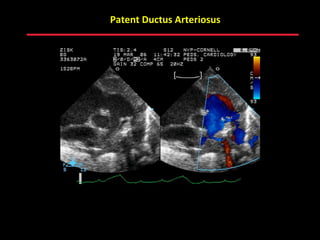
Patent Ductus Arteriosus


        ABB MD
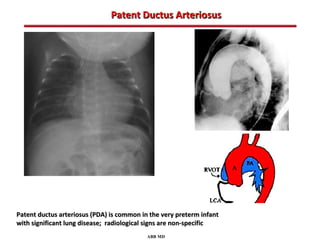
Patent Ductus Arteriosus


Patent ductus arteriosus (PDA) is common in the very preterm infant
with significant lung disease; radiological signs are non-specific
                                           ABB MD
(2) Left Heart Obstruction


• Outflow (LVOT) obstruction
    – Aortic stenosis
    – Aortic coarctation
    – Hypoplastic left heart syndrome
    – Interrupted aortic arch

• Inflow obstruction
     – TAPVR (total anomalous pulmonary venous connection
    with obstruction)


                                  ABB MD
(3) Pump Failure

• Cardiomyopathy
   – Hypertrophic/Restrictive
        Infants of diabetic mothers
        Pompe’s disease
   – Dilated/Congestive
        Infectious myocarditis
        Metabolic myopathies
           – e.g., mitochondrial myopathy

• Sustained dysrhythmia
   – Tachyarrhythmia (SVT, A-flutter)
   – Bradyarrhythmia (heart block)
                                  ABB MD
Non-Cardiac Causes of Heart Failure

• Hyperthyroidism                     • Severe anemia
• AV malformations                    • Polycythemia
• Multiple hemangiomas                • Renal failure
• Hypoglycemia                        • Severe systemic hypertension
• Hypocalcemia                        • Adrenal insufficiency
• Asphyxia                            • Metabolic disease (Pompe’s disease)
• Sepsis
           Other Cardiac Causes of Heart Failure

             • Myocarditis
             • Cardiac dysrhythmias (SVT, 30 heart block)
             • ALCAPA (anomalous LCA from PA)
                                      ABB MD
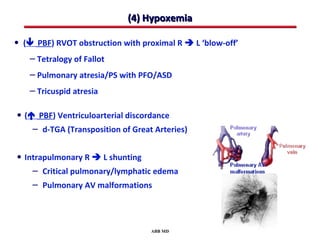
(4) Hypoxemia

• ( PBF) RVOT obstruction with proximal R  L ‘blow-off’
    – Tetralogy of Fallot
    – Pulmonary atresia/PS with PFO/ASD
    – Tricuspid atresia

• ( PBF) Ventriculoarterial discordance
    – d-TGA (Transposition of Great Arteries)

• Intrapulmonary R  L shunting
    – Critical pulmonary/lymphatic edema
    – Pulmonary AV malformations


                                   ABB MD
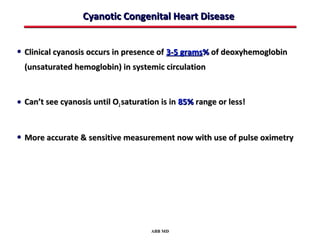
Cyanotic Congenital Heart Disease


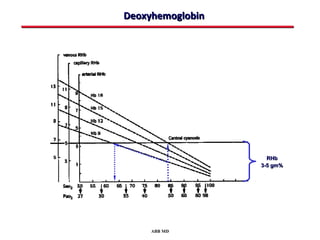
• Clinical cyanosis occurs in presence of 3-5 grams% of deoxyhemoglobin
  (unsaturated hemoglobin) in systemic circulation


• Can’t see cyanosis until O2 saturation is in 85% range or less!


• More accurate & sensitive measurement now with use of pulse oximetry


                                      ABB MD
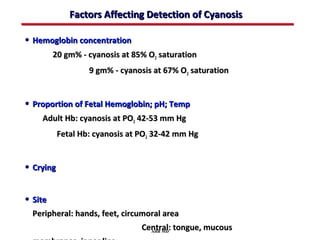
Factors Affecting Detection of Cyanosis

• Hemoglobin concentration
         20 gm% - cyanosis at 85% O2 saturation
                   9 gm% - cyanosis at 67% O 2 saturation


• Proportion of Fetal Hemoglobin; pH; Temp
    Adult Hb: cyanosis at PO2 42-53 mm Hg
           Fetal Hb: cyanosis at PO2 32-42 mm Hg


• Crying


• Site
  Peripheral: hands, feet, circumoral area
                                 Central: tongue, mucous
                                   ABB MD
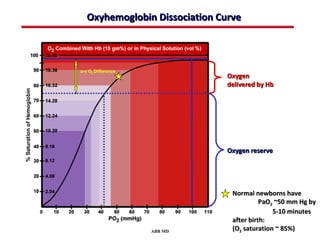
Oxyhemoglobin Dissociation Curve


a-v O2 Difference
                                Oxygen
                                delivered by Hb


                                Oxygen reserve


                                 Normal newborns have
                                           PaO2 ~50 mm Hg by
                                               5-10 minutes
                                 after birth:
                    ABB MD       (O2 saturation ~ 85%)
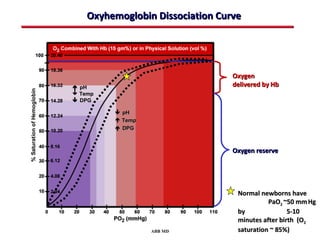
Oxyhemoglobin Dissociation Curve


                                  Oxygen
 pH                              delivered by Hb
 Temp
 DPG

          pH
          Temp
          DPG


                                  Oxygen reserve


                                   Normal newborns have
                                             PaO2 ~50 mm Hg
                                   by               5-10
                                   minutes after birth (O2
                  ABB MD           saturation ~ 85%)
Deoxyhemoglobin


                    RHb
                  3-5 gm%


     ABB MD
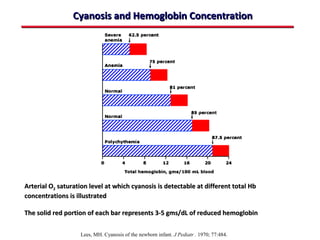
Cyanosis and Hemoglobin Concentration


Arterial O2 saturation level at which cyanosis is detectable at different total Hb
concentrations is illustrated

The solid red portion of each bar represents 3-5 gms/dL of reduced hemoglobin

                   Lees, MH. Cyanosis of the newborn infant. J Pediatr . 1970; 77:484.
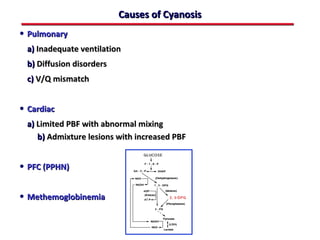
Causes of Cyanosis
• Pulmonary
  a) Inadequate ventilation
  b) Diffusion disorders
  c) V/Q mismatch


• Cardiac
  a) Limited PBF with abnormal mixing
     b) Admixture lesions with increased PBF


• PFC (PPHN)

• Methemoglobinemia


                                  ABB MD
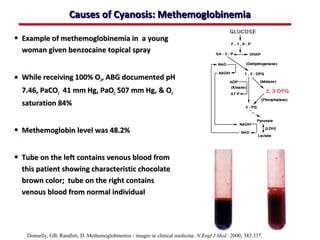
Causes of Cyanosis: Methemoglobinemia

• Example of methemoglobinemia in a young
  woman given benzocaine topical spray


• While receiving 100% O2, ABG documented pH
  7.46, PaCO2 41 mm Hg, PaO2 507 mm Hg, & O2
  saturation 84%


• Methemoglobin level was 48.2%

• Tube on the left contains venous blood from
  this patient showing characteristic chocolate
  brown color; tube on the right contains
  venous blood from normal individual


   Donnelly, GB, Randlett, D. Methemoglobinemia - images in clinical medicine. N Engl J Med. 2000; 343:337.
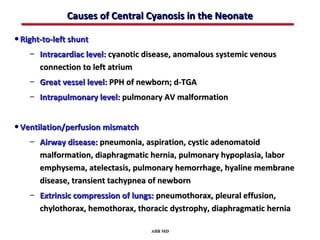
Causes of Central Cyanosis in the Neonate

• Right-to-left shunt
    – Intracardiac level: cyanotic disease, anomalous systemic venous
      connection to left atrium
    – Great vessel level: PPH of newborn; d-TGA
    – Intrapulmonary level: pulmonary AV malformation


• Ventilation/perfusion mismatch
    – Airway disease: pneumonia, aspiration, cystic adenomatoid
      malformation, diaphragmatic hernia, pulmonary hypoplasia, labor
      emphysema, atelectasis, pulmonary hemorrhage, hyaline membrane
      disease, transient tachypnea of newborn
    – Extrinsic compression of lungs: pneumothorax, pleural effusion,
      chylothorax, hemothorax, thoracic dystrophy, diaphragmatic hernia

                                   ABB MD
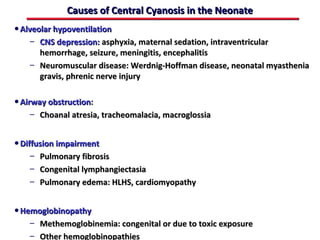
Causes of Central Cyanosis in the Neonate
• Alveolar hypoventilation
    – CNS depression: asphyxia, maternal sedation, intraventricular
      hemorrhage, seizure, meningitis, encephalitis
    – Neuromuscular disease: Werdnig-Hoffman disease, neonatal myasthenia
      gravis, phrenic nerve injury

• Airway obstruction:
    – Choanal atresia, tracheomalacia, macroglossia


• Diffusion impairment
    –   Pulmonary fibrosis
    –   Congenital lymphangiectasia
    –   Pulmonary edema: HLHS, cardiomyopathy


• Hemoglobinopathy
    – Methemoglobinemia: congenital or due to toxic exposure
    – Other hemoglobinopathies
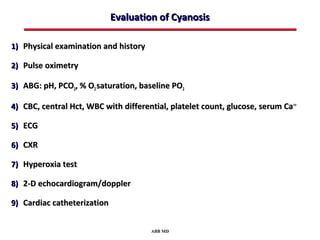
Evaluation of Cyanosis

1) Physical examination and history

2) Pulse oximetry

3) ABG: pH, PCO2, % O2 saturation, baseline PO2
4) CBC, central Hct, WBC with differential, platelet count, glucose, serum Ca ++

5) ECG

6) CXR

7) Hyperoxia test

8) 2-D echocardiogram/doppler

9) Cardiac catheterization


                                       ABB MD
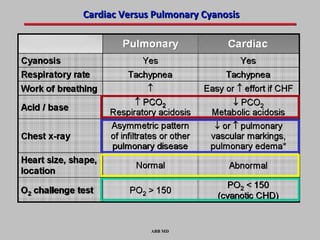
Cardiac Versus Pulmonary Cyanosis


              ABB MD
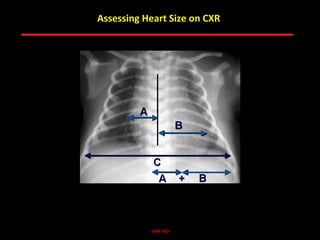
Assessing Heart Size on CXR


           ABB MD
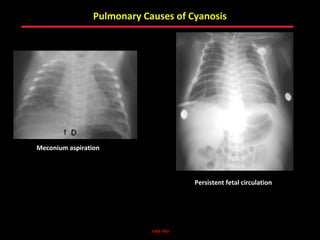
Pulmonary Causes of Cyanosis


Meconium aspiration


                                     Persistent fetal circulation


                            ABB MD
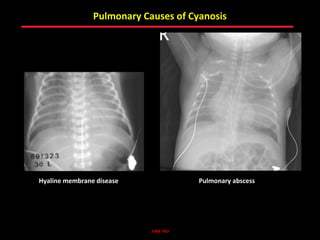
Pulmonary Causes of Cyanosis


Hyaline membrane disease              Pulmonary abscess
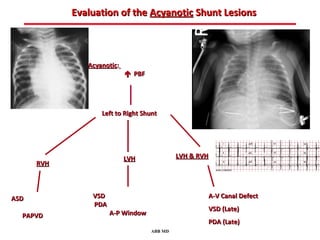
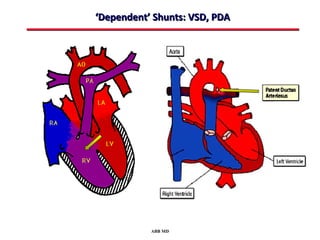


                            ABB MD
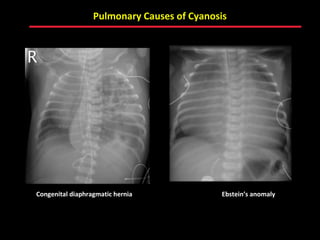
Pulmonary Causes of Cyanosis


Congenital diaphragmatic hernia             Ebstein’s anomaly


                                  ABB MD
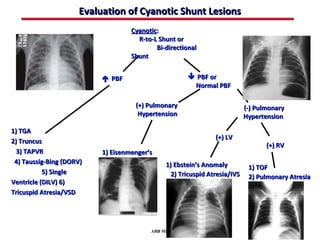
Evaluation of Cyanotic Shunt Lesions
                                   Cyanotic:
                                     R-to-L Shunt or
                                           Bi-directional
                                   Shunt


                           PBF                        PBF or
                                                       Normal PBF

                                    (+) Pulmonary                          (-) Pulmonary
                                     Hypertension                          Hypertension

1) TGA
                                                               (+) LV
2) Truncus
                                                                                  (+) RV
  3) TAPVR                1) Eisenmenger’s
 4) Taussig-Bing (DORV)                       1) Ebstein’s Anomaly          1) TOF
           5) Single                            2) Tricuspid Atresia/IVS    2) Pulmonary Atresia
Ventricle (DILV) 6)
Tricuspid Atresia/VSD


                                         ABB MD
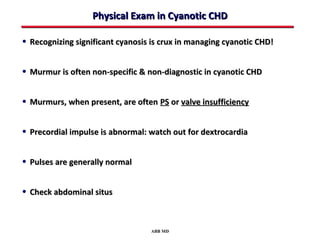
Physical Exam in Cyanotic CHD

• Recognizing significant cyanosis is crux in managing cyanotic CHD!


• Murmur is often non-specific & non-diagnostic in cyanotic CHD


• Murmurs, when present, are often PS or valve insufficiency


• Precordial impulse is abnormal: watch out for dextrocardia


• Pulses are generally normal


• Check abdominal situs


                                  ABB MD
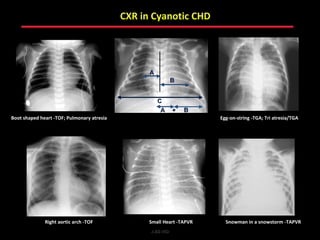
CXR in Cyanotic CHD


Boot shaped heart -TOF; Pulmonary atresia                              Egg-on-string -TGA; Tri atresia/TGA


              Right aortic arch -TOF              Small Heart -TAPVR     Snowman in a snowstorm -TAPVR
                                                  ABB MD
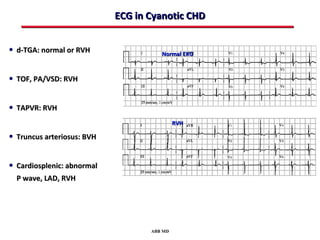
ECG in Cyanotic CHD


• d-TGA: normal or RVH                Normal EKG


• TOF, PA/VSD: RVH

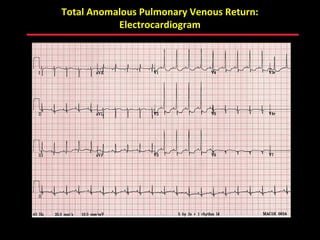
• TAPVR: RVH
                                            RVH

• Truncus arteriosus: BVH

• Cardiosplenic: abnormal
  P wave, LAD, RVH


                                   ABB MD
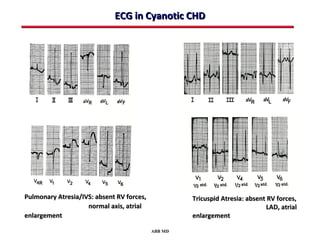
ECG in Cyanotic CHD


Pulmonary Atresia/IVS: absent RV forces,            Tricuspid Atresia: absent RV forces,
                    normal axis, atrial                                       LAD, atrial
enlargement                                         enlargement

                                           ABB MD
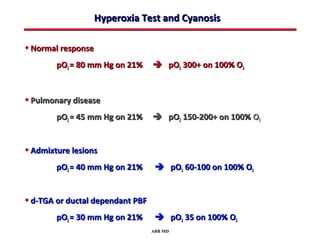
Hyperoxia Test and Cyanosis

• Normal response
        pO2 = 80 mm Hg on 21%      pO2 300+ on 100% O2


• Pulmonary disease
        pO2 = 45 mm Hg on 21%      pO2 150-200+ on 100% O2


• Admixture lesions
        pO2 = 40 mm Hg on 21%       pO2 60-100 on 100% O2


• d-TGA or ductal dependant PBF
        pO2 = 30 mm Hg on 21%       pO2 35 on 100% O2
                                  ABB MD
Left Heart Outflow Obstruction

• Symptoms related to:
    – Inadequate systemic blood flow
    – Pulmonary edema due to pulmonary venous hypertension


• Timing of symptoms related to:
    – Closure of ductus arteriosus
         Within days of birth
         May be hastened by hyperoxia


                                     ABB MD
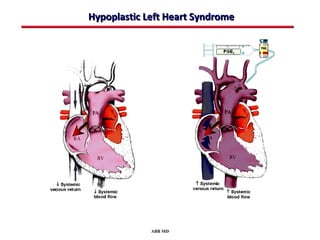
Hypoplastic Left Heart Syndrome


             ABB MD
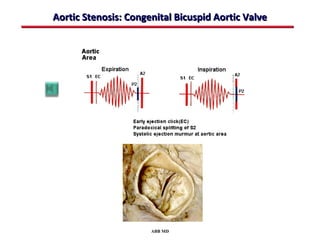
Aortic Stenosis: Congenital Bicuspid Aortic Valve


                      ABB MD
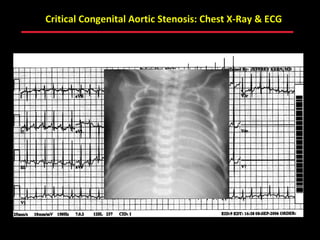
Critical Congenital Aortic Stenosis: Chest X-Ray & ECG


                        ABB MD
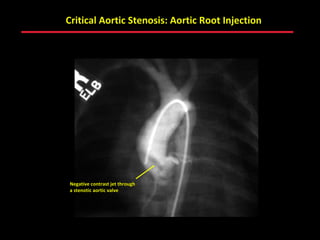
Critical Aortic Stenosis: Aortic Root Injection


Negative contrast jet through
a stenotic aortic valve


                                ABB MD
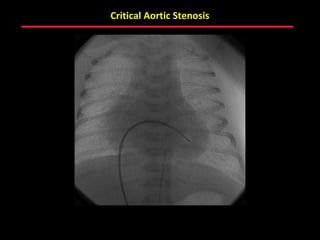
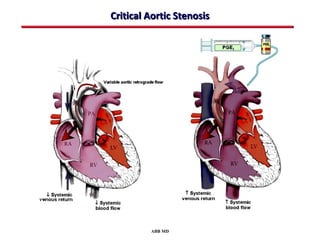
Critical Aortic Stenosis


         ABB MD
Critical Aortic Stenosis


         ABB MD
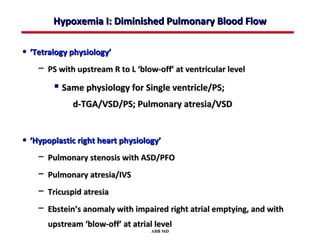
Hypoxemia I: Diminished Pulmonary Blood Flow

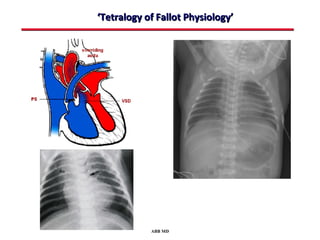
• ‘Tetralogy physiology’
    − PS with upstream R to L ‘blow-off’ at ventricular level
         Same physiology for Single ventricle/PS;
              d-TGA/VSD/PS; Pulmonary atresia/VSD


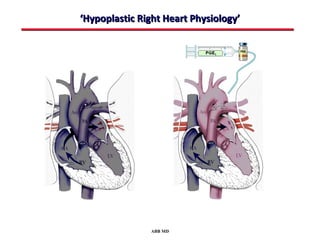
• ‘Hypoplastic right heart physiology’
    − Pulmonary stenosis with ASD/PFO
    − Pulmonary atresia/IVS
    − Tricuspid atresia
    − Ebstein’s anomaly with impaired right atrial emptying, and with
       upstream ‘blow-off’ at atrial level
                                    ABB MD
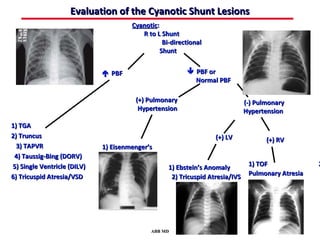
Evaluation of the Cyanotic Shunt Lesions
                                      Cyanotic:
                                         R to L Shunt
                                                 Bi-directional
                                                Shunt


                              PBF                        PBF or
                                                           Normal PBF

                                       (+) Pulmonary                           (-) Pulmonary
                                        Hypertension                           Hypertension

1) TGA
2) Truncus                                                         (+) LV             (+) RV
  3) TAPVR                   1) Eisenmenger’s
 4) Taussig-Bing (DORV)
5) Single Ventricle (DILV)                         1) Ebstein’s Anomaly         1) TOF              2
6) Tricuspid Atresia/VSD                            2) Tricuspid Atresia/IVS    Pulmonary Atresia


                                            ABB MD
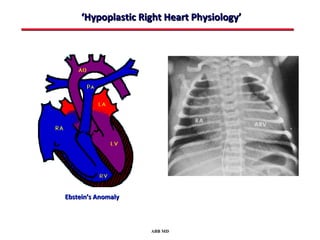
‘Hypoplastic Right Heart Physiology’


Ebstein’s Anomaly


                    ABB MD
‘Hypoplastic Right Heart Physiology’


               ABB MD
‘Tetralogy of Fallot Physiology’


            ABB MD
Hypoxemia-II: Normal to Increased Pulmonary Flow

• Ventriculoarterial discordance (d-TGA)
    – Cyanosis is greatest when ‘mixing’ is least

    – Mixing is best with:
        1) Aorta to pulmonary shunt at ductal level ( PDA)

        2) LA to RA reciprocal shunt at patent foramen ovale ( PFO)

        3) Ventricular septal defect (VSD)


                                   ABB MD
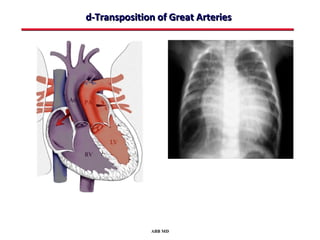
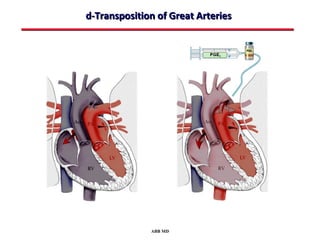
d-Transposition of Great Arteries


              ABB MD
d-Transposition of Great Arteries


              ABB MD
Differential Diagnosis According to Age at Presentation ‘CHF’
           (Poor Perfusion or Respiratory Distress)

In the delivery room (in the first few hours)
    − Left ventricular inflow obstruction
    − LVOT obstruction with restrictive ASD
    − Myocardial failure


 In the first few days
    – Ductal-dependent systemic blood flow
         LVOT (left ventricular outflow tract) obstruction
    – Large volume left  right shunt
         ‘Obligate shunt’ or volume overload
              - AVSD with LV  RA shunt or severe MR)
          - Truncus arteriosus with truncal regurgitation
                                  ABB MD
Differential Diagnosis According to Age at Presentation ‘CHF’
               (Poor Perfusion or Respiratory Distress)

In first few days
    − Ductal-dependent systemic blood flow
         LVOT (left ventricular outflow tract) obstruction
    − Large volume left  right shunt
         ‘Obligate shunt’ or volume load                      -
          AVSD with LV  RA shunt or severe MR)
          - Truncus arteriosus with truncal regurgitation


 After 1-2 weeks
    − Large volume left  right shunt
             ‘Dependent shunt’ (e.g., VSD, PDA)

                                    ABB MD
Conclusions

• Understanding pathophysiology of congenital heart disease simplifies
  differential diagnosis

     Symptomatic congenital heart disease relates to:
        1) Left  Right shunt (large volume)

        2) Left heart inflow obstruction or outflow obstruction

        3) Pump failure

        4) Hypoxemia


                                    ABB MD
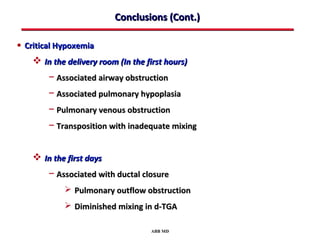
Conclusions (Cont.)

• Critical Hypoxemia
     In the delivery room (In the first hours)
        − Associated airway obstruction
        − Associated pulmonary hypoplasia
        − Pulmonary venous obstruction
        − Transposition with inadequate mixing


     In the first days
        − Associated with ductal closure
             Pulmonary outflow obstruction
             Diminished mixing in d-TGA

                                    ABB MD
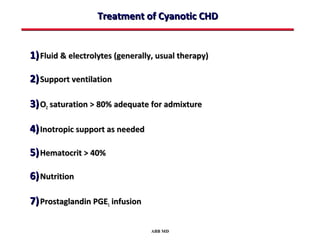
Treatment of Cyanotic CHD


1) Fluid & electrolytes (generally, usual therapy)

2) Support ventilation

3) O2 saturation > 80% adequate for admixture

4) Inotropic support as needed

5) Hematocrit > 40%

6) Nutrition

7) Prostaglandin PGE1 infusion

                                 ABB MD
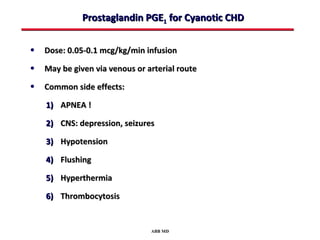
Prostaglandin PGE1 for Cyanotic CHD


• Dose: 0.05-0.1 mcg/kg/min infusion
• May be given via venous or arterial route
• Common side effects:
    1) APNEA !

    2) CNS: depression, seizures

    3) Hypotension

    4) Flushing

    5) Hyperthermia

    6) Thrombocytosis


                               ABB MD
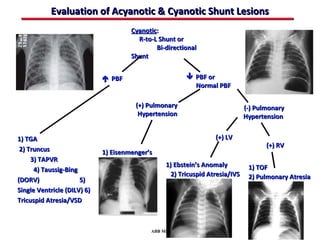
Evaluation of Acyanotic & Cyanotic Shunt Lesions
                                      Cyanotic:
                                        R-to-L Shunt or
                                              Bi-directional
                                      Shunt


                              PBF                       PBF or
                                                          Normal PBF

                                       (+) Pulmonary                          (-) Pulmonary
                                        Hypertension                          Hypertension


1) TGA                                                            (+) LV
                                                                                     (+) RV
 2) Truncus                  1) Eisenmenger’s
     3) TAPVR
                                                 1) Ebstein’s Anomaly          1) TOF
      4) Taussig-Bing
                                                   2) Tricuspid Atresia/IVS    2) Pulmonary Atresia
(DORV)                5)
Single Ventricle (DILV) 6)
Tricuspid Atresia/VSD


                                            ABB MD
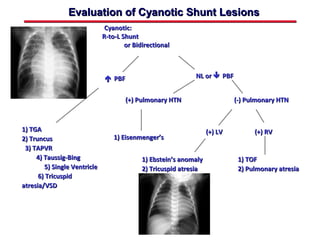
Evaluation of Cyanotic Shunt Lesions
                               Cyanotic:
                              R-to-L Shunt
                                      or Bidirectional


                               PBF                          NL or  PBF


                                      (+) Pulmonary HTN                     (-) Pulmonary HTN


1) TGA                                                             (+) LV         (+) RV
2) Truncus                        1) Eisenmenger’s
 3) TAPVR
     4) Taussig-Bing                        1) Ebstein’s anomaly             1) TOF
        5) Single Ventricle                 2) Tricuspid atresia             2) Pulmonary atresia
      6) Tricuspid
atresia/VSD


                                               ABB MD
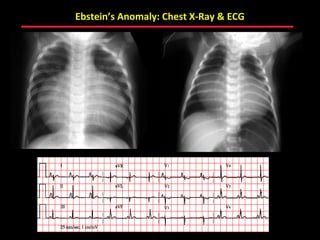
Ebstein’s Anomaly: Chest X-Ray & ECG


                ABB MD
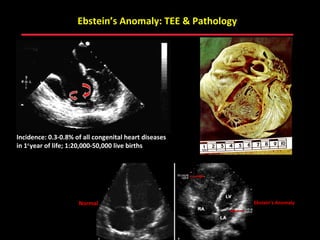
Ebstein’s Anomaly: TEE & Pathology


Incidence: 0.3-0.8% of all congenital heart diseases
in 1st year of life; 1:20,000-50,000 live births


                     Normal                               Ebstein’s Anomaly


                                              ABB MD
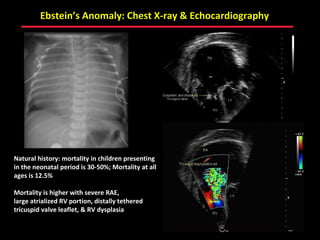
Ebstein’s Anomaly: Chest X-ray & Echocardiography


Natural history: mortality in children presenting
in the neonatal period is 30-50%; Mortality at all
ages is 12.5%

Mortality is higher with severe RAE,
large atrialized RV portion, distally tethered
tricuspid valve leaflet, & RV dysplasia
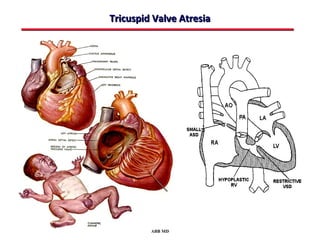
Tricuspid Valve Atresia


         ABB MD
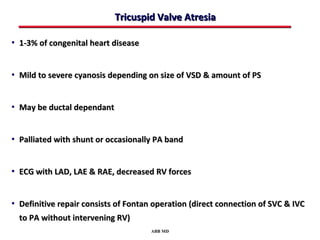
Tricuspid Valve Atresia

• 1-3% of congenital heart disease


• Mild to severe cyanosis depending on size of VSD & amount of PS


• May be ductal dependant


• Palliated with shunt or occasionally PA band


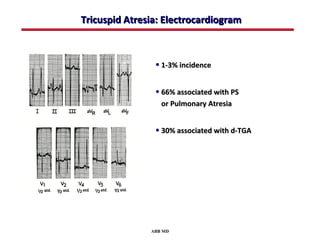
• ECG with LAD, LAE & RAE, decreased RV forces


• Definitive repair consists of Fontan operation (direct connection of SVC & IVC
  to PA without intervening RV)
                                      ABB MD
Tricuspid Atresia: Electrocardiogram


                • 1-3% incidence

                • 66% associated with PS
                  or Pulmonary Atresia


                • 30% associated with d-TGA


               ABB MD
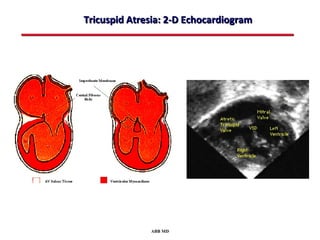
Tricuspid Atresia: 2-D Echocardiogram


              ABB MD
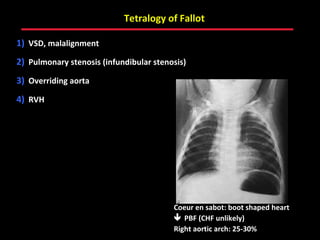
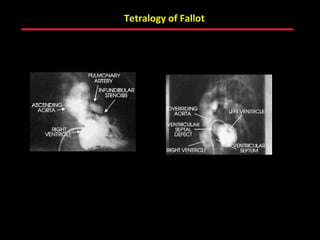
Tetralogy of Fallot

1) VSD, malalignment
2) Pulmonary stenosis (infundibular stenosis)
3) Overriding aorta
4) RVH


                                            Coeur en sabot: boot shaped heart
                                             PBF (CHF unlikely)
                                   ABB MD   Right aortic arch: 25-30%
Tetralogy of Fallot


      ABB MD
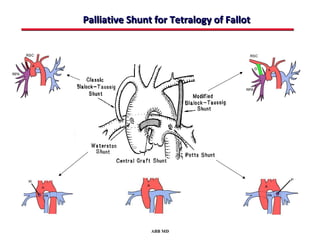
Palliative Shunt for Tetralogy of Fallot


                ABB MD
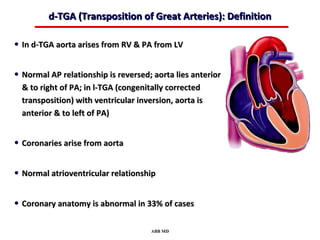
d-TGA (Transposition of Great Arteries): Definition

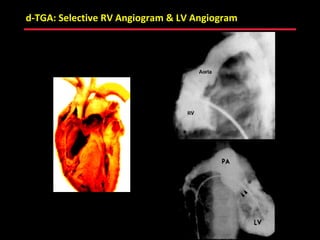
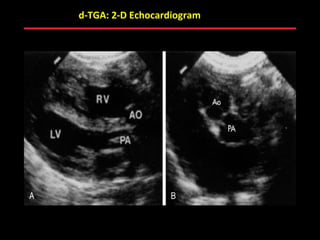
• In d-TGA aorta arises from RV & PA from LV

• Normal AP relationship is reversed; aorta lies anterior
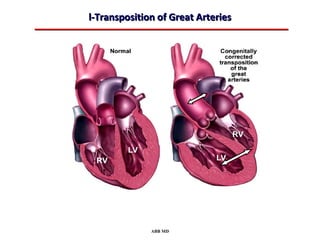
  & to right of PA; in l-TGA (congenitally corrected
  transposition) with ventricular inversion, aorta is
  anterior & to left of PA)


• Coronaries arise from aorta

• Normal atrioventricular relationship

• Coronary anatomy is abnormal in 33% of cases

                                      ABB MD
d-Transposition of Great Vessels

• 5% of CHD; male:female ratio is 3:1

• Presents with severe cyanosis
   (pO2 ~ 20-30 mm Hg or O2 saturation ~ 50-70%) in the 1st week


• Newborns with TGV, ASD or VSD, & PDA are less cyanotic

• Frequently have no murmur

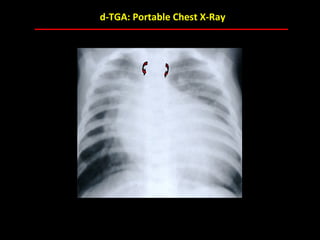
• ‘Egg shaped heart’ on CXR

• May require balloon atrial septostomy to palliate

• Surgery of choice is arterial switch operation
                                    ABB MD
d-TGA: Physical Exam

• Cyanosis: moderate to severe; PaO2 of 20-30 mm Hg
   (O2 saturation 50-80%)


• Normal peripheral pulses


• Normal to increased RV impulse


• Loud single S2 because of anterior position of aorta


• Soft 1-2/6 systolic flow murmur at mid-LSB or no murmur


                                  ABB MD
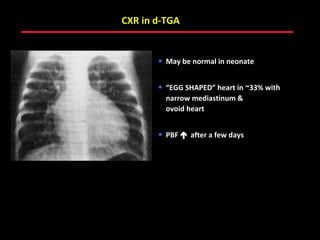
CXR in d-TGA


        • May be normal in neonate

        • “EGG SHAPED” heart in ~33% with
          narrow mediastinum &
          ovoid heart


        • PBF  after a few days


      ABB MD
d-TGA: Portable Chest X-Ray


           ABB MD
d-Transposition of Great Arteries (d-TGA)
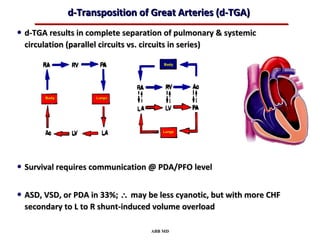
• d-TGA results in complete separation of pulmonary & systemic
  circulation (parallel circuits vs. circuits in series)


• Survival requires communication @ PDA/PFO level

• ASD, VSD, or PDA in 33%; ∴ may be less cyanotic, but with more CHF
  secondary to L to R shunt-induced volume overload

                                        ABB MD
d-TGA: Pathophysiology

• Frequently, only small connection is present between right & left circuits
  leading to cyanosis


• Low arterial pO2 leads to anaerobic glycolysis & metabolic acidosis

• Hypoxia & acidosis  carotid & cerebral chemoreceptor activation resulting
  in hyperventilation; detrimental to cardiac function


• Postnatal  in pulmonary vascular resistance leads to volume overload in
  left heart


• Hypoxia, acidosis, and volume overload lead to CHF


                                     ABB MD
Establishing the Diagnosis

• Can be found prenatally on prenatal echocardiogram

• Newborn is cyanotic from birth; cyanosis does not respond to administration
  of O2


• “Peaceful tachypnea” unless in heart failure

• No murmur necessarily heard, but single, loud S2 is heard

• Chest X-ray shows  pulmonary vascular markings & cardiomegaly

• EKG: RAD & RVH (difficult to diagnose in neonate)

• Echo used to demonstrate TGA
                                    ABB MD
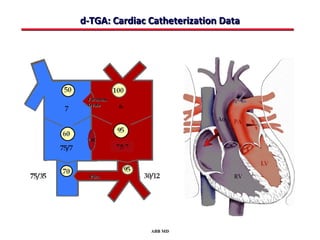
d-TGA: Cardiac Catheterization Data


               ABB MD
d-TGA: Selective RV Angiogram & LV Angiogram


                         ABB MD
d-TGA: 2-D Echocardiogram


              ABB MD
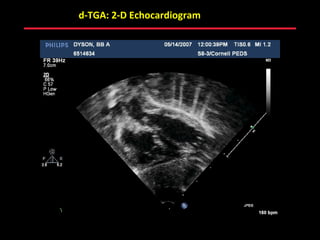
d-TGA: 2-D Echocardiogram


              ABB MD
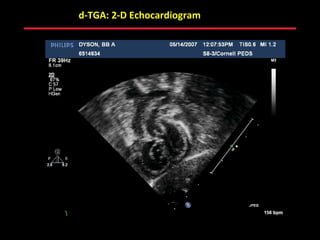
d-TGA: 2-D Echocardiogram


              ABB MD
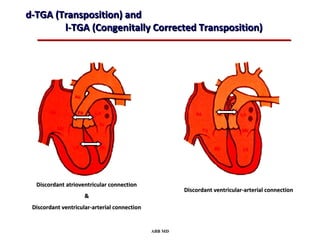
d-TGA (Transposition) and
        l-TGA (Congenitally Corrected Transposition)


  Discordant atrioventricular connection
                                                       Discordant ventricular-arterial connection
                     &
 Discordant ventricular-arterial connection


                                              ABB MD
l-Transposition of Great Arteries


              ABB MD
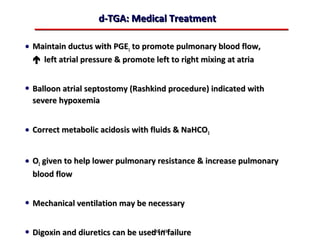
d-TGA: Medical Treatment

• Maintain ductus with PGE1 to promote pulmonary blood flow,
   left atrial pressure & promote left to right mixing at atria


• Balloon atrial septostomy (Rashkind procedure) indicated with
  severe hypoxemia


• Correct metabolic acidosis with fluids & NaHCO3

• O2 given to help lower pulmonary resistance & increase pulmonary
  blood flow


• Mechanical ventilation may be necessary

• Digoxin and diuretics can be used in failure
                                  ABB MD
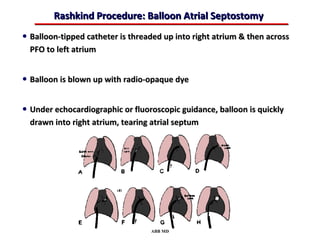
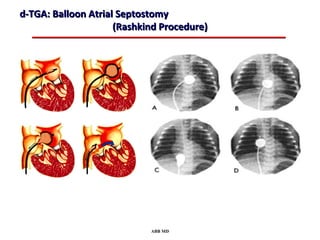
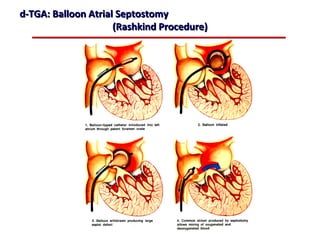
Rashkind Procedure: Balloon Atrial Septostomy
• Balloon-tipped catheter is threaded up into right atrium & then across
  PFO to left atrium


• Balloon is blown up with radio-opaque dye

• Under echocardiographic or fluoroscopic guidance, balloon is quickly
  drawn into right atrium, tearing atrial septum


                                  ABB MD
d-TGA: Balloon Atrial Septostomy
                     (Rashkind Procedure)


                            ABB MD
d-TGA: Balloon Atrial Septostomy
                     (Rashkind Procedure)


                            ABB MD
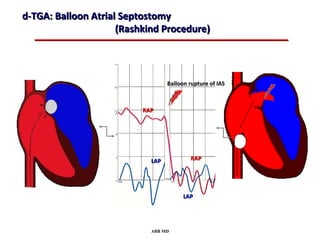
d-TGA: Balloon Atrial Septostomy
                     (Rashkind Procedure)


                                  Balloon rupture of IAS


                          RAP


                            LAP           RAP


                                        LAP


                            ABB MD
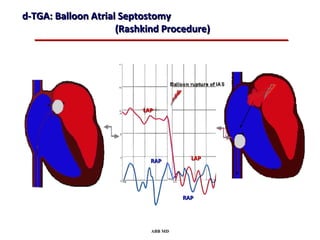
d-TGA: Balloon Atrial Septostomy
                     (Rashkind Procedure)


                          LAP


                            RAP        LAP


                                     RAP


                            ABB MD
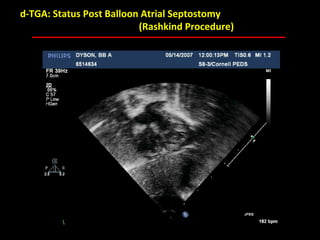
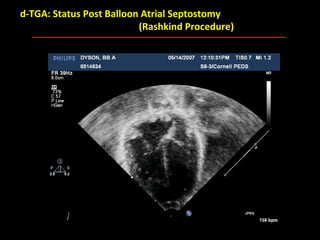
d-TGA: Status Post Balloon Atrial Septostomy
                          (Rashkind Procedure)


                            ABB MD
d-TGA: Status Post Balloon Atrial Septostomy
                          (Rashkind Procedure)


                            ABB MD
d-Transposition of Great Arteries: Surgery


• Old surgical approach: ‘Atrial Switch’
    – Mustard operation
    – Senning operation


• New surgical approach: ‘Arterial Switch’
    – Jatene operation


                                  ABB MD
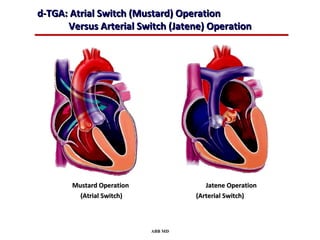
d-TGA: Atrial Switch (Mustard) Operation
      Versus Arterial Switch (Jatene) Operation


       Mustard Operation               Jatene Operation
         (Atrial Switch)            (Arterial Switch)


                           ABB MD
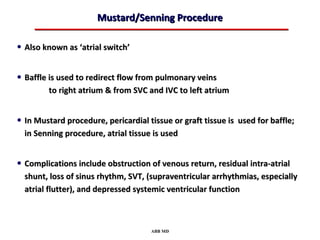
Mustard/Senning Procedure

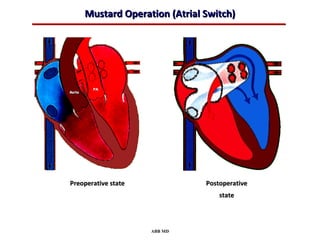
• Also known as ‘atrial switch’

• Baffle is used to redirect flow from pulmonary veins
         to right atrium & from SVC and IVC to left atrium


• In Mustard procedure, pericardial tissue or graft tissue is used for baffle;
  in Senning procedure, atrial tissue is used


• Complications include obstruction of venous return, residual intra-atrial
  shunt, loss of sinus rhythm, SVT, (supraventricular arrhythmias, especially
  atrial flutter), and depressed systemic ventricular function


                                     ABB MD
Mustard Operation (Atrial Switch)


Preoperative state            Postoperative
                                  state


                     ABB MD
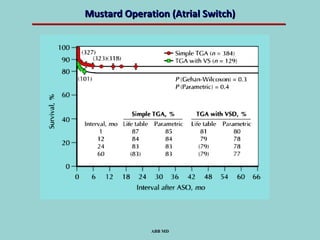
Mustard Operation (Atrial Switch)


              ABB MD
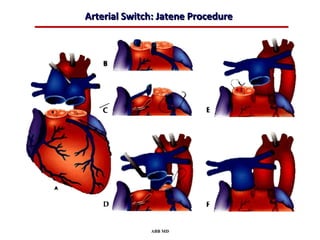
Arterial Switch: Jatene Procedure
• Ideal procedure because it results in anatomic & physiologic correction

• Great arteries are transected & connected to distal portion of the
  opposite great artery
    - Aorta connected to PA root so now LV to aorta & RV to PA

• Coronary arteries are transplanted into PA root

• Surgery should be done before age 4 weeks so LV pressure remains
  systemic


• Complications: pulmonary stenosis; aortic insufficiency; coronary artery
  obstruction


                                   ABB MD
Arterial Switch: Jatene Procedure


              ABB MD
Comparison of Outcomes: Atrial Switch
     Senning Procedure Versus Mustard Procedure

• Senning group (atrial tissue) has better survival than Mustard
 (pericardium or graft tissue)
  - 95% vs. 86% @ 5 yrs; 94% vs. 82% @ 10 yrs;
      94% vs. 77% @ 15 yrs


• Late deaths in both group generally sudden with no preceding
 ventricular dysfunction


• Major complications: 1) arrhythmias (34% in RSR @ 15 yrs);
 RV dysfunction (52% with normal function at 15 years)


• Incidence of RV dysfunction increases rapidly after 10 yrs
                                  ABB MD
Comparison of Outcomes: Arterial Switch


• 1 study group published data @ 3-9 yrs & then 8-14 yrs post procedure

• @ 3-9 years:
   – 96.1% had normal exercise tolerance; 93.5% were in RSR; 100% had
      normal LV function; 10.4% had mild AI; 29.9% supravalvular pulmonic
      stenosis


• @ 8-14 years
   – 93.3% had normal exercise tolerance; 91.7% were in RSR; 100% had
      normal LV function; mild AI seen in 13.3%; supravalvular pulmonic
      stenosis in 41.6%


                                    ABB MD
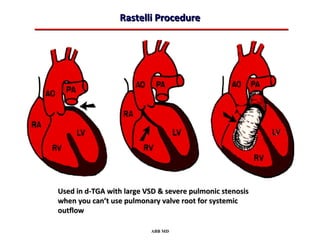
Rastelli Procedure

• Used in d-TGA with large VSD & severe pulmonic stenosis
    – Can’t use pulmonary valve root for systemic outflow

• Redirection of pulmonary & systemic blood carried out at ventricular level

• LV is directed to aorta by creating intraventricular tunnel between VSD &
  aortic valve


• Conduit is placed between RV & PA

• Complications: conduit obstruction & complete AV block

• Conduit must be replaced as child grows

                                    ABB MD
Rastelli Procedure


Used in d-TGA with large VSD & severe pulmonic stenosis
when you can’t use pulmonary valve root for systemic
outflow

                          ABB MD
d-TGA: Risk Factors for
           Postoperative Ventricular Dysrhythmia


1) Poor RV or LV function


2) Diminished diastolic compliance


3) Increased systolic RV or LV pressure


4) Surgical ventriculotomy (scar)


5) Age @ time of surgery


6) Longer postoperative follow-up interval

                                    ABB MD
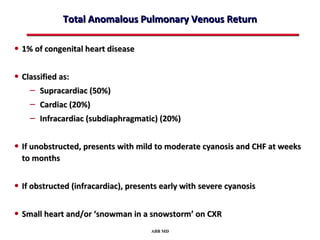
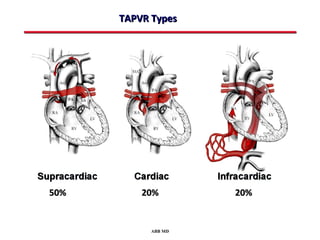
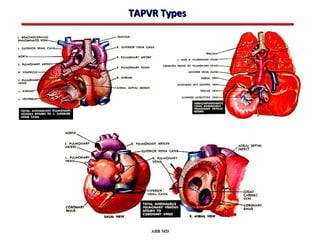
Total Anomalous Pulmonary Venous Return

• 1% of congenital heart disease

• Classified as:
    – Supracardiac (50%)
    – Cardiac (20%)
    – Infracardiac (subdiaphragmatic) (20%)

• If unobstructed, presents with mild to moderate cyanosis and CHF at weeks
  to months


• If obstructed (infracardiac), presents early with severe cyanosis

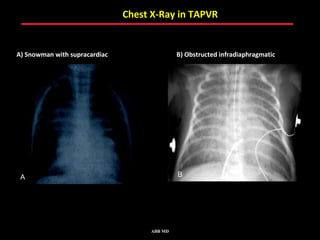
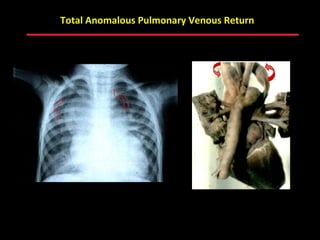
• Small heart and/or ‘snowman in a snowstorm’ on CXR
                                      ABB MD
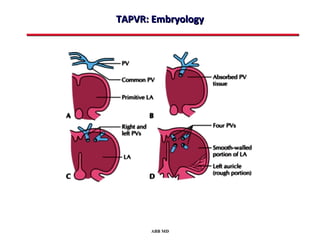
TAPVR: Embryology


      ABB MD
TAPVR Types


50%       20%        20%


            ABB MD
TAPVR Types


    ABB MD
Chest X-Ray in TAPVR


A) Snowman with supracardiac                 B) Obstructed infradiaphragmatic


 A                                           B


                                    ABB MD
Total Anomalous Pulmonary Venous Return


                  ABB MD
Total Anomalous Pulmonary Venous Return:
           Electrocardiogram


                  ABB MD
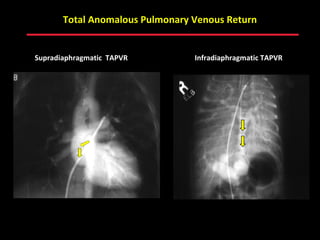
Total Anomalous Pulmonary Venous Return


Supradiaphragmatic TAPVR            Infradiaphragmatic TAPVR


                           ABB MD
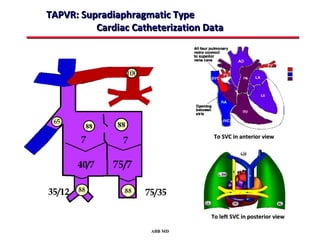
TAPVR: Supradiaphragmatic Type
          Cardiac Catheterization Data


                                   To SVC in anterior view


                                   To left SVC in posterior view

                      ABB MD
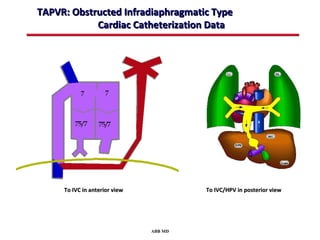
TAPVR: Obstructed Infradiaphragmatic Type
            Cardiac Catheterization Data


     To IVC in anterior view            To IVC/HPV in posterior view


                               ABB MD
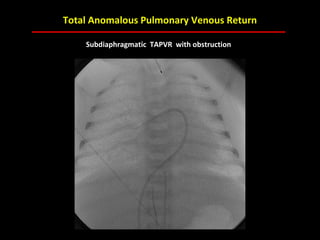
Total Anomalous Pulmonary Venous Return

    Subdiaphragmatic TAPVR with obstruction


                     ABB MD

CHD Screening in Newborn

  • 1.
    Screening for Congenital Heart Disease in the Newborn A. Bornstein, MD, FACC Assistant Professor of Science Education Hofstra North Shore LIJ School of Medicine Hempstead, New York ABB MD
  • 2.
    Goals of thePresentation Provide pathophysiologic framework to: • Enhance understanding of the various ways in which congenital heart disease can present in the neonate • Simplify the approach to congenital heart defects by organizing them into categories • Decrease the dependence upon rote memory • Facilitate management of affected patients ABB MD
  • 3.
    Prevalence • Fertility ratein the USA as of 2007 is 1.7-2.6 • Birth rate in the USA as of 2007 is 14.16/1000 population • For every 1,000,000 population there are ~14,160 births  ~142 with congenital heart disease  ~71 (50%) with ‘clinically significant’ problems  ~35 (~50%) of these problems are critical and will need help in the 1st 30 days  ~28 (~80%) will need help in the 1st week ABB MD
  • 4.
    Background 60 - 65varieties of CHD <1% of all live-born neonates (40,000 infants/year) ~33-50% have ‘critical heart disease’ ABB MD
  • 5.
    Most Common CongenitalHeart Defects • Figures are taken from 2 classic studies • Lesions listed account for 70-80% of all CHD USA study: 1 of 56,109 births UK study: 2 of 160,480 births Mitchell S C et al. Circulation. 1971; 43: 323–32. ABB MD Dickinson D F et al. Br Heart J. 1981; 46: 55–62.
  • 6.
  • 7.
  • 8.
    Fetal Circulation toNeonatal Circulation PO2 21 mm Hg O2 Sat 55% Ligamentum arteriosum  PO2 20 mm Hg Ligamentum venosum  O2 Sat 52% Ligamentum teres  Medial umbilical ligaments  PO2 32-35 mm Hg O2 Sat 82-88% ABB MD
  • 9.
    Adult Derivatives ofFetal Vessels: Structures Derived from Fetal Circulation • Ductus venosus  ligamentum venosum remnant within the liver Ligamentum arteriosum  • Umbilical vein  intra-abdominal portion Limba fossa ovalis  of ligamentum teres (Round ligament) • Umbilical arteries  intra-abdominal portions Ligamentum venosum  of medial umbilical ligaments (proximal parts  superior vesicle arteries) • Septum secundum  lower edge of limbus fossae ovalis (annulus ovalis) Ligamentum teres  Medial umbilical ligaments  • PDA  ligamentum arteriosum ABB MD
  • 10.
    Postnatal Circulation: PulmonaryPressure Changes Age in days ABB MD
  • 11.
    Fetal to Transitionalto Neonatal Circulation Mechanisms: 1) Physical expansion 2)  O2 as a gas ABB MD
  • 12.
    Fetal to Transitionalto Neonatal Circulation Mechanisms: 1) Physical expansion 2)  O2 as a gas ABB MD
  • 13.
    Fetal to Transitionalto Neonatal Circulation Spontaneous closure of ductus arteriosus occurs in 1st 4 days By echocardiogram/doppler, 67% of ducts closed by 25.5 hours; only 11% are patent (89% of ducts closed) by 73.8 hours of life ABB MD
  • 14.
    Developmental Approach toCongenital Heart Disease Clark EB. Mechanisms in the pathogenesis of congenital heart defects. In: Pierpont ME, Moller J: The Genetics of Cardiovascular Disease. Boston, MA: Martinus-Nijoff, 1986;3-11. ABB MD
  • 15.
    Congenital Heart Disease:Genomics • Incidence of CHD is 7-8/1000 live births (<1%) (10% of spontaneously aborted fetus) • Etiology of congenital heart defects generally multifactorial (90%) (2% due to environmental teratogens) • 7-8% are associated with heritable syndromes; 1% nonheritable syndromes • Chromosomal defects occur in 8-13 % i.e., Trisomy 21 (Down syndrome); Chromosome 22q11.2 microdeletion (DiGeorge syndrome, Velocardiofacial syndrome) • Single gene disorders can occur (i.e., fibrillin defect in Marfan’s Syndrome) • 5% are associated with other organ system defects ABB MD
  • 16.
    Incidence of CHDby Lesion Type Left to Right Shunts 40%-45% Obstructive Lesions 25%-30% Right to Left Shunts 20%-25% ABB MD
  • 17.
    Congenital Cardiac Anomalies L R Shunt Obstructive R  L Shunt (40%-45%) (25%-30%) VSD HLHS (20%-25%) AS TOF PDA d-TGA CoA Tricuspid atresia ASD IAA Pulmonary atresia AV canal TAPVR PS Truncus arteriosus Ebstein’s anomaly ABB MD
  • 18.
    Initial Overall Assessmentof the Neonate • Physical appearance • VS: respiratory rate 30-60 BPM & heart rate 100-160 PPM • Color (pulse oximetry in arms & legs) • BP & Pulses (4 extremities) • Skin perfusion  • Precordial activity, heart sounds, murmurs • Liver size, liver/stomach location (situs solitus vs. inversus) • Neurologic ABB MD
  • 19.
    Initial Overall Assessmentof the Neonate • Heart: heart sounds, murmurs, cardiac timing cycles ABB MD
  • 20.
    Valvar Pulmonic Stenosis PS Valve Area Gradient < 50 mm Hg Mild > 1.0 cm 2 50-80 mm Hg Moderate .5-1.0 cm 2 > 80 mm Hg Severe < .5 cm2 Pulmonary valve ABB MD
  • 21.
    Major Signs &Symptoms of Cyanotic CHD • Cyanosis: complications of R  L or bidirectional shunt 1) Erythrocytosis 2) Hyperviscosity 3) Abnormal hemostasis 4) CVA 5) Clubbing 6) Cerebral abscess 7) Endocarditis ABB MD
  • 22.
    Initial Overall Assessmentof the Neonate • Precordial activity, heart sounds, murmurs - Dextrocardia vs. Mesocardia vs. Levocardia Dextrocardia with situs inversus Mesocardia & situs inversus (right- Mesocardia with situs ambiguous: mirror image dextrocardia: sided stomach bubble): DORV, AV pulmonary atresia, common atrium, no congenital heart disease canal, PS, & asplenia VSD, & TGA • Liver size, liver/stomach location - (Situs Solitus vs. Situs Inversus) ABB MD
  • 23.
    Heterotaxy Syndromes • Precordialactivity, heart sounds, murmurs • Dextrocardia vs. Mesocardia vs. Levocardia • Liver size, liver/stomach location - (Situs Solitus vs. Situs Inversus) Dextrocardia with situs solitus: VSD, & TGA Mesocardia with situs ambiguous pulmonary atresia, common atrium, ABB MD VSD, & TGA
  • 24.
    Heterotaxy Syndromes • Precordialactivity, heart sounds, murmurs - Dextrocardia vs. Mesocardia vs. Levocardia • Liver size, liver/stomach location - (Situs Solitus vs. Situs Inversus) • Spleen: Asplenia vs. Polysplenia Dextrocardia with situs solitus Mesocardia with situs ambiguous pulmonary atresia, common atrium, ABB MD VSD, & TGA
  • 25.
    Major Signs &Symptoms of CHD in the Neonate • Tachycardia • Tachypnea – Dyspnea – Hyperpnea • Pallor, mottling  • Cyanosis  ABB MD
  • 26.
    The Dyspneic/Tachypneic Neonate •Rapid breathing (>60 breaths/minute) – Shallow  Maintain minute ventilation • Increased work of breathing – Lung/chest compliance   Frequently related to  interstitial lung fluid – Lymphatic fluid   Micro/macro atelectasis  Small airway obstruction ABB MD
  • 27.
    The Dyspneic/Tachypneic Neonate •Rapid breathing (>60 breaths/minute) • Increased work of breathing • Expiratory grunting • Nasal flaring • Intercostal and sternal retractions (recession) • Central cyanosis while breathing room air • Aeration (ventilation) of lungs  with or without crackles or crepitations ABB MD
  • 28.
    Major Signs &Symptoms of CHD in the Neonate • Pulmonary plethora: – Infant with respiratory distress (including tachypnea, orthopnea caused by pulmonary volume overload Nasal flaring Diaphoresis with tense anxious facies Expiratory grunting Rapid breathing (>60 breaths/min) Increased work of breathing Intercostal & sternal retractions ABB MD
  • 29.
    The Hyperpneic/Tachypneic Neonate •Rapid breathing • Hyperventilation – Deep – Hypoxic drive – Compensation for metabolic acidosis (e.g., Kussmaul respirations) – Compliant lung/chest  ‘Dry’ lungs ABB MD
  • 30.
    Disasters in theDelivery Room Most dramatic delivery room resuscitations related to cardiovascular or pulmonary anomalies are secondary to: 1) TAPVR with obstruction 2) HLHS with restrictive ASD 3) Airway obstruction  TOF & absent PV syndrome (to & fro murmur) 1) Pulmonary hypoplasia  Ebstein’s Anomaly; Congenital diaphragmatic hernia 1) Cardiomyopathy or sustained dysrhythmia  Frequently seen in nonimmune hydrops fetalis ABB MD
  • 31.
    Disaster in theDelivery Room • Pulmonary venous inflow obstruction - TAPVR with obstruction Descending vein (pulmonary venous confluence) • LV outflow obstruction - HLHS with restrictive ASD ABB MD
  • 32.
    TAPVR With PulmonaryVenous Obstruction • TAPVR • Atresia or obstruction of the common pulmonary venous confluence ABB MD
  • 33.
    Ductal Dependent CyanoticCHD Lesions ABB MD
  • 34.
    Ductal Dependent ObstructiveCHD Lesions ABB MD
  • 35.
    Pathophysiologic Types ofLesions in Neonatal Cardiovascular Distress 1) Large volume L  R shunt 2) Left heart obstruction - Outflow obstruction - Inflow obstruction 3) Pump failure - Cardiomyopathy - Sustained arrhythmia 4) Hypoxemia - PBF  : RVOT obstruction with upstream R  L ‘blow-off’ - PBF  : Ventriculoarterial discordance: d-TGA ABB MD
  • 36.
    (1) Large VolumeLeft to Right Shunt • Ventricular septal defect • Patent ductus arteriosus • A-V septal (‘canal’) defect • Persistent truncus arteriosus ABB MD
  • 37.
    Evaluation of theAcyanotic Shunt Lesions Acyanotic:  PBF Left to Right Shunt LVH LVH & RVH RVH ASD VSD A-V Canal Defect PDA VSD (Late) PAPVD A-P Window PDA (Late) ABB MD
  • 38.
  • 39.
    Ventricular Septal Defect:Types and Position r ABB MD
  • 40.
    Ventricular Septal Defect:Types and Position ABB MD
  • 41.
  • 42.
  • 43.
    Patent Ductus Arteriosus Patentductus arteriosus (PDA) is common in the very preterm infant with significant lung disease; radiological signs are non-specific ABB MD
  • 44.
    (2) Left HeartObstruction • Outflow (LVOT) obstruction – Aortic stenosis – Aortic coarctation – Hypoplastic left heart syndrome – Interrupted aortic arch • Inflow obstruction – TAPVR (total anomalous pulmonary venous connection with obstruction) ABB MD
  • 45.
    (3) Pump Failure •Cardiomyopathy – Hypertrophic/Restrictive  Infants of diabetic mothers  Pompe’s disease – Dilated/Congestive  Infectious myocarditis  Metabolic myopathies – e.g., mitochondrial myopathy • Sustained dysrhythmia – Tachyarrhythmia (SVT, A-flutter) – Bradyarrhythmia (heart block) ABB MD
  • 46.
    Non-Cardiac Causes ofHeart Failure • Hyperthyroidism • Severe anemia • AV malformations • Polycythemia • Multiple hemangiomas • Renal failure • Hypoglycemia • Severe systemic hypertension • Hypocalcemia • Adrenal insufficiency • Asphyxia • Metabolic disease (Pompe’s disease) • Sepsis Other Cardiac Causes of Heart Failure • Myocarditis • Cardiac dysrhythmias (SVT, 30 heart block) • ALCAPA (anomalous LCA from PA) ABB MD
  • 47.
    (4) Hypoxemia • (PBF) RVOT obstruction with proximal R  L ‘blow-off’ – Tetralogy of Fallot – Pulmonary atresia/PS with PFO/ASD – Tricuspid atresia • ( PBF) Ventriculoarterial discordance – d-TGA (Transposition of Great Arteries) • Intrapulmonary R  L shunting – Critical pulmonary/lymphatic edema – Pulmonary AV malformations ABB MD
  • 48.
    Cyanotic Congenital HeartDisease • Clinical cyanosis occurs in presence of 3-5 grams% of deoxyhemoglobin (unsaturated hemoglobin) in systemic circulation • Can’t see cyanosis until O2 saturation is in 85% range or less! • More accurate & sensitive measurement now with use of pulse oximetry ABB MD
  • 49.
    Factors Affecting Detectionof Cyanosis • Hemoglobin concentration 20 gm% - cyanosis at 85% O2 saturation 9 gm% - cyanosis at 67% O 2 saturation • Proportion of Fetal Hemoglobin; pH; Temp Adult Hb: cyanosis at PO2 42-53 mm Hg Fetal Hb: cyanosis at PO2 32-42 mm Hg • Crying • Site Peripheral: hands, feet, circumoral area Central: tongue, mucous ABB MD
  • 50.
    Oxyhemoglobin Dissociation Curve a-vO2 Difference Oxygen delivered by Hb Oxygen reserve Normal newborns have PaO2 ~50 mm Hg by 5-10 minutes after birth: ABB MD (O2 saturation ~ 85%)
  • 51.
    Oxyhemoglobin Dissociation Curve Oxygen  pH delivered by Hb  Temp  DPG  pH  Temp  DPG Oxygen reserve Normal newborns have PaO2 ~50 mm Hg by 5-10 minutes after birth (O2 ABB MD saturation ~ 85%)
  • 52.
    Deoxyhemoglobin RHb 3-5 gm% ABB MD
  • 53.
    Cyanosis and HemoglobinConcentration Arterial O2 saturation level at which cyanosis is detectable at different total Hb concentrations is illustrated The solid red portion of each bar represents 3-5 gms/dL of reduced hemoglobin Lees, MH. Cyanosis of the newborn infant. J Pediatr . 1970; 77:484.
  • 54.
    Causes of Cyanosis •Pulmonary a) Inadequate ventilation b) Diffusion disorders c) V/Q mismatch • Cardiac a) Limited PBF with abnormal mixing b) Admixture lesions with increased PBF • PFC (PPHN) • Methemoglobinemia ABB MD
  • 55.
    Causes of Cyanosis:Methemoglobinemia • Example of methemoglobinemia in a young woman given benzocaine topical spray • While receiving 100% O2, ABG documented pH 7.46, PaCO2 41 mm Hg, PaO2 507 mm Hg, & O2 saturation 84% • Methemoglobin level was 48.2% • Tube on the left contains venous blood from this patient showing characteristic chocolate brown color; tube on the right contains venous blood from normal individual Donnelly, GB, Randlett, D. Methemoglobinemia - images in clinical medicine. N Engl J Med. 2000; 343:337.
  • 56.
    Causes of CentralCyanosis in the Neonate • Right-to-left shunt – Intracardiac level: cyanotic disease, anomalous systemic venous connection to left atrium – Great vessel level: PPH of newborn; d-TGA – Intrapulmonary level: pulmonary AV malformation • Ventilation/perfusion mismatch – Airway disease: pneumonia, aspiration, cystic adenomatoid malformation, diaphragmatic hernia, pulmonary hypoplasia, labor emphysema, atelectasis, pulmonary hemorrhage, hyaline membrane disease, transient tachypnea of newborn – Extrinsic compression of lungs: pneumothorax, pleural effusion, chylothorax, hemothorax, thoracic dystrophy, diaphragmatic hernia ABB MD
  • 57.
    Causes of CentralCyanosis in the Neonate • Alveolar hypoventilation – CNS depression: asphyxia, maternal sedation, intraventricular hemorrhage, seizure, meningitis, encephalitis – Neuromuscular disease: Werdnig-Hoffman disease, neonatal myasthenia gravis, phrenic nerve injury • Airway obstruction: – Choanal atresia, tracheomalacia, macroglossia • Diffusion impairment – Pulmonary fibrosis – Congenital lymphangiectasia – Pulmonary edema: HLHS, cardiomyopathy • Hemoglobinopathy – Methemoglobinemia: congenital or due to toxic exposure – Other hemoglobinopathies
  • 58.
    Evaluation of Cyanosis 1)Physical examination and history 2) Pulse oximetry 3) ABG: pH, PCO2, % O2 saturation, baseline PO2 4) CBC, central Hct, WBC with differential, platelet count, glucose, serum Ca ++ 5) ECG 6) CXR 7) Hyperoxia test 8) 2-D echocardiogram/doppler 9) Cardiac catheterization ABB MD
  • 59.
    Cardiac Versus PulmonaryCyanosis ABB MD
  • 60.
    Assessing Heart Sizeon CXR ABB MD
  • 61.
    Pulmonary Causes ofCyanosis Meconium aspiration Persistent fetal circulation ABB MD
  • 62.
    Pulmonary Causes ofCyanosis Hyaline membrane disease Pulmonary abscess ABB MD
  • 63.
    Pulmonary Causes ofCyanosis Congenital diaphragmatic hernia Ebstein’s anomaly ABB MD
  • 64.
    Evaluation of CyanoticShunt Lesions Cyanotic: R-to-L Shunt or Bi-directional Shunt  PBF  PBF or Normal PBF (+) Pulmonary (-) Pulmonary Hypertension Hypertension 1) TGA (+) LV 2) Truncus (+) RV 3) TAPVR 1) Eisenmenger’s 4) Taussig-Bing (DORV) 1) Ebstein’s Anomaly 1) TOF 5) Single 2) Tricuspid Atresia/IVS 2) Pulmonary Atresia Ventricle (DILV) 6) Tricuspid Atresia/VSD ABB MD
  • 65.
    Physical Exam inCyanotic CHD • Recognizing significant cyanosis is crux in managing cyanotic CHD! • Murmur is often non-specific & non-diagnostic in cyanotic CHD • Murmurs, when present, are often PS or valve insufficiency • Precordial impulse is abnormal: watch out for dextrocardia • Pulses are generally normal • Check abdominal situs ABB MD
  • 66.
    CXR in CyanoticCHD Boot shaped heart -TOF; Pulmonary atresia Egg-on-string -TGA; Tri atresia/TGA Right aortic arch -TOF Small Heart -TAPVR Snowman in a snowstorm -TAPVR ABB MD
  • 67.
    ECG in CyanoticCHD • d-TGA: normal or RVH Normal EKG • TOF, PA/VSD: RVH • TAPVR: RVH RVH • Truncus arteriosus: BVH • Cardiosplenic: abnormal P wave, LAD, RVH ABB MD
  • 68.
    ECG in CyanoticCHD Pulmonary Atresia/IVS: absent RV forces, Tricuspid Atresia: absent RV forces, normal axis, atrial LAD, atrial enlargement enlargement ABB MD
  • 69.
    Hyperoxia Test andCyanosis • Normal response pO2 = 80 mm Hg on 21%  pO2 300+ on 100% O2 • Pulmonary disease pO2 = 45 mm Hg on 21%  pO2 150-200+ on 100% O2 • Admixture lesions pO2 = 40 mm Hg on 21%  pO2 60-100 on 100% O2 • d-TGA or ductal dependant PBF pO2 = 30 mm Hg on 21%  pO2 35 on 100% O2 ABB MD
  • 70.
    Left Heart OutflowObstruction • Symptoms related to: – Inadequate systemic blood flow – Pulmonary edema due to pulmonary venous hypertension • Timing of symptoms related to: – Closure of ductus arteriosus  Within days of birth  May be hastened by hyperoxia ABB MD
  • 71.
    Hypoplastic Left HeartSyndrome ABB MD
  • 72.
    Aortic Stenosis: CongenitalBicuspid Aortic Valve ABB MD
  • 73.
    Critical Congenital AorticStenosis: Chest X-Ray & ECG ABB MD
  • 74.
    Critical Aortic Stenosis:Aortic Root Injection Negative contrast jet through a stenotic aortic valve ABB MD
  • 75.
  • 76.
  • 77.
    Hypoxemia I: DiminishedPulmonary Blood Flow • ‘Tetralogy physiology’ − PS with upstream R to L ‘blow-off’ at ventricular level  Same physiology for Single ventricle/PS; d-TGA/VSD/PS; Pulmonary atresia/VSD • ‘Hypoplastic right heart physiology’ − Pulmonary stenosis with ASD/PFO − Pulmonary atresia/IVS − Tricuspid atresia − Ebstein’s anomaly with impaired right atrial emptying, and with upstream ‘blow-off’ at atrial level ABB MD
  • 78.
    Evaluation of theCyanotic Shunt Lesions Cyanotic: R to L Shunt Bi-directional Shunt  PBF  PBF or Normal PBF (+) Pulmonary (-) Pulmonary Hypertension Hypertension 1) TGA 2) Truncus (+) LV (+) RV 3) TAPVR 1) Eisenmenger’s 4) Taussig-Bing (DORV) 5) Single Ventricle (DILV) 1) Ebstein’s Anomaly 1) TOF 2 6) Tricuspid Atresia/VSD 2) Tricuspid Atresia/IVS Pulmonary Atresia ABB MD
  • 79.
    ‘Hypoplastic Right HeartPhysiology’ Ebstein’s Anomaly ABB MD
  • 80.
    ‘Hypoplastic Right HeartPhysiology’ ABB MD
  • 81.
    ‘Tetralogy of FallotPhysiology’ ABB MD
  • 82.
    Hypoxemia-II: Normal toIncreased Pulmonary Flow • Ventriculoarterial discordance (d-TGA) – Cyanosis is greatest when ‘mixing’ is least – Mixing is best with: 1) Aorta to pulmonary shunt at ductal level ( PDA) 2) LA to RA reciprocal shunt at patent foramen ovale ( PFO) 3) Ventricular septal defect (VSD) ABB MD
  • 83.
    d-Transposition of GreatArteries ABB MD
  • 84.
    d-Transposition of GreatArteries ABB MD
  • 85.
    Differential Diagnosis Accordingto Age at Presentation ‘CHF’ (Poor Perfusion or Respiratory Distress) In the delivery room (in the first few hours) − Left ventricular inflow obstruction − LVOT obstruction with restrictive ASD − Myocardial failure  In the first few days – Ductal-dependent systemic blood flow  LVOT (left ventricular outflow tract) obstruction – Large volume left  right shunt  ‘Obligate shunt’ or volume overload - AVSD with LV  RA shunt or severe MR) - Truncus arteriosus with truncal regurgitation ABB MD
  • 86.
    Differential Diagnosis Accordingto Age at Presentation ‘CHF’ (Poor Perfusion or Respiratory Distress) In first few days − Ductal-dependent systemic blood flow  LVOT (left ventricular outflow tract) obstruction − Large volume left  right shunt  ‘Obligate shunt’ or volume load - AVSD with LV  RA shunt or severe MR) - Truncus arteriosus with truncal regurgitation  After 1-2 weeks − Large volume left  right shunt  ‘Dependent shunt’ (e.g., VSD, PDA) ABB MD
  • 87.
    Conclusions • Understanding pathophysiologyof congenital heart disease simplifies differential diagnosis  Symptomatic congenital heart disease relates to: 1) Left  Right shunt (large volume) 2) Left heart inflow obstruction or outflow obstruction 3) Pump failure 4) Hypoxemia ABB MD
  • 88.
    Conclusions (Cont.) • CriticalHypoxemia  In the delivery room (In the first hours) − Associated airway obstruction − Associated pulmonary hypoplasia − Pulmonary venous obstruction − Transposition with inadequate mixing  In the first days − Associated with ductal closure  Pulmonary outflow obstruction  Diminished mixing in d-TGA ABB MD
  • 89.
    Treatment of CyanoticCHD 1) Fluid & electrolytes (generally, usual therapy) 2) Support ventilation 3) O2 saturation > 80% adequate for admixture 4) Inotropic support as needed 5) Hematocrit > 40% 6) Nutrition 7) Prostaglandin PGE1 infusion ABB MD
  • 90.
    Prostaglandin PGE1 forCyanotic CHD • Dose: 0.05-0.1 mcg/kg/min infusion • May be given via venous or arterial route • Common side effects: 1) APNEA ! 2) CNS: depression, seizures 3) Hypotension 4) Flushing 5) Hyperthermia 6) Thrombocytosis ABB MD
  • 91.
    Evaluation of Acyanotic& Cyanotic Shunt Lesions Cyanotic: R-to-L Shunt or Bi-directional Shunt  PBF  PBF or Normal PBF (+) Pulmonary (-) Pulmonary Hypertension Hypertension 1) TGA (+) LV (+) RV 2) Truncus 1) Eisenmenger’s 3) TAPVR 1) Ebstein’s Anomaly 1) TOF 4) Taussig-Bing 2) Tricuspid Atresia/IVS 2) Pulmonary Atresia (DORV) 5) Single Ventricle (DILV) 6) Tricuspid Atresia/VSD ABB MD
  • 92.
    Evaluation of CyanoticShunt Lesions Cyanotic: R-to-L Shunt or Bidirectional  PBF NL or  PBF (+) Pulmonary HTN (-) Pulmonary HTN 1) TGA (+) LV (+) RV 2) Truncus 1) Eisenmenger’s 3) TAPVR 4) Taussig-Bing 1) Ebstein’s anomaly 1) TOF 5) Single Ventricle 2) Tricuspid atresia 2) Pulmonary atresia 6) Tricuspid atresia/VSD ABB MD
  • 93.
    Ebstein’s Anomaly: ChestX-Ray & ECG ABB MD
  • 94.
    Ebstein’s Anomaly: TEE& Pathology Incidence: 0.3-0.8% of all congenital heart diseases in 1st year of life; 1:20,000-50,000 live births Normal Ebstein’s Anomaly ABB MD
  • 95.
    Ebstein’s Anomaly: ChestX-ray & Echocardiography Natural history: mortality in children presenting in the neonatal period is 30-50%; Mortality at all ages is 12.5% Mortality is higher with severe RAE, large atrialized RV portion, distally tethered tricuspid valve leaflet, & RV dysplasia
  • 96.
  • 97.
    Tricuspid Valve Atresia •1-3% of congenital heart disease • Mild to severe cyanosis depending on size of VSD & amount of PS • May be ductal dependant • Palliated with shunt or occasionally PA band • ECG with LAD, LAE & RAE, decreased RV forces • Definitive repair consists of Fontan operation (direct connection of SVC & IVC to PA without intervening RV) ABB MD
  • 98.
    Tricuspid Atresia: Electrocardiogram • 1-3% incidence • 66% associated with PS or Pulmonary Atresia • 30% associated with d-TGA ABB MD
  • 99.
    Tricuspid Atresia: 2-DEchocardiogram ABB MD
  • 100.
    Tetralogy of Fallot 1)VSD, malalignment 2) Pulmonary stenosis (infundibular stenosis) 3) Overriding aorta 4) RVH Coeur en sabot: boot shaped heart  PBF (CHF unlikely) ABB MD Right aortic arch: 25-30%
  • 101.
  • 102.
    Palliative Shunt forTetralogy of Fallot ABB MD
  • 103.
    d-TGA (Transposition ofGreat Arteries): Definition • In d-TGA aorta arises from RV & PA from LV • Normal AP relationship is reversed; aorta lies anterior & to right of PA; in l-TGA (congenitally corrected transposition) with ventricular inversion, aorta is anterior & to left of PA) • Coronaries arise from aorta • Normal atrioventricular relationship • Coronary anatomy is abnormal in 33% of cases ABB MD
  • 104.
    d-Transposition of GreatVessels • 5% of CHD; male:female ratio is 3:1 • Presents with severe cyanosis (pO2 ~ 20-30 mm Hg or O2 saturation ~ 50-70%) in the 1st week • Newborns with TGV, ASD or VSD, & PDA are less cyanotic • Frequently have no murmur • ‘Egg shaped heart’ on CXR • May require balloon atrial septostomy to palliate • Surgery of choice is arterial switch operation ABB MD
  • 105.
    d-TGA: Physical Exam •Cyanosis: moderate to severe; PaO2 of 20-30 mm Hg (O2 saturation 50-80%) • Normal peripheral pulses • Normal to increased RV impulse • Loud single S2 because of anterior position of aorta • Soft 1-2/6 systolic flow murmur at mid-LSB or no murmur ABB MD
  • 106.
    CXR in d-TGA • May be normal in neonate • “EGG SHAPED” heart in ~33% with narrow mediastinum & ovoid heart • PBF  after a few days ABB MD
  • 107.
  • 108.
    d-Transposition of GreatArteries (d-TGA) • d-TGA results in complete separation of pulmonary & systemic circulation (parallel circuits vs. circuits in series) • Survival requires communication @ PDA/PFO level • ASD, VSD, or PDA in 33%; ∴ may be less cyanotic, but with more CHF secondary to L to R shunt-induced volume overload ABB MD
  • 109.
    d-TGA: Pathophysiology • Frequently,only small connection is present between right & left circuits leading to cyanosis • Low arterial pO2 leads to anaerobic glycolysis & metabolic acidosis • Hypoxia & acidosis  carotid & cerebral chemoreceptor activation resulting in hyperventilation; detrimental to cardiac function • Postnatal  in pulmonary vascular resistance leads to volume overload in left heart • Hypoxia, acidosis, and volume overload lead to CHF ABB MD
  • 110.
    Establishing the Diagnosis •Can be found prenatally on prenatal echocardiogram • Newborn is cyanotic from birth; cyanosis does not respond to administration of O2 • “Peaceful tachypnea” unless in heart failure • No murmur necessarily heard, but single, loud S2 is heard • Chest X-ray shows  pulmonary vascular markings & cardiomegaly • EKG: RAD & RVH (difficult to diagnose in neonate) • Echo used to demonstrate TGA ABB MD
  • 111.
  • 112.
    d-TGA: Selective RVAngiogram & LV Angiogram ABB MD
  • 113.
  • 114.
  • 115.
  • 116.
    d-TGA (Transposition) and l-TGA (Congenitally Corrected Transposition) Discordant atrioventricular connection Discordant ventricular-arterial connection & Discordant ventricular-arterial connection ABB MD
  • 117.
    l-Transposition of GreatArteries ABB MD
  • 118.
    d-TGA: Medical Treatment •Maintain ductus with PGE1 to promote pulmonary blood flow,  left atrial pressure & promote left to right mixing at atria • Balloon atrial septostomy (Rashkind procedure) indicated with severe hypoxemia • Correct metabolic acidosis with fluids & NaHCO3 • O2 given to help lower pulmonary resistance & increase pulmonary blood flow • Mechanical ventilation may be necessary • Digoxin and diuretics can be used in failure ABB MD
  • 119.
    Rashkind Procedure: BalloonAtrial Septostomy • Balloon-tipped catheter is threaded up into right atrium & then across PFO to left atrium • Balloon is blown up with radio-opaque dye • Under echocardiographic or fluoroscopic guidance, balloon is quickly drawn into right atrium, tearing atrial septum ABB MD
  • 120.
    d-TGA: Balloon AtrialSeptostomy (Rashkind Procedure) ABB MD
  • 121.
    d-TGA: Balloon AtrialSeptostomy (Rashkind Procedure) ABB MD
  • 122.
    d-TGA: Balloon AtrialSeptostomy (Rashkind Procedure) Balloon rupture of IAS RAP LAP RAP LAP ABB MD
  • 123.
    d-TGA: Balloon AtrialSeptostomy (Rashkind Procedure) LAP RAP LAP RAP ABB MD
  • 124.
    d-TGA: Status PostBalloon Atrial Septostomy (Rashkind Procedure) ABB MD
  • 125.
    d-TGA: Status PostBalloon Atrial Septostomy (Rashkind Procedure) ABB MD
  • 126.
    d-Transposition of GreatArteries: Surgery • Old surgical approach: ‘Atrial Switch’ – Mustard operation – Senning operation • New surgical approach: ‘Arterial Switch’ – Jatene operation ABB MD
  • 127.
    d-TGA: Atrial Switch(Mustard) Operation Versus Arterial Switch (Jatene) Operation Mustard Operation Jatene Operation (Atrial Switch) (Arterial Switch) ABB MD
  • 128.
    Mustard/Senning Procedure • Alsoknown as ‘atrial switch’ • Baffle is used to redirect flow from pulmonary veins to right atrium & from SVC and IVC to left atrium • In Mustard procedure, pericardial tissue or graft tissue is used for baffle; in Senning procedure, atrial tissue is used • Complications include obstruction of venous return, residual intra-atrial shunt, loss of sinus rhythm, SVT, (supraventricular arrhythmias, especially atrial flutter), and depressed systemic ventricular function ABB MD
  • 129.
    Mustard Operation (AtrialSwitch) Preoperative state Postoperative state ABB MD
  • 130.
  • 131.
    Arterial Switch: JateneProcedure • Ideal procedure because it results in anatomic & physiologic correction • Great arteries are transected & connected to distal portion of the opposite great artery - Aorta connected to PA root so now LV to aorta & RV to PA • Coronary arteries are transplanted into PA root • Surgery should be done before age 4 weeks so LV pressure remains systemic • Complications: pulmonary stenosis; aortic insufficiency; coronary artery obstruction ABB MD
  • 132.
    Arterial Switch: JateneProcedure ABB MD
  • 133.
    Comparison of Outcomes:Atrial Switch Senning Procedure Versus Mustard Procedure • Senning group (atrial tissue) has better survival than Mustard (pericardium or graft tissue) - 95% vs. 86% @ 5 yrs; 94% vs. 82% @ 10 yrs; 94% vs. 77% @ 15 yrs • Late deaths in both group generally sudden with no preceding ventricular dysfunction • Major complications: 1) arrhythmias (34% in RSR @ 15 yrs); RV dysfunction (52% with normal function at 15 years) • Incidence of RV dysfunction increases rapidly after 10 yrs ABB MD
  • 134.
    Comparison of Outcomes:Arterial Switch • 1 study group published data @ 3-9 yrs & then 8-14 yrs post procedure • @ 3-9 years: – 96.1% had normal exercise tolerance; 93.5% were in RSR; 100% had normal LV function; 10.4% had mild AI; 29.9% supravalvular pulmonic stenosis • @ 8-14 years – 93.3% had normal exercise tolerance; 91.7% were in RSR; 100% had normal LV function; mild AI seen in 13.3%; supravalvular pulmonic stenosis in 41.6% ABB MD
  • 135.
    Rastelli Procedure • Usedin d-TGA with large VSD & severe pulmonic stenosis – Can’t use pulmonary valve root for systemic outflow • Redirection of pulmonary & systemic blood carried out at ventricular level • LV is directed to aorta by creating intraventricular tunnel between VSD & aortic valve • Conduit is placed between RV & PA • Complications: conduit obstruction & complete AV block • Conduit must be replaced as child grows ABB MD
  • 136.
    Rastelli Procedure Used ind-TGA with large VSD & severe pulmonic stenosis when you can’t use pulmonary valve root for systemic outflow ABB MD
  • 137.
    d-TGA: Risk Factorsfor Postoperative Ventricular Dysrhythmia 1) Poor RV or LV function 2) Diminished diastolic compliance 3) Increased systolic RV or LV pressure 4) Surgical ventriculotomy (scar) 5) Age @ time of surgery 6) Longer postoperative follow-up interval ABB MD
  • 138.
    Total Anomalous PulmonaryVenous Return • 1% of congenital heart disease • Classified as: – Supracardiac (50%) – Cardiac (20%) – Infracardiac (subdiaphragmatic) (20%) • If unobstructed, presents with mild to moderate cyanosis and CHF at weeks to months • If obstructed (infracardiac), presents early with severe cyanosis • Small heart and/or ‘snowman in a snowstorm’ on CXR ABB MD
  • 139.
  • 140.
    TAPVR Types 50% 20% 20% ABB MD
  • 141.
  • 142.
    Chest X-Ray inTAPVR A) Snowman with supracardiac B) Obstructed infradiaphragmatic A B ABB MD
  • 143.
    Total Anomalous PulmonaryVenous Return ABB MD
  • 144.
    Total Anomalous PulmonaryVenous Return: Electrocardiogram ABB MD
  • 145.
    Total Anomalous PulmonaryVenous Return Supradiaphragmatic TAPVR Infradiaphragmatic TAPVR ABB MD
  • 146.
    TAPVR: Supradiaphragmatic Type Cardiac Catheterization Data To SVC in anterior view To left SVC in posterior view ABB MD
  • 147.
    TAPVR: Obstructed InfradiaphragmaticType Cardiac Catheterization Data To IVC in anterior view To IVC/HPV in posterior view ABB MD
  • 148.
    Total Anomalous PulmonaryVenous Return Subdiaphragmatic TAPVR with obstruction ABB MD

Editor's Notes

  • #15 There is no doubt that in the last 20 years, genetic aspects of congenital heart defects (CHD) have not advanced in step with improvements in the diagnosis and treatment of cardiovascular malformations. The importance of genetics in the etiology of CHD is supported by the frequent association of CHD with genetic syndromes, the familial recurrence of certain defects and similarities between animal and human models. The pathogenetic classification of CHD introduced by Clark, groups cardiac malformations according to possible morphogenetic pathways instead of anatomic or clinical criteria. The epidemiological results collected by the Baltimore-Washington Infant Study have shown that one third of children with CHD are diagnosed as having a genetic syndrome or an extracardiac malformation. Syndromes with a chromosomal anomaly identifiable by standard cytogenetic techniques were initially studied. The commonest were Down’s syndrome, Turner’s syndrome, trisomy 13, trisomy 18, and monosomy 8p. More recently developed cytogenetic techniques, including high resolution chromosomal analysis and fluorescent in situ hybridization (FISH), can detect subtle rearrangements in chromosomes which may be overlooked by standard methods. These techniques may be used in the diagnosis of syndromes due to a microdeletion, such as DiGeorge/velo-cardio-facial syndrome (caused by microdeletion 22q11.2) and William&apos;s syndrome (caused by microdeletion 7q11). Molecular instruments such as linkage analysis and positional cloning are being used to identify genes causing Mendelian monogenic syndromes with CHD. In general, the identification of genes is achieved by collecting pedigrees segregating the gene of interest. The genes responsible for Holt-Oram, Ellis-van Creveld, and Noonan syndromes have been mapped in this fashion. The ultimate proof of cloning the gene is provided by sequence analysis and demonstration of the mutation in the patient. The “candidate gene” approach has been successfully utilized in cloning the gene involved in Marfan syndrome. The “lumping” of syndromes previously considered as separate disorders has been possible, following the identification of microdeletion 22q11.2 as the cause of DiGeorge, velo-cardio-facial and conotruncal anomaly face syndromes, and PTPN11 mutations in cases of Noonan and LEOPARD syndromes. Little information is yet available with regard to genes causing isolated CHD, in individuals who do not have a particular syndrome. In the earlier studies, the majority of non-syndromic CHD is considered to have a “multifactorial” basis. Multifactorial means that CHD is due to the combined effect of one or more genes interacting with stochastic or environmental risk factors. Nevertheless, a higher occurrence risk for CHD has been noted in some families compared to that found in the general population.2 A Mendelian transmission has been identified for some specific isolated defects, including atrial septal defect, atrioventricular canal defect, hypertrophic cardiomyopathy, supravalvular aortic stenosis, and anomalous pulmonary venous return. Familial segregation of anatomically different CHD can shed light on pathogenetic mechanisms between different lesions, as occurring by the contemporary finding of complete transposition of the great arteries and congenitally corrected transposition in the same family, suggesting that both defects could be related to situs and looping abnormalities. A continuous and interactive interaction between clinicians, geneticists, embryologists and anatomists is needed for the further understanding of the pathogenetic mechanisms and possible genetic causes of CHD. A correlation between specific anatomic-cardiac patterns and the above mentioned genetic syndromes has been demonstrated, suggesting that specific morphogenetic mechanisms put in motion by genes can result in a specific cardiac phenotype. We can cite pulmonary stenosis with dysplastic valves in Noonan syndrome, the complete form of atrioventricular canal defect in Down syndrome and other chromosomal imbalances, the partial form of atrioventricular canal defect with left-sided obstructions in non-Down patients, the muscular ventricular septal defect in Holt-Oram syndrome, the subtype of tetralogy of Fallot with right or cervical aortic arch, absent infundibular septum or pulmonary valve in microdeletion 22. For clinicians, the delineation of the type and frequency of CHD in syndromes can be useful to guide diagnostic evaluation and management. As a practical aid, the presence of a specific subtype of CHD can guide the clinician to diagnose a specific genetic syndrome or to the search for commonly associated extracardiac defects. On the other hand, the diagnosis of a specific syndrome can guide the cardiologist to the search for specific cardiac defects.
  • #16 Congenital heart disease (CHD) is one of the most common types of birth defects, occurring in 1% of live births and 10% of spontaneously aborted fetus. CHD can be caused by polygenic inheritance or multiple factors. Molecular analysis has indicated that 8% of CHD cases are due to chromosomal abnormality, 2% to environmental teratogens, and 90% to multiple factors
  • #23 As well as the general position in the chest that the heart occupies, it is also important to define where the individual chambers of the heart are placed. This is most easily done using echocardiography to define atrial and ventricular positions. Defining the bronchial anatomy on plain radiographs may also be useful. There are a number of potential abnormalities in position of the atria, ventricles, and abdominal contents. It is also useful to define, in cases of ambiguous abdominal contents, whether there is asplenia or polysplenia. Complex cardiac anomalies are common in these situations. With asplenia, there is a risk of overwhelming sepsis. The image to the right shows an infant with a relatively central cardiac silhouette. The NG tube is seen draining to the right side of the abdomen. The liver appears to be centrally placed. The echocardiogram demonstrated a complex anomaly with pulmonary atresia, a common atrium, a large VSD, and transposition of the great arteries.
  • #24 Heterotaxy Syndrome: typical anatomic features of classic asplenia: trilobed lungs with bilateral minor fissures and eparterial bronchi, bilateral systemic atria, midline liver, absent spleen, and variable location of the stomach. (2) Drawing shows the typical anatomic features of classic polysplenia: bilobed lungs with bilateral hyparterial bronchi, bilateral pulmonary atria, midline liver, and multiple spleens located along the greater curvature of the stomach, which occurs in variable locations. As well as the general position in the chest that the heart occupies, it is also important to define where the individual chambers of the heart are placed. This is most easily done using echocardiography to define atrial and ventricular positions. Defining the bronchial anatomy on plain radiographs may also be useful. There are a number of potential abnormalities in position of the atria, ventricles, and abdominal contents. It is also useful to define, in cases of ambiguous abdominal contents, whether there is asplenia or polysplenia. Complex cardiac anomalies are common in these situations. With asplenia, there is a risk of overwhelming sepsis. The image to right shows an infant with a relatively central cardiac silhouette. The NG tube is seen draining to the right side of the abdomen. The liver appears to be centrally placed. The echocardiogram demonstrated a complex anomaly with pulmonary atresia, a common atrium, a large VSD, and transposition of the great arteries. Typical anatomic features of classic asplenia: trilobed lungs with bilateral minor fissures and eparterial bronchi, bilateral systemic atria, midline liver, absent spleen, and variable location of the stomach. (2) Drawing shows the typical anatomic features of classic polysplenia: bilobed lungs with bilateral hyparterial bronchi, bilateral pulmonary atria, midline liver, and multiple spleens located along the greater curvature of the stomach, which occurs in variable locations.
  • #25 Heterotaxy Syndrome: typical anatomic features of classic asplenia: trilobed lungs with bilateral minor fissures and eparterial bronchi, bilateral systemic atria, midline liver, absent spleen, and variable location of the stomach. (2) Drawing shows the typical anatomic features of classic polysplenia: bilobed lungs with bilateral hyparterial bronchi, bilateral pulmonary atria, midline liver, and multiple spleens located along the greater curvature of the stomach, which occurs in variable locations. As well as the general position in the chest that the heart occupies, it is also important to define where the individual chambers of the heart are placed. This is most easily done using echocardiography to define atrial and ventricular positions. Defining the bronchial anatomy on plain radiographs may also be useful. There are a number of potential abnormalities in position of the atria, ventricles, and abdominal contents. It is also useful to define, in cases of ambiguous abdominal contents, whether there is asplenia or polysplenia. Complex cardiac anomalies are common in these situations. With asplenia, there is a risk of overwhelming sepsis. The image to right shows an infant with a relatively central cardiac silhouette. The NG tube is seen draining to the right side of the abdomen. The liver appears to be centrally placed. The echocardiogram demonstrated a complex anomaly with pulmonary atresia, a common atrium, a large VSD, and transposition of the great arteries. Typical anatomic features of classic asplenia: trilobed lungs with bilateral minor fissures and eparterial bronchi, bilateral systemic atria, midline liver, absent spleen, and variable location of the stomach. (2) Drawing shows the typical anatomic features of classic polysplenia: bilobed lungs with bilateral hyparterial bronchi, bilateral pulmonary atria, midline liver, and multiple spleens located along the greater curvature of the stomach, which occurs in variable locations.
  • #32 In patients with hypoplastic left heart syndrome (HLHS) and intact atrial septum, the blood entering the left atrium cannot egress. Emergency treatment interventionally or surgically is mandatory immediately after birth. We describe a patient with HLHS and intact atrial septum who underwent successful transvenous atrial septostomy immediately after birth. When the interatrial communication became restrictive, stent implantation into the arterial duct and into the atrial septum was performed on the 7th day of life. Despite good hemodynamic response, the lung damage was severe and persistent, rendering staged surgical correction impossible. The child died on the 23rd day of life. Autopsy showed patent and correct placed stents in the duct and the atrial septum. There was severe dilatation of pulmonary lymphatic and venous vessels, suggestive of long–standing pulmonary venous hypertension. In conclusion, this form of HLHS has a poor prognosis despite early and aggressive interventional treatment
  • #44 Patent ductus arteriosus (PDA) is common in the very preterm infant with significant lung disease. Radiological signs are non-specific. However, if the PDA is large with a significant left-to-right shunt, the lung fields will become generally hazy and the heart enlarges. This may or may not be in association with evolving CLD. The second image shows cardiomegaly and some pulmonary plethora in a 4-week old baby with a large duct which had not closed with two courses of treatment with Indomethecin.
  • #54 The arterial oxygen saturation level at which cyanosis is detectable at different total hemoglobin concentrations is illustrated above. The solid red portion of each bar represents 3-5 gms/dL of reduced hemoglobin.
  • #55 Methemoglobinemia is a disorder characterized by the presence of a higher than normal level of methemoglobin (metHb) in the blood. Methemoglobin is a form of hemoglobin that does not bind oxygen. When its concentration is elevated in red blood cells, anemia and tissue hypoxia can occur. Normally, methemoglobin levels are &lt;1%, as measured by the co-oximetry test. Elevated levels of methemoglobin in the blood are caused when the mechanisms that defend against oxidative stress within the red blood cell are overwhelmed and the oxygen carrying ferrous ion (Fe2+) of the heme group of the hemoglobin molecule is oxidized to the ferric state (Fe3+). This converts hemoglobin to methemoglobin, which is a non-oxygen binding form of hemoglobin that binds a water molecule instead of oxygen. Spontaneous formation of methemoglobin is normally counteracted by protective enzyme systems: NADH methemoglobin reductase (cytochrome-b5 reductase) (major pathway), NADPH methemoglobin reductase (minor pathway) and to a lesser extent the ascorbic acid and glutathione enzyme systems. Congenital methemoglobinemia The congenital form of methemoglobinemia has an autosomal recessive pattern of inheritance. Due to a deficiency of the enzyme diaphorase I (NADH methemoglobin reductase), methemoglobin levels rise and the blood of met-Hb sufferers has reduced oxygen-carrying capacity. Instead of being red in colour, the arterial blood of met-Hb sufferers is brown. This results in skin of white sufferers gaining a bluish cast. Hereditary met-Hb is caused by a recessive gene. If only one parent has this gene, offspring will have normal-hued skin, but, if both parents carry the gene there is a chance the offspring will have blue-hued skin. Another cause of congenital methemoglobinemia is seen in patients with abnormal hemoglobin variants such as hemoglobin M (HbM), or hemoglobin H (HbH), which are not amenable to reduction despite intact enzyme systems. Methemoglobinemia can also arise in patients with pyruvate kinase deficiency due to impaired production of NADH, the essential cofactor for diaphorase I. Similarly, patients with Glucose-6-phosphate dehydrogenase (G6PD) deficiency may have impaired production of another co-factor, NADPH. Acquired methemoglobinemia Methemoglobinemia (methemoglobinaemia) can also be acquired. The protective enzyme systems normally present in red blood cells maintain methemoglobin levels at less than one percent of the total hemoglobin in healthy people. Exposure to exogenous oxidizing drugs and their metabolites (such as benzocaine, dapsone and nitrates) may accelerate the rate of formation of methemoglobin up to one-thousandfold, overwhelming the protective enzyme systems and acutely increasing methemoglobin levels. Other classical drug causes of methemoglobinemia include antibiotics (trimethoprim, sulphonamides and dapsone), local anaesthetics (especially articaine and prilocaine), and others such as aniline dyes, metoclopramide, chlorates and bromates. Ingestion of compounds containing nitrates (such as the patina chemical bismuth nitrate) can also cause methemoglobinemia. Infants under 6 months of age are particularly susceptible to methemoglobinemia caused by nitrates ingested in drinking water, dehydration usually caused by gastroenteritis with diarrhea, sepsis and topical anesthetics containing benzocaine or prilocaine. Nitrates that are used in agricultural fertilizers leaked into the ground and may contaminate well water. The current EPA standard of 10 ppm nitrate-nitrogen for drinking water is specifically designed to protect infants. Treatment Methemoglobinemia can be treated with supplemental oxygen and methylene blue 1% solution (10mg/ml) 1-2mg/kg administered intravenously slowly over five minutes followed by IV flush with normal saline. Methylene blue restores the iron in hemoglobin to its normal (reduced) oxygen-carrying state. This is achieved through the enzyme inducing effect of methylene blue on levels of diaphorase II (NADPH methemoglobin reductase). Diaphorase II normally contributes only a small percentage of the red blood cells reducing capacity but is pharmacologically activated by exogenous cofactors, such as methylene blue, to 5 times its normal level of activity. Genetically induced chronic low-level methemoglobinemia may be treated with oral methylene blue daily. Also, vitamin C can occasionally reduce cyanosis associated with chronic methemoglobinemia but has no role in treatment of acute acquired methemoglobinemia.
  • #56 Methemoglobinemia is a disorder characterized by the presence of a higher than normal level of methemoglobin (metHb) in the blood. Methemoglobin is a form of hemoglobin that does not bind oxygen. When its concentration is elevated in red blood cells, anemia and tissue hypoxia can occur. Normally, methemoglobin levels are &lt;1%, as measured by the co-oximetry test. Elevated levels of methemoglobin in the blood are caused when the mechanisms that defend against oxidative stress within the red blood cell are overwhelmed and the oxygen carrying ferrous ion (Fe2+) of the heme group of the hemoglobin molecule is oxidized to the ferric state (Fe3+). This converts hemoglobin to methemoglobin, which is a non-oxygen binding form of hemoglobin that binds a water molecule instead of oxygen. Spontaneous formation of methemoglobin is normally counteracted by protective enzyme systems: NADH methemoglobin reductase (cytochrome-b5 reductase) (major pathway), NADPH methemoglobin reductase (minor pathway) and to a lesser extent the ascorbic acid and glutathione enzyme systems. Congenital methemoglobinemia The congenital form of methemoglobinemia has an autosomal recessive pattern of inheritance. Due to a deficiency of the enzyme diaphorase I (NADH methemoglobin reductase), methemoglobin levels rise and the blood of met-Hb sufferers has reduced oxygen-carrying capacity. Instead of being red in colour, the arterial blood of met-Hb sufferers is brown. This results in skin of white sufferers gaining a bluish cast. Hereditary met-Hb is caused by a recessive gene. If only one parent has this gene, offspring will have normal-hued skin, but, if both parents carry the gene there is a chance the offspring will have blue-hued skin. Another cause of congenital methemoglobinemia is seen in patients with abnormal hemoglobin variants such as hemoglobin M (HbM), or hemoglobin H (HbH), which are not amenable to reduction despite intact enzyme systems. Methemoglobinemia can also arise in patients with pyruvate kinase deficiency due to impaired production of NADH - the essential cofactor for diaphorase I. Similarly, patients with Glucose-6-phosphate dehydrogenase (G6PD) deficiency may have impaired production of another co-factor, NADPH. Acquired methemoglobinemia Methemoglobinemia (methemoglobinemia) can also be acquired. The protective enzyme systems normally present in red blood cells maintain methemoglobin levels at less than one percent of the total hemoglobin in healthy people. Exposure to exogenous oxidizing drugs and their metabolites (such as benzocaine, dapsone and nitrates) may accelerate the rate of formation of methemoglobin up to one-thousandfold, overwhelming the protective enzyme systems and acutely increasing methemoglobin levels. Other classical drug causes of methemoglobinemia include antibiotics (trimethoprim, sulphonamides and dapsone), local anesthetics (especially articaine and prilocaine), and others such as aniline dyes, metoclopramide, chlorates and bromates. Ingestion of compounds containing nitrates (such as the patina chemical bismuth nitrate) can also cause methemoglobinemia. Infants under 6 months of age are particularly susceptible to methemoglobinemia caused by nitrates ingested in drinking water, dehydration usually caused by gastroenteritis with diarrhea, sepsis and topical anesthetics containing benzocaine or prilocaine. Nitrates that are used in agricultural fertilizers leaked into the ground and may contaminate well water. The current EPA standard of 10 ppm nitrate-nitrogen for drinking water is specifically designed to protect infants. Treatment Methemoglobinemia can be treated with supplemental oxygen and methylene blue[4] 1% solution (10mg/ml) 1-2mg/kg administered intravenously slowly over five minutes followed by IV flush with normal saline. Methylene blue restores the iron in hemoglobin to its normal (reduced) oxygen-carrying state. This is achieved through the enzyme inducing effect of methylene blue on levels of diaphorase II (NADPH methemoglobin reductase). Diaphorase II normally contributes only a small percentage of the red blood cells reducing capacity but is pharmacologically activated by exogenous cofactors, such as methylene blue, to 5 times its normal level of activity. Genetically induced chronic low-level methemoglobinemia may be treated with oral methylene blue daily. Also, vitamin C can occasionally reduce cyanosis associated with chronic methemoglobinemia but has no role in treatment of acute acquired methemoglobinemia.
  • #94 Incidence: Ebstein’s anomaly occur in 0.3-0.8% of all congenital heart diseases in the first year of life, 1:20,000-50,000 live births. There is equal male to female occurrence. There are some findings that may suggest a familial occurrence of this disease. Ebstein malformation of the tricuspid valve may be associated with VSD, ASD, AV canal defect, corrected transposition of the great arteries, pulmonary stenosis and pulmonary atresia. It is seen in patients with Down syndrome, Marfan’s syndrome, Ulrich-Noonan syndrome and Cornelia de Lange. Maternal lithium ingestion has been strongly related to Ebstein’s malformation. Natural history: mortality in children presenting in the neonatal period is 30-50%. Mortality at all ages is 12.5%. Mortality is higher with severe right atrial enlargement, large atrialized right ventricular portion, distally tethered tricuspid valve leaflet and right ventricular dysplasia. Mortality rate is higher in patients with other associated congenital heart diseases, when presentation is in infancy and with severe cyanosis or congestive heart failure. Embryology: RV enlarges by a process known as undermining in which the muscular tissue under the tricuspid valve’s endocardial tissue is resorbed with fibroblast infiltration of leaflets and remnant attachments (chordae). The anterior leaflet of the tricuspid valve form at an earlier embryological stage than the posterior and septal leaflet. Papillary muscles are myocardial bands that are not resorbed nor infiltrated by fibroblasts. Therefore, it is possible that an abnormal process of undermining of the right ventricle occurs during embryologic development leading to abnormal septal and posterior tricuspid valve leaflet formation. Pathology: there is adherence of posterior and septal leaflets to the myocardium with apical displacement of effective orifice. Anterior leaflet becomes redundant &amp; fenestrated. Portion of RV that becomes incorporated into RA because of apical displacement of tricuspid valve orifice become atrialized &amp; annulus of the tricuspid valve become dilated. Normally, there is some apical displacement of the affected tricuspid valve orifice which should be less than .8 cm/M2 of the body surface area. In mild cases the tricuspid valve leaflets are normal appearing with only mild apical displacement. In moderate to severe cases the leaflets are thick, nodular and focally muscularized and attached to the underlying muscular wall. The chordae of the tricuspid valves are either very few or absent. In most severe cases the whole right ventricular inlet portion is atrialized. Pathophysiology: anterior tricuspid valve leaflet forms a large sail-like structure with or without fenestration and with or without blood flow obstruction. When there is no fenestration of the tricuspid valve leaflet it will result in tricuspid stenosis. Rarely is the anterior leaflet atretic. Tricuspid valve annulus is in normal location but dilated. The tricuspid valve forms an incomplete fibrous ring resulting in Wolf-Parkinson-White syndrome. In severe cases the inferior right ventricular wall is thin and void of muscle cells thus forming an aneurysmal structure. The right ventricle is dilated and the interventricular septum bulges leftward. This may cause episodic left ventricular outflow tract obstruction. The right atrium is dilated secondary to tricuspid valve anomalies and tricuspid insufficiency. The patent foramen ovale is almost always patent and is sometimes associated with a secundum ASD. Surgical plication of the tricuspid valve may cause kinking of the right coronary artery leading to infarction of the right ventricle and the left ventricular wall. Construction of tricuspid valve into competent valve may still not cause right ventricular dilatation to regress secondary to irreversible RV wall changes. Differential diagnosis: 1) Uhl’s anomaly: in this anomaly there is thinning of RV wall, however, tricuspid valve is normal though often is incompetent. 2) ARVD Arrhythmogenic right ventricular dysplasia: this also has a normal tricuspid valve with excessive infiltration of RV. 3) Tricuspid valve dysplasia: this anomaly is associated with abnormal tricuspid valve leaflet but attachment and location of the leaflets are normal. 4) Unguarded tricuspid valve orifice: in this pathology there is no tricuspid valve tissue; usually associated with pulmonary atresia. 5) Hypoplasia of the right ventricle apex is typically associated with normal tricuspid valve. Ebstein’s malformation could affect the left sided valve. This occurs with cardiac situs inversus and mirror image of the heart or this may occur in l-Transposition of the great arteries with morphologic right ventricle on left side and since atrioventricular valves follow ventricles they are associated with the tricuspid valve and will be left sided in this kind of anomaly and this may be affected by Ebstein’s anomaly. In such situations, tricuspid valve disease is typically not as severe as in cases of AV concordance and Ebstein’s malformation. Rarely, mitral valve Ebstein malformation may be noted and even more rarely both tricuspid and mitral valves are affected. Clinical Manifestations: patients may present with cyanosis, syncope, congestive heart failure, palpitation, sudden death and/or paradoxical embolization. Severity of symptoms do not necessarily correlate with severity of pathological changes of the tricuspid valve. On examination the patients will have malar flush, not correlating with cyanosis or polycythemia. Cyanosis and clubbing are common. There is sometimes deformed chest wall secondary to cardiomegaly. The precordium usually is quiet despite cardiomegaly. Systolic thrill is sometimes appreciated. There are normal neck veins even with severe TR secondary to a large compliant right atrium. The most striking finding is triple or quadruple rhythm secondary to added sounds which may result from a split S1 due to the delay in tricuspid valve closure. S2 is widely and persistently split secondary to right bundle branch block and delayed right ventricular semilunar valve closure. Also, ventricular filling sounds are present. When Ebstein’s malformation is presented in the neonatal period it may be due to severe tricuspid valve regurgitation with severely dilated right atrium similar to pulmonary atresia with intact ventricular septum. On the other hand, it could present in a fashion similar to tricuspid atresia due to obstruction of the tricuspid valve. During fetal life the tricuspid insufficiency if it is severe enough will cause severe dilatation of the right atrium which would hamper the normal growth of the lungs causing hypoplasia of the lungs. On the other hand, if the Ebstein’s malformation is mild and the right atrium does not dilate significantly soon after birth due to a drop in the pulmonary vascular resistance the clinical situation may improve. Characteristic ECG findings include: large P wave; some studies suggest that a large P wave correlates with decreased oxygen saturation, severe symptoms and increased risk of death with or without pre-excitation. 87-97% of patients initially present in normal sinus rhythm. PR interval is prolonged in 16-42% of cases. Right axis deviation is common in frontal plane axis. Complete or incomplete right bundle branch block is seen in 77-94% of cases. QRS morphology is abnormal with slurring, notching and low voltage due to paucity of right ventricular tissue and displacement of the left ventricle by large RA. Absent Q wave in V6 due to ventricular displacement secondary to dilated right atrium. Pre-excitation in 6-26% of patients in (WPW). WPW is seen in other types of congenital heart disease but of all of the WPW cases with congenital heart disease, one-third of them have Ebstein’s malformation. WPW is usually of type B (RV free wall bypass tract). This will present as a positive delta wave in lead V6 giving the appearance of left bundle branch block. Pre-excitation may not be easy to spot because of large P waves and delayed conduction in atrium causing prolonged PR interval and therefore attention should be paid to the delta wave rather than a short PR interval. 24-Hour Holter monitor is valuable in assessing arrhythmias not spotted on a 12-lead ECG. Exercise testing is usually done for assessing function severity but is also helpful with exercise induced arrhythmia. Electrophysiology: before echocardiography, diagnosis was done by obtaining RV electrical recording with right atrial pressure tracing during cardiac catheterization. However, cardiac catheterization is risky as it may lead to arrhythmia and therefore should be done cautiously. In reciprocating a tachycardia the RP distance on surface ECG is prolonged due to delayed atrial conduction in almost all patients. Almost all bypass pathways are on the right side (free wall or septa), however, it is to the left side with corrected TGA in situs inversus with Ebstein’s malformation. Most supraventricular tachycardias are orthodromic. Electrophysiology study is indicated in patients with Ebstein’s malformation and arrhythmias. Sudden death is encountered in 3-10% of patients and this is thought to be secondary to SVT leading to ventricular tachycardia or fast conduction of atrial fibrillation or flutter. Ebstein’s malformation cause 6% of all cases of sudden death with congenital heart disease which is a large percentage for such a rare anomaly. Sudden death percentage increases after tricuspid valve annuloplasty. Chest Radiography: size of the heart varies and maybe anywhere from normal to severe cardiomegaly. Right atrial enlargement is the main cause of cardiomegaly and this may cause displacement of the left ventricle posteriorly. Pulmonary blood flow is decreased or within normal limits. If increased pulmonary blood flow is noted on an x-ray than this makes the diagnosis doubtful. Echocardiography This could assess the functional severity by the following observations: The amount of right-to-left shunting at the atrial level. Degree of tricuspid insufficiency (width of jet at origin and whether it goes to the hepatic veins). Right and left ventricular dysfunction. In addition, echocardiography can assess potential response to surgery by assessing anatomy: displacement of septal leaflet; tethering of anterior leaflet; fenestration of anterior leaflet; leaflet dysplasia; RV enlargement, aneurysm of RVOT. When repairing tricuspid valve in Ebstein malformation it is important to have intra-operative echocardiography to assess success of such procedure. Residual insufficiency, RV function and tricuspid insufficiency through prosthetic valve if one is placed in could be assessed. Right ventricular and left ventricular function should be monitored postoperatively in patients with plication of the tricuspid valve since right coronary artery may be kinked in the process of plication. Postoperative pericardial effusion is poorly tolerated in these patients and consequently should be closely monitored. Cardiac catheterization: typically not required. Surgical treatment of Ebstein’s malformation: Valvuloplasty and RV reduction with ASD closure could be performed. Tricuspid valve replacement with prosthesis would eliminate tricuspid insufficiency. Pre-operative electrophysiology for bypass pathways is necessary in order to perform intra-operative ablation. Management of arrhythmias: since there is an increased rate of dysrhythmia preoperatively (SVT in 21% of the cases, ventricular tachycardia and ventricular fibrillation in 13% of cases, sinus bradycardia and pause in 23% of cases). Therefore, prophylactic Lidocaine intravenously for two days followed by treatment with Procainamide for 3 months may be helpful. However, effectiveness of such treatment is questionable. Chronic atrial flutter is best treated with Digoxin in Class 1-A or Class 1-C patients. Digoxin should be started first since Class 1-A drugs are vagolytic and may cause 1:1 conduction of atrial flutter. For refractory atrial flutter Class 3 treatment such as Amiodarone may be necessary. Some beta blockers are not effective. In treating WPW beta blockers 1-A or 1-C agents could be utilized. Ventricular arrhythmias could be treated with 1-A, 1-B or 3 (Amiodarone) could be used. With decreased heart rate pacemaker is used. Patients who require ventricular pacing should be done through epicardial leads rather intravenously since the tricuspid valve function is already compromised. Ablating bypass pathways when repairing tricuspid valve is effective. Temporary post-operative atrioventricular wires are helpful in diagnosis and management.
  • #95 Incidence: Ebstein’s anomaly occur in 0.3-0.8% of all congenital heart diseases in the first year of life, 1:20,000-50,000 live births. There is equal male to female occurrence. There are some findings that may suggest a familial occurrence of this disease. Ebstein malformation of the tricuspid valve may be associated with VSD, ASD, AV canal defect, corrected transposition of the great arteries, pulmonary stenosis and pulmonary atresia. It is seen in patients with Down syndrome, Marfan’s syndrome, Ulrich-Noonan syndrome and Cornelia de Lange. Maternal lithium ingestion has been strongly related to Ebstein’s malformation. Natural history: mortality in children presenting in the neonatal period is 30-50%. Mortality at all ages is 12.5%. Mortality is higher with severe right atrial enlargement, large atrialized right ventricular portion, distally tethered tricuspid valve leaflet and right ventricular dysplasia. Mortality rate is higher in patients with other associated congenital heart diseases, when presentation is in infancy and with severe cyanosis or congestive heart failure. Embryology: RV enlarges by a process known as undermining in which the muscular tissue under the tricuspid valve’s endocardial tissue is resorbed with fibroblast infiltration of leaflets and remnant attachments (chordae). The anterior leaflet of the tricuspid valve form at an earlier embryological stage than the posterior and septal leaflet. Papillary muscles are myocardial bands that are not resorbed nor infiltrated by fibroblasts. Therefore, it is possible that an abnormal process of undermining of the right ventricle occurs during embryologic development leading to abnormal septal and posterior tricuspid valve leaflet formation. Pathology: there is adherence of posterior and septal leaflets to the myocardium with apical displacement of effective orifice. Anterior leaflet becomes redundant &amp; fenestrated. Portion of RV that becomes incorporated into RA because of apical displacement of tricuspid valve orifice become atrialized &amp; annulus of the tricuspid valve become dilated. Normally, there is some apical displacement of the affected tricuspid valve orifice which should be less than .8 cm/M2 of the body surface area. In mild cases the tricuspid valve leaflets are normal appearing with only mild apical displacement. In moderate to severe cases the leaflets are thick, nodular and focally muscularized and attached to the underlying muscular wall. The chordae of the tricuspid valves are either very few or absent. In most severe cases the whole right ventricular inlet portion is atrialized. Pathophysiology: anterior tricuspid valve leaflet forms a large sail-like structure with or without fenestration and with or without blood flow obstruction. When there is no fenestration of the tricuspid valve leaflet it will result in tricuspid stenosis. Rarely is the anterior leaflet atretic. Tricuspid valve annulus is in normal location but dilated. The tricuspid valve forms an incomplete fibrous ring resulting in Wolf-Parkinson-White syndrome. In severe cases the inferior right ventricular wall is thin and void of muscle cells thus forming an aneurysmal structure. The right ventricle is dilated and the interventricular septum bulges leftward. This may cause episodic left ventricular outflow tract obstruction. The right atrium is dilated secondary to tricuspid valve anomalies and tricuspid insufficiency. The patent foramen ovale is almost always patent and is sometimes associated with a secundum ASD. Surgical plication of the tricuspid valve may cause kinking of the right coronary artery leading to infarction of the right ventricle and the left ventricular wall. Construction of tricuspid valve into competent valve may still not cause right ventricular dilatation to regress secondary to irreversible RV wall changes. Differential diagnosis: 1) Uhl’s anomaly: in this anomaly there is thinning of RV wall, however, tricuspid valve is normal though often is incompetent. 2) ARVD Arrhythmogenic right ventricular dysplasia: this also has a normal tricuspid valve with excessive infiltration of RV. 3) Tricuspid valve dysplasia: this anomaly is associated with abnormal tricuspid valve leaflet but attachment and location of the leaflets are normal. 4) Unguarded tricuspid valve orifice: in this pathology there is no tricuspid valve tissue; usually associated with pulmonary atresia. 5) Hypoplasia of the right ventricle apex is typically associated with normal tricuspid valve. Ebstein’s malformation could affect the left sided valve. This occurs with cardiac situs inversus and mirror image of the heart or this may occur in l-Transposition of the great arteries with morphologic right ventricle on left side and since atrioventricular valves follow ventricles they are associated with the tricuspid valve and will be left sided in this kind of anomaly and this may be affected by Ebstein’s anomaly. In such situations, tricuspid valve disease is typically not as severe as in cases of AV concordance and Ebstein’s malformation. Rarely, mitral valve Ebstein malformation may be noted and even more rarely both tricuspid and mitral valves are affected. Clinical Manifestations: patients may present with cyanosis, syncope, congestive heart failure, palpitation, sudden death and/or paradoxical embolization. Severity of symptoms do not necessarily correlate with severity of pathological changes of the tricuspid valve. On examination the patients will have malar flush, not correlating with cyanosis or polycythemia. Cyanosis and clubbing are common. There is sometimes deformed chest wall secondary to cardiomegaly. The precordium usually is quiet despite cardiomegaly. Systolic thrill is sometimes appreciated. There are normal neck veins even with severe TR secondary to a large compliant right atrium. The most striking finding is triple or quadruple rhythm secondary to added sounds which may result from a split S1 due to the delay in tricuspid valve closure. S2 is widely and persistently split secondary to right bundle branch block and delayed right ventricular semilunar valve closure. Also, ventricular filling sounds are present. When Ebstein’s malformation is presented in the neonatal period it may be due to severe tricuspid valve regurgitation with severely dilated right atrium similar to pulmonary atresia with intact ventricular septum. On the other hand, it could present in a fashion similar to tricuspid atresia due to obstruction of the tricuspid valve. During fetal life the tricuspid insufficiency if it is severe enough will cause severe dilatation of the right atrium which would hamper the normal growth of the lungs causing hypoplasia of the lungs. On the other hand, if the Ebstein’s malformation is mild and the right atrium does not dilate significantly soon after birth due to a drop in the pulmonary vascular resistance the clinical situation may improve. Characteristic ECG findings include: large P wave; some studies suggest that a large P wave correlates with decreased oxygen saturation, severe symptoms and increased risk of death with or without pre-excitation. 87-97% of patients initially present in normal sinus rhythm. PR interval is prolonged in 16-42% of cases. Right axis deviation is common in frontal plane axis. Complete or incomplete right bundle branch block is seen in 77-94% of cases. QRS morphology is abnormal with slurring, notching and low voltage due to paucity of right ventricular tissue and displacement of the left ventricle by large RA. Absent Q wave in V6 due to ventricular displacement secondary to dilated right atrium. Pre-excitation in 6-26% of patients in (WPW). WPW is seen in other types of congenital heart disease but of all of the WPW cases with congenital heart disease, one-third of them have Ebstein’s malformation. WPW is usually of type B (RV free wall bypass tract). This will present as a positive delta wave in lead V6 giving the appearance of left bundle branch block. Pre-excitation may not be easy to spot because of large P waves and delayed conduction in atrium causing prolonged PR interval and therefore attention should be paid to the delta wave rather than a short PR interval. 24-Hour Holter monitor is valuable in assessing arrhythmias not spotted on a 12-lead ECG. Exercise testing is usually done for assessing function severity but is also helpful with exercise induced arrhythmia. Electrophysiology: before echocardiography, diagnosis was done by obtaining RV electrical recording with right atrial pressure tracing during cardiac catheterization. However, cardiac catheterization is risky as it may lead to arrhythmia and therefore should be done cautiously. In reciprocating a tachycardia the RP distance on surface ECG is prolonged due to delayed atrial conduction in almost all patients. Almost all bypass pathways are on the right side (free wall or septa), however, it is to the left side with corrected TGA in situs inversus with Ebstein’s malformation. Most supraventricular tachycardias are orthodromic. Electrophysiology study is indicated in patients with Ebstein’s malformation and arrhythmias. Sudden death is encountered in 3-10% of patients and this is thought to be secondary to SVT leading to ventricular tachycardia or fast conduction of atrial fibrillation or flutter. Ebstein’s malformation cause 6% of all cases of sudden death with congenital heart disease which is a large percentage for such a rare anomaly. Sudden death percentage increases after tricuspid valve annuloplasty. Chest Radiography: size of the heart varies and maybe anywhere from normal to severe cardiomegaly. Right atrial enlargement is the main cause of cardiomegaly and this may cause displacement of the left ventricle posteriorly. Pulmonary blood flow is decreased or within normal limits. If increased pulmonary blood flow is noted on an x-ray than this makes the diagnosis doubtful. Echocardiography This could assess the functional severity by the following observations: The amount of right-to-left shunting at the atrial level. Degree of tricuspid insufficiency (width of jet at origin and whether it goes to the hepatic veins). Right and left ventricular dysfunction. In addition, echocardiography can assess potential response to surgery by assessing anatomy: displacement of septal leaflet; tethering of anterior leaflet; fenestration of anterior leaflet; leaflet dysplasia; RV enlargement, aneurysm of RVOT. When repairing tricuspid valve in Ebstein malformation it is important to have intra-operative echocardiography to assess success of such procedure. Residual insufficiency, RV function and tricuspid insufficiency through prosthetic valve if one is placed in could be assessed. Right ventricular and left ventricular function should be monitored postoperatively in patients with plication of the tricuspid valve since right coronary artery may be kinked in the process of plication. Postoperative pericardial effusion is poorly tolerated in these patients and consequently should be closely monitored. Cardiac catheterization: typically not required. Surgical treatment of Ebstein’s malformation: Valvuloplasty and RV reduction with ASD closure could be performed. Tricuspid valve replacement with prosthesis would eliminate tricuspid insufficiency. Pre-operative electrophysiology for bypass pathways is necessary in order to perform intra-operative ablation. Management of arrhythmias: since there is an increased rate of dysrhythmia preoperatively (SVT in 21% of the cases, ventricular tachycardia and ventricular fibrillation in 13% of cases, sinus bradycardia and pause in 23% of cases). Therefore, prophylactic Lidocaine intravenously for two days followed by treatment with Procainamide for 3 months may be helpful. However, effectiveness of such treatment is questionable. Chronic atrial flutter is best treated with Digoxin in Class 1-A or Class 1-C patients. Digoxin should be started first since Class 1-A drugs are vagolytic and may cause 1:1 conduction of atrial flutter. For refractory atrial flutter Class 3 treatment such as Amiodarone may be necessary. Some beta blockers are not effective. In treating WPW beta blockers 1-A or 1-C agents could be utilized. Ventricular arrhythmias could be treated with 1-A, 1-B or 3 (Amiodarone) could be used. With decreased heart rate pacemaker is used. Patients who require ventricular pacing should be done through epicardial leads rather intravenously since the tricuspid valve function is already compromised. Ablating bypass pathways when repairing tricuspid valve is effective. Temporary post-operative atrioventricular wires are helpful in diagnosis and management.
  • #96 Incidence: Ebstein’s anomaly occur in 0.3-0.8% of all congenital heart diseases in the first year of life, 1:20,000-50,000 live births. There is equal male to female occurrence. There are some findings that may suggest a familial occurrence of this disease. Ebstein malformation of the tricuspid valve may be associated with VSD, ASD, AV canal defect, corrected transposition of the great arteries, pulmonary stenosis and pulmonary atresia. It is seen in patients with Down syndrome, Marfan’s syndrome, Ulrich-Noonan syndrome and Cornelia de Lange. Maternal lithium ingestion has been strongly related to Ebstein’s malformation. Natural history: mortality in children presenting in the neonatal period is 30-50%. Mortality at all ages is 12.5%. Mortality is higher with severe right atrial enlargement, large atrialized right ventricular portion, distally tethered tricuspid valve leaflet and right ventricular dysplasia. Mortality rate is higher in patients with other associated congenital heart diseases, when presentation is in infancy and with severe cyanosis or congestive heart failure. Embryology: RV enlarges by a process known as undermining in which the muscular tissue under the tricuspid valve’s endocardial tissue is resorbed with fibroblast infiltration of leaflets and remnant attachments (chordae). The anterior leaflet of the tricuspid valve form at an earlier embryological stage than the posterior and septal leaflet. Papillary muscles are myocardial bands that are not resorbed nor infiltrated by fibroblasts. Therefore, it is possible that an abnormal process of undermining of the right ventricle occurs during embryologic development leading to abnormal septal and posterior tricuspid valve leaflet formation. Pathology: there is adherence of posterior and septal leaflets to the myocardium with apical displacement of effective orifice. Anterior leaflet becomes redundant &amp; fenestrated. Portion of RV that becomes incorporated into RA because of apical displacement of tricuspid valve orifice become atrialized &amp; annulus of the tricuspid valve become dilated. Normally, there is some apical displacement of the affected tricuspid valve orifice which should be less than .8 cm/M2 of the body surface area. In mild cases the tricuspid valve leaflets are normal appearing with only mild apical displacement. In moderate to severe cases the leaflets are thick, nodular and focally muscularized and attached to the underlying muscular wall. The chordae of the tricuspid valves are either very few or absent. In most severe cases the whole right ventricular inlet portion is atrialized. Pathophysiology: anterior tricuspid valve leaflet forms a large sail-like structure with or without fenestration and with or without blood flow obstruction. When there is no fenestration of the tricuspid valve leaflet it will result in tricuspid stenosis. Rarely is the anterior leaflet atretic. Tricuspid valve annulus is in normal location but dilated. The tricuspid valve forms an incomplete fibrous ring resulting in Wolf-Parkinson-White syndrome. In severe cases the inferior right ventricular wall is thin and void of muscle cells thus forming an aneurysmal structure. The right ventricle is dilated and the interventricular septum bulges leftward. This may cause episodic left ventricular outflow tract obstruction. The right atrium is dilated secondary to tricuspid valve anomalies and tricuspid insufficiency. The patent foramen ovale is almost always patent and is sometimes associated with a secundum ASD. Surgical plication of the tricuspid valve may cause kinking of the right coronary artery leading to infarction of the right ventricle and the left ventricular wall. Construction of tricuspid valve into competent valve may still not cause right ventricular dilatation to regress secondary to irreversible RV wall changes. Differential diagnosis: 1) Uhl’s anomaly: in this anomaly there is thinning of RV wall, however, tricuspid valve is normal though often is incompetent. 2) ARVD Arrhythmogenic right ventricular dysplasia: this also has a normal tricuspid valve with excessive infiltration of RV. 3) Tricuspid valve dysplasia: this anomaly is associated with abnormal tricuspid valve leaflet but attachment and location of the leaflets are normal. 4) Unguarded tricuspid valve orifice: in this pathology there is no tricuspid valve tissue; usually associated with pulmonary atresia. 5) Hypoplasia of the right ventricle apex is typically associated with normal tricuspid valve. Ebstein’s malformation could affect the left sided valve. This occurs with cardiac situs inversus and mirror image of the heart or this may occur in l-Transposition of the great arteries with morphologic right ventricle on left side and since atrioventricular valves follow ventricles they are associated with the tricuspid valve and will be left sided in this kind of anomaly and this may be affected by Ebstein’s anomaly. In such situations, tricuspid valve disease is typically not as severe as in cases of AV concordance and Ebstein’s malformation. Rarely, mitral valve Ebstein malformation may be noted and even more rarely both tricuspid and mitral valves are affected. Clinical Manifestations: patients may present with cyanosis, syncope, congestive heart failure, palpitation, sudden death and/or paradoxical embolization. Severity of symptoms do not necessarily correlate with severity of pathological changes of the tricuspid valve. On examination the patients will have malar flush, not correlating with cyanosis or polycythemia. Cyanosis and clubbing are common. There is sometimes deformed chest wall secondary to cardiomegaly. The precordium usually is quiet despite cardiomegaly. Systolic thrill is sometimes appreciated. There are normal neck veins even with severe TR secondary to a large compliant right atrium. The most striking finding is triple or quadruple rhythm secondary to added sounds which may result from a split S1 due to the delay in tricuspid valve closure. S2 is widely and persistently split secondary to right bundle branch block and delayed right ventricular semilunar valve closure. Also, ventricular filling sounds are present. When Ebstein’s malformation is presented in the neonatal period it may be due to severe tricuspid valve regurgitation with severely dilated right atrium similar to pulmonary atresia with intact ventricular septum. On the other hand, it could present in a fashion similar to tricuspid atresia due to obstruction of the tricuspid valve. During fetal life the tricuspid insufficiency if it is severe enough will cause severe dilatation of the right atrium which would hamper the normal growth of the lungs causing hypoplasia of the lungs. On the other hand, if the Ebstein’s malformation is mild and the right atrium does not dilate significantly soon after birth due to a drop in the pulmonary vascular resistance the clinical situation may improve. Characteristic ECG findings include: large P wave; some studies suggest that a large P wave correlates with decreased oxygen saturation, severe symptoms and increased risk of death with or without pre-excitation. 87-97% of patients initially present in normal sinus rhythm. PR interval is prolonged in 16-42% of cases. Right axis deviation is common in frontal plane axis. Complete or incomplete right bundle branch block is seen in 77-94% of cases. QRS morphology is abnormal with slurring, notching and low voltage due to paucity of right ventricular tissue and displacement of the left ventricle by large RA. Absent Q wave in V6 due to ventricular displacement secondary to dilated right atrium. Pre-excitation in 6-26% of patients in (WPW). WPW is seen in other types of congenital heart disease but of all of the WPW cases with congenital heart disease, one-third of them have Ebstein’s malformation. WPW is usually of type B (RV free wall bypass tract). This will present as a positive delta wave in lead V6 giving the appearance of left bundle branch block. Pre-excitation may not be easy to spot because of large P waves and delayed conduction in atrium causing prolonged PR interval and therefore attention should be paid to the delta wave rather than a short PR interval. 24-Hour Holter monitor is valuable in assessing arrhythmias not spotted on a 12-lead ECG. Exercise testing is usually done for assessing function severity but is also helpful with exercise induced arrhythmia. Electrophysiology: before echocardiography, diagnosis was done by obtaining RV electrical recording with right atrial pressure tracing during cardiac catheterization. However, cardiac catheterization is risky as it may lead to arrhythmia and therefore should be done cautiously. In reciprocating a tachycardia the RP distance on surface ECG is prolonged due to delayed atrial conduction in almost all patients. Almost all bypass pathways are on the right side (free wall or septa), however, it is to the left side with corrected TGA in situs inversus with Ebstein’s malformation. Most supraventricular tachycardias are orthodromic. Electrophysiology study is indicated in patients with Ebstein’s malformation and arrhythmias. Sudden death is encountered in 3-10% of patients and this is thought to be secondary to SVT leading to ventricular tachycardia or fast conduction of atrial fibrillation or flutter. Ebstein’s malformation cause 6% of all cases of sudden death with congenital heart disease which is a large percentage for such a rare anomaly. Sudden death percentage increases after tricuspid valve annuloplasty. Chest Radiography: size of the heart varies and maybe anywhere from normal to severe cardiomegaly. Right atrial enlargement is the main cause of cardiomegaly and this may cause displacement of the left ventricle posteriorly. Pulmonary blood flow is decreased or within normal limits. If increased pulmonary blood flow is noted on an x-ray than this makes the diagnosis doubtful. Echocardiography This could assess the functional severity by the following observations: The amount of right-to-left shunting at the atrial level. Degree of tricuspid insufficiency (width of jet at origin and whether it goes to the hepatic veins). Right and left ventricular dysfunction. In addition, echocardiography can assess potential response to surgery by assessing anatomy: displacement of septal leaflet; tethering of anterior leaflet; fenestration of anterior leaflet; leaflet dysplasia; RV enlargement, aneurysm of RVOT. When repairing tricuspid valve in Ebstein malformation it is important to have intra-operative echocardiography to assess success of such procedure. Residual insufficiency, RV function and tricuspid insufficiency through prosthetic valve if one is placed in could be assessed. Right ventricular and left ventricular function should be monitored postoperatively in patients with plication of the tricuspid valve since right coronary artery may be kinked in the process of plication. Postoperative pericardial effusion is poorly tolerated in these patients and consequently should be closely monitored. Cardiac catheterization: typically not required. Surgical treatment of Ebstein’s malformation: Valvuloplasty and RV reduction with ASD closure could be performed. Tricuspid valve replacement with prosthesis would eliminate tricuspid insufficiency. Pre-operative electrophysiology for bypass pathways is necessary in order to perform intra-operative ablation. Management of arrhythmias: since there is an increased rate of dysrhythmia preoperatively (SVT in 21% of the cases, ventricular tachycardia and ventricular fibrillation in 13% of cases, sinus bradycardia and pause in 23% of cases). Therefore, prophylactic Lidocaine intravenously for two days followed by treatment with Procainamide for 3 months may be helpful. However, effectiveness of such treatment is questionable. Chronic atrial flutter is best treated with Digoxin in Class 1-A or Class 1-C patients. Digoxin should be started first since Class 1-A drugs are vagolytic and may cause 1:1 conduction of atrial flutter. For refractory atrial flutter Class 3 treatment such as Amiodarone may be necessary. Some beta blockers are not effective. In treating WPW beta blockers 1-A or 1-C agents could be utilized. Ventricular arrhythmias could be treated with 1-A, 1-B or 3 (Amiodarone) could be used. With decreased heart rate pacemaker is used. Patients who require ventricular pacing should be done through epicardial leads rather intravenously since the tricuspid valve function is already compromised. Ablating bypass pathways when repairing tricuspid valve is effective. Temporary post-operative atrioventricular wires are helpful in diagnosis and management.
  • #130 Baffle across atrium connecting pulmonary veins to RV then to aorta. RA deoxygenated blood flows across ASD to LV then to PA.
  • #131 Baffle across atrium connecting pulmonary veins to RV then to aorta. RA deoxygenated blood flows across ASD to LV then to PA.