Chart of Accounts Considerations
Discussion Document


                                   1
Contents

Issues Facing Companies
Why Focus on the COA?
Impact of Future Reporting Requirements
What is the Chart of Accounts
Finance Reporting Vision
COA Myths vs. Realities
Reasons for Undertaking a COA Project


                                          2
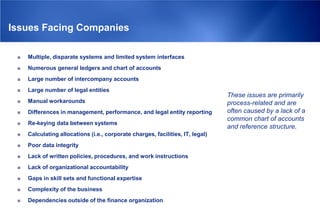
Issues Facing Companies

    Multiple, disparate systems and limited system interfaces
    Numerous general ledgers and chart of accounts
    Large number of intercompany accounts
    Large number of legal entities
                                                                                These issues are primarily
    Manual workarounds                                                         process-related and are
    Differences in management, performance, and legal entity reporting         often caused by a lack of a
                                                                                common chart of accounts
    Re-keying data between systems
                                                                                and reference structure.
    Calculating allocations (i.e., corporate charges, facilities, IT, legal)
    Poor data integrity
    Lack of written policies, procedures, and work instructions
    Lack of organizational accountability
    Gaps in skill sets and functional expertise
    Complexity of the business
    Dependencies outside of the finance organization
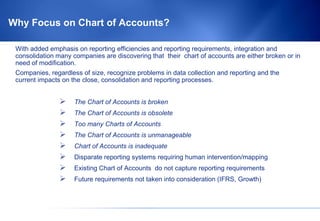
Why Focus on Chart of Accounts?

 With added emphasis on reporting efficiencies and reporting requirements, integration and
 consolidation many companies are discovering that their chart of accounts are either broken or in
 need of modification.
 Companies, regardless of size, recognize problems in data collection and reporting and the
 current impacts on the close, consolidation and reporting processes.


                    The Chart of Accounts is broken
                    The Chart of Accounts is obsolete
                    Too many Charts of Accounts
                    The Chart of Accounts is unmanageable
                    Chart of Accounts is inadequate
                    Disparate reporting systems requiring human intervention/mapping
                    Existing Chart of Accounts do not capture reporting requirements
                    Future requirements not taken into consideration (IFRS, Growth)
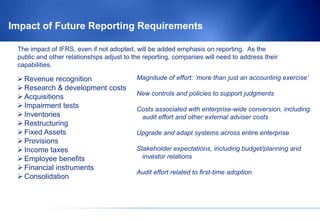
Impact of Future Reporting Requirements

 The impact of IFRS, even if not adopted, will be added emphasis on reporting. As the
 public and other relationships adjust to the reporting, companies will need to address their
 capabilities.

  Revenue recognition                     Magnitude of effort: ‘more than just an accounting exercise’
  Research & development costs
                                           New controls and policies to support judgments
  Acquisitions
  Impairment tests                        Costs associated with enterprise-wide conversion, including
  Inventories                              audit effort and other external adviser costs
  Restructuring
  Fixed Assets                            Upgrade and adapt systems across entire enterprise
  Provisions
  Income taxes                            Stakeholder expectations, including budget/planning and
  Employee benefits                         investor relations
  Financial instruments
                                           Audit effort related to first-time adoption
  Consolidation
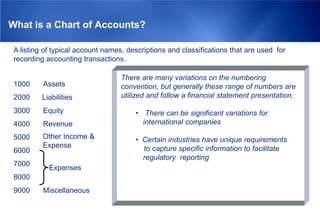
What is a Chart of Accounts?

 A listing of typical account names, descriptions and classifications that are used for
 recording accounting transactions.

                                  There are many variations on the numbering
 1000     Assets                  convention, but generally these range of numbers are
 2000     Liabilities             utilized and follow a financial statement presentation.

 3000     Equity                       • There can be significant variations for
 4000     Revenue                        international companies

 5000     Other Income &               • Certain industries have unique requirements
          Expense                        to capture specific information to facilitate
 6000
                                         regulatory reporting
 7000
            Expenses
 8000
 9000     Miscellaneous
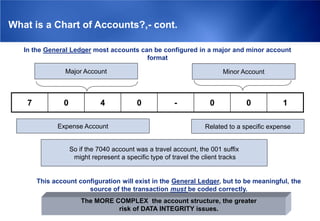
What is a Chart of Accounts?,- cont.

   In the General Ledger most accounts can be configured in a major and minor account
                                         format

                 Major Account                                            Minor Account


    7           0             4            0             -           0             0          1

              Expense Account                                       Related to a specific expense


                    So if the 7040 account was a travel account, the 001 suffix
                     might represent a specific type of travel the client tracks


        This account configuration will exist in the General Ledger, but to be meaningful, the
                        source of the transaction must be coded correctly.
                        The MORE COMPLEX the account structure, the greater
                                  risk of DATA INTEGRITY issues.
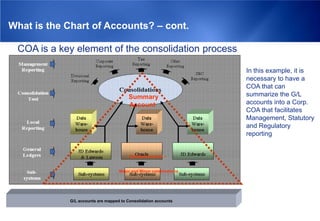
What is the Chart of Accounts? – cont.

 COA is a key element of the consolidation process

                                                                  In this example, it is
                                                                  necessary to have a
                                                                  COA that can
                                        Summary                   summarize the G/L
                                        Account                   accounts into a Corp.
                                                                  COA that facilitates
                                                                  Management, Statutory
                                                                  and Regulatory
                                                                  reporting


                                        Detailed Account –


                                   Major and Minor combinations


            G/L accounts are mapped to Consolidation accounts
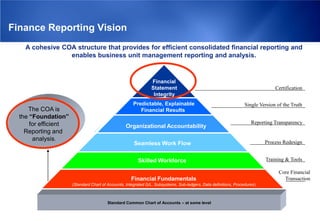
Finance Reporting Vision
    A cohesive COA structure that provides for efficient consolidated financial reporting and
                 enables business unit management reporting and analysis.


                                                                Financial
                                                                Statement                                                        Certification
                                                                 Integrity
                                                      Predictable, Explainable                                     Single Version of the Truth
     The COA is                                          Financial Results
  the “Foundation”
      for efficient                                                                                                   Reporting Transparency
                                                   Organizational Accountability
    Reporting and
       analysis.
                                                       Seamless Work Flow                                                   Process Redesign


                                                         Skilled Workforce                                                  Training & Tools

                                                                                                                                   Core Financial
                                                     Financial Fundamentals                                                          Transaction
                      (Standard Chart of Accounts, Integrated G/L, Subsystems, Sub-ledgers, Data definitions, Procedures)


                                         Standard Common Chart of Accounts – at some level
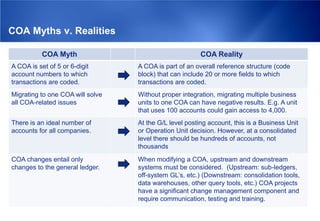
COA Myths v. Realities

           COA Myth                                     COA Reality
A COA is set of 5 or 6-digit      A COA is part of an overall reference structure (code
account numbers to which          block) that can include 20 or more fields to which
transactions are coded.           transactions are coded.
Migrating to one COA will solve   Without proper integration, migrating multiple business
all COA-related issues            units to one COA can have negative results. E.g. A unit
                                  that uses 100 accounts could gain access to 4,000.
There is an ideal number of       At the G/L level posting account, this is a Business Unit
accounts for all companies.       or Operation Unit decision. However, at a consolidated
                                  level there should be hundreds of accounts, not
                                  thousands
COA changes entail only           When modifying a COA, upstream and downstream
changes to the general ledger.    systems must be considered. (Upstream: sub-ledgers,
                                  off-system GL’s, etc.) (Downstream: consolidation tools,
                                  data warehouses, other query tools, etc.) COA projects
                                  have a significant change management component and
                                  require communication, testing and training.
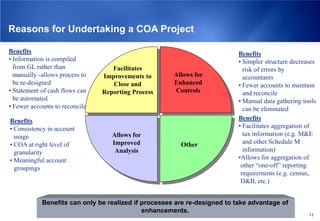
Reasons for Undertaking a COA Project

Benefits                                                                   Benefits
• Information is compiled                                                  • Simpler structure decreases
  from GL rather than              Facilitates                               risk of errors by
  manually -allows process to                     Allows for
                                        Data Request Forms
                                Improvements to                              accountants
  be re-designed                   Close and      Enhanced                 • Fewer accounts to maintain
• Statement of cash flows can   Reporting Process  Controls                  and reconcile
  be automated                                                             • Manual data gathering tools
• Fewer accounts to reconcile                                                can be eliminated
Benefits                                                                   Benefits
• Consistency in account                                                   • Facilitates aggregation of
  usage                           Allows for                                 tax information (e.g. M&E
• COA at right level of           Improved              Other                and other Schedule M
  granularity                      Analysis                                  information)
• Meaningful account                                                       •Allows for aggregation of
  groupings                                                                 other “one-off” reporting
                                                                            requirements (e.g. census,
                                                                            D&B, etc.)


            Benefits can only be realized if processes are re-designed to take advantage of
                                             enhancements.
                                                                                                     11
Contact Information


 Kevin J. Duffy
 duffyri@yahoo.com
 www.linkedin.com/duffyri

Chart Of Accounts Considerations

  • 1.
    Chart of AccountsConsiderations Discussion Document 1
  • 2.
    Contents Issues Facing Companies WhyFocus on the COA? Impact of Future Reporting Requirements What is the Chart of Accounts Finance Reporting Vision COA Myths vs. Realities Reasons for Undertaking a COA Project 2
  • 3.
    Issues Facing Companies  Multiple, disparate systems and limited system interfaces  Numerous general ledgers and chart of accounts  Large number of intercompany accounts  Large number of legal entities These issues are primarily  Manual workarounds process-related and are  Differences in management, performance, and legal entity reporting often caused by a lack of a common chart of accounts  Re-keying data between systems and reference structure.  Calculating allocations (i.e., corporate charges, facilities, IT, legal)  Poor data integrity  Lack of written policies, procedures, and work instructions  Lack of organizational accountability  Gaps in skill sets and functional expertise  Complexity of the business  Dependencies outside of the finance organization
  • 4.
    Why Focus onChart of Accounts? With added emphasis on reporting efficiencies and reporting requirements, integration and consolidation many companies are discovering that their chart of accounts are either broken or in need of modification. Companies, regardless of size, recognize problems in data collection and reporting and the current impacts on the close, consolidation and reporting processes.  The Chart of Accounts is broken  The Chart of Accounts is obsolete  Too many Charts of Accounts  The Chart of Accounts is unmanageable  Chart of Accounts is inadequate  Disparate reporting systems requiring human intervention/mapping  Existing Chart of Accounts do not capture reporting requirements  Future requirements not taken into consideration (IFRS, Growth)
  • 5.
    Impact of FutureReporting Requirements The impact of IFRS, even if not adopted, will be added emphasis on reporting. As the public and other relationships adjust to the reporting, companies will need to address their capabilities.  Revenue recognition Magnitude of effort: ‘more than just an accounting exercise’  Research & development costs New controls and policies to support judgments  Acquisitions  Impairment tests Costs associated with enterprise-wide conversion, including  Inventories audit effort and other external adviser costs  Restructuring  Fixed Assets Upgrade and adapt systems across entire enterprise  Provisions  Income taxes Stakeholder expectations, including budget/planning and  Employee benefits investor relations  Financial instruments Audit effort related to first-time adoption  Consolidation
  • 6.
    What is aChart of Accounts? A listing of typical account names, descriptions and classifications that are used for recording accounting transactions. There are many variations on the numbering 1000 Assets convention, but generally these range of numbers are 2000 Liabilities utilized and follow a financial statement presentation. 3000 Equity • There can be significant variations for 4000 Revenue international companies 5000 Other Income & • Certain industries have unique requirements Expense to capture specific information to facilitate 6000 regulatory reporting 7000 Expenses 8000 9000 Miscellaneous
  • 7.
    What is aChart of Accounts?,- cont. In the General Ledger most accounts can be configured in a major and minor account format Major Account Minor Account 7 0 4 0 - 0 0 1 Expense Account Related to a specific expense So if the 7040 account was a travel account, the 001 suffix might represent a specific type of travel the client tracks This account configuration will exist in the General Ledger, but to be meaningful, the source of the transaction must be coded correctly. The MORE COMPLEX the account structure, the greater risk of DATA INTEGRITY issues.
  • 8.
    What is theChart of Accounts? – cont. COA is a key element of the consolidation process In this example, it is necessary to have a COA that can Summary summarize the G/L Account accounts into a Corp. COA that facilitates Management, Statutory and Regulatory reporting Detailed Account – Major and Minor combinations G/L accounts are mapped to Consolidation accounts
  • 9.
    Finance Reporting Vision A cohesive COA structure that provides for efficient consolidated financial reporting and enables business unit management reporting and analysis. Financial Statement Certification Integrity Predictable, Explainable Single Version of the Truth The COA is Financial Results the “Foundation” for efficient Reporting Transparency Organizational Accountability Reporting and analysis. Seamless Work Flow Process Redesign Skilled Workforce Training & Tools Core Financial Financial Fundamentals Transaction (Standard Chart of Accounts, Integrated G/L, Subsystems, Sub-ledgers, Data definitions, Procedures) Standard Common Chart of Accounts – at some level
  • 10.
    COA Myths v.Realities COA Myth COA Reality A COA is set of 5 or 6-digit A COA is part of an overall reference structure (code account numbers to which block) that can include 20 or more fields to which transactions are coded. transactions are coded. Migrating to one COA will solve Without proper integration, migrating multiple business all COA-related issues units to one COA can have negative results. E.g. A unit that uses 100 accounts could gain access to 4,000. There is an ideal number of At the G/L level posting account, this is a Business Unit accounts for all companies. or Operation Unit decision. However, at a consolidated level there should be hundreds of accounts, not thousands COA changes entail only When modifying a COA, upstream and downstream changes to the general ledger. systems must be considered. (Upstream: sub-ledgers, off-system GL’s, etc.) (Downstream: consolidation tools, data warehouses, other query tools, etc.) COA projects have a significant change management component and require communication, testing and training.
  • 11.
    Reasons for Undertakinga COA Project Benefits Benefits • Information is compiled • Simpler structure decreases from GL rather than Facilitates risk of errors by manually -allows process to Allows for Data Request Forms Improvements to accountants be re-designed Close and Enhanced • Fewer accounts to maintain • Statement of cash flows can Reporting Process Controls and reconcile be automated • Manual data gathering tools • Fewer accounts to reconcile can be eliminated Benefits Benefits • Consistency in account • Facilitates aggregation of usage Allows for tax information (e.g. M&E • COA at right level of Improved Other and other Schedule M granularity Analysis information) • Meaningful account •Allows for aggregation of groupings other “one-off” reporting requirements (e.g. census, D&B, etc.) Benefits can only be realized if processes are re-designed to take advantage of enhancements. 11
  • 12.
    Contact Information KevinJ. Duffy duffyri@yahoo.com www.linkedin.com/duffyri