PUNJAB COLLEGE OF TECHNICAL EDUCATION, LUDHIANA
                                  COURSE PLAN

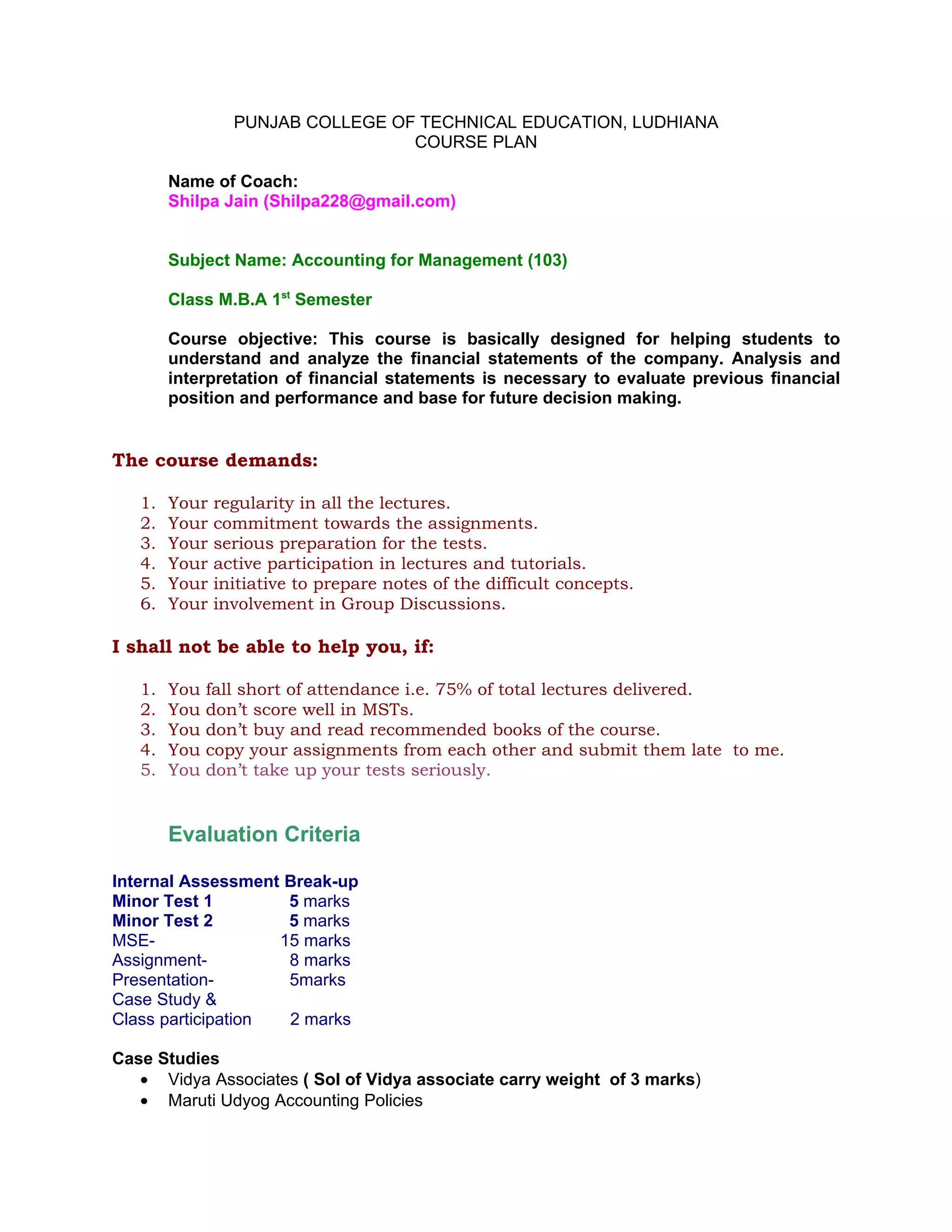
        Name of Coach:
        Shilpa Jain (Shilpa228@gmail.com)


        Subject Name: Accounting for Management (103)

        Class M.B.A 1st Semester

        Course objective: This course is basically designed for helping students to
        understand and analyze the financial statements of the company. Analysis and
        interpretation of financial statements is necessary to evaluate previous financial
        position and performance and base for future decision making.


The course demands:

   1.   Your   regularity in all the lectures.
   2.   Your   commitment towards the assignments.
   3.   Your   serious preparation for the tests.
   4.   Your   active participation in lectures and tutorials.
   5.   Your   initiative to prepare notes of the difficult concepts.
   6.   Your   involvement in Group Discussions.

I shall not be able to help you, if:

   1.   You   fall short of attendance i.e. 75% of total lectures delivered.
   2.   You   don’t score well in MSTs.
   3.   You   don’t buy and read recommended books of the course.
   4.   You   copy your assignments from each other and submit them late to me.
   5.   You   don’t take up your tests seriously.


        Evaluation Criteria

Internal Assessment Break-up
Minor Test 1         5 marks
Minor Test 2         5 marks
MSE-                15 marks
Assignment-          8 marks
Presentation-        5marks
Case Study &
Class participation  2 marks

Case Studies
   • Vidya Associates ( Sol of Vidya associate carry weight of 3 marks)
   • Maruti Udyog Accounting Policies
•   Nestle India Ltd. ( Understanding corporate balance sheet & Ratio analysis)
   •   Amit Bekhi & Co. ( Break Even Point)
   •   Target Costing ( A case study of Nano)


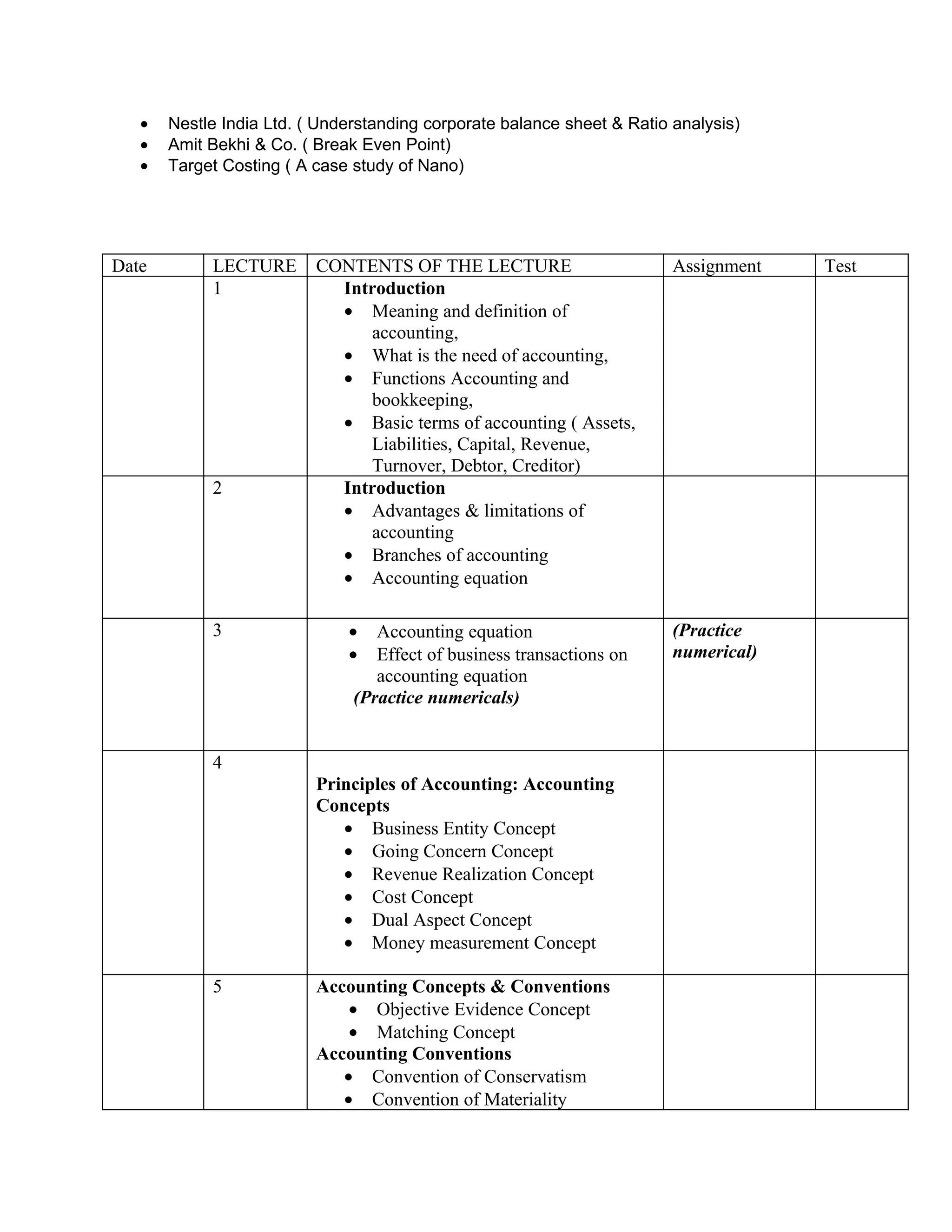
Date        LECTURE       CONTENTS OF THE LECTURE                        Assignment   Test
            1               Introduction
                            • Meaning and definition of
                               accounting,
                            • What is the need of accounting,
                            • Functions Accounting and
                               bookkeeping,
                            • Basic terms of accounting ( Assets,
                               Liabilities, Capital, Revenue,
                               Turnover, Debtor, Creditor)
            2               Introduction
                            • Advantages & limitations of
                               accounting
                            • Branches of accounting
                            • Accounting equation

            3                 •   Accounting equation                    (Practice
                              •   Effect of business transactions on     numerical)
                                  accounting equation
                               (Practice numericals)


            4
                          Principles of Accounting: Accounting
                          Concepts
                             • Business Entity Concept
                             • Going Concern Concept
                             • Revenue Realization Concept
                             • Cost Concept
                             • Dual Aspect Concept
                             • Money measurement Concept

            5             Accounting Concepts & Conventions
                              • Objective Evidence Concept
                              • Matching Concept
                          Accounting Conventions
                             • Convention of Conservatism
                             • Convention of Materiality
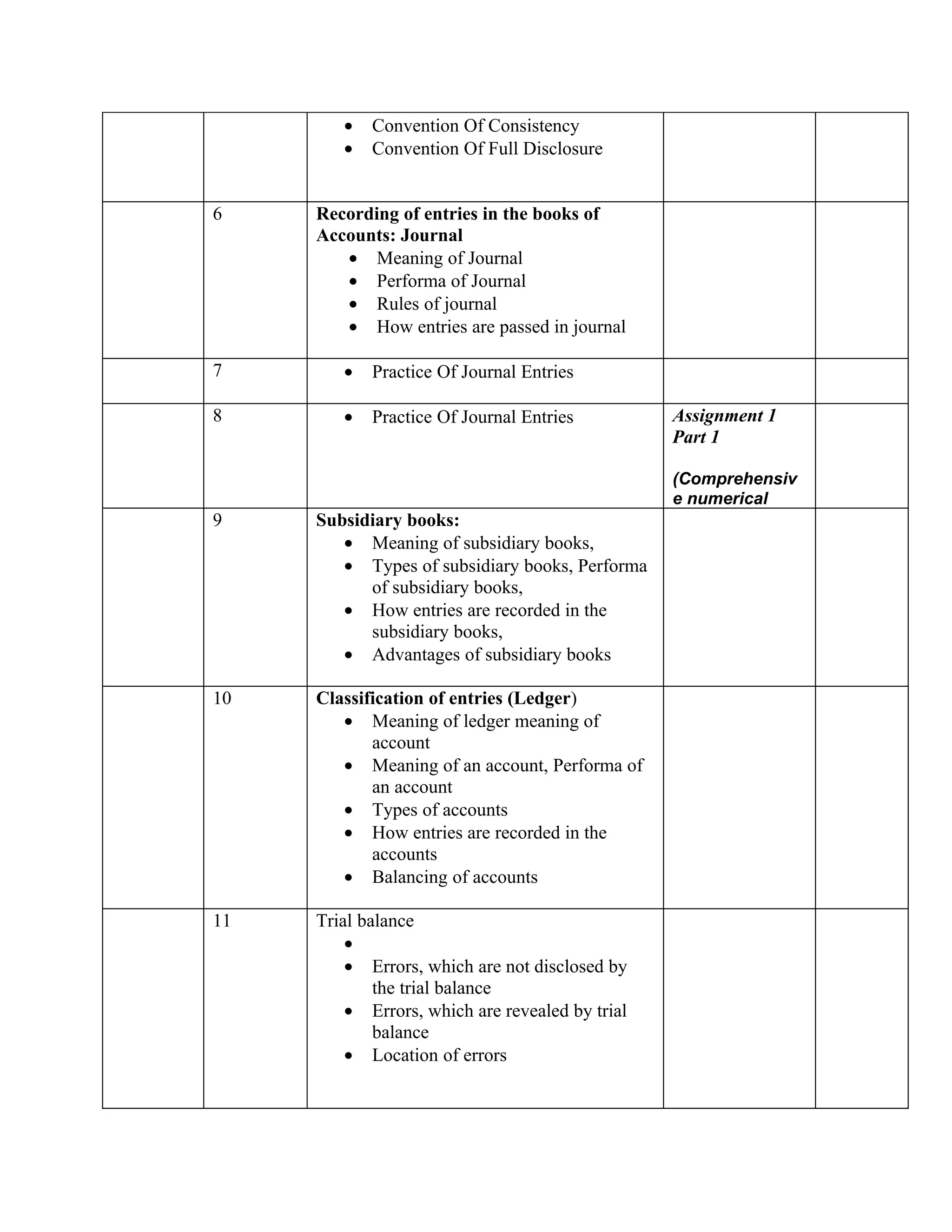
•   Convention Of Consistency
        •   Convention Of Full Disclosure


6    Recording of entries in the books of
     Accounts: Journal
        • Meaning of Journal
        • Performa of Journal
        • Rules of journal
        • How entries are passed in journal

7       •   Practice Of Journal Entries

8       •   Practice Of Journal Entries          Assignment 1
                                                 Part 1

                                                 (Comprehensiv
                                                 e numerical
9    Subsidiary books:
        • Meaning of subsidiary books,
        • Types of subsidiary books, Performa
           of subsidiary books,
        • How entries are recorded in the
           subsidiary books,
        • Advantages of subsidiary books

10   Classification of entries (Ledger)
        • Meaning of ledger meaning of
            account
        • Meaning of an account, Performa of
            an account
        • Types of accounts
        • How entries are recorded in the
            accounts
        • Balancing of accounts

11   Trial balance
         •
         • Errors, which are not disclosed by
             the trial balance
         • Errors, which are revealed by trial
             balance
         • Location of errors
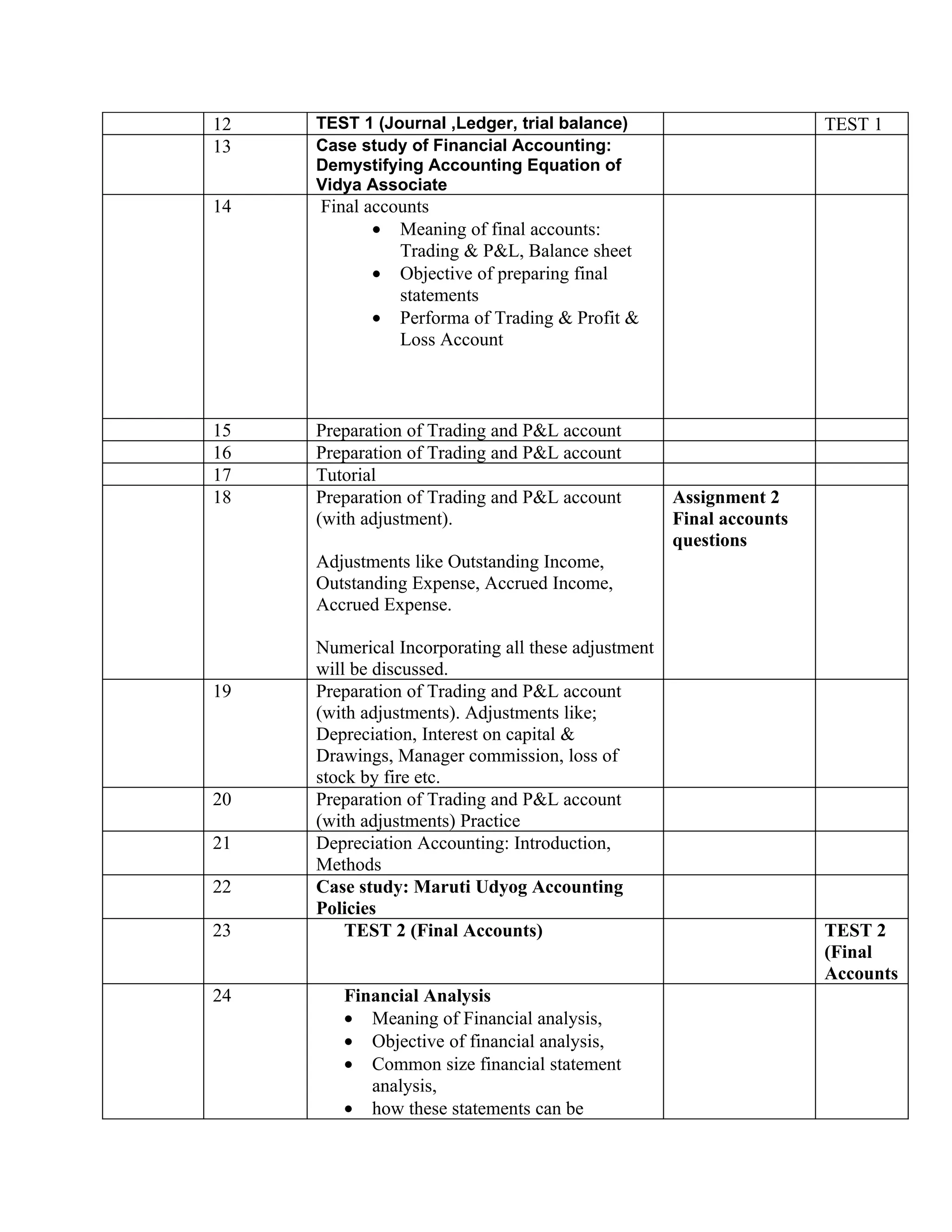
12   TEST 1 (Journal ,Ledger, trial balance)                         TEST 1
13   Case study of Financial Accounting:
     Demystifying Accounting Equation of
     Vidya Associate
14   Final accounts
            • Meaning of final accounts:
               Trading & P&L, Balance sheet
            • Objective of preparing final
               statements
            • Performa of Trading & Profit &
               Loss Account


15   Preparation of Trading and P&L account
16   Preparation of Trading and P&L account
17   Tutorial
18   Preparation of Trading and P&L account         Assignment 2
     (with adjustment).                             Final accounts
                                                    questions
     Adjustments like Outstanding Income,
     Outstanding Expense, Accrued Income,
     Accrued Expense.

     Numerical Incorporating all these adjustment
     will be discussed.
19   Preparation of Trading and P&L account
     (with adjustments). Adjustments like;
     Depreciation, Interest on capital &
     Drawings, Manager commission, loss of
     stock by fire etc.
20   Preparation of Trading and P&L account
     (with adjustments) Practice
21   Depreciation Accounting: Introduction,
     Methods
22   Case study: Maruti Udyog Accounting
     Policies
23       TEST 2 (Final Accounts)                                     TEST 2
                                                                     (Final
                                                                     Accounts
24      Financial Analysis
        • Meaning of Financial analysis,
        • Objective of financial analysis,
        • Common size financial statement
           analysis,
        • how these statements can be
interpreted
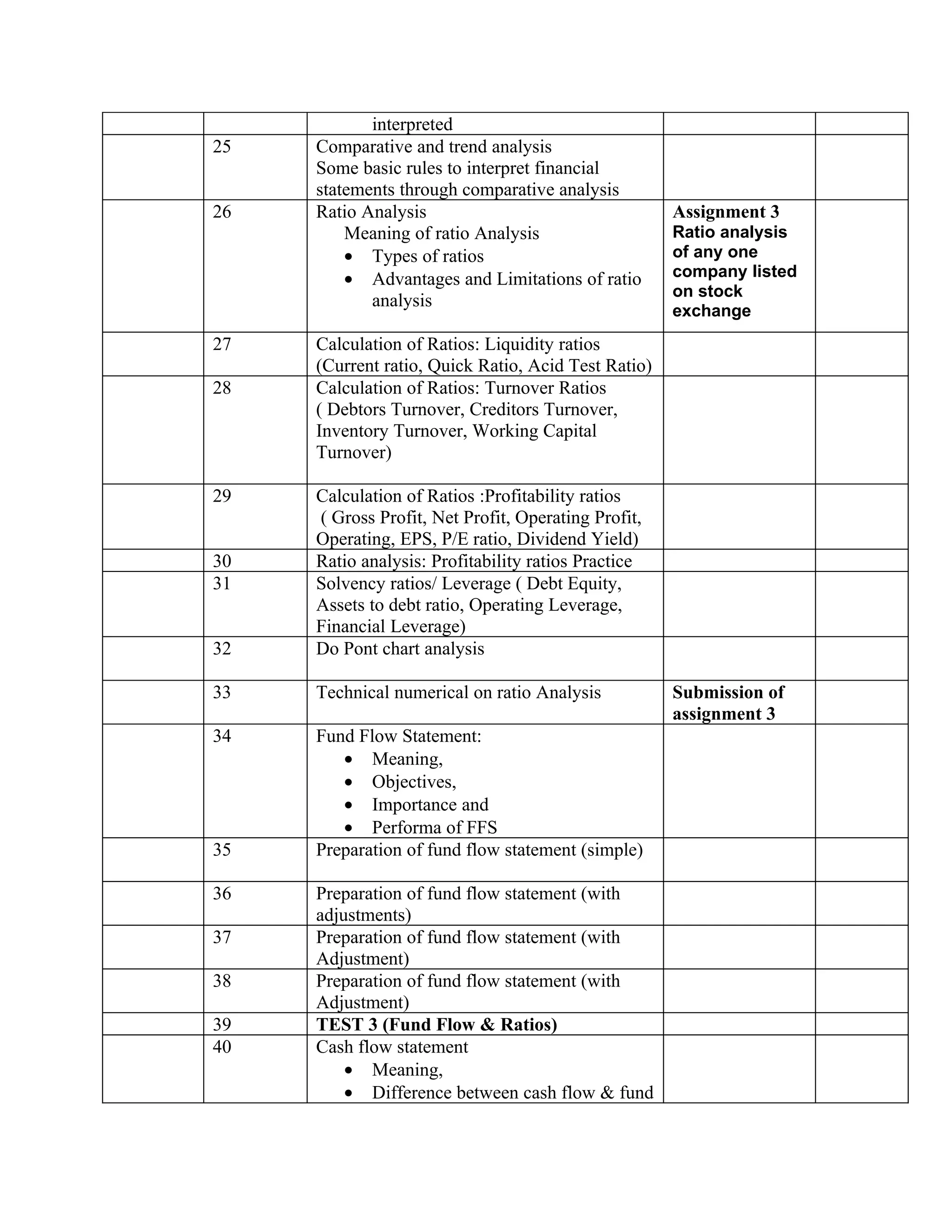
25   Comparative and trend analysis
     Some basic rules to interpret financial
     statements through comparative analysis
26   Ratio Analysis                                  Assignment 3
         Meaning of ratio Analysis                   Ratio analysis
         • Types of ratios                           of any one
         • Advantages and Limitations of ratio       company listed
                                                     on stock
            analysis
                                                     exchange
27   Calculation of Ratios: Liquidity ratios
     (Current ratio, Quick Ratio, Acid Test Ratio)
28   Calculation of Ratios: Turnover Ratios
     ( Debtors Turnover, Creditors Turnover,
     Inventory Turnover, Working Capital
     Turnover)

29   Calculation of Ratios :Profitability ratios
     ( Gross Profit, Net Profit, Operating Profit,
     Operating, EPS, P/E ratio, Dividend Yield)
30   Ratio analysis: Profitability ratios Practice
31   Solvency ratios/ Leverage ( Debt Equity,
     Assets to debt ratio, Operating Leverage,
     Financial Leverage)
32   Do Pont chart analysis

33   Technical numerical on ratio Analysis           Submission of
                                                     assignment 3
34   Fund Flow Statement:
        • Meaning,
        • Objectives,
        • Importance and
        • Performa of FFS
35   Preparation of fund flow statement (simple)

36   Preparation of fund flow statement (with
     adjustments)
37   Preparation of fund flow statement (with
     Adjustment)
38   Preparation of fund flow statement (with
     Adjustment)
39   TEST 3 (Fund Flow & Ratios)
40   Cash flow statement
         • Meaning,
         • Difference between cash flow & fund
flow statement
        • Performa of cash flow statement
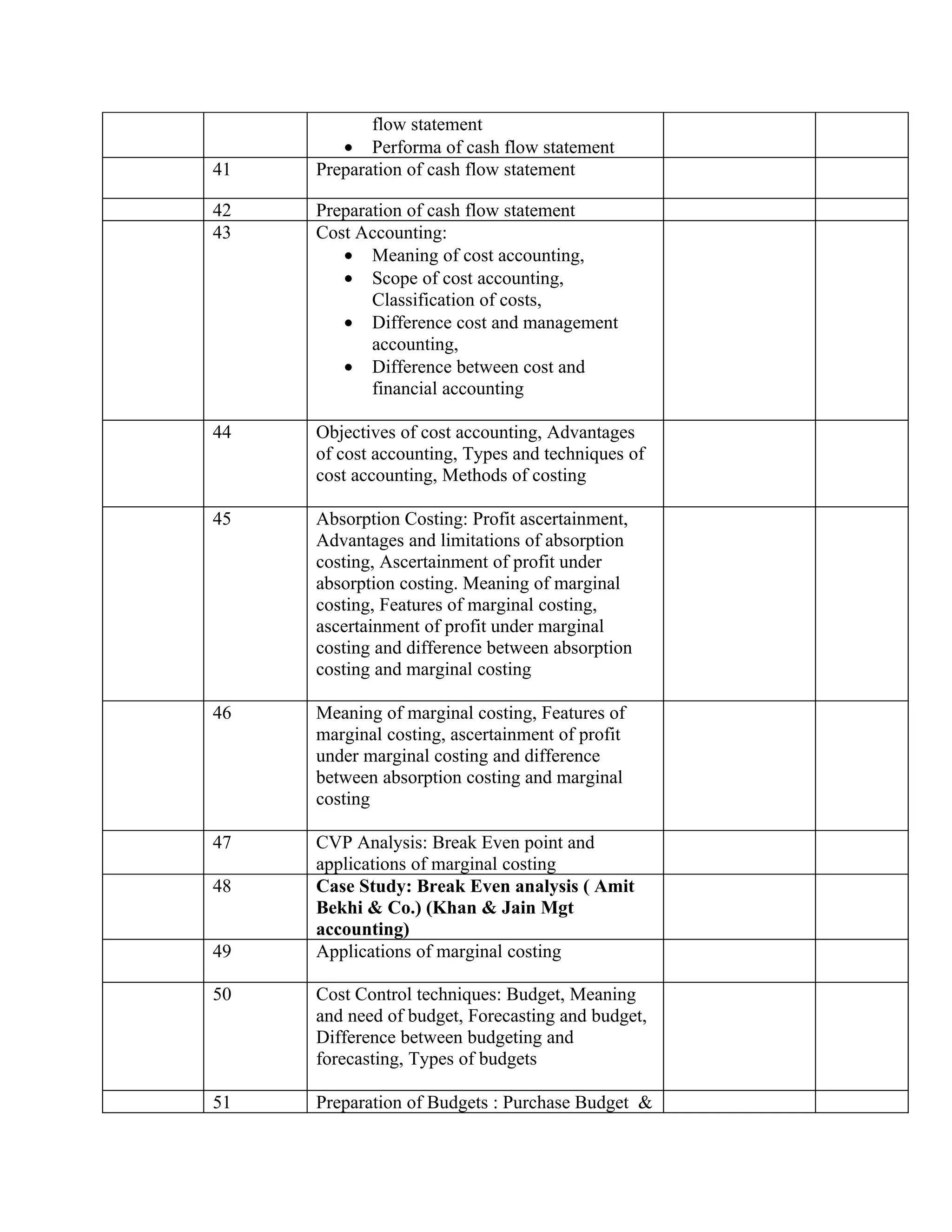
41   Preparation of cash flow statement

42   Preparation of cash flow statement
43   Cost Accounting:
        • Meaning of cost accounting,
        • Scope of cost accounting,
            Classification of costs,
        • Difference cost and management
            accounting,
        • Difference between cost and
            financial accounting

44   Objectives of cost accounting, Advantages
     of cost accounting, Types and techniques of
     cost accounting, Methods of costing

45   Absorption Costing: Profit ascertainment,
     Advantages and limitations of absorption
     costing, Ascertainment of profit under
     absorption costing. Meaning of marginal
     costing, Features of marginal costing,
     ascertainment of profit under marginal
     costing and difference between absorption
     costing and marginal costing

46   Meaning of marginal costing, Features of
     marginal costing, ascertainment of profit
     under marginal costing and difference
     between absorption costing and marginal
     costing

47   CVP Analysis: Break Even point and
     applications of marginal costing
48   Case Study: Break Even analysis ( Amit
     Bekhi & Co.) (Khan & Jain Mgt
     accounting)
49   Applications of marginal costing

50   Cost Control techniques: Budget, Meaning
     and need of budget, Forecasting and budget,
     Difference between budgeting and
     forecasting, Types of budgets

51   Preparation of Budgets : Purchase Budget &
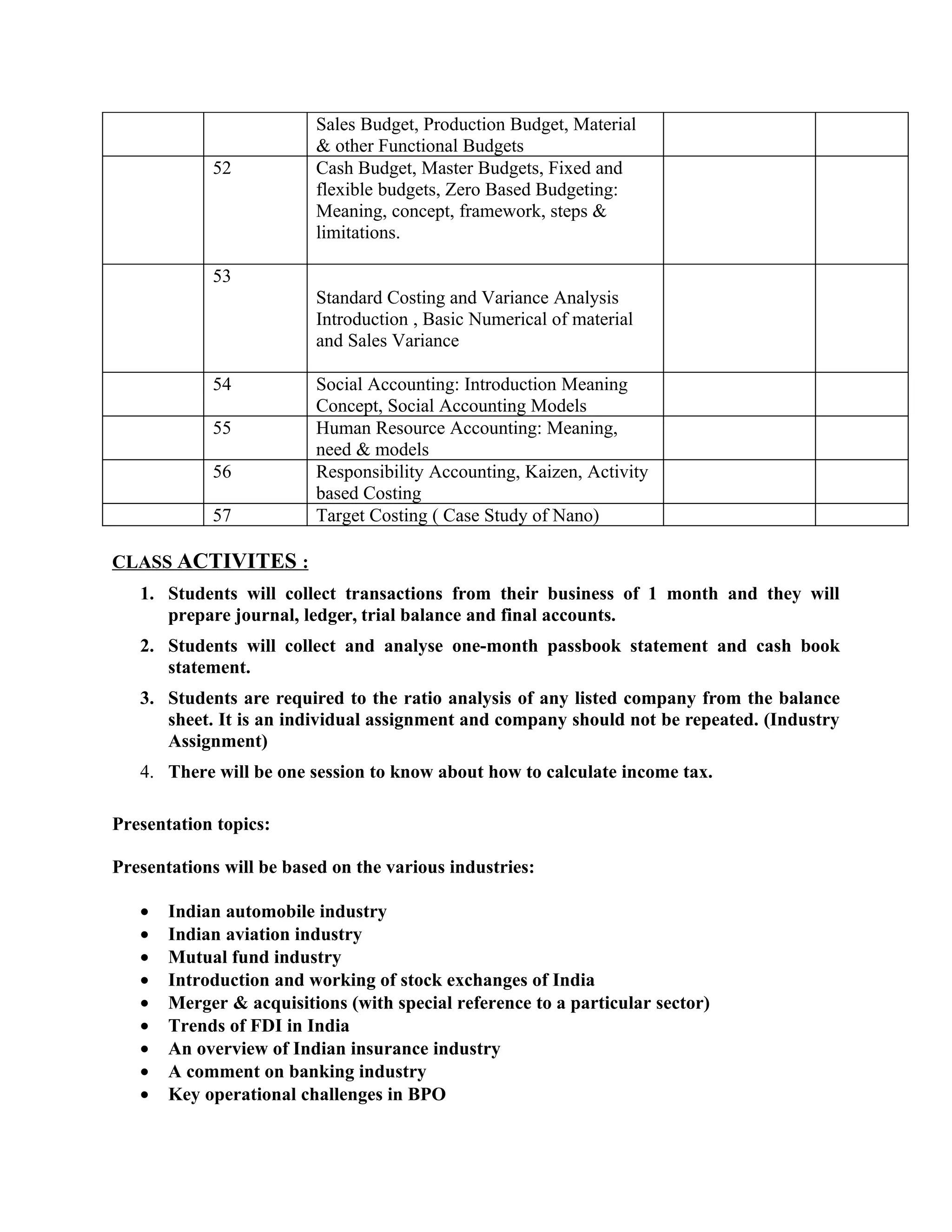
Sales Budget, Production Budget, Material
                          & other Functional Budgets
            52            Cash Budget, Master Budgets, Fixed and
                          flexible budgets, Zero Based Budgeting:
                          Meaning, concept, framework, steps &
                          limitations.

            53
                          Standard Costing and Variance Analysis
                          Introduction , Basic Numerical of material
                          and Sales Variance

            54            Social Accounting: Introduction Meaning
                          Concept, Social Accounting Models
            55            Human Resource Accounting: Meaning,
                          need & models
            56            Responsibility Accounting, Kaizen, Activity
                          based Costing
            57            Target Costing ( Case Study of Nano)

CLASS ACTIVITES :
   1. Students will collect transactions from their business of 1 month and they will
      prepare journal, ledger, trial balance and final accounts.
   2. Students will collect and analyse one-month passbook statement and cash book
      statement.
   3. Students are required to the ratio analysis of any listed company from the balance
      sheet. It is an individual assignment and company should not be repeated. (Industry
      Assignment)
   4. There will be one session to know about how to calculate income tax.

Presentation topics:

Presentations will be based on the various industries:

   •   Indian automobile industry
   •   Indian aviation industry
   •   Mutual fund industry
   •   Introduction and working of stock exchanges of India
   •   Merger & acquisitions (with special reference to a particular sector)
   •   Trends of FDI in India
   •   An overview of Indian insurance industry
   •   A comment on banking industry
   •   Key operational challenges in BPO
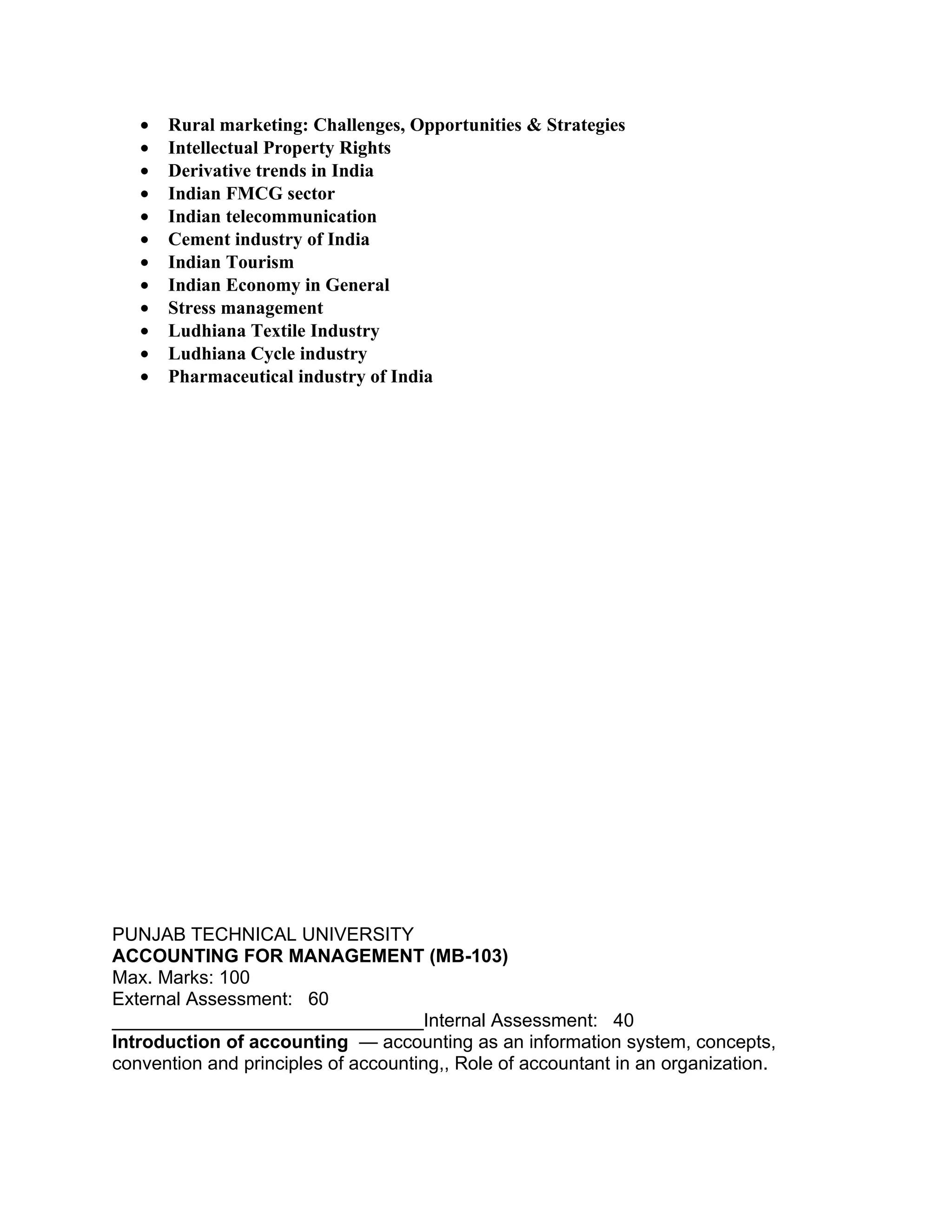
•   Rural marketing: Challenges, Opportunities & Strategies
   •   Intellectual Property Rights
   •   Derivative trends in India
   •   Indian FMCG sector
   •   Indian telecommunication
   •   Cement industry of India
   •   Indian Tourism
   •   Indian Economy in General
   •   Stress management
   •   Ludhiana Textile Industry
   •   Ludhiana Cycle industry
   •   Pharmaceutical industry of India


PUNJAB TECHNICAL UNIVERSITY
ACCOUNTING FOR MANAGEMENT (MB-103)
Max. Marks: 100
External Assessment: 60
______________________________Internal Assessment: 40
Introduction of accounting — accounting as an information system, concepts,
convention and principles of accounting,, Role of accountant in an organization.
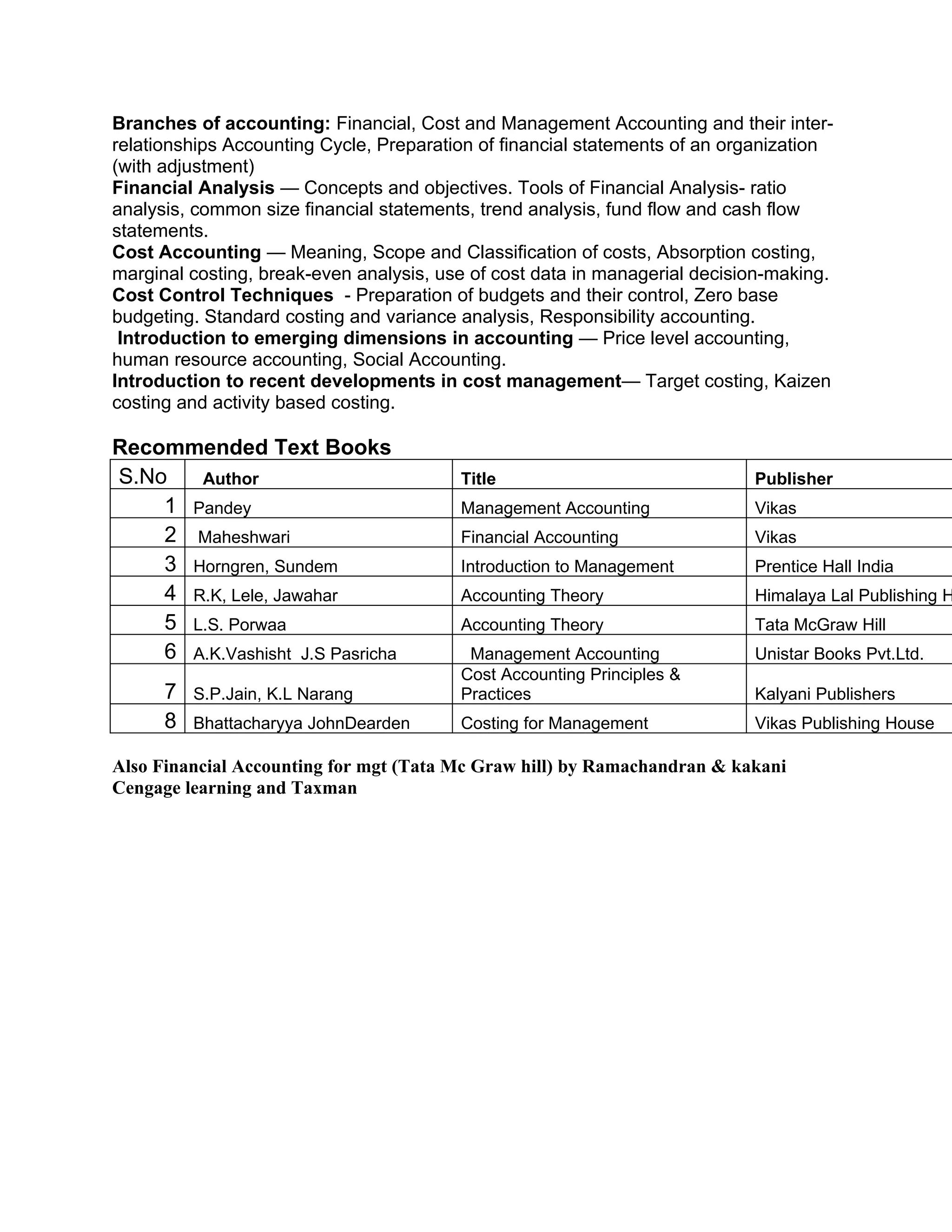
Branches of accounting: Financial, Cost and Management Accounting and their inter-
relationships Accounting Cycle, Preparation of financial statements of an organization
(with adjustment)
Financial Analysis — Concepts and objectives. Tools of Financial Analysis- ratio
analysis, common size financial statements, trend analysis, fund flow and cash flow
statements.
Cost Accounting — Meaning, Scope and Classification of costs, Absorption costing,
marginal costing, break-even analysis, use of cost data in managerial decision-making.
Cost Control Techniques - Preparation of budgets and their control, Zero base
budgeting. Standard costing and variance analysis, Responsibility accounting.
 Introduction to emerging dimensions in accounting — Price level accounting,
human resource accounting, Social Accounting.
Introduction to recent developments in cost management— Target costing, Kaizen
costing and activity based costing.

Recommended Text Books
S.No   Author                            Title                              Publisher
    1 Pandey                             Management Accounting              Vikas
    2 Maheshwari                         Financial Accounting               Vikas
    3 Horngren, Sundem                   Introduction to Management         Prentice Hall India
    4 R.K, Lele, Jawahar                 Accounting Theory                  Himalaya Lal Publishing H
    5 L.S. Porwaa                        Accounting Theory                  Tata McGraw Hill
    6 A.K.Vashisht J.S Pasricha           Management Accounting             Unistar Books Pvt.Ltd.
                                         Cost Accounting Principles &
      7   S.P.Jain, K.L Narang           Practices                          Kalyani Publishers
      8   Bhattacharyya JohnDearden      Costing for Management             Vikas Publishing House

Also Financial Accounting for mgt (Tata Mc Graw hill) by Ramachandran & kakani
Cengage learning and Taxman

Module

  • 1.
    PUNJAB COLLEGE OFTECHNICAL EDUCATION, LUDHIANA COURSE PLAN Name of Coach: Shilpa Jain (Shilpa228@gmail.com) Subject Name: Accounting for Management (103) Class M.B.A 1st Semester Course objective: This course is basically designed for helping students to understand and analyze the financial statements of the company. Analysis and interpretation of financial statements is necessary to evaluate previous financial position and performance and base for future decision making. The course demands: 1. Your regularity in all the lectures. 2. Your commitment towards the assignments. 3. Your serious preparation for the tests. 4. Your active participation in lectures and tutorials. 5. Your initiative to prepare notes of the difficult concepts. 6. Your involvement in Group Discussions. I shall not be able to help you, if: 1. You fall short of attendance i.e. 75% of total lectures delivered. 2. You don’t score well in MSTs. 3. You don’t buy and read recommended books of the course. 4. You copy your assignments from each other and submit them late to me. 5. You don’t take up your tests seriously. Evaluation Criteria Internal Assessment Break-up Minor Test 1 5 marks Minor Test 2 5 marks MSE- 15 marks Assignment- 8 marks Presentation- 5marks Case Study & Class participation 2 marks Case Studies • Vidya Associates ( Sol of Vidya associate carry weight of 3 marks) • Maruti Udyog Accounting Policies
  • 2.
    • Nestle India Ltd. ( Understanding corporate balance sheet & Ratio analysis) • Amit Bekhi & Co. ( Break Even Point) • Target Costing ( A case study of Nano) Date LECTURE CONTENTS OF THE LECTURE Assignment Test 1 Introduction • Meaning and definition of accounting, • What is the need of accounting, • Functions Accounting and bookkeeping, • Basic terms of accounting ( Assets, Liabilities, Capital, Revenue, Turnover, Debtor, Creditor) 2 Introduction • Advantages & limitations of accounting • Branches of accounting • Accounting equation 3 • Accounting equation (Practice • Effect of business transactions on numerical) accounting equation (Practice numericals) 4 Principles of Accounting: Accounting Concepts • Business Entity Concept • Going Concern Concept • Revenue Realization Concept • Cost Concept • Dual Aspect Concept • Money measurement Concept 5 Accounting Concepts & Conventions • Objective Evidence Concept • Matching Concept Accounting Conventions • Convention of Conservatism • Convention of Materiality
  • 3.
    • Convention Of Consistency • Convention Of Full Disclosure 6 Recording of entries in the books of Accounts: Journal • Meaning of Journal • Performa of Journal • Rules of journal • How entries are passed in journal 7 • Practice Of Journal Entries 8 • Practice Of Journal Entries Assignment 1 Part 1 (Comprehensiv e numerical 9 Subsidiary books: • Meaning of subsidiary books, • Types of subsidiary books, Performa of subsidiary books, • How entries are recorded in the subsidiary books, • Advantages of subsidiary books 10 Classification of entries (Ledger) • Meaning of ledger meaning of account • Meaning of an account, Performa of an account • Types of accounts • How entries are recorded in the accounts • Balancing of accounts 11 Trial balance • • Errors, which are not disclosed by the trial balance • Errors, which are revealed by trial balance • Location of errors
  • 4.
    12 TEST 1 (Journal ,Ledger, trial balance) TEST 1 13 Case study of Financial Accounting: Demystifying Accounting Equation of Vidya Associate 14 Final accounts • Meaning of final accounts: Trading & P&L, Balance sheet • Objective of preparing final statements • Performa of Trading & Profit & Loss Account 15 Preparation of Trading and P&L account 16 Preparation of Trading and P&L account 17 Tutorial 18 Preparation of Trading and P&L account Assignment 2 (with adjustment). Final accounts questions Adjustments like Outstanding Income, Outstanding Expense, Accrued Income, Accrued Expense. Numerical Incorporating all these adjustment will be discussed. 19 Preparation of Trading and P&L account (with adjustments). Adjustments like; Depreciation, Interest on capital & Drawings, Manager commission, loss of stock by fire etc. 20 Preparation of Trading and P&L account (with adjustments) Practice 21 Depreciation Accounting: Introduction, Methods 22 Case study: Maruti Udyog Accounting Policies 23 TEST 2 (Final Accounts) TEST 2 (Final Accounts 24 Financial Analysis • Meaning of Financial analysis, • Objective of financial analysis, • Common size financial statement analysis, • how these statements can be
  • 5.
    interpreted 25 Comparative and trend analysis Some basic rules to interpret financial statements through comparative analysis 26 Ratio Analysis Assignment 3 Meaning of ratio Analysis Ratio analysis • Types of ratios of any one • Advantages and Limitations of ratio company listed on stock analysis exchange 27 Calculation of Ratios: Liquidity ratios (Current ratio, Quick Ratio, Acid Test Ratio) 28 Calculation of Ratios: Turnover Ratios ( Debtors Turnover, Creditors Turnover, Inventory Turnover, Working Capital Turnover) 29 Calculation of Ratios :Profitability ratios ( Gross Profit, Net Profit, Operating Profit, Operating, EPS, P/E ratio, Dividend Yield) 30 Ratio analysis: Profitability ratios Practice 31 Solvency ratios/ Leverage ( Debt Equity, Assets to debt ratio, Operating Leverage, Financial Leverage) 32 Do Pont chart analysis 33 Technical numerical on ratio Analysis Submission of assignment 3 34 Fund Flow Statement: • Meaning, • Objectives, • Importance and • Performa of FFS 35 Preparation of fund flow statement (simple) 36 Preparation of fund flow statement (with adjustments) 37 Preparation of fund flow statement (with Adjustment) 38 Preparation of fund flow statement (with Adjustment) 39 TEST 3 (Fund Flow & Ratios) 40 Cash flow statement • Meaning, • Difference between cash flow & fund
  • 6.
    flow statement • Performa of cash flow statement 41 Preparation of cash flow statement 42 Preparation of cash flow statement 43 Cost Accounting: • Meaning of cost accounting, • Scope of cost accounting, Classification of costs, • Difference cost and management accounting, • Difference between cost and financial accounting 44 Objectives of cost accounting, Advantages of cost accounting, Types and techniques of cost accounting, Methods of costing 45 Absorption Costing: Profit ascertainment, Advantages and limitations of absorption costing, Ascertainment of profit under absorption costing. Meaning of marginal costing, Features of marginal costing, ascertainment of profit under marginal costing and difference between absorption costing and marginal costing 46 Meaning of marginal costing, Features of marginal costing, ascertainment of profit under marginal costing and difference between absorption costing and marginal costing 47 CVP Analysis: Break Even point and applications of marginal costing 48 Case Study: Break Even analysis ( Amit Bekhi & Co.) (Khan & Jain Mgt accounting) 49 Applications of marginal costing 50 Cost Control techniques: Budget, Meaning and need of budget, Forecasting and budget, Difference between budgeting and forecasting, Types of budgets 51 Preparation of Budgets : Purchase Budget &
  • 7.
    Sales Budget, ProductionBudget, Material & other Functional Budgets 52 Cash Budget, Master Budgets, Fixed and flexible budgets, Zero Based Budgeting: Meaning, concept, framework, steps & limitations. 53 Standard Costing and Variance Analysis Introduction , Basic Numerical of material and Sales Variance 54 Social Accounting: Introduction Meaning Concept, Social Accounting Models 55 Human Resource Accounting: Meaning, need & models 56 Responsibility Accounting, Kaizen, Activity based Costing 57 Target Costing ( Case Study of Nano) CLASS ACTIVITES : 1. Students will collect transactions from their business of 1 month and they will prepare journal, ledger, trial balance and final accounts. 2. Students will collect and analyse one-month passbook statement and cash book statement. 3. Students are required to the ratio analysis of any listed company from the balance sheet. It is an individual assignment and company should not be repeated. (Industry Assignment) 4. There will be one session to know about how to calculate income tax. Presentation topics: Presentations will be based on the various industries: • Indian automobile industry • Indian aviation industry • Mutual fund industry • Introduction and working of stock exchanges of India • Merger & acquisitions (with special reference to a particular sector) • Trends of FDI in India • An overview of Indian insurance industry • A comment on banking industry • Key operational challenges in BPO
  • 8.
    • Rural marketing: Challenges, Opportunities & Strategies • Intellectual Property Rights • Derivative trends in India • Indian FMCG sector • Indian telecommunication • Cement industry of India • Indian Tourism • Indian Economy in General • Stress management • Ludhiana Textile Industry • Ludhiana Cycle industry • Pharmaceutical industry of India PUNJAB TECHNICAL UNIVERSITY ACCOUNTING FOR MANAGEMENT (MB-103) Max. Marks: 100 External Assessment: 60 ______________________________Internal Assessment: 40 Introduction of accounting — accounting as an information system, concepts, convention and principles of accounting,, Role of accountant in an organization.
  • 9.
    Branches of accounting:Financial, Cost and Management Accounting and their inter- relationships Accounting Cycle, Preparation of financial statements of an organization (with adjustment) Financial Analysis — Concepts and objectives. Tools of Financial Analysis- ratio analysis, common size financial statements, trend analysis, fund flow and cash flow statements. Cost Accounting — Meaning, Scope and Classification of costs, Absorption costing, marginal costing, break-even analysis, use of cost data in managerial decision-making. Cost Control Techniques - Preparation of budgets and their control, Zero base budgeting. Standard costing and variance analysis, Responsibility accounting. Introduction to emerging dimensions in accounting — Price level accounting, human resource accounting, Social Accounting. Introduction to recent developments in cost management— Target costing, Kaizen costing and activity based costing. Recommended Text Books S.No Author Title Publisher 1 Pandey Management Accounting Vikas 2 Maheshwari Financial Accounting Vikas 3 Horngren, Sundem Introduction to Management Prentice Hall India 4 R.K, Lele, Jawahar Accounting Theory Himalaya Lal Publishing H 5 L.S. Porwaa Accounting Theory Tata McGraw Hill 6 A.K.Vashisht J.S Pasricha Management Accounting Unistar Books Pvt.Ltd. Cost Accounting Principles & 7 S.P.Jain, K.L Narang Practices Kalyani Publishers 8 Bhattacharyya JohnDearden Costing for Management Vikas Publishing House Also Financial Accounting for mgt (Tata Mc Graw hill) by Ramachandran & kakani Cengage learning and Taxman