CHARACTERIZATION
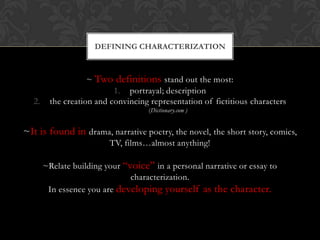
DEFINING CHARACTERIZATION


                   ~ Two definitions stand out the most:
                          1. portrayal; description
  2.    the creation and convincing representation of fictitious characters
                                    (Dictionary.com )


~It is found in drama, narrative poetry, the novel, the short story, comics,
                         TV, films…almost anything!

       ~Relate building your “voice” in a personal narrative or essay to
                               characterization.
        In essence you are developing yourself as the character.
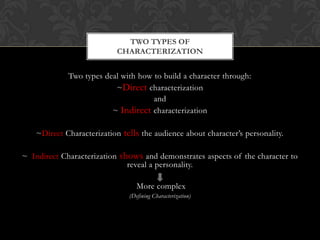
TWO TYPES OF
                            CHARACTERIZATION


             Two types deal with how to build a character through:
                          ~Direct characterization
                                     and
                         ~ Indirect characterization

    ~Direct Characterization tells the audience about character’s personality.

~ Indirect Characterization shows and demonstrates aspects of the character to
                              reveal a personality.

                                  More complex
                               (Defining Characterization)
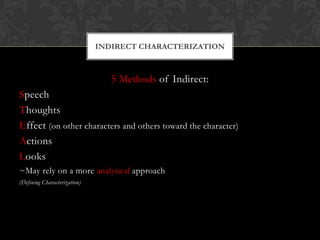
INDIRECT CHARACTERIZATION


                                 5 Methods of Indirect:
Speech
Thoughts
Effect (on other characters and others toward the character)
Actions
Looks
~May rely on a more analytical approach
(Defining Characterization)
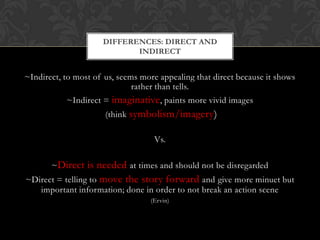
DIFFERENCES: DIRECT AND
                            INDIRECT


~Indirect, to most of us, seems more appealing that direct because it shows
                              rather than tells.
           ~Indirect = imaginative, paints more vivid images
                      (think symbolism/imagery)

                                   Vs.

       ~Direct is needed at times and should not be disregarded
~Direct = telling to move the story forward and give more minuet but
   important information; done in order to not break an action scene
                                  (Ervin)
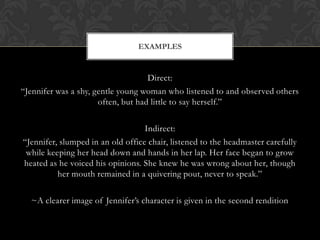
EXAMPLES


                                    Direct:
“Jennifer was a shy, gentle young woman who listened to and observed others
                      often, but had little to say herself.”

                                   Indirect:
“Jennifer, slumped in an old office chair, listened to the headmaster carefully
 while keeping her head down and hands in her lap. Her face began to grow
heated as he voiced his opinions. She knew he was wrong about her, though
          her mouth remained in a quivering pout, never to speak.”

  ~A clearer image of Jennifer’s character is given in the second rendition
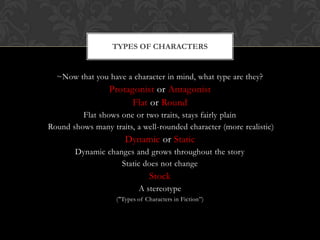
TYPES OF CHARACTERS


  ~Now that you have a character in mind, what type are they?
                 Protagonist or Antagonist
                       Flat or Round
         Flat shows one or two traits, stays fairly plain
Round shows many traits, a well-rounded character (more realistic)
                      Dynamic or Static
       Dynamic changes and grows throughout the story
                   Static does not change
                               Stock
                           A stereotype
                   ("Types of Characters in Fiction”)
EXISTENCE OF CHARACTERS


          The short story “If It’s Love, It’s Not That Easy”
                          by Peter Christopher
~ Creates characters through the use of voicemail recordings, a news report,
                 bills, library notices, and a grocery receipt

~By only hearing one character talk twice, the reader knows both of the main
                  character’s personalities and purposes.

   ~A great use of indirect characterization to develop one static and one
                             dynamic characters
                                  (Christopher)
CITATIONS


"characterization." Dictionary.com Unabridged. Random House, Inc. 18 Apr. 2012.
           <Dictionary.com http://dictionary.reference.com/browse/characterization>.


Defining Characterization. ReadWriteThink, 2004. PDF.


Ervin, Terry W. "Fiction Factor - Direct vs. Indirect Characterization." Fiction Factor. Web.
          13 Apr. 2012. <http://www.fictionfactor.com/guests/characterization.html>.


Christopher, Peter. ""If It's Love, It's Not That Easy"" Web. 13 Apr. 2012. Print.


"Types of Characters in Fiction." Lexiconic Education Resources! Web. 13 Apr. 2012.    <http:
          learn.lexiconic.net/characters.htm>.

Characterization

  • 1.
  • 2.
    DEFINING CHARACTERIZATION ~ Two definitions stand out the most: 1. portrayal; description 2. the creation and convincing representation of fictitious characters (Dictionary.com ) ~It is found in drama, narrative poetry, the novel, the short story, comics, TV, films…almost anything! ~Relate building your “voice” in a personal narrative or essay to characterization. In essence you are developing yourself as the character.
  • 3.
    TWO TYPES OF CHARACTERIZATION Two types deal with how to build a character through: ~Direct characterization and ~ Indirect characterization ~Direct Characterization tells the audience about character’s personality. ~ Indirect Characterization shows and demonstrates aspects of the character to reveal a personality. More complex (Defining Characterization)
  • 4.
    INDIRECT CHARACTERIZATION 5 Methods of Indirect: Speech Thoughts Effect (on other characters and others toward the character) Actions Looks ~May rely on a more analytical approach (Defining Characterization)
  • 5.
    DIFFERENCES: DIRECT AND INDIRECT ~Indirect, to most of us, seems more appealing that direct because it shows rather than tells. ~Indirect = imaginative, paints more vivid images (think symbolism/imagery) Vs. ~Direct is needed at times and should not be disregarded ~Direct = telling to move the story forward and give more minuet but important information; done in order to not break an action scene (Ervin)
  • 6.
    EXAMPLES Direct: “Jennifer was a shy, gentle young woman who listened to and observed others often, but had little to say herself.” Indirect: “Jennifer, slumped in an old office chair, listened to the headmaster carefully while keeping her head down and hands in her lap. Her face began to grow heated as he voiced his opinions. She knew he was wrong about her, though her mouth remained in a quivering pout, never to speak.” ~A clearer image of Jennifer’s character is given in the second rendition
  • 7.
    TYPES OF CHARACTERS ~Now that you have a character in mind, what type are they? Protagonist or Antagonist Flat or Round Flat shows one or two traits, stays fairly plain Round shows many traits, a well-rounded character (more realistic) Dynamic or Static Dynamic changes and grows throughout the story Static does not change Stock A stereotype ("Types of Characters in Fiction”)
  • 8.
    EXISTENCE OF CHARACTERS The short story “If It’s Love, It’s Not That Easy” by Peter Christopher ~ Creates characters through the use of voicemail recordings, a news report, bills, library notices, and a grocery receipt ~By only hearing one character talk twice, the reader knows both of the main character’s personalities and purposes. ~A great use of indirect characterization to develop one static and one dynamic characters (Christopher)
  • 9.
    CITATIONS "characterization." Dictionary.com Unabridged.Random House, Inc. 18 Apr. 2012. <Dictionary.com http://dictionary.reference.com/browse/characterization>. Defining Characterization. ReadWriteThink, 2004. PDF. Ervin, Terry W. "Fiction Factor - Direct vs. Indirect Characterization." Fiction Factor. Web. 13 Apr. 2012. <http://www.fictionfactor.com/guests/characterization.html>. Christopher, Peter. ""If It's Love, It's Not That Easy"" Web. 13 Apr. 2012. Print. "Types of Characters in Fiction." Lexiconic Education Resources! Web. 13 Apr. 2012. <http: learn.lexiconic.net/characters.htm>.