Chapters 4 & 5:Supply and Demand
4-1: What is Demand?Microeconomics is the part of economic theory that deals with the behavior and decision making by individual units, such as people and firms.Microeconomic concepts help explain how prices are determined.Demand is the desire, ability, and willingness to buy a product. Demand is a concept specifying the different quantities of an item that will be bought at different prices.
The Law of Demand:There is an inverse relationship between the price of an item and the quantity demanded.As price goes up, the quantity demanded will go down.As price goes down, the quantity demanded will go up.VideoMarginal Utility is the additional satisfaction or usefulness a consumer gets from having one more unit of a product.
Diminishing Marginal Utility states that the extra satisfaction we get from using additional quantities of the product begins to decline. “How many cars do you really need?”
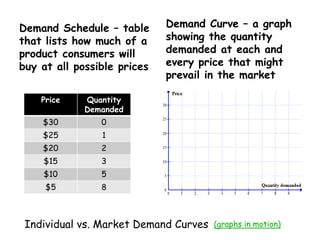
Demand Schedule – table that lists how much of a product consumers will buy at all possible pricesDemand Curve – a graph showing the quantity demanded at each and every price that might prevail in the market(graphs in motion)Individual vs. Market Demand Curves
4-2: Factors Affecting DemandWhen it comes to demand, there are two types of changes.When the price of a product changes while all other factors remain the same, there will be a change in the quantity demanded.  We move along the existing demand curve. Demand curve does not shift.Price of hamburger decreases at McDonalds, people will buy more hamburgers.Sometimes other factors change while the price remains the same.  Then there will be a change, or shift, in total demand.If McDonalds redesigns its restaurants to appeal to more people, they will have more customers, even at the same price.video
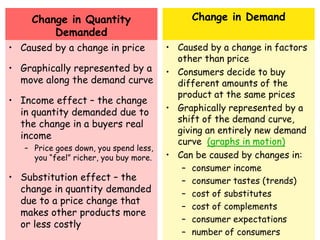
Change in Quantity DemandedChange in DemandCaused by a change in priceGraphically represented by a move along the demand curveIncome effect – the change in quantity demanded due to the change in a buyers real incomePrice goes down, you spend less, you “feel” richer, you buy more.Substitution effect – the change in quantity demanded due to a price change that makes other products more or less costlyCaused by a change in factors other than priceConsumers decide to buy different amounts of the product at the same pricesGraphically represented by a shift of the demand curve, giving an entirely new demand curve  (graphs in motion)Can be caused by changes in:consumer incomeconsumer tastes (trends)cost of substitutescost of complementsconsumer expectationsnumber of consumers
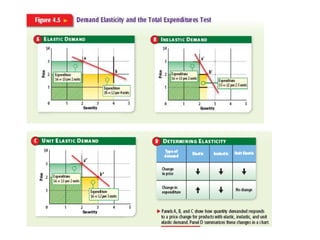
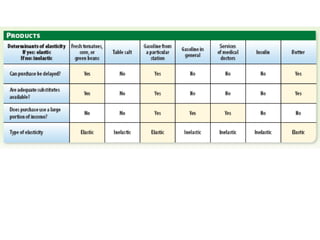
4-3: Elasticity of DemandElasticity is a measure of responsiveness.“cause and effect”how much does a dependent variable respond to a change in the independent variableHow much does the quantity demanded respond to an increase or decrease in price? Depends on its elasticity.Demand is elastic when a change in price results in a relatively larger change in quantity demanded. (m<-1)Demand is inelastic when a change in price results in a relatively smaller change in quantity demanded. (m>-1)A product is unit elastic when a change in price results in a proportional change in quantity demanded. (m=-1)
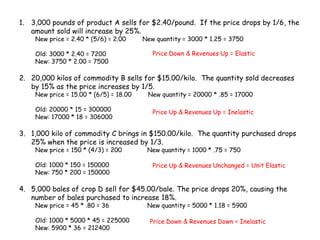
3,000 pounds of product A sells for $2.40/pound.  If the price drops by 1/6, the amount sold will increase by 25%.New price = 2.40 * (5/6) = 2.00         New quantity = 3000 * 1.25 = 3750Old: 3000 * 2.40 = 7200New: 3750 * 2.00 = 750020,000 kilos of commodity B sells for $15.00/kilo.  The quantity sold decreases by 15% as the price increases by 1/5.New price = 15.00 * (6/5) = 18.00         New quantity = 20000 * .85 = 17000Old: 20000 * 15 = 300000New: 17000 * 18 = 3060001,000 kilo of commodity C brings in $150.00/kilo.  The quantity purchased drops 25% when the price is increased by 1/3.New price = 150 * (4/3) = 200	New quantity = 1000 * .75 = 750Old: 1000 * 150 = 150000New: 750 * 200 = 1500005,000 bales of crop D sell for $45.00/bale. The price drops 20%, causing the number of bales purchased to increase 18%.New price = 45 * .80 = 36		New quantity = 5000 * 1.18 = 5900Old: 1000 * 5000 * 45 = 225000New: 5900 * 36 = 212400Price Down & Revenues Up = ElasticPrice Up & Revenues Up = InelasticPrice Up & Revenues Unchanged = Unit ElasticPrice Down & Revenues Down = Inelastic
5-1: What is Supply?Supply is the amount of a product that would be offered for sale at all possible prices that could prevail in the marketThe Law of Supply:There is an direct relationship between the price of an item and the quantity supplied.As price goes up, the quantity supplied will go up.As price goes down, the quantity supplied will go down. (graphs in motion)video
Change in Quantity SuppliedCaused by a change in priceGraphically represented by a move along the supply curveChange in SupplyCaused by a change in factors other than priceProducers offer different amounts of the product to sell at the same pricesGraphically represented by a shift of the supply curve, giving an entirely new supply curve  Can be caused by changes in:cost of resources, productivity, technology, expectationstaxes and subsidies, government regulationsnumber of sellers
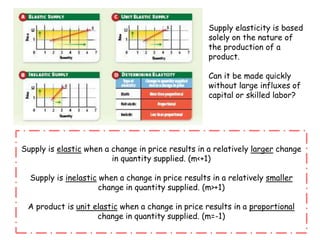
Supply elasticity is based solely on the nature of the production of a product.  Can it be made quickly without large influxes of capital or skilled labor?Supply is elastic when a change in price results in a relatively larger change in quantity supplied. (m<+1)Supply is inelastic when a change in price results in a relatively smaller change in quantity supplied. (m>+1)A product is unit elastic when a change in price results in a proportional change in quantity supplied. (m=-1)
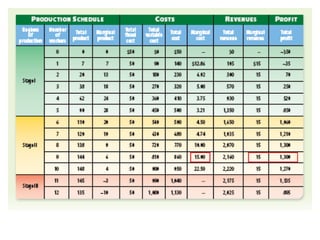
5-2: Theory of ProductionThe production function shows how total output changes when the amount of a single variable (usually labor) changes over the short run.The marginal product is the extra output or change in total product caused by adding one more unit of variable input.Can be illustrated with a production schedule or graph(graphs in motion).
Stages of ProductionI.  Increasing marginal returns- Each additional worker adds more to the total output than the worker before.II. Decreasing marginal returns	- Each additional worker is making a diminishing, but still positive, contributionIII. Negative marginal returns	- Each additional worker decreases total output
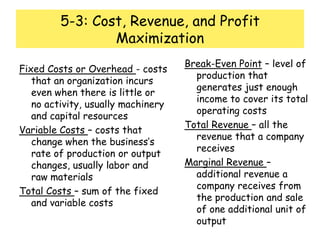
5-3: Cost, Revenue, and Profit MaximizationBreak-Even Point – level of production that generates just enough income to cover its total operating costsTotal Revenue – all the revenue that a company receivesMarginal Revenue – additional revenue a company receives from the production and sale of one additional unit of outputFixed Costs or Overhead - costs that an organization incurs even when there is little or no activity, usually machinery and capital resourcesVariable Costs – costs that change when the business’s rate of production or output changes, usually labor and raw materialsTotal Costs – sum of the fixed and variable costs

Chapters 4 & 5

  • 1.
    Chapters 4 &5:Supply and Demand
  • 2.
    4-1: What isDemand?Microeconomics is the part of economic theory that deals with the behavior and decision making by individual units, such as people and firms.Microeconomic concepts help explain how prices are determined.Demand is the desire, ability, and willingness to buy a product. Demand is a concept specifying the different quantities of an item that will be bought at different prices.
  • 3.
    The Law ofDemand:There is an inverse relationship between the price of an item and the quantity demanded.As price goes up, the quantity demanded will go down.As price goes down, the quantity demanded will go up.VideoMarginal Utility is the additional satisfaction or usefulness a consumer gets from having one more unit of a product.
  • 4.
    Diminishing Marginal Utilitystates that the extra satisfaction we get from using additional quantities of the product begins to decline. “How many cars do you really need?”
  • 5.
    Demand Schedule –table that lists how much of a product consumers will buy at all possible pricesDemand Curve – a graph showing the quantity demanded at each and every price that might prevail in the market(graphs in motion)Individual vs. Market Demand Curves
  • 6.
    4-2: Factors AffectingDemandWhen it comes to demand, there are two types of changes.When the price of a product changes while all other factors remain the same, there will be a change in the quantity demanded. We move along the existing demand curve. Demand curve does not shift.Price of hamburger decreases at McDonalds, people will buy more hamburgers.Sometimes other factors change while the price remains the same. Then there will be a change, or shift, in total demand.If McDonalds redesigns its restaurants to appeal to more people, they will have more customers, even at the same price.video
  • 7.
    Change in QuantityDemandedChange in DemandCaused by a change in priceGraphically represented by a move along the demand curveIncome effect – the change in quantity demanded due to the change in a buyers real incomePrice goes down, you spend less, you “feel” richer, you buy more.Substitution effect – the change in quantity demanded due to a price change that makes other products more or less costlyCaused by a change in factors other than priceConsumers decide to buy different amounts of the product at the same pricesGraphically represented by a shift of the demand curve, giving an entirely new demand curve (graphs in motion)Can be caused by changes in:consumer incomeconsumer tastes (trends)cost of substitutescost of complementsconsumer expectationsnumber of consumers
  • 8.
    4-3: Elasticity ofDemandElasticity is a measure of responsiveness.“cause and effect”how much does a dependent variable respond to a change in the independent variableHow much does the quantity demanded respond to an increase or decrease in price? Depends on its elasticity.Demand is elastic when a change in price results in a relatively larger change in quantity demanded. (m<-1)Demand is inelastic when a change in price results in a relatively smaller change in quantity demanded. (m>-1)A product is unit elastic when a change in price results in a proportional change in quantity demanded. (m=-1)
  • 11.
    3,000 pounds ofproduct A sells for $2.40/pound. If the price drops by 1/6, the amount sold will increase by 25%.New price = 2.40 * (5/6) = 2.00 New quantity = 3000 * 1.25 = 3750Old: 3000 * 2.40 = 7200New: 3750 * 2.00 = 750020,000 kilos of commodity B sells for $15.00/kilo. The quantity sold decreases by 15% as the price increases by 1/5.New price = 15.00 * (6/5) = 18.00 New quantity = 20000 * .85 = 17000Old: 20000 * 15 = 300000New: 17000 * 18 = 3060001,000 kilo of commodity C brings in $150.00/kilo. The quantity purchased drops 25% when the price is increased by 1/3.New price = 150 * (4/3) = 200 New quantity = 1000 * .75 = 750Old: 1000 * 150 = 150000New: 750 * 200 = 1500005,000 bales of crop D sell for $45.00/bale. The price drops 20%, causing the number of bales purchased to increase 18%.New price = 45 * .80 = 36 New quantity = 5000 * 1.18 = 5900Old: 1000 * 5000 * 45 = 225000New: 5900 * 36 = 212400Price Down & Revenues Up = ElasticPrice Up & Revenues Up = InelasticPrice Up & Revenues Unchanged = Unit ElasticPrice Down & Revenues Down = Inelastic
  • 12.
    5-1: What isSupply?Supply is the amount of a product that would be offered for sale at all possible prices that could prevail in the marketThe Law of Supply:There is an direct relationship between the price of an item and the quantity supplied.As price goes up, the quantity supplied will go up.As price goes down, the quantity supplied will go down. (graphs in motion)video
  • 13.
    Change in QuantitySuppliedCaused by a change in priceGraphically represented by a move along the supply curveChange in SupplyCaused by a change in factors other than priceProducers offer different amounts of the product to sell at the same pricesGraphically represented by a shift of the supply curve, giving an entirely new supply curve Can be caused by changes in:cost of resources, productivity, technology, expectationstaxes and subsidies, government regulationsnumber of sellers
  • 14.
    Supply elasticity isbased solely on the nature of the production of a product. Can it be made quickly without large influxes of capital or skilled labor?Supply is elastic when a change in price results in a relatively larger change in quantity supplied. (m<+1)Supply is inelastic when a change in price results in a relatively smaller change in quantity supplied. (m>+1)A product is unit elastic when a change in price results in a proportional change in quantity supplied. (m=-1)
  • 15.
    5-2: Theory ofProductionThe production function shows how total output changes when the amount of a single variable (usually labor) changes over the short run.The marginal product is the extra output or change in total product caused by adding one more unit of variable input.Can be illustrated with a production schedule or graph(graphs in motion).
  • 16.
    Stages of ProductionI. Increasing marginal returns- Each additional worker adds more to the total output than the worker before.II. Decreasing marginal returns - Each additional worker is making a diminishing, but still positive, contributionIII. Negative marginal returns - Each additional worker decreases total output
  • 17.
    5-3: Cost, Revenue,and Profit MaximizationBreak-Even Point – level of production that generates just enough income to cover its total operating costsTotal Revenue – all the revenue that a company receivesMarginal Revenue – additional revenue a company receives from the production and sale of one additional unit of outputFixed Costs or Overhead - costs that an organization incurs even when there is little or no activity, usually machinery and capital resourcesVariable Costs – costs that change when the business’s rate of production or output changes, usually labor and raw materialsTotal Costs – sum of the fixed and variable costs