Chapter 9:Sources of Government Revenue
9-1: The Economics of TaxationEconomic Impact of TaxesResource allocation – when taxes are raised on a product, consumers buy less, manufacturers produce less, and resources will have to go to other industries to be employedBehavior adjustment -  taxes can be used to encourage or discourage certain types of activitiesBy changing incentives to save, invest and work, taxes affect productivity and growth
Criteria for Effective TaxesEquity - fairSimplicity – easy to understandEfficiency – benefits outweigh costsTwo Principles of Taxation:Benefit Principle – belief that taxes should be paid based on benefits received, regardless of incomeAbility to Pay Principle – belief that taxes should be paid according to the level of income, regardless of benefits received
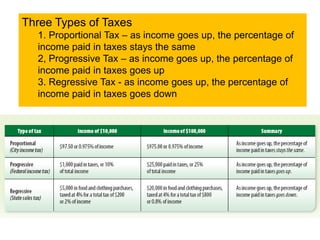
Three Types of Taxes1. Proportional Tax – as income goes up, the percentage of income paid in taxes stays the same2, Progressive Tax – as income goes up, the percentage of income paid in taxes goes up3. Regressive Tax - as income goes up, the percentage of income paid in taxes goes down
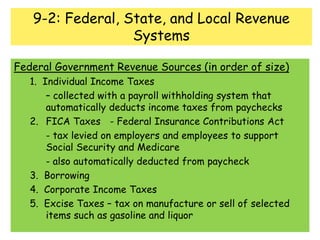
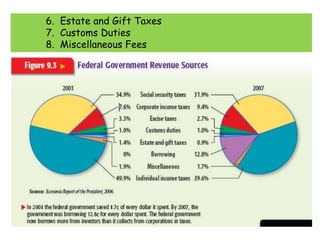
9-2: Federal, State, and Local Revenue SystemsFederal Government Revenue Sources (in order of size)	1.  Individual Income Taxes 		– collected with a payroll withholding system that 	automatically deducts income taxes from paychecks	2. 	FICA Taxes	- Federal Insurance Contributions Act		- tax levied on employers and employees to support 	Social Security and Medicare		- also automatically deducted from paycheck	3.  Borrowing	4.  Corporate Income Taxes	5.  Excise Taxes – tax on manufacture or sell of selected 	items such as gasoline and liquor
	6.  Estate and Gift Taxes	7.  Customs Duties	8.  Miscellaneous Fees
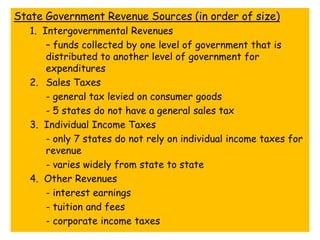
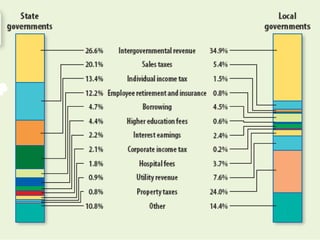
State Government Revenue Sources (in order of size)	1.  Intergovernmental Revenues		– funds collected by one level of government that is 	distributed to another level of government for 	expenditures	2. 	Sales Taxes			- general tax levied on consumer goods		- 5 states do not have a general sales tax	3.  Individual Income Taxes		- only 7 states do not rely on individual income taxes for 	revenue		- varies widely from state to state	4.  Other Revenues		- interest earnings		- tuition and fees		- corporate income taxes
Local Government Revenue Sources (in order of size)	1.  Intergovernmental Revenues	2. 	Property Taxes			- tax on tangible and intangible possessions such as real 	estate, buildings, furniture, stocks, bonds and bank 	accounts	3.  Utility Revenues		- public utility companies that supply water, electricity, 	sewer, and sometimes telecommunications are often 	owned by local governments	4.  Sales Taxes	5.  Other Revenue Sources		- interest earnings		- fees		- borrowing
9-3: Current Tax Issues and ReformsCurrent Tax Code is incredibly complexTax Reform: 1981Economic Recovery Tax Act included large tax deductions for individuals and businesses, accelerated depreciation, and investment tax creditsTax Reform: 1986Tax Reform: 1993Tax Reform: 1997Tax Reform: 2001Tax Reform: 2003Permanent tax cuts by 2011?
Alternative Tax ApproachesFlat Tax – a proportional tax on individual incomeSimpleCloses “loopholes”Save $$ and time preparing tax returnsRemoves incentives in current tax codeValue-Added Tax – Tax consumption, not incomeEquivalent to a national sales taxTax on the value added at every stage of the production process

Chapter 9

  • 1.
    Chapter 9:Sources ofGovernment Revenue
  • 2.
    9-1: The Economicsof TaxationEconomic Impact of TaxesResource allocation – when taxes are raised on a product, consumers buy less, manufacturers produce less, and resources will have to go to other industries to be employedBehavior adjustment - taxes can be used to encourage or discourage certain types of activitiesBy changing incentives to save, invest and work, taxes affect productivity and growth
  • 3.
    Criteria for EffectiveTaxesEquity - fairSimplicity – easy to understandEfficiency – benefits outweigh costsTwo Principles of Taxation:Benefit Principle – belief that taxes should be paid based on benefits received, regardless of incomeAbility to Pay Principle – belief that taxes should be paid according to the level of income, regardless of benefits received
  • 4.
    Three Types ofTaxes1. Proportional Tax – as income goes up, the percentage of income paid in taxes stays the same2, Progressive Tax – as income goes up, the percentage of income paid in taxes goes up3. Regressive Tax - as income goes up, the percentage of income paid in taxes goes down
  • 5.
    9-2: Federal, State,and Local Revenue SystemsFederal Government Revenue Sources (in order of size) 1. Individual Income Taxes – collected with a payroll withholding system that automatically deducts income taxes from paychecks 2. FICA Taxes - Federal Insurance Contributions Act - tax levied on employers and employees to support Social Security and Medicare - also automatically deducted from paycheck 3. Borrowing 4. Corporate Income Taxes 5. Excise Taxes – tax on manufacture or sell of selected items such as gasoline and liquor
  • 6.
    6. Estateand Gift Taxes 7. Customs Duties 8. Miscellaneous Fees
  • 8.
    State Government RevenueSources (in order of size) 1. Intergovernmental Revenues – funds collected by one level of government that is distributed to another level of government for expenditures 2. Sales Taxes - general tax levied on consumer goods - 5 states do not have a general sales tax 3. Individual Income Taxes - only 7 states do not rely on individual income taxes for revenue - varies widely from state to state 4. Other Revenues - interest earnings - tuition and fees - corporate income taxes
  • 9.
    Local Government RevenueSources (in order of size) 1. Intergovernmental Revenues 2. Property Taxes - tax on tangible and intangible possessions such as real estate, buildings, furniture, stocks, bonds and bank accounts 3. Utility Revenues - public utility companies that supply water, electricity, sewer, and sometimes telecommunications are often owned by local governments 4. Sales Taxes 5. Other Revenue Sources - interest earnings - fees - borrowing
  • 12.
    9-3: Current TaxIssues and ReformsCurrent Tax Code is incredibly complexTax Reform: 1981Economic Recovery Tax Act included large tax deductions for individuals and businesses, accelerated depreciation, and investment tax creditsTax Reform: 1986Tax Reform: 1993Tax Reform: 1997Tax Reform: 2001Tax Reform: 2003Permanent tax cuts by 2011?
  • 13.
    Alternative Tax ApproachesFlatTax – a proportional tax on individual incomeSimpleCloses “loopholes”Save $$ and time preparing tax returnsRemoves incentives in current tax codeValue-Added Tax – Tax consumption, not incomeEquivalent to a national sales taxTax on the value added at every stage of the production process