UNEQUAL COUPLING
TREE DIAGRAMS
SPLITTING DIAGRAMS
aka “TREE” DIAGRAMS
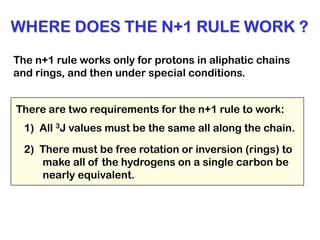
WHERE DOES THE N+1 RULE WORK ?
The n+1 rule works only for protons in aliphatic chains
and rings, and then under special conditions.
1) All 3J values must be the same all along the chain.
There are two requirements for the n+1 rule to work:
2) There must be free rotation or inversion (rings) to
make all of the hydrogens on a single carbon be
nearly equivalent.
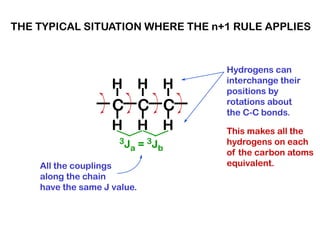
C
H
H
C
H
H
C
H
H
3Ja = 3Jb
Hydrogens can
interchange their
positions by
rotations about
the C-C bonds.
All the couplings
along the chain
have the same J value.
THE TYPICAL SITUATION WHERE THE n+1 RULE APPLIES
This makes all the
hydrogens on each
of the carbon atoms
equivalent.
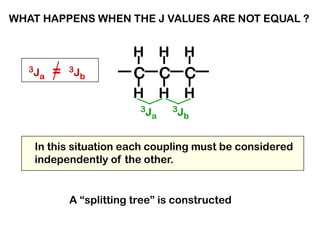
WHAT HAPPENS WHEN THE J VALUES ARE NOT EQUAL ?
C
H
H
C
H
H
C
H
H
3Ja
3Jb
3Ja = 3Jb
In this situation each coupling must be considered
independently of the other.
A “splitting tree” is constructed
C
H
H
C
H
H
C
H
H
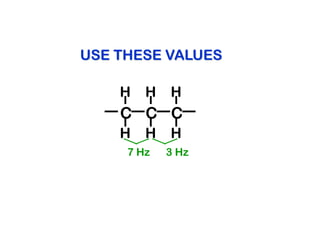
7 Hz 3 Hz
USE THESE VALUES
C
H
H
C
H
H
C
H
H
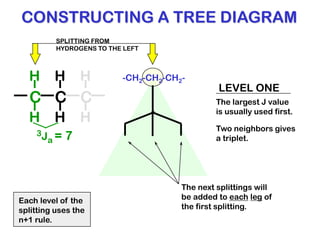
3Ja = 7
-CH2-CH2-CH2-
CONSTRUCTING A TREE DIAGRAM
The largest J value
is usually used first.
SPLITTING FROM
HYDROGENS TO THE LEFT
The next splittings will
be added to each leg of
the first splitting.
LEVEL ONE
Two neighbors gives
a triplet.
Each level of the
splitting uses the
n+1 rule.
C
H
H
C
H
H
C
H
H
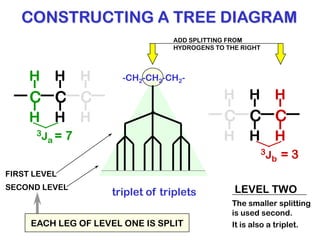
3Ja = 7
-CH2-CH2-CH2-
CONSTRUCTING A TREE DIAGRAM
C
H
H
C
H
H
C
H
H
3Jb = 3
triplet of triplets
ADD SPLITTING FROM
HYDROGENS TO THE RIGHT
The smaller splitting
is used second.
FIRST LEVEL
SECOND LEVEL LEVEL TWO
It is also a triplet.
EACH LEG OF LEVEL ONE IS SPLIT
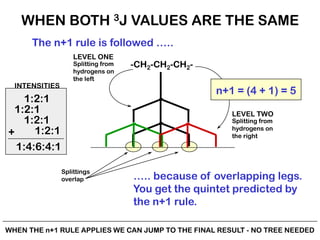
WHEN BOTH 3J VALUES ARE THE SAME
-CH2-CH2-CH2-
….. because of overlapping legs.
You get the quintet predicted by
the n+1 rule.
The n+1 rule is followed …..
n+1 = (4 + 1) = 5
Splitting from
hydrogens on
the left
Splitting from
hydrogens on
the right
Splittings
overlap
1:2:1
1:2:1
1:2:1
1:2:1
1:4:6:4:1
INTENSITIES
+
LEVEL ONE
LEVEL TWO
WHEN THE n+1 RULE APPLIES WE CAN JUMP TO THE FINAL RESULT - NO TREE NEEDED
2-PHENYLPROPANAL
A case where there are unequal J values.
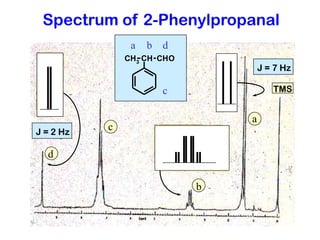
Spectrum of 2-Phenylpropanal
J = 2 Hz
J = 7 Hz
a
b
c
d
CH
CH3
CHO
a b d
c TMS
CH
CH3
CHO
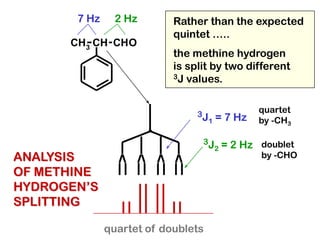
3J1 = 7 Hz
7 Hz 2 Hz
3J2 = 2 Hz
the methine hydrogen
is split by two different
3J values.
Rather than the expected
quintet …..
ANALYSIS
OF METHINE
HYDROGEN’S
SPLITTING
quartet
by -CH3
doublet
by -CHO
quartet of doublets
PURE ETHANOL
ETHANOL
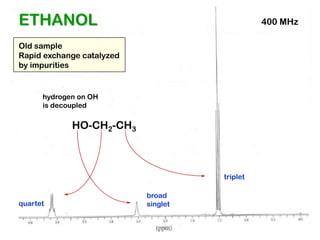
Old sample
Rapid exchange catalyzed
by impurities
quartet
triplet
broad
singlet
HO-CH2-CH3
hydrogen on OH
is decoupled
400 MHz
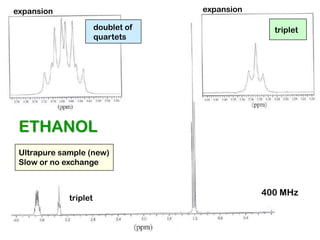
ETHANOL
Ultrapure sample (new)
Slow or no exchange
triplet
doublet of
quartets
triplet
400 MHz
expansion expansion
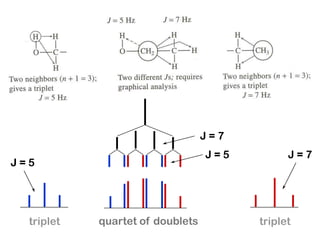
quartet of doublets
J = 7
J = 5
triplet triplet
J = 7
J = 5
VINYL ACETATE
ALKENE HYDROGENS
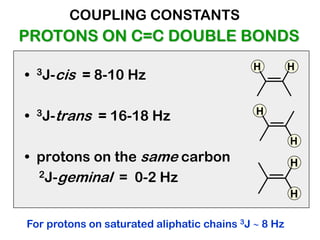
• 3J-cis = 8-10 Hz
• 3J-trans = 16-18 Hz
• protons on the same carbon
2J-geminal = 0-2 Hz
H
H
H
H
H
H
PROTONS ON C=C DOUBLE BONDS
COUPLING CONSTANTS
For protons on saturated aliphatic chains 3J ~ 8 Hz
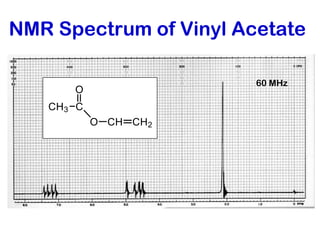
NMR Spectrum of Vinyl Acetate
CH3 C
O
O CH CH2
60 MHz
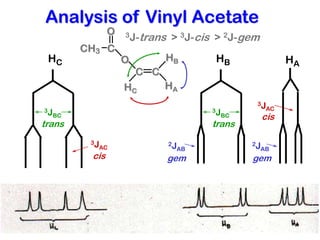
Analysis of Vinyl Acetate
HC HB HA
CH3 C
O
O
C
HC
C
HA
HB
3JBC
3JAC
3JAC
3JBC
2JAB
2JAB
trans trans
cis
cis
gem gem
3J-trans > 3J-cis > 2J-gem
2,4-DINITROANISOLE
BENZENE HYDROGENS
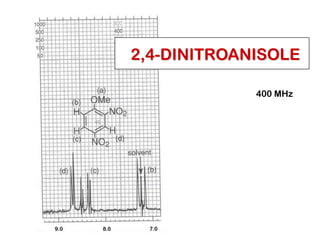
2,4-DINITROANISOLE
400 MHz
9.0 8.0 7.0
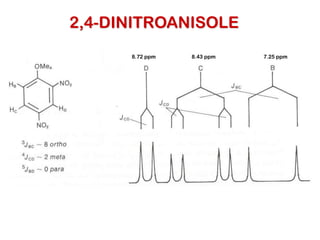
2,4-DINITROANISOLE
8.72 ppm 8.43 ppm 7.25 ppm
END

chapter-7.ppt unequal coupling tree diagram

  • 1.
    UNEQUAL COUPLING TREE DIAGRAMS SPLITTINGDIAGRAMS aka “TREE” DIAGRAMS
  • 2.
    WHERE DOES THEN+1 RULE WORK ? The n+1 rule works only for protons in aliphatic chains and rings, and then under special conditions. 1) All 3J values must be the same all along the chain. There are two requirements for the n+1 rule to work: 2) There must be free rotation or inversion (rings) to make all of the hydrogens on a single carbon be nearly equivalent.
  • 3.
    C H H C H H C H H 3Ja = 3Jb Hydrogenscan interchange their positions by rotations about the C-C bonds. All the couplings along the chain have the same J value. THE TYPICAL SITUATION WHERE THE n+1 RULE APPLIES This makes all the hydrogens on each of the carbon atoms equivalent.
  • 4.
    WHAT HAPPENS WHENTHE J VALUES ARE NOT EQUAL ? C H H C H H C H H 3Ja 3Jb 3Ja = 3Jb In this situation each coupling must be considered independently of the other. A “splitting tree” is constructed
  • 5.
    C H H C H H C H H 7 Hz 3Hz USE THESE VALUES
  • 6.
    C H H C H H C H H 3Ja = 7 -CH2-CH2-CH2- CONSTRUCTINGA TREE DIAGRAM The largest J value is usually used first. SPLITTING FROM HYDROGENS TO THE LEFT The next splittings will be added to each leg of the first splitting. LEVEL ONE Two neighbors gives a triplet. Each level of the splitting uses the n+1 rule.
  • 7.
    C H H C H H C H H 3Ja = 7 -CH2-CH2-CH2- CONSTRUCTINGA TREE DIAGRAM C H H C H H C H H 3Jb = 3 triplet of triplets ADD SPLITTING FROM HYDROGENS TO THE RIGHT The smaller splitting is used second. FIRST LEVEL SECOND LEVEL LEVEL TWO It is also a triplet. EACH LEG OF LEVEL ONE IS SPLIT
  • 8.
    WHEN BOTH 3JVALUES ARE THE SAME -CH2-CH2-CH2- ….. because of overlapping legs. You get the quintet predicted by the n+1 rule. The n+1 rule is followed ….. n+1 = (4 + 1) = 5 Splitting from hydrogens on the left Splitting from hydrogens on the right Splittings overlap 1:2:1 1:2:1 1:2:1 1:2:1 1:4:6:4:1 INTENSITIES + LEVEL ONE LEVEL TWO WHEN THE n+1 RULE APPLIES WE CAN JUMP TO THE FINAL RESULT - NO TREE NEEDED
  • 9.
    2-PHENYLPROPANAL A case wherethere are unequal J values.
  • 10.
    Spectrum of 2-Phenylpropanal J= 2 Hz J = 7 Hz a b c d CH CH3 CHO a b d c TMS
  • 11.
    CH CH3 CHO 3J1 = 7Hz 7 Hz 2 Hz 3J2 = 2 Hz the methine hydrogen is split by two different 3J values. Rather than the expected quintet ….. ANALYSIS OF METHINE HYDROGEN’S SPLITTING quartet by -CH3 doublet by -CHO quartet of doublets
  • 12.
  • 13.
    ETHANOL Old sample Rapid exchangecatalyzed by impurities quartet triplet broad singlet HO-CH2-CH3 hydrogen on OH is decoupled 400 MHz
  • 14.
    ETHANOL Ultrapure sample (new) Slowor no exchange triplet doublet of quartets triplet 400 MHz expansion expansion
  • 15.
    quartet of doublets J= 7 J = 5 triplet triplet J = 7 J = 5
  • 16.
  • 17.
    • 3J-cis =8-10 Hz • 3J-trans = 16-18 Hz • protons on the same carbon 2J-geminal = 0-2 Hz H H H H H H PROTONS ON C=C DOUBLE BONDS COUPLING CONSTANTS For protons on saturated aliphatic chains 3J ~ 8 Hz
  • 18.
    NMR Spectrum ofVinyl Acetate CH3 C O O CH CH2 60 MHz
  • 19.
    Analysis of VinylAcetate HC HB HA CH3 C O O C HC C HA HB 3JBC 3JAC 3JAC 3JBC 2JAB 2JAB trans trans cis cis gem gem 3J-trans > 3J-cis > 2J-gem
  • 20.
  • 21.
  • 22.
  • 23.