CLUSTERING
CHAPTER 7: MACHINE LEARNING – THEORY & PRACTICE
Introduction
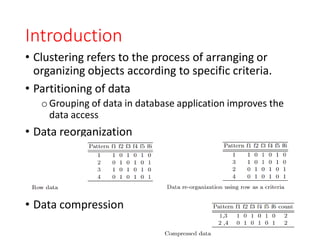
• Clustering refers to the process of arranging or
organizing objects according to specific criteria.
• Partitioning of data
oGrouping of data in database application improves the
data access
• Data reorganization
• Data compression
Introduction
• Summarization
oStatistical measures like mean, mode, and median
can provide summarized information.
• Matrix factorization
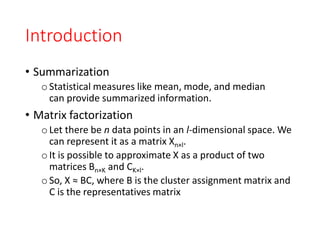
o Let there be n data points in an l-dimensional space. We
can represent it as a matrix Xn×l.
oIt is possible to approximate X as a product of two
matrices Bn×K and CK×l.
oSo, X ≈ BC, where B is the cluster assignment matrix and
C is the representatives matrix
Clustering process
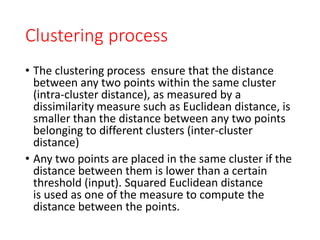
• The clustering process ensure that the distance
between any two points within the same cluster
(intra-cluster distance), as measured by a
dissimilarity measure such as Euclidean distance, is
smaller than the distance between any two points
belonging to different clusters (inter-cluster
distance)
• Any two points are placed in the same cluster if the
distance between them is lower than a certain
threshold (input). Squared Euclidean distance
is used as one of the measure to compute the
distance between the points.
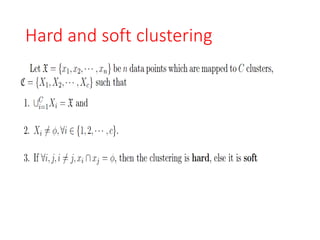
Hard and soft clustering
Data abstraction
• Clustering is a useful method for data abstraction, and
it can be applied to generate clusters of data points
that can be represented by their centroid or
medoid or leader or some other suitable entity.
• The centroid is computed as the sample mean of the
data points in a cluster.
• The medoid is the point that minimizes the sum of
distances to all other points in the cluster.
• Note: The centroid can shift dramatically based on the
position of the outlier, while the medoid remains stable
within the boundaries of the original cluster.
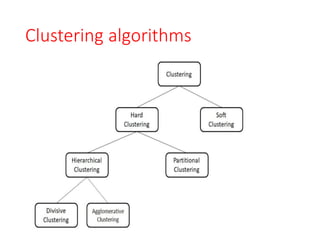
Clustering algorithms
Divisive clustering
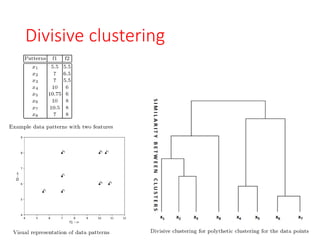
• Divisive algorithms are either polythetic where the
division is based on more than one feature or
monothetic when only one feature is considered at
a time.
• The polythetic scheme is based on finding all
possible 2-partitions of the data and choosing the
best among them. If there are n patterns, the
number
of distinct 2-partions is given by (2n −2)/2 = 2n−1 – 1.
Divisive clustering
• Among all possible 2-partitions, the partition with the
least sum of the sample variances of the two clusters is
chosen as the best.
• From the resulting partition, the cluster with the
maximum sample variance is selected and is split into
an optimal 2-partition.
• This process is repeated till we get singleton clusters.
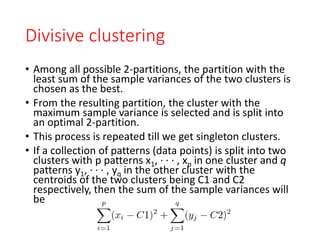
• If a collection of patterns (data points) is split into two
clusters with p patterns x1, · · · , xp in one cluster and q
patterns y1, · · · , yq in the other cluster with the
centroids of the two clusters being C1 and C2
respectively, then the sum of the sample variances will
be
Divisive clustering
Monothetic clustering
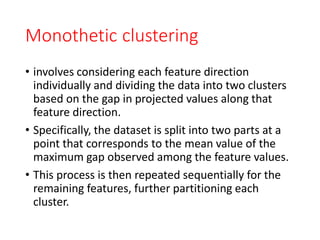
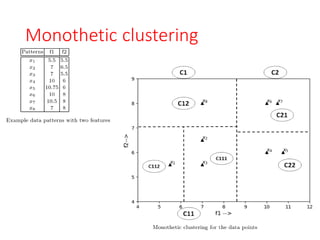
• involves considering each feature direction
individually and dividing the data into two clusters
based on the gap in projected values along that
feature direction.
• Specifically, the dataset is split into two parts at a
point that corresponds to the mean value of the
maximum gap observed among the feature values.
• This process is then repeated sequentially for the
remaining features, further partitioning each
cluster.
Monothetic clustering
Agglomerative clustering
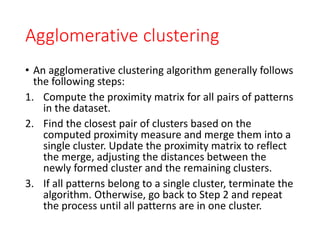
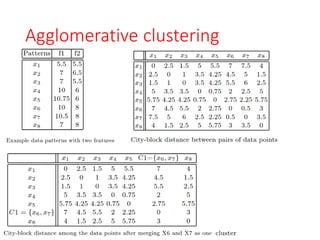
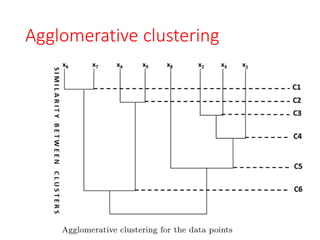
• An agglomerative clustering algorithm generally follows
the following steps:
1. Compute the proximity matrix for all pairs of patterns
in the dataset.
2. Find the closest pair of clusters based on the
computed proximity measure and merge them into a
single cluster. Update the proximity matrix to reflect
the merge, adjusting the distances between the
newly formed cluster and the remaining clusters.
3. If all patterns belong to a single cluster, terminate the
algorithm. Otherwise, go back to Step 2 and repeat
the process until all patterns are in one cluster.
Agglomerative clustering
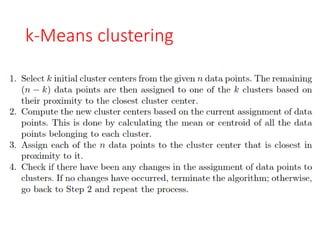
k-Means clustering
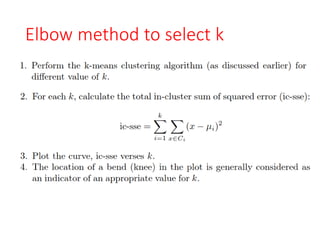
Elbow method to select k
k-Means++ clustering
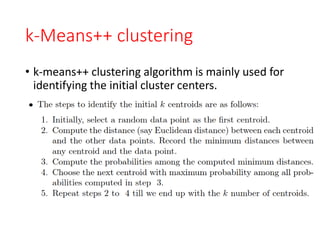
• k-means++ clustering algorithm is mainly used for
identifying the initial cluster centers.
Agglomerative clustering
Soft partitioning
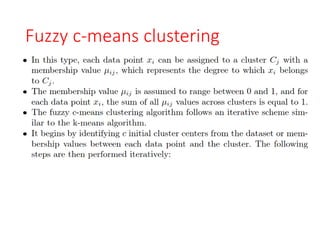
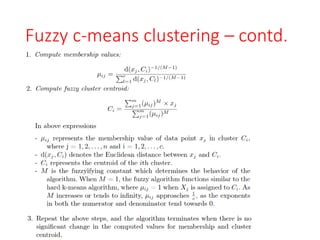
1. Fuzzy clustering: Each data point is assigned to
multiple clusters, typically more than one, based on a
membership value. The value is computed using the
data point and the corresponding cluster centroid.
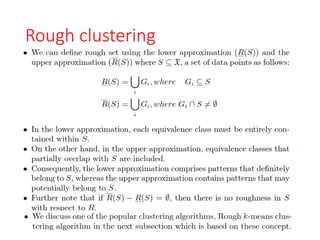
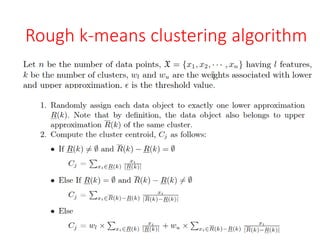
2. Rough clustering: Each cluster is assumed to have
both a non-overlapping part and an overlapping part.
Data points in the non-overlapping portion
exclusively belong to that cluster, while data points in
the overlapping part may belong to multiple clusters.
3. Neural network-based clustering: In this method,
varying weights associated with the data points are
used to obtain a soft partition.
Soft partitioning – Contd.
1. Simulated annealing: In this case, the current solution is
randomly updated, and the resulting solution is accepted
with a certain proba-bility. If the resulting solution is
better than the current solution, it is accepted; otherwise,
it is accepted with a probability ranging from 0 to 1.
2. Tabu search: Unlike simulated annealing, multiple
solutions are stored, and the current solution is perturbed
in various ways to determine the next configuration.
3. Evolutionary algorithms: This method maintains a
population of solutions. In addition to the fitness values
of individuals, a random search based on the interaction
among solutions with mutation is employed to generate
the next population.
Fuzzy c-means clustering
Fuzzy c-means clustering – contd.
Rough clustering
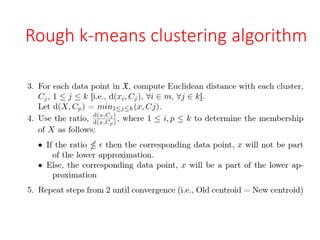
Rough k-means clustering algorithm
Clustering large datasets
• Issues:
• Number of dataset scans
• Incremental changes in dataset
• Solutions:
• Single dataset scan clustering algorithms
• Incremental clustering algorithms
• Abstraction based clustering
• Examples
• PC-Clustering algorithm
• Leader clustering algorithm
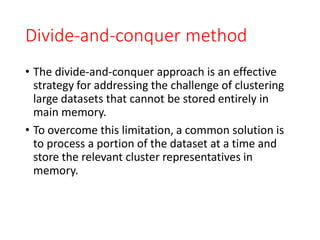
Divide-and-conquer method
• The divide-and-conquer approach is an effective
strategy for addressing the challenge of clustering
large datasets that cannot be stored entirely in
main memory.
• To overcome this limitation, a common solution is
to process a portion of the dataset at a time and
store the relevant cluster representatives in
memory.
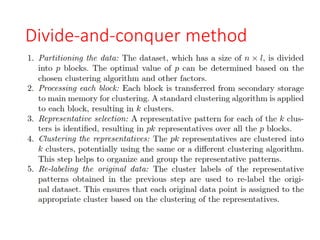
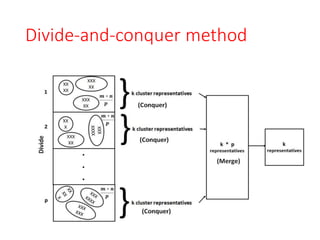
Divide-and-conquer method

Chapter7 clustering types concepts algorithms.pdf

  • 1.
    CLUSTERING CHAPTER 7: MACHINELEARNING – THEORY & PRACTICE
  • 2.
    Introduction • Clustering refersto the process of arranging or organizing objects according to specific criteria. • Partitioning of data oGrouping of data in database application improves the data access • Data reorganization • Data compression
  • 3.
    Introduction • Summarization oStatistical measureslike mean, mode, and median can provide summarized information. • Matrix factorization o Let there be n data points in an l-dimensional space. We can represent it as a matrix Xn×l. oIt is possible to approximate X as a product of two matrices Bn×K and CK×l. oSo, X ≈ BC, where B is the cluster assignment matrix and C is the representatives matrix
  • 4.
    Clustering process • Theclustering process ensure that the distance between any two points within the same cluster (intra-cluster distance), as measured by a dissimilarity measure such as Euclidean distance, is smaller than the distance between any two points belonging to different clusters (inter-cluster distance) • Any two points are placed in the same cluster if the distance between them is lower than a certain threshold (input). Squared Euclidean distance is used as one of the measure to compute the distance between the points.
  • 5.
    Hard and softclustering
  • 6.
    Data abstraction • Clusteringis a useful method for data abstraction, and it can be applied to generate clusters of data points that can be represented by their centroid or medoid or leader or some other suitable entity. • The centroid is computed as the sample mean of the data points in a cluster. • The medoid is the point that minimizes the sum of distances to all other points in the cluster. • Note: The centroid can shift dramatically based on the position of the outlier, while the medoid remains stable within the boundaries of the original cluster.
  • 7.
  • 8.
    Divisive clustering • Divisivealgorithms are either polythetic where the division is based on more than one feature or monothetic when only one feature is considered at a time. • The polythetic scheme is based on finding all possible 2-partitions of the data and choosing the best among them. If there are n patterns, the number of distinct 2-partions is given by (2n −2)/2 = 2n−1 – 1.
  • 9.
    Divisive clustering • Amongall possible 2-partitions, the partition with the least sum of the sample variances of the two clusters is chosen as the best. • From the resulting partition, the cluster with the maximum sample variance is selected and is split into an optimal 2-partition. • This process is repeated till we get singleton clusters. • If a collection of patterns (data points) is split into two clusters with p patterns x1, · · · , xp in one cluster and q patterns y1, · · · , yq in the other cluster with the centroids of the two clusters being C1 and C2 respectively, then the sum of the sample variances will be
  • 10.
  • 11.
    Monothetic clustering • involvesconsidering each feature direction individually and dividing the data into two clusters based on the gap in projected values along that feature direction. • Specifically, the dataset is split into two parts at a point that corresponds to the mean value of the maximum gap observed among the feature values. • This process is then repeated sequentially for the remaining features, further partitioning each cluster.
  • 12.
  • 13.
    Agglomerative clustering • Anagglomerative clustering algorithm generally follows the following steps: 1. Compute the proximity matrix for all pairs of patterns in the dataset. 2. Find the closest pair of clusters based on the computed proximity measure and merge them into a single cluster. Update the proximity matrix to reflect the merge, adjusting the distances between the newly formed cluster and the remaining clusters. 3. If all patterns belong to a single cluster, terminate the algorithm. Otherwise, go back to Step 2 and repeat the process until all patterns are in one cluster.
  • 14.
  • 15.
  • 16.
  • 17.
    k-Means++ clustering • k-means++clustering algorithm is mainly used for identifying the initial cluster centers.
  • 18.
  • 19.
    Soft partitioning 1. Fuzzyclustering: Each data point is assigned to multiple clusters, typically more than one, based on a membership value. The value is computed using the data point and the corresponding cluster centroid. 2. Rough clustering: Each cluster is assumed to have both a non-overlapping part and an overlapping part. Data points in the non-overlapping portion exclusively belong to that cluster, while data points in the overlapping part may belong to multiple clusters. 3. Neural network-based clustering: In this method, varying weights associated with the data points are used to obtain a soft partition.
  • 20.
    Soft partitioning –Contd. 1. Simulated annealing: In this case, the current solution is randomly updated, and the resulting solution is accepted with a certain proba-bility. If the resulting solution is better than the current solution, it is accepted; otherwise, it is accepted with a probability ranging from 0 to 1. 2. Tabu search: Unlike simulated annealing, multiple solutions are stored, and the current solution is perturbed in various ways to determine the next configuration. 3. Evolutionary algorithms: This method maintains a population of solutions. In addition to the fitness values of individuals, a random search based on the interaction among solutions with mutation is employed to generate the next population.
  • 21.
  • 22.
  • 23.
  • 24.
  • 25.
  • 26.
    Clustering large datasets •Issues: • Number of dataset scans • Incremental changes in dataset • Solutions: • Single dataset scan clustering algorithms • Incremental clustering algorithms • Abstraction based clustering • Examples • PC-Clustering algorithm • Leader clustering algorithm
  • 27.
    Divide-and-conquer method • Thedivide-and-conquer approach is an effective strategy for addressing the challenge of clustering large datasets that cannot be stored entirely in main memory. • To overcome this limitation, a common solution is to process a portion of the dataset at a time and store the relevant cluster representatives in memory.
  • 28.
  • 29.