Professional Learning at Bourchier St: 18/10/2010
Persuasive writing in some resources may be referred to as Expositions.

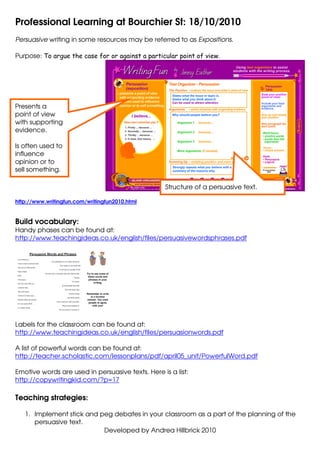
Purpose: To argue the case for or against a particular point of view.


Presents a
point of view
with supporting
evidence.

Is often used to
influence
opinion or to
sell something.

                                                   Structure of a persuasive text.

http://www.writingfun.com/writingfun2010.html


Build vocabulary:
Handy phases can be found at:
http://www.teachingideas.co.uk/english/files/persuasivewordsphrases.pdf


Labels for the classroom can be found at:
http://www.teachingideas.co.uk/english/files/persuasionwords.pdf

A list of powerful words can be found at:
http://teacher.scholastic.com/lessonplans/pdf/april05_unit/PowerfulWord.pdf

Emotive words are used in persuasive texts. Here is a list:
http://copywritingkid.com/?p=17

Teaching strategies:

   1. Implement stick and peg debates in your classroom as a part of the planning of the
      persuasive text.
                           Developed by Andrea Hillbrick 2010
-     The students have three icy pole sticks. The students have the opportunity to
                 express three arguments to support their point of view. When there are no
                 sticks left the debate/discussion stops.
           -     For younger students provide clothes pegs that they can attach to their
                 clothing. This works the same as the sticks.
           -     You can determine the number of sticks/pegs.
           -     Provide a different colour stick or peg so the students can ask questions.

   2. Implement a four corners debate as part of the planning of a persuasive text.
        -    The students engage in an exchange of ideas in response to a text read,
             elaborating and justifying their responses to the text.
        -    The students elect the stance of strongly disagree, disagree, agree, strongly
             disagree
        -    The students then write a reaction to the position they selected.

                          What would be an issue that your students could debate?

    If you are unsure of debate topics check out the list at:
http://www.idebate.org/debatabase/search.php?junior=yes

   3. Evaluate current persuasive texts to build the students understandings of the text type.
      Leaflet Evaluations - Children read a 'flyer' from a place of interest and evaluate it to see if it
      helps attract visitors, before possibly designing their own.

                             Is there a venue that the students would relate to?

   4. With older students implement a Persuasive writing web quest.
      Webquest - Fuse

   5. Analyse advertisements to encourage students to look closely at things they see every day.
        The following site is an excellent resource for teachers to visit to access suitable
        advertisements for analysis. http://www.visit4info.com/

   6. Have a hot seat in your classroom. The students are given 30-60 seconds to promote
      a product, location, movie, song, website, toy, food, venue, sport…..An inflatable
      chair is awesome for this task as it is fun and when deflated easy to store.

                       What do you think your students could promote in the hot seat?


    7. Use this online tool that provides the framework to develop a persuasive text. The
       online tool could be used for the whole class focus or during independent writing.
        http://www.readwritethink.org/files/resources/interactives/persuasion_map/

   8. With students in Year 3 and beyond you may wish to share this PowerPoint which outlines the
      features of persuasive text.
      http://www.readwritethink.org/files/resources/lesson_images/lesson56/persuasive_strategies.p
      ps# 263,8,Research

   9. If you are highly selective about the footage to show your students, snippets of ABC:
     ‘The Gruen Transfer’ can be very valuable.
(Some material on this site may contain coarse language and is recommended for mature audiences.)

                                Developed by Andrea Hillbrick 2010
- The home page for the show is:
      http://www.abc.net.au/tv/gruentransfer/default.htm

      - Study guides for the shows can be found at:
      http://www.metromagazine.com.au/studyguides/study.asp

      - ‘The Pitch’ is a great opportunity to develop persuasive writing skills in your
      classroom. Students select an everyday item to write a ‘pitch’ for their peers.

10. Make a Little Book with your students and provide time for the students to research
    their issue/topic. In the Little Book the students record facts, data and quotes to use
    in their persuasive writing.

11. Read picture story books and ask the students to adopt a character. The students
    act, draw, write about the storyline from their character’s point of view.

12. Thinker’s Key: The Brick Wall Key
    Make a statement which could not generally be questioned or disputed, and then
    try to break down the wall by outlining other ways of dealing with the situation.
    Eg. Governments need to collect taxes in order to provide necessary services.
    (Reference: Tony Ryan)

13. Thinker’s Key: The Ridiculous Key
   Make a ridiculous statement that would be virtually impossible to implement, and
   then attempt to substantiate it.
   Eg. The Government should buy a brand new car for every taxpayer. (Reference:
   Tony Ryan)

14. Write, perform and film an advertisement to share with another class or families.

15. For Early Years students - Design a page for a holiday brochure to attract people
     to the seaside. There is a wide selection of seaside photographs to embed and
     some seaside themed clipart too. http://www.purplemash.com/brochure/

 16. For Early Years students - The estate agents need you to help them write an
     advert for property they are putting on the market.
     http://www.purplemash.com/forsale/

17.     Students can develop character cards at
       http://www.readwritethink.org/files/resources/interactives/trading_cards/. The
       students can then write a persuasive text such as a poster to promote the
       character.

18.     Jigsaw/expert groups are a great way to explore a topic or issue before writing.

19. If you have tried all the ideas above and you still want more check out this
    website!
       http://www.primaryresources.co.uk/english/englishD10.htm

20. My added extra – awards, advertisements, bill boards, blog, debates, emails,
    flyers, headlines, jingles, job applications, letters, memos, newspapers, opinions,
    quotes, raps, reports, slogans, travel guide, t-shirts,
                          Developed by Andrea Hillbrick 2010

Professional learning persuasive writing

  • 1.
    Professional Learning atBourchier St: 18/10/2010 Persuasive writing in some resources may be referred to as Expositions. Purpose: To argue the case for or against a particular point of view. Presents a point of view with supporting evidence. Is often used to influence opinion or to sell something. Structure of a persuasive text. http://www.writingfun.com/writingfun2010.html Build vocabulary: Handy phases can be found at: http://www.teachingideas.co.uk/english/files/persuasivewordsphrases.pdf Labels for the classroom can be found at: http://www.teachingideas.co.uk/english/files/persuasionwords.pdf A list of powerful words can be found at: http://teacher.scholastic.com/lessonplans/pdf/april05_unit/PowerfulWord.pdf Emotive words are used in persuasive texts. Here is a list: http://copywritingkid.com/?p=17 Teaching strategies: 1. Implement stick and peg debates in your classroom as a part of the planning of the persuasive text. Developed by Andrea Hillbrick 2010
  • 2.
    - The students have three icy pole sticks. The students have the opportunity to express three arguments to support their point of view. When there are no sticks left the debate/discussion stops. - For younger students provide clothes pegs that they can attach to their clothing. This works the same as the sticks. - You can determine the number of sticks/pegs. - Provide a different colour stick or peg so the students can ask questions. 2. Implement a four corners debate as part of the planning of a persuasive text. - The students engage in an exchange of ideas in response to a text read, elaborating and justifying their responses to the text. - The students elect the stance of strongly disagree, disagree, agree, strongly disagree - The students then write a reaction to the position they selected. What would be an issue that your students could debate? If you are unsure of debate topics check out the list at: http://www.idebate.org/debatabase/search.php?junior=yes 3. Evaluate current persuasive texts to build the students understandings of the text type. Leaflet Evaluations - Children read a 'flyer' from a place of interest and evaluate it to see if it helps attract visitors, before possibly designing their own. Is there a venue that the students would relate to? 4. With older students implement a Persuasive writing web quest. Webquest - Fuse 5. Analyse advertisements to encourage students to look closely at things they see every day. The following site is an excellent resource for teachers to visit to access suitable advertisements for analysis. http://www.visit4info.com/ 6. Have a hot seat in your classroom. The students are given 30-60 seconds to promote a product, location, movie, song, website, toy, food, venue, sport…..An inflatable chair is awesome for this task as it is fun and when deflated easy to store. What do you think your students could promote in the hot seat? 7. Use this online tool that provides the framework to develop a persuasive text. The online tool could be used for the whole class focus or during independent writing. http://www.readwritethink.org/files/resources/interactives/persuasion_map/ 8. With students in Year 3 and beyond you may wish to share this PowerPoint which outlines the features of persuasive text. http://www.readwritethink.org/files/resources/lesson_images/lesson56/persuasive_strategies.p ps# 263,8,Research 9. If you are highly selective about the footage to show your students, snippets of ABC: ‘The Gruen Transfer’ can be very valuable. (Some material on this site may contain coarse language and is recommended for mature audiences.) Developed by Andrea Hillbrick 2010
  • 3.
    - The homepage for the show is: http://www.abc.net.au/tv/gruentransfer/default.htm - Study guides for the shows can be found at: http://www.metromagazine.com.au/studyguides/study.asp - ‘The Pitch’ is a great opportunity to develop persuasive writing skills in your classroom. Students select an everyday item to write a ‘pitch’ for their peers. 10. Make a Little Book with your students and provide time for the students to research their issue/topic. In the Little Book the students record facts, data and quotes to use in their persuasive writing. 11. Read picture story books and ask the students to adopt a character. The students act, draw, write about the storyline from their character’s point of view. 12. Thinker’s Key: The Brick Wall Key Make a statement which could not generally be questioned or disputed, and then try to break down the wall by outlining other ways of dealing with the situation. Eg. Governments need to collect taxes in order to provide necessary services. (Reference: Tony Ryan) 13. Thinker’s Key: The Ridiculous Key Make a ridiculous statement that would be virtually impossible to implement, and then attempt to substantiate it. Eg. The Government should buy a brand new car for every taxpayer. (Reference: Tony Ryan) 14. Write, perform and film an advertisement to share with another class or families. 15. For Early Years students - Design a page for a holiday brochure to attract people to the seaside. There is a wide selection of seaside photographs to embed and some seaside themed clipart too. http://www.purplemash.com/brochure/ 16. For Early Years students - The estate agents need you to help them write an advert for property they are putting on the market. http://www.purplemash.com/forsale/ 17. Students can develop character cards at http://www.readwritethink.org/files/resources/interactives/trading_cards/. The students can then write a persuasive text such as a poster to promote the character. 18. Jigsaw/expert groups are a great way to explore a topic or issue before writing. 19. If you have tried all the ideas above and you still want more check out this website! http://www.primaryresources.co.uk/english/englishD10.htm 20. My added extra – awards, advertisements, bill boards, blog, debates, emails, flyers, headlines, jingles, job applications, letters, memos, newspapers, opinions, quotes, raps, reports, slogans, travel guide, t-shirts, Developed by Andrea Hillbrick 2010