EXERCISE!
Form groups anddraw up the following number
patterns:
1. A basic, easy to spot pattern (give 3 terms only)
2. A more complicated number pattern
using &
3.Any unusual number pattern
4. A diagrammatic pattern
Now, swap questions and describe & extend the
number patterns of the other groups.
9.
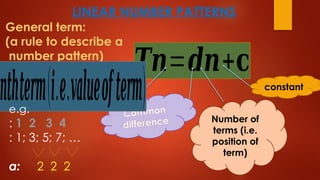
LINEAR NUMBER PATTERNS
Generalterm:
(a rule to describe a
number pattern)
𝑻𝒏=𝒅𝒏+𝐜
constant
Number of
terms (i.e.
position of
term)
Common
difference
𝒏𝒕𝒉𝒕𝒆𝒓𝒎(𝒊.𝒆.𝒗𝒂𝒍𝒖𝒆𝒐𝒇𝒕𝒆𝒓𝒎)
e.g.
: 1 2 3 4
: 1; 3; 5; 7; …
a: 2 2 2
10.
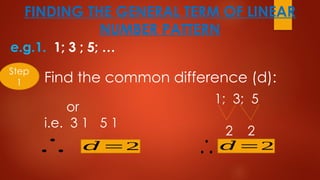
FINDING THE GENERALTERM OF LINEAR
NUMBER PATTERN
Find the common difference (d):
or
i.e. 3 1 5 1
e.g.1. 1; 3 ; 5; …
Step
1
𝑑=2
∴
1; 3; 5
2 2
𝑑=2
∴
11.
Step
2 Substitute intothe general term:
𝑑=2
Therefore the general term of 1; 3 ; 5 … is
𝑇 𝑛=2𝑛−1
1
𝒐𝑟𝑇2=3𝒐𝒓 𝑇3=5
Find the constant (c) by substituting a number:
Step
3
e.g.
∴
∴
Find the general term of the matchstick sequence
12.
Example .2. ;; ; …
Step
1
𝑭𝒊𝒏𝒅 𝒅
Therefore, the general
term of is
Step
2
Step
3
𝑭𝒊𝒏𝒅 𝒄
𝒅=−𝟑
∴ 𝒅=−𝟑
∴
𝑇𝑛=𝒅𝒏+𝑪
𝑇𝑛=−𝟑𝒏+𝑪
∴
Substitute
0
𝑪
∴
Finding general terms in the stars!
Summary & examples of linear number patterns
13.
1.Find terms ofthe following
•
•
•
•
2. Find the 23rd
term given:
3. Which term has a value of -48, given
EXERCISE!
14.
Geometric number patterns
Geometricnumber patterns have a
constant ratio
i.e we multiply , by a number to get or
=
e.g. 7 ; 28 ; 112 ; … or = = 4
15.
Worked Examples
1. Findthe constant ratio of:
or
2. Complete the table:
1 2 3 4
+1 3 9 19 579
= 33
+1
+1
=+1
579 = 2+1
578 = 2
=
=
=
Geometric number patterns in matchsticks
16.
EXERCISE!
1.Complete the followinggeometric number pattern
to 7 terms:
2.What is the constant ratio, given:
3.Complete the following table:
1 2 3 4 17
- -5 -8 -13 -85 -404
INPUT OUTPUT VALUES
Whenwe take a number (called the input)
and perform a mathematical operation on
it (i.e. we get a resulting number (called the output)
Input & output numbers can be
represented in flow diagrams, tables &
equations
19.
1. FLOW DIAGRAMS
Flowdiagrams are graphical
representations of taking an input value,
applying a mathematical operation or
rule; and getting an output value
=> aka “number machines”
20.
EXAMPLE .1.
Multiply by5 and
subtract 9
-2
0
2
INPUT
MATHEMATICAL
OPERATION
OUTPUT
-19
1
-9
Number machines
21.
EXAMPLE .2.
-23
9
19
𝒚 =𝟐𝒙+𝟏
12
4
9
INPUT
MATHEMATICAL RULE
IE. FORMULA OUTPUT
𝑦
𝑥
EXERCISE! CREATE YOUR OWN FLOW DIAGRAM & ASK
YOUR FRIEND TO FIND THE OUTPUTS.
22.
TABLES
The top rowindicates the input values
( while the bottom row indicates the
output values (); based on the
mathematical rule
e.g.1 5 1
0 4 11
23 11 8 4 -52
-60
23.
e.g. 2
10
10 =
12=
48 =
EXERCISE!
Create your own table and ask
your friend to find the
missing
24.
EQUATIONS
An equation isa general rule, which
describes what you must do to your
input, value in order to get anvalue
e.g. 1. Find the value of (if
(8)+6
Substitute
8
25.
e.g. 2. Findthe value of if
given:
Substitute
EXERCISE! find given4
f = 9,given:
Substituting into more complex equations
26.
EQUIVALENT FORMS
As wehave seen, input and output values
can be represented in different ways
i.e. flow diagrams; tables & equations.
All the different ways are called equivalent
forms; as they all represent the same input
and output values.
Example.1. Represent the following scenario in
a flow diagram, table and formula: multiply a
number by three and add six.
27.
MULTIPLY A NUMBERBY THREE AND ADD SIX
FLOW DIAGRAM:
TABLE:
EQUATION:
3 AND 6
-10
0
8
𝒙 𝒚
-10 0 8
-24 6 30
Choose your
own input
values!
-24
6
30
28.
EXAMPLE .2.
Represent theequation, , graphically, by first
constructing a table and then plotting the
co-ordinates on the Cartesian plane.
-2 -1 0 1 2
-8 -6 -4 -2 0
29.
EXERCISE!
1. Complete andrepresent the following flow
diagram in a table and an the Cartesian plane:
2. Represent the following scenario in a flow diagram
and determine the corresponding formula:
“Take a number multiplied by four and
subtract one”
𝒚 =
𝟏
𝟐
𝒙 + 𝟑
-4
1
7
ALGEBRAIC LANGUAGE :RECAP!
Exponent
• A term:
Base
(variable)
Coefficient
(number in front of variable)
• Terms are separated by and signs: and
classified based on the number of terms e.g.
1.
32.
ADDING AND SUBTRACTINGLIKE TERMS
• Like terms have the same base and same exponents
• We can only add or subtract like terms e.g.
2.
=
and )
←𝑔𝑟𝑜𝑢𝑝𝑙𝑖𝑘𝑒𝑡𝑒𝑟𝑚𝑠𝑎𝑛𝑑 𝒂𝒅𝒅
Like terms song
MULTIPLYING TERMS(PRODUCTS/BRACKETS)
• Notation:
=
•Multiply the term outside the brackets by each
term inside the bracket
e.g.
.
-) Remember to
add exponents
when multiplying
the same bases
together!
Multiply by
35.
Only multiply theterm next to the bracket by the
terms inside the brackets
𝟔𝒙𝒊𝒔𝒂𝒔𝒆𝒑𝒂𝒓𝒂𝒕𝒆𝒕𝒆𝒓𝒎𝒐𝒏𝒍𝒚−𝟓𝒙𝒊𝒔𝒎𝒖𝒍𝒕𝒊𝒑𝒍𝒊𝒆𝒅𝒊𝒏𝒕𝒐𝒕𝒉𝒆𝒃𝒓𝒂𝒄𝒌𝒆𝒕
e.g.
Work inside-out if there are multiple brackets in the sum:
e.g. {
{
{
Multiply out inside
brackets
Simplify like terms
inside brackets
Multiply out brackets
by -1
Simplify like terms
36.
Distribute Law -examples
Working inside-out for multiple brackets
Expanding brackets
37.
Only multiplying twobinomials together, we use FOIL:
e.g. (
Remember to
Simplify like terms
End up with a trinomial!
DIVIDING TERMS
• Useyour knowledge of exponents to determine : “where there more
and by how much?” when dividing the same bases
e.g. 1.
2.
𝑙𝑖𝑘𝑒𝑡𝑒𝑟𝑚𝑠−𝒔𝒐𝒔𝒊𝒎𝒑𝒍𝒊𝒇𝒚!
41.
• When youhave
i.e. each of the numerator divided by the denominator
e.g. 1
Simplify by
cancelling
Unlike terms so can’t
simplify
SQUARES & CUBES
Useyour knowledge of exponents to raise each factor in the
brackets to a power of 2 (squaring) or 3 (cubing)
e.g. . Remember to multiply
exponents when raising to a
power
(−𝟑)𝟑
=−𝟑×−𝟑×−𝟑=−𝟐𝟕
(𝟐)𝟑
=𝟖≠𝟔.(𝒊𝒆𝟐×𝟐×𝟐)
(−𝟑)𝟐
=−𝟑×−𝟑=+𝟗
45.
SQUARE-ROOTING &CUBE-ROOTING
• Eachfactor needs to be square-rooted or cube- rooted
e.g. 1.
First simplify before taking the
𝟑
√−𝒏𝒐𝒆.𝒈.−𝟒×𝟒×−𝟒=−𝟔𝟒
Divide exponents by 2 when
100 and
100!
Factorization
• Factorization isthe method used to make many (unlike)
terms into 1 term, by means of introducing brackets
• There are 3 types of factorization:
i) Common factor (CF)
- Take out the factor (number and/or variables to the
lowest power) and put it in front of the bracket
- Now divide each term by the CF and place inside the brackets
- e.g. 1.
Always start by
looking for a
common factor!
48.
e.g. 2.
Note! Whenyou take a neg. sign out as
a CF, the sign of the terms need to
change
Take out lowest
power of each
term!
e.g.
We have CF in terms
of: numbers, variables
and brackets!
Remember to simplify
fully inside the brackets
Common factor
& grouping
ii) Different squares(DOS)
- Check that there is a difference (minus sign) between two
terms, which are perfect squares
- Open 2 brackets: one + and another - i.e.(…+…)(…...)
- Take the and
i.e.
e.g.
=
iii) Trinomials Trinomialsmean
3 terms
- Have the general form:
- Take out a CF first (if applicable!)
- Open two brackets and look at 2nd
sign to
determine the signs of the brackets
54.
iii) Trinomials continued…
−𝑠𝑖𝑔𝑛:(𝑥+…)(𝑥+…)
Factors of 6 to get
- e.g.
- e.g.
− 𝑠𝑖𝑔𝑛:(𝑥+…)(𝑥− …)
Factors of 6 to get
55.
Factors of 6to get
e.g.
e.g.
+𝑠𝑖𝑔𝑛:→−𝑠𝑖𝑔𝑛:(𝑥−…)(𝑥 −…)
− 𝑠𝑖𝑔𝑛:(𝑥+…)(𝑥− …)
Factors of 6 to get
Don’t forget! Always
check for a CF first!
Factorizing trinomials
GRADE 8 RECAP!EXAMPLES:
Solve for
OPERATIONS
i.e.
• First multiply brackets
• Then
OPERATIONS
Solving basic equations
64.
3.
0
48
• to getrid of
• Solve for
+
• Find LCD
• Multiply out brackets
Solving fractional equations
65.
=
• For experientialequations,
make the bases the same,
using prime factorisation
• Once the bases are the
same, equate the
exponents & solve for
6. • Notice how the LHS will
always be pos and RHS
always neg
• LHS RHS no solution.
Solving exponential equations
66.
7. • Noticehow LHS is the
same as RHS
• LHS RHS for any real
values of
8. Determine the co-ordinates of
• Substitute the
co-ordinates into the
equation of the
straight line & solve.
67.
9. The sumof three
consecutive numbers is 48.
find the numbers
Let the first number =
• Let the smallest
value
• Use key words to set
up the equation e.g.
“sum” means +
• Solve for
• Remember to
answer the
question!
Word problem steps and examples
68.
10. Sally’s motheris 50
years of age, how old is
Sally if her mother is 14
years older than twice
Sally's age?
Let Sally’s age =
.
• Let the unknown
• Set up the equation
& solve
• Answer the question
69.
Quadratic Equations
Have thegeneral form: +
Factorize quadratic equations:
Since the product of 2 factors equals 0; then
either the 1st
factor or the 2nd
factor must = 0.
i.e AB
B =
Likewise…
Quadratic equations always result in 2
answers.
70.
Examples solve for
•Either the first or
second factor
(bracket) = 0
• Notice the 2 answers
2.
(
• The constant 4
doesn’t effect
the answers of
check by
71.
• Factorize…CF
• Puteach factor = 0 & solve
• Notice the 2 answers
4. 18
9
• Factorize… CF
• Factorize… Dos
• Remember the constant
“2” doesn’t effect the
answers
72.
=
• Factorize…trinomial
6. 6
6
•Quadratic equation all terms
∴
on LHS & factorize
• NB! You cant divide by otherw
you will lose
1 answer
Quadratic equations
LINEAR GRAPHS CANBE CLASSIFIED BY THEIR GENERAL SHAPE
1. Increasing linear
• ,
so
•
2. Decreasing linear
•
•
Investigating the ef
fects of
m in a Straight Line
SPECIAL FEATURES OFSTRAIGHT LINE GRAPHS
∗Parallel lines have the same gradients: 𝒎𝟏=𝒎𝟐
For perpendicular lines :
( )
⏊
79.
FINDING THE EQUATIONOF A STRAIGHT LINE
Std.Form:
Step 1:Determine then co-ordinates
Of 2 points that lie on the graph
e.g.
Step 2: Use the co-ordinates of the
2 points to determine the gradient
e.g.
Step 3 : Determine the
Step 4 : Write equation in standard form:
e.g. Read “C” off
graph
80.
FIND THE EQUATIONOF THE FOLLOWING GRAPH:
• Step 1: Co – ordinates that lie on the graph
• Step 2: Find m
2
• Step 3: Find
Substitute
• Step 4: Write in standard form
Can’t read c off the
graph! substitute a
point that lies on graph
to find c
81.
Calculating the gradientof a straight line
Finding the equation of a straight line
Finding the equation of parallel lines
Finding the equation of a perpendicular line
DRAWING STRAIGHT LINEGRAPHS
We can always draw any graph by means of point-by-point
plotting, given the equation e.g.
• Step 1:Draw up a table within a range of values(ie.neg;0;pos)
e.g.
-2 1 0 1 2
• Step 2: Substitute the into the given equation, to find
corresponding
e.g.
2 1 0 1 2
14 9 4 1 6
84.
• Step 3:Plot the co-ordinates on the
Cartesian plane using the table
e.g.
2 1 0 1 2
14 9 4 1 6
;
Drawing straight line graphs using point-by-point plotting
85.
We can drawstraight line graphs, using the
dual – intercept method, given the equation
e.g.
• Step 1: Make ( to find the intercept)
e.g. Can’t you also just
read off “C”
From the standard
form of the graph?!
• Step 2:Make( to find the intercept)
e.g.
• Step 3: Plot both (dual) intercepts and
draw a straight line!
86.
Draw the straightline graph, given
• Step 1: make
e.g. Note! This graph
is not standard
form, so you cant
read off “c”
• Step 2: make
e.g. (0)
10
• Step 3: Plot the graph
Summary: Straig
ht line graphs
87.
EXERCISE
1. Draw thefollowing graphs, use point by point plotting:
1.1
1.2
1.3
1.4
1.5
Hint! This is not a
straight line graph! It
is a quadratic () and
doesn’t have the form
88.
EXERCISE
2. Draw thegraphs, using the dual –intercept method:
2.1
2.2
2.3
2.4
2.5








![ict_presentation_final_final_final[1].pptx](https://cdn.slidesharecdn.com/ss_thumbnails/ictpresentationfinalfinalfinal1-251230145259-2b4839bd-thumbnail.jpg?width=640&height=640&fit=bounds)


