The eDREAM project is co-founded by the EU’s Horizon 2020 innovation programme
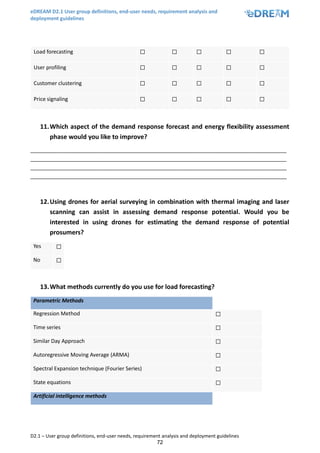
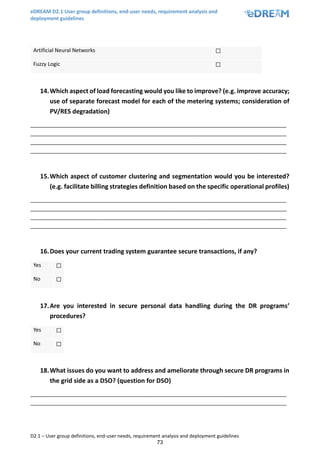
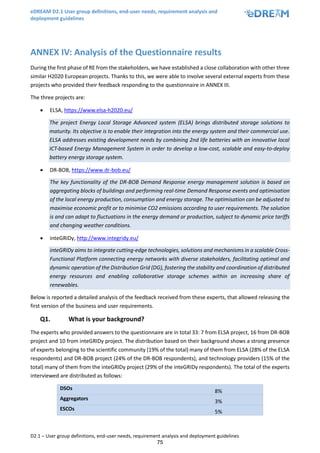
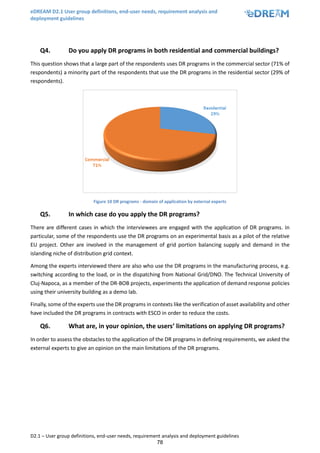
under grant agreement No 774478
DELIVERABLE: D2.1 User group definitions, end-user needs, requirement
analysis and deployment guidelines V1
Author: Giuseppe Mastandrea (E@W)
Ref. Ares(2018)4484503 - 31/08/2018
eDREAM D2.1 User group definitions, end-user needs, requirement analysis and
deployment guidelines
D2.1 – User group definitions, end-user needs, requirement analysis and deployment guidelines
2
Imprint
User group definitions, end-user needs, requirement analysis and deployment guidelines V1, August 2018
Contractual Date of Delivery to the EC: 31.08.2018
Actual Date of Delivery to the EC: 31.08.2018
Author(s): Giuseppe Mastandrea (E@W)
Participant(s): Luigi D’Oriano (E@W), Giuseppe Rana (E@W), Giuseppe Raveduto
(ENG), Vincenzo Croce (ENG), Mircea Bukur (KIWI), Ugo Stecchi
(ATOS), Francesca Santori (ASM), Tudor Cioara (TUC), Claudia Pop
(TUC), Francesco Bellesini (EMOT), Andrei Ceclan (SVT), Radu
Moldovan (SVT), Benjamin Hunter (TU), Antigoni Noula (CERTH),
Dimosthenis Ioannidis (CERTH)
Project: enabling new Demand Response Advanced,
Market oriented and secure technologies,
solutions and business models (eDREAM)
http://edream-h2020.eu/
Work package: Wp2 – User requirements, use cases and system specification
Task: 2.1 – User and Business Requirements Definition
Confidentiality: public
Version: 1.0
Legal Disclaimer
The project enabling new Demand Response Advanced, Market oriented and secure technologies, solutions and
business models (eDREAM) has received funding from the European Union’s Horizon 2020 research and innovation
programme under grant agreement No. 774478. The sole responsibility for the content of this publication lies with the
authors. It does not necessarily reflect the opinion of the Innovation and Networks Executive Agency (INEA) or the
European Commission (EC). INEA or the EC are not responsible for any use that may be made of the information
contained therein.
Copyright
© Energy@Work Società Cooperativa a R.L.. Copies of this publication – also of extracts thereof – may only be made
with reference to the publisher.
eDREAM D2.1 User group definitions, end-user needs, requirement analysis and
deployment guidelines
D2.1 – User group definitions, end-user needs, requirement analysis and deployment guidelines
3
Executive Summary
The deliverable D2.1 related to the Task 2.1 and entitled "User group definitions, end-user needs,
requirements analysis and deployment guidelines" is the first WP2 report, describing the first set of
stakeholders’ requirements.
The aim of this deliverable, that relies on the definition of the Business and User Requirements, is one of
the crucial steps for the effective project design that is the main objective of the WP2 "User requirements,
use cases and system specification".
Indeed, it is important not to overlook during the project the appropriate understanding of the needs and
expectation of the main stakeholders (internal and external to the project) as it can offer a reliable perspective
on how to address and review the project objectives.
To this end, starting from the aim of the eDREAM project to develop new solutions for DSOs, as well as
improving decision making of aggregators and energy retailers, a detailed stakeholders elicitation plan has
been defined in order to especially consider their needs from the very beginning of the project up to the
release of the first consolidated prototype.
In the Stakeholders elicitation plan, the necessity to start from the results of the internal elicitation phase has
been considered, which allowed to make possible the definition of the first set of requirements as a basis for
activating the processes of external stakeholders’ involvement through Focus Group, Interviews,
Requirements workshops and Survey/Questionnaire.
In this first version of the deliverable, the overall approach and methodology for requirement elicitation has
been defined, while the internal elicitation process will be described in detail as the preparation of the
external elicitation process focusing on the first feedback from other H2020 projects consortia.
Thanks to this Participatory Design (PD), a first systematic formalization of all relevant stakeholder
requirements has been defined in this version of the deliverable, leading to a set of relevant use cases and
scenarios described in the first version of the D2.2.
According to the schedule defined in the Stakeholders elicitation plan, the external elicitation process will be
implemented throughout the project, also through the organization of an International Conference scheduled
during the period of the second release of this deliverable (D2.6).
This process will actively involve stakeholders in the design process to meet their requirements and consider
them as the basis for drafting the system requirements and architecture of eDREAM platform, in order to
ensure the results in terms of its usability and accessibility.
Finally, in the last phase of the Task 2.1 related to the deliverable D2.8, during which the verification and
refinement of the requirements along with the process of the prototype integration are expected, the
prototype will be used as design-probe and act as triggering-artefact to stimulate both the research and
innovation development processes. Further exploratory and experimental user workshops and reports will
refine the user requirements, while on the other hand the developers will gain insight into the needed
technologies.
eDREAM D2.1 User group definitions, end-user needs, requirement analysis and
deployment guidelines
D2.1 – User group definitions, end-user needs, requirement analysis and deployment guidelines
4
Table of Contents
Executive Summary ................................................................................................................................................... 3
Table of Contents....................................................................................................................................................... 4
List of Figures............................................................................................................................................................. 5
List of Tables .............................................................................................................................................................. 6
List of Acronyms and Abbreviations .......................................................................................................................... 9
1 Introduction.................................................................................................................................................... 10
1.1 Scope and objectives of the deliverable and relevance in the eDREAM framework.............................. 10
1.2 Structure of the deliverable.................................................................................................................... 11
2 Definition of stakeholders and user groups.................................................................................................... 13
3 Requirements Engineering and Elicitation...................................................................................................... 16
3.1 General Approach ................................................................................................................................... 16
3.2 Techniques and Approaches for Requirements Elicitation and Engineering........................................... 19
3.3 Definition of the Requirements .............................................................................................................. 23
4 Business Requirements v1.............................................................................................................................. 28
4.1 Introduction and methodology............................................................................................................... 28
4.2 eDREAM business requirements specification........................................................................................ 28
4.2.1 Field Data Aggregation.................................................................................................................... 28
4.2.2 DR optimal design........................................................................................................................... 29
4.2.3 DR Services and big data technologies for flexibility and local energy trading .............................. 31
4.2.4 Secure blockchain-based applications for DR management, control and financial settlement ..... 35
5 User requirements v1..................................................................................................................................... 37
5.1 Introduction and Methodology............................................................................................................... 37
5.2 eDREAM user requirements specification .............................................................................................. 37
5.2.1 Electric meters, edge and field device electric measures............................................................... 37
5.2.2 Weather data availability................................................................................................................ 37
5.2.3 Multi-Building DR characterization through thermal, optical and LIDAR information fusion, along
with power grids GIS data............................................................................................................................... 37
5.2.4 Forecast of electricity production/consumption ............................................................................ 38
5.2.5 Baseline load calculations in DR programs..................................................................................... 39
5.2.6 PV/RES Degradation and Trend Analysis......................................................................................... 39
5.2.7 Graph-based analytics .................................................................................................................... 40
5.2.8 Big Data Clustering at Multiple Scale.............................................................................................. 40
5.2.9 VPP & Customer Segmentation and Profiling................................................................................. 41
5.2.10 Virtual Power Plant Generation Modelling and Optimal Coalition Forecasting ............................. 43
5.2.11 Decision Making and DR Optimization ........................................................................................... 43
5.2.12 Interactive Visualization for VPP coalition...................................................................................... 43
5.2.13 Forecast of electricity production/consumption at the grid level .................................................. 44
eDREAM D2.1 User group definitions, end-user needs, requirement analysis and
deployment guidelines
D2.1 – User group definitions, end-user needs, requirement analysis and deployment guidelines
5
5.2.14 EVSEs and EV fleet monitoring ....................................................................................................... 45
5.2.15 EVSE remote control....................................................................................................................... 46
5.2.16 Baseline flexibility estimation......................................................................................................... 47
5.2.17 Interactive Multi-purpose Visualization for system flexibility services........................................... 47
5.2.18 Secure Data Handling...................................................................................................................... 48
5.2.19 LV grid congestion control through flexibility management........................................................... 49
5.2.20 Prosumers flexibility monitoring and DR tracking .......................................................................... 49
5.2.21 Peer to peer local energy trading among prosumers ..................................................................... 50
5.2.22 Interactive Visualization to customize self-enforcing smart contracts for prosumer bidding and
scheduling in electricity markets.................................................................................................................... 51
5.2.23 Closed loop DR verification and Financial settlement through eDREAM ledger ............................ 51
6 Mapping Business Requirements/Use Cases.................................................................................................. 53
6.1 Prosumer DR flexibility aggregation via smart contract.......................................................................... 58
6.2 Peer-to-peer local energy trading ........................................................................................................... 61
6.3 VPP in Energy Community....................................................................................................................... 62
References ............................................................................................................................................................... 66
ANNEX I: Business requirements template.............................................................................................................. 67
ANNEX II: User requirements template................................................................................................................... 68
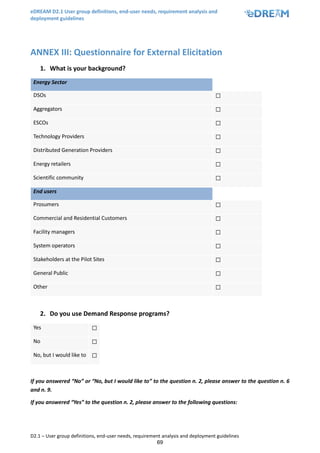
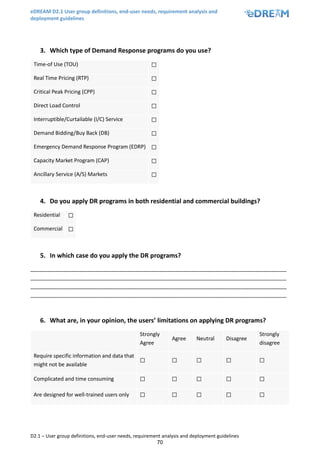
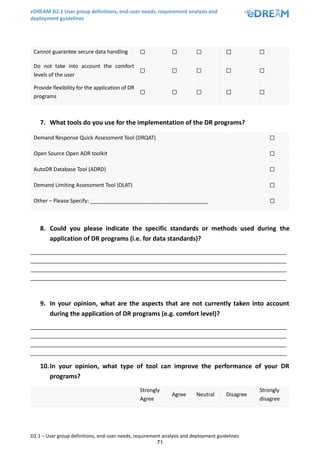
ANNEX III: Questionnaire for External Elicitation .................................................................................................... 69
ANNEX IV: Analysis of the Questionnaire results..................................................................................................... 75
List of Figures
Figure 1 Power/Interest Grid ................................................................................................................................... 14
Figure 2 Flow of the Requirements' Elicitation over the life of the eDREAM project.............................................. 16
Figure 3 Iterative application of processes for the Requirements Definition and System Specifications................ 18
Figure 4 “Pyramid” Diagrammatic representation of the different types of requirements and their eDREAM
reference Tasks ........................................................................................................................................................ 19
Figure 5 Requirement elicitation techniques and their start in eDREAM project ................................................... 20
Figure 6 Requirements identification and Use Cases definition in the eDREAM project ........................................ 24
Figure 7 eDREAM System Functionalities ................................................................................................................ 26
Figure 8 Pie Charts representing the percentage distribution of the categories of external experts interviewed . 76
Figure 9 Histogram about the use of DR programs by external experts.................................................................. 77
Figure 10 DR programs - domain of application by external experts ...................................................................... 78
Figure 11 External Experts opinion about the limitations on applying DR programs.............................................. 79
Figure 12 Tools used for DR programs by the External Experts............................................................................... 80
Figure 13 External Experts preferences in terms of tools to solve the problems of application of the DR programs
................................................................................................................................................................................. 82
Figure 14 Methods used for load forecasting by the External Experts.................................................................... 83
Figure 15 Interest in automatic financial settlement through the use of the smart contract from the external
experts..................................................................................................................................................................... 85
Figure 16 Percentage of experts applying DR programs with or without a GUI-based platform ............................ 86
eDREAM D2.1 User group definitions, end-user needs, requirement analysis and
deployment guidelines
D2.1 – User group definitions, end-user needs, requirement analysis and deployment guidelines
6
List of Tables
Table 1 Main objectives of the three versions of the deliverable for Business and User requirements definition. 11
Table 2 Key stakeholders group identified as target audience of eDREAM............................................................. 15
Table 3 Stakeholders Register.................................................................................................................................. 15
Table 4 Steps related to the Phase 1 of the RE process........................................................................................... 17
Table 5 Steps related to the Phase 2 of the RE process........................................................................................... 17
Table 6 Steps related to the Phase 3 of the RE process........................................................................................... 18
Table 7 MF1: DR optimal design .............................................................................................................................. 24
Table 8 MF2: DR Services and big data technologies for optimizing flexibility........................................................ 25
Table 9 MF3: Secure blockchain-based applications for DR management, control and financial settlement......... 25
Table 10 eDREAM Functionalities and relative Requirements................................................................................. 27
Table 11 FD-BR01 Electric meters, edge and field device electric measures........................................................... 29
Table 12 FD-BR02 Weather data availability............................................................................................................ 29
Table 13 MF01-BR01 Multi-Building DR characterization through thermal, optical and LIDAR information fusion,
along with power grids GIS data.............................................................................................................................. 29
Table 14 MF01-BR02 Forecast of electricity production/consumption................................................................... 30
Table 15 MF01-BR03 Baseline load calculations in DR programs............................................................................ 30
Table 16 MF01-BR04 PV/RES Degradation and Trend Analysis................................................................................ 30
Table 17 MF01-BR05 Graph-based analytics ........................................................................................................... 31
Table 18 MF02-BR01 Big Data Clustering at Multiple Scale..................................................................................... 31
Table 19 MF02-BR02 VPP & Customer Segmentation and Profiling........................................................................ 31
Table 20 MF02-BR03 Virtual Power Plant Generation Modelling and Optimal Coalition Forecasting .................... 32
Table 21 MF02-BR04 Decision Making and DR Optimization .................................................................................. 32
Table 22 MF02-BR05 Interactive Visualization for VPP coalition............................................................................. 33
Table 23 MF02-BR06 Forecast of electricity production/consumption at the grid level......................................... 33
Table 24 MF02-BR07 EVSEs and EV fleet monitoring .............................................................................................. 33
Table 25 MF02-BR08 EVSE remote control.............................................................................................................. 34
Table 26 MF02-BR09 Baseline flexibility estimation................................................................................................ 34
Table 27 MF02-BR10 Interactive Multi-purpose Visualization for system flexibility services.................................. 34
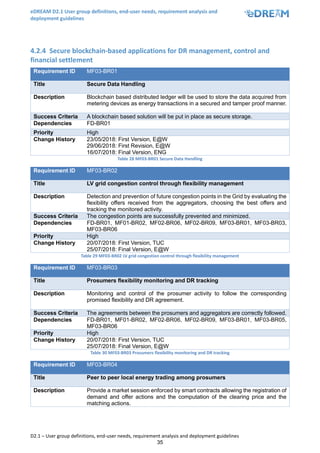
Table 28 MF03-BR01 Secure Data Handling ............................................................................................................ 35
Table 29 MF03-BR02 LV grid congestion control through flexibility management.................................................. 35
Table 30 MF03-BR03 Prosumers flexibility monitoring and DR tracking................................................................. 35
Table 31 MF03-BR04 Peer to peer local energy trading among prosumers ............................................................ 36
Table 32 MF03-BR05 Interactive Visualization to customize self-enforcing smart contracts for prosumer bidding
and scheduling in electricity markets ...................................................................................................................... 36
Table 33 MF03-BR06 Closed loop DR verification and Financial settlement........................................................... 36
Table 34 FD-BR01-UR01........................................................................................................................................... 37
Table 35 FD-BR02-UR01........................................................................................................................................... 37
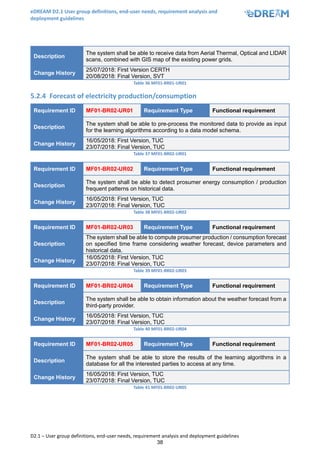
Table 36 MF01-BR01-UR01...................................................................................................................................... 38
Table 37 MF01-BR02-UR01...................................................................................................................................... 38
Table 38 MF01-BR02-UR02...................................................................................................................................... 38
Table 39 MF01-BR02-UR03...................................................................................................................................... 38
Table 40 MF01-BR02-UR04...................................................................................................................................... 38
Table 41 MF01-BR02-UR05...................................................................................................................................... 38
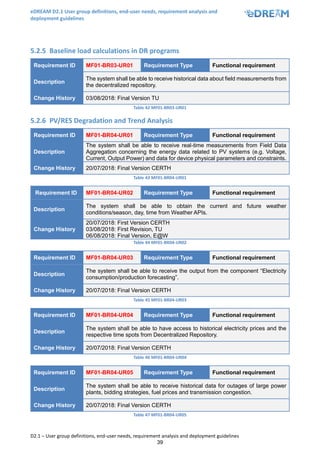
Table 42 MF01-BR03-UR01...................................................................................................................................... 39
Table 43 MF01-BR04-UR01...................................................................................................................................... 39
Table 44 MF01-BR04-UR02...................................................................................................................................... 39
Table 45 MF01-BR04-UR03...................................................................................................................................... 39
Table 46 MF01-BR04-UR04...................................................................................................................................... 39
Table 47 MF01-BR04-UR05...................................................................................................................................... 39
Table 48 MF01-BR05-UR01...................................................................................................................................... 40
Table 49 MF01-BR05-UR02...................................................................................................................................... 40
eDREAM D2.1 User group definitions, end-user needs, requirement analysis and
deployment guidelines
D2.1 – User group definitions, end-user needs, requirement analysis and deployment guidelines
7
Table 50 MF01-BR05-UR03...................................................................................................................................... 40
Table 51 MF01-BR05-UR04...................................................................................................................................... 40
Table 52 MF02-BR01-UR01...................................................................................................................................... 40
Table 53 MF02-BR01-UR02...................................................................................................................................... 40
Table 54 MF02-BR01-UR03...................................................................................................................................... 41
Table 55 MF02-BR01-UR04...................................................................................................................................... 41
Table 56 MF02-BR01-UR05...................................................................................................................................... 41
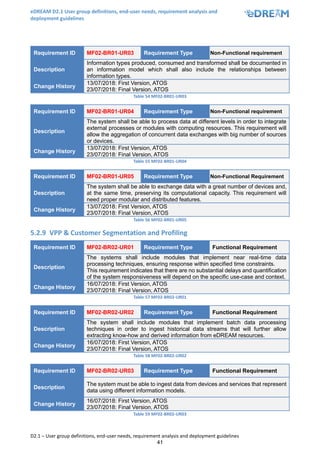
Table 57 MF02-BR02-UR01...................................................................................................................................... 41
Table 58 MF02-BR02-UR02...................................................................................................................................... 41
Table 59 MF02-BR02-UR03...................................................................................................................................... 41
Table 60 MF02-BR02-UR04...................................................................................................................................... 42
Table 61 MF02-BR02-UR05...................................................................................................................................... 42
Table 62 MF02-BR02-UR06...................................................................................................................................... 42
Table 63 MF02-BR02-UR07...................................................................................................................................... 42
Table 64 MF02-BR02-UR08...................................................................................................................................... 42
Table 65 MF02-BR02-UR09...................................................................................................................................... 42
Table 66 MF02-BR03-UR01...................................................................................................................................... 43
Table 67 MF02-BR03-UR02...................................................................................................................................... 43
Table 68 MF02-BR03-UR03...................................................................................................................................... 43
Table 69 MF02-BR04-UR01...................................................................................................................................... 43
Table 70 MF02-BR05-UR01...................................................................................................................................... 43
Table 71 MF02-BR05-UR02...................................................................................................................................... 44
Table 72 MF02-BR05-UR03...................................................................................................................................... 44
Table 73 MF02-BR05-UR04...................................................................................................................................... 44
Table 74 MF02-BR05-UR05...................................................................................................................................... 44
Table 75 MF02-BR05-UR06...................................................................................................................................... 44
Table 76 MF02-BR05-UR07...................................................................................................................................... 44
Table 77 MF02-BR06-UR01...................................................................................................................................... 44
Table 78 MF02-BR06-UR02...................................................................................................................................... 45
Table 79 MF02-BR06-UR03...................................................................................................................................... 45
Table 80 MF02-BR07-UR01...................................................................................................................................... 45
Table 81 MF02-BR07-UR02...................................................................................................................................... 45
Table 82 MF02-BR07-UR03...................................................................................................................................... 45
Table 83 MF02-BR07-UR04...................................................................................................................................... 45
Table 84 MF02-BR07-UR05...................................................................................................................................... 46
Table 85 MF02-BR07-UR06...................................................................................................................................... 46
Table 86 MF02-BR07-UR07...................................................................................................................................... 46
Table 87 MF02-BR08-UR01...................................................................................................................................... 46
Table 88 MF02-BR08-UR02...................................................................................................................................... 46
Table 89 MF02-BR08-UR03...................................................................................................................................... 46
Table 90 MF02-BR09-UR01...................................................................................................................................... 47
Table 91 MF02-BR09-UR02...................................................................................................................................... 47
Table 92 MF02-BR10-UR01...................................................................................................................................... 47
Table 93 MF02-BR10-UR02...................................................................................................................................... 47
Table 94 MF02-BR10-UR03...................................................................................................................................... 47
Table 95 MF02-BR10-UR04...................................................................................................................................... 47
Table 96 MF02-BR10-UR05...................................................................................................................................... 48
Table 97 MF02-BR10-UR06...................................................................................................................................... 48
Table 98 MF02-BR10-UR07...................................................................................................................................... 48
Table 99 MF03-BR01-UR01...................................................................................................................................... 48
Table 100 MF03-BR01-UR02.................................................................................................................................... 48
Table 101 MF03-BR01-UR03.................................................................................................................................... 48
Table 102 MF03-BR01-UR04.................................................................................................................................... 49
Table 103 MF03-BR02-UR01.................................................................................................................................... 49
eDREAM D2.1 User group definitions, end-user needs, requirement analysis and
deployment guidelines
D2.1 – User group definitions, end-user needs, requirement analysis and deployment guidelines
8
Table 104 MF03-BR02-UR02.................................................................................................................................... 49
Table 105 MF03-BR02-UR03.................................................................................................................................... 49
Table 106 MF03-BR02-UR04.................................................................................................................................... 49
Table 107 MF03-BR03-UR01.................................................................................................................................... 49
Table 108 MF03-BR03-UR02.................................................................................................................................... 50
Table 109 MF03-BR03-UR03.................................................................................................................................... 50
Table 110 MF03-BR03-UR04.................................................................................................................................... 50
Table 111 MF03-BR04-UR01.................................................................................................................................... 50
Table 112 MF03-BR04-UR02.................................................................................................................................... 50
Table 113 MF03-BR04-UR03.................................................................................................................................... 50
Table 114 MF03-BR04-UR04.................................................................................................................................... 51
Table 115 MF03-BR05-UR01.................................................................................................................................... 51
Table 116 MF03-BR05-UR02.................................................................................................................................... 51
Table 117 MF03-BR06-UR01.................................................................................................................................... 51
Table 118 MF03-BR06-UR02.................................................................................................................................... 51
Table 119 MF03-BR06-UR03.................................................................................................................................... 52
Table 120 MF03-BR06-UR04.................................................................................................................................... 52
Table 121 MF03-BR06-UR05.................................................................................................................................... 52
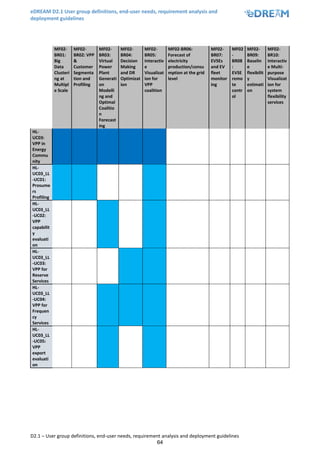
Table 122 eDREAM use cases inventory .................................................................................................................. 54
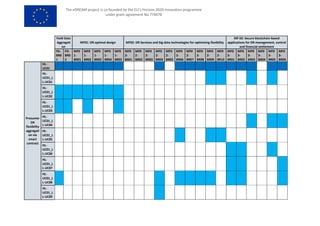
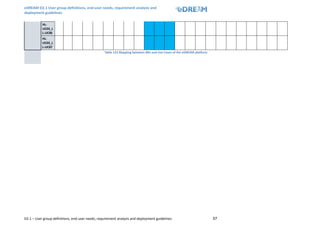
Table 123 Mapping between BRs and Use Cases of the eDREAM platform............................................................ 57
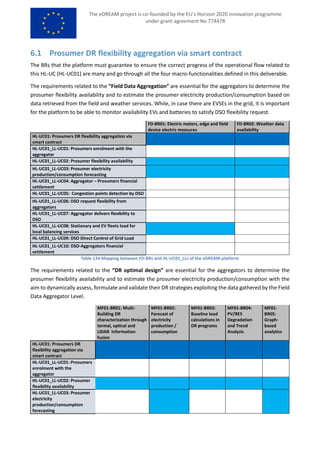
Table 124 Mapping between FD-BRs and HL-UC01_LLs of the eDREAM platform.................................................. 58
Table 125 Mapping between MF01-BRs and HL-UC01_LLs of the eDREAM platform............................................. 59
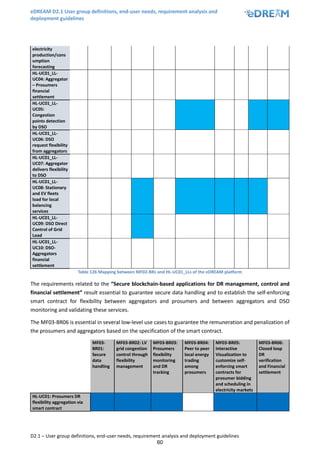
Table 126 Mapping between MF02-BRs and HL-UC01_LLs of the eDREAM platform............................................. 60
Table 127 Mapping between MF03-BRs and HL-UC01_LLs of the eDREAM platform............................................. 61
Table 128 Mapping between BRs (FD-BR01 and MF03-BRs) and HL-UC02_LLs of the eDREAM platform.............. 62
Table 129 Mapping between BRs (FD-BRs and MF01-BRs) and HL-UC03_LLs of the eDREAM platform ................ 63
Table 130 Mapping between MF02-BRs and HL-UC03_LLs of the eDREAM platform............................................. 65
Table 131 Business Requirements template............................................................................................................ 67
Table 132 User Requirements template .................................................................................................................. 68
Table 133 Percentage distribution of the categories of external experts interviewed............................................ 76
Table 134 DR programs intensity of use .................................................................................................................. 77
Table 135 Aspects not yet addressed by DR program - ELSA experts’ opinion........................................................ 81
Table 136 Aspects not yet addressed by DR program - DR-BOB experts’ opinion................................................... 81
Table 137 Aspects not yet addressed by DR program - inteGRIDy experts’ opinion ............................................... 82
Table 138 Expectation from visualization tool for DR programs - ELSA experts’ opinion........................................ 86
Table 139 Expectation from visualization tool for DR programs – DR-BOB experts’ opinion.................................. 86
Table 140 Expectation from visualization tool for DR programs - inteGRIDy experts’ opinion ............................... 87
eDREAM D2.1 User group definitions, end-user needs, requirement analysis and
deployment guidelines
D2.1 – User group definitions, end-user needs, requirement analysis and deployment guidelines
9
List of Acronyms and Abbreviations
eDREAM enabling new Demand Response Advanced, Market oriented and secure technologies, solutions
and business models
WP Work Package
PD Participatory Design
DSO Distribution System Operator
DR Demand Response
RE Requirements Elicitation
TGs Target groups
PMBOK Project Management Body of Knowledge
StRS Stakeholder Requirements Specification
VPP Virtual Power Plant
HL-UC High Level Use Case
LL-UC Low Level Use Case
MF Macro-Functionality
BRs Business Requirements
FD Field Data
URs User Requirements
EVSE Electric Vehicle Supply Equipment
EV Electric Vehicle
UI User Interface
ESCO Energy Service COmpany
eDREAM D2.1 User group definitions, end-user needs, requirement analysis and
deployment guidelines
D2.1 – User group definitions, end-user needs, requirement analysis and deployment guidelines
10
1 Introduction
The purpose of this deliverable, as the technical output of the project, is to elicit the business and user
requirements for the eDREAM environment and system. The deliverable describes the steps and actions
performed in Task 2.1 during the first eight months of the project and can be considered as a key input for
the definition of the use cases and application scenarios (T2.2) and for the upcoming tasks in WP2 as well as
WP3, WP4, WP5, WP6 and WP7. The main stakeholders of the eDREAM platform are described in detail in
the task, identifying their needs and requirements to address the project objectives in the early design phase.
1.1 Scope and objectives of the deliverable and relevance in the
eDREAM framework
The eDREAM project aims to develop innovative technologies in the field of DR management and the
balancing of energy resources by exploiting new technologies such as deep learning and big data analytics for
energy demand and production forecasts, blockchain secure distributed control for implementation of a peer-
to-peer market of energy assets and a close DR verification, through the use of self-enforcing smart-contracts
and consensus based validation to track energy transactions in a tamper-proof manner and determining
financial settlement in a near real time fashion.
The components, that will be developed during the project, will be integrated through a scalable Cross-
functional Backbone Platform that will connect energy networks with diverse stakeholders, based on their
requirements and the characteristics of two different eDREAM Pilot use cases. This platform can be seen as a
complex system in which different kind of users can use the available tools, models and mechanisms in
support of the Distribution Services.
In this perspective, the eDREAM ecosystem can be defined as the community of internal and external
stakeholders of the project in conjunction with its core technology framework.
Understanding the needs and expectations of eDREAM’s stakeholders, is of utmost importance as it may offer
a fresh and valuable perspective on how to tackle the goals and objectives of the project.
This assessment goes beyond the development of the innovative solutions proposed and the expected
integration of the eDREAM technologies (which is a mandatory achievement) and defines the eDREAM
solution against the needs and trends expressed by the stakeholders from the initial phase of the project up
to the realization of the first version of the prototypes.
This deliverable pursues this direction and focuses on the elicitation of stakeholders, extrapolating their needs
as well as their implementation priorities.
To this end, three different versions of this deliverable are expected to be released throughout the course of
the project as defined below:
eDREAM D2.1 User group definitions, end-user needs, requirement analysis and
deployment guidelines
D2.1 – User group definitions, end-user needs, requirement analysis and deployment guidelines
11
Deliverable Objectives
D 2.1: User group
definitions, end-user needs,
requirement analysis and
deployment guidelines V1
[M8]
1. Definition of the methodology for the identification of the Target
groups (TGs)
2. Definition of the overall approach and methodology for
requirement elicitation
3. Validation of the defined elicitation approach through the
involvement of other H2020 project consortia, establishing a
collaboration with them
4. Definition of the first set of the Business and User requirements
through internal elicitation
5. Refinement of the first set of the Business and User requirements
based on the first feedback from other H2020 Project Consortia
D 2.6: User group
definitions, end-user needs,
requirement analysis and
deployment guidelines V2
[M20]
1. Organization of the International Conference targeting more than
100 stakeholders in Europe
2. Collection of the needs and requirements coming from the
identified TGs
3. Continuous assessment of the Business and User requirements
D 2.8: User group
definitions, end-user needs,
requirement analysis and
deployment guidelines V3
[M30]
1. Continuous Involvement of the identified TGs to assess
requirements
2. Use of the prototypes as design-probes to refine the requirements
3. Final version of the Business and User Requirements
Table 1 Main objectives of the three versions of the deliverable for Business and User requirements definition
1.2 Structure of the deliverable
D 2.1 “User group definitions, end-user needs, requirement analysis and deployment guidelines” consists of
six chapters, in which the adopted elicitation processes and the project requirements defined at the end of
the first cycle of elicitation have been described, as follows:
• General description of the scope and objective of the deliverable [Chapter 1];
• Definition of the methodologies for the identification of the eDREAM target groups [Chapter 2];
• Definition of the methodologies to be adopted for the elicitation and assessment of needs and
expectations of stakeholders [Chapter 3];
• Description of the Business Requirements (BRs) extrapolated at the end of the first cycle of elicitation
through internal and external elicitation [Chapter 4];
eDREAM D2.1 User group definitions, end-user needs, requirement analysis and
deployment guidelines
D2.1 – User group definitions, end-user needs, requirement analysis and deployment guidelines
12
• Description of the User Requirements (URs) extrapolated at the end of the first cycle of elicitation
through internal and external elicitation [Chapter 5];
• Definition of the relationships of the business and user requirements with the use cases and
application scenarios [Chapter 6];
Finally, the templates proposed for the description of the Business and User Requirements, the Questionnaire
elaborated for the external Experts and Stakeholders and the summary of the feedback from other three
H2020 project consortia are included respectively in ANNEX 1 – Business requirements template, ANNEX 2 –
User requirements template, ANNEX 3 - Questionnaire for External Elicitation and ANNEX 4 – Analysis of the
Questionnaire results.
eDREAM D2.1 User group definitions, end-user needs, requirement analysis and
deployment guidelines
D2.1 – User group definitions, end-user needs, requirement analysis and deployment guidelines
13
2 Definition of stakeholders and user groups
The identification of the potential stakeholders is the first important phase of a project, since once grouped
according to well defined categories to constitute the Target Groups (TGs), they will be involved in the
Requirements Elicitation (RE) process where business and user needs are identified and captured.
The success of projects depends heavily on designers' ability to meet the needs and requirements of
stakeholders throughout the entire life cycle.
In the stakeholders’ identification all the possible categories have to be considered, such as energy users, grid
operators, organization decision makers, regulatory bodies and society as a whole in the context of the
business and the proposed solution.
A stakeholder is any entity (individual or organization) with a legitimate expectation from the system, in other
words, the stakeholders are all those who may be influenced or who would be able to influence the system in
general [1].
These stakeholders represent the source of the requirements during the requirement elicitation phase. The
stakeholder identification activity is not a simple step and information on stakeholders is not readily available.
Most developers are faced with problems in finding the right stakeholders with the appropriate time, interest
and knowledge for the project.
Therefore, it is essential at a very early stage of the project to think on potential stakeholders and TGs, as an
effective RE process requires active participation by stakeholders who may be affected by the project or who
could influence it.
The influence of the stakeholders on a project can vary greatly from one to another, so the possibility of
involvement can be immense. For example, RE processes could involve people who pay for the system,
customers, people who design the components, system users etc. This demonstrates the necessity to start
with a categorization procedure in stakeholder analysis, in order to manage the RE in an appropriate manner.
In accordance with the stakeholder analysis methodology defined by the PMBOK [1], in the stakeholder
identification phase we have to consider the following tools and techniques:
• Stakeholder analysis: Collection and evaluation of information to determine what interests should
be taken into account for the project;
• Expert Rating: Technical and / or managerial expert judgment (originated from any qualified source);
• Meetings: Profile analysis meetings to develop understanding of major project stakeholders.
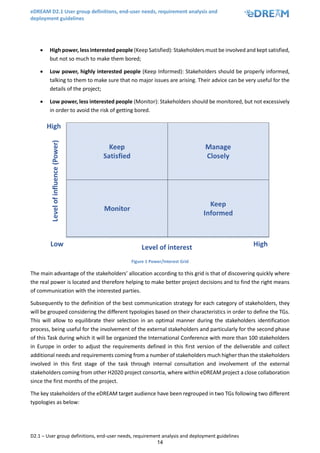
In particular, a useful tool to determine the impact of a potential stakeholder on the project can be the
Power/Interest Grid, which could also provide support in the selection of the proper communication
approach for each stakeholder or stakeholder group. The “power/interest matrix” classifies stakeholders
based on their power and interest in the project, allocating the stakeholders to one of the following
categories:
• High power, highly interested people (Manage Closely): Stakeholders should be fully involved and
maximum effort should be made to satisfy them;
eDREAM D2.1 User group definitions, end-user needs, requirement analysis and
deployment guidelines
D2.1 – User group definitions, end-user needs, requirement analysis and deployment guidelines
14
• High power, less interested people (Keep Satisfied): Stakeholders must be involved and kept satisfied,
but not so much to make them bored;
• Low power, highly interested people (Keep Informed): Stakeholders should be properly informed,
talking to them to make sure that no major issues are arising. Their advice can be very useful for the
details of the project;
• Low power, less interested people (Monitor): Stakeholders should be monitored, but not excessively
in order to avoid the risk of getting bored.
Figure 1 Power/Interest Grid
The main advantage of the stakeholders’ allocation according to this grid is that of discovering quickly where
the real power is located and therefore helping to make better project decisions and to find the right means
of communication with the interested parties.
Subsequently to the definition of the best communication strategy for each category of stakeholders, they
will be grouped considering the different typologies based on their characteristics in order to define the TGs.
This will allow to equilibrate their selection in an optimal manner during the stakeholders identification
process, being useful for the involvement of the external stakeholders and particularly for the second phase
of this Task during which it will be organized the International Conference with more than 100 stakeholders
in Europe in order to adjust the requirements defined in this first version of the deliverable and collect
additional needs and requirements coming from a number of stakeholders much higher than the stakeholders
involved in this first stage of the task through internal consultation and involvement of the external
stakeholders coming from other H2020 project consortia, where within eDREAM project a close collaboration
since the first months of the project.
The key stakeholders of the eDREAM target audience have been regrouped in two TGs following two different
typologies as below:
eDREAM D2.1 User group definitions, end-user needs, requirement analysis and
deployment guidelines
D2.1 – User group definitions, end-user needs, requirement analysis and deployment guidelines
15
Energy Sector End users
• Energy retailers
• DSOs
• TSOs
• Distributed Generation Providers
• Centralized Generation Providers
• Energy Aggregators and brokers
• ESCOs
• Technology Providers
• Scientific community
• Building Occupants
• Facility managers & owners
• System operators
• Commercial and Residential Customers
• Stakeholders at the Pilot Sites
• Municipalities with pools of buildings
• Universities with pools of buildings
• Energy professional associations
• General Public
Table 2 Key stakeholders group identified as target audience of eDREAM
It is important to pay attention to the role of these different groups of stakeholders within the eDREAM
project, as to achieve the project objectives it is necessary to understand the individual actors potentially
affected and envisioned by the system and project results, identify their needs and recognize synergies among
them.
The identification of stakeholders will be a part of the Stakeholder Register, which will include the
classification of stakeholders, and then the assessment of stakeholders as a result of the stakeholders’
analysis. This will be used in the second release of the deliverable.
The Stakeholder Register will be elaborated in the different eDREAM stakeholder management processes to
gather useful requirements for the project.
Stakeholder ID
/ Name
Stakeholder
Group
Power (H/L) Interest (H/L) Needs Observations,
concerns and
opportunities
Table 3 Stakeholders Register
eDREAM D2.1 User group definitions, end-user needs, requirement analysis and
deployment guidelines
D2.1 – User group definitions, end-user needs, requirement analysis and deployment guidelines
16
3 Requirements Engineering and Elicitation
3.1 General Approach
The elicitation of the requirements as one of the most important parts of the System Life Cycle Processes
must be tackled with extreme care, since many systems fail due to wrong or inefficient elicitation practices.
A requirement can be defined as a stakeholder need and the elicitation is all about knowing the wishes of the
stakeholders. It provides a success basis for a project and the delivery of the expected system and often reduce
the gap between developers, stakeholders, and end users [2].
The requirement elicitation is a process to discover the stakeholders' needs and collect the relative
requirements. It addresses many problems such as user involvement and perfect documentation. Wrong or
missing requirements lead to different system than expected, unreliable or more expensive than alternative
solutions.
The quality of the requirements phase affects the overall quality of the entire software production cycle and
therefore the produced platform. Thus, it is essential to write a good Stakeholder Requirements Specification
(StRS) [3] defining in a clear and correct way the system capabilities.
For all these reasons, it is worth mentioning that the requirements should be managed throughout the project
lifecycle. In the eDREAM project, an iterative approach to elicit and assess the requirements over the project
duration has been defined as follows:
Figure 2 Flow of the Requirements' Elicitation over the life of the eDREAM project
The essential eDREAM Requirements Elicitation process will be driven by stakeholders’ needs along the
project life, involving them according to the approach defined in Chapter 2. Elicitation is not just a step or a
task that must be done at a certain point, it is a set of techniques that are applied throughout the entire
project.
eDREAM D2.1 User group definitions, end-user needs, requirement analysis and
deployment guidelines
D2.1 – User group definitions, end-user needs, requirement analysis and deployment guidelines
17
The functionalities provided by the eDREAM platform will be compared continuously with the different
stakeholders’ requirements. Therefore, the involved stakeholders and end users of the set of eDREAM
technologies and components will be at the core of the project in all its phases, for which it is important to
use a common method and elicitation techniques and to provide a set of clear requirements for the
developers of the system.
Within the eDREAM project, the RE process is structured in three phases as shown in the Figure 2.
The first phase is the object of this deliverable aims to provide the definition of the methodologies for
identifying the stakeholders and elicit the requirements. In this phase, the activities have been focused on
the tools for the recovery of information, such as: the study of the literature, the definition of a first set of
requirements through the internal interrogation of the pilots by the internal technology providers, the
creation of a project presentation and the definition of survey / questionnaire for the external stakeholders.
The work done has been validated through a first round of external consultation in which other H2020 project
consortia has been involved in order to create the requirements’ base, useful for subsequent activities, i.e.
definition of the use cases and system specification (WP2), system implementation (WP3, WP4, WP5),
deployment (WP6) and validation (WP7), and the assessment procedures that will be implemented in the
following two phases of this task.
Phase 1: Elicitation preparation and definition of the first set of requirements
• Definition of the methodology for the identification of the potential stakeholders;
• Definition of the Elicitation methodology to retrieve information for the compilation of the StRS;
• Internal Elicitation for the identification and categorization of the first set of Business and User
Requirements in order to facilitate the external elicitation;
• Preparation of a short, clear and informative presentation of the project for the stakeholder groups
identified;
• Preparation of the Survey/Questionnaire to retrieve needs from external stakeholders;
• Release of the first version of the StRS;
Table 4 Steps related to the Phase 1 of the RE process
In the Second phase, the requirements previously defined will be consolidated through the application of the
RE techniques and the organization of the events including the International Conference.
Phase 2: Consolidation of the external requirement elicitation process
• Use of different RE techniques to involve external stakeholders;
• Organization of events for meeting and discussing the requirements with the external
stakeholders;
• Release of the second version of the StRS;
Table 5 Steps related to the Phase 2 of the RE process
eDREAM D2.1 User group definitions, end-user needs, requirement analysis and
deployment guidelines
D2.1 – User group definitions, end-user needs, requirement analysis and deployment guidelines
18
In the Third phase, the requirements will be validated also using the project prototypes as design-probes in
order to release the final version of StRS.
Phase 3: Requirements final processing and validation
• Continuous Involvement of the identified External Stakeholders to assess requirements;
• Validation/processing of gathered information through the continuous comparison with the
project prototype;
• Creation of a concluding StRS.
Table 6 Steps related to the Phase 3 of the RE process
Then, the eDREAM RE process follows an iterative approach in which the repetition of the consultation steps
is carried out along the three phases.
The same process for requirements analysis and definition will be repeated on the same level of the system
definition procedures, providing specific requirements outcomes for the other part of the iteration, i.e. the
architectural design process, and for the definition and implementation of the eDREAM system following the
methods and the specifications defined in [3] and [4].
Only for the last iteration cycle, when the first versions of the prototypes will be available, the process will
exploit these prototypes to study and use the feedback from the first prototype tests that will be carried out
with a set of potential users in order to help the final refinements process of the requirements (T2.1), use
cases (T2.2) and Architectural and System Specification (T2.4) and to avoid some problems in the last phase
of the system implementation (WP3, WP4 WP5), deployment (WP6) and validation (WP7).
Figure 3 Iterative application of processes for the Requirements Definition and System Specifications
eDREAM D2.1 User group definitions, end-user needs, requirement analysis and
deployment guidelines
D2.1 – User group definitions, end-user needs, requirement analysis and deployment guidelines
19
3.2 Techniques and Approaches for Requirements Elicitation and
Engineering
Following the iterative process for the requirements definition and system specification already defined in
the previous paragraph, in the definition of techniques for gathering and engineering of the needs, the
interactions with other project tasks and WPs were always taken into consideration.
This kind of approach will allow us to move from the problem domain, represented by the user needs that
will be discovered in this Task, to a definition of a system that will constitute the solution domain, represented
by the features of the system and the software requirements that will drive its design and implementation.
The iterative approach also allows us to do so in a logical, stepwise fashion, making sure to understand the
problem and the user's needs before we envision or define the solution. This road map, along with its
important distinctions, will be important for the subsequent tasks of the project.
In this way, the gap from the problem domain (understanding user needs) to the solution domain (specific
requirements intended to address the user needs) is bridged through the application of a "pyramid" approach
[5] [6] as the graphic below shows:
Figure 4 “Pyramid” Diagrammatic representation of the different types of requirements and their eDREAM reference Tasks
The needs gathering processes were placed at the top of the pyramid because they are considered high-level
requirements in the measure of how much closer the users are, while going down into the pyramid we move
away from the user, approaching the design and development phase of the system for which it will be
necessary to detail and deepen in depth the requirements defined at a high level in order to obtain a
consistent definition of the system requirements.
So, each level of the pyramid must provide details about a type of requirements exploiting techniques able
to provide answers to the following questions:
• “Why is the project needed?” a consolidated set of Business Requirements useful for the definition
of the User and System Requirements;
• “What do users need the system to do?” a consolidated set of User Requirements useful for the
definition of System Requirements;
eDREAM D2.1 User group definitions, end-user needs, requirement analysis and
deployment guidelines
D2.1 – User group definitions, end-user needs, requirement analysis and deployment guidelines
20
• “What does the system need to do?” a consolidated set of System Requirements.
System requirements are clearly articulated statements of what a system must be able to do and satisfy
stakeholder needs and requirements. They are derived from business requirements and user requirements.
Focusing on the aims of this deliverable, i.e. business and user requirements definition, the best techniques
for eliciting the requirements at the business and user requirements level, were determined as follows, also
taking as a reference the [7] and [8]:
Figure 5 Requirement elicitation techniques and their start in eDREAM project
The tools and techniques selected for the RE process were distributed through the three phases of the
process, inserting each tool in the more appropriate iteration cycle. In consideration of the iterative process,
once a tool is introduced it will be used through all subsequent iterative cycles.
Literature Review and Document Analysis: The analysis of existing literature and documentation is an activity
focused on the collection and the revision of all the existing appropriate documentation for the project
objectives that can contain data related to a relevant solution. Useful documentation could be anything
written about the project objectives (manuals, scientific papers, existing procedures etc.). This type of
elicitation is particularly useful when the goal is to upgrade an existing system or when an understanding of
an existing system will improve a new system. The analysis of the documentation should not be used as only
source. It is often not sufficient to completely extract all the requirements for a given project.
In eDREAM context, it has been used as a support activity for the definition of the first set of requirements as
a valid base for the subsequent elicitation activities in which more involvement of the stakeholders is
expected. As a continuous refinement of the requirements, this activity will be updated along the three
phases of the process and will consider any new contribution from the literature.
Briefly Project and 1° version of Requirements Description: The definition of the summary of the project and
the first version of the requirements by the internal design and development team can be useful to provide
greater support to the elicitation activities in which the involvement of the stakeholders is expected.
In eDREAM context, it has been made a project presentation for external experts and the first set of
requirements through the interaction between the internal partners responsible for the pilots and the design
and development team.
eDREAM D2.1 User group definitions, end-user needs, requirement analysis and
deployment guidelines
D2.1 – User group definitions, end-user needs, requirement analysis and deployment guidelines
21
External Experts involvement from other H2020 similar projects: The interaction with external experts can
be useful for the preparation of the base requirements before starting the activities for the large-scale
involvement of the relevant stakeholders.
In the eDREAM context, the interaction with three different consortia of similar H2020 research projects was
used to refine the first set of requirements. A specific questionnaire has been prepared and proposed to these
external experts. Finding of the interaction can be found in Annexes III-IV.
Focus Group: Focus groups are made up of a mix of stakeholders who come together to provide input on
business needs. Focus groups are particularly useful when key stakeholders are not particularly enterprising
or available. They are also a good way to get a lot of information in a short time. Focus groups are also ideal
for establishing a consensus view and highlighting areas of conflict and disagreement during requirement
activity.
In the eDREAM context, this technique will be used starting from the second iteration cycle of the RE process,
taking full advantage of the events that are planned to be organized.
Interviews: In the RE phase is important for the design and development team to meet the stakeholders and
at the same time, it is important to let feel them involved. For these reasons, the interviews are the most
popular and common technique used for RE. They offer the opportunity to discuss the thoughts of
stakeholders and get their perspectives on the business needs and the feasibility of potential solutions
providing an efficient way to quickly collect large amounts of data.
Because the interviews are essentially social activities based on human interaction, they are intrinsically
informal and their effectiveness depends a lot on the quality of interactions among the interviewees. The
interviews results, such as the usefulness of the information collected, may change significantly depending
on the interviewer's skills. There are different ways to conduct interviews. In particular, there are three most
common typologies, i.e. unstructured, structured, and semi-structured.
The structured interviews present predefined questions while the unstructured interviews are usually free-
flowing conversation in which the interviewer applies only limited control over the direction of the
discussions. The semi-structured interviews represent generally a combination of the former two. In any case,
at the end of the interviews, it's important to share the notes with the interviewees in order to make sure
that there have been no misunderstandings.
In the eDREAM context, this technique will be used starting from the second iteration cycle of the RE process,
taking full advantage of the events that are planned to be organized.
Observations: Observation is very useful when considering a project that will change or improve current
processes. It consists of the observation from the analyst of the actual execution of existing processes by the
users without direct interference. This technique is often used in conjunction with others such as interviews
and task analysis. There are available two basic types of observation, the direct and the indirect observation.
The direct observation is used to understand the nature of tasks and the context in which they are performed.
In the direct observation, the participants are observed directly in their natural setting in order to understand
the nature of the tasks and the context in which they are performed. The observer, that could be a member
eDREAM D2.1 User group definitions, end-user needs, requirement analysis and
deployment guidelines
D2.1 – User group definitions, end-user needs, requirement analysis and deployment guidelines
22
of the design team or not, record their findings and report them back to the design team carry out the
observations. The Indirect observation is used less often within the required activity, e.g., Interaction logging
on an existing system can be used to provide some data on how an activity is performed at the moment, but
the information is too closely related to the details of the existing IT support to be particularly useful if a
completely new system is planned.
In the eDREAM context, this technique will be used starting from the second iteration cycle of the RE process,
taking full advantage by the presence of internal stakeholders in the project consortium, involving them in
validation activities in order to obtain the first feedback from these activities. This feedback will simplify the
use of the prototypes as a design probe expected in the third phase of this deliverable.
Workshops: Requirements workshops are meetings in which the collection of information of interest is
expected to take place involving previously identified groups of stakeholders. The goal is to obtain, refine and
modify the requirements. In order to be successful, the requirements workshop need a moderator to direct
the discussion in the needs workshops, and the input of the participants must be recorded. Participants can
also brainstorm together and listen to each other's contributions and they can provide immediate feedback
and improvements to identified business needs, which can ensure a quick and effective elicitation of
requirements.
In the eDREAM context, this technique will be used starting from the second iteration cycle of the RE process,
taking full advantage of the events that are planned to be organized.
Survey/Questionnaires: The questionnaires are mainly used during the early stages of requirements
processing and can be structured to offer a series of finite choices for each question or they can offer open-
ended input, depending on the needs of the project. Open-ended questions are useful for a broader discovery
of business needs. However, the open-ended questions are more prohibitive to analyse than closed questions
when the number of participants becomes significantly large.
To be effective, the terms, concepts, and boundaries of the project domain must be well established and
understood by the participants and by the designer of the questionnaire. Questions must be focused to avoid
gathering large amounts of redundant and irrelevant information. From this, it follows that the questionnaires
are useful for quick data gathering from a large group of well-chosen stakeholders. Questionnaires are
generally considered useful as informal checklists to ensure that key elements are addressed in advance and
to establish the basis for subsequent elicitation activities.
Questionnaires should be paper-based or web-based structured forms having an instruction for filling in the
questionnaire. For a successful questionnaire, it is essential to require to the participants to provide the
relative feedback within a reasonable deadline and to keep confidential company information confidential.
In the eDREAM context, this technique will be used starting from the second iteration cycle of the RE process,
taking full advantage from the questionnaire already prepared for the interrogation of consortia of other
similar H2020 project in the first iterative cycle and from the events that are planned to be organized.
Public consultation: Acquisition of the opinions of stakeholders and other interested parties (EU citizens,
public and private organizations etc.), in order to gain quantitative evidence on the related issues of
interoperability, including the feedback received through eDREAM website: www.edream-h2020.eu
eDREAM D2.1 User group definitions, end-user needs, requirement analysis and
deployment guidelines
D2.1 – User group definitions, end-user needs, requirement analysis and deployment guidelines
23
In the eDREAM context, this technique will be used starting from the second iteration cycle of the RE process,
taking full advantage of the events that are planned to be organized.
Prototyping (storyboard, navigation flow, paper prototyping, screen flows): Prototyping is particularly useful
for stakeholders, such as business owners, and end users who may not understand all the technical aspects
of the requirements, but relate better to a visual representation of the final product. To quote BABOK [8],
"Stakeholders often find prototyping to be a concrete means of identifying, describing and validating their
interface needs". The prototyping process is normally iterative, improving as stakeholders gather more inputs
and assessments. Prototyping can be an interactive screen (normally consisting of hypertext only without real
data behind it), a mock-up (like a PowerPoint), a navigation flow (like a Visio diagram) or a storyboard. In the
early stages of the discovery, it is possible to make simple and loss-free prototypes (such as pencil sketches)
and create more detailed interactive prototypes once the business requirements have been identified. In the
latter case, a more detailed prototype phase, the functionality of the prototype must meet the business needs
previously identified as indicated in the requirements.
In the eDREAM context, the first version of the prototypes will be used to assess the requirements already
defined in the previous stages by verifying the prototypes adherence with what was expected according to
the requirements.
3.3 Definition of the Requirements
As described in the previous sections, in this first phase of the requirements definition process, we have
proceeded internally to define a first set of requirements that was then validated through a consultation
process of external experts belonging to consortia of other similar H2020 projects.
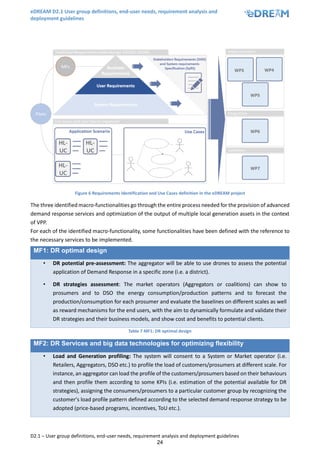
With the aims to facilitate requirements engineering and use cases definition for the eDREAM platform
implementation, in the consideration of the two pilots’ sites of the Project (one related to the microgrid and
one related to the VPP), ten different functionalities grouped under three macro-functionalities has been
identified. These functionalities are essential for the realization of the project objectives with the reference
on the three expected High-Level Use Cases (HL-UCs): Prosumer DR flexibility aggregation via smart contract,
Peer-to-peer local energy trading market and VPP in Energy Community.
eDREAM D2.1 User group definitions, end-user needs, requirement analysis and
deployment guidelines
D2.1 – User group definitions, end-user needs, requirement analysis and deployment guidelines
24
Figure 6 Requirements identification and Use Cases definition in the eDREAM project
The three identified macro-functionalities go through the entire process needed for the provision of advanced
demand response services and optimization of the output of multiple local generation assets in the context
of VPP.
For each of the identified macro-functionality, some functionalities have been defined with the reference to
the necessary services to be implemented.
MF1: DR optimal design
• DR potential pre-assessment: The aggregator will be able to use drones to assess the potential
application of Demand Response in a specific zone (i.e. a district).
• DR strategies assessment: The market operators (Aggregators or coalitions) can show to
prosumers and to DSO the energy consumption/production patterns and to forecast the
production/consumption for each prosumer and evaluate the baselines on different scales as well
as reward mechanisms for the end users, with the aim to dynamically formulate and validate their
DR strategies and their business models, and show cost and benefits to potential clients.
Table 7 MF1: DR optimal design
MF2: DR Services and big data technologies for optimizing flexibility
• Load and Generation profiling: The system will consent to a System or Market operator (i.e.
Retailers, Aggregators, DSO etc.) to profile the load of customers/prosumers at different scale. For
instance, an aggregator can load the profile of the customers/prosumers based on their behaviours
and then profile them according to some KPIs (i.e. estimation of the potential available for DR
strategies), assigning the consumers/prosumers to a particular customer group by recognizing the
customer’s load profile pattern defined according to the selected demand response strategy to be
adopted (price-based programs, incentives, ToU etc.).
eDREAM D2.1 User group definitions, end-user needs, requirement analysis and
deployment guidelines
D2.1 – User group definitions, end-user needs, requirement analysis and deployment guidelines
25
• Services for Community-based virtual power plants: The user here is a community (energy
management cooperative) or a market operator (i.e. Aggregator) responsible for the execution of
DR programs for a group of customers. The user will be able to control and optimize the energy
balance in multiple local distributed generation resources, operating on a profit-oriented
approach, thus providing also flexibility services to the network (i.e. a DSO) representing the assets
of the customers. Ideally, the community can collapse so the end user can be also a single
prosumer.
• Active grid System flexibility DR services: The prosumers, directly or via enabling aggregators, will
be able to offer their production assets as flexibility resources. Ideally also a DSO can exploit for
itself the grid flexibility in order to improve grid stability, accessing on the grid resources and
managing the flexibility of the single producer to provide flexibility-as-a-service. The DSO will be
supported in decision making, the actions selected will operate on services to balance the grid and
then the platform will match the requested services with prosumers offers.
Table 8 MF2: DR Services and big data technologies for optimizing flexibility
MF3: Secure blockchain-based applications for DR management, control and
financial settlement
• Secure Energy data handling: The Aggregator/DSO/Retailer will store data feed by smart energy
metering devices using blockchain distributed ledger framework in secure way.
• Smart contract for DR flexibility services: The Aggregators aggregate individual flexibility of
prosumers via smart contract in response to the DSO flexibility request and are made aware of
individual prosumer deviations from flexibility request.
• Smart Contract for Energy trading market: The aggregators/producers/prosumers will be able to
offer their services by reacting to changes in the price of energy compared to the reference value,
thanks to the trading marketplace that will be created using the smart-contracts. The
producers/prosumers trade energy in a peer to peer fashion either directly or through an energy
aggregator if they are not big enough.
• Decentralized coordinated control for micro-grid: The DSO can control the assets of specific
producers, in single form of in the form of a coalition, balancing the grid. As result the DSO will be
enacted with the possibility of assessing and tracing the share of the contracted flexibility service
has been activated in reality at the grid level.
• DR Financial Settlement: The aggregator can validate the automatic financial settlement of DR
transaction using blockchain. In UK, for instance, today it can take up to 3 months, based on the
existing measurement and verification requirements from National Grid for each commercial
programme, for the payments to reach the end-users. Data collected from the Aggregators is
reconciled against fiscal meters data via Elexon – a process that is time and resource consuming.
In the smart contract scenario, each energy unit delivered by a participating site in any programme
generates a token transaction that can be exchanged in real time for its monetary value.
Table 9 MF3: Secure blockchain-based applications for DR management, control and financial settlement
eDREAM D2.1 User group definitions, end-user needs, requirement analysis and
deployment guidelines
D2.1 – User group definitions, end-user needs, requirement analysis and deployment guidelines
26
The technologies defined within the macro-functionalities were then put into relation, creating a flow of
functioning that goes through them, highlighting the different dependencies between them as follows:
Figure 7 eDREAM System Functionalities
Starting from the identified macro-functionalities, on the basis of the technologies available from the
technical partner of the project, of the internal consultation of the partner responsible of the pilots by the
internal technology providers and of the reviewers and consultation of the external expert from other H2020
project consortia, the BRs related to each single functionality are defined as shown in the following table:
eDREAM D2.1 User group definitions, end-user needs, requirement analysis and
deployment guidelines
D2.1 – User group definitions, end-user needs, requirement analysis and deployment guidelines
27
Macro functionality 1: DR optimal design
F
u
n
c
t
i
o
n
a
l
i
t
i
e
s
DR potential pre-assessment • Multi-Building DR characterization through thermal, optical and LIDAR
information fusion, along with power grids GIS data
R
e
q
u
i
r
e
m
e
n
t
s
DR strategies assessment • Forecast of electricity production/consumption
• Baseline load calculations in DR programs
• PV/RES Degradation and Trend Analysis
• Graph-based analytics
Macro functionality 2: DR Services and big data technologies for optimizing flexibility
Load & Generation Profiling • Big Data Clustering at Multiple Scale
• VPP and Customer segmentation and profiling
Services for Community-based
virtual power plants
• Virtual Power Plant Generation Modelling and Optimal Coalition
Forecasting
• Decision Making and DR Optimization
• Interactive Visualization for VPP coalition
Active Grid System flexibility
DR services*
• Forecast of electricity production / consumption at the grid level
• Baseline flexibility estimation
• Electric Vehicle Supply Equipments (EVSEs) and Electric Vehicle (EV)
fleet monitoring
• EVSE remote control
• Decision Making** and DR Optimization
• Interactive Multi-purpose Visualization for system flexibility services
Macro functionality 3: Secure blockchain-based applications for DR management, control and financial
settlement
Secure energy data handling • Secure data handling
Smart contract for DR
flexibility services
• LV grid congestion control through flexibility management
• Prosumers flexibility monitoring and DR tracking
• Interactive visualization to customize self-enforcing smart contracts
for prosumer bidding and scheduling in electricity markets
Smart Contract for energy
trading market
• Peer to peer energy trading among prosumers
• Interactive visualization to customize self-enforcing smart contracts
for prosumer bidding and scheduling in electricity markets
Decentralized coordinated
control for Grid
• LV grid congestion control through flexibility management
• Interactive visualization to customize self-enforcing smart contracts
for prosumer bidding and scheduling in electricity markets
DR Financial Settlement • Closed loop DR verification and Financial settlement
• Interactive visualization to customize self-enforcing smart contracts
for prosumer bidding and scheduling in electricity markets
Table 10 eDREAM Functionalities and relative Requirements
*in eDREAM this functionality will be tested in the application scenario of a microgrid that provide flexibility to the DSO
**to get a price curve from flexibility needs and to identify the optimal scheduling among prosumers in order to relax congestions
eDREAM D2.1 User group definitions, end-user needs, requirement analysis and
deployment guidelines
D2.1 – User group definitions, end-user needs, requirement analysis and deployment guidelines
28
4 Business Requirements v1
4.1 Introduction and methodology
The Business requirements are a high-level description of what the system needs to do. They are based on the
vision of the process and on the vision of the architecture of the to-be design. Business requirements are listed
as key features necessary to meet the objectives and strategies indicated for the project. The Business
requirements provide guidance for the project and become the basis for the User Requirements [9].
In this chapter each Business Requirement defined in the previous section will be described on the basis of
the feedback of the first stage of the Business Requirements Elicitation process which, in the first 8 months
of the project, has required the implementation of the following activities:
• Definition of the Elicitation methodology to define the Business Requirements through the internal
and external consultation;
• Internal Elicitation for the identification and categorization of the first set of Business Requirements
Identification;
• Preparation of a short, clear and informative presentation of the project for the external experts from
other H2020 similar project consortia;
• Preparation and release of a Survey/Questionnaire to gather needs from the external stakeholders;
• Discussion and confrontation with external experts also through this questionnaire;
• Release of the first version of the Business Requirements.
Starting from the internal elicitation, a first set of BRs has been made. Afterwards, a questionnaire has been
created to refine the first set of requirements according to an initial stakeholders’ prospective. The
questionnaire submitted to other H2020 similar project consortia and the relative analysis of the results can
be found, respectively, in Annex III and Annex IV, while in this chapter can be found the refined requirements.
A specific template has been adopted for the definition of Business Requirements. During the internal
elicitation phase, the template was circulated among the project partners to identify the main requirements.
The template for Business Requirement definition can be found in the ANNEX I of this deliverable.
4.2 eDREAM business requirements specification
4.2.1 Field Data Aggregation
Requirement ID FD-BR01
Title Electric meters, edge and field device electric measures
Description The eDREAM platform should have an interface with the Automatic Meter
Infrastructure in order to retrieve data about the load curves.
Data from electric equipment and field devices should be acquired directly (from
apparatus) or indirectly (from SAP, SCADA and other data acquisition systems).
Among the others, some protocols sample to be chosen, are provided for
protection and substations (IEC 61850, CIM), for electric vehicles charging
eDREAM D2.1 User group definitions, end-user needs, requirement analysis and
deployment guidelines
D2.1 – User group definitions, end-user needs, requirement analysis and deployment guidelines
29
stations (e.g.: OSPC etc.), for home and building automation (e.g.: zigbee, knx
etc.) and for general purpose (e.g.: Modbus, profibus etc.).
Success Criteria Setting up of a data collection infrastructure able to gather all the data of interest
for the application of DR programs.
Dependencies Availability of data collection infrastructure
MF01-BR02, MF01-BR03, MF01-BR05, MF02-BR01, MF02-BR03, MF02-BR06,
MF02-BR07, MF02-BR08, MF03-BR01, MF03-BR02, MF03-BR03, MF03-BR04
Priority High
Change History 02/05/2018: First Version, ATOS
16/05/2018: First Revision, E@W
24/07/2018: Second Revision, E@W
20/08/2018: Final Version, SVT
Table 11 FD-BR01 Electric meters, edge and field device electric measures
Requirement ID FD-BR02
Title Weather data availability
Description The presence of mechanisms for real time weather data recovery (API to retrieve
weather data from online weather services, local weather stations) is expected.
Success Criteria Setting up of a mechanism to retrieve the weather data.
Dependencies Availability of weather service or weather station
MF01-BR02, MF01-BR05, MF02-BR03, MF02-BR06, MF02-BR07
Priority High
Change History 16/05/2018: First Version, E@W
24/07/2018 Final Version E@W
Table 12 FD-BR02 Weather data availability
4.2.2 DR optimal design
Requirement ID MF01-BR01
Title Multi-Building DR characterization through thermal, optical and LIDAR
information fusion, along with power grids GIS data
Description Estimate the demand response potential over a wide area of building assets
based on the energy demand profile assessment and the overall energy
performance of the buildings through optical, thermal and LIDAR images.
Success Criteria 1) Present data for differences between peak and minimum energy
demand (aggregated and individual) requirements
2) Provide information about the presence of energy intensive plant items
of the building (e.g. HVAC, CHP, …) and the heat-loss parameters
3) Information about the orientation and shading of the building
4) Detect data for EE, RES micro-generation potential.
Dependencies X
Priority Mid
Change History 25/07/2018: First Version, CERTH
03/08/2018: First Revision TU
08/08/2018: Second Revision, E@W
20/08/2018: Final Version, SVT
Table 13 MF01-BR01 Multi-Building DR characterization through thermal, optical and LIDAR information fusion, along with power
grids GIS data
eDREAM D2.1 User group definitions, end-user needs, requirement analysis and
deployment guidelines
D2.1 – User group definitions, end-user needs, requirement analysis and deployment guidelines
30
Requirement ID MF01-BR02
Title Forecast of electricity production/consumption
Description Detection of prosumer energy consumption/production patterns. Forecasts the
production / consumption for each prosumer on a time period through the Big
data analysis and deep learning techniques.
Success Criteria Accurate predictions of energy supply and demand at different levels of
granularities (scale / time).
Dependencies FD-BR01, FD-BR02, MF03-BR01
Priority High
Change History 18/05/2018: First Version, TUC
27/06/2018: First Revision, E@W
23/07/2018: Second Revision, TUC
24/07/2018: Final Version, E@W
Table 14 MF01-BR02 Forecast of electricity production/consumption
Requirement ID MF01-BR03
Title Baseline load calculations in DR programs
Description Estimate the baseline load of a customer based on the provided smart metering
data / energy demand profiles.
Success Criteria Present data for baseline load estimation(s) and associated accuracy
Dependencies FD-BR01, MF03-BR01
Priority High
Change History 02/08/2018: First Version, TU
08/08/2018: Final Version, E@W
Table 15 MF01-BR03 Baseline load calculations in DR programs
Requirement ID MF01-BR04
Title PV/RES Degradation and Trend Analysis
Description Improve the short-term forecasting of generation (e.g. support day-ahead, direct
trading, coupon-based DR programs etc.) based on PV degradation analysis
(input for long term energy production estimation) and trend analysis.
Success Criteria 1) Calculation of the degradation rate (Rd) at which PV systems or modules
lose performance over time.
2) Short-term electricity price forecasting based on time series historical
data.
Dependencies MF01-BR02
Priority Mid
Change History 20/07/2018: First Version, CERTH
08/08/2018: Final Version, E@W
Table 16 MF01-BR04 PV/RES Degradation and Trend Analysis
Requirement ID MF01-BR05
Title Graph-based analytics
Description Graphical representation of analyzed output data from forecasting Tools and
Demand-Response algorithms, Visualization of RES performance (e.g. energy
production etc.), Graphical representation of simulation results related to grid’s
operation and of data from real-time monitoring of the connected devices (e.g.
energy consumption, user’s consumption preferences etc.).
eDREAM D2.1 User group definitions, end-user needs, requirement analysis and
deployment guidelines
D2.1 – User group definitions, end-user needs, requirement analysis and deployment guidelines
31
Success Criteria 1) Analysis of spatio-temporal domain patterns of real-time/near real-time
data
2) Present the simulation results in conjunction with KPIs
3) Validation capability of simulation results
4) Validation of DR strategies
Dependencies FD-BR01, FD-BR02, MF02-BR06, MF02-BR13, MF03-BR01
Priority Mid
Change History 24/05/2018: First Version, CERTH
27/06/2018: First Revision, E@W
20/07/2018: Final Version, CERTH
Table 17 MF01-BR05 Graph-based analytics
4.2.3 DR Services and big data technologies for flexibility and local energy trading
Requirement ID MF02-BR01
Title Big Data Clustering at Multiple Scale
Description Scalable procedure for extracting a number of clusters from a large amount of
users load curves in order to be helpful especially for the possibility to apply this
procedure to heterogeneous data sets with a variable number of load curves.
That means the possibility to apply the same technique with different constraints
and starting conditions.
Success Criteria Clusterization will produce a number of well identified and separate clusters. The
number and the mutual distance of clusters will respect the threshold derived
from proper indicators to be defined.
Dependencies FD-BR01, MF01-BR03, MF02-BR03
Priority Mid
Change History 02/05/2018: First Version, ATOS
23/05/2018: First Revision, E@W
23/07/2018: Second Revision, ATOS
26/07/2018: Final Version, E@W
Table 18 MF02-BR01 Big Data Clustering at Multiple Scale
Requirement ID MF02-BR02
Title VPP & Customer Segmentation and Profiling
Description Assignment of the customers to a particular customer group by recognizing the
customer’s load profile pattern. Segmentation of prosumers and producers will
be also useful for categorizing the participation of small and medium generation
to ancillary and balance markets.
Success Criteria A number of categories of producers and consumers will be identified according
to indicators to be defined (technology, generation curve, time response,
frequency, voltage and reactive capacity modulation, etc.). The profiling
clusterization will be consider also dynamic and time variable constraints.
It will be restituted useful profiles according to the selected demand response
strategy to be adopted (price-based programs, incentives, ToU, etc.).
Dependencies MF01-BR03, MF02-BR01
Priority Mid
Change History 02/05/2018: First Version, ATOS
23/05/2018: First Revision, E@W
23/07/2018: Second Revision, ATOS
08/08/2018: Final Version, E@W
Table 19 MF02-BR02 VPP & Customer Segmentation and Profiling
eDREAM D2.1 User group definitions, end-user needs, requirement analysis and
deployment guidelines
D2.1 – User group definitions, end-user needs, requirement analysis and deployment guidelines
32
Requirement ID MF02-BR03
Title Virtual Power Plant Generation Modelling and Optimal Coalition
Forecasting
Description Set of functionalities able to guarantee an optimal aggregation of the producers
in Virtual Power Plant for stable and reliable supply.
Success Criteria Construction of optimal coalitions of energy producers using bio-inspired
heuristics.
Dependencies FD-BR01, FD-BR02, MF01-BR01, MF01-BR04, MF03-BR01
Priority High
Change History 18/05/2018: First Version, TUC
23/05/2018: First Revision, E@W
15/07/2018: Second Revision, TUC
25/07/2018: Final Version, E@W
Table 20 MF02-BR03 Virtual Power Plant Generation Modelling and Optimal Coalition Forecasting
Requirement ID MF02-BR04
Title Decision Making and DR Optimization
Description The DSO will need a dedicated application in order to request services to the
platform to perform optimized control through a decision-making support system
and a toolset for DR Optimization.
The application will handle the provision of consumption/production (and VPP
production) forecasts and notifications for detected events.
The DSO will be supported in decision making, the actions selected will operate
on services (e.g. production/load modulation) to balance the grid and then the
platform will match the requested services with prosumers offers in order to
identify the optimal scheduling among prosumers to relax the congestions. The
price will be the controlling signal so the actions trigger will leverage price level
(trigger) corresponding to matched requests.
In the case of VPP, loads and generators profiles together with flexibility
assessment and consumption/generation forecast are used to obtain optimal
setpoints for generators and load curtailment according to the RES drop Energy
Community scenario.
Success Criteria A variety of optimization algorithms/strategies available to support DR
optimization needs of customers.
Decision making supporting tools implementing optimized DR strategies and
integrate services for forecast requests, events detection.
Service requests/offers matching system able to interact with prosumers’ smart
contracts and aggregate flexibility service offers.
Dependencies MF01-BR11
Priority High
Change History 11/05/2018: First draft, ENG
23/05/2018: First Revision, E@W
28/06/2018: Second Revision, E@W
03/08/2018: Final Version, TU
Table 21 MF02-BR04 Decision Making and DR Optimization
Requirement ID MF02-BR05
Title Interactive Visualization for VPP coalition
Description Visualization of the necessary data for the interaction between the VPP coalitions,
the prosumers and the DSO.
eDREAM D2.1 User group definitions, end-user needs, requirement analysis and
deployment guidelines
D2.1 – User group definitions, end-user needs, requirement analysis and deployment guidelines
33
Success Criteria 1) Visualization of the surplus /deficit of locally produced electrical energy,
generation peaks, valleys compensations and aggregated energy
production potential
2) Visualization of energy consumption/production patterns to prosumers
and DSO
3) Visual clustering among different prosumers (DERs)
4) Correlation with critical KPIs
5) Visualization of price incentives/reward mechanisms according to DR
strategy
6) Signals by DSO for required ancillary services
7) Visualize cost and benefits to potential clients (prosumers)
Dependencies MF01-BR05, MF02-BR13
Priority High
Change History 25/07/2018: First Version, CERTH
08/08/2018: Final Version, E@W
Table 22 MF02-BR05 Interactive Visualization for VPP coalition
Requirement ID MF02-BR06
Title Forecast of electricity production/consumption at the grid level
Description Detection of energy consumption/production patterns at micro-grid level.
Forecasts the production / consumption at micro-grid level through the Big data
analysis and deep learning techniques to provide useful forecast data, regarding
also power grid losses to the DSO, so as to improve choosing the best offers in
terms of flexibility.
Success Criteria Accurate predictions of energy supply and demand at micro-grid level
Dependencies FD-BR01, FD-BR02, MF03-BR01
Priority High
Change History 18/05/2018: First Version, TUC
28/06/2018: First Revision, E@W
15/07/2018: Second Revision, TUC
20/08/2018: Final Version E@W
Table 23 MF02-BR06 Forecast of electricity production/consumption at the grid level
Requirement ID MF02-BR07
Title EVSEs and EV fleet monitoring
Description Quantify in real time the flexibility that could be provided and is being provided
from the Fleet Manager to the DSO
Success Criteria DR campaign performed using EVs as big consumers
Dependencies FD-BR01, FD-BR02, MF02-BR04, MF02-BR09, MF03-BR01
Priority High
Change History 23/05/2018: First Version, EMOT
23/05/2018: First Revision, E@W
20/07/2018: Second Revision, EMOT
08/08/2018: Final Version, E@W
Table 24 MF02-BR07 EVSEs and EV fleet monitoring
eDREAM D2.1 User group definitions, end-user needs, requirement analysis and
deployment guidelines
D2.1 – User group definitions, end-user needs, requirement analysis and deployment guidelines
34
Requirement ID MF02-BR08
Title EVSE remote control
Description Allow the Fleet Manager to start/stop a charging session
Success Criteria DR campaign performed using EVs as big consumers
Dependencies FD-BR01, MF03-BR01
Priority High
Change History 23/05/2018: First Version, EMOT
23/05/2018: First Revision, E@W
20/07/2018: Second Revision, EMOT
08/08/2018: Final Version, E@W
Table 25 MF02-BR08 EVSE remote control
Requirement ID MF02-BR09
Title Baseline flexibility estimation
Description Estimate the energy flexibility availability of the consumer.
Success Criteria Present data for baseline flexibility estimation(s) and associated accuracy
Dependencies MF01-BR01, MF01-BR03
Priority High
Change History 11/05/2018: First draft, ENG
28/06/2018: First Revision, E@W
03/08/2018: Final Version, TU
Table 26 MF02-BR09 Baseline flexibility estimation
Requirement ID MF02-BR10
Title Interactive Multi-purpose Visualization for system flexibility services
Description Visualization of the parameters and benefits related to flexibility services for the
interaction between prosumers, aggregators, VPPs and DSO.
Visualization of the results of the applied DR strategies and the indication of the
flexibility availability of end-users (prosumers). This application allows DSO to
know in real-time the share of really activated and validated flexibility services
and to support smart integration of fluctuating RES along with ensuring power
network reliability.
Success Criteria 1) Visualization for the prosumers of flexibility service capability
2) Information for the prosumers’ energy consumption shifting profile (after
the applied DR strategy) and scheduling of energy consumption
3) Enable the DSO through multi-objective analysis of the visual patterns to
formulate his energy management strategy and integrate the available
share of RES without creating instability.
Dependencies MF01-BR05, MF02-BR06
Priority High
Change History 24/05/2018: First Version, CERTH
02/07/2018: First Revision, E@W
25/07/2018: Final Version, CERTH
Table 27 MF02-BR10 Interactive Multi-purpose Visualization for system flexibility services
eDREAM D2.1 User group definitions, end-user needs, requirement analysis and
deployment guidelines
D2.1 – User group definitions, end-user needs, requirement analysis and deployment guidelines
35
4.2.4 Secure blockchain-based applications for DR management, control and
financial settlement
Requirement ID MF03-BR01
Title Secure Data Handling
Description Blockchain based distributed ledger will be used to store the data acquired from
metering devices as energy transactions in a secured and tamper proof manner.
Success Criteria A blockchain based solution will be put in place as secure storage.
Dependencies FD-BR01
Priority High
Change History 23/05/2018: First Version, E@W
29/06/2018: First Revision, E@W
16/07/2018: Final Version, ENG
Table 28 MF03-BR01 Secure Data Handling
Requirement ID MF03-BR02
Title LV grid congestion control through flexibility management
Description Detection and prevention of future congestion points in the Grid by evaluating the
flexibility offers received from the aggregators, choosing the best offers and
tracking the monitored activity.
Success Criteria The congestion points are successfully prevented and minimized.
Dependencies FD-BR01, MF01-BR02, MF02-BR06, MF02-BR09, MF03-BR01, MF03-BR03,
MF03-BR06
Priority High
Change History 20/07/2018: First Version, TUC
25/07/2018: Final Version, E@W
Table 29 MF03-BR02 LV grid congestion control through flexibility management
Requirement ID MF03-BR03
Title Prosumers flexibility monitoring and DR tracking
Description Monitoring and control of the prosumer activity to follow the corresponding
promised flexibility and DR agreement.
Success Criteria The agreements between the prosumers and aggregators are correctly followed.
Dependencies FD-BR01, MF01-BR02, MF02-BR06, MF02-BR09, MF03-BR01, MF03-BR05,
MF03-BR06
Priority High
Change History 20/07/2018: First Version, TUC
25/07/2018: Final Version, E@W
Table 30 MF03-BR03 Prosumers flexibility monitoring and DR tracking
Requirement ID MF03-BR04
Title Peer to peer local energy trading among prosumers
Description Provide a market session enforced by smart contracts allowing the registration of
demand and offer actions and the computation of the clearing price and the
matching actions.
eDREAM D2.1 User group definitions, end-user needs, requirement analysis and
deployment guidelines
D2.1 – User group definitions, end-user needs, requirement analysis and deployment guidelines
36
Success Criteria Accurate clearing Price and correct matching between the demand and offers
actions.
Dependencies FD-BR01, MF01-BR02, MF03-BR01, MF03-BR05, MF03-BR06
Priority High
Change History 15/07/2018: First Version, TUC
25/07/2018: Final Version, E@W
Table 31 MF03-BR04 Peer to peer local energy trading among prosumers
Requirement ID MF03-BR05
Title Interactive Visualization to customize self-enforcing smart contracts for
prosumer bidding and scheduling in electricity markets
Description A dedicated application will be developed in order to provide a user interface for
prosumers, in which they will be able to interact with the smart contract defining
the service, edit and delete the parameters: trigger price level, penalty, flexibility
offer (production/load modulation).
Success Criteria Prosumers will be able to manage subscription to smart contracts defining
different services to be offered and manage load/price parameters of subscribed
contracts.
Dependencies MF03-BR01, MF03-BR03, MF03-BR04
Priority Mid
Change History 11/05/2018: First Version, ENG
23/05/2018: First Revision, E@W
16/07/2018: Second Revision, ENG
25/07/2018: Final Version, E@W
Table 32 MF03-BR05 Interactive Visualization to customize self-enforcing smart contracts for prosumer bidding and scheduling in
electricity markets
Requirement ID MF03-BR06
Title Closed loop DR verification and Financial settlement
Description Services matched through the platform between DSO and Prosumer and DSO
and aggregator (e.g. production/load modulation) will be monitored and verified.
Prosumers and aggregators will be billed or remunerated accordingly.
The verification process will be used also to sanction actors who don’t comply
with the agreements.
Success Criteria Monitoring of the Outputs from the smart contracts (MATCHED) defining prices,
penalties and services.
The verification process will be used for (1) Billing, (2) User Remuneration, (3)
Penalties.
Dependencies MF03-BR02, MF03-BR03, MF03-BR04
Priority High
Change History 11/05/2018: First Version, ENG
29/06/2018: First Revision, E@W
16/07/2018: Second Version, ENG
22/08/2018: Final Version, E@W
Table 33 MF03-BR06 Closed loop DR verification and Financial settlement
eDREAM D2.1 User group definitions, end-user needs, requirement analysis and
deployment guidelines
D2.1 – User group definitions, end-user needs, requirement analysis and deployment guidelines
37
5 User requirements v1
5.1 Introduction and Methodology
The User Requirements provide further details to the Business Requirements in terms of functionality, usability,
performance, security, legal compliance, and globalization. They cover the requirements that the user(s) need
to perform the to-be design. They include functional requirements, UI requirements and non-functional
requirements [9].
User requirements (within the context of the StRS) include required inputs/selections/information
observations which users/operators/maintainers need to perform through the use of the system, any outputs
they require from the system to perform these tasks, and any applicable conditions or constraints governing
their interaction with (i.e., usability of) the system.
A specific template has been adopted for the definition of the User Requirements. During the internal
elicitation phase, the template was circulated among the project partners to identify the main requirements.
The template for the User Requirements definition can be found in the ANNEX II of this deliverable.
5.2 eDREAM user requirements specification
5.2.1 Electric meters, edge and field device electric measures
Requirement ID FD-BR01-UR01 Requirement Type Functional Requirements
Description The system should be able to acquire real time measures from the field with
adequate latency, or from existing automatic reading systems. The importance to
receive and process data from field devices (directly from equipment or indirectly
from others supervision systems) is relevant in micro-grid operation especially in
islanding operation, when low inertia occurs. The proper time latency should be
identified according for each service to provide by eDREAM platform.
Change History 16/07/2018: First Version, ATOS
23/07/2018: First Revision, ATOS
20/08/2018: Final Version, SVT
Table 34 FD-BR01-UR01
5.2.2 Weather data availability
Requirement ID FD-BR02-UR01 Requirement Type Functional Requirements
Description The system should be able to acquire weather data with a certain granularity
useful for the forecast functionalities.
Change History 03/08/2018: Final Version, E@W
Table 35 FD-BR02-UR01
5.2.3 Multi-Building DR characterization through thermal, optical and LIDAR
information fusion, along with power grids GIS data
Requirement ID MF01-BR01-UR01 Requirement Type Functional requirement
eDREAM D2.1 User group definitions, end-user needs, requirement analysis and
deployment guidelines
D2.1 – User group definitions, end-user needs, requirement analysis and deployment guidelines
38
Description
The system shall be able to receive data from Aerial Thermal, Optical and LIDAR
scans, combined with GIS map of the existing power grids.
Change History
25/07/2018: First Version CERTH
20/08/2018: Final Version, SVT
Table 36 MF01-BR01-UR01
5.2.4 Forecast of electricity production/consumption
Requirement ID MF01-BR02-UR01 Requirement Type Functional requirement
Description
The system shall be able to pre-process the monitored data to provide as input
for the learning algorithms according to a data model schema.
Change History
16/05/2018: First Version, TUC
23/07/2018: Final Version, TUC
Table 37 MF01-BR02-UR01
Requirement ID MF01-BR02-UR02 Requirement Type Functional requirement
Description
The system shall be able to detect prosumer energy consumption / production
frequent patterns on historical data.
Change History
16/05/2018: First Version, TUC
23/07/2018: Final Version, TUC
Table 38 MF01-BR02-UR02
Requirement ID MF01-BR02-UR03 Requirement Type Functional requirement
Description
The system shall be able to compute prosumer production / consumption forecast
on specified time frame considering weather forecast, device parameters and
historical data.
Change History
16/05/2018: First Version, TUC
23/07/2018: Final Version, TUC
Table 39 MF01-BR02-UR03
Requirement ID MF01-BR02-UR04 Requirement Type Functional requirement
Description
The system shall be able to obtain information about the weather forecast from a
third-party provider.
Change History
16/05/2018: First Version, TUC
23/07/2018: Final Version, TUC
Table 40 MF01-BR02-UR04
Requirement ID MF01-BR02-UR05 Requirement Type Functional requirement
Description
The system shall be able to store the results of the learning algorithms in a
database for all the interested parties to access at any time.
Change History
16/05/2018: First Version, TUC
23/07/2018: Final Version, TUC
Table 41 MF01-BR02-UR05
eDREAM D2.1 User group definitions, end-user needs, requirement analysis and
deployment guidelines
D2.1 – User group definitions, end-user needs, requirement analysis and deployment guidelines
39
5.2.5 Baseline load calculations in DR programs
Requirement ID MF01-BR03-UR01 Requirement Type Functional requirement
Description
The system shall be able to receive historical data about field measurements from
the decentralized repository.
Change History 03/08/2018: Final Version TU
Table 42 MF01-BR03-UR01
5.2.6 PV/RES Degradation and Trend Analysis
Requirement ID MF01-BR04-UR01 Requirement Type Functional requirement
Description
The system shall be able to receive real-time measurements from Field Data
Aggregation concerning the energy data related to PV systems (e.g. Voltage,
Current, Output Power) and data for device physical parameters and constraints.
Change History 20/07/2018: Final Version CERTH
Table 43 MF01-BR04-UR01
Requirement ID MF01-BR04-UR02 Requirement Type Functional requirement
Description
The system shall be able to obtain the current and future weather
conditions/season, day, time from Weather APIs.
Change History
20/07/2018: First Version CERTH
03/08/2018: First Revision, TU
06/08/2018: Final Version, E@W
Table 44 MF01-BR04-UR02
Requirement ID MF01-BR04-UR03 Requirement Type Functional requirement
Description
The system shall be able to receive the output from the component “Electricity
consumption/production forecasting”.
Change History 20/07/2018: Final Version CERTH
Table 45 MF01-BR04-UR03
Requirement ID MF01-BR04-UR04 Requirement Type Functional requirement
Description
The system shall be able to have access to historical electricity prices and the
respective time spots from Decentralized Repository.
Change History 20/07/2018: Final Version CERTH
Table 46 MF01-BR04-UR04
Requirement ID MF01-BR04-UR05 Requirement Type Functional requirement
Description
The system shall be able to receive historical data for outages of large power
plants, bidding strategies, fuel prices and transmission congestion.
Change History 20/07/2018: Final Version CERTH
Table 47 MF01-BR04-UR05
eDREAM D2.1 User group definitions, end-user needs, requirement analysis and
deployment guidelines
D2.1 – User group definitions, end-user needs, requirement analysis and deployment guidelines
40
5.2.7 Graph-based analytics
Requirement ID MF01-BR05-UR01 Requirement Type Functional requirement
Description
The system shall be able to obtain and pre-process large volume of historical
data.
Change History
23/05/2018: First Version, CERTH
25/07/2018: Final Version, CERTH
Table 48 MF01-BR05-UR01
Requirement ID MF01-BR05-UR02 Requirement Type Functional requirement
Description
The system shall be able to have access to real-time and near real-time data from
smart meters, monitoring devices and automatic reading meters.
Change History
23/05/2018: First Version, CERTH
25/07/2018: First Revision, CERTH
20/08/2018: Final Version, SVT
Table 49 MF01-BR05-UR02
Requirement ID MF01-BR05-UR03 Requirement Type Functional requirement
Description The system shall have access to KPIs from Decentralized Repository.
Change History
23/05/2018: First Version, CERTH
25/07/2018: Final Version, CERTH
Table 50 MF01-BR05-UR03
Requirement ID MF01-BR05-UR04 Requirement Type Functional requirement
Description The system shall be able to receive the output data from Forecasting Tools.
Change History
23/05/2018: First Version, CERTH
25/07/2018: Final Version, CERTH
Table 51 MF01-BR05-UR04
5.2.8 Big Data Clustering at Multiple Scale
Requirement ID MF02-BR01-UR01 Requirement Type Non-Functional requirement
Description
The system should be able to scalable horizontally or vertically depending on the
demands related to data ingestion, processing and storage.
Change History
13/07/2018: First Version, ATOS
23/07/2018: Final Version, ATOS
Table 52 MF02-BR01-UR01
Requirement ID MF02-BR01-UR02 Requirement Type Non-Functional requirement
Description
It should be possible to decompose the solution in different micro-services, so to
better run different processes in several machines.
Change History
13/07/2018: First Version, ATOS
23/07/2018: Final Version, ATOS
Table 53 MF02-BR01-UR02
eDREAM D2.1 User group definitions, end-user needs, requirement analysis and
deployment guidelines
D2.1 – User group definitions, end-user needs, requirement analysis and deployment guidelines
41
Requirement ID MF02-BR01-UR03 Requirement Type Non-Functional requirement
Description
Information types produced, consumed and transformed shall be documented in
an information model which shall also include the relationships between
information types.
Change History
13/07/2018: First Version, ATOS
23/07/2018: Final Version, ATOS
Table 54 MF02-BR01-UR03
Requirement ID MF02-BR01-UR04 Requirement Type Non-Functional requirement
Description
The system shall be able to process data at different levels in order to integrate
external processes or modules with computing resources. This requirement will
allow the aggregation of concurrent data exchanges with big number of sources
or devices.
Change History
13/07/2018: First Version, ATOS
23/07/2018: Final Version, ATOS
Table 55 MF02-BR01-UR04
Requirement ID MF02-BR01-UR05 Requirement Type Non-Functional Requirement
Description
The system shall be able to exchange data with a great number of devices and,
at the same time, preserving its computational capacity. This requirement will
need proper modular and distributed features.
Change History
13/07/2018: First Version, ATOS
23/07/2018: Final Version, ATOS
Table 56 MF02-BR01-UR05
5.2.9 VPP & Customer Segmentation and Profiling
Requirement ID MF02-BR02-UR01 Requirement Type Functional Requirement
Description
The systems shall include modules that implement near real-time data
processing techniques, ensuring response within specified time constraints.
This requirement indicates that there are no substantial delays and quantification
of the system responsiveness will depend on the specific use-case and context.
Change History
16/07/2018: First Version, ATOS
23/07/2018: Final Version, ATOS
Table 57 MF02-BR02-UR01
Requirement ID MF02-BR02-UR02 Requirement Type Functional Requirement
Description
The system shall include modules that implement batch data processing
techniques in order to ingest historical data streams that will further allow
extracting know-how and derived information from eDREAM resources.
Change History
16/07/2018: First Version, ATOS
23/07/2018: Final Version, ATOS
Table 58 MF02-BR02-UR02
Requirement ID MF02-BR02-UR03 Requirement Type Functional Requirement
Description
The system must be able to ingest data from devices and services that represent
data using different information models.
Change History
16/07/2018: First Version, ATOS
23/07/2018: Final Version, ATOS
Table 59 MF02-BR02-UR03
eDREAM D2.1 User group definitions, end-user needs, requirement analysis and
deployment guidelines
D2.1 – User group definitions, end-user needs, requirement analysis and deployment guidelines
42
Requirement ID MF02-BR02-UR04 Requirement Type Functional requirement
Description
The system shall be able to process EV data (Battery State-of-Charge, residual
Autonomy, minutes to Full Charge, Geolocation, Doors Car State, Engine Car
State) in order to quantify in real time the flexibility that could be provided from
the Fleet Manager to the DSO.
Change History
22/05/2018: First Version, EMOT
08/08/2018: Final Version, E@W
Table 60 MF02-BR02-UR04
Requirement ID MF02-BR02-UR05 Requirement Type Functional requirement
Description
The system shall be able to process EVSE data (power, voltage, current, plug
status, energy consumption) in order to quantify the flexibility that is being
provided in real time and to allow the Fleet Manager to start/stop a charging
session, according with the DR campaigns sent by eDREAM platform.
Change History
22/05/2018: First Version, EMOT
08/08/2018: Final Version, E@W
Table 61 MF02-BR02-UR05
Requirement ID MF02-BR02-UR06 Requirement Type Functional Requirement
Description
The system should provide ingestion mechanisms to collect data at different
ingestion rates.
Change History
16/07/2018: First Version, ATOS
23/07/2018: Final Version, ATOS
Table 62 MF02-BR02-UR06
Requirement ID MF02-BR02-UR07 Requirement Type Functional requirement
Description
The system must be able to execute different clusterization processes in parallel,
useful for the evaluation of the available flexibility capacity for different entities
(generators, loads, EVs).
Change History
16/07/2018: First Version, ATOS
23/07/2018: Final Version, ATOS
Table 63 MF02-BR02-UR07
Requirement ID MF02-BR02-UR08 Requirement Type Functional requirement
Description
The system must be able to process data gathered from different sources in order
to achieve flexibility profiling. It is crucial for such calculation to ensure the
capacity to provide data coming from differed database and data lake (batch, pre-
processed, other modules outputs, devices etc.).
Change History
16/07/2018: First Version, ATOS
23/07/2018: Final Version, ATOS
Table 64 MF02-BR02-UR08
Requirement ID MF02-BR02-UR09 Requirement Type Non-Functional Requirement
Description
Information model: Information models that govern the data exchanged with the
different types of devices and managed or stored by the modules will consider
context data or metadata, e.g., location, accuracy, submit and generation times,
ownership.
Change History
16/07/2018: First Version, ATOS
23/07/2018: Final Version, ATOS
Table 65 MF02-BR02-UR09
eDREAM D2.1 User group definitions, end-user needs, requirement analysis and
deployment guidelines
D2.1 – User group definitions, end-user needs, requirement analysis and deployment guidelines
43
5.2.10 Virtual Power Plant Generation Modelling and Optimal Coalition
Forecasting
Requirement ID MF02-BR03-UR01 Requirement Type Functional requirement
Description
The system shall aggregate and optimize the production profiles by surplus /
deficit and peaks / valleys compensations.
Change History
16/05/2018: First Version, TUC
23/07/2018: Final Version, TUC
Table 66 MF02-BR03-UR01
Requirement ID MF02-BR03-UR02 Requirement Type Functional requirement
Description
The system shall provide the composition of Virtual Power Plant optimized for
improved supply reliability.
Change History
16/05/2018: First Version, TUC
23/07/2018: Final Version, TUC
Table 67 MF02-BR03-UR02
Requirement ID MF02-BR03-UR03 Requirement Type Functional requirement
Description
The system shall provide the list of renewable energy sources considered in the
creation of VPP.
Change History
16/05/2018: First Version, TUC
23/07/2018: Final Version, TUC
Table 68 MF02-BR03-UR03
5.2.11 Decision Making and DR Optimization
Requirement ID MF02-BR04-UR01 Requirement Type Functional requirement
Description
The system shall be able to receive analytics data on the efficacy of currently
implemented DR strategies from Graph-based Analytics
Change History 03/08/2018: Final Version TU
Table 69 MF02-BR04-UR01
5.2.12 Interactive Visualization for VPP coalition
Requirement ID MF02-BR05-UR01 Requirement Type Functional requirement
Description
The system shall be able to receive energy consumption/production patterns from
Graph-based analytics
Change History 25/07/2018: Final Version, CERTH
Table 70 MF02-BR05-UR01
Requirement ID MF02-BR05-UR02 Requirement Type Functional requirement
Description The system shall be able to have access to KPIs from Decentralized Repository.
eDREAM D2.1 User group definitions, end-user needs, requirement analysis and
deployment guidelines
D2.1 – User group definitions, end-user needs, requirement analysis and deployment guidelines
44
Change History 25/07/2018: Final Version, CERTH
Table 71 MF02-BR05-UR02
Requirement ID MF02-BR05-UR03 Requirement Type Functional requirement
Description
The system shall be able to receive the customers (prosumers) segmentation
from the “VPP customers segmentation” component.
Change History 25/07/2018: Final Version, CERTH
Table 72 MF02-BR05-UR03
Requirement ID MF02-BR05-UR04 Requirement Type Functional requirement
Description
The system shall be able to obtain the optimized DR strategy in VPP level from
the VPP DR services optimization engine” component.
Change History 25/07/2018: Final Version, CERTH
Table 73 MF02-BR05-UR04
Requirement ID MF02-BR05-UR05 Requirement Type Functional requirement
Description
The system shall be able to have access to real-time data for energy
consumption/production from field devices or automatic reading meters.
Change History
25/07/2018: First Version, CERTH
20/08/2018: Final Version, SVT
Table 74 MF02-BR05-UR05
Requirement ID MF02-BR05-UR06 Requirement Type Functional requirement
Description The system shall be able to receive the output from “Trend analysis” component.
Change History 25/07/2018: Final Version, CERTH
Table 75 MF02-BR05-UR06
Requirement ID MF02-BR05-UR07 Requirement Type Functional requirement
Description The system shall be able to have access to energy prices from Energy markets.
Change History
25/07/2018: First Version, CERTH
20/08/2018: Final Version, SVT
Table 76 MF02-BR05-UR07
5.2.13 Forecast of electricity production/consumption at the grid level
Requirement ID MF02-BR06-UR01 Requirement Type Functional requirement
Description
The system shall be able to detect grid energy consumption/production frequent
patterns on historical data.
Change History
16/05/2018: First Version, TUC
23/07/2018: Final Version, TUC
Table 77 MF02-BR06-UR01
eDREAM D2.1 User group definitions, end-user needs, requirement analysis and
deployment guidelines
D2.1 – User group definitions, end-user needs, requirement analysis and deployment guidelines
45
Requirement ID MF02-BR06-UR02 Requirement Type Functional requirement
Description
The system shall be able to compute grid production/consumption forecast on
specified time frame considering weather forecast, device parameters and
historical data.
Change History
16/05/2018: First Version, TUC
23/07/2018: Final Version, TUC
Table 78 MF02-BR06-UR02
Requirement ID MF02-BR06-UR03 Requirement Type Functional requirement
Description
The system shall be able to store the results of the learning algorithms in a
database for all the interested parties to access at any time.
Change History
16/05/2018: First Version, TUC
23/07/2018: Final Version, TUC
Table 79 MF02-BR06-UR03
5.2.14 EVSEs and EV fleet monitoring
Requirement ID MF02-BR07-UR01 Requirement Type Functional requirement
Description Connectivity and interoperability between EV and EVSE systems.
Change History 20/07/2018: Final Version, EMOT
Table 80 MF02-BR07-UR01
Requirement ID MF02-BR07-UR02 Requirement Type Performance requirement
Description EV data and EVSE data must be collected in real time (or very close to real time).
Change History 20/07/2018: Final Version, EMOT
Table 81 MF02-BR07-UR02
Requirement ID MF02-BR07-UR03 Requirement Type Non-functional requirement
Description
Data storage: all EVSE and EV data must be stored.
EVSE data: energy data, number of sockets in use, current vehicle ID attached,
EVSE status.
EV data: battery State of Charge (SoC %), residual autonomy (km), minutes to
full charge (m), geolocation, doors car state, engine car state.
Change History 20/07/2018: Final Version, EMOT
Table 82 MF02-BR07-UR03
Requirement ID MF02-BR07-UR04 Requirement Type Performance requirement
Description
Data accessibility: data coming from EVSEs and the EVs should be consistent,
reliable, transparent and accessible to the partners.
Change History 20/07/2018: Final Version, EMOT
Table 83 MF02-BR07-UR04
eDREAM D2.1 User group definitions, end-user needs, requirement analysis and
deployment guidelines
D2.1 – User group definitions, end-user needs, requirement analysis and deployment guidelines
46
Requirement ID MF02-BR07-UR05 Requirement Type Functional requirement
Description EVSE unique identifier: each EVSE must have a unique identifier.
Change History 20/07/2018: Final Version, EMOT
Table 84 MF02-BR07-UR05
Requirement ID MF02-BR07-UR06 Requirement Type Functional requirement
Description EV unique identifier: each EV must have a unique identifier.
Change History 20/07/2018: Final Version, EMOT
Table 85 MF02-BR07-UR06
Requirement ID MF02-BR07-UR07 Requirement Type Usability requirement
Description EVSE data and EV data must be showed in a web platform.
Change History 20/07/2018: Final Version, EMOT
Table 86 MF02-BR07-UR07
5.2.15 EVSE remote control
Requirement ID MF02-BR08-UR01 Requirement Type Process requirement
Description EVSEs must be constantly connected to eDREAM platform.
Change History 20/07/2018: Final Version, EMOT
Table 87 MF02-BR08-UR01
Requirement ID MF02-BR08-UR02 Requirement Type Functional requirement
Description
EVSE must be able to start or stop a charging session following a DR signal
received by eDREAM platform.
Change History 20/07/2018: Final Version, EMOT
Table 88 MF02-BR08-UR02
Requirement ID MF02-BR08-UR03 Requirement Type Functional requirement
Description
EV load forecasting: to perform optimized DR campaign it is necessary to
constantly calculate EV load forecasting to estimate the amount of energy that
electric vehicles can consume to meet the DSO's flexibility demand.
Change History 20/07/2018: Final Version, EMOT
Table 89 MF02-BR08-UR03
eDREAM D2.1 User group definitions, end-user needs, requirement analysis and
deployment guidelines
D2.1 – User group definitions, end-user needs, requirement analysis and deployment guidelines
47
5.2.16 Baseline flexibility estimation
Requirement ID MF02-BR09-UR01 Requirement Type Functional requirement
Description
Assess flexibility availability of individual prosumers, by using available historical
data, their profile and accepted willing.
Change History
16/05/2018: First Version, TUC
23/07/2018: First Revision, TUC
20/08/2018: Final Version, SVT
Table 90 MF02-BR09-UR01
Requirement ID MF02-BR09-UR02 Requirement Type Functional requirement
Description
Assess flexibility values from Decentralized network Control Optimization and DR
verification for improvement of baseline flexibility improvement.
Change History 03/05/2018: Final Version, TU
Table 91 MF02-BR09-UR02
5.2.17 Interactive Multi-purpose Visualization for system flexibility services
Requirement ID MF02-BR10-UR01 Requirement Type Functional requirement
Description
The system shall be able to obtain the result from “Electricity consumption/
production forecasting” component.
Change History
23/05/2018: First Version, CERTH
25/07/2018: Final Version, CERTH
Table 92 MF02-BR10-UR01
Requirement ID MF02-BR10-UR02 Requirement Type Functional requirement
Description
The system shall be able to receive the user’s preferences about load modulation
and shifting.
Change History
23/05/2018: First Version, CERTH
25/07/2018: Final Version, CERTH
Table 93 MF02-BR10-UR02
Requirement ID MF02-BR10-UR03 Requirement Type Functional requirement
Description
The system shall be able to have access to real-time data about power
measurements of resources from field devices.
Change History
23/05/2018: First Version, CERTH
25/07/2018: Final Version, CERTH
Table 94 MF02-BR10-UR03
Requirement ID MF02-BR10-UR04 Requirement Type Functional requirement
Description
The system shall be able to have access to critical KPIs from Decentralized
Repository.
Change History
23/05/2018: First Version, CERTH
25/07/2018: Final Version, CERTH
Table 95 MF02-BR10-UR04
eDREAM D2.1 User group definitions, end-user needs, requirement analysis and
deployment guidelines
D2.1 – User group definitions, end-user needs, requirement analysis and deployment guidelines
48
Requirement ID MF02-BR10-UR05 Requirement Type Functional requirement
Description
The system shall be able to receive the customers (prosumers) segmentation
from the “VPP customers segmentation” component.
Change History
23/05/2018: First Version, CERTH
25/07/2018: Final Version, CERTH
Table 96 MF02-BR10-UR05
Requirement ID MF02-BR10-UR06 Requirement Type Functional requirement
Description The system shall be able to have access to energy prices.
Change History
23/05/2018: First Version, CERTH
25/07/2018: Final Version, CERTH
Table 97 MF02-BR10-UR06
Requirement ID MF02-BR10-UR07 Requirement Type Functional requirement
Description
The system shall be able to obtain the optimized DR strategy in VPP level from
the VPP DR services optimization engine” component.
Change History
23/05/2018: First Version, CERTH
25/07/2018: Final Version, CERTH
Table 98 MF02-BR10-UR07
5.2.18 Secure Data Handling
Requirement ID MF03-BR01-UR01 Requirement Type Functional requirement
Description
The storage solution shall enable the other components of the platform to access
the stored data.
Change History 16/07/2018: Final Version, ENG
Table 99 MF03-BR01-UR01
Requirement ID MF03-BR01-UR02 Requirement Type Non-functional requirement
Description Secure storage scalability and transaction speed.
Change History 16/07/2018: Final Version, ENG
Table 100 MF03-BR01-UR02
Requirement ID MF03-BR01-UR03 Requirement Type Non-functional requirement
Description Energy transactions shall be stored in a secure and tamper proof manner.
Change History 16/07/2018: Final Version, ENG
Table 101 MF03-BR01-UR03
eDREAM D2.1 User group definitions, end-user needs, requirement analysis and
deployment guidelines
D2.1 – User group definitions, end-user needs, requirement analysis and deployment guidelines
49
Requirement ID MF03-BR01-UR04 Requirement Type Non-functional requirement
Description The storage solution shall grant the access to data only to authorized users.
Change History 16/07/2018: Final Version, ENG
Table 102 MF03-BR01-UR04
5.2.19 LV grid congestion control through flexibility management
Requirement ID MF03-BR02-UR01 Requirement Type Functional Requirement
Description
The system shall allow the DSO to detect future congestion or voltage fluctuation
points at LV grid level.
Change History
20/07/2018: First Version, TUC
20/08/2018: Final Version, SVT
Table 103 MF03-BR02-UR01
Requirement ID MF03-BR02-UR02 Requirement Type Functional Requirement
Description
The system shall allow the DSO to communicate flexibility requests to flexibility
aggregators.
Change History 20/07/2018: Final Version, TUC
Table 104 MF03-BR02-UR02
Requirement ID MF03-BR02-UR03 Requirement Type Functional Requirement
Description The system shall allow the DSO to select from several flexibility offers.
Change History 20/07/2018: Final Version, TUC
Table 105 MF03-BR02-UR03
Requirement ID MF03-BR02-UR04 Requirement Type Functional Requirement
Description
The system shall allow the track the flexibility delivery of each aggregator and to
aggregate and compensate potential local imbalances.
Change History 20/07/2018: Final Version, TUC
Table 106 MF03-BR02-UR04
5.2.20 Prosumers flexibility monitoring and DR tracking
Requirement ID MF03-BR03-UR01 Requirement Type Functional Requirement
Description The system shall allow the aggregators to send flexibility requests to prosumers.
Change History 20/07/2018: Final Version, TUC
Table 107 MF03-BR03-UR01
eDREAM D2.1 User group definitions, end-user needs, requirement analysis and
deployment guidelines
D2.1 – User group definitions, end-user needs, requirement analysis and deployment guidelines
50
Requirement ID MF03-BR03-UR02 Requirement Type Functional Requirement
Description
The system shall allow the prosumers to send their flexibility availability to
aggregators.
Change History 20/07/2018: Final Version, TUC
Table 108 MF03-BR03-UR02
Requirement ID MF03-BR03-UR03 Requirement Type Functional Requirement
Description
The system shall allow the aggregators to elect a sub set of prosumers to meet a
specific aggregated level of flexibility.
Change History 20/07/2018: Final Version, TUC
Table 109 MF03-BR03-UR03
Requirement ID MF03-BR03-UR04 Requirement Type Functional Requirement
Description
The system shall allow to track the flexibility delivery of each individual prosumer
in its portfolio and to aggregate and compensate potential local imbalances.
Change History 20/07/2018: Final Version, TUC
Table 110 MF03-BR03-UR04
5.2.21 Peer to peer local energy trading among prosumers
Requirement ID MF03-BR04-UR01 Requirement Type Non-functional requirement
Description The system shall store transactions in a secured and tamper proof manner.
Change History
16/05/2018: First Version, TUC
15/07/2018: Final Version, TUC
Table 111 MF03-BR04-UR01
Requirement ID MF03-BR04-UR02 Requirement Type Functional requirement
Description
The system shall allow for prosumer registration with the market and their
validation.
Change History
16/05/2018: First Version, TUC
15/07/2018: Final Version, TUC
Table 112 MF03-BR04-UR02
Requirement ID MF03-BR04-UR03 Requirement Type Functional requirement
Description
The system shall allow any validated prosumer to publish new energy bid/offer
actions in the system.
Change History
16/05/2018: First Version, TUC
15/07/2018: Final Version, TUC
Table 113 MF03-BR04-UR03
eDREAM D2.1 User group definitions, end-user needs, requirement analysis and
deployment guidelines
D2.1 – User group definitions, end-user needs, requirement analysis and deployment guidelines
51
Requirement ID MF03-BR04-UR04 Requirement Type Functional requirement
Description
The system shall match the energy bids and offers submitted during a market
session and determine the clearing price.
Change History
16/05/2018: First Version, TUC
15/07/2018: Final Version, TUC
Table 114 MF03-BR04-UR04
5.2.22 Interactive Visualization to customize self-enforcing smart contracts
for prosumer bidding and scheduling in electricity markets
Requirement ID MF03-BR05-UR01 Requirement Type Functional requirement
Description
The application interface shall allow the prosumers to initialize or edit the
parameters used by the smart contracts for both the energy and flexibility trading.
Change History 16/07/2018: Final Version, ENG
Table 115 MF03-BR05-UR01
Requirement ID MF03-BR05-UR02 Requirement Type Non functional requirement
Description
The application shall grant the access only to authorized users and grant the
non-repudiability.
Change History 16/07/2018: Final Version, ENG
Table 116 MF03-BR05-UR02
5.2.23 Closed loop DR verification and Financial settlement through eDREAM
ledger
Requirement ID MF03-BR06-UR01 Requirement Type Functional requirement
Description Validate DR Flexibility actually provided (at prosumer level).
Change History 16/05/2018: Final Version, TUC
Table 117 MF03-BR06-UR01
Requirement ID MF03-BR06-UR02 Requirement Type Functional requirement
Description Register energy Bid/Offers in Marketplace.
Change History 16/05/2018: Final Version, TUC
Table 118 MF03-BR06-UR02
Requirement ID MF03-BR06-UR03 Requirement Type Functional requirement
Description Matching of energy demand with energy production.
eDREAM D2.1 User group definitions, end-user needs, requirement analysis and
deployment guidelines
D2.1 – User group definitions, end-user needs, requirement analysis and deployment guidelines
52
Change History 16/05/2018: Final Version, TUC
Table 119 MF03-BR06-UR03
Requirement ID MF03-BR06-UR04 Requirement Type Functional requirement
Description Mining new blocks of energy transactions.
Change History 16/05/2018: Final Version, TUC
Table 120 MF03-BR06-UR04
Requirement ID MF03-BR06-UR05 Requirement Type
Functional requirement
Description Settle Accounts according to DR Flexibility Validation.
Change History 16/05/2018: Final Version, TUC
Table 121 MF03-BR06-UR05
The eDREAM project is co-founded by the EU’s Horizon 2020 innovation programme
under grant agreement No 774478
6 Mapping Business Requirements/Use Cases
As previously highlighted, the activities of Task 2.1, related to this deliverable, were proceeded in parallel with
those of Task 2.2 in which use cases of the eDream solution have been defined.
Thanks to the Participatory Design (PD) activated during these first eight months involving both internal and
external experts, the first formalization of Stakeholder requirements in the D2.1 has led to a definition of a
set of relevant use cases and scenarios described in the first version of the D2.2.
The approach based on the definition of platform functionalities in the consideration of both the feedback
from the internal and external elicitation process and the characteristics of the two pilots’ sites of the Project
(one related to the microgrid and one related to the VPP), has facilitated the definition of use cases allowing
an easy identification of the use flows of the platform by associating the relative functionalities to the steps
of using the platform.
It follows that the individuation of the functionalities has been essential for the definition of the project
objectives with the reference on the three expected High-Level Use Cases (HL-UCs) in D2.2: Prosumer DR
flexibility aggregation via smart contract, Peer-to-peer local energy trading market and VPP in Energy
Community.
For each of these HL-UCs, specific low-level use cases have been defined in detail in the D2.2. In the table
below are shown the entire hierarchy of use cases defined for the eDREAM platform.
eDREAM USE CASES INVENTORY
HL-UC01: Prosumers DR flexibility aggregation via smart contract
HL-UC01_LL-UC01: Prosumers enrolment with the aggregator
HL-UC01_LL-UC02: Prosumer flexibility availability
HL-UC01_LL-UC03: Prosumer electricity production/consumption forecasting
HL-UC01_LL-UC04: Aggregator – Prosumers financial settlement
HL-UC01_LL-UC05: Congestion points detection by DSO
HL-UC01_LL-UC06: DSO request flexibility from aggregators
HL-UC01_LL-UC07: Aggregator delivers flexibility to DSO
HL-UC01_LL-UC08: Stationary and EV fleets load for local balancing services
HL-UC01_LL-UC09: DSO Direct Control of Grid Load
HL-UC01_LL-UC10: DSO-Aggregators financial settlement
HL-UC02: Peer-to-peer local energy trading
eDREAM D2.1 User group definitions, end-user needs, requirement analysis and
deployment guidelines
D2.1 – User group definitions, end-user needs, requirement analysis and deployment guidelines
54
HL-UC02_LL-UC01: Prosumers registration with the energy trading platform
HL-UC02_LL-UC02: Prosumers bids/offers submission
HL-UC02_LL-UC03: Energy clearing price calculation and bids/offers matching
HL-UC02_LL-UC04: Transactions validation and financial settlement
HL-UC02_LL-UC05: Prosumers buy / sell energy tokens
HL-UC03: VPP in Energy Community
HL-UC03_LL-UC01: Prosumers Profiling
HL-UC03_LL-UC02: VPP capability evaluation
HL-UC03_LL-UC03: VPP for Reserve Services
HL-UC03_LL-UC04: VPP for Frequency Services
HL-UC03_LL-UC05: VPP export evaluation
HL-UC03_LL-UC06: VPP for Wholesale Market – Intraday trading
HL-UC03_LL-UC07: VPP for Imbalance market
Table 122 eDREAM use cases inventory
In this chapter, there will be reported the relationships between the BRs and the HL-UCs, comprised the
relative Low-Level Use Cases.
In the table below are shown the mapping between the BRs and the Use Cases, in which is indicated for each
use case the relative requirements that the platform must guarantee to ensure the correct progress of the
use case operations flow.
The eDREAM project is co-founded by the EU’s Horizon 2020 innovation programme
under grant agreement No 774478
Field Data
Aggregati
on
MF01: DR optimal design MF02: DR Services and big data technologies for optimizing flexibility
MF 03: Secure blockchain-based
applications for DR management, control
and financial settlement
FD-
BR0
1
FD-
BR0
2
MF0
1-
BR01
MF0
1-
BR02
MF0
1-
BR03
MF0
1-
BR04
MF0
1-
BR05
MF0
2-
BR01
MF0
2-
BR02
MF0
2-
BR03
MF0
2-
BR04
MF0
2-
BR05
MF0
2-
BR06
MF0
2-
BR07
MF0
2-
BR08
MF0
2-
BR09
MF0
2-
BR10
MF0
3-
BR01
MF0
3-
BR02
MF0
3-
BR03
MF0
3-
BR04
MF0
3-
BR05
MF0
3-
BR06
Prosumer
DR
flexibility
aggregati
on via
smart
contract
HL-
UC01
HL-
UC01_L
L-UC01
HL-
UC01_L
L-UC02
HL-
UC01_L
L-UC03
HL-
UC01_L
L-UC04
HL-
UC01_L
L-UC05
HL-
UC01_L
L-UC06
HL-
UC01_L
L-UC07
HL-
UC01_L
L-UC08
HL-
UC01_L
L-UC09
eDREAM D2.1 User group definitions, end-user needs, requirement analysis and
deployment guidelines
D2.1 – User group definitions, end-user needs, requirement analysis and deployment guidelines 56
HL-
UC01_L
L-UC10
Peer-to-
peer local
energy
trading
market
HL-
UC02
HL-
UC02_L
L-UC01
HL-
UC02_L
L-UC02
HL-
UC02_L
L-UC03
HL-
UC02_L
L-UC04
HL-
UC02_L
L-UC05
VPP in
Energy
Communi
ty
HL-
UC03
HL-
UC03_L
L-UC01
HL-
UC03_L
L-UC02
HL-
UC03_L
L-UC03
HL-
UC03_L
L-UC04
HL-
UC03_L
L-UC05
eDREAM D2.1 User group definitions, end-user needs, requirement analysis and
deployment guidelines
D2.1 – User group definitions, end-user needs, requirement analysis and deployment guidelines 57
HL-
UC03_L
L-UC06
HL-
UC03_L
L-UC07
Table 123 Mapping between BRs and Use Cases of the eDREAM platform
The eDREAM project is co-founded by the EU’s Horizon 2020 innovation programme
under grant agreement No 774478
6.1 Prosumer DR flexibility aggregation via smart contract
The BRs that the platform must guarantee to ensure the correct progress of the operational flow related to
this HL-UC (HL-UC01) are many and go through all the four macro-functionalities defined in this deliverable.
The requirements related to the “Field Data Aggregation” are essential for the aggregators to determine the
prosumer flexibility availability and to estimate the prosumer electricity production/consumption based on
data retrieved from the field and weather services. While, in case there are EVSEs in the grid, it is important
for the platform to be able to monitor availability EVs and batteries to satisfy DSO flexibility request.
FD-BR01: Electric meters, edge and field
device electric measures
FD-BR02: Weather data
availability
HL-UC01: Prosumers DR flexibility aggregation via
smart contract
HL-UC01_LL-UC01: Prosumers enrolment with the
aggregator
HL-UC01_LL-UC02: Prosumer flexibility availability
HL-UC01_LL-UC03: Prosumer electricity
production/consumption forecasting
HL-UC01_LL-UC04: Aggregator – Prosumers financial
settlement
HL-UC01_LL-UC05: Congestion points detection by DSO
HL-UC01_LL-UC06: DSO request flexibility from
aggregators
HL-UC01_LL-UC07: Aggregator delivers flexibility to
DSO
HL-UC01_LL-UC08: Stationary and EV fleets load for
local balancing services
HL-UC01_LL-UC09: DSO Direct Control of Grid Load
HL-UC01_LL-UC10: DSO-Aggregators financial
settlement
Table 124 Mapping between FD-BRs and HL-UC01_LLs of the eDREAM platform
The requirements related to the “DR optimal design” are essential for the aggregators to determine the
prosumer flexibility availability and to estimate the prosumer electricity production/consumption with the
aim to dynamically assess, formulate and validate their DR strategies exploiting the data gathered by the Field
Data Aggregator Level.
MF01-BR01: Multi-
Building DR
characterization through
termal, optical and
LIDAR information
fusion
MF01-BR02:
Forecast of
electricity
production /
consumption
MF01-BR03:
Baseline load
calculations in
DR programs
MF01-BR04:
PV/RES
Degradation
and Trend
Analysis
MF01-
BR05:
Graph-
based
analytics
HL-UC01: Prosumers DR
flexibility aggregation via
smart contract
HL-UC01_LL-UC01: Prosumers
enrolment with the
aggregator
HL-UC01_LL-UC02: Prosumer
flexibility availability
HL-UC01_LL-UC03: Prosumer
electricity
production/consumption
forecasting
eDREAM D2.1 User group definitions, end-user needs, requirement analysis and
deployment guidelines
D2.1 – User group definitions, end-user needs, requirement analysis and deployment guidelines
59
HL-UC01_LL-UC04: Aggregator
– Prosumers financial
settlement
HL-UC01_LL-UC05:
Congestion points detection
by DSO
HL-UC01_LL-UC06: DSO
request flexibility from
aggregators
HL-UC01_LL-UC07: Aggregator
delivers flexibility to DSO
HL-UC01_LL-UC08: Stationary
and EV fleets load for local
balancing services
HL-UC01_LL-UC09: DSO Direct
Control of Grid Load
HL-UC01_LL-UC10: DSO-
Aggregators financial
settlement
Table 125 Mapping between MF01-BRs and HL-UC01_LLs of the eDREAM platform
The requirements related to the “DR Services and big data technologies for optimizing flexibility” are
essential for the aggregators to raise prosumers awareness of the DR programs in order to encourage their
enrolment and for the DSO to detect day ahead congestion points in the grid and have a decision support
system in the case where, due to insufficient flexibility made available by the aggregate, the DSO the DSO
must directly intervene by technically limiting connection capacity or using direct control of prosumers assets
to avoid an overload. While, in case there are EVSEs in the grid results important to monitor the fleet of EVs
and to monitor and control the EVSEs.
MF02-
BR01:
Big
Data
Cluster
ing at
Multip
le
Scale
MF02-
BR02:
VPP &
Customer
Segment
ation and
Profiling
MF02-
BR03:
Virtual
Power
Plant
Genera
tion
Modelli
ng and
Optima
l
Coalitio
n
Forecas
ting
MF02-
BR04:
Decision
Making
and DR
Optimiza
tion
MF02-
BR05:
Interacti
ve
Visualiza
tion for
VPP
coalition
MF02-BR06:
Forecast of
electricity
production/cons
umption at the
grid level
MF02-
BR07:
EVSEs
and EV
fleet
monito
ring
MF0
2-
BR08
:
EVSE
rem
ote
cont
rol
MF02-
BR09:
Baselin
e
flexibili
ty
estima
tion
MF02-
BR10:
Interacti
ve
Multi-
purpose
Visualiza
tion for
system
flexibilit
y
services
HL-UC01:
Prosumers DR
flexibility
aggregation via
smart contract
HL-UC01_LL-
UC01: Prosumers
enrolment with
the aggregator
HL-UC01_LL-
UC02: Prosumer
flexibility
availability
HL-UC01_LL-
UC03: Prosumer
eDREAM D2.1 User group definitions, end-user needs, requirement analysis and
deployment guidelines
D2.1 – User group definitions, end-user needs, requirement analysis and deployment guidelines
60
electricity
production/cons
umption
forecasting
HL-UC01_LL-
UC04: Aggregator
– Prosumers
financial
settlement
HL-UC01_LL-
UC05:
Congestion
points detection
by DSO
HL-UC01_LL-
UC06: DSO
request flexibility
from aggregators
HL-UC01_LL-
UC07: Aggregator
delivers flexibility
to DSO
HL-UC01_LL-
UC08: Stationary
and EV fleets
load for local
balancing
services
HL-UC01_LL-
UC09: DSO Direct
Control of Grid
Load
HL-UC01_LL-
UC10: DSO-
Aggregators
financial
settlement
Table 126 Mapping between MF02-BRs and HL-UC01_LLs of the eDREAM platform
The requirements related to the “Secure blockchain-based applications for DR management, control and
financial settlement” result essential to guarantee secure data handling and to establish the self-enforcing
smart contract for flexibility between aggregators and prosumers and between aggregators and DSO
monitoring and validating these services.
The MF03-BR06 is essential in several low-level use cases to guarantee the remuneration and penalization of
the prosumers and aggregators based on the specification of the smart contract.
MF03-
BR01:
Secure
data
handling
MF03-BR02: LV
grid congestion
control through
flexibility
management
MF03-BR03:
Prosumers
flexibility
monitoring
and DR
tracking
MF03-BR04:
Peer to peer
local energy
trading
among
prosumers
MF03-BR05:
Interactive
Visualization to
customize self-
enforcing smart
contracts for
prosumer bidding
and scheduling in
electricity markets
MF03-BR06:
Closed loop
DR
verification
and Financial
settlement
HL-UC01: Prosumers DR
flexibility aggregation via
smart contract
eDREAM D2.1 User group definitions, end-user needs, requirement analysis and
deployment guidelines
D2.1 – User group definitions, end-user needs, requirement analysis and deployment guidelines
61
HL-UC01_LL-UC01:
Prosumers enrolment with
the aggregator
HL-UC01_LL-UC02:
Prosumer flexibility
availability
HL-UC01_LL-UC03:
Prosumer electricity
production/consumption
forecasting
HL-UC01_LL-UC04:
Aggregator – Prosumers
financial settlement
HL-UC01_LL-UC05:
Congestion points
detection by DSO
HL-UC01_LL-UC06: DSO
request flexibility from
aggregators
HL-UC01_LL-UC07:
Aggregator delivers
flexibility to DSO
HL-UC01_LL-UC08:
Stationary and EV fleets
load for local balancing
services
HL-UC01_LL-UC09: DSO
Direct Control of Grid Load
HL-UC01_LL-UC10: DSO-
Aggregators financial
settlement
Table 127 Mapping between MF03-BRs and HL-UC01_LLs of the eDREAM platform
6.2 Peer-to-peer local energy trading
The BRs that the platform must guarantee to ensure the correct progress of the operational flow related to
this HL-UC (HL-UC02) are essentially related to the third macro-functionality, “Secure blockchain-based
applications for DR management, control and financial settlement”, because it considers the case in which
the prosumers are registered with the energy trading platform or with the energy aggregator.
These requirements result essential to guarantee secure data handling and to establish the peer to peer local
energy trading market among prosumers.
The MF03-BR06 is essential in several low-level use cases to validate energy transactions and settle prosumers
accounts.
The data about the prosumer identification and energy production/demand will be available thanks to the
compliance with the relevant requirements about the field data gathering and aggregation (FD-BR01) and the
interactive visualization tool (MF03-BR05).
eDREAM D2.1 User group definitions, end-user needs, requirement analysis and
deployment guidelines
D2.1 – User group definitions, end-user needs, requirement analysis and deployment guidelines
62
FD-BR01:
Electric
meters,
edge and
field device
electric
measures
MF03-
BR01:
Secure
data
handling
MF03-BR02: LV
grid congestion
control through
flexibility
management
MF03-BR03:
Prosumers
flexibility
monitoring
and DR
tracking
MF03-BR04:
Peer to peer
local energy
trading
among
prosumers
MF03-BR05:
Interactive
Visualization to
customize self-
enforcing smart
contracts for
prosumer bidding
and scheduling in
electricity markets
MF03-BR06:
Closed loop
DR
verification
and Financial
settlement
HL-UC02: Peer-
to-peer local
energy trading
HL-UC02_LL-
UC01:
Prosumers
registration
with the
energy trading
platform
HL-UC02_LL-
UC02:
Prosumers
bids/offers
submission
HL-UC02_LL-
UC03: Energy
clearing price
calculation and
bids/offers
matching
HL-UC02_LL-
UC04:
Transactions
validation and
financial
settlement
HL-UC02_LL-
UC05:
Prosumers buy
/ sell energy
tokens
Table 128 Mapping between BRs (FD-BR01 and MF03-BRs) and HL-UC02_LLs of the eDREAM platform
6.3 VPP in Energy Community
The BRs that the platform must guarantee to ensure the correct progress of the operational flow related to
this HL-UC (HL-UC03) are many and go through the first three macro-functionalities defined in this
deliverable.
The requirements related to the “Field Data Aggregation” together with the requirements related the “DR
optimal design” are essential for the aggregators or VPP energy managers to receives data of short term
generation forecasting, customers’ behaviour, and power demand and supply in community’s nodes to
categorize and assign each prosumer to a specific profile pattern.
eDREAM D2.1 User group definitions, end-user needs, requirement analysis and
deployment guidelines
D2.1 – User group definitions, end-user needs, requirement analysis and deployment guidelines
63
FD-BR01:
Electric
meters,
edge and
field device
electric
measures
FD-BR02:
Weather
data
availability
MF01-BR01: Multi-
Building DR
characterization
through thermal,
optical and LIDAR
information fusion
MF01-BR02:
Forecast of
electricity
production /
consumption
MF01-BR03:
Baseline load
calculations
in DR
programs
MF01-BR04:
PV/RES
Degradation
and Trend
Analysis
MF01-
BR05:
Graph-
based
analytics
HL-UC03: VPP
in Energy
Community
HL-UC03_LL-
UC01:
Prosumers
Profiling
HL-UC03_LL-
UC02: VPP
capability
evaluation
HL-UC03_LL-
UC03: VPP for
Reserve
Services
HL-UC03_LL-
UC04: VPP for
Frequency
Services
HL-UC03_LL-
UC05: VPP
export
evaluation
HL-UC03_LL-
UC06: VPP for
Wholesale
Market –
Intraday
trading
HL-UC03_LL-
UC07: VPP for
Imbalance
market
Table 129 Mapping between BRs (FD-BRs and MF01-BRs) and HL-UC03_LLs of the eDREAM platform
The requirements related to the “DR Services and big data technologies for optimizing flexibility” are
essential for the aggregators or VPP energy managers to perform big data analysis to profile loads to be shed
and to identify setpoints of dispatchable generators in order to balance energy demand.
These requirements are essential to provide some balancing and ancillary services such as reserve services,
frequency services, intraday trading and imbalance market.
eDREAM D2.1 User group definitions, end-user needs, requirement analysis and
deployment guidelines
D2.1 – User group definitions, end-user needs, requirement analysis and deployment guidelines
64
MF02-
BR01:
Big
Data
Clusteri
ng at
Multipl
e Scale
MF02-
BR02: VPP
&
Customer
Segmenta
tion and
Profiling
MF02-
BR03:
Virtual
Power
Plant
Generati
on
Modelli
ng and
Optimal
Coalitio
n
Forecast
ing
MF02-
BR04:
Decision
Making
and DR
Optimizat
ion
MF02-
BR05:
Interactiv
e
Visualizat
ion for
VPP
coalition
MF02-BR06:
Forecast of
electricity
production/consu
mption at the grid
level
MF02-
BR07:
EVSEs
and EV
fleet
monitor
ing
MF02
-
BR08
:
EVSE
remo
te
contr
ol
MF02-
BR09:
Baselin
e
flexibilit
y
estimati
on
MF02-
BR10:
Interactiv
e Multi-
purpose
Visualizat
ion for
system
flexibility
services
HL-
UC03:
VPP in
Energy
Commu
nity
HL-
UC03_LL
-UC01:
Prosume
rs
Profiling
HL-
UC03_LL
-UC02:
VPP
capabilit
y
evaluati
on
HL-
UC03_LL
-UC03:
VPP for
Reserve
Services
HL-
UC03_LL
-UC04:
VPP for
Frequen
cy
Services
HL-
UC03_LL
-UC05:
VPP
export
evaluati
on
eDREAM D2.1 User group definitions, end-user needs, requirement analysis and
deployment guidelines
D2.1 – User group definitions, end-user needs, requirement analysis and deployment guidelines
65
HL-
UC03_LL
-UC06:
VPP for
Wholesa
le
Market
–
Intraday
trading
HL-
UC03_LL
-UC07:
VPP for
Imbalan
ce
market
Table 130 Mapping between MF02-BRs and HL-UC03_LLs of the eDREAM platform
eDREAM D2.1 User group definitions, end-user needs, requirement analysis and
deployment guidelines
D2.1 – User group definitions, end-user needs, requirement analysis and deployment guidelines
66
References
[1]. Guide to the Project Management Body of Knowledge (PMBOK® Guide)–Sixth Edition
[2]. Systematic Review of Requirement Elicitation Techniques - Shadab Khan, Aruna B Dulloo and Meghna
Verma - International Journal of Information and Computation Technology. ISSN 0974-2239 Volume 4,
Number 2 (2014), pp. 133-138
[3]. ISO/IEC/IEEE 29148:2011 Systems and software engineering - Life cycle processes - Requirements
engineering
[4]. ISO/IEC/IEEE 15288:2015 Systems and software engineering - System life cycle processes
[5]. Managing Software Requirements: A Use Case Approach - Dean Leffingwell and Don Widrig, Addison-
Wesley 2003
[6]. Intro to Requirements Gathering - Kelly Brooke, 2015, http://www.delphicdigital.com/blog/intro-to-
requirements-gathering
[7]. Interaction Design: Beyond Human-Computer Interaction - Jenny Preece, Helen Sharp, Yvonne
Rogers – Wiley 2002
[8]. The Guide to the Business Analysis Body of Knowledge (BABOK), Version 2.0, International Institute
of Business Analysis, March 2009
[9]. Business and User Requirements Template – DOIT, New Mexico Department of Information
Technology, http://www.doit.state.nm.us/project_templates.html
eDREAM D2.1 User group definitions, end-user needs, requirement analysis and
deployment guidelines
D2.1 – User group definitions, end-user needs, requirement analysis and deployment guidelines
67
ANNEX I: Business requirements template
On the basis of the attributes of the requirements defined in [3] and [9] the following template has been
created for the definition of the Business Requirements:
Requirement ID <Unique ID > (i.e. MF01-BR01)
Title <Title of the Requirement>
Description < Description of Requirement>
Success Criteria <Provide a target that makes it possible to test if requirement was satisfied>
Dependencies <List other requirement IDs that this requirement is dependent on>
Priority Low/Mid/High
Change History <List history of changes to this requirement>
Table 131 Business Requirements template
Requirement ID: Unique identifier of the requirement that could reflect links and relationships, helping in
traceability of requirements. Once assigned, the identification must be unique - it is never modified (even if
the identified requirement changes) nor is it reused (even if the identified requirement is eliminated).
Title: Short sentence describing the requirement.
Description: Few lines of text describing the requirement.
Success Criteria: Defines the condition for the verification that the requirement has been satisfied providing
the information necessary to measure if the requirement has been satisfied.
Dependencies: Indication of the dependencies with other requirements if they exist.
Priority: Identification of the priority of the requirement established through a consensus process among
internal and external stakeholders and based on simple evaluation scheme which provides for the indication
of High, Medium, or Low priority.
Change History: Shows each change of the requirement within a timeline.
eDREAM D2.1 User group definitions, end-user needs, requirement analysis and
deployment guidelines
D2.1 – User group definitions, end-user needs, requirement analysis and deployment guidelines
68
ANNEX II: User requirements template
The following template has been created for the definition of the User Requirements:
Requirement ID <Unique ID > Requirement Type Choose from
(Functional requirement)
(Performance requirement)
(Usability requirement)
(Interface requirement)
(Process requirement)
(Non-functional requirement)
(Design Constraint)
Description < description of requirement in Natural Language>
Change History <List history of changes to this requirement>
Table 132 User Requirements template
Requirement ID: Unique identifier of the requirement that could reflect links and relationships, helping in
traceability of requirements. Once assigned, the identification must be unique - it is never modified (even if
the identified requirement changes) nor is it reused (even if the identified requirement is eliminated).
Requirement type [3][9]:
• Functional requirement: specifies the functionality of the software that developers need to
integrate into the system to allow users to perform their tasks, thereby meeting business
requirements;
• Performance requirement: defines the extent or the manner in which, and under what conditions,
a function or task must be performed. These are quantitative requirements of system performance
and can be verified individually;
• Usability requirement: provides the basis for the design and evaluation of systems to meet the user
needs. Usability requirements are developed in conjunction with, and form part of, the overall
requirements specification of a system.
• Interface requirement: definition of how the system is required to interact with external systems
(external interface), or how the system elements within the system, including human elements,
interact with each other (internal interface);
• Process requirement: describes what the system is to do, without specifying how the solution is to
be implemented;
• Non-functional requirement: defines the system’s quality characteristics;
• Design Constraint: limits the options open to a solution designer by imposing unmovable boundaries
and limits.
Description: Few lines of text describing the requirement.
Change History: Shows each change of the requirement within a timeline.
eDREAM D2.1 User group definitions, end-user needs, requirement analysis and
deployment guidelines
D2.1 – User group definitions, end-user needs, requirement analysis and deployment guidelines
69
ANNEX III: Questionnaire for External Elicitation
1. What is your background?
Energy Sector
DSOs ☐
Aggregators ☐
ESCOs ☐
Technology Providers ☐
Distributed Generation Providers ☐
Energy retailers ☐
Scientific community ☐
End users
Prosumers ☐
Commercial and Residential Customers ☐
Facility managers ☐
System operators ☐
Stakeholders at the Pilot Sites ☐
General Public ☐
Other ☐
2. Do you use Demand Response programs?
Yes ☐
No ☐
No, but I would like to ☐
If you answered “No” or “No, but I would like to” to the question n. 2, please answer to the question n. 6
and n. 9.
If you answered “Yes” to the question n. 2, please answer to the following questions:
eDREAM D2.1 User group definitions, end-user needs, requirement analysis and
deployment guidelines
D2.1 – User group definitions, end-user needs, requirement analysis and deployment guidelines
70
3. Which type of Demand Response programs do you use?
Time-of Use (TOU) ☐
Real Time Pricing (RTP) ☐
Critical Peak Pricing (CPP) ☐
Direct Load Control ☐
Interruptible/Curtailable (I/C) Service ☐
Demand Bidding/Buy Back (DB) ☐
Emergency Demand Response Program (EDRP) ☐
Capacity Market Program (CAP) ☐
Ancillary Service (A/S) Markets ☐
4. Do you apply DR programs in both residential and commercial buildings?
Residential ☐
Commercial ☐
5. In which case do you apply the DR programs?
_______________________________________________________________________________________
_______________________________________________________________________________________
_______________________________________________________________________________________
_______________________________________________________________________________________
6. What are, in your opinion, the users’ limitations on applying DR programs?
Strongly
Agree
Agree Neutral Disagree
Strongly
disagree
Require specific information and data that
might not be available
☐ ☐ ☐ ☐ ☐
Complicated and time consuming ☐ ☐ ☐ ☐ ☐
Are designed for well-trained users only ☐ ☐ ☐ ☐ ☐
eDREAM D2.1 User group definitions, end-user needs, requirement analysis and
deployment guidelines
D2.1 – User group definitions, end-user needs, requirement analysis and deployment guidelines
71
Cannot guarantee secure data handling ☐ ☐ ☐ ☐ ☐
Do not take into account the comfort
levels of the user
☐ ☐ ☐ ☐ ☐
Provide flexibility for the application of DR
programs
☐ ☐ ☐ ☐ ☐
7. What tools do you use for the implementation of the DR programs?
Demand Response Quick Assessment Tool (DRQAT) ☐
Open Source Open ADR toolkit ☐
AutoDR Database Tool (ADRD) ☐
Demand Limiting Assessment Tool (DLAT) ☐
Other – Please Specify: ________________________________________ ☐
8. Could you please indicate the specific standards or methods used during the
application of DR programs (i.e. for data standards)?
_______________________________________________________________________________________
_______________________________________________________________________________________
_______________________________________________________________________________________
_______________________________________________________________________________________
9. In your opinion, what are the aspects that are not currently taken into account
during the application of DR programs (e.g. comfort level)?
_______________________________________________________________________________________
_______________________________________________________________________________________
_______________________________________________________________________________________
_______________________________________________________________________________________
10.In your opinion, what type of tool can improve the performance of your DR
programs?
Strongly
Agree
Agree Neutral Disagree
Strongly
disagree
eDREAM D2.1 User group definitions, end-user needs, requirement analysis and
deployment guidelines
D2.1 – User group definitions, end-user needs, requirement analysis and deployment guidelines
72
Load forecasting ☐ ☐ ☐ ☐ ☐
User profiling ☐ ☐ ☐ ☐ ☐
Customer clustering ☐ ☐ ☐ ☐ ☐
Price signaling ☐ ☐ ☐ ☐ ☐
11.Which aspect of the demand response forecast and energy flexibility assessment
phase would you like to improve?
_______________________________________________________________________________________
_______________________________________________________________________________________
_______________________________________________________________________________________
_______________________________________________________________________________________
12.Using drones for aerial surveying in combination with thermal imaging and laser
scanning can assist in assessing demand response potential. Would you be
interested in using drones for estimating the demand response of potential
prosumers?
Yes ☐
No ☐
13.What methods currently do you use for load forecasting?
Parametric Methods
Regression Method ☐
Time series ☐
Similar Day Approach ☐
Autoregressive Moving Average (ARMA) ☐
Spectral Expansion technique (Fourier Series) ☐
State equations ☐
Artificial intelligence methods
eDREAM D2.1 User group definitions, end-user needs, requirement analysis and
deployment guidelines
D2.1 – User group definitions, end-user needs, requirement analysis and deployment guidelines
73
Artificial Neural Networks ☐
Fuzzy Logic ☐
14.Which aspect of load forecasting would you like to improve? (e.g. improve accuracy;
use of separate forecast model for each of the metering systems; consideration of
PV/RES degradation)
_______________________________________________________________________________________
_______________________________________________________________________________________
_______________________________________________________________________________________
_______________________________________________________________________________________
15.Which aspect of customer clustering and segmentation would you be interested?
(e.g. facilitate billing strategies definition based on the specific operational profiles)
_______________________________________________________________________________________
_______________________________________________________________________________________
_______________________________________________________________________________________
_______________________________________________________________________________________
16.Does your current trading system guarantee secure transactions, if any?
Yes ☐
No ☐
17.Are you interested in secure personal data handling during the DR programs’
procedures?
Yes ☐
No ☐
18.What issues do you want to address and ameliorate through secure DR programs in
the grid side as a DSO? (question for DSO)
_______________________________________________________________________________________
_______________________________________________________________________________________
eDREAM D2.1 User group definitions, end-user needs, requirement analysis and
deployment guidelines
D2.1 – User group definitions, end-user needs, requirement analysis and deployment guidelines
74
_______________________________________________________________________________________
_______________________________________________________________________________________
19.Are you interested in automatic financial settlement through the use of smart
contract?
Yes ☐
No ☐
20.Do the current tools provide interactive user visualization?
Yes ☐
No ☐
21.What do you expect from interactive multi-purpose visualization tool for the
application of DR programs?
_______________________________________________________________________________________
_______________________________________________________________________________________
_______________________________________________________________________________________
_______________________________________________________________________________________
eDREAM D2.1 User group definitions, end-user needs, requirement analysis and
deployment guidelines
D2.1 – User group definitions, end-user needs, requirement analysis and deployment guidelines
75
ANNEX IV: Analysis of the Questionnaire results
During the first phase of RE from the stakeholders, we have established a close collaboration with other three
similar H2020 European projects. Thanks to this, we were able to involve several external experts from these
projects who provided their feedback responding to the questionnaire in ANNEX III.
The three projects are:
• ELSA, https://www.elsa-h2020.eu/
The project Energy Local Storage Advanced system (ELSA) brings distributed storage solutions to
maturity. Its objective is to enable their integration into the energy system and their commercial use.
ELSA addresses existing development needs by combining 2nd life batteries with an innovative local
ICT-based Energy Management System in order to develop a low-cost, scalable and easy-to-deploy
battery energy storage system.
• DR-BOB, https://www.dr-bob.eu/
The key functionality of the DR-BOB Demand Response energy management solution is based on
aggregating blocks of buildings and performing real-time Demand Response events and optimisation
of the local energy production, consumption and energy storage. The optimisation can be adjusted to
maximise economic profit or to minimise CO2 emissions according to user requirements. The solution
is and can adapt to fluctuations in the energy demand or production, subject to dynamic price tariffs
and changing weather conditions.
• inteGRIDy, http://www.integridy.eu/
inteGRIDy aims to integrate cutting-edge technologies, solutions and mechanisms in a scalable Cross-
Functional Platform connecting energy networks with diverse stakeholders, facilitating optimal and
dynamic operation of the Distribution Grid (DG), fostering the stability and coordination of distributed
energy resources and enabling collaborative storage schemes within an increasing share of
renewables.
Below is reported a detailed analysis of the feedback received from these experts, that allowed releasing the
first version of the business and user requirements.
Q1. What is your background?
The experts who provided answers to the questionnaire are in total 33: 7 from ELSA project, 16 from DR-BOB
project and 10 from inteGRIDy project. The distribution based on their background shows a strong presence
of experts belonging to the scientific community (19% of the total) many of them from ELSA (28% of the ELSA
respondents) and DR-BOB project (24% of the DR-BOB respondents), and technology providers (15% of the
total) many of them from the inteGRIDy project (29% of the inteGRIDy respondents). The total of the experts
interviewed are distributed as follows:
DSOs
8%
Aggregators
3%
ESCOs
5%
eDREAM D2.1 User group definitions, end-user needs, requirement analysis and
deployment guidelines
D2.1 – User group definitions, end-user needs, requirement analysis and deployment guidelines
76
Technology Providers
15%
Energy retailers
2%
Scientific community
19%
Prosumers
3%
Commercial and Residential Customers
9%
Facility managers
5%
System operators
2%
Stakeholders at the Pilot Sites
6%
General Public
13%
Other
11%
Table 133 Percentage distribution of the categories of external experts interviewed
Below is reported the expert distribution based on a single project and on all of them, represented with pie
charts:
Figure 8 Pie Charts representing the percentage distribution of the categories of external experts interviewed
eDREAM D2.1 User group definitions, end-user needs, requirement analysis and
deployment guidelines
D2.1 – User group definitions, end-user needs, requirement analysis and deployment guidelines
77
Q2. Do you use Demand Response programs?
The analysis of the responses shows that a third of the experts questioned already use DR programs, while
despite the two thirds of the interviewed is not involved in the use of DR programs, it is important to note
that half of them would still be interested in DR programs.
Figure 9 Histogram about the use of DR programs by external experts
Q3. Which type of Demand Response programs do you use?
With this question, we wanted to ask external experts who use DR programs to tell us what kind of program
they currently use. This type of knowledge has helped us in defining the project objectives and the related
application scenarios with consequent effects on the definition of the requirements.
The DR programs used by the external experts are different and their intensity of use can be summarized as
follows:
Time-of Use (TOU) 7
Real Time Pricing (RTP) 3
Critical Peak Pricing (CPP) 4
Direct Load Control 5
Interruptible/Curtailable (I/C) Service 2
Demand Bidding/Buy Back (DB) 1
Emergency Demand Response Program
(EDRP)
0
Capacity Market Program (CAP) 2
Ancillary Service (A/S) Markets 3
Table 134 DR programs intensity of use
eDREAM D2.1 User group definitions, end-user needs, requirement analysis and
deployment guidelines
D2.1 – User group definitions, end-user needs, requirement analysis and deployment guidelines
78
Q4. Do you apply DR programs in both residential and commercial buildings?
This question shows that a large part of the respondents uses DR programs in the commercial sector (71% of
respondents) a minority part of the respondents that use the DR programs in the residential sector (29% of
respondents).
Figure 10 DR programs - domain of application by external experts
Q5. In which case do you apply the DR programs?
There are different cases in which the interviewees are engaged with the application of DR programs. In
particular, some of the respondents use the DR programs on an experimental basis as a pilot of the relative
EU project. Other are involved in the management of grid portion balancing supply and demand in the
islanding niche of distribution grid context.
Among the experts interviewed there are also who use the DR programs in the manufacturing process, e.g.
switching according to the load, or in the dispatching from National Grid/DNO. The Technical University of
Cluj-Napoca, as a member of the DR-BOB projects, experiments the application of demand response policies
using their university building as a demo lab.
Finally, some of the experts use the DR programs in contexts like the verification of asset availability and other
have included the DR programs in contracts with ESCO in order to reduce the costs.
Q6. What are, in your opinion, the users’ limitations on applying DR programs?
In order to assess the obstacles to the application of the DR programs in defining requirements, we asked the
external experts to give an opinion on the main limitations of the DR programs.
eDREAM D2.1 User group definitions, end-user needs, requirement analysis and
deployment guidelines
D2.1 – User group definitions, end-user needs, requirement analysis and deployment guidelines
79
Figure 11 External Experts opinion about the limitations on applying DR programs
eDREAM D2.1 User group definitions, end-user needs, requirement analysis and
deployment guidelines
D2.1 – User group definitions, end-user needs, requirement analysis and deployment guidelines
80
Q7. What tools do you use for the implementation of the DR programs?
The following pie chart summarizes the answers obtained from this question:
Figure 12 Tools used for DR programs by the External Experts
Regarding those who indicated the use of other tools for the implementation of DR programs, most of these
respondents specified to use tools developed in-house to provide several functionalities such as:
management of local energy storage, DR potential analysis, DR platform and tool to monitor, analyse,
optimize and predict energy consumption.
Q8. Could you please indicate the specific standards or methods used during the
application of DR programs (i.e. for data standards)?
The technologies and standard indicated, mainly for data standard, from the external experts are the follow:
• Open ADR;
• REST API;
• Metering Data provided in formats requested by national grid;
• Field Middleware Communication: Sensors Mesh network (Zwave, Zigbee, WiFi), openHAB "agnostic"
protocol, API;
• General methodologies: User profiling engine, Flexibility estimation engine, visual analytic engine;
Q9. In your opinion, what are the aspects that are not currently taken into
account during the application of DR programs (e.g. comfort level)?
In defining the requirements, this question helped us to identify and understand the main problems that a
project about Demand Response has to solve according to the opinion of the experts' group. The following
are the different answers provided by the experts:
eDREAM D2.1 User group definitions, end-user needs, requirement analysis and
deployment guidelines
D2.1 – User group definitions, end-user needs, requirement analysis and deployment guidelines
81
ELSA
Internal processes of the production
Comfort Level: In case of set-point actuation for load control there are two option: (1) to stay in comfort
range, (2) to leave the comfort range. Data security is still a challenge specially in case of flexibility services
Flexibility protocol
Table 135 Aspects not yet addressed by DR program - ELSA experts’ opinion
DR-BOB
Comfort level, energy capacity of the users, motivation to participate (rewards), talking about energy
savings itself isn't really interesting so way to find a way to better engage people
Flexibility indicator, impact on the national infrastructure of electricity distribution and production
Feedback to consumers
For blocks of buildings the aggregation of the energy data leads to an energy profile over several peaks
At the moment there are no real available DR offer for residential in France
Comfort
Comfort level of the end users, baseline to take into consideration
Comfort level of the end users
Comfort level, occupants’ engagement
User interaction
Load variation, comfort level
Table 136 Aspects not yet addressed by DR program - DR-BOB experts’ opinion
inteGRIDy
Comfort level
Cultural differences: young democracies insist on real-time monitoring; they are afraid that these data are
not secured.
Customer involvement
Specific equipment required and associated costs
Comfort level, flexibility for the application of the DR programs
Comfort level
Level of power available (or not) to operate DR, end user comfort
eDREAM D2.1 User group definitions, end-user needs, requirement analysis and
deployment guidelines
D2.1 – User group definitions, end-user needs, requirement analysis and deployment guidelines
82
Simpler pricing schemas
Table 137 Aspects not yet addressed by DR program - inteGRIDy experts’ opinion
Q10. In your opinion, what type of tool can improve the performance of your DR
programs?
During the requirements definition, this question can help to keep in mind the priorities in terms of
functionality to be provided. In this regard, below are reported the histograms in which are summarized the
results about the preferences in terms of tools that could solve the problems of application of the DR
programs.
Figure 13 External Experts preferences in terms of tools to solve the problems of application of the DR programs
eDREAM D2.1 User group definitions, end-user needs, requirement analysis and
deployment guidelines
D2.1 – User group definitions, end-user needs, requirement analysis and deployment guidelines
83
Q11. Which aspect of the demand response forecast and energy flexibility
assessment phase would you like to improve?
The more indicated assessment phase aspects to be improved are the load and production forecasting also
through the use of the information about weather and building occupancy, and the baseline evaluation.
Other aspects indicated are capacity market and incentivizing, what-if scenario and cost/benefit simulation
forecast.
Q12. Using drones for aerial surveying in combination with thermal imaging and
laser scanning can assist in assessing demand response potential. Would you be
interested in using drones for estimating the demand response of potential
prosumers?
The 50% of respondents showed interest in the use of the drones for aerial surveying in combination with
thermal imaging and laser scanning in the assessment phase of DR application for estimating the demand
response of potential prosumers. Considering the composition of the respondents (see question n. 1) we can
say that this was an important result which was taken into account during the definition of the requirements.
Q13. What methods currently do you use for load forecasting?
The knowledge of the methods used by external experts for load forecasting can be very important both in
the project requirements definition phase and in the subsequent phases in which this specific functionality
will be developed in the context of the eDREAM project.
The answers obtained are summarized below:
Figure 14 Methods used for load forecasting by the External Experts
Q14. Which aspect of load forecasting would you like to improve? (e.g. improve
accuracy; use of separate forecast model for each of the metering systems;
consideration of PV/RES degradation)
eDREAM D2.1 User group definitions, end-user needs, requirement analysis and
deployment guidelines
D2.1 – User group definitions, end-user needs, requirement analysis and deployment guidelines
84
Beside knowing the methods used for load forecasting, it is also important to know what are the problems
related to this functionality in order to define the specific needs of the stakeholders useful for the definition
of the requirements.
The aspects to improve the load forecasting indicated by the External Experts are the following:
• PV/RES degradation;
• Ensure the use of other methods adopted for building profiles;
• Consideration of the number of devices (loads) in buildings and the number of occupants in real-
time;
• Consideration of the user behaviour;
• Improve load forecast accuracy and peak values;
• Use of separate forecast model for each metering segment;
• Monitor the power in order to identify peak times (under a minute frequency).
Q15. Which aspect of customer clustering and segmentation would you be
interested? (e.g. facilitate billing strategies definition based on the specific
operational profiles)
The aspects of customer clustering and segmentation in for which external experts are concerned are:
• Facilitate billing and deployment strategy;
• Consideration of Block of Buildings;
• Split assets by profile;
• Clear regulation on the aggregator role;
• Consideration of flexible appliances in place, battery, thermal storage;
• More stable load;
• Easier forecasting causes the user behavior is less influential;
• Data security;
• More flexibility;
These aspects were considered in the definition of specific requirements and also in the definition of the
application scenarios and use cases in the deliverable 2.2.
Q16. Does your current trading system guarantee secure transactions, if any?
Only 50% of external experts believe that their trading system guarantee secure transactions. This information
highlights how important it is to take this aspect into account during the requirements definition phase. For
this reason, this aspect has been carefully considered in the definition of requirements relative to the 3rd
macro-functionality.
eDREAM D2.1 User group definitions, end-user needs, requirement analysis and
deployment guidelines
D2.1 – User group definitions, end-user needs, requirement analysis and deployment guidelines
85
Q17. Are you interested in secure personal data handling during the DR programs’
procedures?
This question present that the 100% of the external experts are interested in secure data handling during the
DR programs’ procedures, therefore this is an aspect to be taken into great consideration in the requirements
definition. Indeed, this aspect has been carefully considered in the definition of requirements relative to the
3rd macro-functionality.
Q18. What issues do you want to address and ameliorate through secure DR
programs in the grid side as a DSO? (question for DSO)
Considering the DSOs are just over 8% of respondents and therefore this question has had little feedback
from external experts, it has been still important to find out that the issues to address and ameliorate through
secure DR programs in the grid side as a DSO for the interviewed are: reduce peak load and the peak demand
mitigation during certain periods of the year.
Q19. Are you interested in automatic financial settlement through the use of smart
contract?
As shown in the following figure, the 77% of the external experts interviewed are interested in automatic
financial settlement through the use of the smart contract.
Figure 15 Interest in automatic financial settlement through the use of the smart contract from the external experts
This aspect has been carefully considered in the definition of requirements relative to the 3rd macro-
functionality.
Q20. Do the current tools provide interactive user visualization?
Having an interactive user visualization interface is very important for a DR service platform. The 82% of the
experts interviewed already use a tool for DR program equipped with a graphical user interface which allows
the user to interact with the platform. The 18% do not use tools with a graphical interface because, for the
moment, they use the software internally in their organization or only for academic reasons.
eDREAM D2.1 User group definitions, end-user needs, requirement analysis and
deployment guidelines
D2.1 – User group definitions, end-user needs, requirement analysis and deployment guidelines
86
Figure 16 Percentage of experts applying DR programs with or without a GUI-based platform
Q21. What do you expect from interactive multi-purpose visualization tool for the
application of DR programs?
In defining the requirements, this question helped us to identify and understand the main needs in terms of
visualization that a project about Demand Response has to satisfy according to the opinion of the experts'
group. The following are the different answers provided by the experts:
ELSA
Helpfully for customer
Improve the visualization also through tools for the user involvement such as the gamification. Tools for
error diagnosis
Table 138 Expectation from visualization tool for DR programs - ELSA experts’ opinion
DR-BOB
More analytics
Motivate the end users to involve
BMS/EMS connected to real DR programs allowing automatically manage assets and send the data in
secured way to DNO/DSO. Based on BIM probably to allow exploitation of building during the whole
lifecycle.
A real time and historical analysis at asset, building and site level. A comparison with similar clients’ profiles
Portfolio view and asset view, line, baseline forecast, potential earnings
Table 139 Expectation from visualization tool for DR programs – DR-BOB experts’ opinion
eDREAM D2.1 User group definitions, end-user needs, requirement analysis and
deployment guidelines
D2.1 – User group definitions, end-user needs, requirement analysis and deployment guidelines
87
inteGRIDy
Real Time update of consumption prediction based on consumer history behaviour and profile
Enhance adoption by offering easier to use tools and programs
Analytics of various KPI based on the historical data per asset/district whole portfolio.
Asset vs portfolio performance in various KPI (energy consumption, CO2 emission, flexibility, etc…).
DR dispatch module
Table 140 Expectation from visualization tool for DR programs - inteGRIDy experts’ opinion

Attachment_0 (2).pdf

  • 1.
    The eDREAM projectis co-founded by the EU’s Horizon 2020 innovation programme under grant agreement No 774478 DELIVERABLE: D2.1 User group definitions, end-user needs, requirement analysis and deployment guidelines V1 Author: Giuseppe Mastandrea (E@W) Ref. Ares(2018)4484503 - 31/08/2018
  • 2.
    eDREAM D2.1 Usergroup definitions, end-user needs, requirement analysis and deployment guidelines D2.1 – User group definitions, end-user needs, requirement analysis and deployment guidelines 2 Imprint User group definitions, end-user needs, requirement analysis and deployment guidelines V1, August 2018 Contractual Date of Delivery to the EC: 31.08.2018 Actual Date of Delivery to the EC: 31.08.2018 Author(s): Giuseppe Mastandrea (E@W) Participant(s): Luigi D’Oriano (E@W), Giuseppe Rana (E@W), Giuseppe Raveduto (ENG), Vincenzo Croce (ENG), Mircea Bukur (KIWI), Ugo Stecchi (ATOS), Francesca Santori (ASM), Tudor Cioara (TUC), Claudia Pop (TUC), Francesco Bellesini (EMOT), Andrei Ceclan (SVT), Radu Moldovan (SVT), Benjamin Hunter (TU), Antigoni Noula (CERTH), Dimosthenis Ioannidis (CERTH) Project: enabling new Demand Response Advanced, Market oriented and secure technologies, solutions and business models (eDREAM) http://edream-h2020.eu/ Work package: Wp2 – User requirements, use cases and system specification Task: 2.1 – User and Business Requirements Definition Confidentiality: public Version: 1.0 Legal Disclaimer The project enabling new Demand Response Advanced, Market oriented and secure technologies, solutions and business models (eDREAM) has received funding from the European Union’s Horizon 2020 research and innovation programme under grant agreement No. 774478. The sole responsibility for the content of this publication lies with the authors. It does not necessarily reflect the opinion of the Innovation and Networks Executive Agency (INEA) or the European Commission (EC). INEA or the EC are not responsible for any use that may be made of the information contained therein. Copyright © Energy@Work Società Cooperativa a R.L.. Copies of this publication – also of extracts thereof – may only be made with reference to the publisher.
  • 3.
    eDREAM D2.1 Usergroup definitions, end-user needs, requirement analysis and deployment guidelines D2.1 – User group definitions, end-user needs, requirement analysis and deployment guidelines 3 Executive Summary The deliverable D2.1 related to the Task 2.1 and entitled "User group definitions, end-user needs, requirements analysis and deployment guidelines" is the first WP2 report, describing the first set of stakeholders’ requirements. The aim of this deliverable, that relies on the definition of the Business and User Requirements, is one of the crucial steps for the effective project design that is the main objective of the WP2 "User requirements, use cases and system specification". Indeed, it is important not to overlook during the project the appropriate understanding of the needs and expectation of the main stakeholders (internal and external to the project) as it can offer a reliable perspective on how to address and review the project objectives. To this end, starting from the aim of the eDREAM project to develop new solutions for DSOs, as well as improving decision making of aggregators and energy retailers, a detailed stakeholders elicitation plan has been defined in order to especially consider their needs from the very beginning of the project up to the release of the first consolidated prototype. In the Stakeholders elicitation plan, the necessity to start from the results of the internal elicitation phase has been considered, which allowed to make possible the definition of the first set of requirements as a basis for activating the processes of external stakeholders’ involvement through Focus Group, Interviews, Requirements workshops and Survey/Questionnaire. In this first version of the deliverable, the overall approach and methodology for requirement elicitation has been defined, while the internal elicitation process will be described in detail as the preparation of the external elicitation process focusing on the first feedback from other H2020 projects consortia. Thanks to this Participatory Design (PD), a first systematic formalization of all relevant stakeholder requirements has been defined in this version of the deliverable, leading to a set of relevant use cases and scenarios described in the first version of the D2.2. According to the schedule defined in the Stakeholders elicitation plan, the external elicitation process will be implemented throughout the project, also through the organization of an International Conference scheduled during the period of the second release of this deliverable (D2.6). This process will actively involve stakeholders in the design process to meet their requirements and consider them as the basis for drafting the system requirements and architecture of eDREAM platform, in order to ensure the results in terms of its usability and accessibility. Finally, in the last phase of the Task 2.1 related to the deliverable D2.8, during which the verification and refinement of the requirements along with the process of the prototype integration are expected, the prototype will be used as design-probe and act as triggering-artefact to stimulate both the research and innovation development processes. Further exploratory and experimental user workshops and reports will refine the user requirements, while on the other hand the developers will gain insight into the needed technologies.
  • 4.
    eDREAM D2.1 Usergroup definitions, end-user needs, requirement analysis and deployment guidelines D2.1 – User group definitions, end-user needs, requirement analysis and deployment guidelines 4 Table of Contents Executive Summary ................................................................................................................................................... 3 Table of Contents....................................................................................................................................................... 4 List of Figures............................................................................................................................................................. 5 List of Tables .............................................................................................................................................................. 6 List of Acronyms and Abbreviations .......................................................................................................................... 9 1 Introduction.................................................................................................................................................... 10 1.1 Scope and objectives of the deliverable and relevance in the eDREAM framework.............................. 10 1.2 Structure of the deliverable.................................................................................................................... 11 2 Definition of stakeholders and user groups.................................................................................................... 13 3 Requirements Engineering and Elicitation...................................................................................................... 16 3.1 General Approach ................................................................................................................................... 16 3.2 Techniques and Approaches for Requirements Elicitation and Engineering........................................... 19 3.3 Definition of the Requirements .............................................................................................................. 23 4 Business Requirements v1.............................................................................................................................. 28 4.1 Introduction and methodology............................................................................................................... 28 4.2 eDREAM business requirements specification........................................................................................ 28 4.2.1 Field Data Aggregation.................................................................................................................... 28 4.2.2 DR optimal design........................................................................................................................... 29 4.2.3 DR Services and big data technologies for flexibility and local energy trading .............................. 31 4.2.4 Secure blockchain-based applications for DR management, control and financial settlement ..... 35 5 User requirements v1..................................................................................................................................... 37 5.1 Introduction and Methodology............................................................................................................... 37 5.2 eDREAM user requirements specification .............................................................................................. 37 5.2.1 Electric meters, edge and field device electric measures............................................................... 37 5.2.2 Weather data availability................................................................................................................ 37 5.2.3 Multi-Building DR characterization through thermal, optical and LIDAR information fusion, along with power grids GIS data............................................................................................................................... 37 5.2.4 Forecast of electricity production/consumption ............................................................................ 38 5.2.5 Baseline load calculations in DR programs..................................................................................... 39 5.2.6 PV/RES Degradation and Trend Analysis......................................................................................... 39 5.2.7 Graph-based analytics .................................................................................................................... 40 5.2.8 Big Data Clustering at Multiple Scale.............................................................................................. 40 5.2.9 VPP & Customer Segmentation and Profiling................................................................................. 41 5.2.10 Virtual Power Plant Generation Modelling and Optimal Coalition Forecasting ............................. 43 5.2.11 Decision Making and DR Optimization ........................................................................................... 43 5.2.12 Interactive Visualization for VPP coalition...................................................................................... 43 5.2.13 Forecast of electricity production/consumption at the grid level .................................................. 44
  • 5.
    eDREAM D2.1 Usergroup definitions, end-user needs, requirement analysis and deployment guidelines D2.1 – User group definitions, end-user needs, requirement analysis and deployment guidelines 5 5.2.14 EVSEs and EV fleet monitoring ....................................................................................................... 45 5.2.15 EVSE remote control....................................................................................................................... 46 5.2.16 Baseline flexibility estimation......................................................................................................... 47 5.2.17 Interactive Multi-purpose Visualization for system flexibility services........................................... 47 5.2.18 Secure Data Handling...................................................................................................................... 48 5.2.19 LV grid congestion control through flexibility management........................................................... 49 5.2.20 Prosumers flexibility monitoring and DR tracking .......................................................................... 49 5.2.21 Peer to peer local energy trading among prosumers ..................................................................... 50 5.2.22 Interactive Visualization to customize self-enforcing smart contracts for prosumer bidding and scheduling in electricity markets.................................................................................................................... 51 5.2.23 Closed loop DR verification and Financial settlement through eDREAM ledger ............................ 51 6 Mapping Business Requirements/Use Cases.................................................................................................. 53 6.1 Prosumer DR flexibility aggregation via smart contract.......................................................................... 58 6.2 Peer-to-peer local energy trading ........................................................................................................... 61 6.3 VPP in Energy Community....................................................................................................................... 62 References ............................................................................................................................................................... 66 ANNEX I: Business requirements template.............................................................................................................. 67 ANNEX II: User requirements template................................................................................................................... 68 ANNEX III: Questionnaire for External Elicitation .................................................................................................... 69 ANNEX IV: Analysis of the Questionnaire results..................................................................................................... 75 List of Figures Figure 1 Power/Interest Grid ................................................................................................................................... 14 Figure 2 Flow of the Requirements' Elicitation over the life of the eDREAM project.............................................. 16 Figure 3 Iterative application of processes for the Requirements Definition and System Specifications................ 18 Figure 4 “Pyramid” Diagrammatic representation of the different types of requirements and their eDREAM reference Tasks ........................................................................................................................................................ 19 Figure 5 Requirement elicitation techniques and their start in eDREAM project ................................................... 20 Figure 6 Requirements identification and Use Cases definition in the eDREAM project ........................................ 24 Figure 7 eDREAM System Functionalities ................................................................................................................ 26 Figure 8 Pie Charts representing the percentage distribution of the categories of external experts interviewed . 76 Figure 9 Histogram about the use of DR programs by external experts.................................................................. 77 Figure 10 DR programs - domain of application by external experts ...................................................................... 78 Figure 11 External Experts opinion about the limitations on applying DR programs.............................................. 79 Figure 12 Tools used for DR programs by the External Experts............................................................................... 80 Figure 13 External Experts preferences in terms of tools to solve the problems of application of the DR programs ................................................................................................................................................................................. 82 Figure 14 Methods used for load forecasting by the External Experts.................................................................... 83 Figure 15 Interest in automatic financial settlement through the use of the smart contract from the external experts..................................................................................................................................................................... 85 Figure 16 Percentage of experts applying DR programs with or without a GUI-based platform ............................ 86
  • 6.
    eDREAM D2.1 Usergroup definitions, end-user needs, requirement analysis and deployment guidelines D2.1 – User group definitions, end-user needs, requirement analysis and deployment guidelines 6 List of Tables Table 1 Main objectives of the three versions of the deliverable for Business and User requirements definition. 11 Table 2 Key stakeholders group identified as target audience of eDREAM............................................................. 15 Table 3 Stakeholders Register.................................................................................................................................. 15 Table 4 Steps related to the Phase 1 of the RE process........................................................................................... 17 Table 5 Steps related to the Phase 2 of the RE process........................................................................................... 17 Table 6 Steps related to the Phase 3 of the RE process........................................................................................... 18 Table 7 MF1: DR optimal design .............................................................................................................................. 24 Table 8 MF2: DR Services and big data technologies for optimizing flexibility........................................................ 25 Table 9 MF3: Secure blockchain-based applications for DR management, control and financial settlement......... 25 Table 10 eDREAM Functionalities and relative Requirements................................................................................. 27 Table 11 FD-BR01 Electric meters, edge and field device electric measures........................................................... 29 Table 12 FD-BR02 Weather data availability............................................................................................................ 29 Table 13 MF01-BR01 Multi-Building DR characterization through thermal, optical and LIDAR information fusion, along with power grids GIS data.............................................................................................................................. 29 Table 14 MF01-BR02 Forecast of electricity production/consumption................................................................... 30 Table 15 MF01-BR03 Baseline load calculations in DR programs............................................................................ 30 Table 16 MF01-BR04 PV/RES Degradation and Trend Analysis................................................................................ 30 Table 17 MF01-BR05 Graph-based analytics ........................................................................................................... 31 Table 18 MF02-BR01 Big Data Clustering at Multiple Scale..................................................................................... 31 Table 19 MF02-BR02 VPP & Customer Segmentation and Profiling........................................................................ 31 Table 20 MF02-BR03 Virtual Power Plant Generation Modelling and Optimal Coalition Forecasting .................... 32 Table 21 MF02-BR04 Decision Making and DR Optimization .................................................................................. 32 Table 22 MF02-BR05 Interactive Visualization for VPP coalition............................................................................. 33 Table 23 MF02-BR06 Forecast of electricity production/consumption at the grid level......................................... 33 Table 24 MF02-BR07 EVSEs and EV fleet monitoring .............................................................................................. 33 Table 25 MF02-BR08 EVSE remote control.............................................................................................................. 34 Table 26 MF02-BR09 Baseline flexibility estimation................................................................................................ 34 Table 27 MF02-BR10 Interactive Multi-purpose Visualization for system flexibility services.................................. 34 Table 28 MF03-BR01 Secure Data Handling ............................................................................................................ 35 Table 29 MF03-BR02 LV grid congestion control through flexibility management.................................................. 35 Table 30 MF03-BR03 Prosumers flexibility monitoring and DR tracking................................................................. 35 Table 31 MF03-BR04 Peer to peer local energy trading among prosumers ............................................................ 36 Table 32 MF03-BR05 Interactive Visualization to customize self-enforcing smart contracts for prosumer bidding and scheduling in electricity markets ...................................................................................................................... 36 Table 33 MF03-BR06 Closed loop DR verification and Financial settlement........................................................... 36 Table 34 FD-BR01-UR01........................................................................................................................................... 37 Table 35 FD-BR02-UR01........................................................................................................................................... 37 Table 36 MF01-BR01-UR01...................................................................................................................................... 38 Table 37 MF01-BR02-UR01...................................................................................................................................... 38 Table 38 MF01-BR02-UR02...................................................................................................................................... 38 Table 39 MF01-BR02-UR03...................................................................................................................................... 38 Table 40 MF01-BR02-UR04...................................................................................................................................... 38 Table 41 MF01-BR02-UR05...................................................................................................................................... 38 Table 42 MF01-BR03-UR01...................................................................................................................................... 39 Table 43 MF01-BR04-UR01...................................................................................................................................... 39 Table 44 MF01-BR04-UR02...................................................................................................................................... 39 Table 45 MF01-BR04-UR03...................................................................................................................................... 39 Table 46 MF01-BR04-UR04...................................................................................................................................... 39 Table 47 MF01-BR04-UR05...................................................................................................................................... 39 Table 48 MF01-BR05-UR01...................................................................................................................................... 40 Table 49 MF01-BR05-UR02...................................................................................................................................... 40
  • 7.
    eDREAM D2.1 Usergroup definitions, end-user needs, requirement analysis and deployment guidelines D2.1 – User group definitions, end-user needs, requirement analysis and deployment guidelines 7 Table 50 MF01-BR05-UR03...................................................................................................................................... 40 Table 51 MF01-BR05-UR04...................................................................................................................................... 40 Table 52 MF02-BR01-UR01...................................................................................................................................... 40 Table 53 MF02-BR01-UR02...................................................................................................................................... 40 Table 54 MF02-BR01-UR03...................................................................................................................................... 41 Table 55 MF02-BR01-UR04...................................................................................................................................... 41 Table 56 MF02-BR01-UR05...................................................................................................................................... 41 Table 57 MF02-BR02-UR01...................................................................................................................................... 41 Table 58 MF02-BR02-UR02...................................................................................................................................... 41 Table 59 MF02-BR02-UR03...................................................................................................................................... 41 Table 60 MF02-BR02-UR04...................................................................................................................................... 42 Table 61 MF02-BR02-UR05...................................................................................................................................... 42 Table 62 MF02-BR02-UR06...................................................................................................................................... 42 Table 63 MF02-BR02-UR07...................................................................................................................................... 42 Table 64 MF02-BR02-UR08...................................................................................................................................... 42 Table 65 MF02-BR02-UR09...................................................................................................................................... 42 Table 66 MF02-BR03-UR01...................................................................................................................................... 43 Table 67 MF02-BR03-UR02...................................................................................................................................... 43 Table 68 MF02-BR03-UR03...................................................................................................................................... 43 Table 69 MF02-BR04-UR01...................................................................................................................................... 43 Table 70 MF02-BR05-UR01...................................................................................................................................... 43 Table 71 MF02-BR05-UR02...................................................................................................................................... 44 Table 72 MF02-BR05-UR03...................................................................................................................................... 44 Table 73 MF02-BR05-UR04...................................................................................................................................... 44 Table 74 MF02-BR05-UR05...................................................................................................................................... 44 Table 75 MF02-BR05-UR06...................................................................................................................................... 44 Table 76 MF02-BR05-UR07...................................................................................................................................... 44 Table 77 MF02-BR06-UR01...................................................................................................................................... 44 Table 78 MF02-BR06-UR02...................................................................................................................................... 45 Table 79 MF02-BR06-UR03...................................................................................................................................... 45 Table 80 MF02-BR07-UR01...................................................................................................................................... 45 Table 81 MF02-BR07-UR02...................................................................................................................................... 45 Table 82 MF02-BR07-UR03...................................................................................................................................... 45 Table 83 MF02-BR07-UR04...................................................................................................................................... 45 Table 84 MF02-BR07-UR05...................................................................................................................................... 46 Table 85 MF02-BR07-UR06...................................................................................................................................... 46 Table 86 MF02-BR07-UR07...................................................................................................................................... 46 Table 87 MF02-BR08-UR01...................................................................................................................................... 46 Table 88 MF02-BR08-UR02...................................................................................................................................... 46 Table 89 MF02-BR08-UR03...................................................................................................................................... 46 Table 90 MF02-BR09-UR01...................................................................................................................................... 47 Table 91 MF02-BR09-UR02...................................................................................................................................... 47 Table 92 MF02-BR10-UR01...................................................................................................................................... 47 Table 93 MF02-BR10-UR02...................................................................................................................................... 47 Table 94 MF02-BR10-UR03...................................................................................................................................... 47 Table 95 MF02-BR10-UR04...................................................................................................................................... 47 Table 96 MF02-BR10-UR05...................................................................................................................................... 48 Table 97 MF02-BR10-UR06...................................................................................................................................... 48 Table 98 MF02-BR10-UR07...................................................................................................................................... 48 Table 99 MF03-BR01-UR01...................................................................................................................................... 48 Table 100 MF03-BR01-UR02.................................................................................................................................... 48 Table 101 MF03-BR01-UR03.................................................................................................................................... 48 Table 102 MF03-BR01-UR04.................................................................................................................................... 49 Table 103 MF03-BR02-UR01.................................................................................................................................... 49
  • 8.
    eDREAM D2.1 Usergroup definitions, end-user needs, requirement analysis and deployment guidelines D2.1 – User group definitions, end-user needs, requirement analysis and deployment guidelines 8 Table 104 MF03-BR02-UR02.................................................................................................................................... 49 Table 105 MF03-BR02-UR03.................................................................................................................................... 49 Table 106 MF03-BR02-UR04.................................................................................................................................... 49 Table 107 MF03-BR03-UR01.................................................................................................................................... 49 Table 108 MF03-BR03-UR02.................................................................................................................................... 50 Table 109 MF03-BR03-UR03.................................................................................................................................... 50 Table 110 MF03-BR03-UR04.................................................................................................................................... 50 Table 111 MF03-BR04-UR01.................................................................................................................................... 50 Table 112 MF03-BR04-UR02.................................................................................................................................... 50 Table 113 MF03-BR04-UR03.................................................................................................................................... 50 Table 114 MF03-BR04-UR04.................................................................................................................................... 51 Table 115 MF03-BR05-UR01.................................................................................................................................... 51 Table 116 MF03-BR05-UR02.................................................................................................................................... 51 Table 117 MF03-BR06-UR01.................................................................................................................................... 51 Table 118 MF03-BR06-UR02.................................................................................................................................... 51 Table 119 MF03-BR06-UR03.................................................................................................................................... 52 Table 120 MF03-BR06-UR04.................................................................................................................................... 52 Table 121 MF03-BR06-UR05.................................................................................................................................... 52 Table 122 eDREAM use cases inventory .................................................................................................................. 54 Table 123 Mapping between BRs and Use Cases of the eDREAM platform............................................................ 57 Table 124 Mapping between FD-BRs and HL-UC01_LLs of the eDREAM platform.................................................. 58 Table 125 Mapping between MF01-BRs and HL-UC01_LLs of the eDREAM platform............................................. 59 Table 126 Mapping between MF02-BRs and HL-UC01_LLs of the eDREAM platform............................................. 60 Table 127 Mapping between MF03-BRs and HL-UC01_LLs of the eDREAM platform............................................. 61 Table 128 Mapping between BRs (FD-BR01 and MF03-BRs) and HL-UC02_LLs of the eDREAM platform.............. 62 Table 129 Mapping between BRs (FD-BRs and MF01-BRs) and HL-UC03_LLs of the eDREAM platform ................ 63 Table 130 Mapping between MF02-BRs and HL-UC03_LLs of the eDREAM platform............................................. 65 Table 131 Business Requirements template............................................................................................................ 67 Table 132 User Requirements template .................................................................................................................. 68 Table 133 Percentage distribution of the categories of external experts interviewed............................................ 76 Table 134 DR programs intensity of use .................................................................................................................. 77 Table 135 Aspects not yet addressed by DR program - ELSA experts’ opinion........................................................ 81 Table 136 Aspects not yet addressed by DR program - DR-BOB experts’ opinion................................................... 81 Table 137 Aspects not yet addressed by DR program - inteGRIDy experts’ opinion ............................................... 82 Table 138 Expectation from visualization tool for DR programs - ELSA experts’ opinion........................................ 86 Table 139 Expectation from visualization tool for DR programs – DR-BOB experts’ opinion.................................. 86 Table 140 Expectation from visualization tool for DR programs - inteGRIDy experts’ opinion ............................... 87
  • 9.
    eDREAM D2.1 Usergroup definitions, end-user needs, requirement analysis and deployment guidelines D2.1 – User group definitions, end-user needs, requirement analysis and deployment guidelines 9 List of Acronyms and Abbreviations eDREAM enabling new Demand Response Advanced, Market oriented and secure technologies, solutions and business models WP Work Package PD Participatory Design DSO Distribution System Operator DR Demand Response RE Requirements Elicitation TGs Target groups PMBOK Project Management Body of Knowledge StRS Stakeholder Requirements Specification VPP Virtual Power Plant HL-UC High Level Use Case LL-UC Low Level Use Case MF Macro-Functionality BRs Business Requirements FD Field Data URs User Requirements EVSE Electric Vehicle Supply Equipment EV Electric Vehicle UI User Interface ESCO Energy Service COmpany
  • 10.
    eDREAM D2.1 Usergroup definitions, end-user needs, requirement analysis and deployment guidelines D2.1 – User group definitions, end-user needs, requirement analysis and deployment guidelines 10 1 Introduction The purpose of this deliverable, as the technical output of the project, is to elicit the business and user requirements for the eDREAM environment and system. The deliverable describes the steps and actions performed in Task 2.1 during the first eight months of the project and can be considered as a key input for the definition of the use cases and application scenarios (T2.2) and for the upcoming tasks in WP2 as well as WP3, WP4, WP5, WP6 and WP7. The main stakeholders of the eDREAM platform are described in detail in the task, identifying their needs and requirements to address the project objectives in the early design phase. 1.1 Scope and objectives of the deliverable and relevance in the eDREAM framework The eDREAM project aims to develop innovative technologies in the field of DR management and the balancing of energy resources by exploiting new technologies such as deep learning and big data analytics for energy demand and production forecasts, blockchain secure distributed control for implementation of a peer- to-peer market of energy assets and a close DR verification, through the use of self-enforcing smart-contracts and consensus based validation to track energy transactions in a tamper-proof manner and determining financial settlement in a near real time fashion. The components, that will be developed during the project, will be integrated through a scalable Cross- functional Backbone Platform that will connect energy networks with diverse stakeholders, based on their requirements and the characteristics of two different eDREAM Pilot use cases. This platform can be seen as a complex system in which different kind of users can use the available tools, models and mechanisms in support of the Distribution Services. In this perspective, the eDREAM ecosystem can be defined as the community of internal and external stakeholders of the project in conjunction with its core technology framework. Understanding the needs and expectations of eDREAM’s stakeholders, is of utmost importance as it may offer a fresh and valuable perspective on how to tackle the goals and objectives of the project. This assessment goes beyond the development of the innovative solutions proposed and the expected integration of the eDREAM technologies (which is a mandatory achievement) and defines the eDREAM solution against the needs and trends expressed by the stakeholders from the initial phase of the project up to the realization of the first version of the prototypes. This deliverable pursues this direction and focuses on the elicitation of stakeholders, extrapolating their needs as well as their implementation priorities. To this end, three different versions of this deliverable are expected to be released throughout the course of the project as defined below:
  • 11.
    eDREAM D2.1 Usergroup definitions, end-user needs, requirement analysis and deployment guidelines D2.1 – User group definitions, end-user needs, requirement analysis and deployment guidelines 11 Deliverable Objectives D 2.1: User group definitions, end-user needs, requirement analysis and deployment guidelines V1 [M8] 1. Definition of the methodology for the identification of the Target groups (TGs) 2. Definition of the overall approach and methodology for requirement elicitation 3. Validation of the defined elicitation approach through the involvement of other H2020 project consortia, establishing a collaboration with them 4. Definition of the first set of the Business and User requirements through internal elicitation 5. Refinement of the first set of the Business and User requirements based on the first feedback from other H2020 Project Consortia D 2.6: User group definitions, end-user needs, requirement analysis and deployment guidelines V2 [M20] 1. Organization of the International Conference targeting more than 100 stakeholders in Europe 2. Collection of the needs and requirements coming from the identified TGs 3. Continuous assessment of the Business and User requirements D 2.8: User group definitions, end-user needs, requirement analysis and deployment guidelines V3 [M30] 1. Continuous Involvement of the identified TGs to assess requirements 2. Use of the prototypes as design-probes to refine the requirements 3. Final version of the Business and User Requirements Table 1 Main objectives of the three versions of the deliverable for Business and User requirements definition 1.2 Structure of the deliverable D 2.1 “User group definitions, end-user needs, requirement analysis and deployment guidelines” consists of six chapters, in which the adopted elicitation processes and the project requirements defined at the end of the first cycle of elicitation have been described, as follows: • General description of the scope and objective of the deliverable [Chapter 1]; • Definition of the methodologies for the identification of the eDREAM target groups [Chapter 2]; • Definition of the methodologies to be adopted for the elicitation and assessment of needs and expectations of stakeholders [Chapter 3]; • Description of the Business Requirements (BRs) extrapolated at the end of the first cycle of elicitation through internal and external elicitation [Chapter 4];
  • 12.
    eDREAM D2.1 Usergroup definitions, end-user needs, requirement analysis and deployment guidelines D2.1 – User group definitions, end-user needs, requirement analysis and deployment guidelines 12 • Description of the User Requirements (URs) extrapolated at the end of the first cycle of elicitation through internal and external elicitation [Chapter 5]; • Definition of the relationships of the business and user requirements with the use cases and application scenarios [Chapter 6]; Finally, the templates proposed for the description of the Business and User Requirements, the Questionnaire elaborated for the external Experts and Stakeholders and the summary of the feedback from other three H2020 project consortia are included respectively in ANNEX 1 – Business requirements template, ANNEX 2 – User requirements template, ANNEX 3 - Questionnaire for External Elicitation and ANNEX 4 – Analysis of the Questionnaire results.
  • 13.
    eDREAM D2.1 Usergroup definitions, end-user needs, requirement analysis and deployment guidelines D2.1 – User group definitions, end-user needs, requirement analysis and deployment guidelines 13 2 Definition of stakeholders and user groups The identification of the potential stakeholders is the first important phase of a project, since once grouped according to well defined categories to constitute the Target Groups (TGs), they will be involved in the Requirements Elicitation (RE) process where business and user needs are identified and captured. The success of projects depends heavily on designers' ability to meet the needs and requirements of stakeholders throughout the entire life cycle. In the stakeholders’ identification all the possible categories have to be considered, such as energy users, grid operators, organization decision makers, regulatory bodies and society as a whole in the context of the business and the proposed solution. A stakeholder is any entity (individual or organization) with a legitimate expectation from the system, in other words, the stakeholders are all those who may be influenced or who would be able to influence the system in general [1]. These stakeholders represent the source of the requirements during the requirement elicitation phase. The stakeholder identification activity is not a simple step and information on stakeholders is not readily available. Most developers are faced with problems in finding the right stakeholders with the appropriate time, interest and knowledge for the project. Therefore, it is essential at a very early stage of the project to think on potential stakeholders and TGs, as an effective RE process requires active participation by stakeholders who may be affected by the project or who could influence it. The influence of the stakeholders on a project can vary greatly from one to another, so the possibility of involvement can be immense. For example, RE processes could involve people who pay for the system, customers, people who design the components, system users etc. This demonstrates the necessity to start with a categorization procedure in stakeholder analysis, in order to manage the RE in an appropriate manner. In accordance with the stakeholder analysis methodology defined by the PMBOK [1], in the stakeholder identification phase we have to consider the following tools and techniques: • Stakeholder analysis: Collection and evaluation of information to determine what interests should be taken into account for the project; • Expert Rating: Technical and / or managerial expert judgment (originated from any qualified source); • Meetings: Profile analysis meetings to develop understanding of major project stakeholders. In particular, a useful tool to determine the impact of a potential stakeholder on the project can be the Power/Interest Grid, which could also provide support in the selection of the proper communication approach for each stakeholder or stakeholder group. The “power/interest matrix” classifies stakeholders based on their power and interest in the project, allocating the stakeholders to one of the following categories: • High power, highly interested people (Manage Closely): Stakeholders should be fully involved and maximum effort should be made to satisfy them;
  • 14.
    eDREAM D2.1 Usergroup definitions, end-user needs, requirement analysis and deployment guidelines D2.1 – User group definitions, end-user needs, requirement analysis and deployment guidelines 14 • High power, less interested people (Keep Satisfied): Stakeholders must be involved and kept satisfied, but not so much to make them bored; • Low power, highly interested people (Keep Informed): Stakeholders should be properly informed, talking to them to make sure that no major issues are arising. Their advice can be very useful for the details of the project; • Low power, less interested people (Monitor): Stakeholders should be monitored, but not excessively in order to avoid the risk of getting bored. Figure 1 Power/Interest Grid The main advantage of the stakeholders’ allocation according to this grid is that of discovering quickly where the real power is located and therefore helping to make better project decisions and to find the right means of communication with the interested parties. Subsequently to the definition of the best communication strategy for each category of stakeholders, they will be grouped considering the different typologies based on their characteristics in order to define the TGs. This will allow to equilibrate their selection in an optimal manner during the stakeholders identification process, being useful for the involvement of the external stakeholders and particularly for the second phase of this Task during which it will be organized the International Conference with more than 100 stakeholders in Europe in order to adjust the requirements defined in this first version of the deliverable and collect additional needs and requirements coming from a number of stakeholders much higher than the stakeholders involved in this first stage of the task through internal consultation and involvement of the external stakeholders coming from other H2020 project consortia, where within eDREAM project a close collaboration since the first months of the project. The key stakeholders of the eDREAM target audience have been regrouped in two TGs following two different typologies as below:
  • 15.
    eDREAM D2.1 Usergroup definitions, end-user needs, requirement analysis and deployment guidelines D2.1 – User group definitions, end-user needs, requirement analysis and deployment guidelines 15 Energy Sector End users • Energy retailers • DSOs • TSOs • Distributed Generation Providers • Centralized Generation Providers • Energy Aggregators and brokers • ESCOs • Technology Providers • Scientific community • Building Occupants • Facility managers & owners • System operators • Commercial and Residential Customers • Stakeholders at the Pilot Sites • Municipalities with pools of buildings • Universities with pools of buildings • Energy professional associations • General Public Table 2 Key stakeholders group identified as target audience of eDREAM It is important to pay attention to the role of these different groups of stakeholders within the eDREAM project, as to achieve the project objectives it is necessary to understand the individual actors potentially affected and envisioned by the system and project results, identify their needs and recognize synergies among them. The identification of stakeholders will be a part of the Stakeholder Register, which will include the classification of stakeholders, and then the assessment of stakeholders as a result of the stakeholders’ analysis. This will be used in the second release of the deliverable. The Stakeholder Register will be elaborated in the different eDREAM stakeholder management processes to gather useful requirements for the project. Stakeholder ID / Name Stakeholder Group Power (H/L) Interest (H/L) Needs Observations, concerns and opportunities Table 3 Stakeholders Register
  • 16.
    eDREAM D2.1 Usergroup definitions, end-user needs, requirement analysis and deployment guidelines D2.1 – User group definitions, end-user needs, requirement analysis and deployment guidelines 16 3 Requirements Engineering and Elicitation 3.1 General Approach The elicitation of the requirements as one of the most important parts of the System Life Cycle Processes must be tackled with extreme care, since many systems fail due to wrong or inefficient elicitation practices. A requirement can be defined as a stakeholder need and the elicitation is all about knowing the wishes of the stakeholders. It provides a success basis for a project and the delivery of the expected system and often reduce the gap between developers, stakeholders, and end users [2]. The requirement elicitation is a process to discover the stakeholders' needs and collect the relative requirements. It addresses many problems such as user involvement and perfect documentation. Wrong or missing requirements lead to different system than expected, unreliable or more expensive than alternative solutions. The quality of the requirements phase affects the overall quality of the entire software production cycle and therefore the produced platform. Thus, it is essential to write a good Stakeholder Requirements Specification (StRS) [3] defining in a clear and correct way the system capabilities. For all these reasons, it is worth mentioning that the requirements should be managed throughout the project lifecycle. In the eDREAM project, an iterative approach to elicit and assess the requirements over the project duration has been defined as follows: Figure 2 Flow of the Requirements' Elicitation over the life of the eDREAM project The essential eDREAM Requirements Elicitation process will be driven by stakeholders’ needs along the project life, involving them according to the approach defined in Chapter 2. Elicitation is not just a step or a task that must be done at a certain point, it is a set of techniques that are applied throughout the entire project.
  • 17.
    eDREAM D2.1 Usergroup definitions, end-user needs, requirement analysis and deployment guidelines D2.1 – User group definitions, end-user needs, requirement analysis and deployment guidelines 17 The functionalities provided by the eDREAM platform will be compared continuously with the different stakeholders’ requirements. Therefore, the involved stakeholders and end users of the set of eDREAM technologies and components will be at the core of the project in all its phases, for which it is important to use a common method and elicitation techniques and to provide a set of clear requirements for the developers of the system. Within the eDREAM project, the RE process is structured in three phases as shown in the Figure 2. The first phase is the object of this deliverable aims to provide the definition of the methodologies for identifying the stakeholders and elicit the requirements. In this phase, the activities have been focused on the tools for the recovery of information, such as: the study of the literature, the definition of a first set of requirements through the internal interrogation of the pilots by the internal technology providers, the creation of a project presentation and the definition of survey / questionnaire for the external stakeholders. The work done has been validated through a first round of external consultation in which other H2020 project consortia has been involved in order to create the requirements’ base, useful for subsequent activities, i.e. definition of the use cases and system specification (WP2), system implementation (WP3, WP4, WP5), deployment (WP6) and validation (WP7), and the assessment procedures that will be implemented in the following two phases of this task. Phase 1: Elicitation preparation and definition of the first set of requirements • Definition of the methodology for the identification of the potential stakeholders; • Definition of the Elicitation methodology to retrieve information for the compilation of the StRS; • Internal Elicitation for the identification and categorization of the first set of Business and User Requirements in order to facilitate the external elicitation; • Preparation of a short, clear and informative presentation of the project for the stakeholder groups identified; • Preparation of the Survey/Questionnaire to retrieve needs from external stakeholders; • Release of the first version of the StRS; Table 4 Steps related to the Phase 1 of the RE process In the Second phase, the requirements previously defined will be consolidated through the application of the RE techniques and the organization of the events including the International Conference. Phase 2: Consolidation of the external requirement elicitation process • Use of different RE techniques to involve external stakeholders; • Organization of events for meeting and discussing the requirements with the external stakeholders; • Release of the second version of the StRS; Table 5 Steps related to the Phase 2 of the RE process
  • 18.
    eDREAM D2.1 Usergroup definitions, end-user needs, requirement analysis and deployment guidelines D2.1 – User group definitions, end-user needs, requirement analysis and deployment guidelines 18 In the Third phase, the requirements will be validated also using the project prototypes as design-probes in order to release the final version of StRS. Phase 3: Requirements final processing and validation • Continuous Involvement of the identified External Stakeholders to assess requirements; • Validation/processing of gathered information through the continuous comparison with the project prototype; • Creation of a concluding StRS. Table 6 Steps related to the Phase 3 of the RE process Then, the eDREAM RE process follows an iterative approach in which the repetition of the consultation steps is carried out along the three phases. The same process for requirements analysis and definition will be repeated on the same level of the system definition procedures, providing specific requirements outcomes for the other part of the iteration, i.e. the architectural design process, and for the definition and implementation of the eDREAM system following the methods and the specifications defined in [3] and [4]. Only for the last iteration cycle, when the first versions of the prototypes will be available, the process will exploit these prototypes to study and use the feedback from the first prototype tests that will be carried out with a set of potential users in order to help the final refinements process of the requirements (T2.1), use cases (T2.2) and Architectural and System Specification (T2.4) and to avoid some problems in the last phase of the system implementation (WP3, WP4 WP5), deployment (WP6) and validation (WP7). Figure 3 Iterative application of processes for the Requirements Definition and System Specifications
  • 19.
    eDREAM D2.1 Usergroup definitions, end-user needs, requirement analysis and deployment guidelines D2.1 – User group definitions, end-user needs, requirement analysis and deployment guidelines 19 3.2 Techniques and Approaches for Requirements Elicitation and Engineering Following the iterative process for the requirements definition and system specification already defined in the previous paragraph, in the definition of techniques for gathering and engineering of the needs, the interactions with other project tasks and WPs were always taken into consideration. This kind of approach will allow us to move from the problem domain, represented by the user needs that will be discovered in this Task, to a definition of a system that will constitute the solution domain, represented by the features of the system and the software requirements that will drive its design and implementation. The iterative approach also allows us to do so in a logical, stepwise fashion, making sure to understand the problem and the user's needs before we envision or define the solution. This road map, along with its important distinctions, will be important for the subsequent tasks of the project. In this way, the gap from the problem domain (understanding user needs) to the solution domain (specific requirements intended to address the user needs) is bridged through the application of a "pyramid" approach [5] [6] as the graphic below shows: Figure 4 “Pyramid” Diagrammatic representation of the different types of requirements and their eDREAM reference Tasks The needs gathering processes were placed at the top of the pyramid because they are considered high-level requirements in the measure of how much closer the users are, while going down into the pyramid we move away from the user, approaching the design and development phase of the system for which it will be necessary to detail and deepen in depth the requirements defined at a high level in order to obtain a consistent definition of the system requirements. So, each level of the pyramid must provide details about a type of requirements exploiting techniques able to provide answers to the following questions: • “Why is the project needed?” a consolidated set of Business Requirements useful for the definition of the User and System Requirements; • “What do users need the system to do?” a consolidated set of User Requirements useful for the definition of System Requirements;
  • 20.
    eDREAM D2.1 Usergroup definitions, end-user needs, requirement analysis and deployment guidelines D2.1 – User group definitions, end-user needs, requirement analysis and deployment guidelines 20 • “What does the system need to do?” a consolidated set of System Requirements. System requirements are clearly articulated statements of what a system must be able to do and satisfy stakeholder needs and requirements. They are derived from business requirements and user requirements. Focusing on the aims of this deliverable, i.e. business and user requirements definition, the best techniques for eliciting the requirements at the business and user requirements level, were determined as follows, also taking as a reference the [7] and [8]: Figure 5 Requirement elicitation techniques and their start in eDREAM project The tools and techniques selected for the RE process were distributed through the three phases of the process, inserting each tool in the more appropriate iteration cycle. In consideration of the iterative process, once a tool is introduced it will be used through all subsequent iterative cycles. Literature Review and Document Analysis: The analysis of existing literature and documentation is an activity focused on the collection and the revision of all the existing appropriate documentation for the project objectives that can contain data related to a relevant solution. Useful documentation could be anything written about the project objectives (manuals, scientific papers, existing procedures etc.). This type of elicitation is particularly useful when the goal is to upgrade an existing system or when an understanding of an existing system will improve a new system. The analysis of the documentation should not be used as only source. It is often not sufficient to completely extract all the requirements for a given project. In eDREAM context, it has been used as a support activity for the definition of the first set of requirements as a valid base for the subsequent elicitation activities in which more involvement of the stakeholders is expected. As a continuous refinement of the requirements, this activity will be updated along the three phases of the process and will consider any new contribution from the literature. Briefly Project and 1° version of Requirements Description: The definition of the summary of the project and the first version of the requirements by the internal design and development team can be useful to provide greater support to the elicitation activities in which the involvement of the stakeholders is expected. In eDREAM context, it has been made a project presentation for external experts and the first set of requirements through the interaction between the internal partners responsible for the pilots and the design and development team.
  • 21.
    eDREAM D2.1 Usergroup definitions, end-user needs, requirement analysis and deployment guidelines D2.1 – User group definitions, end-user needs, requirement analysis and deployment guidelines 21 External Experts involvement from other H2020 similar projects: The interaction with external experts can be useful for the preparation of the base requirements before starting the activities for the large-scale involvement of the relevant stakeholders. In the eDREAM context, the interaction with three different consortia of similar H2020 research projects was used to refine the first set of requirements. A specific questionnaire has been prepared and proposed to these external experts. Finding of the interaction can be found in Annexes III-IV. Focus Group: Focus groups are made up of a mix of stakeholders who come together to provide input on business needs. Focus groups are particularly useful when key stakeholders are not particularly enterprising or available. They are also a good way to get a lot of information in a short time. Focus groups are also ideal for establishing a consensus view and highlighting areas of conflict and disagreement during requirement activity. In the eDREAM context, this technique will be used starting from the second iteration cycle of the RE process, taking full advantage of the events that are planned to be organized. Interviews: In the RE phase is important for the design and development team to meet the stakeholders and at the same time, it is important to let feel them involved. For these reasons, the interviews are the most popular and common technique used for RE. They offer the opportunity to discuss the thoughts of stakeholders and get their perspectives on the business needs and the feasibility of potential solutions providing an efficient way to quickly collect large amounts of data. Because the interviews are essentially social activities based on human interaction, they are intrinsically informal and their effectiveness depends a lot on the quality of interactions among the interviewees. The interviews results, such as the usefulness of the information collected, may change significantly depending on the interviewer's skills. There are different ways to conduct interviews. In particular, there are three most common typologies, i.e. unstructured, structured, and semi-structured. The structured interviews present predefined questions while the unstructured interviews are usually free- flowing conversation in which the interviewer applies only limited control over the direction of the discussions. The semi-structured interviews represent generally a combination of the former two. In any case, at the end of the interviews, it's important to share the notes with the interviewees in order to make sure that there have been no misunderstandings. In the eDREAM context, this technique will be used starting from the second iteration cycle of the RE process, taking full advantage of the events that are planned to be organized. Observations: Observation is very useful when considering a project that will change or improve current processes. It consists of the observation from the analyst of the actual execution of existing processes by the users without direct interference. This technique is often used in conjunction with others such as interviews and task analysis. There are available two basic types of observation, the direct and the indirect observation. The direct observation is used to understand the nature of tasks and the context in which they are performed. In the direct observation, the participants are observed directly in their natural setting in order to understand the nature of the tasks and the context in which they are performed. The observer, that could be a member
  • 22.
    eDREAM D2.1 Usergroup definitions, end-user needs, requirement analysis and deployment guidelines D2.1 – User group definitions, end-user needs, requirement analysis and deployment guidelines 22 of the design team or not, record their findings and report them back to the design team carry out the observations. The Indirect observation is used less often within the required activity, e.g., Interaction logging on an existing system can be used to provide some data on how an activity is performed at the moment, but the information is too closely related to the details of the existing IT support to be particularly useful if a completely new system is planned. In the eDREAM context, this technique will be used starting from the second iteration cycle of the RE process, taking full advantage by the presence of internal stakeholders in the project consortium, involving them in validation activities in order to obtain the first feedback from these activities. This feedback will simplify the use of the prototypes as a design probe expected in the third phase of this deliverable. Workshops: Requirements workshops are meetings in which the collection of information of interest is expected to take place involving previously identified groups of stakeholders. The goal is to obtain, refine and modify the requirements. In order to be successful, the requirements workshop need a moderator to direct the discussion in the needs workshops, and the input of the participants must be recorded. Participants can also brainstorm together and listen to each other's contributions and they can provide immediate feedback and improvements to identified business needs, which can ensure a quick and effective elicitation of requirements. In the eDREAM context, this technique will be used starting from the second iteration cycle of the RE process, taking full advantage of the events that are planned to be organized. Survey/Questionnaires: The questionnaires are mainly used during the early stages of requirements processing and can be structured to offer a series of finite choices for each question or they can offer open- ended input, depending on the needs of the project. Open-ended questions are useful for a broader discovery of business needs. However, the open-ended questions are more prohibitive to analyse than closed questions when the number of participants becomes significantly large. To be effective, the terms, concepts, and boundaries of the project domain must be well established and understood by the participants and by the designer of the questionnaire. Questions must be focused to avoid gathering large amounts of redundant and irrelevant information. From this, it follows that the questionnaires are useful for quick data gathering from a large group of well-chosen stakeholders. Questionnaires are generally considered useful as informal checklists to ensure that key elements are addressed in advance and to establish the basis for subsequent elicitation activities. Questionnaires should be paper-based or web-based structured forms having an instruction for filling in the questionnaire. For a successful questionnaire, it is essential to require to the participants to provide the relative feedback within a reasonable deadline and to keep confidential company information confidential. In the eDREAM context, this technique will be used starting from the second iteration cycle of the RE process, taking full advantage from the questionnaire already prepared for the interrogation of consortia of other similar H2020 project in the first iterative cycle and from the events that are planned to be organized. Public consultation: Acquisition of the opinions of stakeholders and other interested parties (EU citizens, public and private organizations etc.), in order to gain quantitative evidence on the related issues of interoperability, including the feedback received through eDREAM website: www.edream-h2020.eu
  • 23.
    eDREAM D2.1 Usergroup definitions, end-user needs, requirement analysis and deployment guidelines D2.1 – User group definitions, end-user needs, requirement analysis and deployment guidelines 23 In the eDREAM context, this technique will be used starting from the second iteration cycle of the RE process, taking full advantage of the events that are planned to be organized. Prototyping (storyboard, navigation flow, paper prototyping, screen flows): Prototyping is particularly useful for stakeholders, such as business owners, and end users who may not understand all the technical aspects of the requirements, but relate better to a visual representation of the final product. To quote BABOK [8], "Stakeholders often find prototyping to be a concrete means of identifying, describing and validating their interface needs". The prototyping process is normally iterative, improving as stakeholders gather more inputs and assessments. Prototyping can be an interactive screen (normally consisting of hypertext only without real data behind it), a mock-up (like a PowerPoint), a navigation flow (like a Visio diagram) or a storyboard. In the early stages of the discovery, it is possible to make simple and loss-free prototypes (such as pencil sketches) and create more detailed interactive prototypes once the business requirements have been identified. In the latter case, a more detailed prototype phase, the functionality of the prototype must meet the business needs previously identified as indicated in the requirements. In the eDREAM context, the first version of the prototypes will be used to assess the requirements already defined in the previous stages by verifying the prototypes adherence with what was expected according to the requirements. 3.3 Definition of the Requirements As described in the previous sections, in this first phase of the requirements definition process, we have proceeded internally to define a first set of requirements that was then validated through a consultation process of external experts belonging to consortia of other similar H2020 projects. With the aims to facilitate requirements engineering and use cases definition for the eDREAM platform implementation, in the consideration of the two pilots’ sites of the Project (one related to the microgrid and one related to the VPP), ten different functionalities grouped under three macro-functionalities has been identified. These functionalities are essential for the realization of the project objectives with the reference on the three expected High-Level Use Cases (HL-UCs): Prosumer DR flexibility aggregation via smart contract, Peer-to-peer local energy trading market and VPP in Energy Community.
  • 24.
    eDREAM D2.1 Usergroup definitions, end-user needs, requirement analysis and deployment guidelines D2.1 – User group definitions, end-user needs, requirement analysis and deployment guidelines 24 Figure 6 Requirements identification and Use Cases definition in the eDREAM project The three identified macro-functionalities go through the entire process needed for the provision of advanced demand response services and optimization of the output of multiple local generation assets in the context of VPP. For each of the identified macro-functionality, some functionalities have been defined with the reference to the necessary services to be implemented. MF1: DR optimal design • DR potential pre-assessment: The aggregator will be able to use drones to assess the potential application of Demand Response in a specific zone (i.e. a district). • DR strategies assessment: The market operators (Aggregators or coalitions) can show to prosumers and to DSO the energy consumption/production patterns and to forecast the production/consumption for each prosumer and evaluate the baselines on different scales as well as reward mechanisms for the end users, with the aim to dynamically formulate and validate their DR strategies and their business models, and show cost and benefits to potential clients. Table 7 MF1: DR optimal design MF2: DR Services and big data technologies for optimizing flexibility • Load and Generation profiling: The system will consent to a System or Market operator (i.e. Retailers, Aggregators, DSO etc.) to profile the load of customers/prosumers at different scale. For instance, an aggregator can load the profile of the customers/prosumers based on their behaviours and then profile them according to some KPIs (i.e. estimation of the potential available for DR strategies), assigning the consumers/prosumers to a particular customer group by recognizing the customer’s load profile pattern defined according to the selected demand response strategy to be adopted (price-based programs, incentives, ToU etc.).
  • 25.
    eDREAM D2.1 Usergroup definitions, end-user needs, requirement analysis and deployment guidelines D2.1 – User group definitions, end-user needs, requirement analysis and deployment guidelines 25 • Services for Community-based virtual power plants: The user here is a community (energy management cooperative) or a market operator (i.e. Aggregator) responsible for the execution of DR programs for a group of customers. The user will be able to control and optimize the energy balance in multiple local distributed generation resources, operating on a profit-oriented approach, thus providing also flexibility services to the network (i.e. a DSO) representing the assets of the customers. Ideally, the community can collapse so the end user can be also a single prosumer. • Active grid System flexibility DR services: The prosumers, directly or via enabling aggregators, will be able to offer their production assets as flexibility resources. Ideally also a DSO can exploit for itself the grid flexibility in order to improve grid stability, accessing on the grid resources and managing the flexibility of the single producer to provide flexibility-as-a-service. The DSO will be supported in decision making, the actions selected will operate on services to balance the grid and then the platform will match the requested services with prosumers offers. Table 8 MF2: DR Services and big data technologies for optimizing flexibility MF3: Secure blockchain-based applications for DR management, control and financial settlement • Secure Energy data handling: The Aggregator/DSO/Retailer will store data feed by smart energy metering devices using blockchain distributed ledger framework in secure way. • Smart contract for DR flexibility services: The Aggregators aggregate individual flexibility of prosumers via smart contract in response to the DSO flexibility request and are made aware of individual prosumer deviations from flexibility request. • Smart Contract for Energy trading market: The aggregators/producers/prosumers will be able to offer their services by reacting to changes in the price of energy compared to the reference value, thanks to the trading marketplace that will be created using the smart-contracts. The producers/prosumers trade energy in a peer to peer fashion either directly or through an energy aggregator if they are not big enough. • Decentralized coordinated control for micro-grid: The DSO can control the assets of specific producers, in single form of in the form of a coalition, balancing the grid. As result the DSO will be enacted with the possibility of assessing and tracing the share of the contracted flexibility service has been activated in reality at the grid level. • DR Financial Settlement: The aggregator can validate the automatic financial settlement of DR transaction using blockchain. In UK, for instance, today it can take up to 3 months, based on the existing measurement and verification requirements from National Grid for each commercial programme, for the payments to reach the end-users. Data collected from the Aggregators is reconciled against fiscal meters data via Elexon – a process that is time and resource consuming. In the smart contract scenario, each energy unit delivered by a participating site in any programme generates a token transaction that can be exchanged in real time for its monetary value. Table 9 MF3: Secure blockchain-based applications for DR management, control and financial settlement
  • 26.
    eDREAM D2.1 Usergroup definitions, end-user needs, requirement analysis and deployment guidelines D2.1 – User group definitions, end-user needs, requirement analysis and deployment guidelines 26 The technologies defined within the macro-functionalities were then put into relation, creating a flow of functioning that goes through them, highlighting the different dependencies between them as follows: Figure 7 eDREAM System Functionalities Starting from the identified macro-functionalities, on the basis of the technologies available from the technical partner of the project, of the internal consultation of the partner responsible of the pilots by the internal technology providers and of the reviewers and consultation of the external expert from other H2020 project consortia, the BRs related to each single functionality are defined as shown in the following table:
  • 27.
    eDREAM D2.1 Usergroup definitions, end-user needs, requirement analysis and deployment guidelines D2.1 – User group definitions, end-user needs, requirement analysis and deployment guidelines 27 Macro functionality 1: DR optimal design F u n c t i o n a l i t i e s DR potential pre-assessment • Multi-Building DR characterization through thermal, optical and LIDAR information fusion, along with power grids GIS data R e q u i r e m e n t s DR strategies assessment • Forecast of electricity production/consumption • Baseline load calculations in DR programs • PV/RES Degradation and Trend Analysis • Graph-based analytics Macro functionality 2: DR Services and big data technologies for optimizing flexibility Load & Generation Profiling • Big Data Clustering at Multiple Scale • VPP and Customer segmentation and profiling Services for Community-based virtual power plants • Virtual Power Plant Generation Modelling and Optimal Coalition Forecasting • Decision Making and DR Optimization • Interactive Visualization for VPP coalition Active Grid System flexibility DR services* • Forecast of electricity production / consumption at the grid level • Baseline flexibility estimation • Electric Vehicle Supply Equipments (EVSEs) and Electric Vehicle (EV) fleet monitoring • EVSE remote control • Decision Making** and DR Optimization • Interactive Multi-purpose Visualization for system flexibility services Macro functionality 3: Secure blockchain-based applications for DR management, control and financial settlement Secure energy data handling • Secure data handling Smart contract for DR flexibility services • LV grid congestion control through flexibility management • Prosumers flexibility monitoring and DR tracking • Interactive visualization to customize self-enforcing smart contracts for prosumer bidding and scheduling in electricity markets Smart Contract for energy trading market • Peer to peer energy trading among prosumers • Interactive visualization to customize self-enforcing smart contracts for prosumer bidding and scheduling in electricity markets Decentralized coordinated control for Grid • LV grid congestion control through flexibility management • Interactive visualization to customize self-enforcing smart contracts for prosumer bidding and scheduling in electricity markets DR Financial Settlement • Closed loop DR verification and Financial settlement • Interactive visualization to customize self-enforcing smart contracts for prosumer bidding and scheduling in electricity markets Table 10 eDREAM Functionalities and relative Requirements *in eDREAM this functionality will be tested in the application scenario of a microgrid that provide flexibility to the DSO **to get a price curve from flexibility needs and to identify the optimal scheduling among prosumers in order to relax congestions
  • 28.
    eDREAM D2.1 Usergroup definitions, end-user needs, requirement analysis and deployment guidelines D2.1 – User group definitions, end-user needs, requirement analysis and deployment guidelines 28 4 Business Requirements v1 4.1 Introduction and methodology The Business requirements are a high-level description of what the system needs to do. They are based on the vision of the process and on the vision of the architecture of the to-be design. Business requirements are listed as key features necessary to meet the objectives and strategies indicated for the project. The Business requirements provide guidance for the project and become the basis for the User Requirements [9]. In this chapter each Business Requirement defined in the previous section will be described on the basis of the feedback of the first stage of the Business Requirements Elicitation process which, in the first 8 months of the project, has required the implementation of the following activities: • Definition of the Elicitation methodology to define the Business Requirements through the internal and external consultation; • Internal Elicitation for the identification and categorization of the first set of Business Requirements Identification; • Preparation of a short, clear and informative presentation of the project for the external experts from other H2020 similar project consortia; • Preparation and release of a Survey/Questionnaire to gather needs from the external stakeholders; • Discussion and confrontation with external experts also through this questionnaire; • Release of the first version of the Business Requirements. Starting from the internal elicitation, a first set of BRs has been made. Afterwards, a questionnaire has been created to refine the first set of requirements according to an initial stakeholders’ prospective. The questionnaire submitted to other H2020 similar project consortia and the relative analysis of the results can be found, respectively, in Annex III and Annex IV, while in this chapter can be found the refined requirements. A specific template has been adopted for the definition of Business Requirements. During the internal elicitation phase, the template was circulated among the project partners to identify the main requirements. The template for Business Requirement definition can be found in the ANNEX I of this deliverable. 4.2 eDREAM business requirements specification 4.2.1 Field Data Aggregation Requirement ID FD-BR01 Title Electric meters, edge and field device electric measures Description The eDREAM platform should have an interface with the Automatic Meter Infrastructure in order to retrieve data about the load curves. Data from electric equipment and field devices should be acquired directly (from apparatus) or indirectly (from SAP, SCADA and other data acquisition systems). Among the others, some protocols sample to be chosen, are provided for protection and substations (IEC 61850, CIM), for electric vehicles charging
  • 29.
    eDREAM D2.1 Usergroup definitions, end-user needs, requirement analysis and deployment guidelines D2.1 – User group definitions, end-user needs, requirement analysis and deployment guidelines 29 stations (e.g.: OSPC etc.), for home and building automation (e.g.: zigbee, knx etc.) and for general purpose (e.g.: Modbus, profibus etc.). Success Criteria Setting up of a data collection infrastructure able to gather all the data of interest for the application of DR programs. Dependencies Availability of data collection infrastructure MF01-BR02, MF01-BR03, MF01-BR05, MF02-BR01, MF02-BR03, MF02-BR06, MF02-BR07, MF02-BR08, MF03-BR01, MF03-BR02, MF03-BR03, MF03-BR04 Priority High Change History 02/05/2018: First Version, ATOS 16/05/2018: First Revision, E@W 24/07/2018: Second Revision, E@W 20/08/2018: Final Version, SVT Table 11 FD-BR01 Electric meters, edge and field device electric measures Requirement ID FD-BR02 Title Weather data availability Description The presence of mechanisms for real time weather data recovery (API to retrieve weather data from online weather services, local weather stations) is expected. Success Criteria Setting up of a mechanism to retrieve the weather data. Dependencies Availability of weather service or weather station MF01-BR02, MF01-BR05, MF02-BR03, MF02-BR06, MF02-BR07 Priority High Change History 16/05/2018: First Version, E@W 24/07/2018 Final Version E@W Table 12 FD-BR02 Weather data availability 4.2.2 DR optimal design Requirement ID MF01-BR01 Title Multi-Building DR characterization through thermal, optical and LIDAR information fusion, along with power grids GIS data Description Estimate the demand response potential over a wide area of building assets based on the energy demand profile assessment and the overall energy performance of the buildings through optical, thermal and LIDAR images. Success Criteria 1) Present data for differences between peak and minimum energy demand (aggregated and individual) requirements 2) Provide information about the presence of energy intensive plant items of the building (e.g. HVAC, CHP, …) and the heat-loss parameters 3) Information about the orientation and shading of the building 4) Detect data for EE, RES micro-generation potential. Dependencies X Priority Mid Change History 25/07/2018: First Version, CERTH 03/08/2018: First Revision TU 08/08/2018: Second Revision, E@W 20/08/2018: Final Version, SVT Table 13 MF01-BR01 Multi-Building DR characterization through thermal, optical and LIDAR information fusion, along with power grids GIS data
  • 30.
    eDREAM D2.1 Usergroup definitions, end-user needs, requirement analysis and deployment guidelines D2.1 – User group definitions, end-user needs, requirement analysis and deployment guidelines 30 Requirement ID MF01-BR02 Title Forecast of electricity production/consumption Description Detection of prosumer energy consumption/production patterns. Forecasts the production / consumption for each prosumer on a time period through the Big data analysis and deep learning techniques. Success Criteria Accurate predictions of energy supply and demand at different levels of granularities (scale / time). Dependencies FD-BR01, FD-BR02, MF03-BR01 Priority High Change History 18/05/2018: First Version, TUC 27/06/2018: First Revision, E@W 23/07/2018: Second Revision, TUC 24/07/2018: Final Version, E@W Table 14 MF01-BR02 Forecast of electricity production/consumption Requirement ID MF01-BR03 Title Baseline load calculations in DR programs Description Estimate the baseline load of a customer based on the provided smart metering data / energy demand profiles. Success Criteria Present data for baseline load estimation(s) and associated accuracy Dependencies FD-BR01, MF03-BR01 Priority High Change History 02/08/2018: First Version, TU 08/08/2018: Final Version, E@W Table 15 MF01-BR03 Baseline load calculations in DR programs Requirement ID MF01-BR04 Title PV/RES Degradation and Trend Analysis Description Improve the short-term forecasting of generation (e.g. support day-ahead, direct trading, coupon-based DR programs etc.) based on PV degradation analysis (input for long term energy production estimation) and trend analysis. Success Criteria 1) Calculation of the degradation rate (Rd) at which PV systems or modules lose performance over time. 2) Short-term electricity price forecasting based on time series historical data. Dependencies MF01-BR02 Priority Mid Change History 20/07/2018: First Version, CERTH 08/08/2018: Final Version, E@W Table 16 MF01-BR04 PV/RES Degradation and Trend Analysis Requirement ID MF01-BR05 Title Graph-based analytics Description Graphical representation of analyzed output data from forecasting Tools and Demand-Response algorithms, Visualization of RES performance (e.g. energy production etc.), Graphical representation of simulation results related to grid’s operation and of data from real-time monitoring of the connected devices (e.g. energy consumption, user’s consumption preferences etc.).
  • 31.
    eDREAM D2.1 Usergroup definitions, end-user needs, requirement analysis and deployment guidelines D2.1 – User group definitions, end-user needs, requirement analysis and deployment guidelines 31 Success Criteria 1) Analysis of spatio-temporal domain patterns of real-time/near real-time data 2) Present the simulation results in conjunction with KPIs 3) Validation capability of simulation results 4) Validation of DR strategies Dependencies FD-BR01, FD-BR02, MF02-BR06, MF02-BR13, MF03-BR01 Priority Mid Change History 24/05/2018: First Version, CERTH 27/06/2018: First Revision, E@W 20/07/2018: Final Version, CERTH Table 17 MF01-BR05 Graph-based analytics 4.2.3 DR Services and big data technologies for flexibility and local energy trading Requirement ID MF02-BR01 Title Big Data Clustering at Multiple Scale Description Scalable procedure for extracting a number of clusters from a large amount of users load curves in order to be helpful especially for the possibility to apply this procedure to heterogeneous data sets with a variable number of load curves. That means the possibility to apply the same technique with different constraints and starting conditions. Success Criteria Clusterization will produce a number of well identified and separate clusters. The number and the mutual distance of clusters will respect the threshold derived from proper indicators to be defined. Dependencies FD-BR01, MF01-BR03, MF02-BR03 Priority Mid Change History 02/05/2018: First Version, ATOS 23/05/2018: First Revision, E@W 23/07/2018: Second Revision, ATOS 26/07/2018: Final Version, E@W Table 18 MF02-BR01 Big Data Clustering at Multiple Scale Requirement ID MF02-BR02 Title VPP & Customer Segmentation and Profiling Description Assignment of the customers to a particular customer group by recognizing the customer’s load profile pattern. Segmentation of prosumers and producers will be also useful for categorizing the participation of small and medium generation to ancillary and balance markets. Success Criteria A number of categories of producers and consumers will be identified according to indicators to be defined (technology, generation curve, time response, frequency, voltage and reactive capacity modulation, etc.). The profiling clusterization will be consider also dynamic and time variable constraints. It will be restituted useful profiles according to the selected demand response strategy to be adopted (price-based programs, incentives, ToU, etc.). Dependencies MF01-BR03, MF02-BR01 Priority Mid Change History 02/05/2018: First Version, ATOS 23/05/2018: First Revision, E@W 23/07/2018: Second Revision, ATOS 08/08/2018: Final Version, E@W Table 19 MF02-BR02 VPP & Customer Segmentation and Profiling
  • 32.
    eDREAM D2.1 Usergroup definitions, end-user needs, requirement analysis and deployment guidelines D2.1 – User group definitions, end-user needs, requirement analysis and deployment guidelines 32 Requirement ID MF02-BR03 Title Virtual Power Plant Generation Modelling and Optimal Coalition Forecasting Description Set of functionalities able to guarantee an optimal aggregation of the producers in Virtual Power Plant for stable and reliable supply. Success Criteria Construction of optimal coalitions of energy producers using bio-inspired heuristics. Dependencies FD-BR01, FD-BR02, MF01-BR01, MF01-BR04, MF03-BR01 Priority High Change History 18/05/2018: First Version, TUC 23/05/2018: First Revision, E@W 15/07/2018: Second Revision, TUC 25/07/2018: Final Version, E@W Table 20 MF02-BR03 Virtual Power Plant Generation Modelling and Optimal Coalition Forecasting Requirement ID MF02-BR04 Title Decision Making and DR Optimization Description The DSO will need a dedicated application in order to request services to the platform to perform optimized control through a decision-making support system and a toolset for DR Optimization. The application will handle the provision of consumption/production (and VPP production) forecasts and notifications for detected events. The DSO will be supported in decision making, the actions selected will operate on services (e.g. production/load modulation) to balance the grid and then the platform will match the requested services with prosumers offers in order to identify the optimal scheduling among prosumers to relax the congestions. The price will be the controlling signal so the actions trigger will leverage price level (trigger) corresponding to matched requests. In the case of VPP, loads and generators profiles together with flexibility assessment and consumption/generation forecast are used to obtain optimal setpoints for generators and load curtailment according to the RES drop Energy Community scenario. Success Criteria A variety of optimization algorithms/strategies available to support DR optimization needs of customers. Decision making supporting tools implementing optimized DR strategies and integrate services for forecast requests, events detection. Service requests/offers matching system able to interact with prosumers’ smart contracts and aggregate flexibility service offers. Dependencies MF01-BR11 Priority High Change History 11/05/2018: First draft, ENG 23/05/2018: First Revision, E@W 28/06/2018: Second Revision, E@W 03/08/2018: Final Version, TU Table 21 MF02-BR04 Decision Making and DR Optimization Requirement ID MF02-BR05 Title Interactive Visualization for VPP coalition Description Visualization of the necessary data for the interaction between the VPP coalitions, the prosumers and the DSO.
  • 33.
    eDREAM D2.1 Usergroup definitions, end-user needs, requirement analysis and deployment guidelines D2.1 – User group definitions, end-user needs, requirement analysis and deployment guidelines 33 Success Criteria 1) Visualization of the surplus /deficit of locally produced electrical energy, generation peaks, valleys compensations and aggregated energy production potential 2) Visualization of energy consumption/production patterns to prosumers and DSO 3) Visual clustering among different prosumers (DERs) 4) Correlation with critical KPIs 5) Visualization of price incentives/reward mechanisms according to DR strategy 6) Signals by DSO for required ancillary services 7) Visualize cost and benefits to potential clients (prosumers) Dependencies MF01-BR05, MF02-BR13 Priority High Change History 25/07/2018: First Version, CERTH 08/08/2018: Final Version, E@W Table 22 MF02-BR05 Interactive Visualization for VPP coalition Requirement ID MF02-BR06 Title Forecast of electricity production/consumption at the grid level Description Detection of energy consumption/production patterns at micro-grid level. Forecasts the production / consumption at micro-grid level through the Big data analysis and deep learning techniques to provide useful forecast data, regarding also power grid losses to the DSO, so as to improve choosing the best offers in terms of flexibility. Success Criteria Accurate predictions of energy supply and demand at micro-grid level Dependencies FD-BR01, FD-BR02, MF03-BR01 Priority High Change History 18/05/2018: First Version, TUC 28/06/2018: First Revision, E@W 15/07/2018: Second Revision, TUC 20/08/2018: Final Version E@W Table 23 MF02-BR06 Forecast of electricity production/consumption at the grid level Requirement ID MF02-BR07 Title EVSEs and EV fleet monitoring Description Quantify in real time the flexibility that could be provided and is being provided from the Fleet Manager to the DSO Success Criteria DR campaign performed using EVs as big consumers Dependencies FD-BR01, FD-BR02, MF02-BR04, MF02-BR09, MF03-BR01 Priority High Change History 23/05/2018: First Version, EMOT 23/05/2018: First Revision, E@W 20/07/2018: Second Revision, EMOT 08/08/2018: Final Version, E@W Table 24 MF02-BR07 EVSEs and EV fleet monitoring
  • 34.
    eDREAM D2.1 Usergroup definitions, end-user needs, requirement analysis and deployment guidelines D2.1 – User group definitions, end-user needs, requirement analysis and deployment guidelines 34 Requirement ID MF02-BR08 Title EVSE remote control Description Allow the Fleet Manager to start/stop a charging session Success Criteria DR campaign performed using EVs as big consumers Dependencies FD-BR01, MF03-BR01 Priority High Change History 23/05/2018: First Version, EMOT 23/05/2018: First Revision, E@W 20/07/2018: Second Revision, EMOT 08/08/2018: Final Version, E@W Table 25 MF02-BR08 EVSE remote control Requirement ID MF02-BR09 Title Baseline flexibility estimation Description Estimate the energy flexibility availability of the consumer. Success Criteria Present data for baseline flexibility estimation(s) and associated accuracy Dependencies MF01-BR01, MF01-BR03 Priority High Change History 11/05/2018: First draft, ENG 28/06/2018: First Revision, E@W 03/08/2018: Final Version, TU Table 26 MF02-BR09 Baseline flexibility estimation Requirement ID MF02-BR10 Title Interactive Multi-purpose Visualization for system flexibility services Description Visualization of the parameters and benefits related to flexibility services for the interaction between prosumers, aggregators, VPPs and DSO. Visualization of the results of the applied DR strategies and the indication of the flexibility availability of end-users (prosumers). This application allows DSO to know in real-time the share of really activated and validated flexibility services and to support smart integration of fluctuating RES along with ensuring power network reliability. Success Criteria 1) Visualization for the prosumers of flexibility service capability 2) Information for the prosumers’ energy consumption shifting profile (after the applied DR strategy) and scheduling of energy consumption 3) Enable the DSO through multi-objective analysis of the visual patterns to formulate his energy management strategy and integrate the available share of RES without creating instability. Dependencies MF01-BR05, MF02-BR06 Priority High Change History 24/05/2018: First Version, CERTH 02/07/2018: First Revision, E@W 25/07/2018: Final Version, CERTH Table 27 MF02-BR10 Interactive Multi-purpose Visualization for system flexibility services
  • 35.
    eDREAM D2.1 Usergroup definitions, end-user needs, requirement analysis and deployment guidelines D2.1 – User group definitions, end-user needs, requirement analysis and deployment guidelines 35 4.2.4 Secure blockchain-based applications for DR management, control and financial settlement Requirement ID MF03-BR01 Title Secure Data Handling Description Blockchain based distributed ledger will be used to store the data acquired from metering devices as energy transactions in a secured and tamper proof manner. Success Criteria A blockchain based solution will be put in place as secure storage. Dependencies FD-BR01 Priority High Change History 23/05/2018: First Version, E@W 29/06/2018: First Revision, E@W 16/07/2018: Final Version, ENG Table 28 MF03-BR01 Secure Data Handling Requirement ID MF03-BR02 Title LV grid congestion control through flexibility management Description Detection and prevention of future congestion points in the Grid by evaluating the flexibility offers received from the aggregators, choosing the best offers and tracking the monitored activity. Success Criteria The congestion points are successfully prevented and minimized. Dependencies FD-BR01, MF01-BR02, MF02-BR06, MF02-BR09, MF03-BR01, MF03-BR03, MF03-BR06 Priority High Change History 20/07/2018: First Version, TUC 25/07/2018: Final Version, E@W Table 29 MF03-BR02 LV grid congestion control through flexibility management Requirement ID MF03-BR03 Title Prosumers flexibility monitoring and DR tracking Description Monitoring and control of the prosumer activity to follow the corresponding promised flexibility and DR agreement. Success Criteria The agreements between the prosumers and aggregators are correctly followed. Dependencies FD-BR01, MF01-BR02, MF02-BR06, MF02-BR09, MF03-BR01, MF03-BR05, MF03-BR06 Priority High Change History 20/07/2018: First Version, TUC 25/07/2018: Final Version, E@W Table 30 MF03-BR03 Prosumers flexibility monitoring and DR tracking Requirement ID MF03-BR04 Title Peer to peer local energy trading among prosumers Description Provide a market session enforced by smart contracts allowing the registration of demand and offer actions and the computation of the clearing price and the matching actions.
  • 36.
    eDREAM D2.1 Usergroup definitions, end-user needs, requirement analysis and deployment guidelines D2.1 – User group definitions, end-user needs, requirement analysis and deployment guidelines 36 Success Criteria Accurate clearing Price and correct matching between the demand and offers actions. Dependencies FD-BR01, MF01-BR02, MF03-BR01, MF03-BR05, MF03-BR06 Priority High Change History 15/07/2018: First Version, TUC 25/07/2018: Final Version, E@W Table 31 MF03-BR04 Peer to peer local energy trading among prosumers Requirement ID MF03-BR05 Title Interactive Visualization to customize self-enforcing smart contracts for prosumer bidding and scheduling in electricity markets Description A dedicated application will be developed in order to provide a user interface for prosumers, in which they will be able to interact with the smart contract defining the service, edit and delete the parameters: trigger price level, penalty, flexibility offer (production/load modulation). Success Criteria Prosumers will be able to manage subscription to smart contracts defining different services to be offered and manage load/price parameters of subscribed contracts. Dependencies MF03-BR01, MF03-BR03, MF03-BR04 Priority Mid Change History 11/05/2018: First Version, ENG 23/05/2018: First Revision, E@W 16/07/2018: Second Revision, ENG 25/07/2018: Final Version, E@W Table 32 MF03-BR05 Interactive Visualization to customize self-enforcing smart contracts for prosumer bidding and scheduling in electricity markets Requirement ID MF03-BR06 Title Closed loop DR verification and Financial settlement Description Services matched through the platform between DSO and Prosumer and DSO and aggregator (e.g. production/load modulation) will be monitored and verified. Prosumers and aggregators will be billed or remunerated accordingly. The verification process will be used also to sanction actors who don’t comply with the agreements. Success Criteria Monitoring of the Outputs from the smart contracts (MATCHED) defining prices, penalties and services. The verification process will be used for (1) Billing, (2) User Remuneration, (3) Penalties. Dependencies MF03-BR02, MF03-BR03, MF03-BR04 Priority High Change History 11/05/2018: First Version, ENG 29/06/2018: First Revision, E@W 16/07/2018: Second Version, ENG 22/08/2018: Final Version, E@W Table 33 MF03-BR06 Closed loop DR verification and Financial settlement
  • 37.
    eDREAM D2.1 Usergroup definitions, end-user needs, requirement analysis and deployment guidelines D2.1 – User group definitions, end-user needs, requirement analysis and deployment guidelines 37 5 User requirements v1 5.1 Introduction and Methodology The User Requirements provide further details to the Business Requirements in terms of functionality, usability, performance, security, legal compliance, and globalization. They cover the requirements that the user(s) need to perform the to-be design. They include functional requirements, UI requirements and non-functional requirements [9]. User requirements (within the context of the StRS) include required inputs/selections/information observations which users/operators/maintainers need to perform through the use of the system, any outputs they require from the system to perform these tasks, and any applicable conditions or constraints governing their interaction with (i.e., usability of) the system. A specific template has been adopted for the definition of the User Requirements. During the internal elicitation phase, the template was circulated among the project partners to identify the main requirements. The template for the User Requirements definition can be found in the ANNEX II of this deliverable. 5.2 eDREAM user requirements specification 5.2.1 Electric meters, edge and field device electric measures Requirement ID FD-BR01-UR01 Requirement Type Functional Requirements Description The system should be able to acquire real time measures from the field with adequate latency, or from existing automatic reading systems. The importance to receive and process data from field devices (directly from equipment or indirectly from others supervision systems) is relevant in micro-grid operation especially in islanding operation, when low inertia occurs. The proper time latency should be identified according for each service to provide by eDREAM platform. Change History 16/07/2018: First Version, ATOS 23/07/2018: First Revision, ATOS 20/08/2018: Final Version, SVT Table 34 FD-BR01-UR01 5.2.2 Weather data availability Requirement ID FD-BR02-UR01 Requirement Type Functional Requirements Description The system should be able to acquire weather data with a certain granularity useful for the forecast functionalities. Change History 03/08/2018: Final Version, E@W Table 35 FD-BR02-UR01 5.2.3 Multi-Building DR characterization through thermal, optical and LIDAR information fusion, along with power grids GIS data Requirement ID MF01-BR01-UR01 Requirement Type Functional requirement
  • 38.
    eDREAM D2.1 Usergroup definitions, end-user needs, requirement analysis and deployment guidelines D2.1 – User group definitions, end-user needs, requirement analysis and deployment guidelines 38 Description The system shall be able to receive data from Aerial Thermal, Optical and LIDAR scans, combined with GIS map of the existing power grids. Change History 25/07/2018: First Version CERTH 20/08/2018: Final Version, SVT Table 36 MF01-BR01-UR01 5.2.4 Forecast of electricity production/consumption Requirement ID MF01-BR02-UR01 Requirement Type Functional requirement Description The system shall be able to pre-process the monitored data to provide as input for the learning algorithms according to a data model schema. Change History 16/05/2018: First Version, TUC 23/07/2018: Final Version, TUC Table 37 MF01-BR02-UR01 Requirement ID MF01-BR02-UR02 Requirement Type Functional requirement Description The system shall be able to detect prosumer energy consumption / production frequent patterns on historical data. Change History 16/05/2018: First Version, TUC 23/07/2018: Final Version, TUC Table 38 MF01-BR02-UR02 Requirement ID MF01-BR02-UR03 Requirement Type Functional requirement Description The system shall be able to compute prosumer production / consumption forecast on specified time frame considering weather forecast, device parameters and historical data. Change History 16/05/2018: First Version, TUC 23/07/2018: Final Version, TUC Table 39 MF01-BR02-UR03 Requirement ID MF01-BR02-UR04 Requirement Type Functional requirement Description The system shall be able to obtain information about the weather forecast from a third-party provider. Change History 16/05/2018: First Version, TUC 23/07/2018: Final Version, TUC Table 40 MF01-BR02-UR04 Requirement ID MF01-BR02-UR05 Requirement Type Functional requirement Description The system shall be able to store the results of the learning algorithms in a database for all the interested parties to access at any time. Change History 16/05/2018: First Version, TUC 23/07/2018: Final Version, TUC Table 41 MF01-BR02-UR05
  • 39.
    eDREAM D2.1 Usergroup definitions, end-user needs, requirement analysis and deployment guidelines D2.1 – User group definitions, end-user needs, requirement analysis and deployment guidelines 39 5.2.5 Baseline load calculations in DR programs Requirement ID MF01-BR03-UR01 Requirement Type Functional requirement Description The system shall be able to receive historical data about field measurements from the decentralized repository. Change History 03/08/2018: Final Version TU Table 42 MF01-BR03-UR01 5.2.6 PV/RES Degradation and Trend Analysis Requirement ID MF01-BR04-UR01 Requirement Type Functional requirement Description The system shall be able to receive real-time measurements from Field Data Aggregation concerning the energy data related to PV systems (e.g. Voltage, Current, Output Power) and data for device physical parameters and constraints. Change History 20/07/2018: Final Version CERTH Table 43 MF01-BR04-UR01 Requirement ID MF01-BR04-UR02 Requirement Type Functional requirement Description The system shall be able to obtain the current and future weather conditions/season, day, time from Weather APIs. Change History 20/07/2018: First Version CERTH 03/08/2018: First Revision, TU 06/08/2018: Final Version, E@W Table 44 MF01-BR04-UR02 Requirement ID MF01-BR04-UR03 Requirement Type Functional requirement Description The system shall be able to receive the output from the component “Electricity consumption/production forecasting”. Change History 20/07/2018: Final Version CERTH Table 45 MF01-BR04-UR03 Requirement ID MF01-BR04-UR04 Requirement Type Functional requirement Description The system shall be able to have access to historical electricity prices and the respective time spots from Decentralized Repository. Change History 20/07/2018: Final Version CERTH Table 46 MF01-BR04-UR04 Requirement ID MF01-BR04-UR05 Requirement Type Functional requirement Description The system shall be able to receive historical data for outages of large power plants, bidding strategies, fuel prices and transmission congestion. Change History 20/07/2018: Final Version CERTH Table 47 MF01-BR04-UR05
  • 40.
    eDREAM D2.1 Usergroup definitions, end-user needs, requirement analysis and deployment guidelines D2.1 – User group definitions, end-user needs, requirement analysis and deployment guidelines 40 5.2.7 Graph-based analytics Requirement ID MF01-BR05-UR01 Requirement Type Functional requirement Description The system shall be able to obtain and pre-process large volume of historical data. Change History 23/05/2018: First Version, CERTH 25/07/2018: Final Version, CERTH Table 48 MF01-BR05-UR01 Requirement ID MF01-BR05-UR02 Requirement Type Functional requirement Description The system shall be able to have access to real-time and near real-time data from smart meters, monitoring devices and automatic reading meters. Change History 23/05/2018: First Version, CERTH 25/07/2018: First Revision, CERTH 20/08/2018: Final Version, SVT Table 49 MF01-BR05-UR02 Requirement ID MF01-BR05-UR03 Requirement Type Functional requirement Description The system shall have access to KPIs from Decentralized Repository. Change History 23/05/2018: First Version, CERTH 25/07/2018: Final Version, CERTH Table 50 MF01-BR05-UR03 Requirement ID MF01-BR05-UR04 Requirement Type Functional requirement Description The system shall be able to receive the output data from Forecasting Tools. Change History 23/05/2018: First Version, CERTH 25/07/2018: Final Version, CERTH Table 51 MF01-BR05-UR04 5.2.8 Big Data Clustering at Multiple Scale Requirement ID MF02-BR01-UR01 Requirement Type Non-Functional requirement Description The system should be able to scalable horizontally or vertically depending on the demands related to data ingestion, processing and storage. Change History 13/07/2018: First Version, ATOS 23/07/2018: Final Version, ATOS Table 52 MF02-BR01-UR01 Requirement ID MF02-BR01-UR02 Requirement Type Non-Functional requirement Description It should be possible to decompose the solution in different micro-services, so to better run different processes in several machines. Change History 13/07/2018: First Version, ATOS 23/07/2018: Final Version, ATOS Table 53 MF02-BR01-UR02
  • 41.
    eDREAM D2.1 Usergroup definitions, end-user needs, requirement analysis and deployment guidelines D2.1 – User group definitions, end-user needs, requirement analysis and deployment guidelines 41 Requirement ID MF02-BR01-UR03 Requirement Type Non-Functional requirement Description Information types produced, consumed and transformed shall be documented in an information model which shall also include the relationships between information types. Change History 13/07/2018: First Version, ATOS 23/07/2018: Final Version, ATOS Table 54 MF02-BR01-UR03 Requirement ID MF02-BR01-UR04 Requirement Type Non-Functional requirement Description The system shall be able to process data at different levels in order to integrate external processes or modules with computing resources. This requirement will allow the aggregation of concurrent data exchanges with big number of sources or devices. Change History 13/07/2018: First Version, ATOS 23/07/2018: Final Version, ATOS Table 55 MF02-BR01-UR04 Requirement ID MF02-BR01-UR05 Requirement Type Non-Functional Requirement Description The system shall be able to exchange data with a great number of devices and, at the same time, preserving its computational capacity. This requirement will need proper modular and distributed features. Change History 13/07/2018: First Version, ATOS 23/07/2018: Final Version, ATOS Table 56 MF02-BR01-UR05 5.2.9 VPP & Customer Segmentation and Profiling Requirement ID MF02-BR02-UR01 Requirement Type Functional Requirement Description The systems shall include modules that implement near real-time data processing techniques, ensuring response within specified time constraints. This requirement indicates that there are no substantial delays and quantification of the system responsiveness will depend on the specific use-case and context. Change History 16/07/2018: First Version, ATOS 23/07/2018: Final Version, ATOS Table 57 MF02-BR02-UR01 Requirement ID MF02-BR02-UR02 Requirement Type Functional Requirement Description The system shall include modules that implement batch data processing techniques in order to ingest historical data streams that will further allow extracting know-how and derived information from eDREAM resources. Change History 16/07/2018: First Version, ATOS 23/07/2018: Final Version, ATOS Table 58 MF02-BR02-UR02 Requirement ID MF02-BR02-UR03 Requirement Type Functional Requirement Description The system must be able to ingest data from devices and services that represent data using different information models. Change History 16/07/2018: First Version, ATOS 23/07/2018: Final Version, ATOS Table 59 MF02-BR02-UR03
  • 42.
    eDREAM D2.1 Usergroup definitions, end-user needs, requirement analysis and deployment guidelines D2.1 – User group definitions, end-user needs, requirement analysis and deployment guidelines 42 Requirement ID MF02-BR02-UR04 Requirement Type Functional requirement Description The system shall be able to process EV data (Battery State-of-Charge, residual Autonomy, minutes to Full Charge, Geolocation, Doors Car State, Engine Car State) in order to quantify in real time the flexibility that could be provided from the Fleet Manager to the DSO. Change History 22/05/2018: First Version, EMOT 08/08/2018: Final Version, E@W Table 60 MF02-BR02-UR04 Requirement ID MF02-BR02-UR05 Requirement Type Functional requirement Description The system shall be able to process EVSE data (power, voltage, current, plug status, energy consumption) in order to quantify the flexibility that is being provided in real time and to allow the Fleet Manager to start/stop a charging session, according with the DR campaigns sent by eDREAM platform. Change History 22/05/2018: First Version, EMOT 08/08/2018: Final Version, E@W Table 61 MF02-BR02-UR05 Requirement ID MF02-BR02-UR06 Requirement Type Functional Requirement Description The system should provide ingestion mechanisms to collect data at different ingestion rates. Change History 16/07/2018: First Version, ATOS 23/07/2018: Final Version, ATOS Table 62 MF02-BR02-UR06 Requirement ID MF02-BR02-UR07 Requirement Type Functional requirement Description The system must be able to execute different clusterization processes in parallel, useful for the evaluation of the available flexibility capacity for different entities (generators, loads, EVs). Change History 16/07/2018: First Version, ATOS 23/07/2018: Final Version, ATOS Table 63 MF02-BR02-UR07 Requirement ID MF02-BR02-UR08 Requirement Type Functional requirement Description The system must be able to process data gathered from different sources in order to achieve flexibility profiling. It is crucial for such calculation to ensure the capacity to provide data coming from differed database and data lake (batch, pre- processed, other modules outputs, devices etc.). Change History 16/07/2018: First Version, ATOS 23/07/2018: Final Version, ATOS Table 64 MF02-BR02-UR08 Requirement ID MF02-BR02-UR09 Requirement Type Non-Functional Requirement Description Information model: Information models that govern the data exchanged with the different types of devices and managed or stored by the modules will consider context data or metadata, e.g., location, accuracy, submit and generation times, ownership. Change History 16/07/2018: First Version, ATOS 23/07/2018: Final Version, ATOS Table 65 MF02-BR02-UR09
  • 43.
    eDREAM D2.1 Usergroup definitions, end-user needs, requirement analysis and deployment guidelines D2.1 – User group definitions, end-user needs, requirement analysis and deployment guidelines 43 5.2.10 Virtual Power Plant Generation Modelling and Optimal Coalition Forecasting Requirement ID MF02-BR03-UR01 Requirement Type Functional requirement Description The system shall aggregate and optimize the production profiles by surplus / deficit and peaks / valleys compensations. Change History 16/05/2018: First Version, TUC 23/07/2018: Final Version, TUC Table 66 MF02-BR03-UR01 Requirement ID MF02-BR03-UR02 Requirement Type Functional requirement Description The system shall provide the composition of Virtual Power Plant optimized for improved supply reliability. Change History 16/05/2018: First Version, TUC 23/07/2018: Final Version, TUC Table 67 MF02-BR03-UR02 Requirement ID MF02-BR03-UR03 Requirement Type Functional requirement Description The system shall provide the list of renewable energy sources considered in the creation of VPP. Change History 16/05/2018: First Version, TUC 23/07/2018: Final Version, TUC Table 68 MF02-BR03-UR03 5.2.11 Decision Making and DR Optimization Requirement ID MF02-BR04-UR01 Requirement Type Functional requirement Description The system shall be able to receive analytics data on the efficacy of currently implemented DR strategies from Graph-based Analytics Change History 03/08/2018: Final Version TU Table 69 MF02-BR04-UR01 5.2.12 Interactive Visualization for VPP coalition Requirement ID MF02-BR05-UR01 Requirement Type Functional requirement Description The system shall be able to receive energy consumption/production patterns from Graph-based analytics Change History 25/07/2018: Final Version, CERTH Table 70 MF02-BR05-UR01 Requirement ID MF02-BR05-UR02 Requirement Type Functional requirement Description The system shall be able to have access to KPIs from Decentralized Repository.
  • 44.
    eDREAM D2.1 Usergroup definitions, end-user needs, requirement analysis and deployment guidelines D2.1 – User group definitions, end-user needs, requirement analysis and deployment guidelines 44 Change History 25/07/2018: Final Version, CERTH Table 71 MF02-BR05-UR02 Requirement ID MF02-BR05-UR03 Requirement Type Functional requirement Description The system shall be able to receive the customers (prosumers) segmentation from the “VPP customers segmentation” component. Change History 25/07/2018: Final Version, CERTH Table 72 MF02-BR05-UR03 Requirement ID MF02-BR05-UR04 Requirement Type Functional requirement Description The system shall be able to obtain the optimized DR strategy in VPP level from the VPP DR services optimization engine” component. Change History 25/07/2018: Final Version, CERTH Table 73 MF02-BR05-UR04 Requirement ID MF02-BR05-UR05 Requirement Type Functional requirement Description The system shall be able to have access to real-time data for energy consumption/production from field devices or automatic reading meters. Change History 25/07/2018: First Version, CERTH 20/08/2018: Final Version, SVT Table 74 MF02-BR05-UR05 Requirement ID MF02-BR05-UR06 Requirement Type Functional requirement Description The system shall be able to receive the output from “Trend analysis” component. Change History 25/07/2018: Final Version, CERTH Table 75 MF02-BR05-UR06 Requirement ID MF02-BR05-UR07 Requirement Type Functional requirement Description The system shall be able to have access to energy prices from Energy markets. Change History 25/07/2018: First Version, CERTH 20/08/2018: Final Version, SVT Table 76 MF02-BR05-UR07 5.2.13 Forecast of electricity production/consumption at the grid level Requirement ID MF02-BR06-UR01 Requirement Type Functional requirement Description The system shall be able to detect grid energy consumption/production frequent patterns on historical data. Change History 16/05/2018: First Version, TUC 23/07/2018: Final Version, TUC Table 77 MF02-BR06-UR01
  • 45.
    eDREAM D2.1 Usergroup definitions, end-user needs, requirement analysis and deployment guidelines D2.1 – User group definitions, end-user needs, requirement analysis and deployment guidelines 45 Requirement ID MF02-BR06-UR02 Requirement Type Functional requirement Description The system shall be able to compute grid production/consumption forecast on specified time frame considering weather forecast, device parameters and historical data. Change History 16/05/2018: First Version, TUC 23/07/2018: Final Version, TUC Table 78 MF02-BR06-UR02 Requirement ID MF02-BR06-UR03 Requirement Type Functional requirement Description The system shall be able to store the results of the learning algorithms in a database for all the interested parties to access at any time. Change History 16/05/2018: First Version, TUC 23/07/2018: Final Version, TUC Table 79 MF02-BR06-UR03 5.2.14 EVSEs and EV fleet monitoring Requirement ID MF02-BR07-UR01 Requirement Type Functional requirement Description Connectivity and interoperability between EV and EVSE systems. Change History 20/07/2018: Final Version, EMOT Table 80 MF02-BR07-UR01 Requirement ID MF02-BR07-UR02 Requirement Type Performance requirement Description EV data and EVSE data must be collected in real time (or very close to real time). Change History 20/07/2018: Final Version, EMOT Table 81 MF02-BR07-UR02 Requirement ID MF02-BR07-UR03 Requirement Type Non-functional requirement Description Data storage: all EVSE and EV data must be stored. EVSE data: energy data, number of sockets in use, current vehicle ID attached, EVSE status. EV data: battery State of Charge (SoC %), residual autonomy (km), minutes to full charge (m), geolocation, doors car state, engine car state. Change History 20/07/2018: Final Version, EMOT Table 82 MF02-BR07-UR03 Requirement ID MF02-BR07-UR04 Requirement Type Performance requirement Description Data accessibility: data coming from EVSEs and the EVs should be consistent, reliable, transparent and accessible to the partners. Change History 20/07/2018: Final Version, EMOT Table 83 MF02-BR07-UR04
  • 46.
    eDREAM D2.1 Usergroup definitions, end-user needs, requirement analysis and deployment guidelines D2.1 – User group definitions, end-user needs, requirement analysis and deployment guidelines 46 Requirement ID MF02-BR07-UR05 Requirement Type Functional requirement Description EVSE unique identifier: each EVSE must have a unique identifier. Change History 20/07/2018: Final Version, EMOT Table 84 MF02-BR07-UR05 Requirement ID MF02-BR07-UR06 Requirement Type Functional requirement Description EV unique identifier: each EV must have a unique identifier. Change History 20/07/2018: Final Version, EMOT Table 85 MF02-BR07-UR06 Requirement ID MF02-BR07-UR07 Requirement Type Usability requirement Description EVSE data and EV data must be showed in a web platform. Change History 20/07/2018: Final Version, EMOT Table 86 MF02-BR07-UR07 5.2.15 EVSE remote control Requirement ID MF02-BR08-UR01 Requirement Type Process requirement Description EVSEs must be constantly connected to eDREAM platform. Change History 20/07/2018: Final Version, EMOT Table 87 MF02-BR08-UR01 Requirement ID MF02-BR08-UR02 Requirement Type Functional requirement Description EVSE must be able to start or stop a charging session following a DR signal received by eDREAM platform. Change History 20/07/2018: Final Version, EMOT Table 88 MF02-BR08-UR02 Requirement ID MF02-BR08-UR03 Requirement Type Functional requirement Description EV load forecasting: to perform optimized DR campaign it is necessary to constantly calculate EV load forecasting to estimate the amount of energy that electric vehicles can consume to meet the DSO's flexibility demand. Change History 20/07/2018: Final Version, EMOT Table 89 MF02-BR08-UR03
  • 47.
    eDREAM D2.1 Usergroup definitions, end-user needs, requirement analysis and deployment guidelines D2.1 – User group definitions, end-user needs, requirement analysis and deployment guidelines 47 5.2.16 Baseline flexibility estimation Requirement ID MF02-BR09-UR01 Requirement Type Functional requirement Description Assess flexibility availability of individual prosumers, by using available historical data, their profile and accepted willing. Change History 16/05/2018: First Version, TUC 23/07/2018: First Revision, TUC 20/08/2018: Final Version, SVT Table 90 MF02-BR09-UR01 Requirement ID MF02-BR09-UR02 Requirement Type Functional requirement Description Assess flexibility values from Decentralized network Control Optimization and DR verification for improvement of baseline flexibility improvement. Change History 03/05/2018: Final Version, TU Table 91 MF02-BR09-UR02 5.2.17 Interactive Multi-purpose Visualization for system flexibility services Requirement ID MF02-BR10-UR01 Requirement Type Functional requirement Description The system shall be able to obtain the result from “Electricity consumption/ production forecasting” component. Change History 23/05/2018: First Version, CERTH 25/07/2018: Final Version, CERTH Table 92 MF02-BR10-UR01 Requirement ID MF02-BR10-UR02 Requirement Type Functional requirement Description The system shall be able to receive the user’s preferences about load modulation and shifting. Change History 23/05/2018: First Version, CERTH 25/07/2018: Final Version, CERTH Table 93 MF02-BR10-UR02 Requirement ID MF02-BR10-UR03 Requirement Type Functional requirement Description The system shall be able to have access to real-time data about power measurements of resources from field devices. Change History 23/05/2018: First Version, CERTH 25/07/2018: Final Version, CERTH Table 94 MF02-BR10-UR03 Requirement ID MF02-BR10-UR04 Requirement Type Functional requirement Description The system shall be able to have access to critical KPIs from Decentralized Repository. Change History 23/05/2018: First Version, CERTH 25/07/2018: Final Version, CERTH Table 95 MF02-BR10-UR04
  • 48.
    eDREAM D2.1 Usergroup definitions, end-user needs, requirement analysis and deployment guidelines D2.1 – User group definitions, end-user needs, requirement analysis and deployment guidelines 48 Requirement ID MF02-BR10-UR05 Requirement Type Functional requirement Description The system shall be able to receive the customers (prosumers) segmentation from the “VPP customers segmentation” component. Change History 23/05/2018: First Version, CERTH 25/07/2018: Final Version, CERTH Table 96 MF02-BR10-UR05 Requirement ID MF02-BR10-UR06 Requirement Type Functional requirement Description The system shall be able to have access to energy prices. Change History 23/05/2018: First Version, CERTH 25/07/2018: Final Version, CERTH Table 97 MF02-BR10-UR06 Requirement ID MF02-BR10-UR07 Requirement Type Functional requirement Description The system shall be able to obtain the optimized DR strategy in VPP level from the VPP DR services optimization engine” component. Change History 23/05/2018: First Version, CERTH 25/07/2018: Final Version, CERTH Table 98 MF02-BR10-UR07 5.2.18 Secure Data Handling Requirement ID MF03-BR01-UR01 Requirement Type Functional requirement Description The storage solution shall enable the other components of the platform to access the stored data. Change History 16/07/2018: Final Version, ENG Table 99 MF03-BR01-UR01 Requirement ID MF03-BR01-UR02 Requirement Type Non-functional requirement Description Secure storage scalability and transaction speed. Change History 16/07/2018: Final Version, ENG Table 100 MF03-BR01-UR02 Requirement ID MF03-BR01-UR03 Requirement Type Non-functional requirement Description Energy transactions shall be stored in a secure and tamper proof manner. Change History 16/07/2018: Final Version, ENG Table 101 MF03-BR01-UR03
  • 49.
    eDREAM D2.1 Usergroup definitions, end-user needs, requirement analysis and deployment guidelines D2.1 – User group definitions, end-user needs, requirement analysis and deployment guidelines 49 Requirement ID MF03-BR01-UR04 Requirement Type Non-functional requirement Description The storage solution shall grant the access to data only to authorized users. Change History 16/07/2018: Final Version, ENG Table 102 MF03-BR01-UR04 5.2.19 LV grid congestion control through flexibility management Requirement ID MF03-BR02-UR01 Requirement Type Functional Requirement Description The system shall allow the DSO to detect future congestion or voltage fluctuation points at LV grid level. Change History 20/07/2018: First Version, TUC 20/08/2018: Final Version, SVT Table 103 MF03-BR02-UR01 Requirement ID MF03-BR02-UR02 Requirement Type Functional Requirement Description The system shall allow the DSO to communicate flexibility requests to flexibility aggregators. Change History 20/07/2018: Final Version, TUC Table 104 MF03-BR02-UR02 Requirement ID MF03-BR02-UR03 Requirement Type Functional Requirement Description The system shall allow the DSO to select from several flexibility offers. Change History 20/07/2018: Final Version, TUC Table 105 MF03-BR02-UR03 Requirement ID MF03-BR02-UR04 Requirement Type Functional Requirement Description The system shall allow the track the flexibility delivery of each aggregator and to aggregate and compensate potential local imbalances. Change History 20/07/2018: Final Version, TUC Table 106 MF03-BR02-UR04 5.2.20 Prosumers flexibility monitoring and DR tracking Requirement ID MF03-BR03-UR01 Requirement Type Functional Requirement Description The system shall allow the aggregators to send flexibility requests to prosumers. Change History 20/07/2018: Final Version, TUC Table 107 MF03-BR03-UR01
  • 50.
    eDREAM D2.1 Usergroup definitions, end-user needs, requirement analysis and deployment guidelines D2.1 – User group definitions, end-user needs, requirement analysis and deployment guidelines 50 Requirement ID MF03-BR03-UR02 Requirement Type Functional Requirement Description The system shall allow the prosumers to send their flexibility availability to aggregators. Change History 20/07/2018: Final Version, TUC Table 108 MF03-BR03-UR02 Requirement ID MF03-BR03-UR03 Requirement Type Functional Requirement Description The system shall allow the aggregators to elect a sub set of prosumers to meet a specific aggregated level of flexibility. Change History 20/07/2018: Final Version, TUC Table 109 MF03-BR03-UR03 Requirement ID MF03-BR03-UR04 Requirement Type Functional Requirement Description The system shall allow to track the flexibility delivery of each individual prosumer in its portfolio and to aggregate and compensate potential local imbalances. Change History 20/07/2018: Final Version, TUC Table 110 MF03-BR03-UR04 5.2.21 Peer to peer local energy trading among prosumers Requirement ID MF03-BR04-UR01 Requirement Type Non-functional requirement Description The system shall store transactions in a secured and tamper proof manner. Change History 16/05/2018: First Version, TUC 15/07/2018: Final Version, TUC Table 111 MF03-BR04-UR01 Requirement ID MF03-BR04-UR02 Requirement Type Functional requirement Description The system shall allow for prosumer registration with the market and their validation. Change History 16/05/2018: First Version, TUC 15/07/2018: Final Version, TUC Table 112 MF03-BR04-UR02 Requirement ID MF03-BR04-UR03 Requirement Type Functional requirement Description The system shall allow any validated prosumer to publish new energy bid/offer actions in the system. Change History 16/05/2018: First Version, TUC 15/07/2018: Final Version, TUC Table 113 MF03-BR04-UR03
  • 51.
    eDREAM D2.1 Usergroup definitions, end-user needs, requirement analysis and deployment guidelines D2.1 – User group definitions, end-user needs, requirement analysis and deployment guidelines 51 Requirement ID MF03-BR04-UR04 Requirement Type Functional requirement Description The system shall match the energy bids and offers submitted during a market session and determine the clearing price. Change History 16/05/2018: First Version, TUC 15/07/2018: Final Version, TUC Table 114 MF03-BR04-UR04 5.2.22 Interactive Visualization to customize self-enforcing smart contracts for prosumer bidding and scheduling in electricity markets Requirement ID MF03-BR05-UR01 Requirement Type Functional requirement Description The application interface shall allow the prosumers to initialize or edit the parameters used by the smart contracts for both the energy and flexibility trading. Change History 16/07/2018: Final Version, ENG Table 115 MF03-BR05-UR01 Requirement ID MF03-BR05-UR02 Requirement Type Non functional requirement Description The application shall grant the access only to authorized users and grant the non-repudiability. Change History 16/07/2018: Final Version, ENG Table 116 MF03-BR05-UR02 5.2.23 Closed loop DR verification and Financial settlement through eDREAM ledger Requirement ID MF03-BR06-UR01 Requirement Type Functional requirement Description Validate DR Flexibility actually provided (at prosumer level). Change History 16/05/2018: Final Version, TUC Table 117 MF03-BR06-UR01 Requirement ID MF03-BR06-UR02 Requirement Type Functional requirement Description Register energy Bid/Offers in Marketplace. Change History 16/05/2018: Final Version, TUC Table 118 MF03-BR06-UR02 Requirement ID MF03-BR06-UR03 Requirement Type Functional requirement Description Matching of energy demand with energy production.
  • 52.
    eDREAM D2.1 Usergroup definitions, end-user needs, requirement analysis and deployment guidelines D2.1 – User group definitions, end-user needs, requirement analysis and deployment guidelines 52 Change History 16/05/2018: Final Version, TUC Table 119 MF03-BR06-UR03 Requirement ID MF03-BR06-UR04 Requirement Type Functional requirement Description Mining new blocks of energy transactions. Change History 16/05/2018: Final Version, TUC Table 120 MF03-BR06-UR04 Requirement ID MF03-BR06-UR05 Requirement Type Functional requirement Description Settle Accounts according to DR Flexibility Validation. Change History 16/05/2018: Final Version, TUC Table 121 MF03-BR06-UR05
  • 53.
    The eDREAM projectis co-founded by the EU’s Horizon 2020 innovation programme under grant agreement No 774478 6 Mapping Business Requirements/Use Cases As previously highlighted, the activities of Task 2.1, related to this deliverable, were proceeded in parallel with those of Task 2.2 in which use cases of the eDream solution have been defined. Thanks to the Participatory Design (PD) activated during these first eight months involving both internal and external experts, the first formalization of Stakeholder requirements in the D2.1 has led to a definition of a set of relevant use cases and scenarios described in the first version of the D2.2. The approach based on the definition of platform functionalities in the consideration of both the feedback from the internal and external elicitation process and the characteristics of the two pilots’ sites of the Project (one related to the microgrid and one related to the VPP), has facilitated the definition of use cases allowing an easy identification of the use flows of the platform by associating the relative functionalities to the steps of using the platform. It follows that the individuation of the functionalities has been essential for the definition of the project objectives with the reference on the three expected High-Level Use Cases (HL-UCs) in D2.2: Prosumer DR flexibility aggregation via smart contract, Peer-to-peer local energy trading market and VPP in Energy Community. For each of these HL-UCs, specific low-level use cases have been defined in detail in the D2.2. In the table below are shown the entire hierarchy of use cases defined for the eDREAM platform. eDREAM USE CASES INVENTORY HL-UC01: Prosumers DR flexibility aggregation via smart contract HL-UC01_LL-UC01: Prosumers enrolment with the aggregator HL-UC01_LL-UC02: Prosumer flexibility availability HL-UC01_LL-UC03: Prosumer electricity production/consumption forecasting HL-UC01_LL-UC04: Aggregator – Prosumers financial settlement HL-UC01_LL-UC05: Congestion points detection by DSO HL-UC01_LL-UC06: DSO request flexibility from aggregators HL-UC01_LL-UC07: Aggregator delivers flexibility to DSO HL-UC01_LL-UC08: Stationary and EV fleets load for local balancing services HL-UC01_LL-UC09: DSO Direct Control of Grid Load HL-UC01_LL-UC10: DSO-Aggregators financial settlement HL-UC02: Peer-to-peer local energy trading
  • 54.
    eDREAM D2.1 Usergroup definitions, end-user needs, requirement analysis and deployment guidelines D2.1 – User group definitions, end-user needs, requirement analysis and deployment guidelines 54 HL-UC02_LL-UC01: Prosumers registration with the energy trading platform HL-UC02_LL-UC02: Prosumers bids/offers submission HL-UC02_LL-UC03: Energy clearing price calculation and bids/offers matching HL-UC02_LL-UC04: Transactions validation and financial settlement HL-UC02_LL-UC05: Prosumers buy / sell energy tokens HL-UC03: VPP in Energy Community HL-UC03_LL-UC01: Prosumers Profiling HL-UC03_LL-UC02: VPP capability evaluation HL-UC03_LL-UC03: VPP for Reserve Services HL-UC03_LL-UC04: VPP for Frequency Services HL-UC03_LL-UC05: VPP export evaluation HL-UC03_LL-UC06: VPP for Wholesale Market – Intraday trading HL-UC03_LL-UC07: VPP for Imbalance market Table 122 eDREAM use cases inventory In this chapter, there will be reported the relationships between the BRs and the HL-UCs, comprised the relative Low-Level Use Cases. In the table below are shown the mapping between the BRs and the Use Cases, in which is indicated for each use case the relative requirements that the platform must guarantee to ensure the correct progress of the use case operations flow.
  • 55.
    The eDREAM projectis co-founded by the EU’s Horizon 2020 innovation programme under grant agreement No 774478 Field Data Aggregati on MF01: DR optimal design MF02: DR Services and big data technologies for optimizing flexibility MF 03: Secure blockchain-based applications for DR management, control and financial settlement FD- BR0 1 FD- BR0 2 MF0 1- BR01 MF0 1- BR02 MF0 1- BR03 MF0 1- BR04 MF0 1- BR05 MF0 2- BR01 MF0 2- BR02 MF0 2- BR03 MF0 2- BR04 MF0 2- BR05 MF0 2- BR06 MF0 2- BR07 MF0 2- BR08 MF0 2- BR09 MF0 2- BR10 MF0 3- BR01 MF0 3- BR02 MF0 3- BR03 MF0 3- BR04 MF0 3- BR05 MF0 3- BR06 Prosumer DR flexibility aggregati on via smart contract HL- UC01 HL- UC01_L L-UC01 HL- UC01_L L-UC02 HL- UC01_L L-UC03 HL- UC01_L L-UC04 HL- UC01_L L-UC05 HL- UC01_L L-UC06 HL- UC01_L L-UC07 HL- UC01_L L-UC08 HL- UC01_L L-UC09
  • 56.
    eDREAM D2.1 Usergroup definitions, end-user needs, requirement analysis and deployment guidelines D2.1 – User group definitions, end-user needs, requirement analysis and deployment guidelines 56 HL- UC01_L L-UC10 Peer-to- peer local energy trading market HL- UC02 HL- UC02_L L-UC01 HL- UC02_L L-UC02 HL- UC02_L L-UC03 HL- UC02_L L-UC04 HL- UC02_L L-UC05 VPP in Energy Communi ty HL- UC03 HL- UC03_L L-UC01 HL- UC03_L L-UC02 HL- UC03_L L-UC03 HL- UC03_L L-UC04 HL- UC03_L L-UC05
  • 57.
    eDREAM D2.1 Usergroup definitions, end-user needs, requirement analysis and deployment guidelines D2.1 – User group definitions, end-user needs, requirement analysis and deployment guidelines 57 HL- UC03_L L-UC06 HL- UC03_L L-UC07 Table 123 Mapping between BRs and Use Cases of the eDREAM platform
  • 58.
    The eDREAM projectis co-founded by the EU’s Horizon 2020 innovation programme under grant agreement No 774478 6.1 Prosumer DR flexibility aggregation via smart contract The BRs that the platform must guarantee to ensure the correct progress of the operational flow related to this HL-UC (HL-UC01) are many and go through all the four macro-functionalities defined in this deliverable. The requirements related to the “Field Data Aggregation” are essential for the aggregators to determine the prosumer flexibility availability and to estimate the prosumer electricity production/consumption based on data retrieved from the field and weather services. While, in case there are EVSEs in the grid, it is important for the platform to be able to monitor availability EVs and batteries to satisfy DSO flexibility request. FD-BR01: Electric meters, edge and field device electric measures FD-BR02: Weather data availability HL-UC01: Prosumers DR flexibility aggregation via smart contract HL-UC01_LL-UC01: Prosumers enrolment with the aggregator HL-UC01_LL-UC02: Prosumer flexibility availability HL-UC01_LL-UC03: Prosumer electricity production/consumption forecasting HL-UC01_LL-UC04: Aggregator – Prosumers financial settlement HL-UC01_LL-UC05: Congestion points detection by DSO HL-UC01_LL-UC06: DSO request flexibility from aggregators HL-UC01_LL-UC07: Aggregator delivers flexibility to DSO HL-UC01_LL-UC08: Stationary and EV fleets load for local balancing services HL-UC01_LL-UC09: DSO Direct Control of Grid Load HL-UC01_LL-UC10: DSO-Aggregators financial settlement Table 124 Mapping between FD-BRs and HL-UC01_LLs of the eDREAM platform The requirements related to the “DR optimal design” are essential for the aggregators to determine the prosumer flexibility availability and to estimate the prosumer electricity production/consumption with the aim to dynamically assess, formulate and validate their DR strategies exploiting the data gathered by the Field Data Aggregator Level. MF01-BR01: Multi- Building DR characterization through termal, optical and LIDAR information fusion MF01-BR02: Forecast of electricity production / consumption MF01-BR03: Baseline load calculations in DR programs MF01-BR04: PV/RES Degradation and Trend Analysis MF01- BR05: Graph- based analytics HL-UC01: Prosumers DR flexibility aggregation via smart contract HL-UC01_LL-UC01: Prosumers enrolment with the aggregator HL-UC01_LL-UC02: Prosumer flexibility availability HL-UC01_LL-UC03: Prosumer electricity production/consumption forecasting
  • 59.
    eDREAM D2.1 Usergroup definitions, end-user needs, requirement analysis and deployment guidelines D2.1 – User group definitions, end-user needs, requirement analysis and deployment guidelines 59 HL-UC01_LL-UC04: Aggregator – Prosumers financial settlement HL-UC01_LL-UC05: Congestion points detection by DSO HL-UC01_LL-UC06: DSO request flexibility from aggregators HL-UC01_LL-UC07: Aggregator delivers flexibility to DSO HL-UC01_LL-UC08: Stationary and EV fleets load for local balancing services HL-UC01_LL-UC09: DSO Direct Control of Grid Load HL-UC01_LL-UC10: DSO- Aggregators financial settlement Table 125 Mapping between MF01-BRs and HL-UC01_LLs of the eDREAM platform The requirements related to the “DR Services and big data technologies for optimizing flexibility” are essential for the aggregators to raise prosumers awareness of the DR programs in order to encourage their enrolment and for the DSO to detect day ahead congestion points in the grid and have a decision support system in the case where, due to insufficient flexibility made available by the aggregate, the DSO the DSO must directly intervene by technically limiting connection capacity or using direct control of prosumers assets to avoid an overload. While, in case there are EVSEs in the grid results important to monitor the fleet of EVs and to monitor and control the EVSEs. MF02- BR01: Big Data Cluster ing at Multip le Scale MF02- BR02: VPP & Customer Segment ation and Profiling MF02- BR03: Virtual Power Plant Genera tion Modelli ng and Optima l Coalitio n Forecas ting MF02- BR04: Decision Making and DR Optimiza tion MF02- BR05: Interacti ve Visualiza tion for VPP coalition MF02-BR06: Forecast of electricity production/cons umption at the grid level MF02- BR07: EVSEs and EV fleet monito ring MF0 2- BR08 : EVSE rem ote cont rol MF02- BR09: Baselin e flexibili ty estima tion MF02- BR10: Interacti ve Multi- purpose Visualiza tion for system flexibilit y services HL-UC01: Prosumers DR flexibility aggregation via smart contract HL-UC01_LL- UC01: Prosumers enrolment with the aggregator HL-UC01_LL- UC02: Prosumer flexibility availability HL-UC01_LL- UC03: Prosumer
  • 60.
    eDREAM D2.1 Usergroup definitions, end-user needs, requirement analysis and deployment guidelines D2.1 – User group definitions, end-user needs, requirement analysis and deployment guidelines 60 electricity production/cons umption forecasting HL-UC01_LL- UC04: Aggregator – Prosumers financial settlement HL-UC01_LL- UC05: Congestion points detection by DSO HL-UC01_LL- UC06: DSO request flexibility from aggregators HL-UC01_LL- UC07: Aggregator delivers flexibility to DSO HL-UC01_LL- UC08: Stationary and EV fleets load for local balancing services HL-UC01_LL- UC09: DSO Direct Control of Grid Load HL-UC01_LL- UC10: DSO- Aggregators financial settlement Table 126 Mapping between MF02-BRs and HL-UC01_LLs of the eDREAM platform The requirements related to the “Secure blockchain-based applications for DR management, control and financial settlement” result essential to guarantee secure data handling and to establish the self-enforcing smart contract for flexibility between aggregators and prosumers and between aggregators and DSO monitoring and validating these services. The MF03-BR06 is essential in several low-level use cases to guarantee the remuneration and penalization of the prosumers and aggregators based on the specification of the smart contract. MF03- BR01: Secure data handling MF03-BR02: LV grid congestion control through flexibility management MF03-BR03: Prosumers flexibility monitoring and DR tracking MF03-BR04: Peer to peer local energy trading among prosumers MF03-BR05: Interactive Visualization to customize self- enforcing smart contracts for prosumer bidding and scheduling in electricity markets MF03-BR06: Closed loop DR verification and Financial settlement HL-UC01: Prosumers DR flexibility aggregation via smart contract
  • 61.
    eDREAM D2.1 Usergroup definitions, end-user needs, requirement analysis and deployment guidelines D2.1 – User group definitions, end-user needs, requirement analysis and deployment guidelines 61 HL-UC01_LL-UC01: Prosumers enrolment with the aggregator HL-UC01_LL-UC02: Prosumer flexibility availability HL-UC01_LL-UC03: Prosumer electricity production/consumption forecasting HL-UC01_LL-UC04: Aggregator – Prosumers financial settlement HL-UC01_LL-UC05: Congestion points detection by DSO HL-UC01_LL-UC06: DSO request flexibility from aggregators HL-UC01_LL-UC07: Aggregator delivers flexibility to DSO HL-UC01_LL-UC08: Stationary and EV fleets load for local balancing services HL-UC01_LL-UC09: DSO Direct Control of Grid Load HL-UC01_LL-UC10: DSO- Aggregators financial settlement Table 127 Mapping between MF03-BRs and HL-UC01_LLs of the eDREAM platform 6.2 Peer-to-peer local energy trading The BRs that the platform must guarantee to ensure the correct progress of the operational flow related to this HL-UC (HL-UC02) are essentially related to the third macro-functionality, “Secure blockchain-based applications for DR management, control and financial settlement”, because it considers the case in which the prosumers are registered with the energy trading platform or with the energy aggregator. These requirements result essential to guarantee secure data handling and to establish the peer to peer local energy trading market among prosumers. The MF03-BR06 is essential in several low-level use cases to validate energy transactions and settle prosumers accounts. The data about the prosumer identification and energy production/demand will be available thanks to the compliance with the relevant requirements about the field data gathering and aggregation (FD-BR01) and the interactive visualization tool (MF03-BR05).
  • 62.
    eDREAM D2.1 Usergroup definitions, end-user needs, requirement analysis and deployment guidelines D2.1 – User group definitions, end-user needs, requirement analysis and deployment guidelines 62 FD-BR01: Electric meters, edge and field device electric measures MF03- BR01: Secure data handling MF03-BR02: LV grid congestion control through flexibility management MF03-BR03: Prosumers flexibility monitoring and DR tracking MF03-BR04: Peer to peer local energy trading among prosumers MF03-BR05: Interactive Visualization to customize self- enforcing smart contracts for prosumer bidding and scheduling in electricity markets MF03-BR06: Closed loop DR verification and Financial settlement HL-UC02: Peer- to-peer local energy trading HL-UC02_LL- UC01: Prosumers registration with the energy trading platform HL-UC02_LL- UC02: Prosumers bids/offers submission HL-UC02_LL- UC03: Energy clearing price calculation and bids/offers matching HL-UC02_LL- UC04: Transactions validation and financial settlement HL-UC02_LL- UC05: Prosumers buy / sell energy tokens Table 128 Mapping between BRs (FD-BR01 and MF03-BRs) and HL-UC02_LLs of the eDREAM platform 6.3 VPP in Energy Community The BRs that the platform must guarantee to ensure the correct progress of the operational flow related to this HL-UC (HL-UC03) are many and go through the first three macro-functionalities defined in this deliverable. The requirements related to the “Field Data Aggregation” together with the requirements related the “DR optimal design” are essential for the aggregators or VPP energy managers to receives data of short term generation forecasting, customers’ behaviour, and power demand and supply in community’s nodes to categorize and assign each prosumer to a specific profile pattern.
  • 63.
    eDREAM D2.1 Usergroup definitions, end-user needs, requirement analysis and deployment guidelines D2.1 – User group definitions, end-user needs, requirement analysis and deployment guidelines 63 FD-BR01: Electric meters, edge and field device electric measures FD-BR02: Weather data availability MF01-BR01: Multi- Building DR characterization through thermal, optical and LIDAR information fusion MF01-BR02: Forecast of electricity production / consumption MF01-BR03: Baseline load calculations in DR programs MF01-BR04: PV/RES Degradation and Trend Analysis MF01- BR05: Graph- based analytics HL-UC03: VPP in Energy Community HL-UC03_LL- UC01: Prosumers Profiling HL-UC03_LL- UC02: VPP capability evaluation HL-UC03_LL- UC03: VPP for Reserve Services HL-UC03_LL- UC04: VPP for Frequency Services HL-UC03_LL- UC05: VPP export evaluation HL-UC03_LL- UC06: VPP for Wholesale Market – Intraday trading HL-UC03_LL- UC07: VPP for Imbalance market Table 129 Mapping between BRs (FD-BRs and MF01-BRs) and HL-UC03_LLs of the eDREAM platform The requirements related to the “DR Services and big data technologies for optimizing flexibility” are essential for the aggregators or VPP energy managers to perform big data analysis to profile loads to be shed and to identify setpoints of dispatchable generators in order to balance energy demand. These requirements are essential to provide some balancing and ancillary services such as reserve services, frequency services, intraday trading and imbalance market.
  • 64.
    eDREAM D2.1 Usergroup definitions, end-user needs, requirement analysis and deployment guidelines D2.1 – User group definitions, end-user needs, requirement analysis and deployment guidelines 64 MF02- BR01: Big Data Clusteri ng at Multipl e Scale MF02- BR02: VPP & Customer Segmenta tion and Profiling MF02- BR03: Virtual Power Plant Generati on Modelli ng and Optimal Coalitio n Forecast ing MF02- BR04: Decision Making and DR Optimizat ion MF02- BR05: Interactiv e Visualizat ion for VPP coalition MF02-BR06: Forecast of electricity production/consu mption at the grid level MF02- BR07: EVSEs and EV fleet monitor ing MF02 - BR08 : EVSE remo te contr ol MF02- BR09: Baselin e flexibilit y estimati on MF02- BR10: Interactiv e Multi- purpose Visualizat ion for system flexibility services HL- UC03: VPP in Energy Commu nity HL- UC03_LL -UC01: Prosume rs Profiling HL- UC03_LL -UC02: VPP capabilit y evaluati on HL- UC03_LL -UC03: VPP for Reserve Services HL- UC03_LL -UC04: VPP for Frequen cy Services HL- UC03_LL -UC05: VPP export evaluati on
  • 65.
    eDREAM D2.1 Usergroup definitions, end-user needs, requirement analysis and deployment guidelines D2.1 – User group definitions, end-user needs, requirement analysis and deployment guidelines 65 HL- UC03_LL -UC06: VPP for Wholesa le Market – Intraday trading HL- UC03_LL -UC07: VPP for Imbalan ce market Table 130 Mapping between MF02-BRs and HL-UC03_LLs of the eDREAM platform
  • 66.
    eDREAM D2.1 Usergroup definitions, end-user needs, requirement analysis and deployment guidelines D2.1 – User group definitions, end-user needs, requirement analysis and deployment guidelines 66 References [1]. Guide to the Project Management Body of Knowledge (PMBOK® Guide)–Sixth Edition [2]. Systematic Review of Requirement Elicitation Techniques - Shadab Khan, Aruna B Dulloo and Meghna Verma - International Journal of Information and Computation Technology. ISSN 0974-2239 Volume 4, Number 2 (2014), pp. 133-138 [3]. ISO/IEC/IEEE 29148:2011 Systems and software engineering - Life cycle processes - Requirements engineering [4]. ISO/IEC/IEEE 15288:2015 Systems and software engineering - System life cycle processes [5]. Managing Software Requirements: A Use Case Approach - Dean Leffingwell and Don Widrig, Addison- Wesley 2003 [6]. Intro to Requirements Gathering - Kelly Brooke, 2015, http://www.delphicdigital.com/blog/intro-to- requirements-gathering [7]. Interaction Design: Beyond Human-Computer Interaction - Jenny Preece, Helen Sharp, Yvonne Rogers – Wiley 2002 [8]. The Guide to the Business Analysis Body of Knowledge (BABOK), Version 2.0, International Institute of Business Analysis, March 2009 [9]. Business and User Requirements Template – DOIT, New Mexico Department of Information Technology, http://www.doit.state.nm.us/project_templates.html
  • 67.
    eDREAM D2.1 Usergroup definitions, end-user needs, requirement analysis and deployment guidelines D2.1 – User group definitions, end-user needs, requirement analysis and deployment guidelines 67 ANNEX I: Business requirements template On the basis of the attributes of the requirements defined in [3] and [9] the following template has been created for the definition of the Business Requirements: Requirement ID <Unique ID > (i.e. MF01-BR01) Title <Title of the Requirement> Description < Description of Requirement> Success Criteria <Provide a target that makes it possible to test if requirement was satisfied> Dependencies <List other requirement IDs that this requirement is dependent on> Priority Low/Mid/High Change History <List history of changes to this requirement> Table 131 Business Requirements template Requirement ID: Unique identifier of the requirement that could reflect links and relationships, helping in traceability of requirements. Once assigned, the identification must be unique - it is never modified (even if the identified requirement changes) nor is it reused (even if the identified requirement is eliminated). Title: Short sentence describing the requirement. Description: Few lines of text describing the requirement. Success Criteria: Defines the condition for the verification that the requirement has been satisfied providing the information necessary to measure if the requirement has been satisfied. Dependencies: Indication of the dependencies with other requirements if they exist. Priority: Identification of the priority of the requirement established through a consensus process among internal and external stakeholders and based on simple evaluation scheme which provides for the indication of High, Medium, or Low priority. Change History: Shows each change of the requirement within a timeline.
  • 68.
    eDREAM D2.1 Usergroup definitions, end-user needs, requirement analysis and deployment guidelines D2.1 – User group definitions, end-user needs, requirement analysis and deployment guidelines 68 ANNEX II: User requirements template The following template has been created for the definition of the User Requirements: Requirement ID <Unique ID > Requirement Type Choose from (Functional requirement) (Performance requirement) (Usability requirement) (Interface requirement) (Process requirement) (Non-functional requirement) (Design Constraint) Description < description of requirement in Natural Language> Change History <List history of changes to this requirement> Table 132 User Requirements template Requirement ID: Unique identifier of the requirement that could reflect links and relationships, helping in traceability of requirements. Once assigned, the identification must be unique - it is never modified (even if the identified requirement changes) nor is it reused (even if the identified requirement is eliminated). Requirement type [3][9]: • Functional requirement: specifies the functionality of the software that developers need to integrate into the system to allow users to perform their tasks, thereby meeting business requirements; • Performance requirement: defines the extent or the manner in which, and under what conditions, a function or task must be performed. These are quantitative requirements of system performance and can be verified individually; • Usability requirement: provides the basis for the design and evaluation of systems to meet the user needs. Usability requirements are developed in conjunction with, and form part of, the overall requirements specification of a system. • Interface requirement: definition of how the system is required to interact with external systems (external interface), or how the system elements within the system, including human elements, interact with each other (internal interface); • Process requirement: describes what the system is to do, without specifying how the solution is to be implemented; • Non-functional requirement: defines the system’s quality characteristics; • Design Constraint: limits the options open to a solution designer by imposing unmovable boundaries and limits. Description: Few lines of text describing the requirement. Change History: Shows each change of the requirement within a timeline.
  • 69.
    eDREAM D2.1 Usergroup definitions, end-user needs, requirement analysis and deployment guidelines D2.1 – User group definitions, end-user needs, requirement analysis and deployment guidelines 69 ANNEX III: Questionnaire for External Elicitation 1. What is your background? Energy Sector DSOs ☐ Aggregators ☐ ESCOs ☐ Technology Providers ☐ Distributed Generation Providers ☐ Energy retailers ☐ Scientific community ☐ End users Prosumers ☐ Commercial and Residential Customers ☐ Facility managers ☐ System operators ☐ Stakeholders at the Pilot Sites ☐ General Public ☐ Other ☐ 2. Do you use Demand Response programs? Yes ☐ No ☐ No, but I would like to ☐ If you answered “No” or “No, but I would like to” to the question n. 2, please answer to the question n. 6 and n. 9. If you answered “Yes” to the question n. 2, please answer to the following questions:
  • 70.
    eDREAM D2.1 Usergroup definitions, end-user needs, requirement analysis and deployment guidelines D2.1 – User group definitions, end-user needs, requirement analysis and deployment guidelines 70 3. Which type of Demand Response programs do you use? Time-of Use (TOU) ☐ Real Time Pricing (RTP) ☐ Critical Peak Pricing (CPP) ☐ Direct Load Control ☐ Interruptible/Curtailable (I/C) Service ☐ Demand Bidding/Buy Back (DB) ☐ Emergency Demand Response Program (EDRP) ☐ Capacity Market Program (CAP) ☐ Ancillary Service (A/S) Markets ☐ 4. Do you apply DR programs in both residential and commercial buildings? Residential ☐ Commercial ☐ 5. In which case do you apply the DR programs? _______________________________________________________________________________________ _______________________________________________________________________________________ _______________________________________________________________________________________ _______________________________________________________________________________________ 6. What are, in your opinion, the users’ limitations on applying DR programs? Strongly Agree Agree Neutral Disagree Strongly disagree Require specific information and data that might not be available ☐ ☐ ☐ ☐ ☐ Complicated and time consuming ☐ ☐ ☐ ☐ ☐ Are designed for well-trained users only ☐ ☐ ☐ ☐ ☐
  • 71.
    eDREAM D2.1 Usergroup definitions, end-user needs, requirement analysis and deployment guidelines D2.1 – User group definitions, end-user needs, requirement analysis and deployment guidelines 71 Cannot guarantee secure data handling ☐ ☐ ☐ ☐ ☐ Do not take into account the comfort levels of the user ☐ ☐ ☐ ☐ ☐ Provide flexibility for the application of DR programs ☐ ☐ ☐ ☐ ☐ 7. What tools do you use for the implementation of the DR programs? Demand Response Quick Assessment Tool (DRQAT) ☐ Open Source Open ADR toolkit ☐ AutoDR Database Tool (ADRD) ☐ Demand Limiting Assessment Tool (DLAT) ☐ Other – Please Specify: ________________________________________ ☐ 8. Could you please indicate the specific standards or methods used during the application of DR programs (i.e. for data standards)? _______________________________________________________________________________________ _______________________________________________________________________________________ _______________________________________________________________________________________ _______________________________________________________________________________________ 9. In your opinion, what are the aspects that are not currently taken into account during the application of DR programs (e.g. comfort level)? _______________________________________________________________________________________ _______________________________________________________________________________________ _______________________________________________________________________________________ _______________________________________________________________________________________ 10.In your opinion, what type of tool can improve the performance of your DR programs? Strongly Agree Agree Neutral Disagree Strongly disagree
  • 72.
    eDREAM D2.1 Usergroup definitions, end-user needs, requirement analysis and deployment guidelines D2.1 – User group definitions, end-user needs, requirement analysis and deployment guidelines 72 Load forecasting ☐ ☐ ☐ ☐ ☐ User profiling ☐ ☐ ☐ ☐ ☐ Customer clustering ☐ ☐ ☐ ☐ ☐ Price signaling ☐ ☐ ☐ ☐ ☐ 11.Which aspect of the demand response forecast and energy flexibility assessment phase would you like to improve? _______________________________________________________________________________________ _______________________________________________________________________________________ _______________________________________________________________________________________ _______________________________________________________________________________________ 12.Using drones for aerial surveying in combination with thermal imaging and laser scanning can assist in assessing demand response potential. Would you be interested in using drones for estimating the demand response of potential prosumers? Yes ☐ No ☐ 13.What methods currently do you use for load forecasting? Parametric Methods Regression Method ☐ Time series ☐ Similar Day Approach ☐ Autoregressive Moving Average (ARMA) ☐ Spectral Expansion technique (Fourier Series) ☐ State equations ☐ Artificial intelligence methods
  • 73.
    eDREAM D2.1 Usergroup definitions, end-user needs, requirement analysis and deployment guidelines D2.1 – User group definitions, end-user needs, requirement analysis and deployment guidelines 73 Artificial Neural Networks ☐ Fuzzy Logic ☐ 14.Which aspect of load forecasting would you like to improve? (e.g. improve accuracy; use of separate forecast model for each of the metering systems; consideration of PV/RES degradation) _______________________________________________________________________________________ _______________________________________________________________________________________ _______________________________________________________________________________________ _______________________________________________________________________________________ 15.Which aspect of customer clustering and segmentation would you be interested? (e.g. facilitate billing strategies definition based on the specific operational profiles) _______________________________________________________________________________________ _______________________________________________________________________________________ _______________________________________________________________________________________ _______________________________________________________________________________________ 16.Does your current trading system guarantee secure transactions, if any? Yes ☐ No ☐ 17.Are you interested in secure personal data handling during the DR programs’ procedures? Yes ☐ No ☐ 18.What issues do you want to address and ameliorate through secure DR programs in the grid side as a DSO? (question for DSO) _______________________________________________________________________________________ _______________________________________________________________________________________
  • 74.
    eDREAM D2.1 Usergroup definitions, end-user needs, requirement analysis and deployment guidelines D2.1 – User group definitions, end-user needs, requirement analysis and deployment guidelines 74 _______________________________________________________________________________________ _______________________________________________________________________________________ 19.Are you interested in automatic financial settlement through the use of smart contract? Yes ☐ No ☐ 20.Do the current tools provide interactive user visualization? Yes ☐ No ☐ 21.What do you expect from interactive multi-purpose visualization tool for the application of DR programs? _______________________________________________________________________________________ _______________________________________________________________________________________ _______________________________________________________________________________________ _______________________________________________________________________________________
  • 75.
    eDREAM D2.1 Usergroup definitions, end-user needs, requirement analysis and deployment guidelines D2.1 – User group definitions, end-user needs, requirement analysis and deployment guidelines 75 ANNEX IV: Analysis of the Questionnaire results During the first phase of RE from the stakeholders, we have established a close collaboration with other three similar H2020 European projects. Thanks to this, we were able to involve several external experts from these projects who provided their feedback responding to the questionnaire in ANNEX III. The three projects are: • ELSA, https://www.elsa-h2020.eu/ The project Energy Local Storage Advanced system (ELSA) brings distributed storage solutions to maturity. Its objective is to enable their integration into the energy system and their commercial use. ELSA addresses existing development needs by combining 2nd life batteries with an innovative local ICT-based Energy Management System in order to develop a low-cost, scalable and easy-to-deploy battery energy storage system. • DR-BOB, https://www.dr-bob.eu/ The key functionality of the DR-BOB Demand Response energy management solution is based on aggregating blocks of buildings and performing real-time Demand Response events and optimisation of the local energy production, consumption and energy storage. The optimisation can be adjusted to maximise economic profit or to minimise CO2 emissions according to user requirements. The solution is and can adapt to fluctuations in the energy demand or production, subject to dynamic price tariffs and changing weather conditions. • inteGRIDy, http://www.integridy.eu/ inteGRIDy aims to integrate cutting-edge technologies, solutions and mechanisms in a scalable Cross- Functional Platform connecting energy networks with diverse stakeholders, facilitating optimal and dynamic operation of the Distribution Grid (DG), fostering the stability and coordination of distributed energy resources and enabling collaborative storage schemes within an increasing share of renewables. Below is reported a detailed analysis of the feedback received from these experts, that allowed releasing the first version of the business and user requirements. Q1. What is your background? The experts who provided answers to the questionnaire are in total 33: 7 from ELSA project, 16 from DR-BOB project and 10 from inteGRIDy project. The distribution based on their background shows a strong presence of experts belonging to the scientific community (19% of the total) many of them from ELSA (28% of the ELSA respondents) and DR-BOB project (24% of the DR-BOB respondents), and technology providers (15% of the total) many of them from the inteGRIDy project (29% of the inteGRIDy respondents). The total of the experts interviewed are distributed as follows: DSOs 8% Aggregators 3% ESCOs 5%
  • 76.
    eDREAM D2.1 Usergroup definitions, end-user needs, requirement analysis and deployment guidelines D2.1 – User group definitions, end-user needs, requirement analysis and deployment guidelines 76 Technology Providers 15% Energy retailers 2% Scientific community 19% Prosumers 3% Commercial and Residential Customers 9% Facility managers 5% System operators 2% Stakeholders at the Pilot Sites 6% General Public 13% Other 11% Table 133 Percentage distribution of the categories of external experts interviewed Below is reported the expert distribution based on a single project and on all of them, represented with pie charts: Figure 8 Pie Charts representing the percentage distribution of the categories of external experts interviewed
  • 77.
    eDREAM D2.1 Usergroup definitions, end-user needs, requirement analysis and deployment guidelines D2.1 – User group definitions, end-user needs, requirement analysis and deployment guidelines 77 Q2. Do you use Demand Response programs? The analysis of the responses shows that a third of the experts questioned already use DR programs, while despite the two thirds of the interviewed is not involved in the use of DR programs, it is important to note that half of them would still be interested in DR programs. Figure 9 Histogram about the use of DR programs by external experts Q3. Which type of Demand Response programs do you use? With this question, we wanted to ask external experts who use DR programs to tell us what kind of program they currently use. This type of knowledge has helped us in defining the project objectives and the related application scenarios with consequent effects on the definition of the requirements. The DR programs used by the external experts are different and their intensity of use can be summarized as follows: Time-of Use (TOU) 7 Real Time Pricing (RTP) 3 Critical Peak Pricing (CPP) 4 Direct Load Control 5 Interruptible/Curtailable (I/C) Service 2 Demand Bidding/Buy Back (DB) 1 Emergency Demand Response Program (EDRP) 0 Capacity Market Program (CAP) 2 Ancillary Service (A/S) Markets 3 Table 134 DR programs intensity of use
  • 78.
    eDREAM D2.1 Usergroup definitions, end-user needs, requirement analysis and deployment guidelines D2.1 – User group definitions, end-user needs, requirement analysis and deployment guidelines 78 Q4. Do you apply DR programs in both residential and commercial buildings? This question shows that a large part of the respondents uses DR programs in the commercial sector (71% of respondents) a minority part of the respondents that use the DR programs in the residential sector (29% of respondents). Figure 10 DR programs - domain of application by external experts Q5. In which case do you apply the DR programs? There are different cases in which the interviewees are engaged with the application of DR programs. In particular, some of the respondents use the DR programs on an experimental basis as a pilot of the relative EU project. Other are involved in the management of grid portion balancing supply and demand in the islanding niche of distribution grid context. Among the experts interviewed there are also who use the DR programs in the manufacturing process, e.g. switching according to the load, or in the dispatching from National Grid/DNO. The Technical University of Cluj-Napoca, as a member of the DR-BOB projects, experiments the application of demand response policies using their university building as a demo lab. Finally, some of the experts use the DR programs in contexts like the verification of asset availability and other have included the DR programs in contracts with ESCO in order to reduce the costs. Q6. What are, in your opinion, the users’ limitations on applying DR programs? In order to assess the obstacles to the application of the DR programs in defining requirements, we asked the external experts to give an opinion on the main limitations of the DR programs.
  • 79.
    eDREAM D2.1 Usergroup definitions, end-user needs, requirement analysis and deployment guidelines D2.1 – User group definitions, end-user needs, requirement analysis and deployment guidelines 79 Figure 11 External Experts opinion about the limitations on applying DR programs
  • 80.
    eDREAM D2.1 Usergroup definitions, end-user needs, requirement analysis and deployment guidelines D2.1 – User group definitions, end-user needs, requirement analysis and deployment guidelines 80 Q7. What tools do you use for the implementation of the DR programs? The following pie chart summarizes the answers obtained from this question: Figure 12 Tools used for DR programs by the External Experts Regarding those who indicated the use of other tools for the implementation of DR programs, most of these respondents specified to use tools developed in-house to provide several functionalities such as: management of local energy storage, DR potential analysis, DR platform and tool to monitor, analyse, optimize and predict energy consumption. Q8. Could you please indicate the specific standards or methods used during the application of DR programs (i.e. for data standards)? The technologies and standard indicated, mainly for data standard, from the external experts are the follow: • Open ADR; • REST API; • Metering Data provided in formats requested by national grid; • Field Middleware Communication: Sensors Mesh network (Zwave, Zigbee, WiFi), openHAB "agnostic" protocol, API; • General methodologies: User profiling engine, Flexibility estimation engine, visual analytic engine; Q9. In your opinion, what are the aspects that are not currently taken into account during the application of DR programs (e.g. comfort level)? In defining the requirements, this question helped us to identify and understand the main problems that a project about Demand Response has to solve according to the opinion of the experts' group. The following are the different answers provided by the experts:
  • 81.
    eDREAM D2.1 Usergroup definitions, end-user needs, requirement analysis and deployment guidelines D2.1 – User group definitions, end-user needs, requirement analysis and deployment guidelines 81 ELSA Internal processes of the production Comfort Level: In case of set-point actuation for load control there are two option: (1) to stay in comfort range, (2) to leave the comfort range. Data security is still a challenge specially in case of flexibility services Flexibility protocol Table 135 Aspects not yet addressed by DR program - ELSA experts’ opinion DR-BOB Comfort level, energy capacity of the users, motivation to participate (rewards), talking about energy savings itself isn't really interesting so way to find a way to better engage people Flexibility indicator, impact on the national infrastructure of electricity distribution and production Feedback to consumers For blocks of buildings the aggregation of the energy data leads to an energy profile over several peaks At the moment there are no real available DR offer for residential in France Comfort Comfort level of the end users, baseline to take into consideration Comfort level of the end users Comfort level, occupants’ engagement User interaction Load variation, comfort level Table 136 Aspects not yet addressed by DR program - DR-BOB experts’ opinion inteGRIDy Comfort level Cultural differences: young democracies insist on real-time monitoring; they are afraid that these data are not secured. Customer involvement Specific equipment required and associated costs Comfort level, flexibility for the application of the DR programs Comfort level Level of power available (or not) to operate DR, end user comfort
  • 82.
    eDREAM D2.1 Usergroup definitions, end-user needs, requirement analysis and deployment guidelines D2.1 – User group definitions, end-user needs, requirement analysis and deployment guidelines 82 Simpler pricing schemas Table 137 Aspects not yet addressed by DR program - inteGRIDy experts’ opinion Q10. In your opinion, what type of tool can improve the performance of your DR programs? During the requirements definition, this question can help to keep in mind the priorities in terms of functionality to be provided. In this regard, below are reported the histograms in which are summarized the results about the preferences in terms of tools that could solve the problems of application of the DR programs. Figure 13 External Experts preferences in terms of tools to solve the problems of application of the DR programs
  • 83.
    eDREAM D2.1 Usergroup definitions, end-user needs, requirement analysis and deployment guidelines D2.1 – User group definitions, end-user needs, requirement analysis and deployment guidelines 83 Q11. Which aspect of the demand response forecast and energy flexibility assessment phase would you like to improve? The more indicated assessment phase aspects to be improved are the load and production forecasting also through the use of the information about weather and building occupancy, and the baseline evaluation. Other aspects indicated are capacity market and incentivizing, what-if scenario and cost/benefit simulation forecast. Q12. Using drones for aerial surveying in combination with thermal imaging and laser scanning can assist in assessing demand response potential. Would you be interested in using drones for estimating the demand response of potential prosumers? The 50% of respondents showed interest in the use of the drones for aerial surveying in combination with thermal imaging and laser scanning in the assessment phase of DR application for estimating the demand response of potential prosumers. Considering the composition of the respondents (see question n. 1) we can say that this was an important result which was taken into account during the definition of the requirements. Q13. What methods currently do you use for load forecasting? The knowledge of the methods used by external experts for load forecasting can be very important both in the project requirements definition phase and in the subsequent phases in which this specific functionality will be developed in the context of the eDREAM project. The answers obtained are summarized below: Figure 14 Methods used for load forecasting by the External Experts Q14. Which aspect of load forecasting would you like to improve? (e.g. improve accuracy; use of separate forecast model for each of the metering systems; consideration of PV/RES degradation)
  • 84.
    eDREAM D2.1 Usergroup definitions, end-user needs, requirement analysis and deployment guidelines D2.1 – User group definitions, end-user needs, requirement analysis and deployment guidelines 84 Beside knowing the methods used for load forecasting, it is also important to know what are the problems related to this functionality in order to define the specific needs of the stakeholders useful for the definition of the requirements. The aspects to improve the load forecasting indicated by the External Experts are the following: • PV/RES degradation; • Ensure the use of other methods adopted for building profiles; • Consideration of the number of devices (loads) in buildings and the number of occupants in real- time; • Consideration of the user behaviour; • Improve load forecast accuracy and peak values; • Use of separate forecast model for each metering segment; • Monitor the power in order to identify peak times (under a minute frequency). Q15. Which aspect of customer clustering and segmentation would you be interested? (e.g. facilitate billing strategies definition based on the specific operational profiles) The aspects of customer clustering and segmentation in for which external experts are concerned are: • Facilitate billing and deployment strategy; • Consideration of Block of Buildings; • Split assets by profile; • Clear regulation on the aggregator role; • Consideration of flexible appliances in place, battery, thermal storage; • More stable load; • Easier forecasting causes the user behavior is less influential; • Data security; • More flexibility; These aspects were considered in the definition of specific requirements and also in the definition of the application scenarios and use cases in the deliverable 2.2. Q16. Does your current trading system guarantee secure transactions, if any? Only 50% of external experts believe that their trading system guarantee secure transactions. This information highlights how important it is to take this aspect into account during the requirements definition phase. For this reason, this aspect has been carefully considered in the definition of requirements relative to the 3rd macro-functionality.
  • 85.
    eDREAM D2.1 Usergroup definitions, end-user needs, requirement analysis and deployment guidelines D2.1 – User group definitions, end-user needs, requirement analysis and deployment guidelines 85 Q17. Are you interested in secure personal data handling during the DR programs’ procedures? This question present that the 100% of the external experts are interested in secure data handling during the DR programs’ procedures, therefore this is an aspect to be taken into great consideration in the requirements definition. Indeed, this aspect has been carefully considered in the definition of requirements relative to the 3rd macro-functionality. Q18. What issues do you want to address and ameliorate through secure DR programs in the grid side as a DSO? (question for DSO) Considering the DSOs are just over 8% of respondents and therefore this question has had little feedback from external experts, it has been still important to find out that the issues to address and ameliorate through secure DR programs in the grid side as a DSO for the interviewed are: reduce peak load and the peak demand mitigation during certain periods of the year. Q19. Are you interested in automatic financial settlement through the use of smart contract? As shown in the following figure, the 77% of the external experts interviewed are interested in automatic financial settlement through the use of the smart contract. Figure 15 Interest in automatic financial settlement through the use of the smart contract from the external experts This aspect has been carefully considered in the definition of requirements relative to the 3rd macro- functionality. Q20. Do the current tools provide interactive user visualization? Having an interactive user visualization interface is very important for a DR service platform. The 82% of the experts interviewed already use a tool for DR program equipped with a graphical user interface which allows the user to interact with the platform. The 18% do not use tools with a graphical interface because, for the moment, they use the software internally in their organization or only for academic reasons.
  • 86.
    eDREAM D2.1 Usergroup definitions, end-user needs, requirement analysis and deployment guidelines D2.1 – User group definitions, end-user needs, requirement analysis and deployment guidelines 86 Figure 16 Percentage of experts applying DR programs with or without a GUI-based platform Q21. What do you expect from interactive multi-purpose visualization tool for the application of DR programs? In defining the requirements, this question helped us to identify and understand the main needs in terms of visualization that a project about Demand Response has to satisfy according to the opinion of the experts' group. The following are the different answers provided by the experts: ELSA Helpfully for customer Improve the visualization also through tools for the user involvement such as the gamification. Tools for error diagnosis Table 138 Expectation from visualization tool for DR programs - ELSA experts’ opinion DR-BOB More analytics Motivate the end users to involve BMS/EMS connected to real DR programs allowing automatically manage assets and send the data in secured way to DNO/DSO. Based on BIM probably to allow exploitation of building during the whole lifecycle. A real time and historical analysis at asset, building and site level. A comparison with similar clients’ profiles Portfolio view and asset view, line, baseline forecast, potential earnings Table 139 Expectation from visualization tool for DR programs – DR-BOB experts’ opinion
  • 87.
    eDREAM D2.1 Usergroup definitions, end-user needs, requirement analysis and deployment guidelines D2.1 – User group definitions, end-user needs, requirement analysis and deployment guidelines 87 inteGRIDy Real Time update of consumption prediction based on consumer history behaviour and profile Enhance adoption by offering easier to use tools and programs Analytics of various KPI based on the historical data per asset/district whole portfolio. Asset vs portfolio performance in various KPI (energy consumption, CO2 emission, flexibility, etc…). DR dispatch module Table 140 Expectation from visualization tool for DR programs - inteGRIDy experts’ opinion