The Karnaugh Map
Er abhishek singh
Karnaugh Maps
• Karnaugh maps (K-maps) are graphical representations of
Boolean functions.
• One map cell corresponds to a row in the truth table.
• Also, one map cell corresponds to a minterm or a maxterm in
the Boolean expression
• Multiple-cell areas of the map correspond to standard terms.
• A K-map provides a systematic method for simplifying Boolean
expressions and, if properly used, will produce the simplest SOP
or POS expression possible, known as the minimum expression.
Er abhishek singh
What is K-Map
• It’s similar to truth table; instead of being organized
(i/p and o/p) into columns and rows, the K-map is an
array of cells in which each cell represents a binary
value of the input variables.
• The cells are arranged in a way so that simplification
of a given expression is simply a matter of properly
grouping the cells.
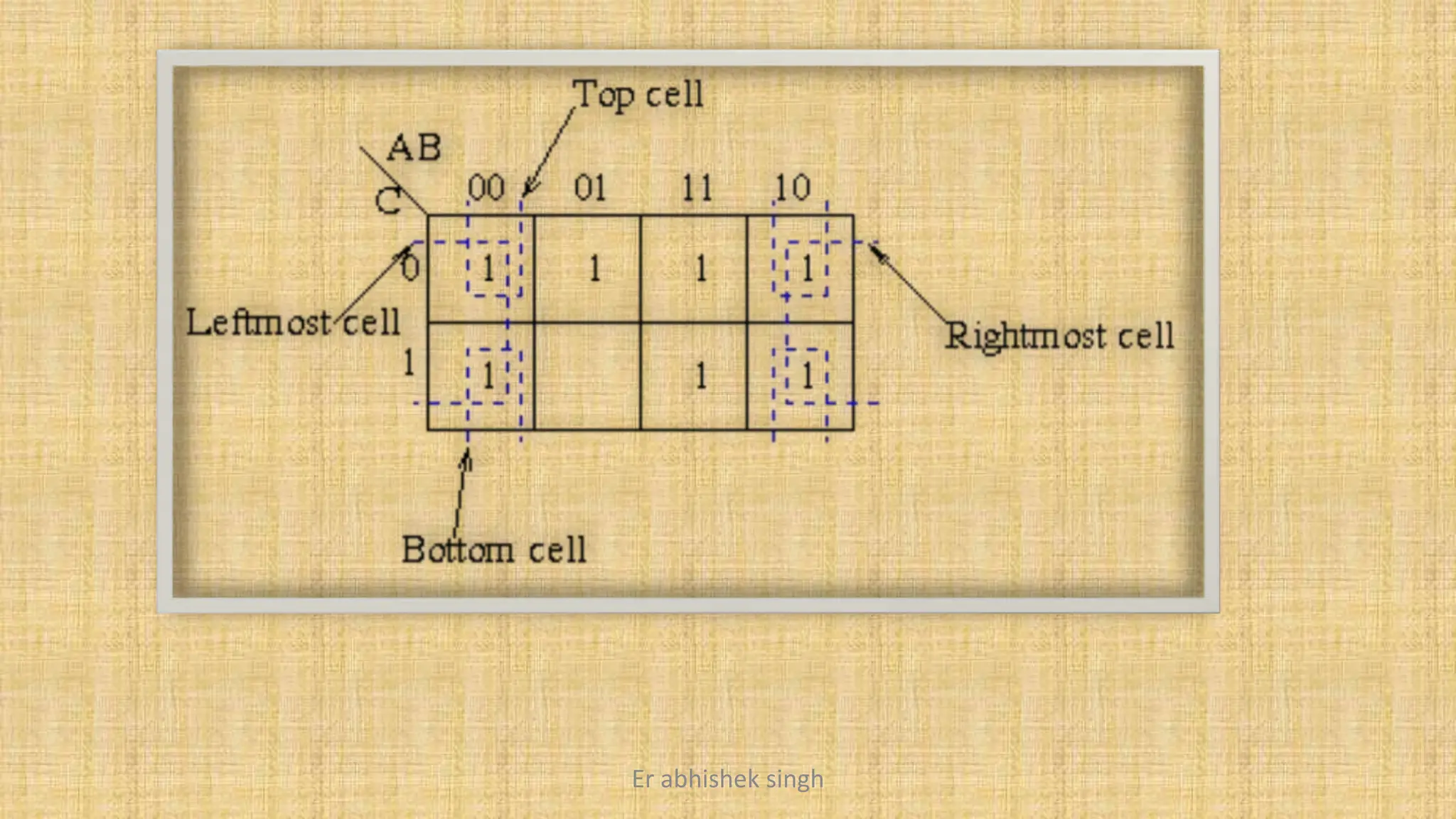
• K-maps can be used for expressions with 2, 3, 4, and
5 variables.
Er abhishek singh
Two-Variable Map
1
0
0 1
x2
x1
0
m0
1
m1
2
m2
3
m3
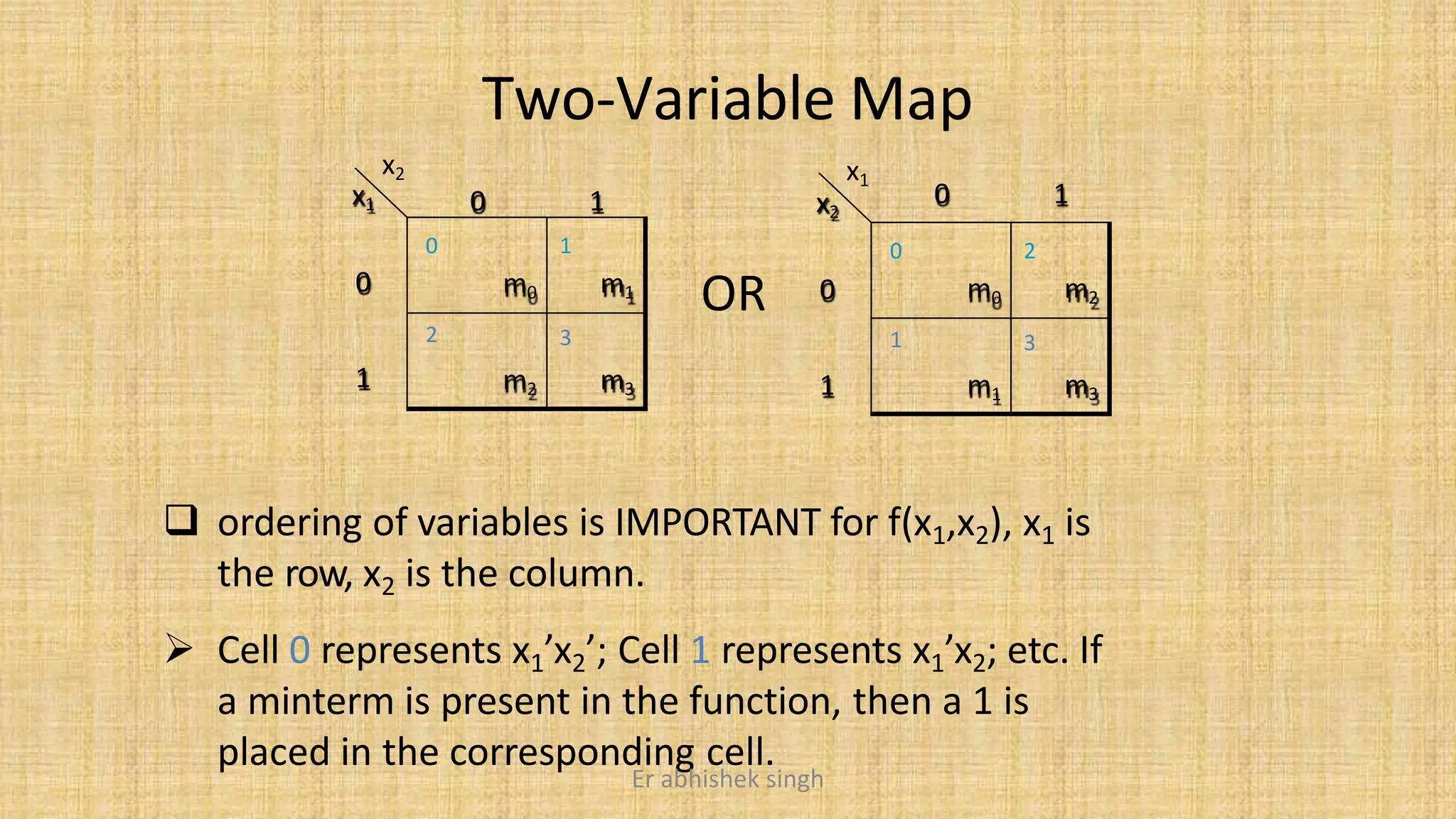
 ordering of variables is IMPORTANT for f(x1,x2), x1 is
the row, x2 is the column.
 Cell 0 represents x1’x2’; Cell 1 represents x1’x2; etc. If
a minterm is present in the function, then a 1 is
placed in the corresponding cell.
1
0
1
0
x1
x2
0
m0
2
m2
1
m1
3
m3
OR
Er abhishek singh
Two-Variable Map
• Any two adjacent cells in the map differ by ONLY one variable,
which appears complemented in one cell and
uncomplemented in the other.
• Example:
m0 (=x1’x2’) is adjacent to m1 (=x1’x2) and m2 (=x1x2’) but NOT m3
(=x1x2)
Er abhishek singh
2-Variable Map -- Example
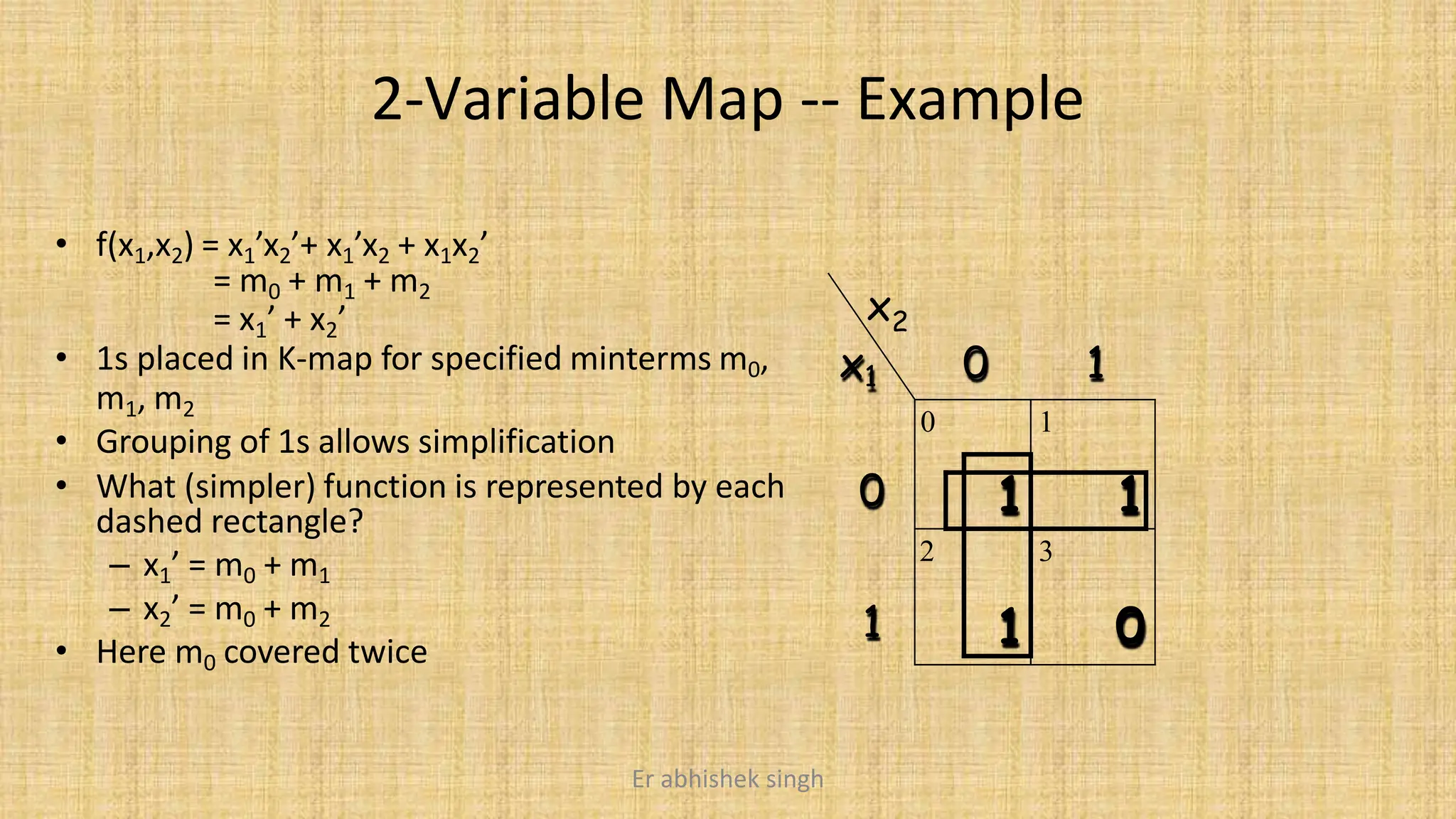
• f(x1,x2) = x1’x2’+ x1’x2 + x1x2’
= m0 + m1 + m2
= x1’ + x2’
• 1s placed in K-map for specified minterms m0,
m1, m2
• Grouping of 1s allows simplification
• What (simpler) function is represented by each
dashed rectangle?
– x1’ = m0 + m1
– x2’ = m0 + m2
• Here m0 covered twice
1
0
1
x
x1 0
2
0 1
1 1
2
1
3
0
Er abhishek singh
The 3 Variable K-Map
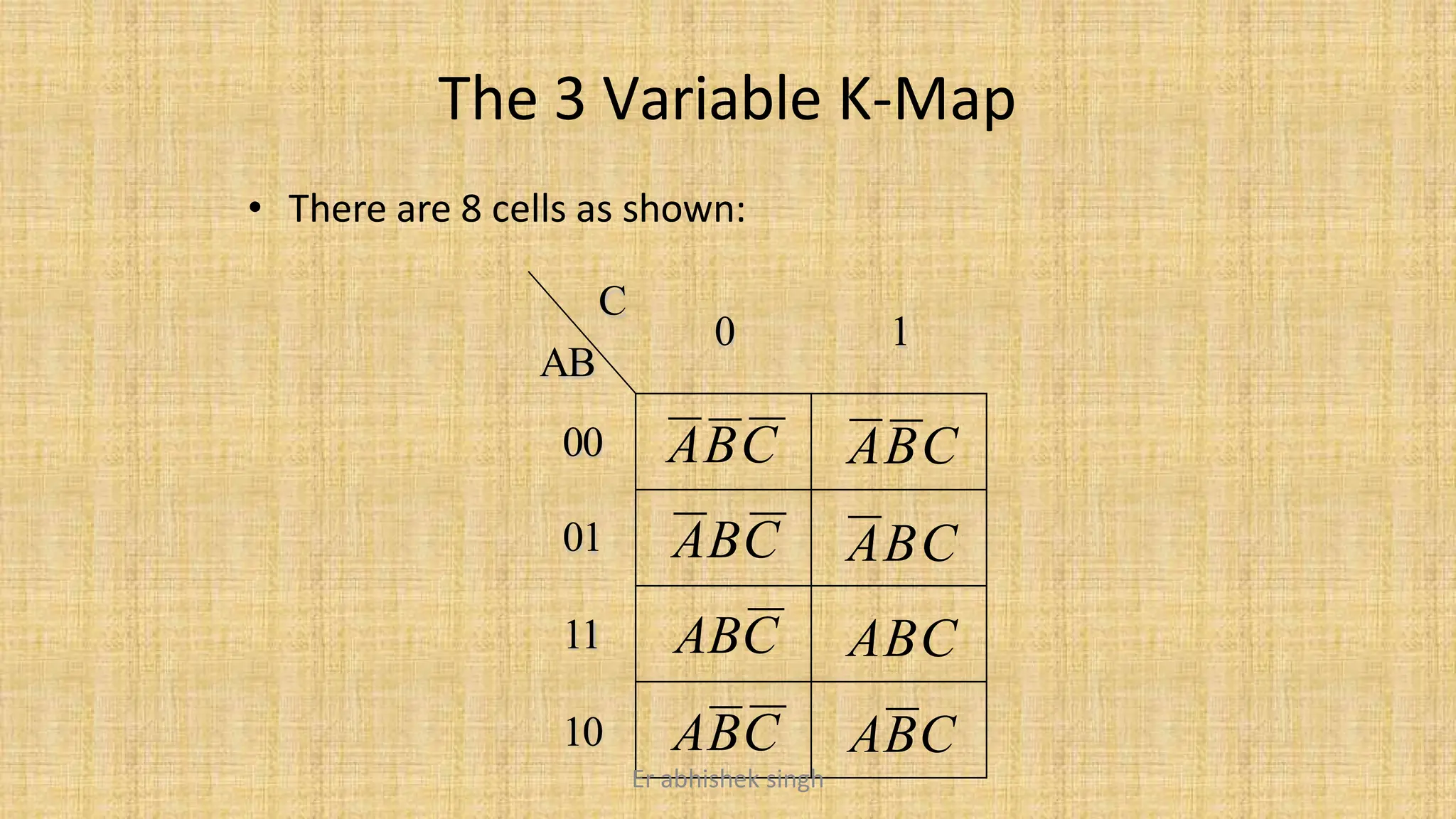
• There are 8 cells as shown:
0 1
C
AB
00
01
11
10
ABC ABC
ABC ABC
ABC ABC
ABC ABC
Er abhishek singh
Example 3 var. k-map
M_
in
_
im
_ iz_
e t
_
he f_
ollowing equation using k-map
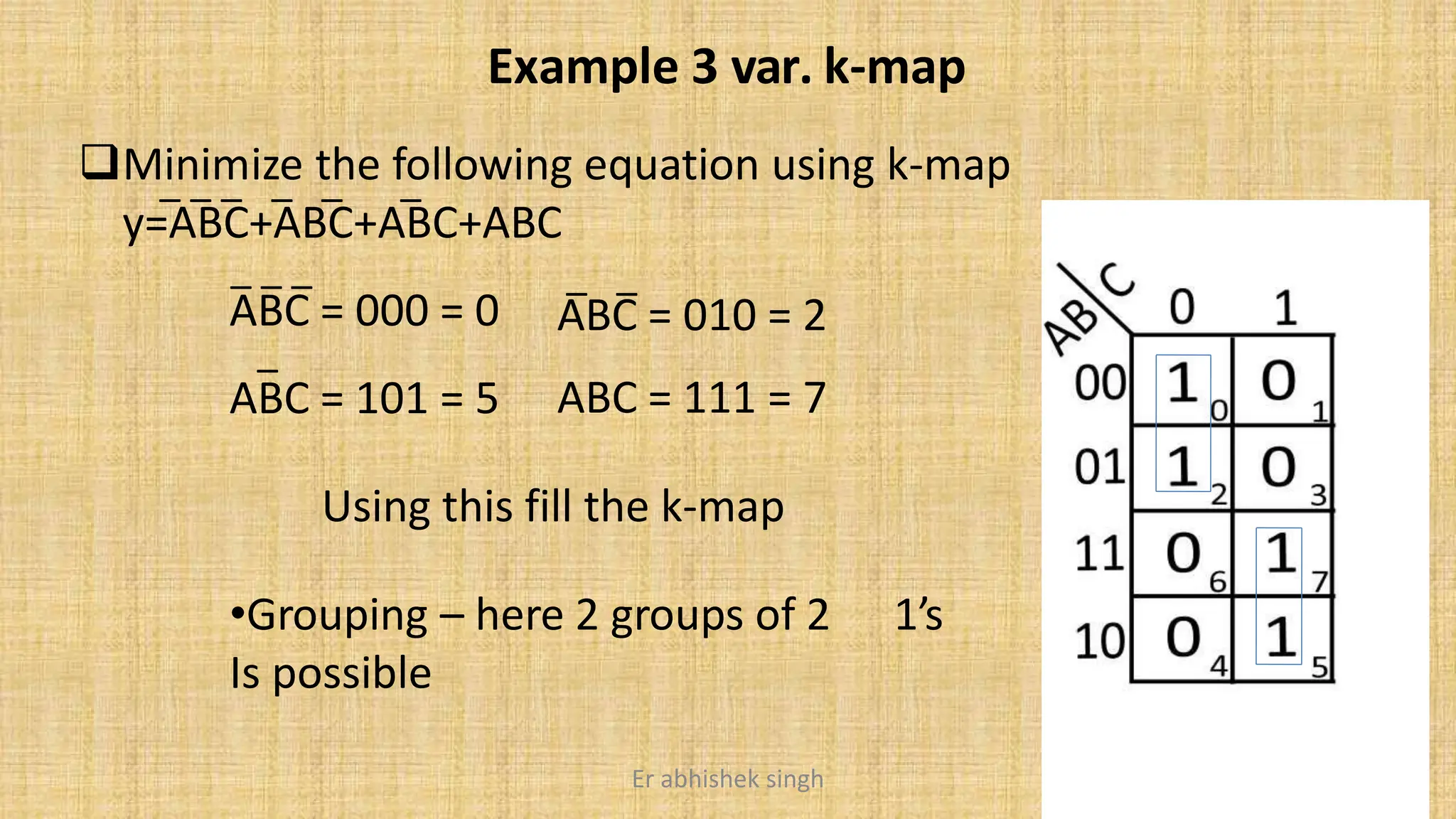
y=ABC+ABC+ABC+ABC
_ _
_ _ _
ABC = 000 = 0
_
ABC = 101 = 5
ABC = 010 = 2
ABC = 111 = 7
Using this fill the k-map
•Grouping – here 2 groups of 2 1’s
Is possible
Er abhishek singh
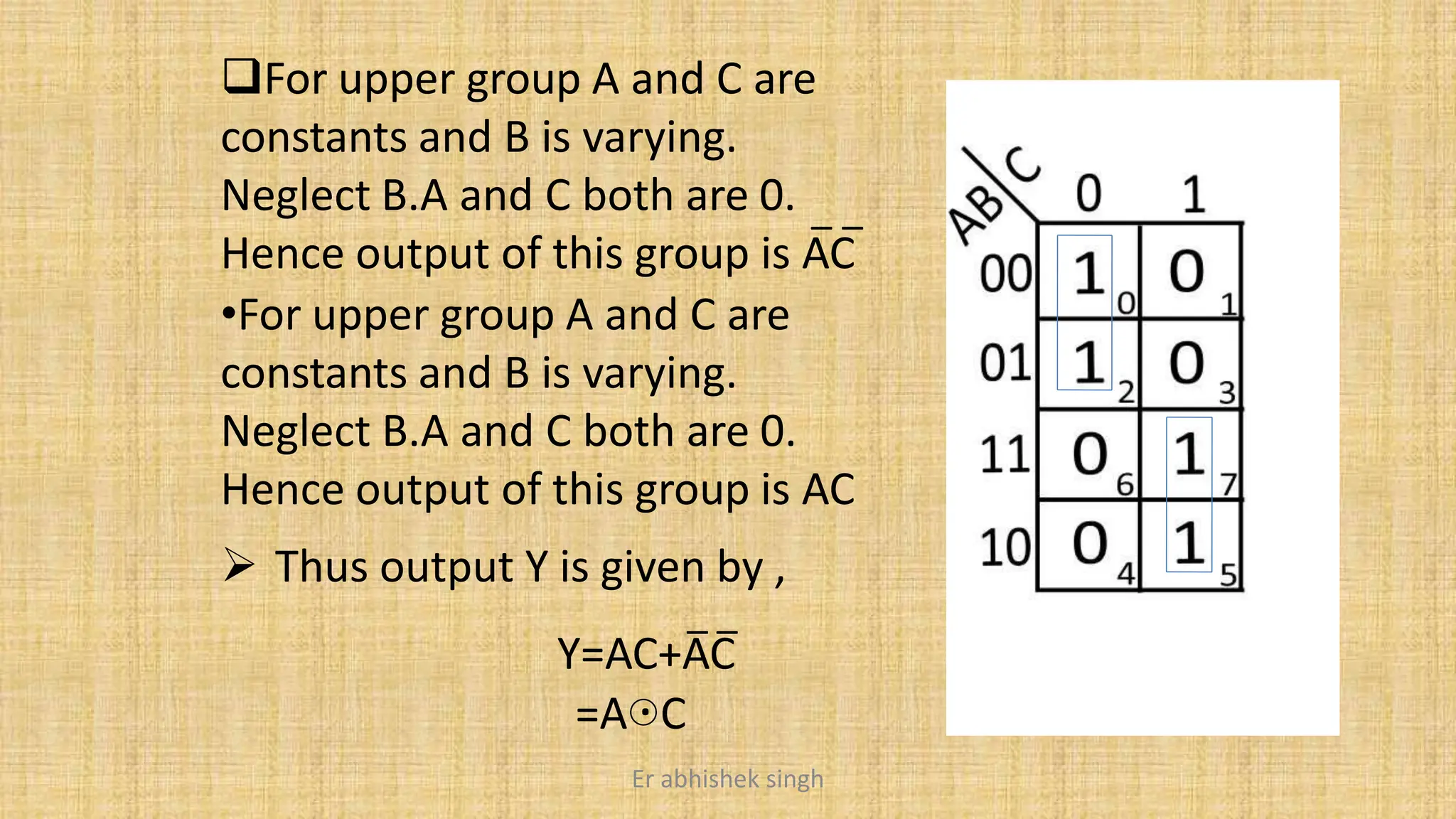
For upper group A and C are
constants and B is varying.
Neglect B.A and C both are 0. _ _
Hence output of this group is AC
•For upper group A and C are
constants and B is varying.
Neglect B.A and C both are 0.
Hence output of this group is AC
 Thus output Y is given by ,
_ _
Y=AC+AC
=A⃝
.C
Er abhishek singh
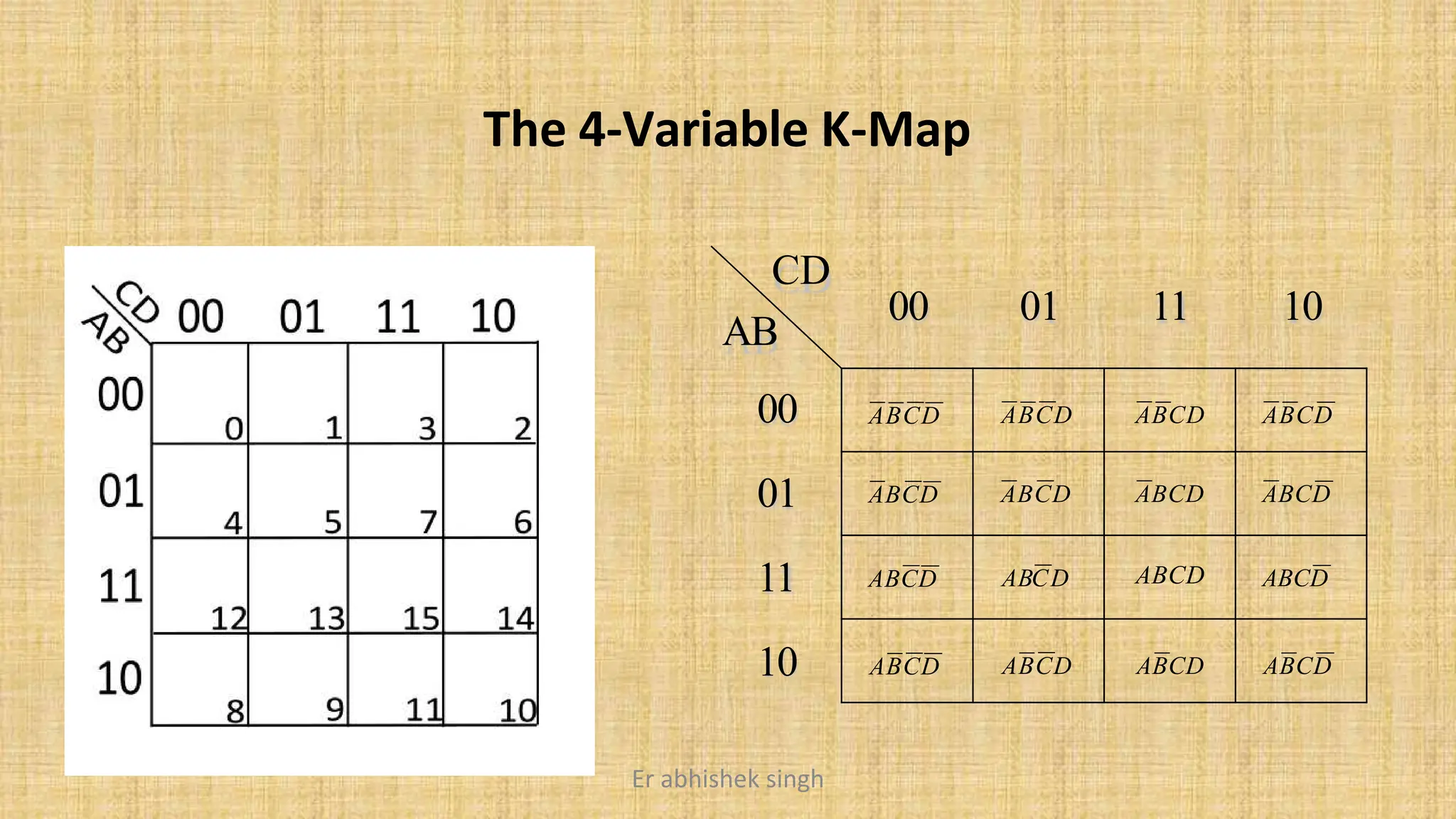
00 01 11 10
CD
AB
00
01
11
10
ABCD ABCD ABCD ABCD
ABCD ABCD ABCD ABCD
ABCD ABCD ABCD ABCD
ABCD ABCD ABCD ABCD
The 4-Variable K-Map
Er abhishek singh
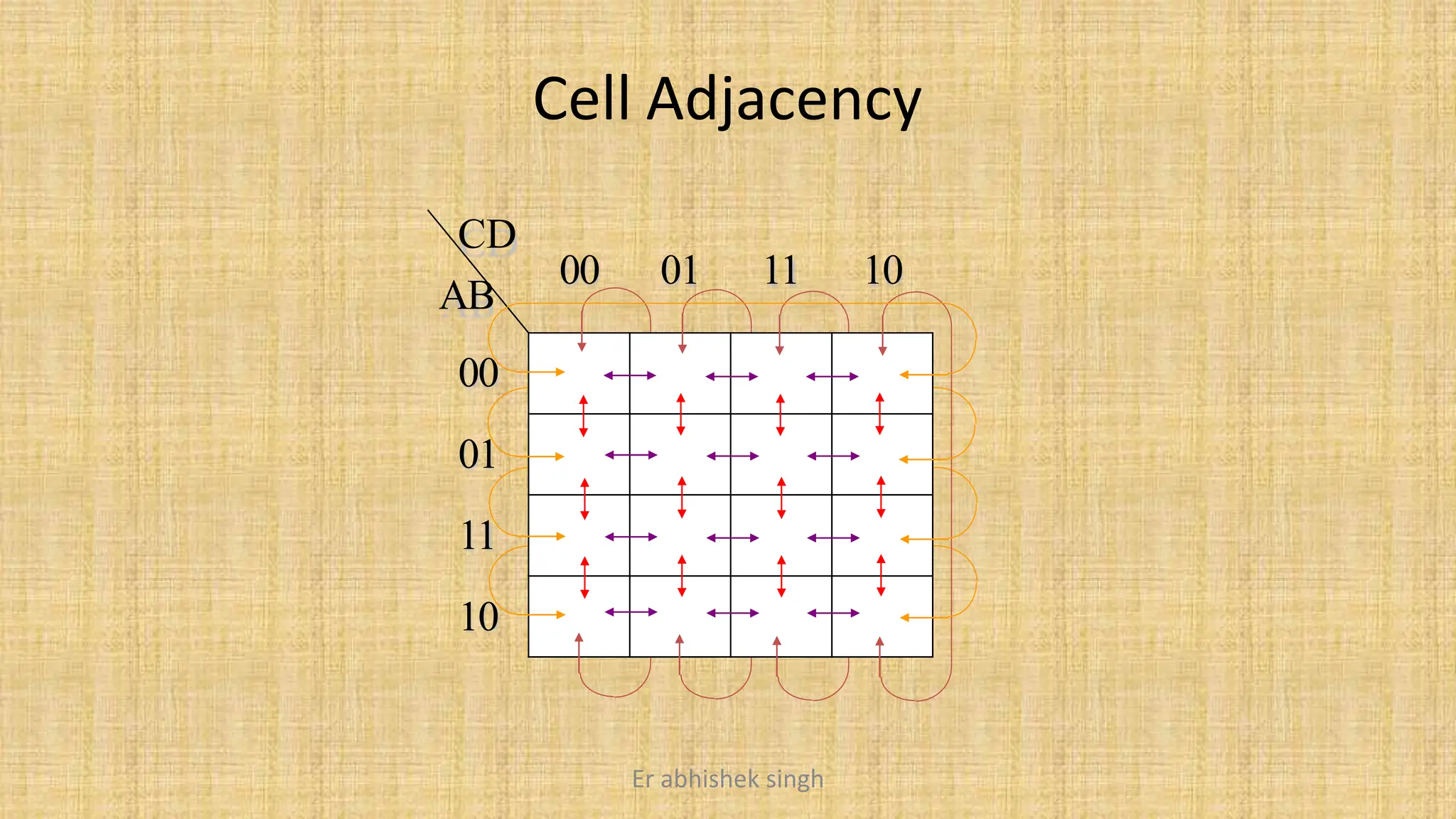
00 01 11 10
CD
AB
00
01
11
10
Cell Adjacency
Er abhishek singh
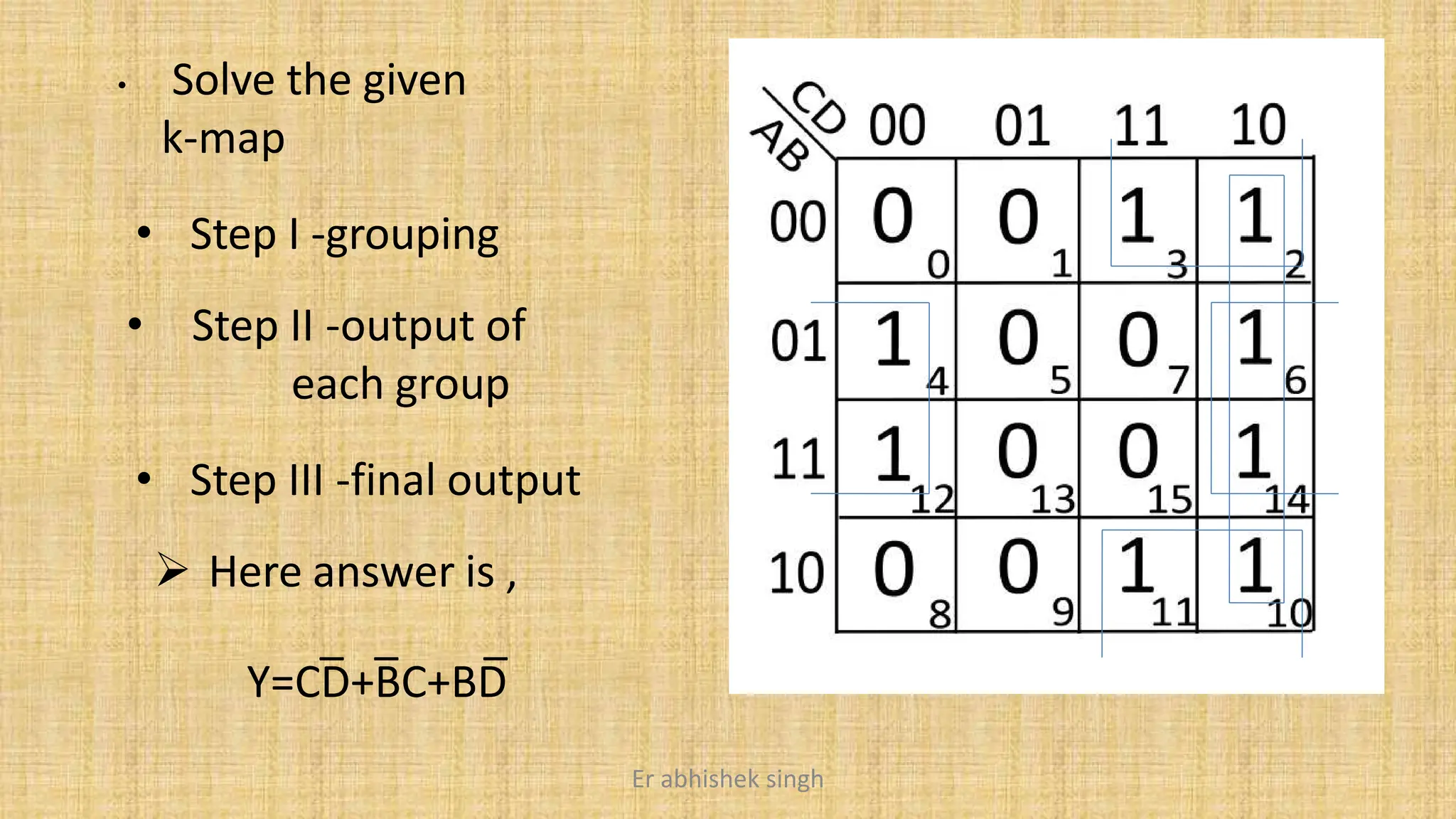
• Solve the given
k-map
• Step I -grouping
• Step II -output of
each group
• Step III -final output
 Here answer is ,
_ _ _
Y=CD+BC+BD
Er abhishek singh
K-Map SOP Minimization
• The K-Map is used for simplifying Boolean expressions to their
minimal form.
• A minimized SOP expression contains the fewest possible
terms with fewest possible variables per term.
• Generally, a minimum SOP expression can be implemented
with fewer logic gates than a standard expression.
Er abhishek singh
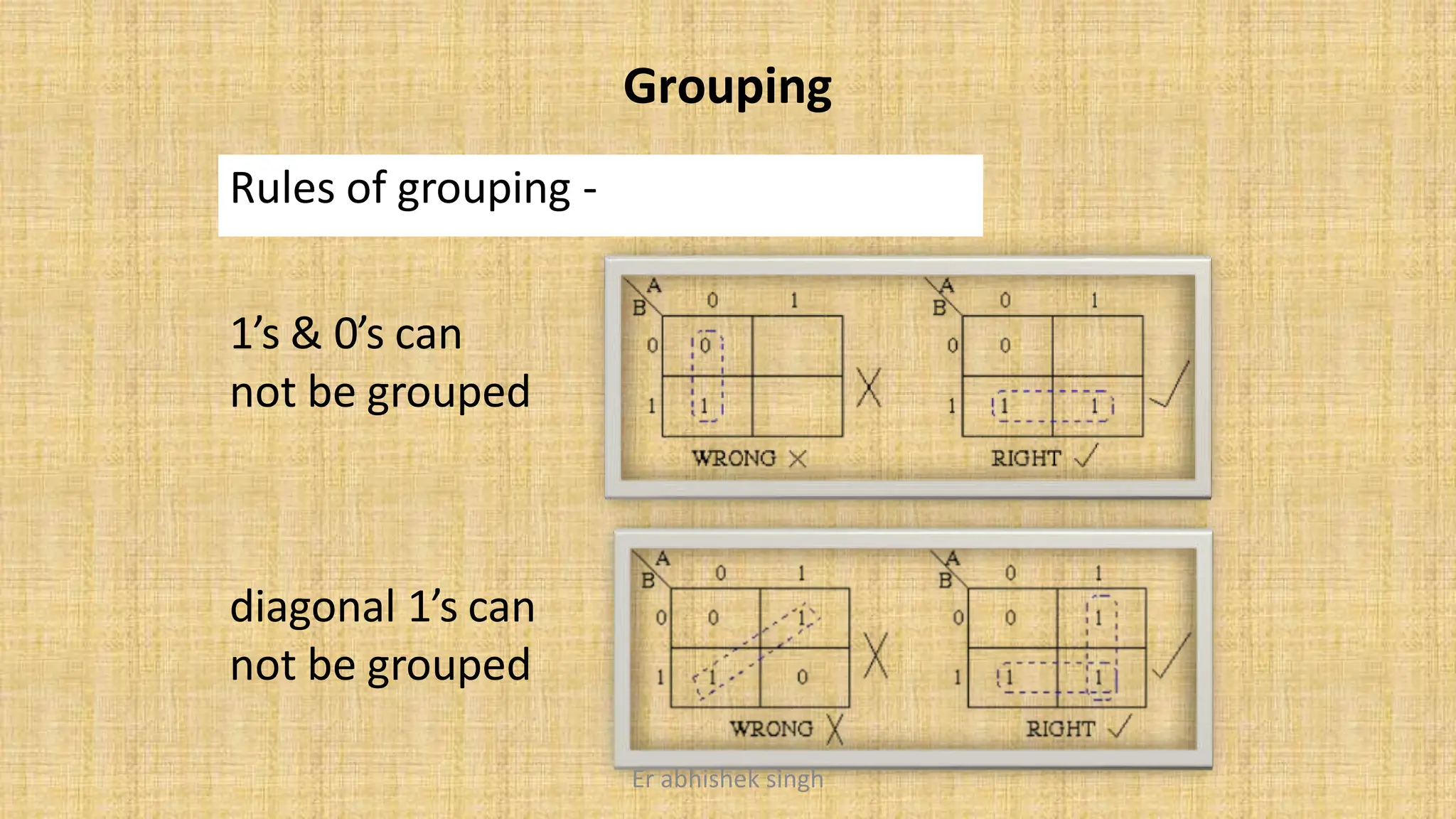
Grouping
Rules of grouping -
1’s & 0’s can
not be grouped
diagonal 1’s can
not be grouped
Er abhishek singh
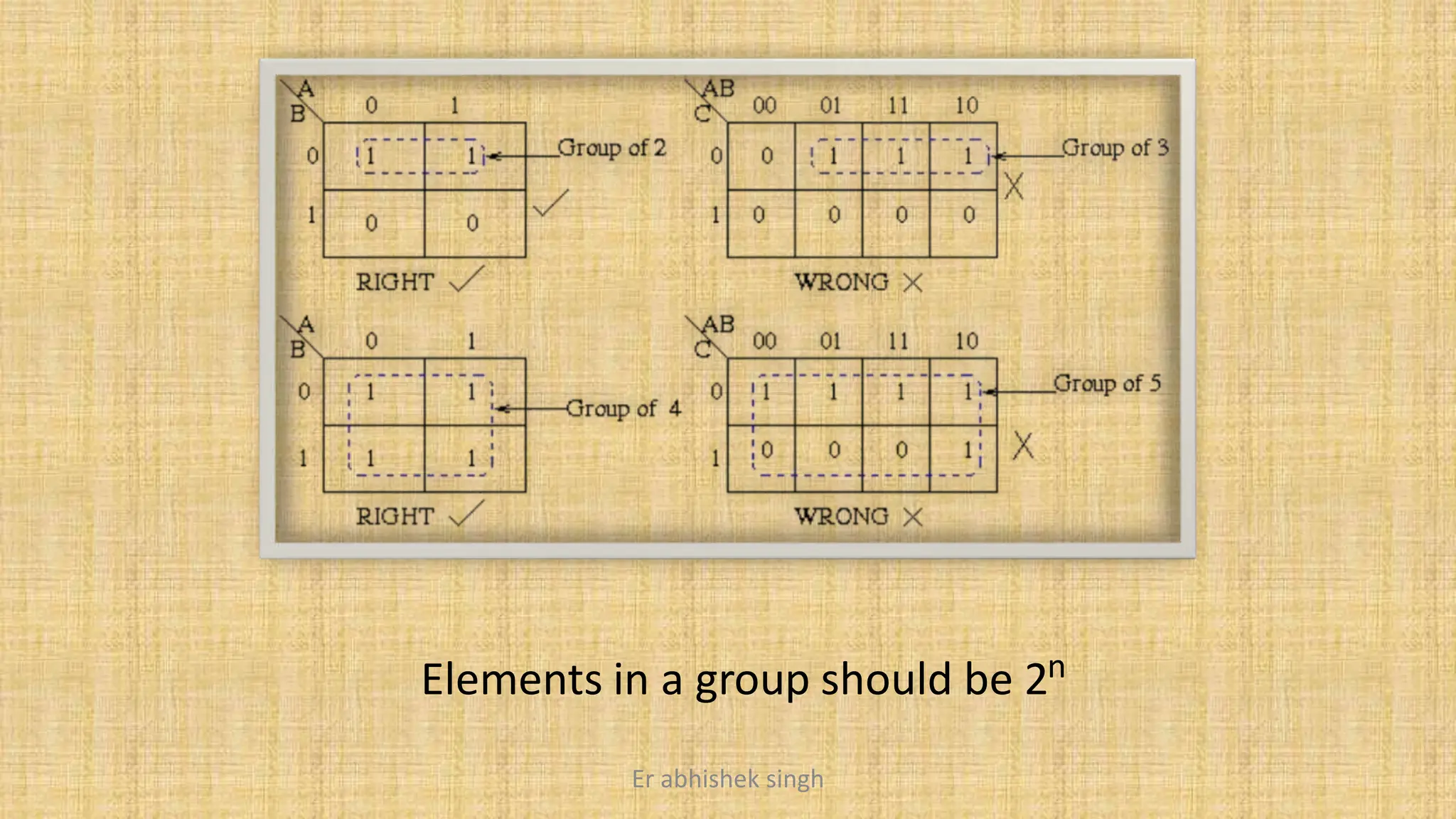
Elements in a group should be 2n
Er abhishek singh
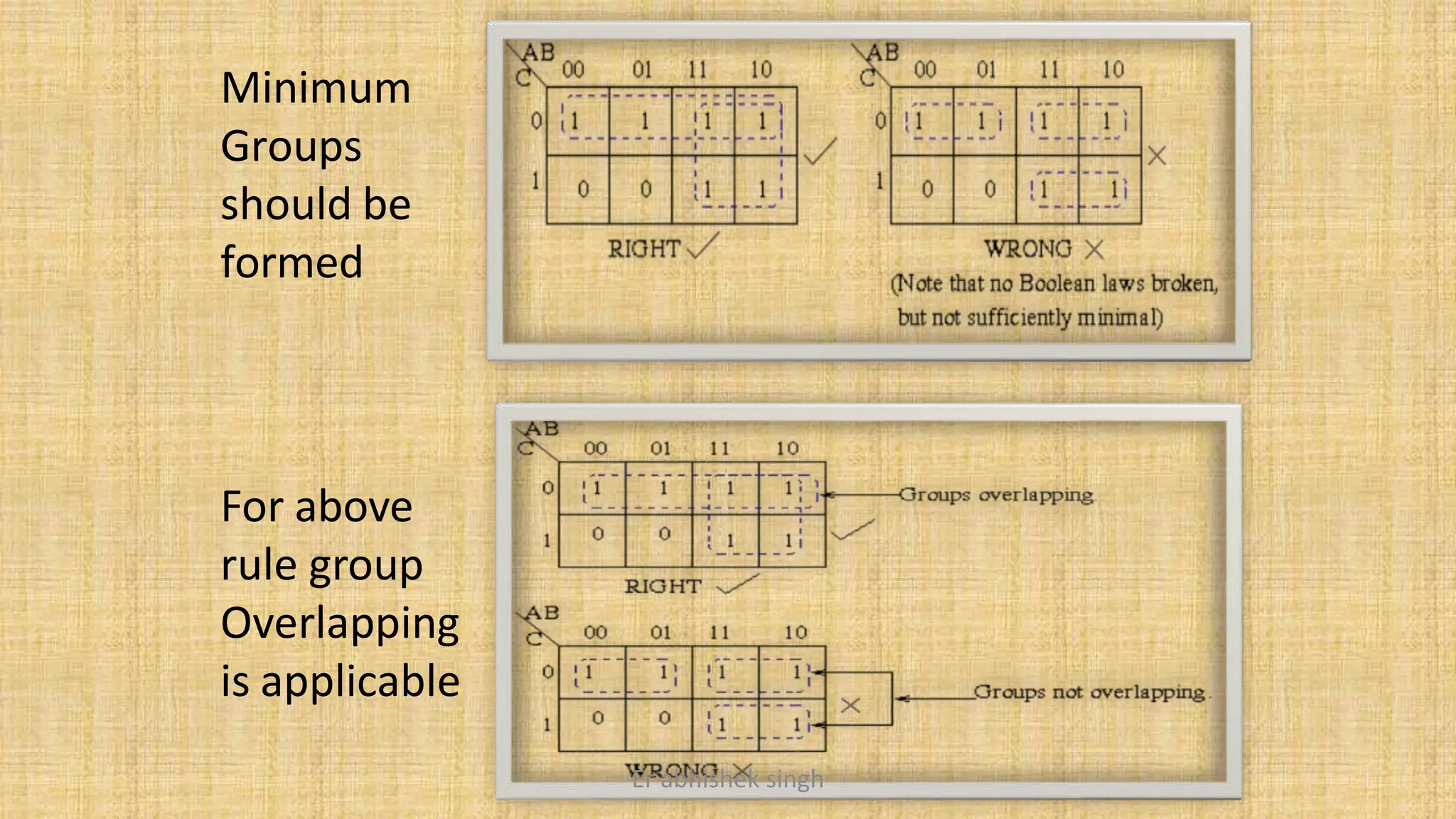
Minimum
Groups
should be
formed
For above
rule group
Overlapping
is applicable
Er abhishek singh
Er abhishek singh
Mapping a Standard SOP Expression
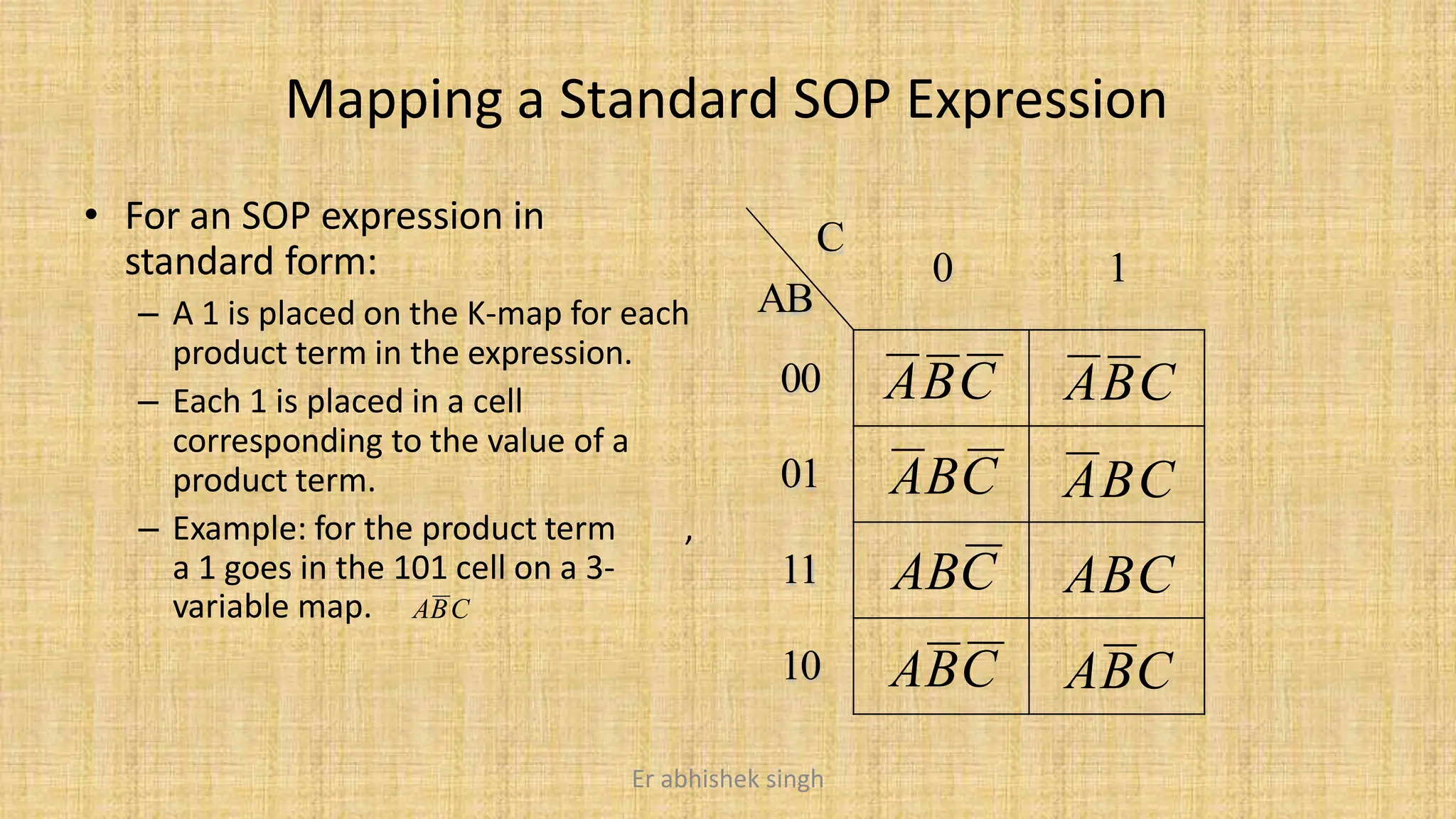
• For an SOP expression in
standard form:
– A 1 is placed on the K-map for each
product term in the expression.
– Each 1 is placed in a cell
corresponding to the value of a
product term.
– Example: for the product term ,
a 1 goes in the 101 cell on a 3-
C
0 1
AB
00
01
11
10
ABC ABC
ABC ABC
ABC ABC
ABC ABC
variable map. ABC
Er abhishek singh
C
AB
00
01
11
10
Mapping a Standard SOP Expression
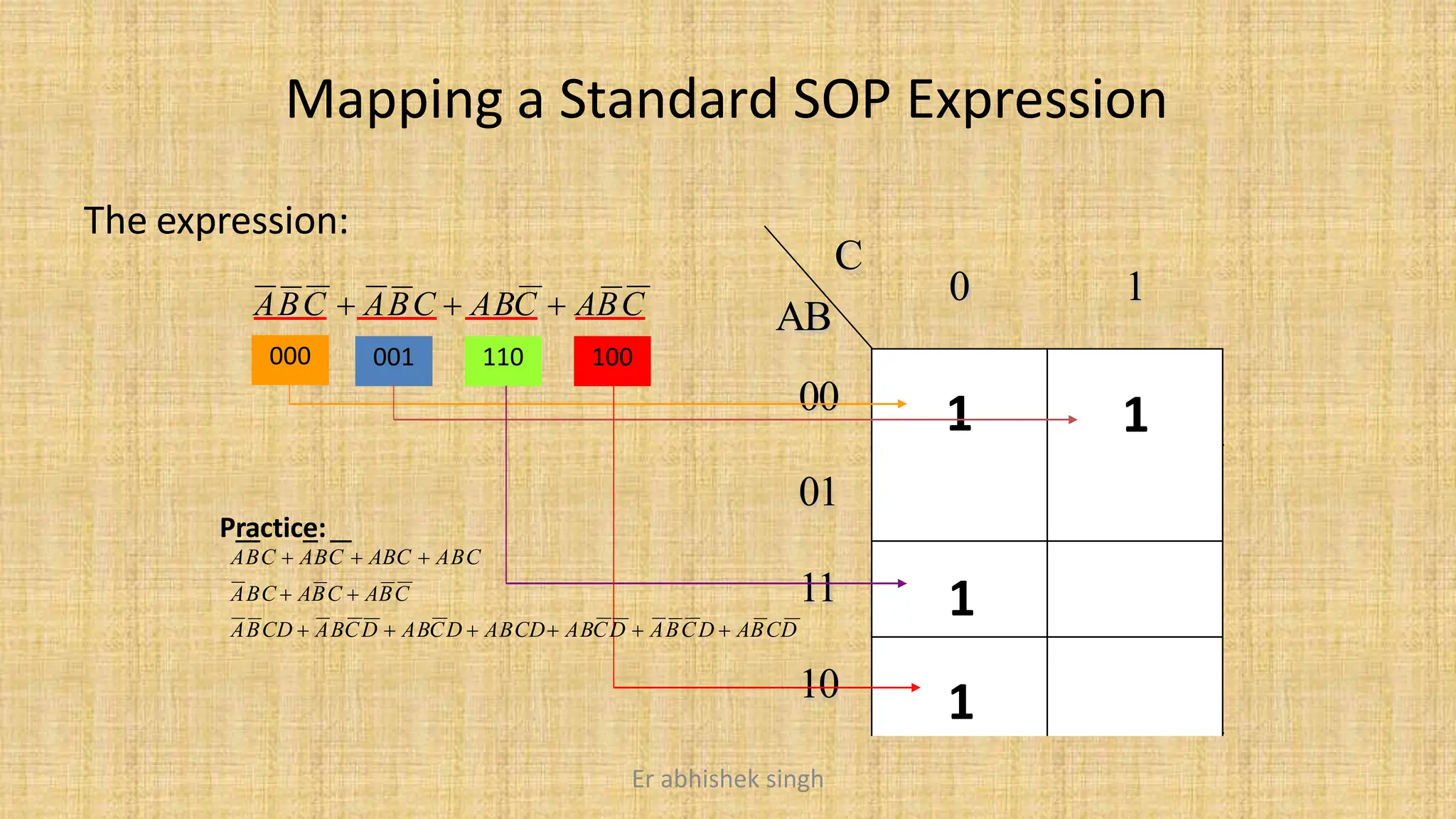
The expression:
ABC  ABC  ABC  ABC
000 001 110 100
0 1
1 1
1
1
ABCD  ABCD  ABCD  ABCD ABCD  ABCD  ABCD
ABC  ABC  ABC
Practice:
ABC  ABC  ABC  ABC
Er abhishek singh
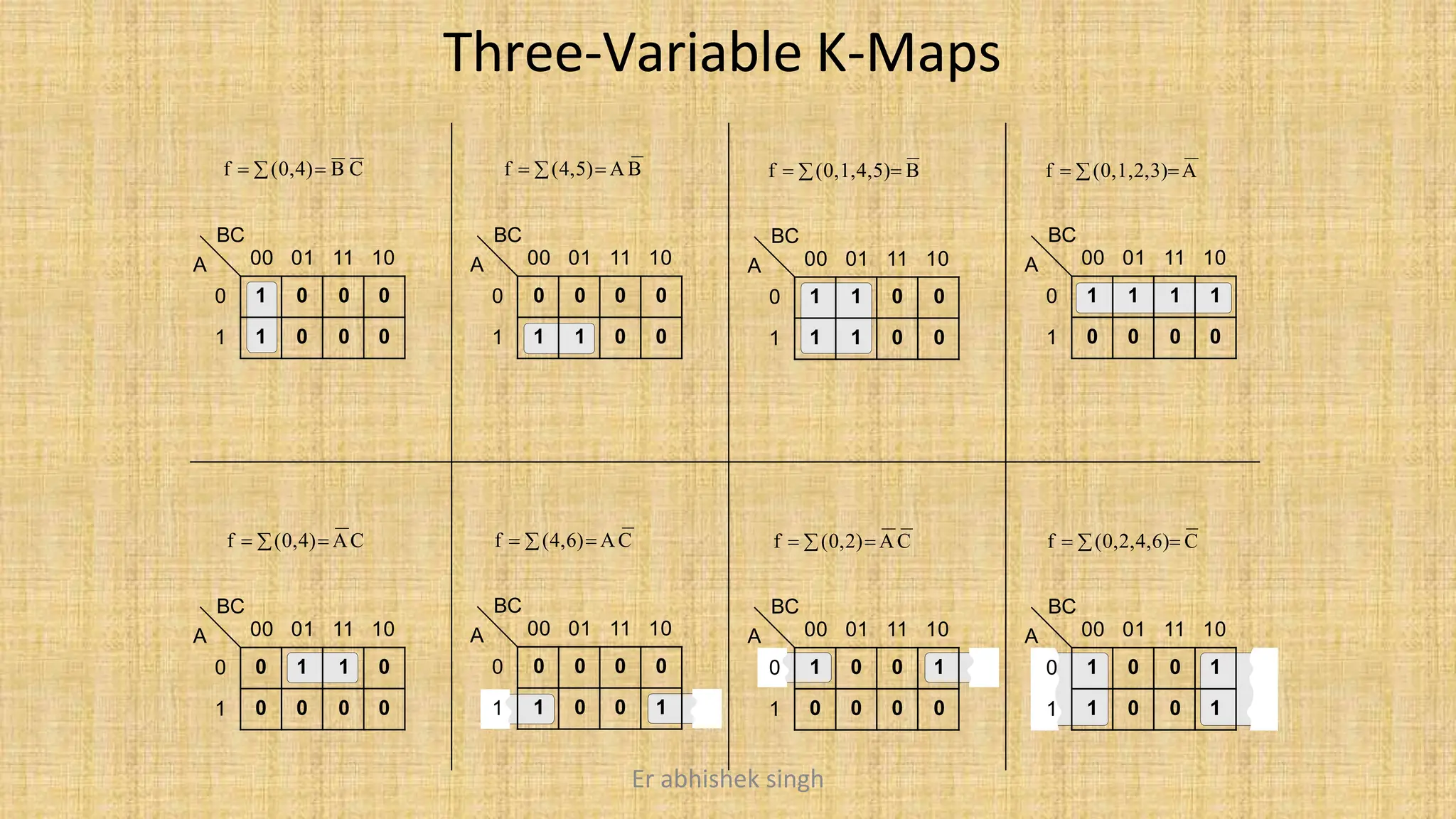
Three-Variable K-Maps
f  (0,4) B C f  (4,5) A B f  (0,1,4,5) B f  (0,1,2,3)A
0
1
BC
A 00 01 11 10
1 0 0 0
1 0 0 0
0
1
BC
A 00 01 11 10
0 0 0 0
1 1 0 0
0
1
BC
A 00 01 11 10
1 1 1 1
0 0 0 0
0
1
BC
A 00 01 11 10
1 1 0 0
1 1 0 0
f  (0,4) AC f  (4,6) AC f  (0,2) AC f  (0,2,4,6) C
0
1
BC
A 00 01 11 10
0 1 1 0
0 0 0 0
0
1
BC
A 00 01 11 10
0 0 0 0
1 0 0 1
0
1
BC
A 00 01 11 10
1 0 0 1
1 0 0 1
0
1
BC
A 00 01 11 10
1 0 0 1
0 0 0 0
Er abhishek singh
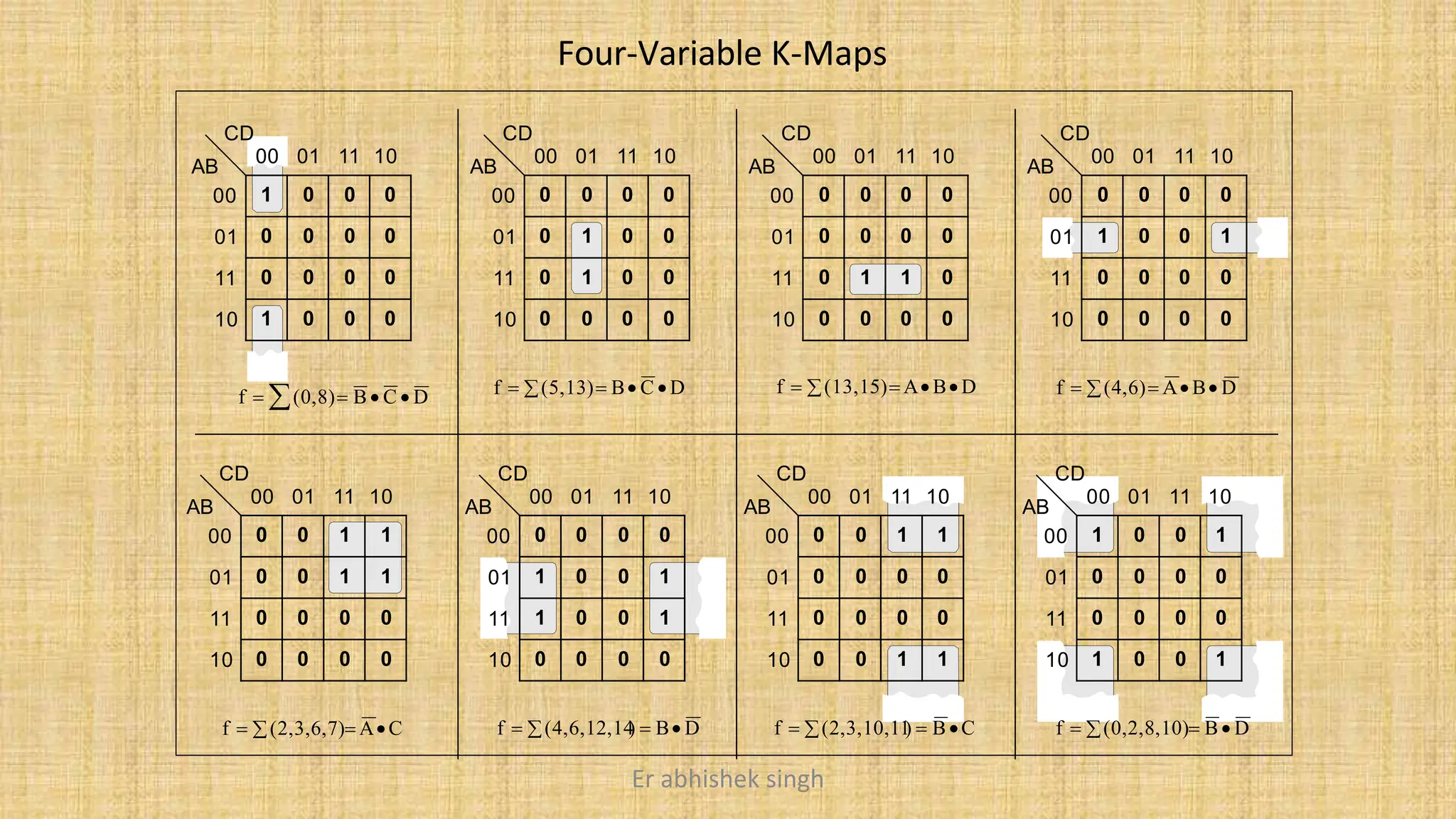
Four-Variable K-Maps
f  (0,8) B C  D f  (5,13) B C D f  (13,15) ABD f  (4,6) AB D
f  (2,3,6,7) AC f  (4,6,12,14
)  B D f  (2,3,10,11
)  BC f  (0,2,8,10) B D
CD
00 01 11 10
AB
00
01
11
10
1 0 0 0
0 0 0 0
0 0 0 0
1 0 0 0
CD
00 01 11 10
AB
00
01
11
10
0 0 0 0
0 1 0 0
0 1 0 0
0 0 0 0
CD
00 01 11 10
AB
00
01
11
10
0 0 0 0
0 0 0 0
0 1 1 0
0 0 0 0
CD
00 01 11 10
AB
00
01
11
10
0 0 0 0
1 0 0 1
0 0 0 0
0 0 0 0
CD
00 01 11 10
AB
00
01
11
10
0 0 1 1
0 0 1 1
0 0 0 0
0 0 0 0
CD
00 01 11 10
AB
00
01
11
10
0 0 0 0
1 0 0 1
1 0 0 1
0 0 0 0
CD
00 01 11 10
AB
00
01
11
10
0 0 1 1
0 0 0 0
0 0 0 0
0 0 1 1
CD
00 01 11 10
AB
00
01
11
10
1 0 0 1
0 0 0 0
0 0 0 0
1 0 0 1
Er abhishek singh
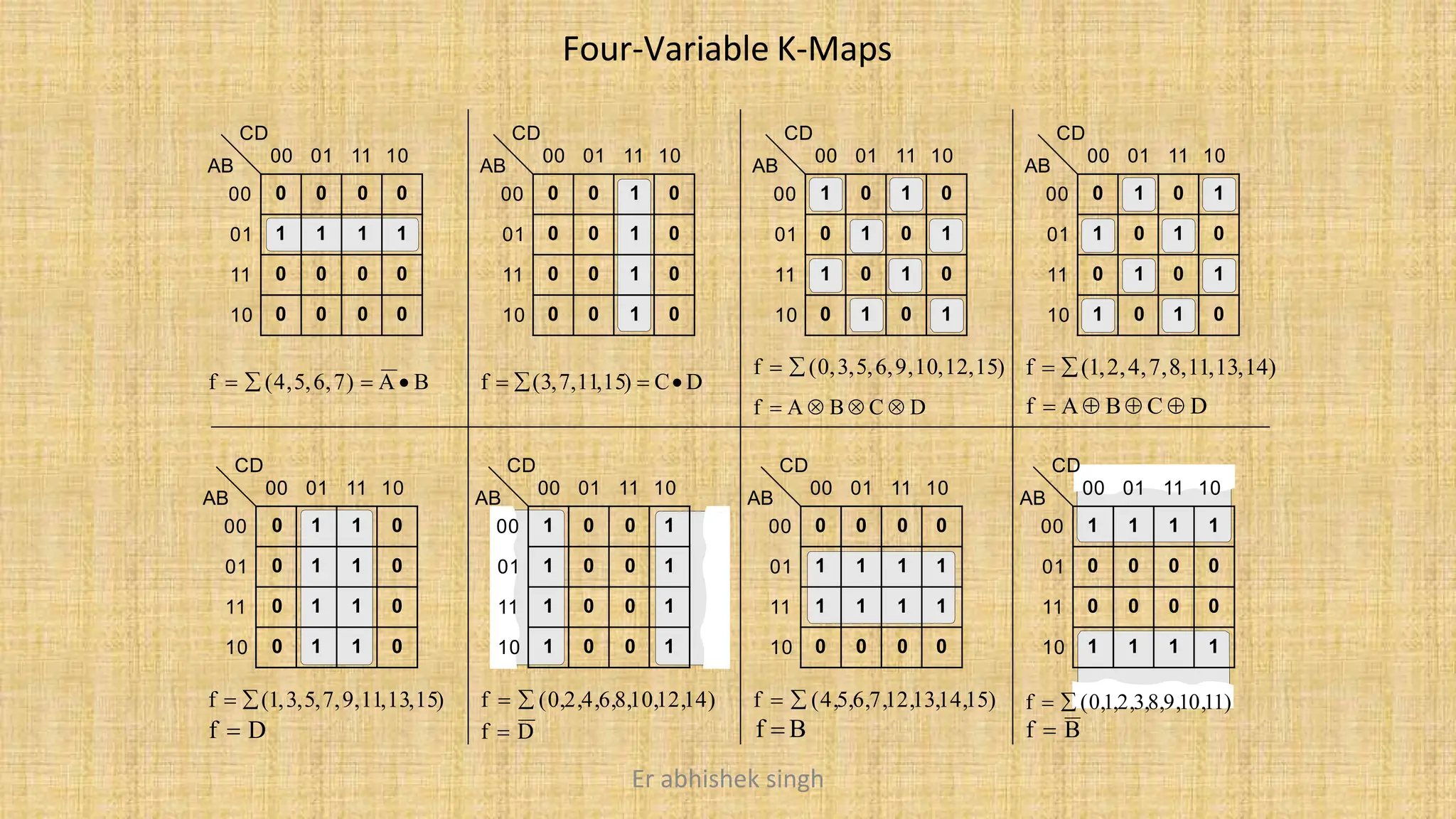
Four-Variable K-Maps
CD
00 01 11 10
AB
00
01
11
10
0 0 0 0
1 1 1 1
0 0 0 0
0 0 0 0
CD
00 01 11 10
AB
00
01
11
10
0 0 1 0
0 0 1 0
0 0 1 0
0 0 1 0
CD
00 01 11 10
AB
00
01
11
10
1 0 1 0
0 1 0 1
1 0 1 0
0 1 0 1
CD
00 01 11 10
AB
00
01
11
10
0 1 0 1
1 0 1 0
0 1 0 1
1 0 1 0
CD
00 01 11 10
AB
00
01
11
10
0 1 1 0
0 1 1 0
0 1 1 0
0 1 1 0
CD
00 01 11 10
AB
00
01
11
10
1 0 0 1
1 0 0 1
1 0 0 1
1 0 0 1
CD
00 01 11 10
AB
00
01
11
10
0 0 0 0
1 1 1 1
1 1 1 1
0 0 0 0
CD
00 01 11 10
AB
00
01
11
10
1 1 1 1
0 0 0 0
0 0 0 0
1 1 1 1
f   (4,5,6,7)  A  B f  (3,7,11,15)  C D
f   (0,3,5,6,9,10,12,15)
f  A  B  C  D
f  (1,2,4,7,8,11,13,14)
f  A  B C  D
f  (1,3,5,7,9,11,13,15)
f  D
f   (0,2,4,6,8,10,12,14)
f  D
f   (4,5,6,7,12,13,14,15)
f  B
f   (0,1,2,3,8,9,10,11)
f  B
Er abhishek singh
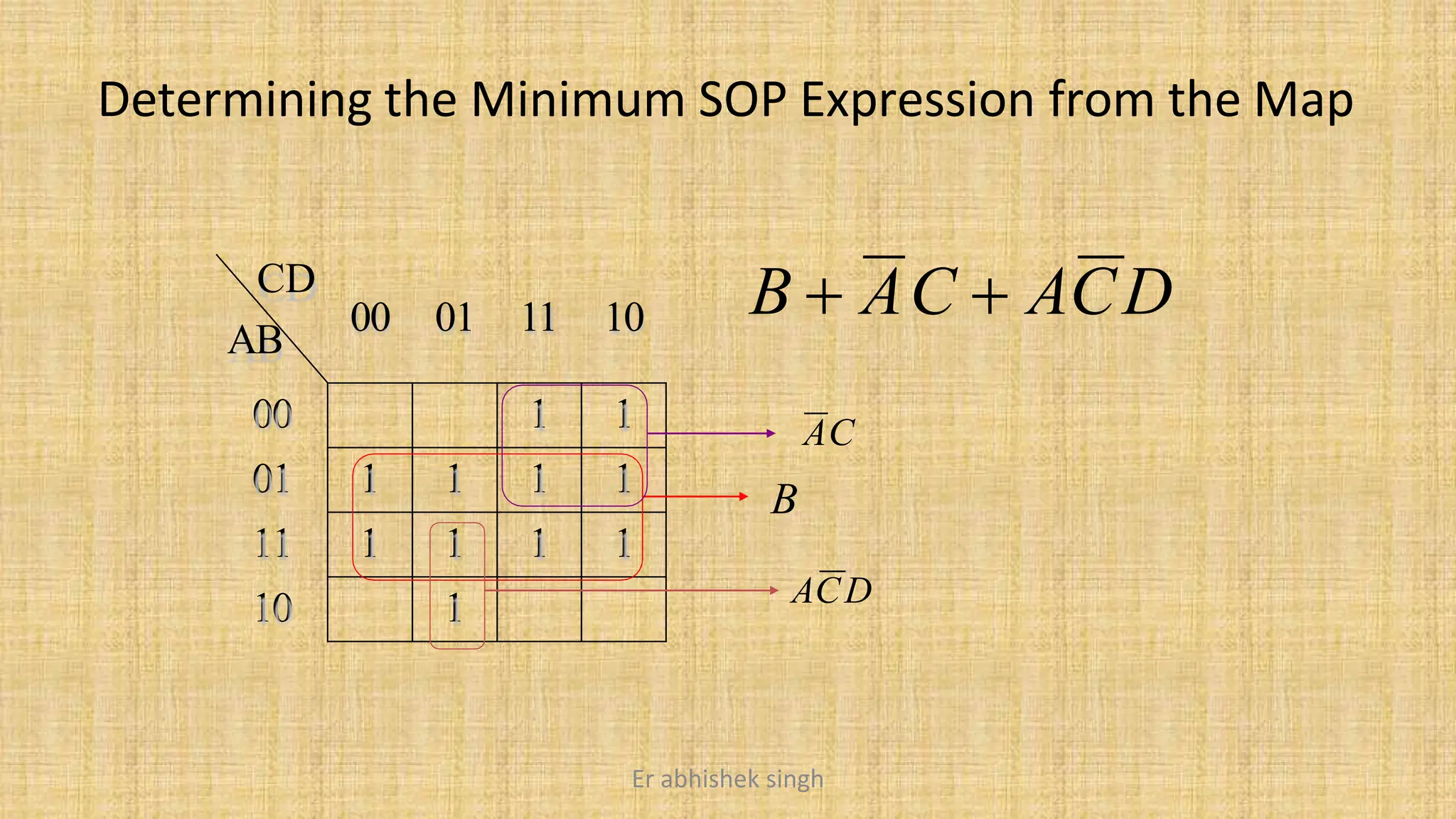
Determining the Minimum SOP Expression from the Map
CD
AB
00 01 11 10
00 1 1
01 1 1 1 1
11 1 1 1 1
10 1
AC
B
ACD
B  AC  ACD
Er abhishek singh
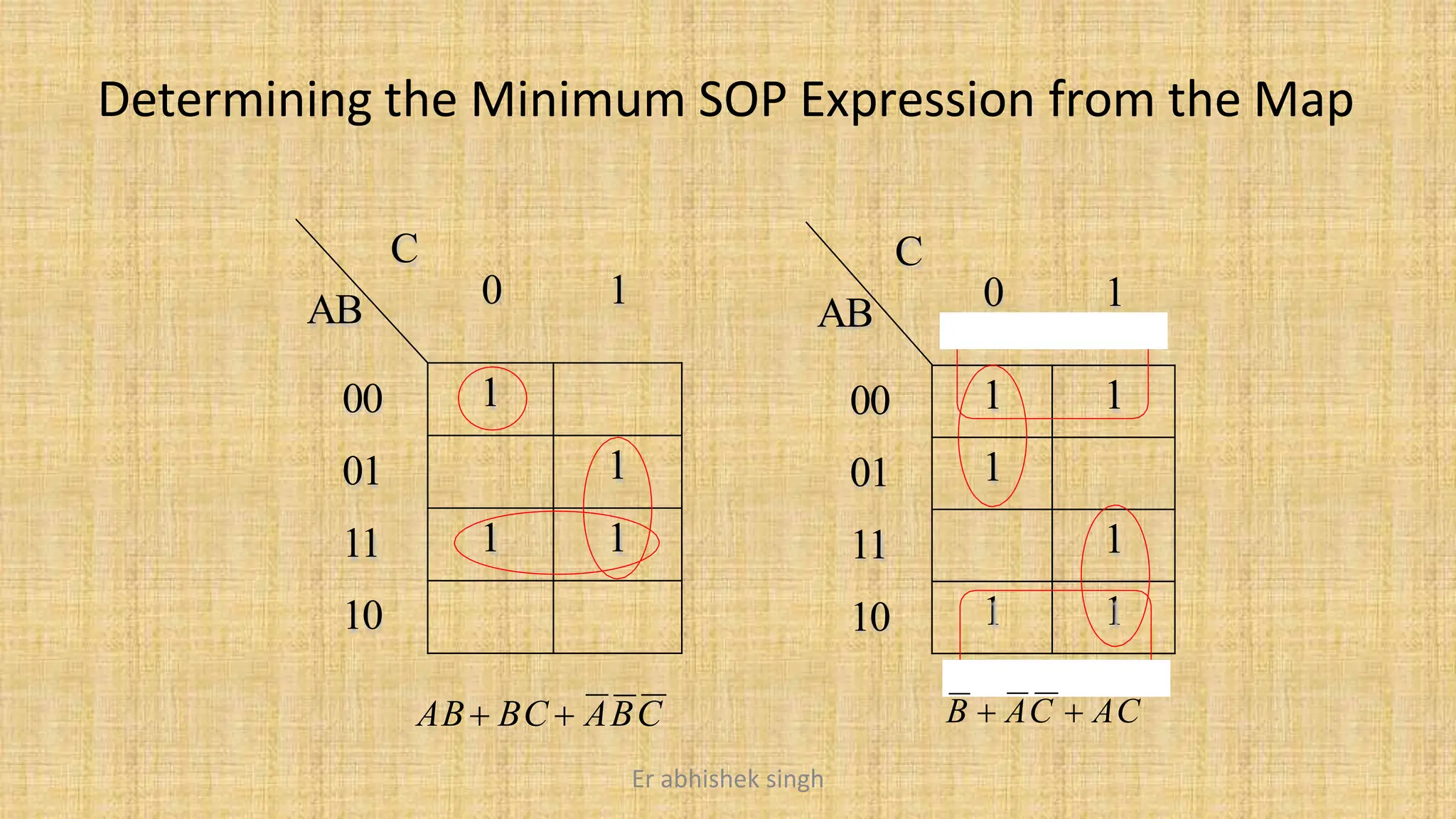
Determining the Minimum SOP Expression from the Map
AB BC  ABC
C
AB 0 1
1
1
1 1
00
01
11
10
0 1
C
AB
00
01
11
10
1 1
1
1
1 1
B  AC  AC
Er abhishek singh
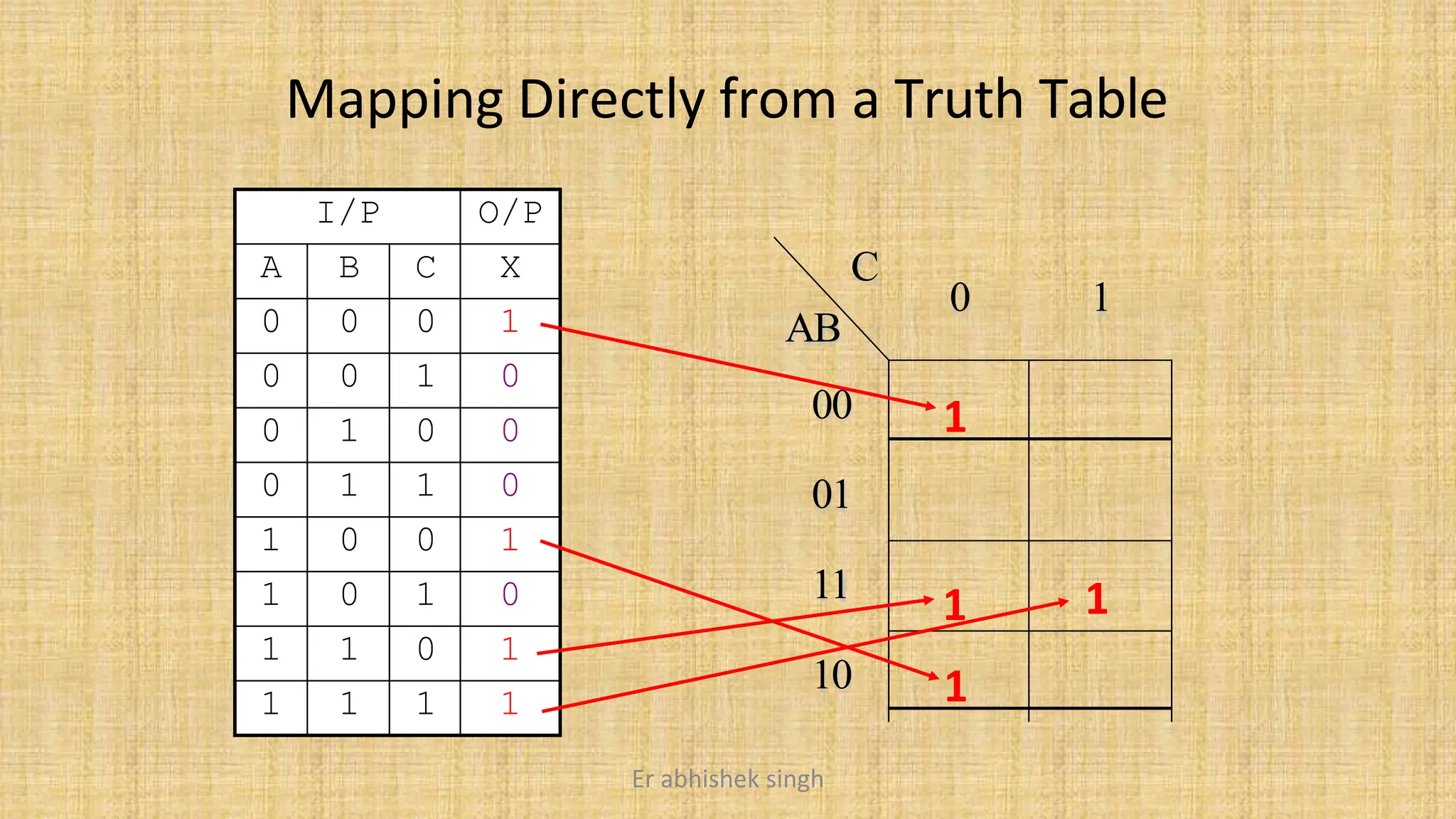
Mapping Directly from a Truth Table
I/P O/P
A B C X
0 0 0 1
0 0 1 0
0 1 0 0
0 1 1 0
1 0 0 1
1 0 1 0
1 1 0 1
1 1 1 1
C
AB
00
01
11
10
0 1
1
1
1
1
Er abhishek singh
Don’t Care Conditions
• A don’t care condition, marked by (X) in the truth
table, indicates a condition where the design doesn’t
care if the output is a (0) or a (1).
• A don’t care condition can be treated as a (0) or a (1)
in a K-Map.
• Treating a don’t care as a (0) means that you do not
need to group it.
• Treating a don’t care as a (1) allows you to make a
grouping larger, resulting in a simpler term in the SOP
equation.
Er abhishek singh
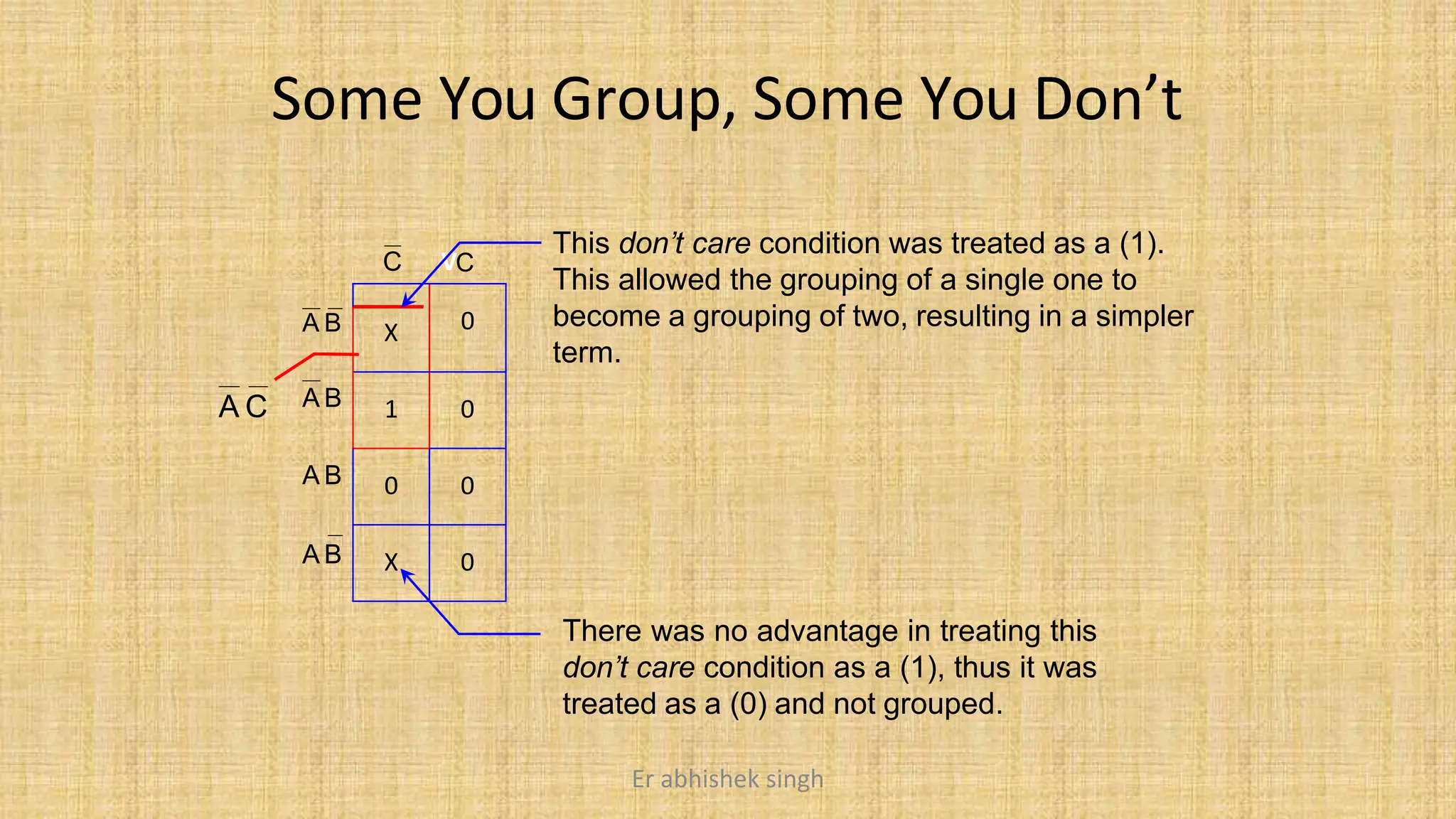
Some You Group, Some You Don’t
0
X
1 0
0 0
X 0
C VC
A B
A B
A B
A B
A C
This don’t care condition was treated as a (1).
This allowed the grouping of a single one to
become a grouping of two, resulting in a simpler
term.
There was no advantage in treating this
don’t care condition as a (1), thus it was
treated as a (0) and not grouped.
Er abhishek singh
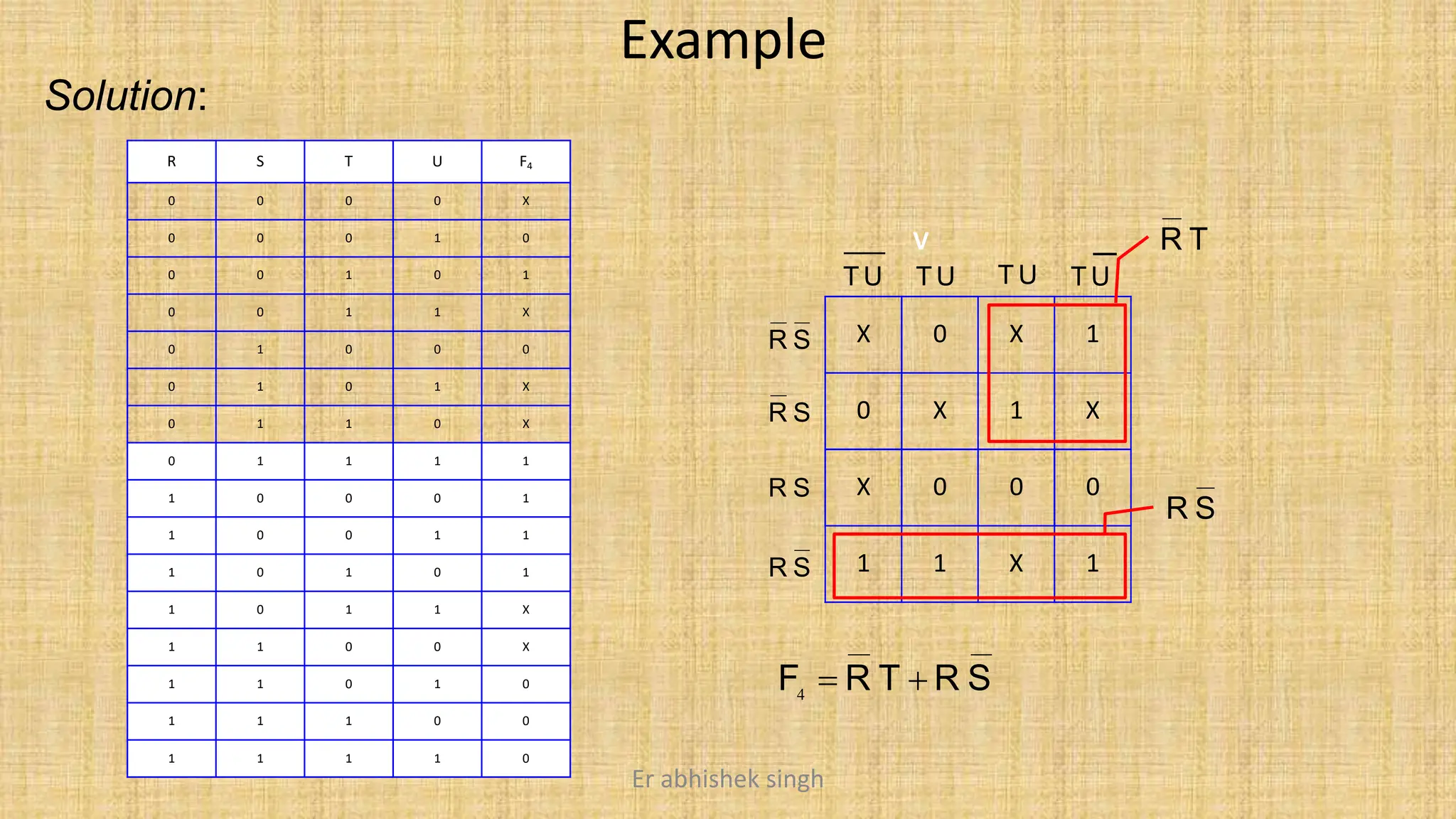
Example
Solution:
F  R T  R S
4
R S T U F4
0 0 0 0 X
0 0 0 1 0
0 0 1 0 1
0 0 1 1 X
0 1 0 0 0
0 1 0 1 X
0 1 1 0 X
0 1 1 1 1
1 0 0 0 1
1 0 0 1 1
1 0 1 0 1
1 0 1 1 X
1 1 0 0 X
1 1 0 1 0
1 1 1 0 0
1 1 1 1 0
X 0 X 1
0 X 1 X
X 0 0 0
1 1 X 1
R S
R S
R S
R S
V
T U T U T U
R T
T U
R S
Er abhishek singh
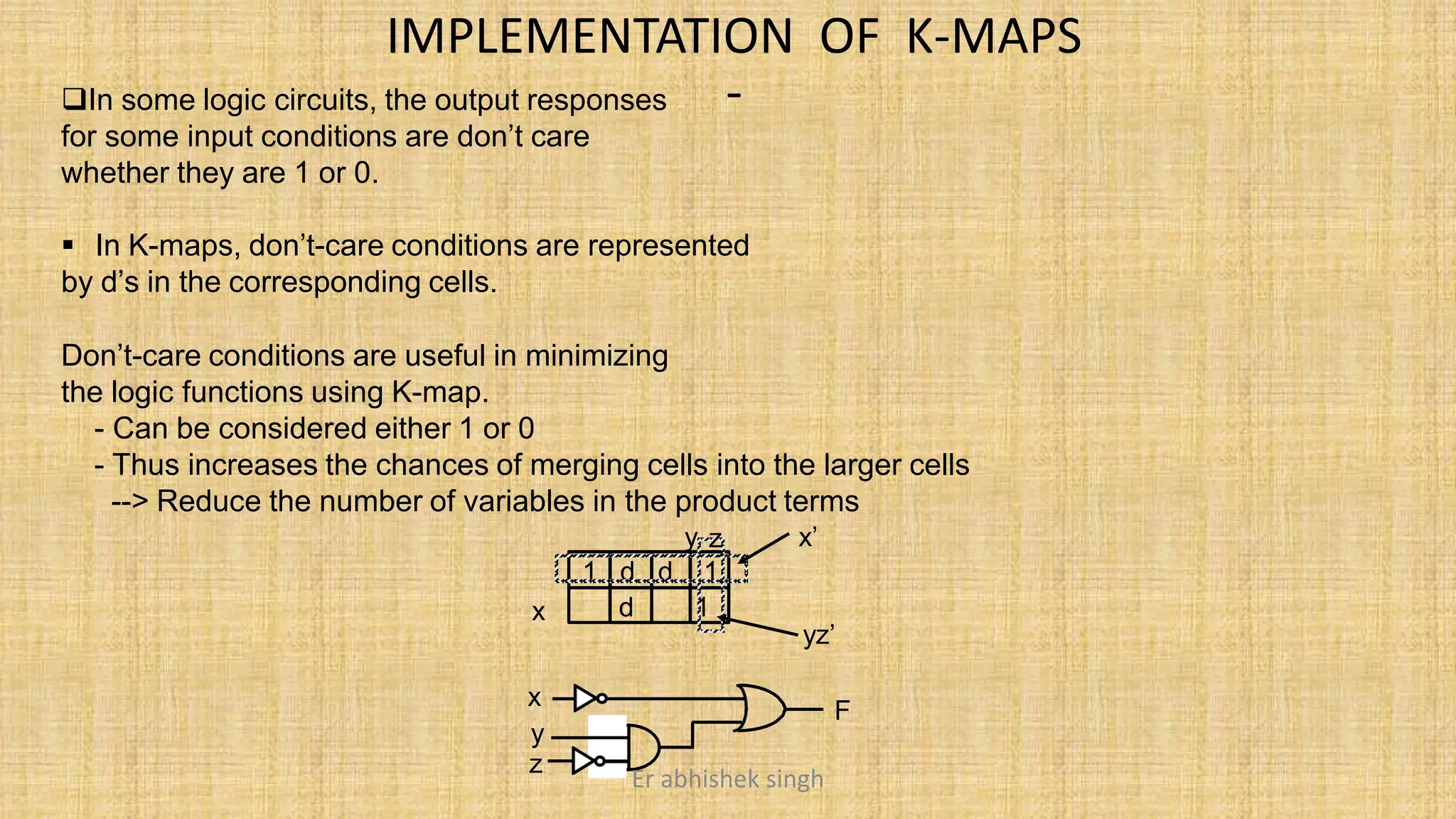
IMPLEMENTATION OF K-MAPS
-
In some logic circuits, the output responses
for some input conditions are don’t care
whether they are 1 or 0.
x
1 d d 1
d 1
 In K-maps, don’t-care conditions are represented
by d’s in the corresponding cells.
Don’t-care conditions are useful in minimizing
the logic functions using K-map.
- Can be considered either 1 or 0
- Thus increases the chances of merging cells into the larger cells
--> Reduce the number of variables in the product terms
y z x’
yz’
x
y
z
F
Er abhishek singh
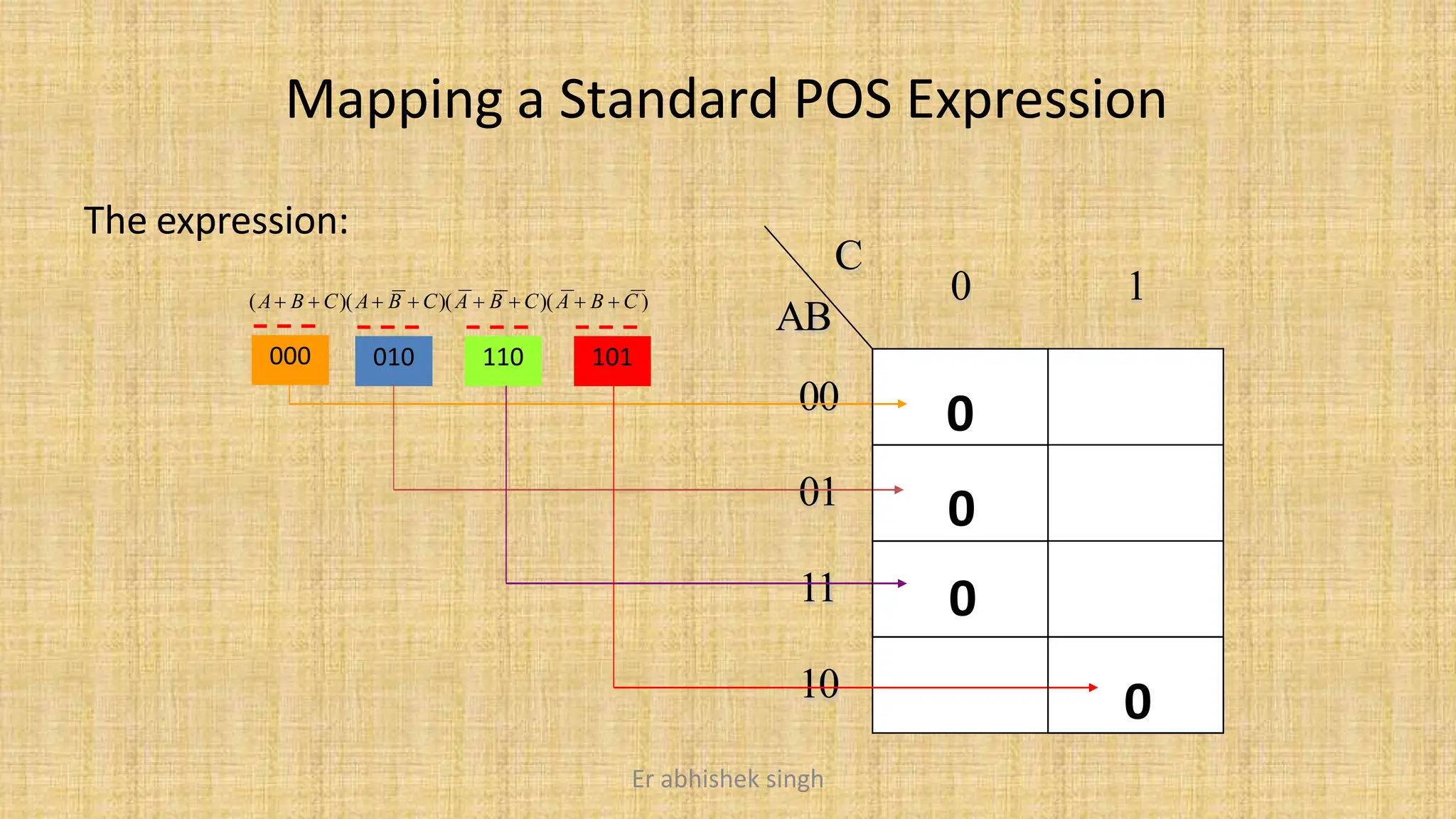
K-Map POS Minimization
• The approaches are much the same (as SOP) except that with
POS expression, 0s representing the standard sum terms are
placed on the K-map instead of 1s.
Er abhishek singh
C
0 1
AB
00
01
11
10
Mapping a Standard POS Expression
The expression:
(A B  C)(A B  C)(A  B  C)(A  B  C )
000 010 110 101
0
0
0
0
Er abhishek singh
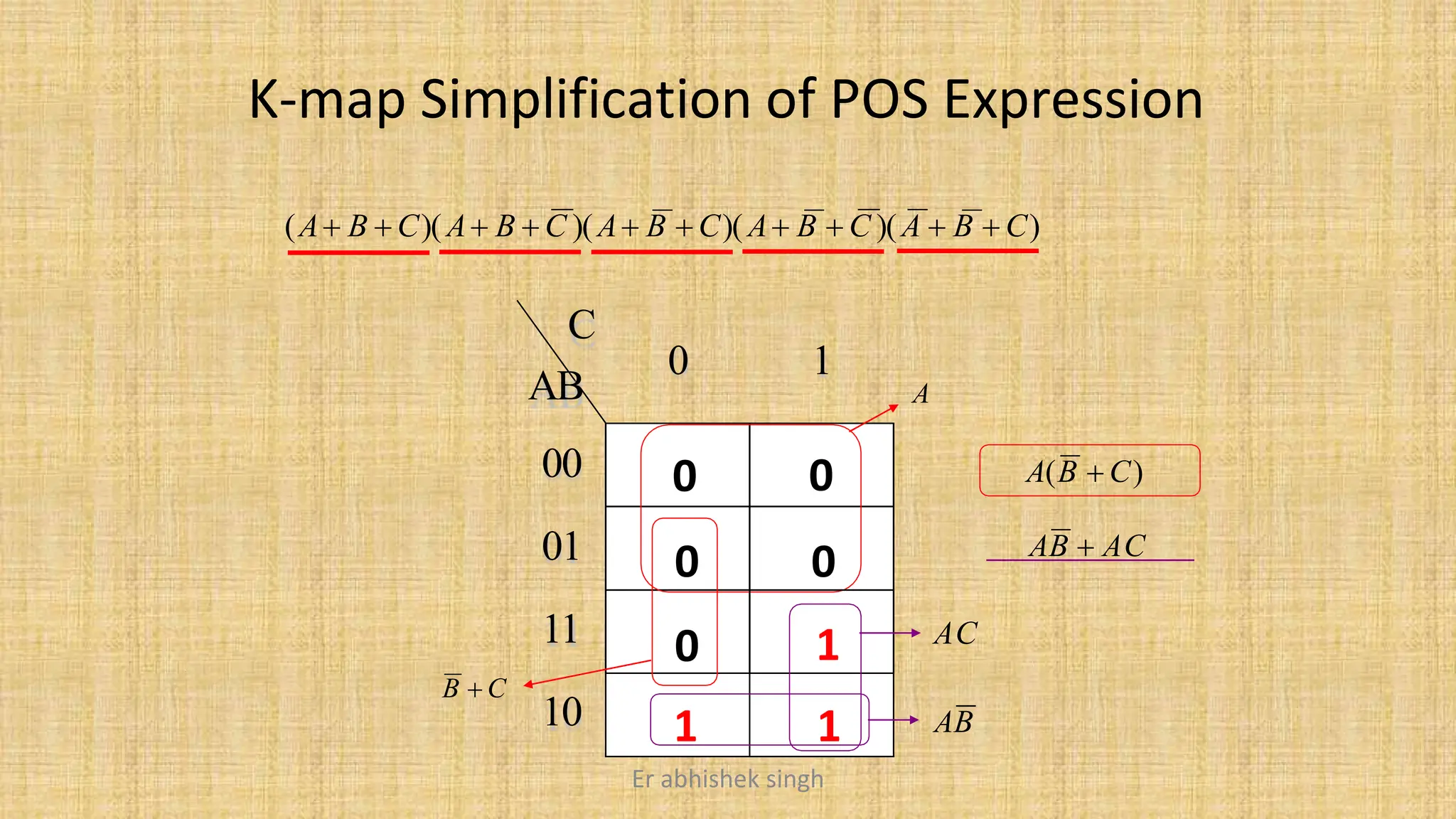
K-map Simplification of POS Expression
(A B  C)(A B  C )(A B  C)(A B  C )(A  B  C)
0 1
C
AB
00
01
11
10 AB
0 0
0 0
0 AC
B  C
A
1
1
1
A(B  C)
AB  AC
Er abhishek singh
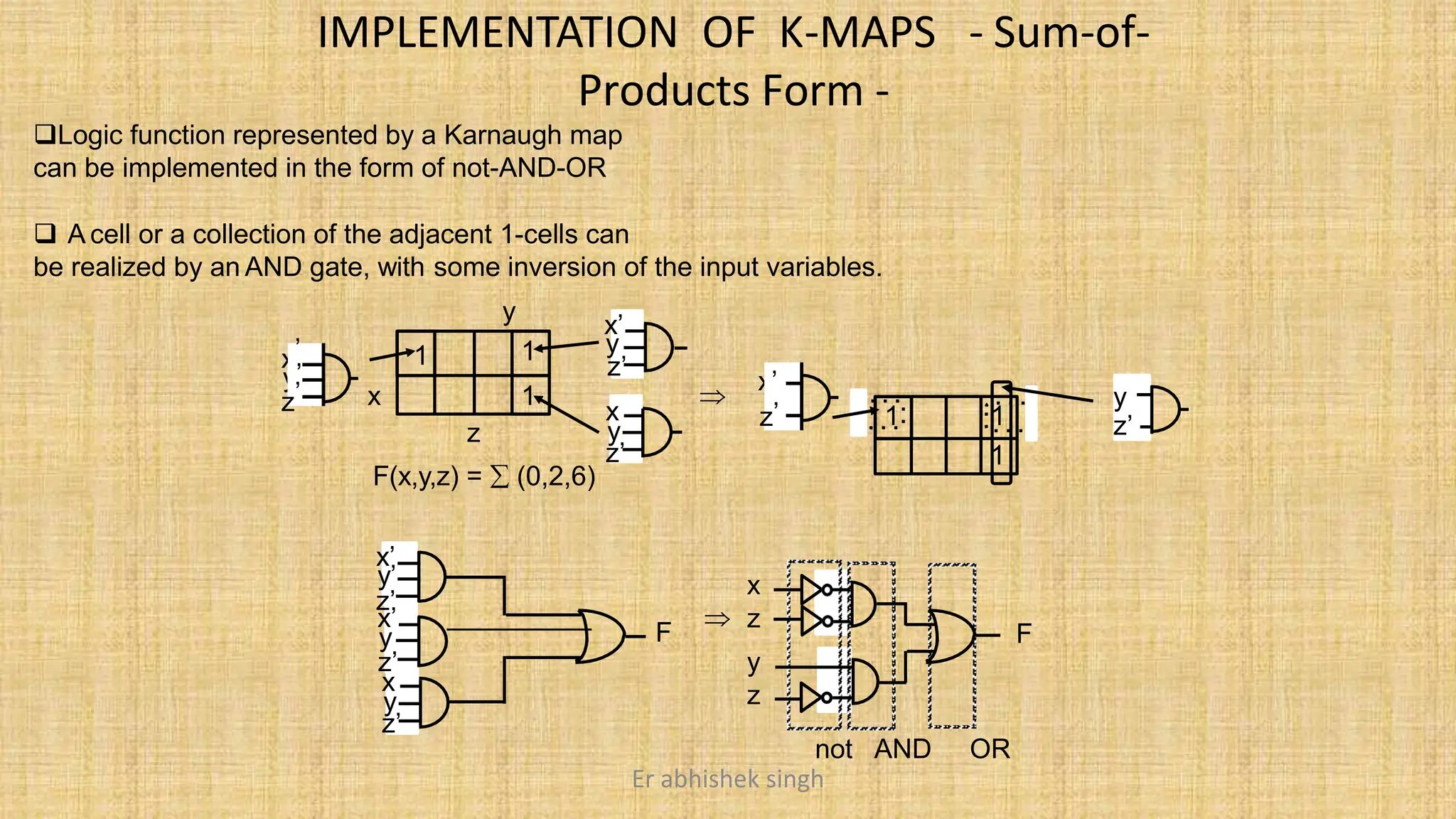
- Sum-of-
IMPLEMENTATION OF K-MAPS
Products Form -
Logic function represented by a Karnaugh map
can be implemented in the form of not-AND-OR
 A cell or a collection of the adjacent 1-cells can
be realized by an AND gate, with some inversion of the input variables.
x
y
x
y
’
’
’
z
x’
y
z’
x
y
z’
1 1
1
z
F(x,y,z) =  (0,2,6)
1 1
1
x’
’
z
y
z’

x’
y
x
y
z’
x’
y’
z’
F
x
z
y
z
F
not AND OR
z’

Er abhishek singh
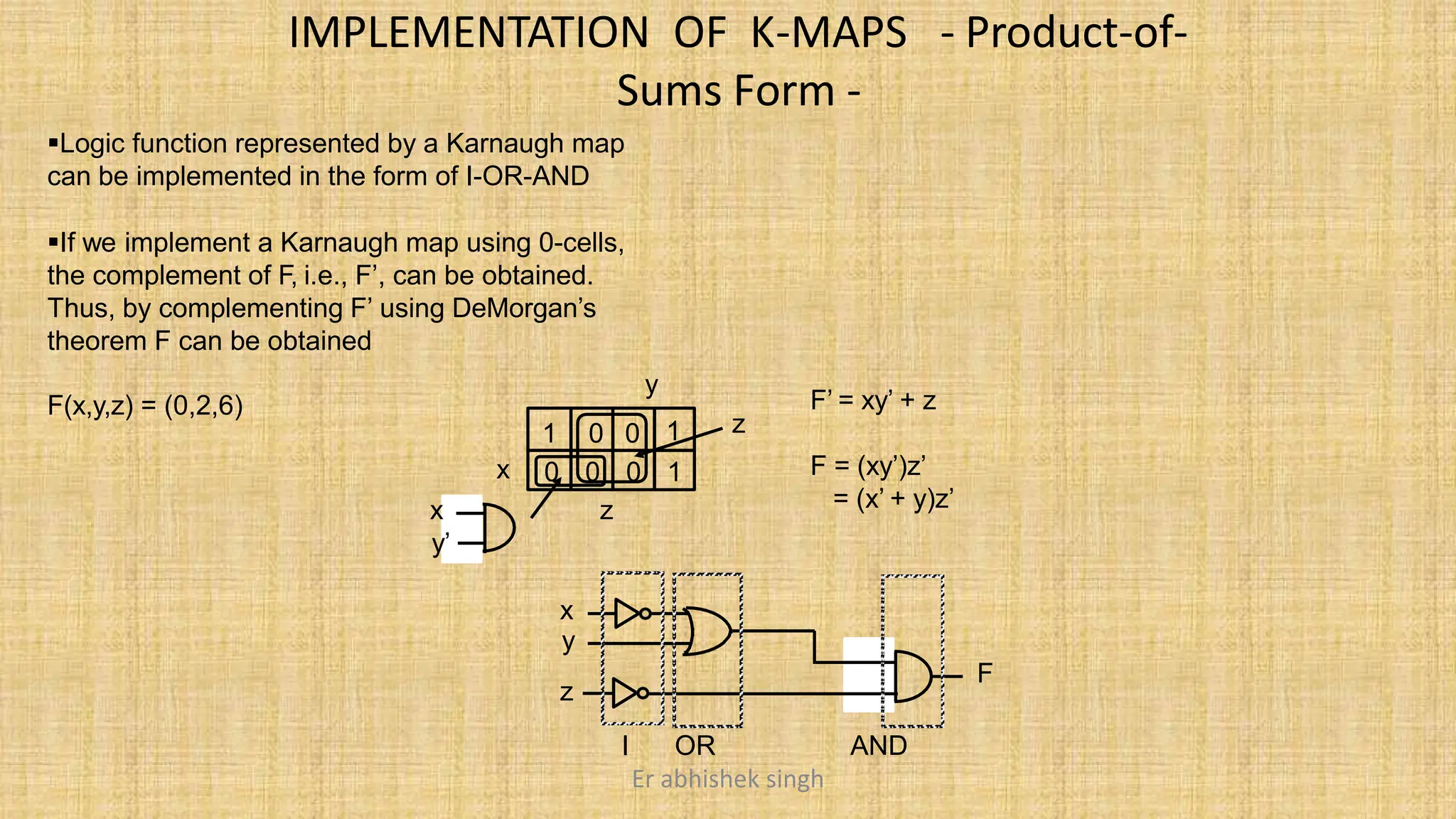
- Product-of-
IMPLEMENTATION OF K-MAPS
Sums Form -
Logic function represented by a Karnaugh map
can be implemented in the form of I-OR-AND
If we implement a Karnaugh map using 0-cells,
the complement of F, i.e., F’, can be obtained.
Thus, by complementing F’ using DeMorgan’s
theorem F can be obtained
F(x,y,z) = (0,2,6)
x
y
z
x
y’
z
F’ = xy’ + z
F = (xy’)z’
= (x’ + y)z’
x
y
z
F
I OR AND
0 0
1 1
0 0 0 1
Er abhishek singh
Design of combinational digital circuits
• Steps to design a combinational digital circuit:
– From the problem statement derive the truth table
– From the truth table derive the unsimplified logic
expression
– Simplify the logic expression
– From the simplified expression draw the logic circuit
Er abhishek singh
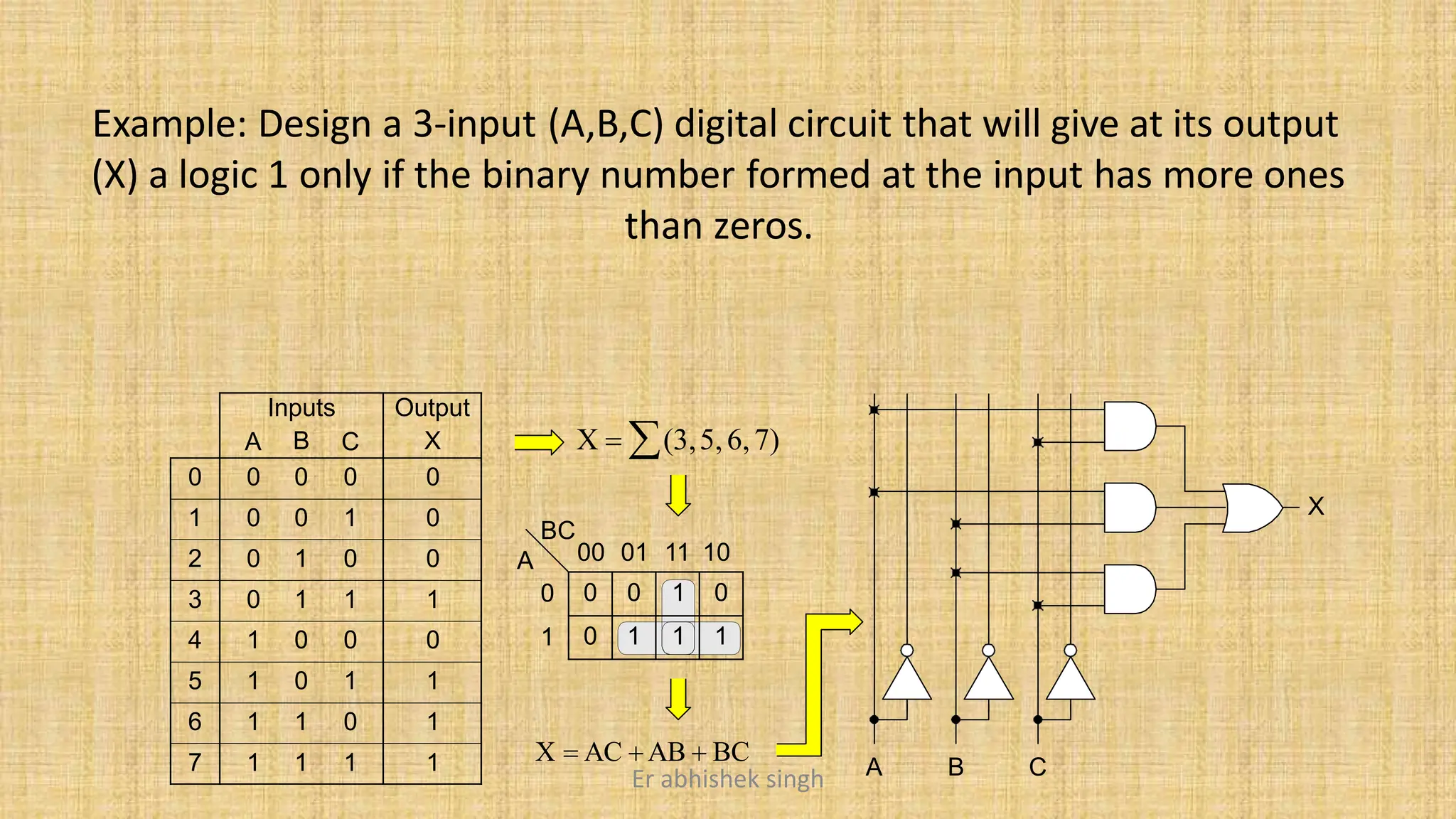
Example: Design a 3-input (A,B,C) digital circuit that will give at its output
(X) a logic 1 only if the binary number formed at the input has more ones
than zeros.
X  AC AB  BC
A
Inputs
B C
Output
X
0 0 0 0 0
1 0 0 1 0
2 0 1 0 0
3 0 1 1 1
4 1 0 0 0
5 1 0 1 1
6 1 1 0 1
7 1 1 1 1
BC
0
1
00 01 11 10
A
0 0 1 0
0 1 1 1
A B C
X
X  (3,5,6,7)
Er abhishek singh
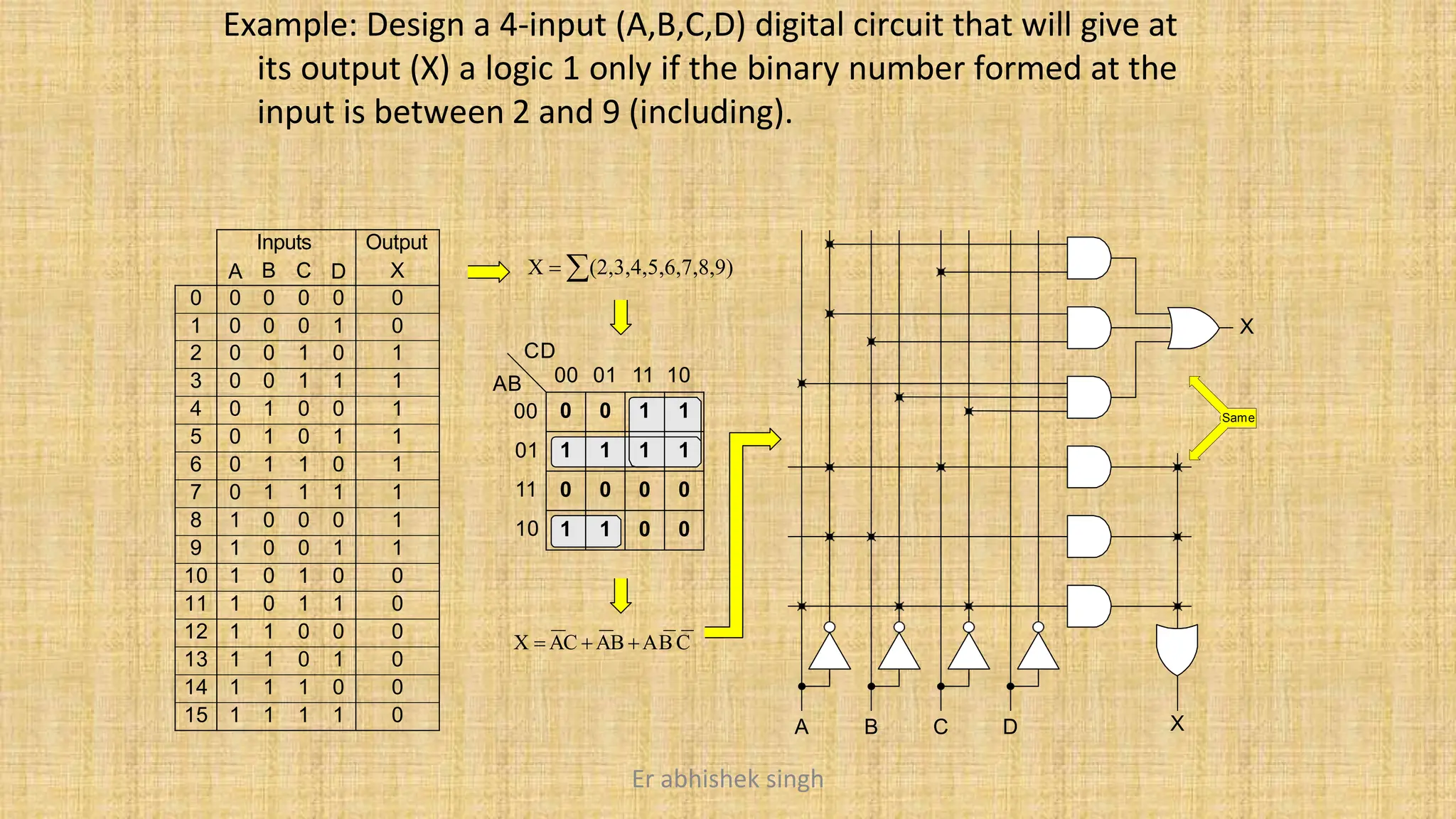
X  AC AB AB C
A B C
X
X  (2,3,4,5,6,7,8,9)
A
Inputs
B C D
Output
X
0 0 0 0 0 0
1 0 0 0 1 0
2 0 0 1 0 1
3 0 0 1 1 1
4 0 1 0 0 1
5 0 1 0 1 1
6 0 1 1 0 1
7 0 1 1 1 1
8 1 0 0 0 1
9 1 0 0 1 1
10 1 0 1 0 0
11 1 0 1 1 0
12 1 1 0 0 0
13 1 1 0 1 0
14 1 1 1 0 0
15 1 1 1 1 0
D
CD
00 01 11 10
00
01
11
10
AB
0 0 1 1
1 1 1 1
0 0 0 0
1 1 0 0
X
Same
Example: Design a 4-input (A,B,C,D) digital circuit that will give at
its output (X) a logic 1 only if the binary number formed at the
input is between 2 and 9 (including).
Er abhishek singh

It’s similar to truth table; instead of being organized

  • 1.
    The Karnaugh Map Erabhishek singh
  • 2.
    Karnaugh Maps • Karnaughmaps (K-maps) are graphical representations of Boolean functions. • One map cell corresponds to a row in the truth table. • Also, one map cell corresponds to a minterm or a maxterm in the Boolean expression • Multiple-cell areas of the map correspond to standard terms. • A K-map provides a systematic method for simplifying Boolean expressions and, if properly used, will produce the simplest SOP or POS expression possible, known as the minimum expression. Er abhishek singh
  • 3.
    What is K-Map •It’s similar to truth table; instead of being organized (i/p and o/p) into columns and rows, the K-map is an array of cells in which each cell represents a binary value of the input variables. • The cells are arranged in a way so that simplification of a given expression is simply a matter of properly grouping the cells. • K-maps can be used for expressions with 2, 3, 4, and 5 variables. Er abhishek singh
  • 4.
    Two-Variable Map 1 0 0 1 x2 x1 0 m0 1 m1 2 m2 3 m3 ordering of variables is IMPORTANT for f(x1,x2), x1 is the row, x2 is the column.  Cell 0 represents x1’x2’; Cell 1 represents x1’x2; etc. If a minterm is present in the function, then a 1 is placed in the corresponding cell. 1 0 1 0 x1 x2 0 m0 2 m2 1 m1 3 m3 OR Er abhishek singh
  • 5.
    Two-Variable Map • Anytwo adjacent cells in the map differ by ONLY one variable, which appears complemented in one cell and uncomplemented in the other. • Example: m0 (=x1’x2’) is adjacent to m1 (=x1’x2) and m2 (=x1x2’) but NOT m3 (=x1x2) Er abhishek singh
  • 6.
    2-Variable Map --Example • f(x1,x2) = x1’x2’+ x1’x2 + x1x2’ = m0 + m1 + m2 = x1’ + x2’ • 1s placed in K-map for specified minterms m0, m1, m2 • Grouping of 1s allows simplification • What (simpler) function is represented by each dashed rectangle? – x1’ = m0 + m1 – x2’ = m0 + m2 • Here m0 covered twice 1 0 1 x x1 0 2 0 1 1 1 2 1 3 0 Er abhishek singh
  • 7.
    The 3 VariableK-Map • There are 8 cells as shown: 0 1 C AB 00 01 11 10 ABC ABC ABC ABC ABC ABC ABC ABC Er abhishek singh
  • 8.
    Example 3 var.k-map M_ in _ im _ iz_ e t _ he f_ ollowing equation using k-map y=ABC+ABC+ABC+ABC _ _ _ _ _ ABC = 000 = 0 _ ABC = 101 = 5 ABC = 010 = 2 ABC = 111 = 7 Using this fill the k-map •Grouping – here 2 groups of 2 1’s Is possible Er abhishek singh
  • 9.
    For upper groupA and C are constants and B is varying. Neglect B.A and C both are 0. _ _ Hence output of this group is AC •For upper group A and C are constants and B is varying. Neglect B.A and C both are 0. Hence output of this group is AC  Thus output Y is given by , _ _ Y=AC+AC =A⃝ .C Er abhishek singh
  • 10.
    00 01 1110 CD AB 00 01 11 10 ABCD ABCD ABCD ABCD ABCD ABCD ABCD ABCD ABCD ABCD ABCD ABCD ABCD ABCD ABCD ABCD The 4-Variable K-Map Er abhishek singh
  • 11.
    00 01 1110 CD AB 00 01 11 10 Cell Adjacency Er abhishek singh
  • 12.
    • Solve thegiven k-map • Step I -grouping • Step II -output of each group • Step III -final output  Here answer is , _ _ _ Y=CD+BC+BD Er abhishek singh
  • 13.
    K-Map SOP Minimization •The K-Map is used for simplifying Boolean expressions to their minimal form. • A minimized SOP expression contains the fewest possible terms with fewest possible variables per term. • Generally, a minimum SOP expression can be implemented with fewer logic gates than a standard expression. Er abhishek singh
  • 14.
    Grouping Rules of grouping- 1’s & 0’s can not be grouped diagonal 1’s can not be grouped Er abhishek singh
  • 15.
    Elements in agroup should be 2n Er abhishek singh
  • 16.
    Minimum Groups should be formed For above rulegroup Overlapping is applicable Er abhishek singh
  • 17.
  • 18.
    Mapping a StandardSOP Expression • For an SOP expression in standard form: – A 1 is placed on the K-map for each product term in the expression. – Each 1 is placed in a cell corresponding to the value of a product term. – Example: for the product term , a 1 goes in the 101 cell on a 3- C 0 1 AB 00 01 11 10 ABC ABC ABC ABC ABC ABC ABC ABC variable map. ABC Er abhishek singh
  • 19.
    C AB 00 01 11 10 Mapping a StandardSOP Expression The expression: ABC  ABC  ABC  ABC 000 001 110 100 0 1 1 1 1 1 ABCD  ABCD  ABCD  ABCD ABCD  ABCD  ABCD ABC  ABC  ABC Practice: ABC  ABC  ABC  ABC Er abhishek singh
  • 20.
    Three-Variable K-Maps f (0,4) B C f  (4,5) A B f  (0,1,4,5) B f  (0,1,2,3)A 0 1 BC A 00 01 11 10 1 0 0 0 1 0 0 0 0 1 BC A 00 01 11 10 0 0 0 0 1 1 0 0 0 1 BC A 00 01 11 10 1 1 1 1 0 0 0 0 0 1 BC A 00 01 11 10 1 1 0 0 1 1 0 0 f  (0,4) AC f  (4,6) AC f  (0,2) AC f  (0,2,4,6) C 0 1 BC A 00 01 11 10 0 1 1 0 0 0 0 0 0 1 BC A 00 01 11 10 0 0 0 0 1 0 0 1 0 1 BC A 00 01 11 10 1 0 0 1 1 0 0 1 0 1 BC A 00 01 11 10 1 0 0 1 0 0 0 0 Er abhishek singh
  • 21.
    Four-Variable K-Maps f (0,8) B C  D f  (5,13) B C D f  (13,15) ABD f  (4,6) AB D f  (2,3,6,7) AC f  (4,6,12,14 )  B D f  (2,3,10,11 )  BC f  (0,2,8,10) B D CD 00 01 11 10 AB 00 01 11 10 1 0 0 0 0 0 0 0 0 0 0 0 1 0 0 0 CD 00 01 11 10 AB 00 01 11 10 0 0 0 0 0 1 0 0 0 1 0 0 0 0 0 0 CD 00 01 11 10 AB 00 01 11 10 0 0 0 0 0 0 0 0 0 1 1 0 0 0 0 0 CD 00 01 11 10 AB 00 01 11 10 0 0 0 0 1 0 0 1 0 0 0 0 0 0 0 0 CD 00 01 11 10 AB 00 01 11 10 0 0 1 1 0 0 1 1 0 0 0 0 0 0 0 0 CD 00 01 11 10 AB 00 01 11 10 0 0 0 0 1 0 0 1 1 0 0 1 0 0 0 0 CD 00 01 11 10 AB 00 01 11 10 0 0 1 1 0 0 0 0 0 0 0 0 0 0 1 1 CD 00 01 11 10 AB 00 01 11 10 1 0 0 1 0 0 0 0 0 0 0 0 1 0 0 1 Er abhishek singh
  • 22.
    Four-Variable K-Maps CD 00 0111 10 AB 00 01 11 10 0 0 0 0 1 1 1 1 0 0 0 0 0 0 0 0 CD 00 01 11 10 AB 00 01 11 10 0 0 1 0 0 0 1 0 0 0 1 0 0 0 1 0 CD 00 01 11 10 AB 00 01 11 10 1 0 1 0 0 1 0 1 1 0 1 0 0 1 0 1 CD 00 01 11 10 AB 00 01 11 10 0 1 0 1 1 0 1 0 0 1 0 1 1 0 1 0 CD 00 01 11 10 AB 00 01 11 10 0 1 1 0 0 1 1 0 0 1 1 0 0 1 1 0 CD 00 01 11 10 AB 00 01 11 10 1 0 0 1 1 0 0 1 1 0 0 1 1 0 0 1 CD 00 01 11 10 AB 00 01 11 10 0 0 0 0 1 1 1 1 1 1 1 1 0 0 0 0 CD 00 01 11 10 AB 00 01 11 10 1 1 1 1 0 0 0 0 0 0 0 0 1 1 1 1 f   (4,5,6,7)  A  B f  (3,7,11,15)  C D f   (0,3,5,6,9,10,12,15) f  A  B  C  D f  (1,2,4,7,8,11,13,14) f  A  B C  D f  (1,3,5,7,9,11,13,15) f  D f   (0,2,4,6,8,10,12,14) f  D f   (4,5,6,7,12,13,14,15) f  B f   (0,1,2,3,8,9,10,11) f  B Er abhishek singh
  • 23.
    Determining the MinimumSOP Expression from the Map CD AB 00 01 11 10 00 1 1 01 1 1 1 1 11 1 1 1 1 10 1 AC B ACD B  AC  ACD Er abhishek singh
  • 24.
    Determining the MinimumSOP Expression from the Map AB BC  ABC C AB 0 1 1 1 1 1 00 01 11 10 0 1 C AB 00 01 11 10 1 1 1 1 1 1 B  AC  AC Er abhishek singh
  • 25.
    Mapping Directly froma Truth Table I/P O/P A B C X 0 0 0 1 0 0 1 0 0 1 0 0 0 1 1 0 1 0 0 1 1 0 1 0 1 1 0 1 1 1 1 1 C AB 00 01 11 10 0 1 1 1 1 1 Er abhishek singh
  • 26.
    Don’t Care Conditions •A don’t care condition, marked by (X) in the truth table, indicates a condition where the design doesn’t care if the output is a (0) or a (1). • A don’t care condition can be treated as a (0) or a (1) in a K-Map. • Treating a don’t care as a (0) means that you do not need to group it. • Treating a don’t care as a (1) allows you to make a grouping larger, resulting in a simpler term in the SOP equation. Er abhishek singh
  • 27.
    Some You Group,Some You Don’t 0 X 1 0 0 0 X 0 C VC A B A B A B A B A C This don’t care condition was treated as a (1). This allowed the grouping of a single one to become a grouping of two, resulting in a simpler term. There was no advantage in treating this don’t care condition as a (1), thus it was treated as a (0) and not grouped. Er abhishek singh
  • 28.
    Example Solution: F  RT  R S 4 R S T U F4 0 0 0 0 X 0 0 0 1 0 0 0 1 0 1 0 0 1 1 X 0 1 0 0 0 0 1 0 1 X 0 1 1 0 X 0 1 1 1 1 1 0 0 0 1 1 0 0 1 1 1 0 1 0 1 1 0 1 1 X 1 1 0 0 X 1 1 0 1 0 1 1 1 0 0 1 1 1 1 0 X 0 X 1 0 X 1 X X 0 0 0 1 1 X 1 R S R S R S R S V T U T U T U R T T U R S Er abhishek singh
  • 29.
    IMPLEMENTATION OF K-MAPS - Insome logic circuits, the output responses for some input conditions are don’t care whether they are 1 or 0. x 1 d d 1 d 1  In K-maps, don’t-care conditions are represented by d’s in the corresponding cells. Don’t-care conditions are useful in minimizing the logic functions using K-map. - Can be considered either 1 or 0 - Thus increases the chances of merging cells into the larger cells --> Reduce the number of variables in the product terms y z x’ yz’ x y z F Er abhishek singh
  • 30.
    K-Map POS Minimization •The approaches are much the same (as SOP) except that with POS expression, 0s representing the standard sum terms are placed on the K-map instead of 1s. Er abhishek singh
  • 31.
    C 0 1 AB 00 01 11 10 Mapping aStandard POS Expression The expression: (A B  C)(A B  C)(A  B  C)(A  B  C ) 000 010 110 101 0 0 0 0 Er abhishek singh
  • 32.
    K-map Simplification ofPOS Expression (A B  C)(A B  C )(A B  C)(A B  C )(A  B  C) 0 1 C AB 00 01 11 10 AB 0 0 0 0 0 AC B  C A 1 1 1 A(B  C) AB  AC Er abhishek singh
  • 33.
    - Sum-of- IMPLEMENTATION OFK-MAPS Products Form - Logic function represented by a Karnaugh map can be implemented in the form of not-AND-OR  A cell or a collection of the adjacent 1-cells can be realized by an AND gate, with some inversion of the input variables. x y x y ’ ’ ’ z x’ y z’ x y z’ 1 1 1 z F(x,y,z) =  (0,2,6) 1 1 1 x’ ’ z y z’  x’ y x y z’ x’ y’ z’ F x z y z F not AND OR z’  Er abhishek singh
  • 34.
    - Product-of- IMPLEMENTATION OFK-MAPS Sums Form - Logic function represented by a Karnaugh map can be implemented in the form of I-OR-AND If we implement a Karnaugh map using 0-cells, the complement of F, i.e., F’, can be obtained. Thus, by complementing F’ using DeMorgan’s theorem F can be obtained F(x,y,z) = (0,2,6) x y z x y’ z F’ = xy’ + z F = (xy’)z’ = (x’ + y)z’ x y z F I OR AND 0 0 1 1 0 0 0 1 Er abhishek singh
  • 35.
    Design of combinationaldigital circuits • Steps to design a combinational digital circuit: – From the problem statement derive the truth table – From the truth table derive the unsimplified logic expression – Simplify the logic expression – From the simplified expression draw the logic circuit Er abhishek singh
  • 36.
    Example: Design a3-input (A,B,C) digital circuit that will give at its output (X) a logic 1 only if the binary number formed at the input has more ones than zeros. X  AC AB  BC A Inputs B C Output X 0 0 0 0 0 1 0 0 1 0 2 0 1 0 0 3 0 1 1 1 4 1 0 0 0 5 1 0 1 1 6 1 1 0 1 7 1 1 1 1 BC 0 1 00 01 11 10 A 0 0 1 0 0 1 1 1 A B C X X  (3,5,6,7) Er abhishek singh
  • 37.
    X  ACAB AB C A B C X X  (2,3,4,5,6,7,8,9) A Inputs B C D Output X 0 0 0 0 0 0 1 0 0 0 1 0 2 0 0 1 0 1 3 0 0 1 1 1 4 0 1 0 0 1 5 0 1 0 1 1 6 0 1 1 0 1 7 0 1 1 1 1 8 1 0 0 0 1 9 1 0 0 1 1 10 1 0 1 0 0 11 1 0 1 1 0 12 1 1 0 0 0 13 1 1 0 1 0 14 1 1 1 0 0 15 1 1 1 1 0 D CD 00 01 11 10 00 01 11 10 AB 0 0 1 1 1 1 1 1 0 0 0 0 1 1 0 0 X Same Example: Design a 4-input (A,B,C,D) digital circuit that will give at its output (X) a logic 1 only if the binary number formed at the input is between 2 and 9 (including). Er abhishek singh