UNCOVERING CLIL STARTING CLIL IN THE CLASSROOM Adapted from Mehisto, P, Marsh, D & Frigols, M. (2008).  Uncovering CLIL: Content and Language Integrated Learning in Bilingual and Multilingual Education  . Oxford: MacMillan, Chapter 3
How does the CLIL methodology translate into the classroom? A week in the life of a primary school CLIL teacher- getting started
To take into account:   The majority of students entering school have very little or no prior knowledge of the CLIL language.  They will often answer questions in their first language. This should not be discouraged.  At the start of a CLIL programme, students’ attention span may be limited.
LANGUAGE   Answer questions or instructions given in the CLIL language.  Respond to questions or instructions by matching.  Greet one another.  Create their own book.  Week one learning outcomes for students
Week one learning outcomes for students CONTENT   Identify key areas of the school.  Students conduct themselves politely.  Use a calendar.  Students create their own books.   LEARNING SKILLS  Students can predict expectations based on classroom rules.
Core CLIL focused on during week one in primary school Multiple focus: Language learning in non-language classes. Content learning in language classes. Integrating several subjects. Cross-curricular themes and projects. Active learning: Favouring peer co-operative work. Teachers acting as facilitators Students evaluate progress in meeting learning outcomes
Core CLIL focused on during week one in primary school Safe and enriching environment: Using routine activities. Building St’s confidence. Accessing authentic materials. Sts awareness of and growth in language. Scaffolding: building on St’s existing knowledge, skills and experience. Responding to diferent learning styles Fostering creative and critical thinking
Core CLIL focused on during week one in primary school Authenticity: Sts indicating language needs. Accomodating Sts’ interests. Connecting learning and the Sts’ lives. Using current materials
A week in the life of a secondary school CLIL teacher- getting started
Guiding principles focused on during week one. COGNITION: Content, language and learning skills outcomes in cooperation with Sts. Learning builds on Sts’ existing knowledge. Analysis of outcomes.
Guiding principles focused on during week one. Community: Sts feel that being members of a learning community is enriching. Sts have self confidence and skills to work in groups. Parents, teachers and Sts are partners in education. Sts have a role in the classroom and in the community.
Guiding principles focused on during week one. Communication: Sts participate in activities and communication. Sts and teachers construct and negotiate meaning. Language/communication skills are developed in all subjects.
To take into account: Sts are likely to have a strong basis in the CLIL language, but could not be fluent. First class: -To get to know each other.    (Clil language)   -To give information about the    course. (L1) The first class could take place outside the classroom.
Getting to know one another Name game #1. Name game #2. Mixer activity #1: Find someone who… Discussion (L1) Outcomes. Use of CLIL language. Challenges Sts will face.
Getting to the content Day 1: Activity 1: Warm up/Setting the stage.  (3 min) Activity 2: Free association. (7 min) Activity 3: learning outcomes. (5 min) Activity 4: Accessing existing knowledge.  (10 min)
Getting to the content Activity 5 & 6: Reading text about volcanoes and related assignments. (20 min) Activity 7: Reflection. (10 min) Activity 8: Achievement barometer (3 min).
Core CLIL focused on during week one in secondary school Multiple focus: Language learning in non-language classes. Content learning in language classes. Integrating several subjects. Cross-curricular themes and projects. Reflection on the learning process.
Core CLIL focused on during week one in secondary school Active learning: Favouring peer co-operative work. Sts help set learning outcomes. Sts evaluate process. Favouring peer co-operative work. Negotiating meaning. Teachers acting as facilitators.
Core CLIL focused on during week one in secondary school Safe and enriching environment: Using routine activities. Building Sts’ confidence. Accessing authentic materials. Sts awareness of and growth in language.
Core CLIL focused on during week one in secondary school Scaffolding: Building on Sts’ existing knowledge, skills and experience. Repackaging information. Responding to different learning styles. Fostering creative and critical thinking.
Core CLIL focused on during week one in secondary school Authenticity : Sts indicating language needs. Accomodating Sts’ interests. Connecting learning and the Sts’ lives. Cooperation: Planning lessons in cooperation with CLIL and non-CLIL teachers.
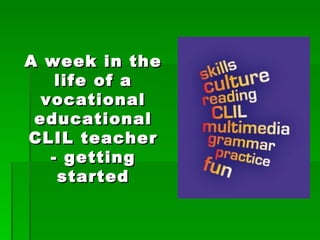
A week in the life of a vocational educational CLIL teacher - getting started
Guiding principles focused on during week one Are similar to the principles stated in secondary school
Getting to know one another - The same framework of the secondary students plan, but with some considerations: Name game adaptation for vocational students. Find someone who… The name game #2 Brainstorming long term benefits. One of the main objectives is to instill self-confidence and a hunger to learn language.
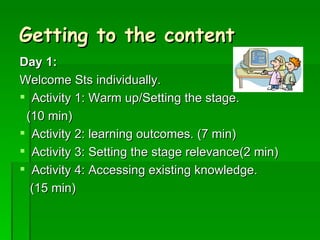
Getting to the content Day 1: Welcome Sts individually.  Activity 1: Warm up/Setting the stage.  (10 min) Activity 2: learning outcomes. (7 min) Activity 3: Setting the stage relevance(2 min) Activity 4: Accessing existing knowledge.  (15 min)
Getting to the content Activity 5 : Reading and analysing charts/ Writing and presentng summaries. (27 min) Activity 6:Tumbometer. (3 min) Core CLIL focused on during week one in secondary school The same as in secondary school.

Chapter3 090909204546-phpapp01

  • 1.
    UNCOVERING CLIL STARTINGCLIL IN THE CLASSROOM Adapted from Mehisto, P, Marsh, D & Frigols, M. (2008). Uncovering CLIL: Content and Language Integrated Learning in Bilingual and Multilingual Education . Oxford: MacMillan, Chapter 3
  • 2.
    How does theCLIL methodology translate into the classroom? A week in the life of a primary school CLIL teacher- getting started
  • 3.
    To take intoaccount: The majority of students entering school have very little or no prior knowledge of the CLIL language. They will often answer questions in their first language. This should not be discouraged. At the start of a CLIL programme, students’ attention span may be limited.
  • 4.
    LANGUAGE Answer questions or instructions given in the CLIL language. Respond to questions or instructions by matching. Greet one another. Create their own book. Week one learning outcomes for students
  • 5.
    Week one learningoutcomes for students CONTENT Identify key areas of the school. Students conduct themselves politely. Use a calendar. Students create their own books. LEARNING SKILLS Students can predict expectations based on classroom rules.
  • 6.
    Core CLIL focusedon during week one in primary school Multiple focus: Language learning in non-language classes. Content learning in language classes. Integrating several subjects. Cross-curricular themes and projects. Active learning: Favouring peer co-operative work. Teachers acting as facilitators Students evaluate progress in meeting learning outcomes
  • 7.
    Core CLIL focusedon during week one in primary school Safe and enriching environment: Using routine activities. Building St’s confidence. Accessing authentic materials. Sts awareness of and growth in language. Scaffolding: building on St’s existing knowledge, skills and experience. Responding to diferent learning styles Fostering creative and critical thinking
  • 8.
    Core CLIL focusedon during week one in primary school Authenticity: Sts indicating language needs. Accomodating Sts’ interests. Connecting learning and the Sts’ lives. Using current materials
  • 9.
    A week inthe life of a secondary school CLIL teacher- getting started
  • 10.
    Guiding principles focusedon during week one. COGNITION: Content, language and learning skills outcomes in cooperation with Sts. Learning builds on Sts’ existing knowledge. Analysis of outcomes.
  • 11.
    Guiding principles focusedon during week one. Community: Sts feel that being members of a learning community is enriching. Sts have self confidence and skills to work in groups. Parents, teachers and Sts are partners in education. Sts have a role in the classroom and in the community.
  • 12.
    Guiding principles focusedon during week one. Communication: Sts participate in activities and communication. Sts and teachers construct and negotiate meaning. Language/communication skills are developed in all subjects.
  • 13.
    To take intoaccount: Sts are likely to have a strong basis in the CLIL language, but could not be fluent. First class: -To get to know each other. (Clil language) -To give information about the course. (L1) The first class could take place outside the classroom.
  • 14.
    Getting to knowone another Name game #1. Name game #2. Mixer activity #1: Find someone who… Discussion (L1) Outcomes. Use of CLIL language. Challenges Sts will face.
  • 15.
    Getting to thecontent Day 1: Activity 1: Warm up/Setting the stage. (3 min) Activity 2: Free association. (7 min) Activity 3: learning outcomes. (5 min) Activity 4: Accessing existing knowledge. (10 min)
  • 16.
    Getting to thecontent Activity 5 & 6: Reading text about volcanoes and related assignments. (20 min) Activity 7: Reflection. (10 min) Activity 8: Achievement barometer (3 min).
  • 17.
    Core CLIL focusedon during week one in secondary school Multiple focus: Language learning in non-language classes. Content learning in language classes. Integrating several subjects. Cross-curricular themes and projects. Reflection on the learning process.
  • 18.
    Core CLIL focusedon during week one in secondary school Active learning: Favouring peer co-operative work. Sts help set learning outcomes. Sts evaluate process. Favouring peer co-operative work. Negotiating meaning. Teachers acting as facilitators.
  • 19.
    Core CLIL focusedon during week one in secondary school Safe and enriching environment: Using routine activities. Building Sts’ confidence. Accessing authentic materials. Sts awareness of and growth in language.
  • 20.
    Core CLIL focusedon during week one in secondary school Scaffolding: Building on Sts’ existing knowledge, skills and experience. Repackaging information. Responding to different learning styles. Fostering creative and critical thinking.
  • 21.
    Core CLIL focusedon during week one in secondary school Authenticity : Sts indicating language needs. Accomodating Sts’ interests. Connecting learning and the Sts’ lives. Cooperation: Planning lessons in cooperation with CLIL and non-CLIL teachers.
  • 22.
    A week inthe life of a vocational educational CLIL teacher - getting started
  • 23.
    Guiding principles focusedon during week one Are similar to the principles stated in secondary school
  • 24.
    Getting to knowone another - The same framework of the secondary students plan, but with some considerations: Name game adaptation for vocational students. Find someone who… The name game #2 Brainstorming long term benefits. One of the main objectives is to instill self-confidence and a hunger to learn language.
  • 25.
    Getting to thecontent Day 1: Welcome Sts individually. Activity 1: Warm up/Setting the stage. (10 min) Activity 2: learning outcomes. (7 min) Activity 3: Setting the stage relevance(2 min) Activity 4: Accessing existing knowledge. (15 min)
  • 26.
    Getting to thecontent Activity 5 : Reading and analysing charts/ Writing and presentng summaries. (27 min) Activity 6:Tumbometer. (3 min) Core CLIL focused on during week one in secondary school The same as in secondary school.