Dr Haroon Rashid Baloch
Department of Prosthodontics,
Ziauddin College of Dentistry.
 A thorough knowledge of the anatomy of the
denture bearing surfaces is paramount to
designing and fabricating functional
dentures.
 The functional anatomy of the denture
foundation areas of the maxilla and mandible
is presented in detail.
 In particular, the relationship of these
anatomic structures that impact retention,
stability and support.
Rashid.H
 Retention
 Stability
 Support
“When the key anatomical landmarks and
their role with retention, stability and support
are understood, dentures can be fabricated
as integral part of oral cavity and not just
artificial mechanical substitutes”
Rashid.H
 The underlying bone
 The mucous membrane
Rashid.H
 Osseous structures support the overlying
denture
 Affects the impression making
 Maxillary denture is supported by two main
bones:
a) Maxilla
b) Palatine bone
 Mandibular Denture is supported mainly by:
a) Mandible
Rashid.H
 The cushion between the denture and the
supporting bone
 Mucous membrane consists of
a) Mucosa
b) Sub mucosa
 The submucosa is formed by connective
tissue that may be:
a) Dense
b) Loose
c) May vary in thickness
Rashid.H
 Makes the bulk of overlying mucous
membrane
 Firmly attached to periosteum
 Thin submucosa  Non resilient soft tissue
 mucous membrane easily traumatized
Rashid.H
 Masticatory  covers the hard palate and the
crest of the alveolar ridge
 Lining Mucosa  covering the cheek, inner
aspect of the lips, soft palate, ventral surface
of the tongue.
 Specialized Mucosa  dorsum of the tongue
Rashid.H
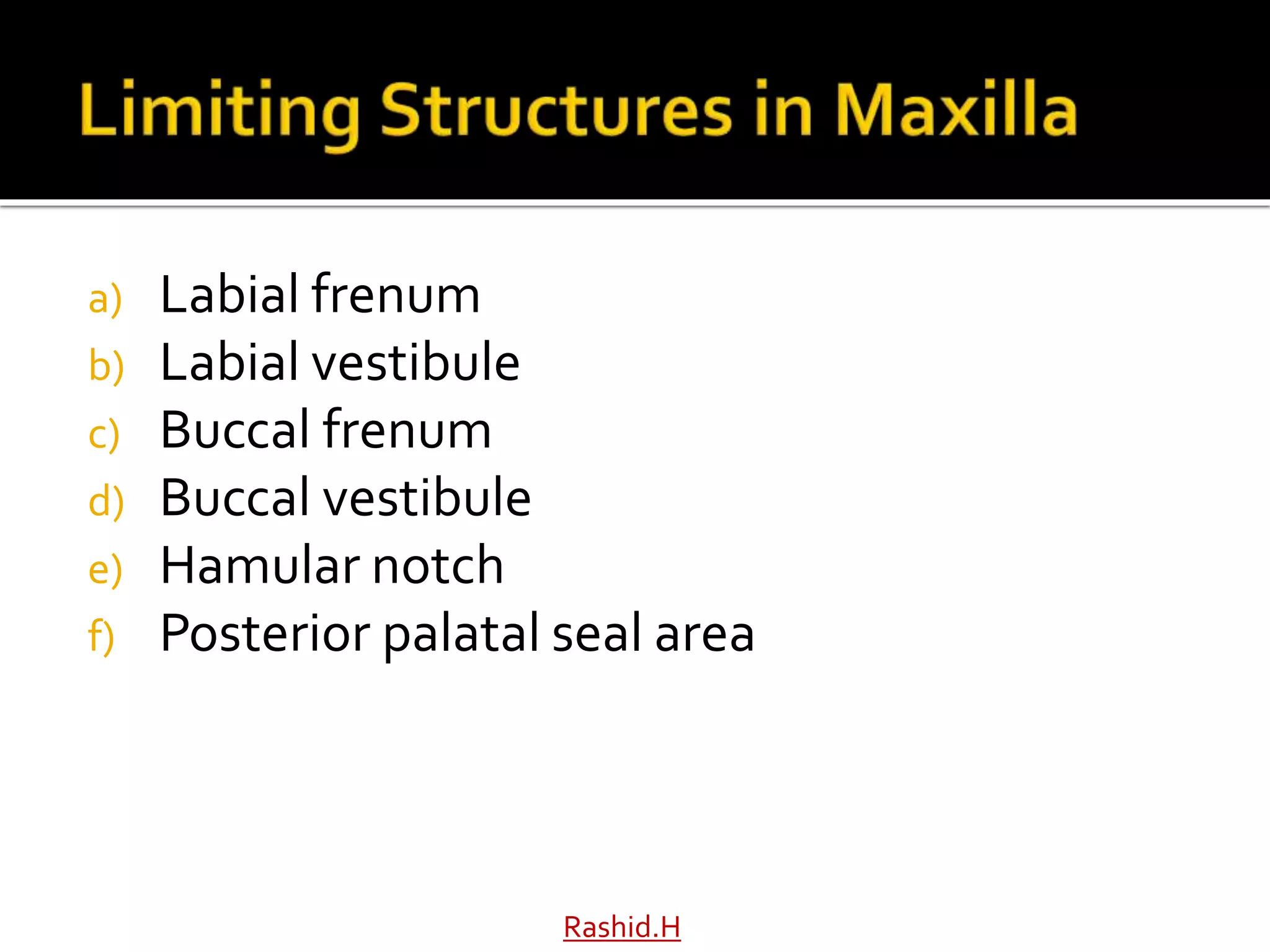
Maxillary Landmarks …..
a) Labial frenum
b) Labial vestibule
c) Buccal frenum
d) Buccal vestibule
e) Hamular notch
f) Posterior palatal seal area
Rashid.H
1. Frenum: Freni are folds of mucous membranes and do not
contain significant muscle fibres.They need to be excised
(frenectomy) or maybe relieved.They may compromise denture
stability and retention.
2. Vestibule: Space between the cheeks and the teeth.When filled
with a denture, greatly enhances retention and stability.
Rashid.H
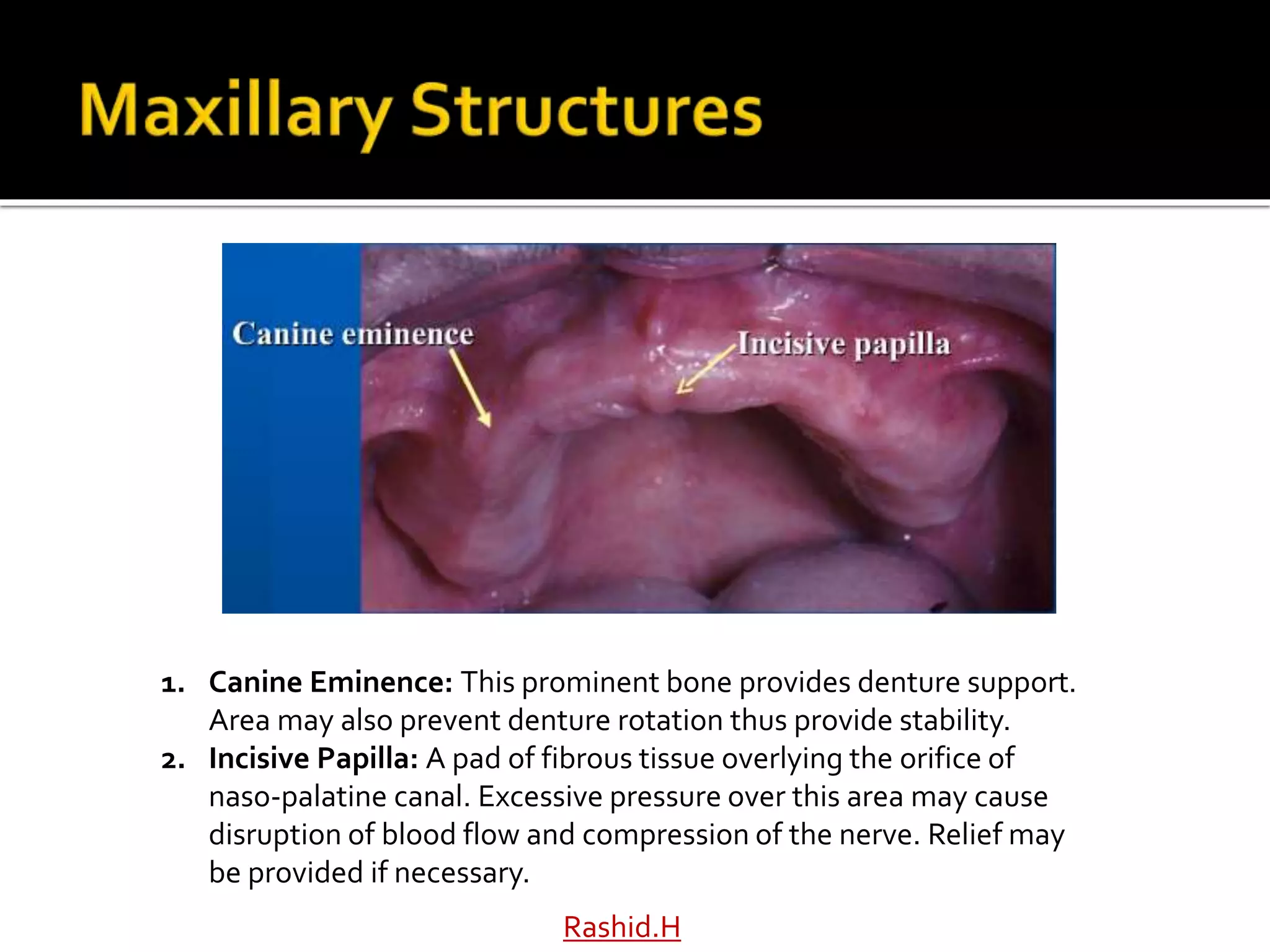
1. Canine Eminence: This prominent bone provides denture support.
Area may also prevent denture rotation thus provide stability.
2. Incisive Papilla: A pad of fibrous tissue overlying the orifice of
naso-palatine canal. Excessive pressure over this area may cause
disruption of blood flow and compression of the nerve. Relief may
be provided if necessary.
Rashid.H
 Divided into right & left by labial frenum *
 The outer surface of the labial vestibule is
attached with the orbicularis oris.
 The fibres of orbicularis oris run in a
horizontal direction.
 The muscle has an indirect effect on the
denture base
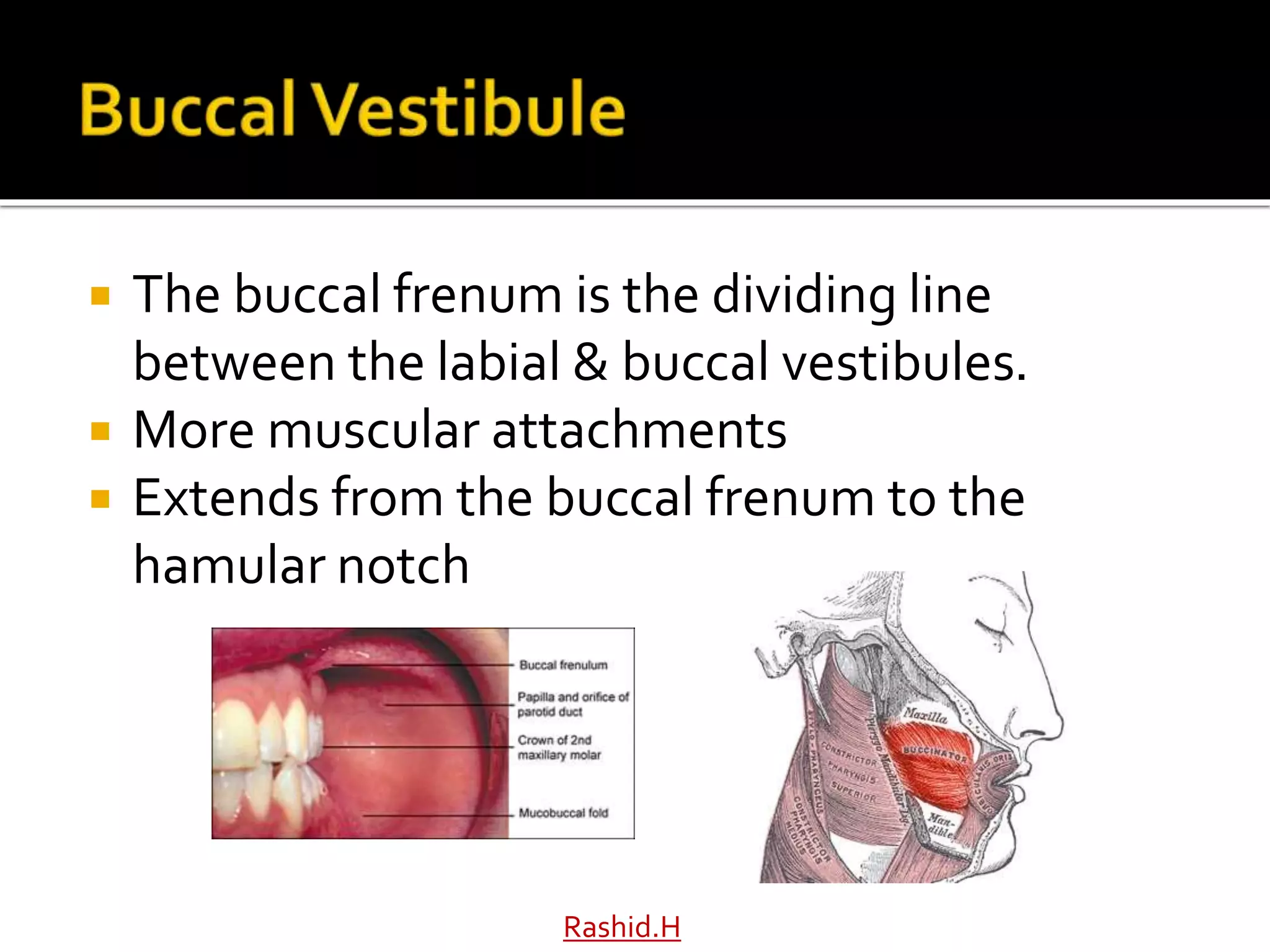
 The buccal frenum is the dividing line
between the labial & buccal vestibules.
 More muscular attachments
 Extends from the buccal frenum to the
hamular notch
Rashid.H
Rashid.H
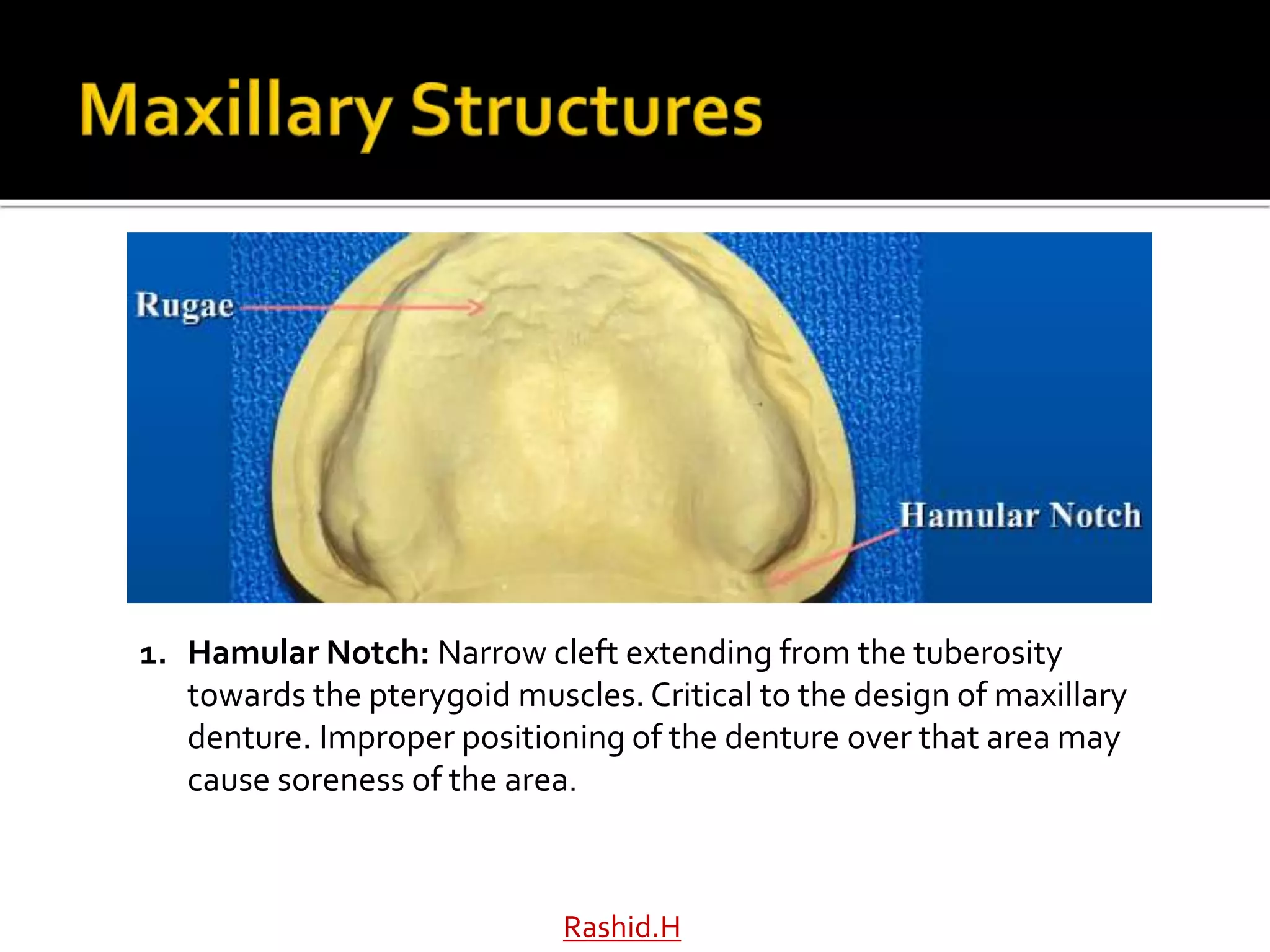
1. Hamular Notch: Narrow cleft extending from the tuberosity
towards the pterygoid muscles. Critical to the design of maxillary
denture. Improper positioning of the denture over that area may
cause soreness of the area.
Labial Notch (narrow) and Buccal Notch (wide)
Rashid.H
1. Tuberosity: Important primary denture support area in
maxilla. Provides resistance to horizontal denture
movements.
2. Posterior Palatal Seal: Is at the junction of hard and soft
palate near the vibrating line. Marks the posterior extension
of the denture.
Rashid.H
Rashid.H
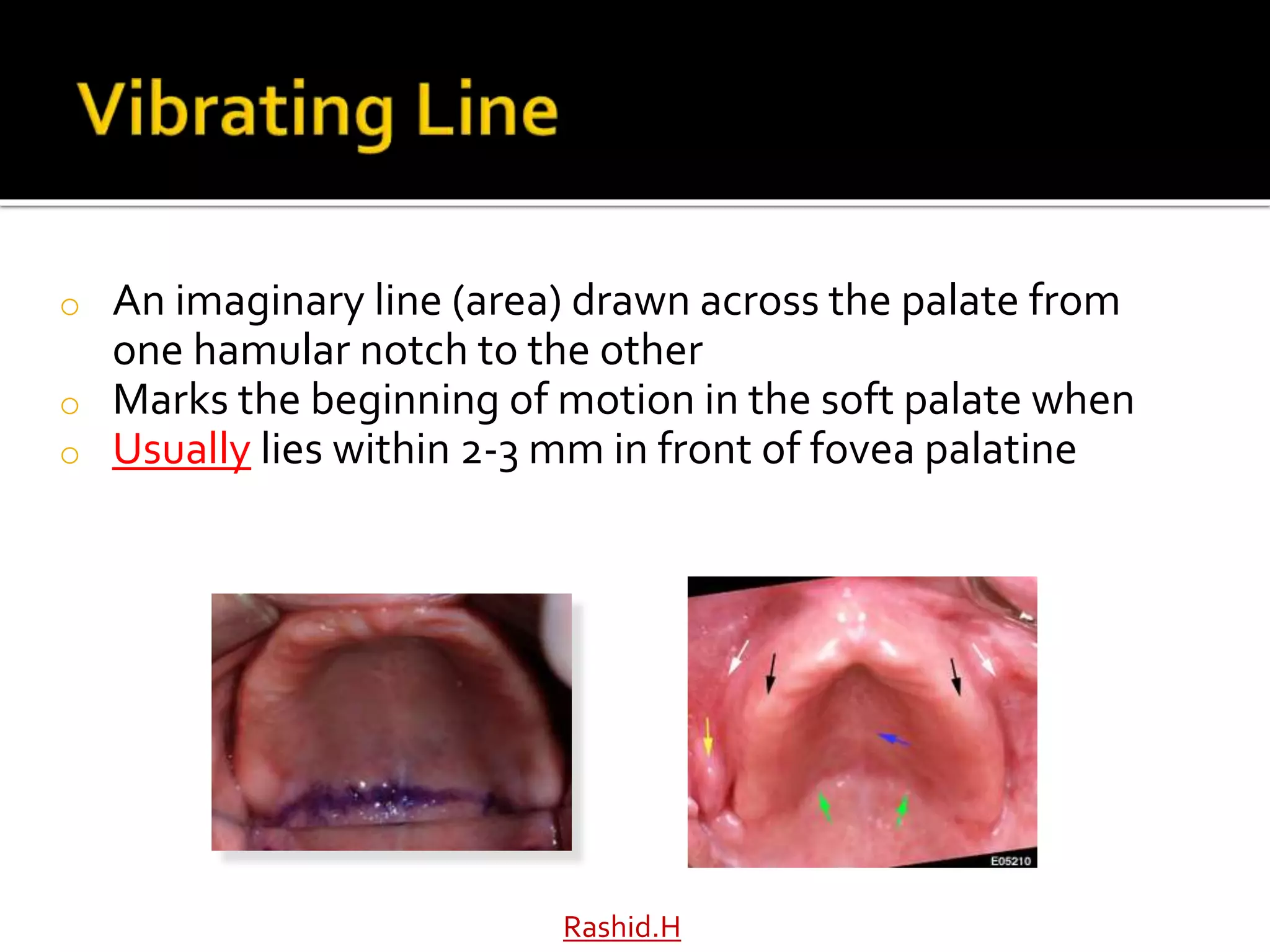
o An imaginary line (area) drawn across the palate from
one hamular notch to the other
o Marks the beginning of motion in the soft palate when
o Usually lies within 2-3 mm in front of fovea palatine
Rashid.H
 The direction of the vibrating line usually varies
with the shape of palate
 Higher the vault the more abrupt and forward the
vibrating line
 Flatter palatal vault, the vibrating line is usually
farther posterior and has a gradual curvature
 Usually two in number, present just behind the
junction of hard and soft-palate
 Are indentations near the midline of the palate
 Formed by the coalescence of several minor
mucous gland ducts
Rashid.H
Coronoid Process: Patient is told to open, protrude and perform lateral
movements to get the impression of coronoid process.The width of the
disto-buccal flange will then be contoured by the coronoid process. (Avoid
over extension)
Minor Salivary Glands: Present at the posterior 1/3rd of the palate.The
impression may appear irregular because of salivary gland secretions that
may adhere to the impression material.
Rashid.H
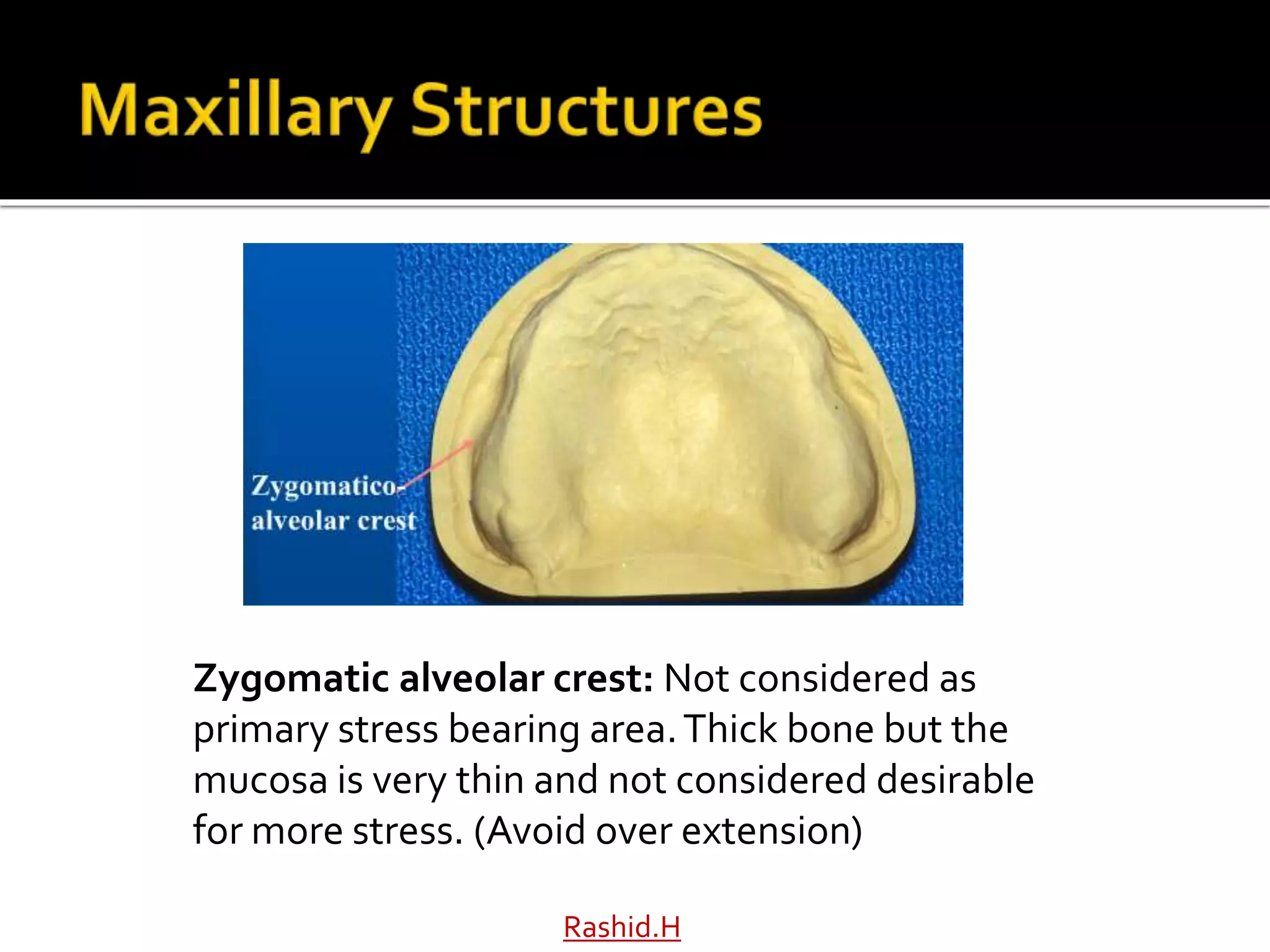
Zygomatic alveolar crest: Not considered as
primary stress bearing area.Thick bone but the
mucosa is very thin and not considered desirable
for more stress. (Avoid over extension)
Rashid.H
1. Hard Palate: Considered to be primary stress bearing area of maxillary
denture. Provides retention, stability and support.
2. Midline Palatal Suture:Thin line extending from incisive papilla towards the
posterior end of the palate. Mucosa is tightly attached and very thin. Relief
may be provided to prevent soreness.
3. Major Palatine Foramen: Carries anterior palatine nerve and vessels. Relief
is NOT provided because of presence of abundant overlying tissues.
 Covered by keratinized stratified squamous
epithelium .
 In the region of medial palatal suture , the
submucosa is extremely thin ; relief should
be provided to avoid trauma or rocking of
the denture
Rashid.H
 Antero-laterally, the submucosa contains
adipose tissue.
 Postero-laterally, it contains glandular tissue.
 The horizontal portion of the hard palate
provides the primary stress-bearing area.
Rashid.H
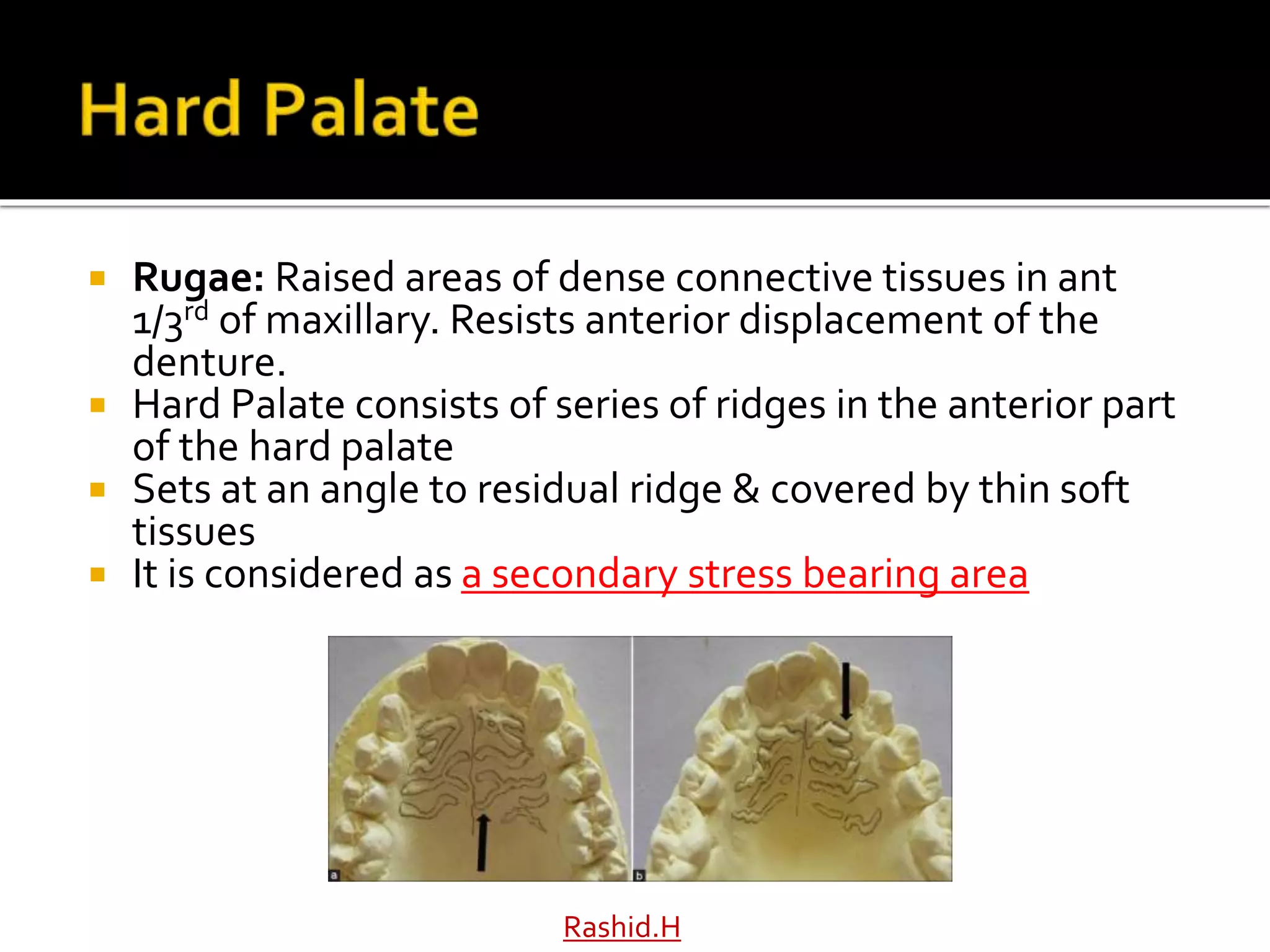
 Rugae: Raised areas of dense connective tissues in ant
1/3rd of maxillary. Resists anterior displacement of the
denture.
 Hard Palate consists of series of ridges in the anterior part
of the hard palate
 Sets at an angle to residual ridge & covered by thin soft
tissues
 It is considered as a secondary stress bearing area
Rashid.H
 Covered by keratinized stratified squamous
epithelium.
 Considered as a secondary stress-bearing area
because it is subject to resorption contrary to
horizontal portion of hard palate.
Rashid.H
 Ideal Maxillary Ridge
Should have:
a) Abundant attached
keratinized tissue
b) Broad and well developed
ridge.
c) Moderate palatal vault
d) Absence of undercuts
e) Well defined hamular
notches
Rashid.H
 Maxillary denture influenced by following
muscles:
a) Anterior Labial Flange  influenced by
orbicularis oris muscle as far as the pre-
molar region
b) Buccal Flange  influenced by the
buccinator muscle
Rashid.H
Mandibular Landmarks ….
Rashid.H
 Labial vestibule
 Buccal vestibule
 Lingual border
 Retromolar Pad
 Sublingual gland region
 Lingual sulcus
Rashid.H
Labial Frenum: Anatomically and histological
same as that of maxillary frenum.
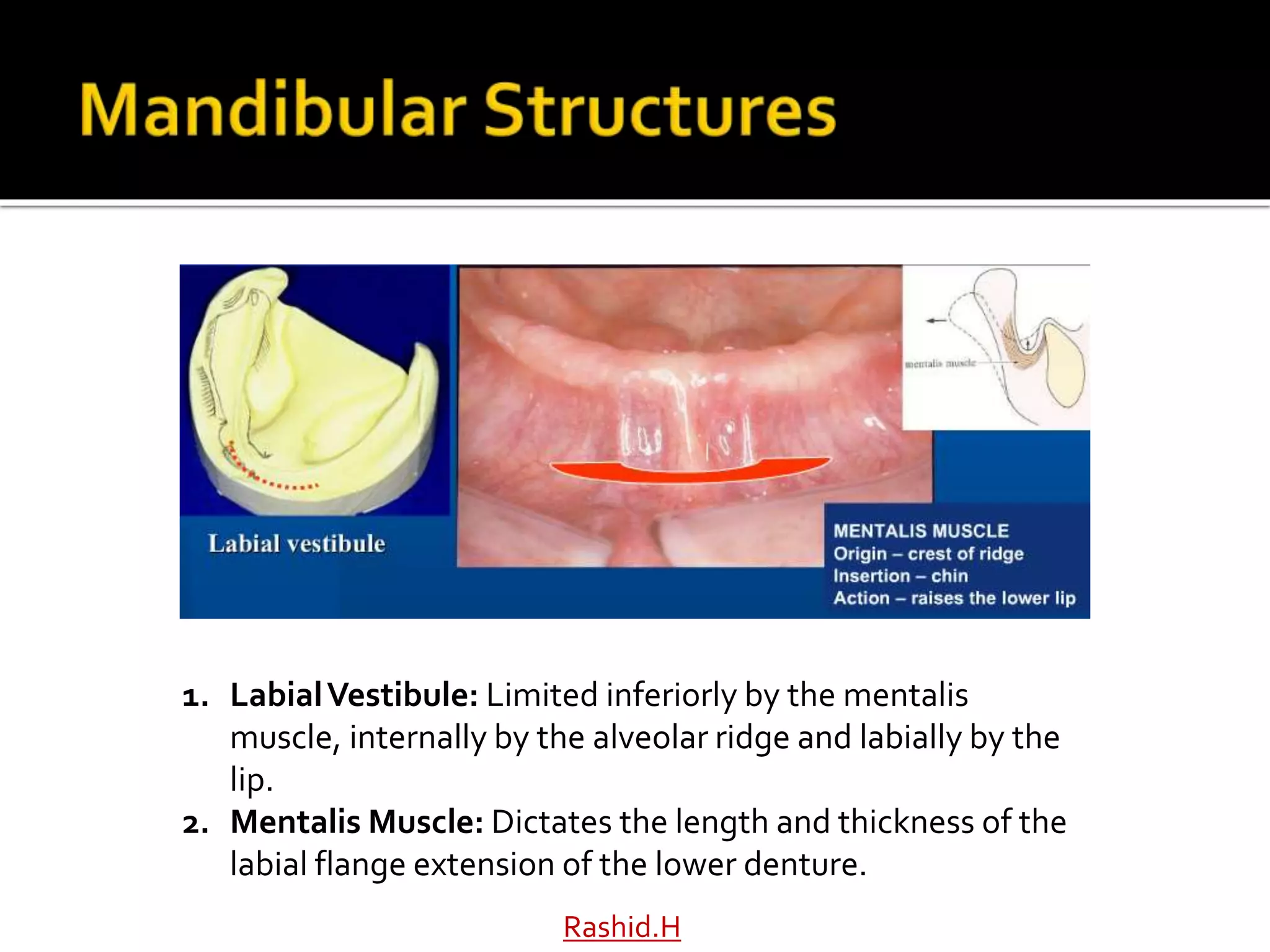
1. LabialVestibule: Limited inferiorly by the mentalis
muscle, internally by the alveolar ridge and labially by the
lip.
2. Mentalis Muscle: Dictates the length and thickness of the
labial flange extension of the lower denture.
Rashid.H
Rashid.H
1. Alveolar Ridge: Secondary support area. High rate of
resorption when excessive pressure is applied.
2. Buccal Frenum: Histologically and functionally same
as that of labial frenum.
Rashid.H
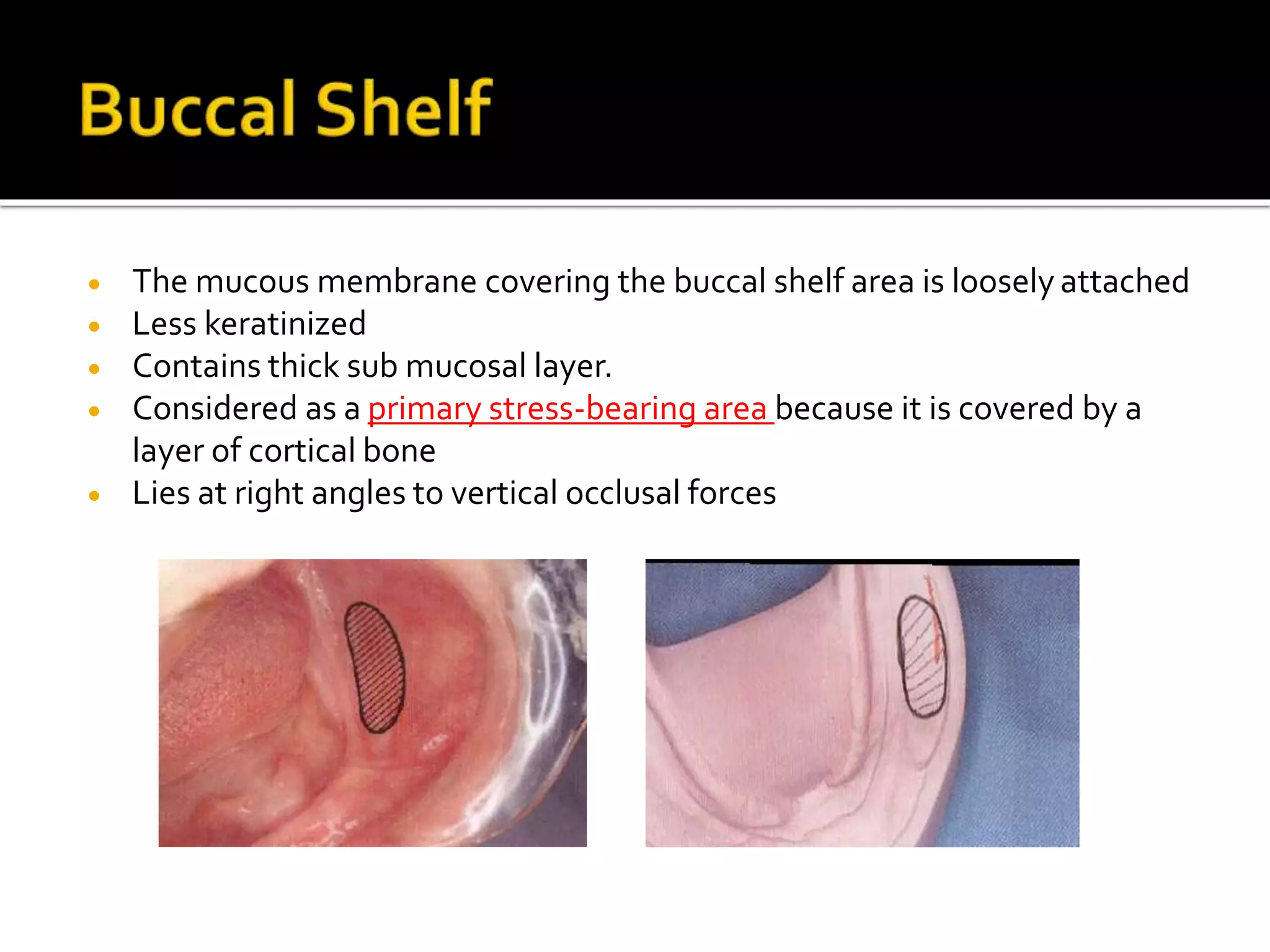
Buccal Shelf: Bordered externally by external oblique ridge and
internally by the slope of the alveolar ridge. PRIMARY STRESS
BEARING AREA IN MANDIBLE.
 The mucous membrane covering the buccal shelf area is loosely attached
 Less keratinized
 Contains thick sub mucosal layer.
 Considered as a primary stress-bearing area because it is covered by a
layer of cortical bone
 Lies at right angles to vertical occlusal forces
Rashid.H
Buccal Shelf: Greater the area of buccal shelf, greater will
be the support available for the denture.
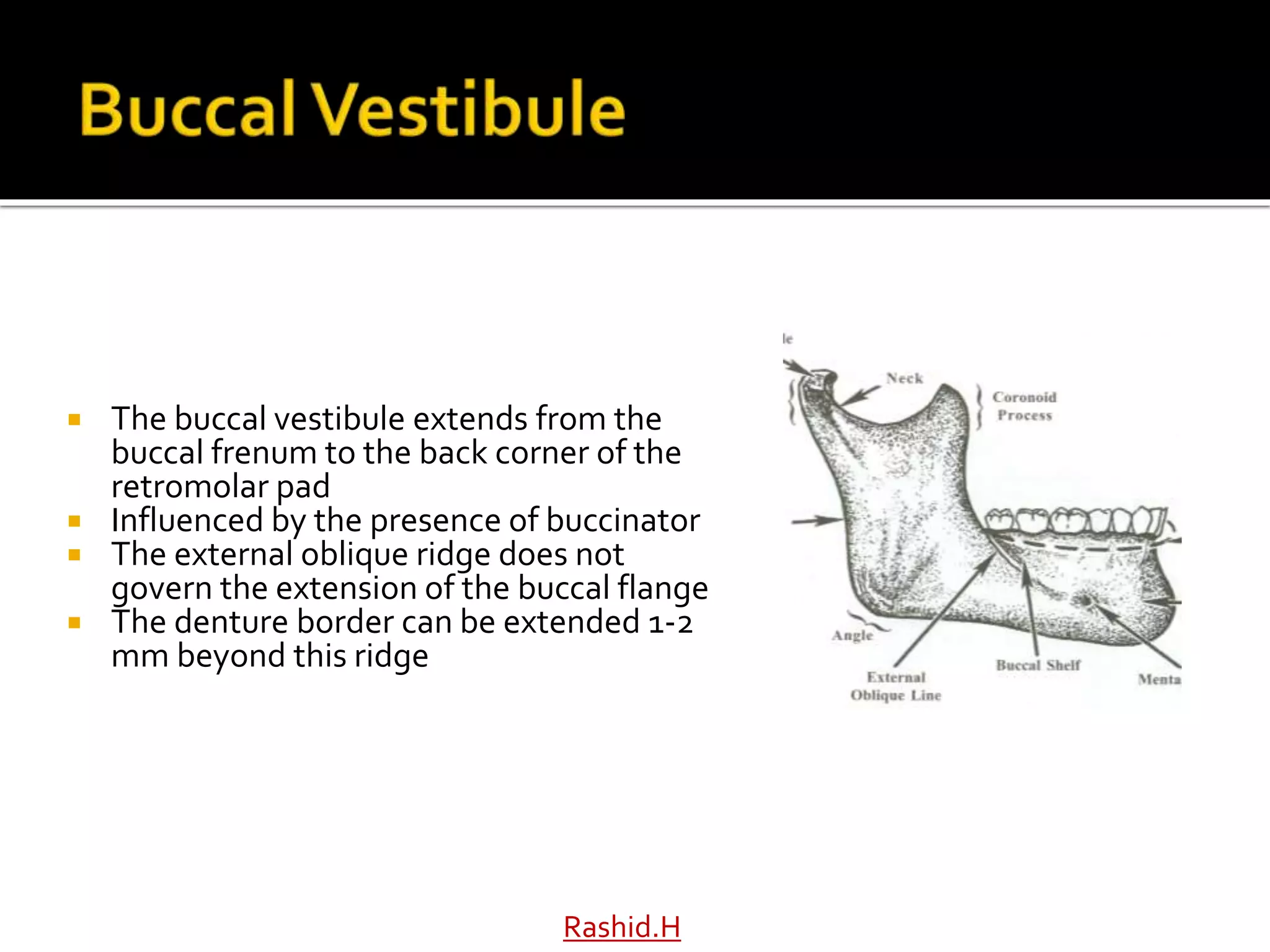
 The buccal vestibule extends from the
buccal frenum to the back corner of the
retromolar pad
 Influenced by the presence of buccinator
 The external oblique ridge does not
govern the extension of the buccal flange
 The denture border can be extended 1-2
mm beyond this ridge
Rashid.H
Rashid.H
External Oblique Ridge: A ridge of dense bone arising from the
mental foramen, coursing superiorly and distally to become
continuous with the anterior border of the ramus. It is the site of
attachment of buccinator muscle and anatomic guide for lateral
termination of the buccal flange of mandibular denture.
Rashid.H
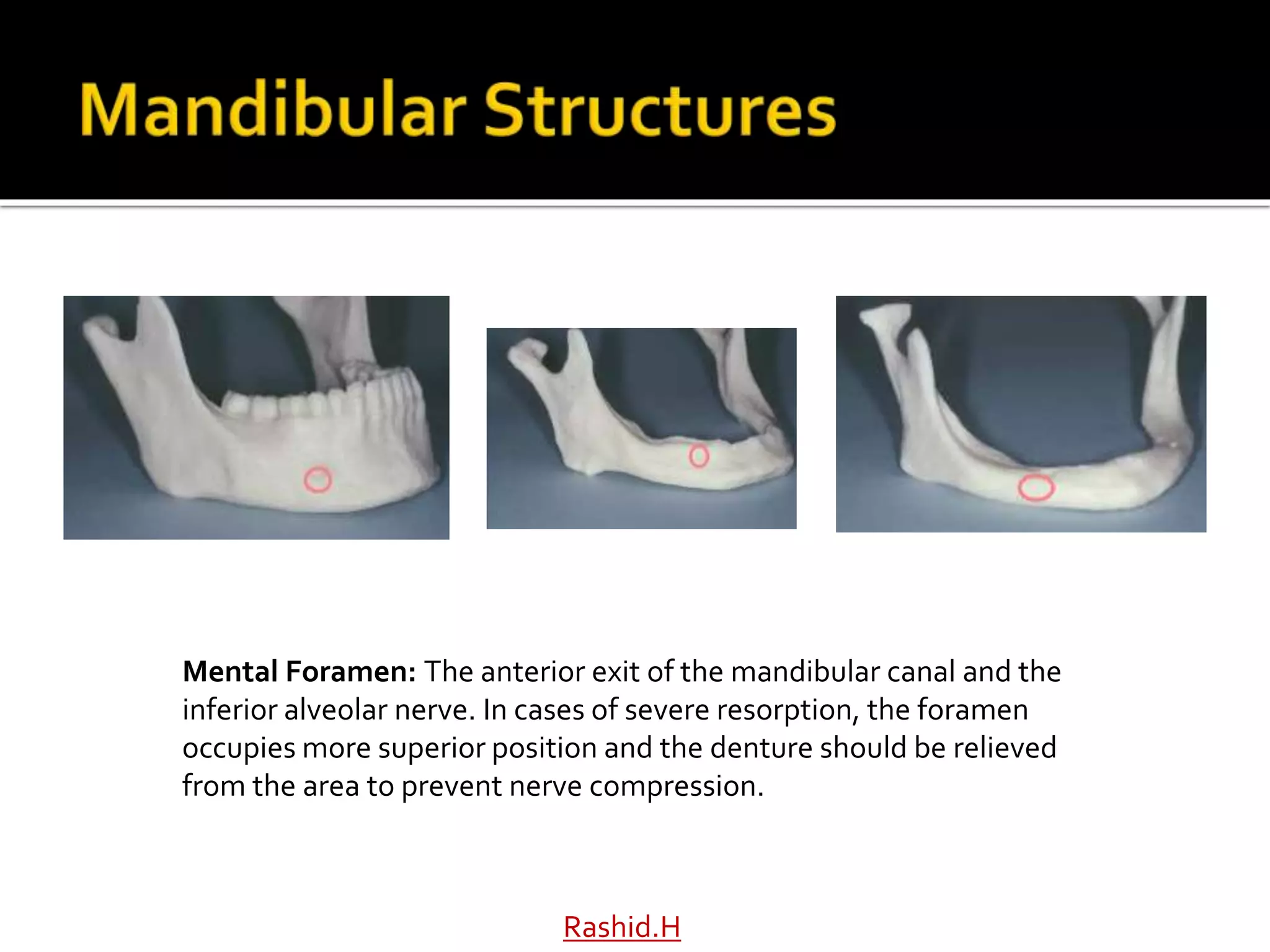
Mental Foramen: The anterior exit of the mandibular canal and the
inferior alveolar nerve. In cases of severe resorption, the foramen
occupies more superior position and the denture should be relieved
from the area to prevent nerve compression.
 Located on lateral surface of mandible
 Most common location  between 1st & 2nd
bicuspid
 If the loss of residual ridge is extensive,
foramen occupies superior position and
denture base should be relieved over the area
to avoid numbness or paresthesia of lower lip.
Rashid.H
Rashid.H
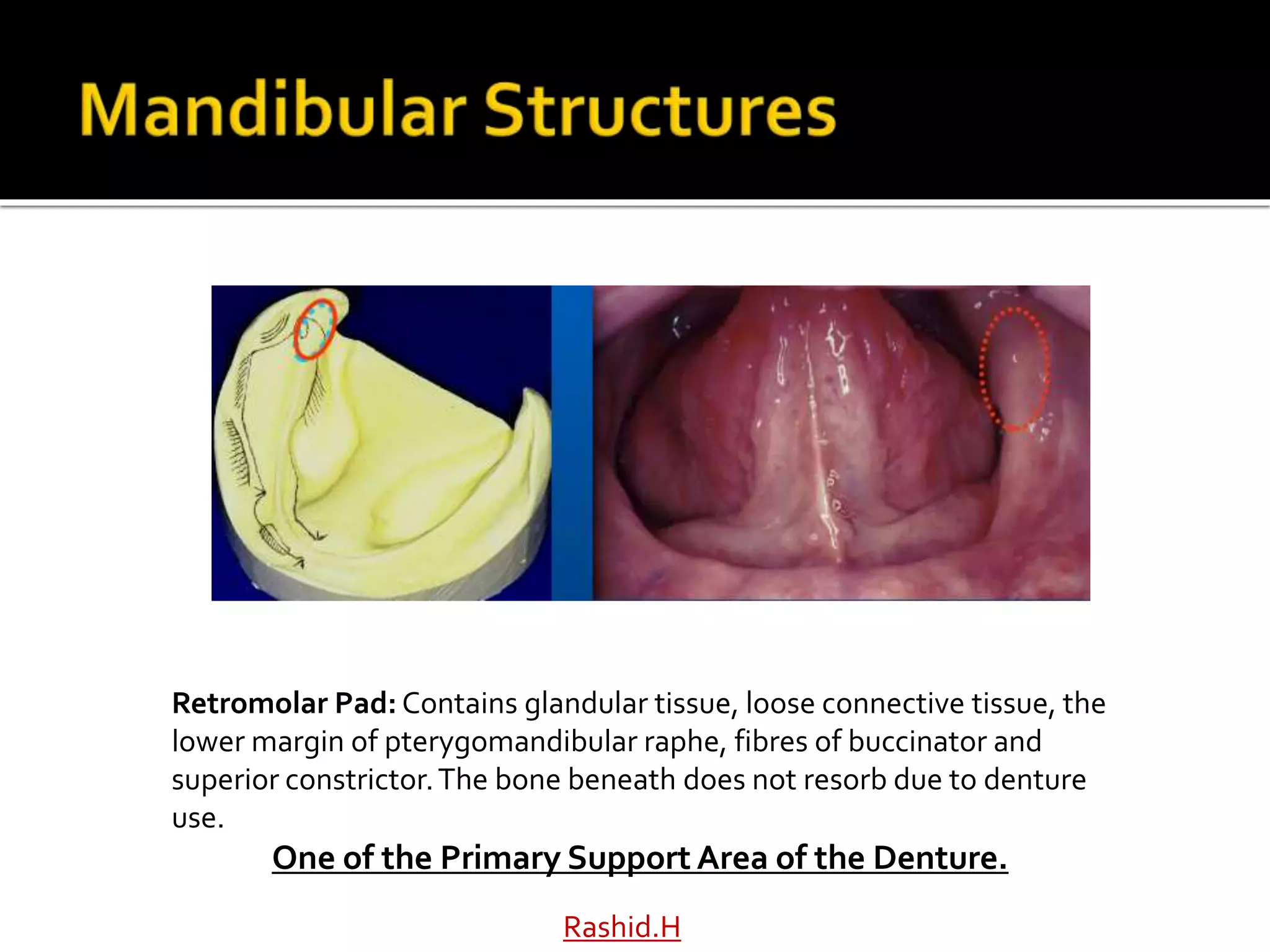
Retromolar Pad: Contains glandular tissue, loose connective tissue, the
lower margin of pterygomandibular raphe, fibres of buccinator and
superior constrictor.The bone beneath does not resorb due to denture
use.
One of the Primary Support Area of the Denture.
Rashid.H
Masseter Groove: The action of masseter muscle reflects
the buccinator muscle in a superior and medial position.
The disto-buccal flange of the denture should be
contoured to allow freedom of this action otherwise the
denture will be dislodged.
Rashid.H
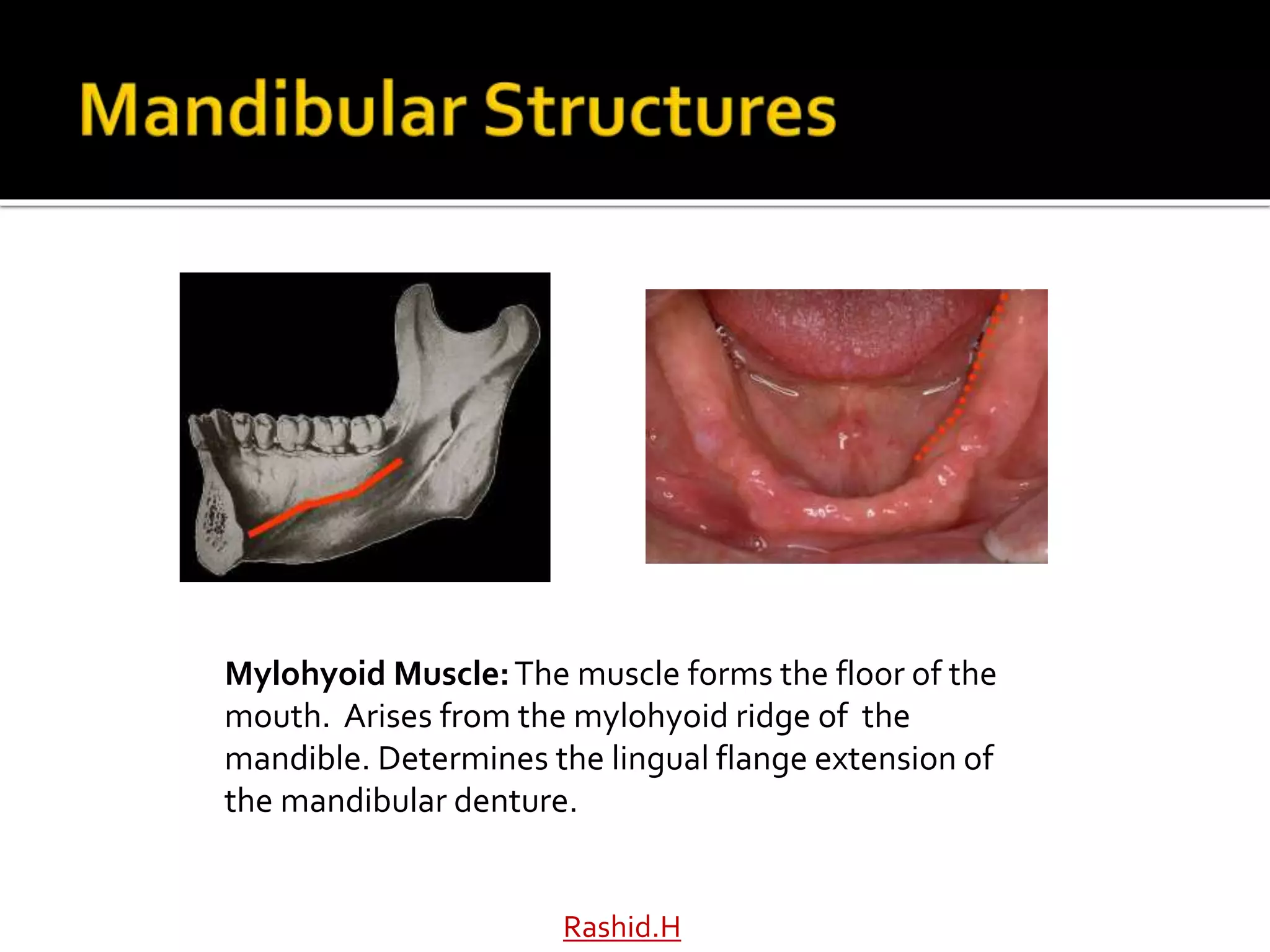
Mylohyoid Muscle:The muscle forms the floor of the
mouth. Arises from the mylohyoid ridge of the
mandible. Determines the lingual flange extension of
the mandibular denture.
 Irregular rough bony crest extending from 3rd
molar to lower border of mandible in region
of chin.
 If mylohyoid ridge is prominent and sharp it
surgical intervention is indicated.
 Mucosa in this region is poorly keratinized
and prone to trauma denture may require
relief in this area.
Rashid.H
Rashid.H
The position of mylohyoid ridge varies
according to the resorption pattern.
Rashid.H
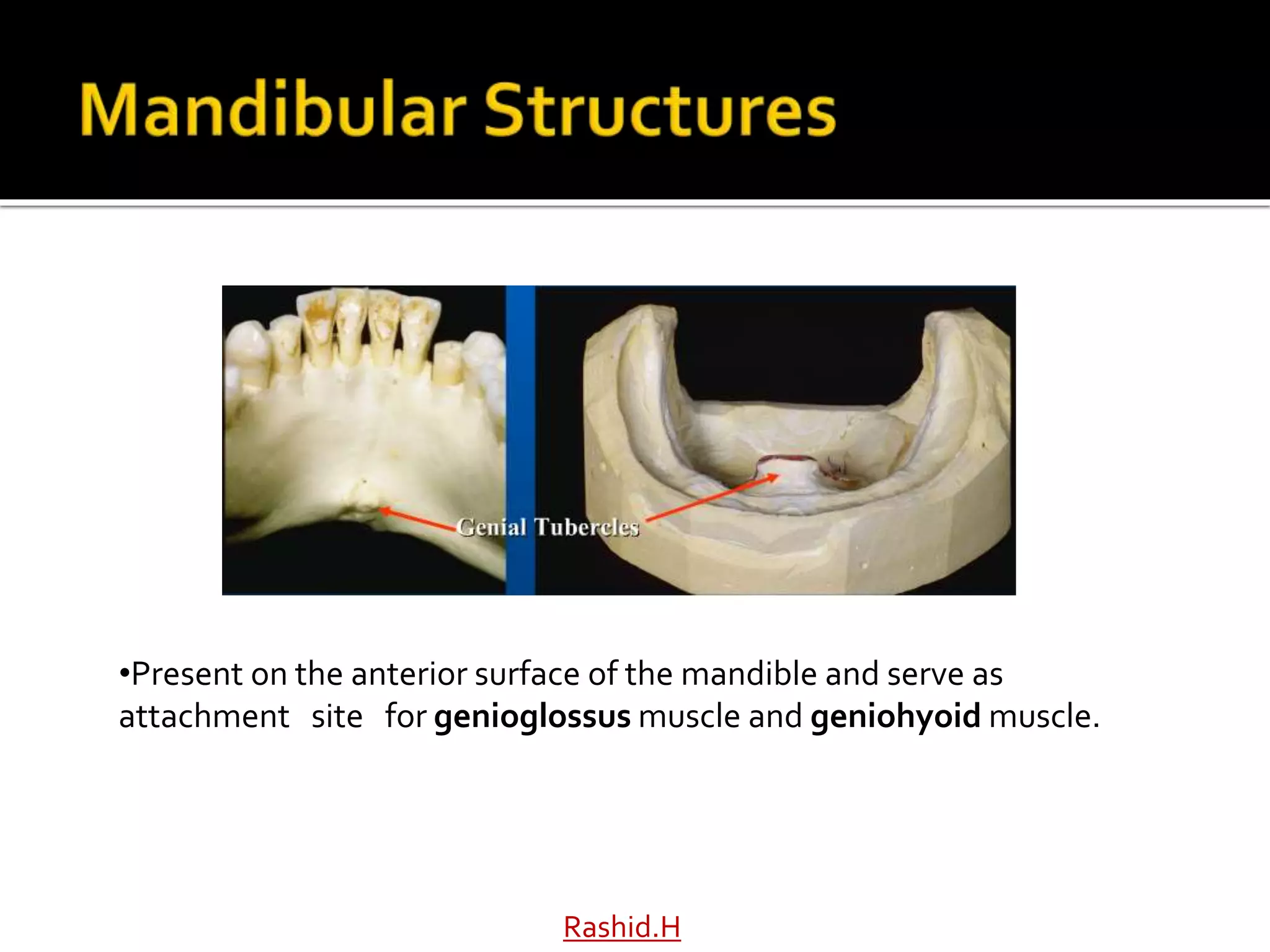
•Present on the anterior surface of the mandible and serve as
attachment site for genioglossus muscle and geniohyoid muscle.
 When the loss of residual ridge is extensive, the
spines are sometimes superior in position than
the crest of ridge; so relief or surgical procedure
is implicated
Rashid.H
Rashid.H
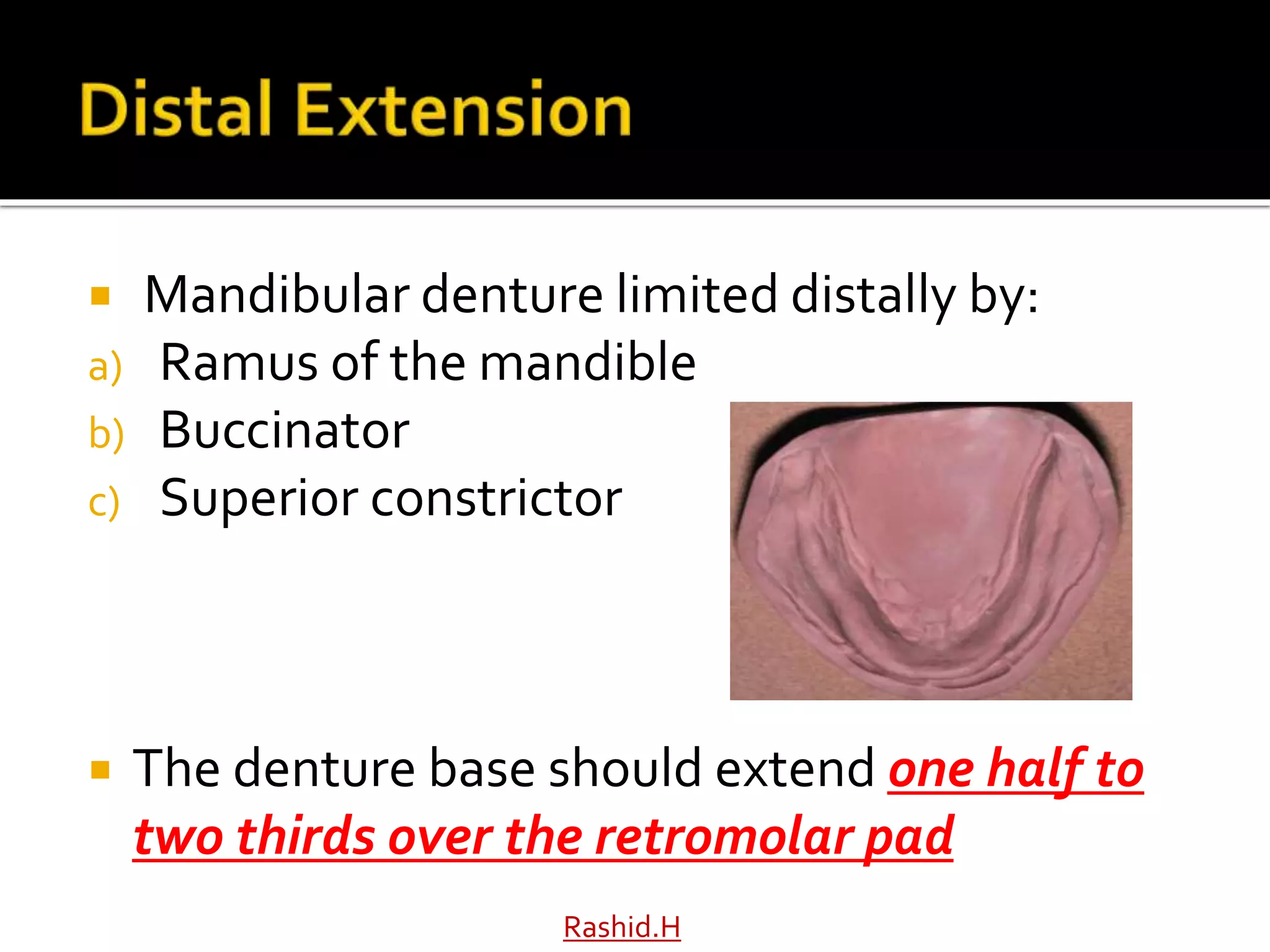
 Mandibular denture limited distally by:
a) Ramus of the mandible
b) Buccinator
c) Superior constrictor
 The denture base should extend one half to
two thirds over the retromolar pad
Rashid.H
 Terminal border of the denture
base
 Compressible soft tissue and
provides:
a) Comfort
b) Peripheral seal
 Must be captured in impression
Rashid.H
 One half to two thirds over retromolar pad
because:
a) Thin mucosa
b) Non keratinized
c) Sub-mucosa has loose alveolar and
glandular tissue
d) Contains fibers of buccinator, superior
constrictor and tendon of temporalis.
Rashid.H
 The mylohyoid muscle has:
a) an indirect effect on anterior lingual
border up to second premolar
b) Direct effect on posterior lingual border
in molar region
c) The muscle elevates the floor of the
mouth in the first stage of deglutition
d) May also elevate hyoid bone
Rashid.H
 Space between the residual ridge & tongue
 Divided intro three regions (anterior, middle &
posterior)
 The anterior region extends from the lingual
frenum up to the mylohyoid muscle
Rashid.H
 Following structures may be found in the
lingual sulcus:
a) Sublingual gland
b) Mylohyoid muscle
c) Geniohyoid muscle
Rashid.H
Rashid.H
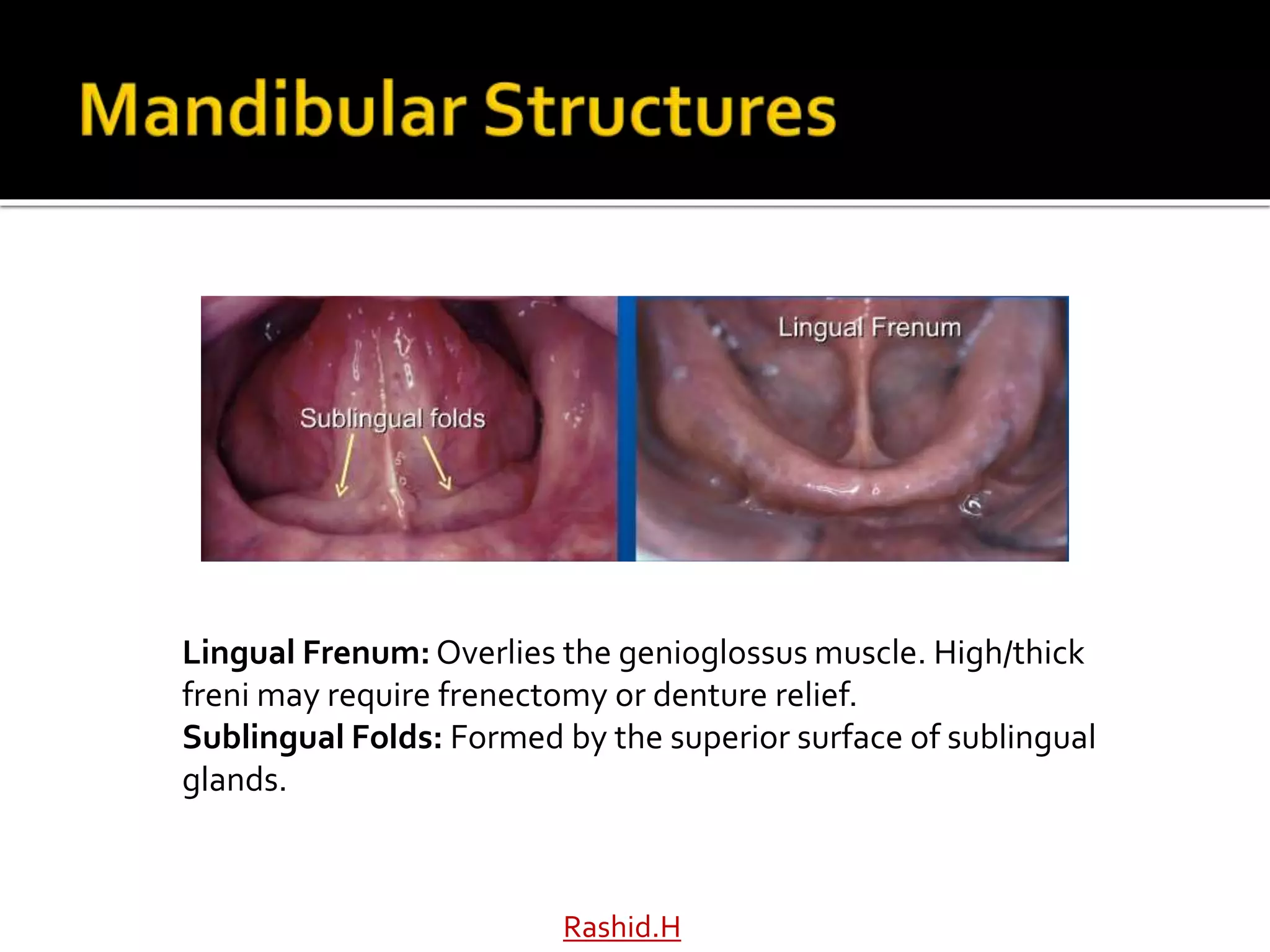
Lingual Frenum: Overlies the genioglossus muscle. High/thick
freni may require frenectomy or denture relief.
Sublingual Folds: Formed by the superior surface of sublingual
glands.
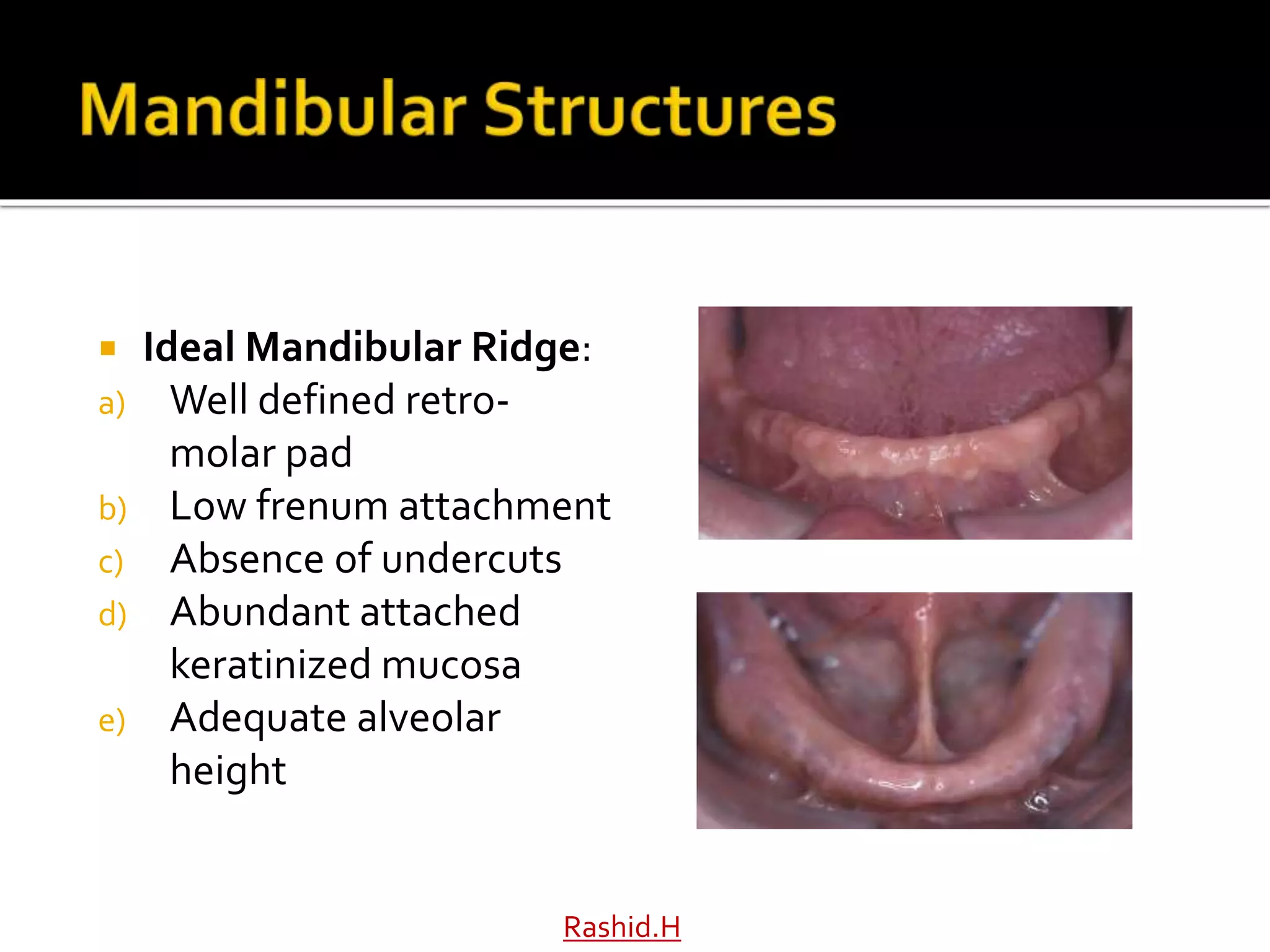
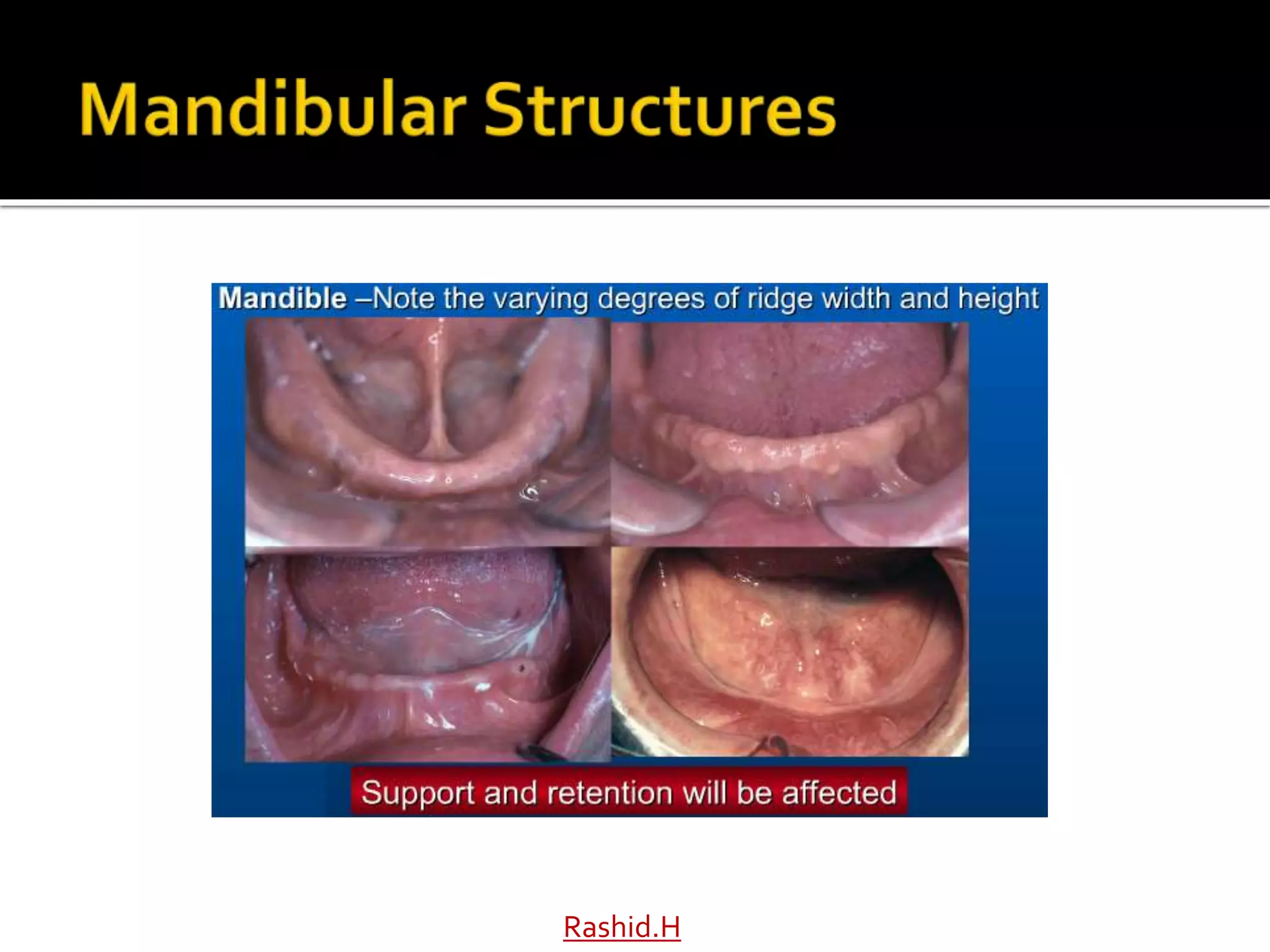
 Ideal Mandibular Ridge:
a) Well defined retro-
molar pad
b) Low frenum attachment
c) Absence of undercuts
d) Abundant attached
keratinized mucosa
e) Adequate alveolar
height
Rashid.H
Rashid.H
 Consists of intrinsic and
extrinsic muscles
 A denture flange must be
contoured so that the
tongue moves freely
 Approximately 35% of the
tongues are abnormal is
size & shape.
Rashid.H
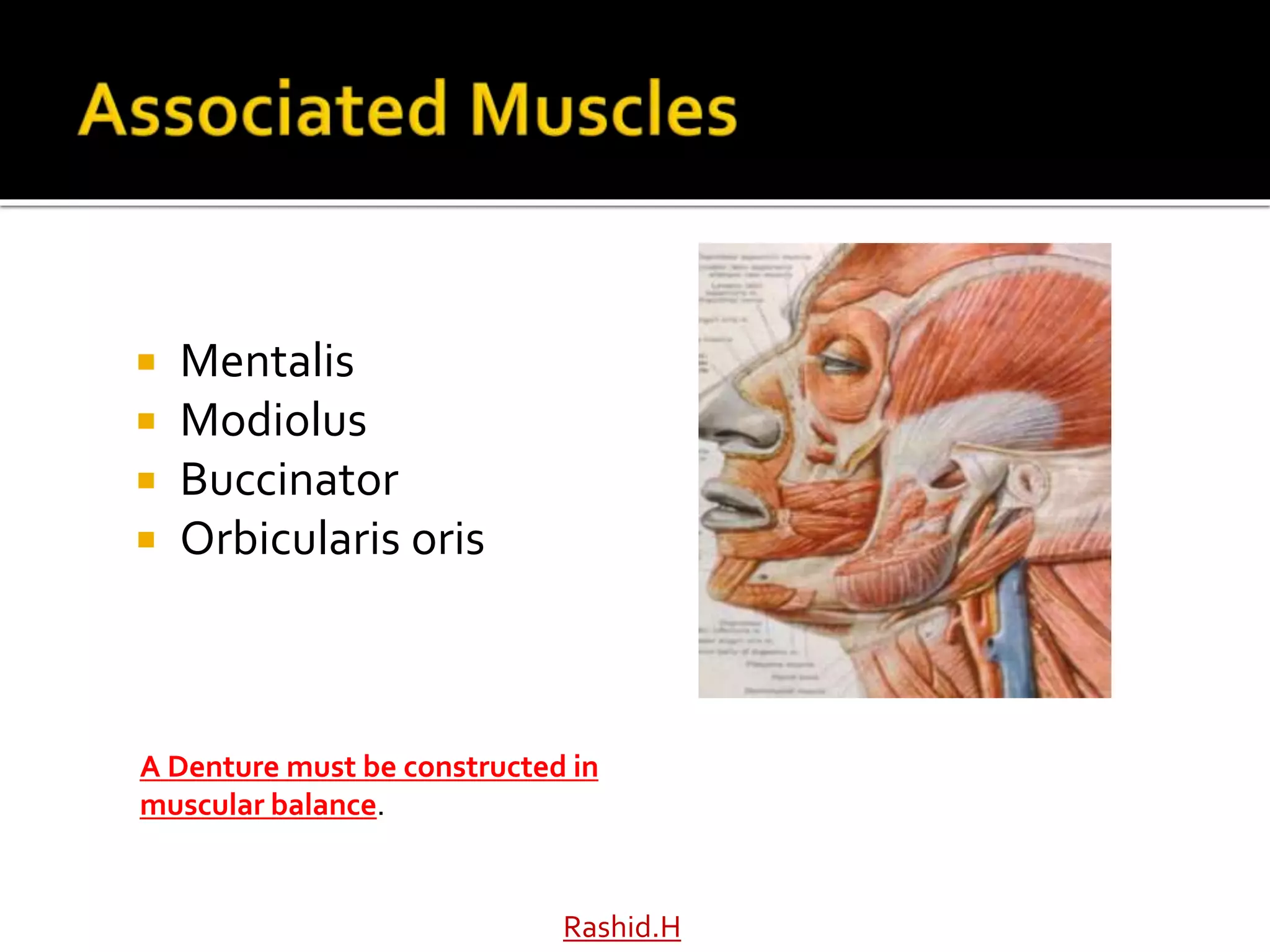
 Mentalis
 Modiolus
 Buccinator
 Orbicularis oris
Rashid.H
A Denture must be constructed in
muscular balance.
Rashid.H
any questions ……..

Anatomy for Complete and Partial Dentures (1).pptx

  • 1.
    Dr Haroon RashidBaloch Department of Prosthodontics, Ziauddin College of Dentistry.
  • 2.
     A thoroughknowledge of the anatomy of the denture bearing surfaces is paramount to designing and fabricating functional dentures.  The functional anatomy of the denture foundation areas of the maxilla and mandible is presented in detail.  In particular, the relationship of these anatomic structures that impact retention, stability and support. Rashid.H
  • 3.
     Retention  Stability Support “When the key anatomical landmarks and their role with retention, stability and support are understood, dentures can be fabricated as integral part of oral cavity and not just artificial mechanical substitutes” Rashid.H
  • 4.
     The underlyingbone  The mucous membrane Rashid.H
  • 5.
     Osseous structuressupport the overlying denture  Affects the impression making  Maxillary denture is supported by two main bones: a) Maxilla b) Palatine bone  Mandibular Denture is supported mainly by: a) Mandible Rashid.H
  • 6.
     The cushionbetween the denture and the supporting bone  Mucous membrane consists of a) Mucosa b) Sub mucosa  The submucosa is formed by connective tissue that may be: a) Dense b) Loose c) May vary in thickness Rashid.H
  • 7.
     Makes thebulk of overlying mucous membrane  Firmly attached to periosteum  Thin submucosa  Non resilient soft tissue  mucous membrane easily traumatized Rashid.H
  • 8.
     Masticatory covers the hard palate and the crest of the alveolar ridge  Lining Mucosa  covering the cheek, inner aspect of the lips, soft palate, ventral surface of the tongue.  Specialized Mucosa  dorsum of the tongue Rashid.H
  • 9.
  • 10.
    a) Labial frenum b)Labial vestibule c) Buccal frenum d) Buccal vestibule e) Hamular notch f) Posterior palatal seal area Rashid.H
  • 11.
    1. Frenum: Freniare folds of mucous membranes and do not contain significant muscle fibres.They need to be excised (frenectomy) or maybe relieved.They may compromise denture stability and retention. 2. Vestibule: Space between the cheeks and the teeth.When filled with a denture, greatly enhances retention and stability. Rashid.H
  • 12.
    1. Canine Eminence:This prominent bone provides denture support. Area may also prevent denture rotation thus provide stability. 2. Incisive Papilla: A pad of fibrous tissue overlying the orifice of naso-palatine canal. Excessive pressure over this area may cause disruption of blood flow and compression of the nerve. Relief may be provided if necessary. Rashid.H
  • 13.
     Divided intoright & left by labial frenum *  The outer surface of the labial vestibule is attached with the orbicularis oris.  The fibres of orbicularis oris run in a horizontal direction.  The muscle has an indirect effect on the denture base
  • 14.
     The buccalfrenum is the dividing line between the labial & buccal vestibules.  More muscular attachments  Extends from the buccal frenum to the hamular notch Rashid.H
  • 15.
    Rashid.H 1. Hamular Notch:Narrow cleft extending from the tuberosity towards the pterygoid muscles. Critical to the design of maxillary denture. Improper positioning of the denture over that area may cause soreness of the area.
  • 16.
    Labial Notch (narrow)and Buccal Notch (wide) Rashid.H
  • 17.
    1. Tuberosity: Importantprimary denture support area in maxilla. Provides resistance to horizontal denture movements. 2. Posterior Palatal Seal: Is at the junction of hard and soft palate near the vibrating line. Marks the posterior extension of the denture. Rashid.H
  • 18.
    Rashid.H o An imaginaryline (area) drawn across the palate from one hamular notch to the other o Marks the beginning of motion in the soft palate when o Usually lies within 2-3 mm in front of fovea palatine
  • 19.
    Rashid.H  The directionof the vibrating line usually varies with the shape of palate  Higher the vault the more abrupt and forward the vibrating line  Flatter palatal vault, the vibrating line is usually farther posterior and has a gradual curvature
  • 20.
     Usually twoin number, present just behind the junction of hard and soft-palate  Are indentations near the midline of the palate  Formed by the coalescence of several minor mucous gland ducts
  • 21.
    Rashid.H Coronoid Process: Patientis told to open, protrude and perform lateral movements to get the impression of coronoid process.The width of the disto-buccal flange will then be contoured by the coronoid process. (Avoid over extension) Minor Salivary Glands: Present at the posterior 1/3rd of the palate.The impression may appear irregular because of salivary gland secretions that may adhere to the impression material.
  • 22.
    Rashid.H Zygomatic alveolar crest:Not considered as primary stress bearing area.Thick bone but the mucosa is very thin and not considered desirable for more stress. (Avoid over extension)
  • 23.
    Rashid.H 1. Hard Palate:Considered to be primary stress bearing area of maxillary denture. Provides retention, stability and support. 2. Midline Palatal Suture:Thin line extending from incisive papilla towards the posterior end of the palate. Mucosa is tightly attached and very thin. Relief may be provided to prevent soreness. 3. Major Palatine Foramen: Carries anterior palatine nerve and vessels. Relief is NOT provided because of presence of abundant overlying tissues.
  • 24.
     Covered bykeratinized stratified squamous epithelium .  In the region of medial palatal suture , the submucosa is extremely thin ; relief should be provided to avoid trauma or rocking of the denture Rashid.H
  • 25.
     Antero-laterally, thesubmucosa contains adipose tissue.  Postero-laterally, it contains glandular tissue.  The horizontal portion of the hard palate provides the primary stress-bearing area. Rashid.H
  • 26.
     Rugae: Raisedareas of dense connective tissues in ant 1/3rd of maxillary. Resists anterior displacement of the denture.  Hard Palate consists of series of ridges in the anterior part of the hard palate  Sets at an angle to residual ridge & covered by thin soft tissues  It is considered as a secondary stress bearing area Rashid.H
  • 27.
     Covered bykeratinized stratified squamous epithelium.  Considered as a secondary stress-bearing area because it is subject to resorption contrary to horizontal portion of hard palate. Rashid.H
  • 28.
     Ideal MaxillaryRidge Should have: a) Abundant attached keratinized tissue b) Broad and well developed ridge. c) Moderate palatal vault d) Absence of undercuts e) Well defined hamular notches Rashid.H
  • 30.
     Maxillary dentureinfluenced by following muscles: a) Anterior Labial Flange  influenced by orbicularis oris muscle as far as the pre- molar region b) Buccal Flange  influenced by the buccinator muscle Rashid.H
  • 31.
  • 32.
  • 33.
     Labial vestibule Buccal vestibule  Lingual border  Retromolar Pad  Sublingual gland region  Lingual sulcus
  • 34.
    Rashid.H Labial Frenum: Anatomicallyand histological same as that of maxillary frenum.
  • 35.
    1. LabialVestibule: Limitedinferiorly by the mentalis muscle, internally by the alveolar ridge and labially by the lip. 2. Mentalis Muscle: Dictates the length and thickness of the labial flange extension of the lower denture. Rashid.H
  • 36.
    Rashid.H 1. Alveolar Ridge:Secondary support area. High rate of resorption when excessive pressure is applied. 2. Buccal Frenum: Histologically and functionally same as that of labial frenum.
  • 37.
    Rashid.H Buccal Shelf: Borderedexternally by external oblique ridge and internally by the slope of the alveolar ridge. PRIMARY STRESS BEARING AREA IN MANDIBLE.
  • 38.
     The mucousmembrane covering the buccal shelf area is loosely attached  Less keratinized  Contains thick sub mucosal layer.  Considered as a primary stress-bearing area because it is covered by a layer of cortical bone  Lies at right angles to vertical occlusal forces
  • 39.
    Rashid.H Buccal Shelf: Greaterthe area of buccal shelf, greater will be the support available for the denture.
  • 40.
     The buccalvestibule extends from the buccal frenum to the back corner of the retromolar pad  Influenced by the presence of buccinator  The external oblique ridge does not govern the extension of the buccal flange  The denture border can be extended 1-2 mm beyond this ridge Rashid.H
  • 41.
    Rashid.H External Oblique Ridge:A ridge of dense bone arising from the mental foramen, coursing superiorly and distally to become continuous with the anterior border of the ramus. It is the site of attachment of buccinator muscle and anatomic guide for lateral termination of the buccal flange of mandibular denture.
  • 42.
    Rashid.H Mental Foramen: Theanterior exit of the mandibular canal and the inferior alveolar nerve. In cases of severe resorption, the foramen occupies more superior position and the denture should be relieved from the area to prevent nerve compression.
  • 43.
     Located onlateral surface of mandible  Most common location  between 1st & 2nd bicuspid  If the loss of residual ridge is extensive, foramen occupies superior position and denture base should be relieved over the area to avoid numbness or paresthesia of lower lip. Rashid.H
  • 44.
    Rashid.H Retromolar Pad: Containsglandular tissue, loose connective tissue, the lower margin of pterygomandibular raphe, fibres of buccinator and superior constrictor.The bone beneath does not resorb due to denture use. One of the Primary Support Area of the Denture.
  • 45.
    Rashid.H Masseter Groove: Theaction of masseter muscle reflects the buccinator muscle in a superior and medial position. The disto-buccal flange of the denture should be contoured to allow freedom of this action otherwise the denture will be dislodged.
  • 46.
    Rashid.H Mylohyoid Muscle:The muscleforms the floor of the mouth. Arises from the mylohyoid ridge of the mandible. Determines the lingual flange extension of the mandibular denture.
  • 47.
     Irregular roughbony crest extending from 3rd molar to lower border of mandible in region of chin.  If mylohyoid ridge is prominent and sharp it surgical intervention is indicated.  Mucosa in this region is poorly keratinized and prone to trauma denture may require relief in this area. Rashid.H
  • 48.
    Rashid.H The position ofmylohyoid ridge varies according to the resorption pattern.
  • 49.
    Rashid.H •Present on theanterior surface of the mandible and serve as attachment site for genioglossus muscle and geniohyoid muscle.
  • 50.
     When theloss of residual ridge is extensive, the spines are sometimes superior in position than the crest of ridge; so relief or surgical procedure is implicated Rashid.H
  • 51.
  • 52.
     Mandibular denturelimited distally by: a) Ramus of the mandible b) Buccinator c) Superior constrictor  The denture base should extend one half to two thirds over the retromolar pad Rashid.H
  • 53.
     Terminal borderof the denture base  Compressible soft tissue and provides: a) Comfort b) Peripheral seal  Must be captured in impression Rashid.H
  • 54.
     One halfto two thirds over retromolar pad because: a) Thin mucosa b) Non keratinized c) Sub-mucosa has loose alveolar and glandular tissue d) Contains fibers of buccinator, superior constrictor and tendon of temporalis. Rashid.H
  • 55.
     The mylohyoidmuscle has: a) an indirect effect on anterior lingual border up to second premolar b) Direct effect on posterior lingual border in molar region c) The muscle elevates the floor of the mouth in the first stage of deglutition d) May also elevate hyoid bone Rashid.H
  • 56.
     Space betweenthe residual ridge & tongue  Divided intro three regions (anterior, middle & posterior)  The anterior region extends from the lingual frenum up to the mylohyoid muscle Rashid.H
  • 57.
     Following structuresmay be found in the lingual sulcus: a) Sublingual gland b) Mylohyoid muscle c) Geniohyoid muscle Rashid.H
  • 58.
    Rashid.H Lingual Frenum: Overliesthe genioglossus muscle. High/thick freni may require frenectomy or denture relief. Sublingual Folds: Formed by the superior surface of sublingual glands.
  • 59.
     Ideal MandibularRidge: a) Well defined retro- molar pad b) Low frenum attachment c) Absence of undercuts d) Abundant attached keratinized mucosa e) Adequate alveolar height Rashid.H
  • 60.
  • 61.
     Consists ofintrinsic and extrinsic muscles  A denture flange must be contoured so that the tongue moves freely  Approximately 35% of the tongues are abnormal is size & shape. Rashid.H
  • 62.
     Mentalis  Modiolus Buccinator  Orbicularis oris Rashid.H A Denture must be constructed in muscular balance.
  • 63.
  • 64.