Chapter 10:
Reproductive System


                 Ruqayya Salam
Exercise 10A
                  The three stages of labor
                   and delivery are the
                   dilation stage, the
                   expulsion stage, and the
                   placental stage.
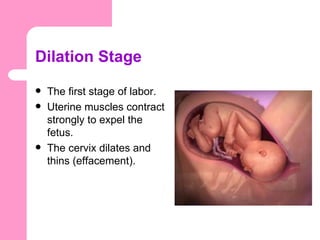
Dilation Stage
   The first stage of labor.
   Uterine muscles contract
    strongly to expel the
    fetus.
   The cervix dilates and
    thins (effacement).
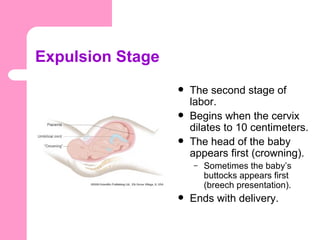
Expulsion Stage
                     The second stage of
                      labor.
                     Begins when the cervix
                      dilates to 10 centimeters.
                     The head of the baby
                      appears first (crowning).
                      –   Sometimes the baby’s
                          buttocks appears first
                          (breech presentation).
                     Ends with delivery.
Placental Stage
   The last stage of labor.
   The uterus continues to
    contract.
   This causes the placenta
    to be expelled through
    the vagina.
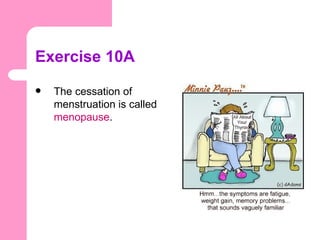
Exercise 10A
   The cessation of
    menstruation is called
    menopause.
Menopause

   Time in a woman’s life when her periods
    eventually stop.
   The body goes through changes so she can no
    longer get pregnant.
   Normally occurs in women ages 45-55.
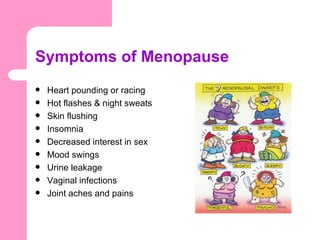
Symptoms of Menopause
   Heart pounding or racing
   Hot flashes & night sweats
   Skin flushing
   Insomnia
   Decreased interest in sex
   Mood swings
   Urine leakage
   Vaginal infections
   Joint aches and pains
Lifestyle Changes to Reduce
Symptoms

   Avoid caffeine, alcohol, and spicy foods.
   Eat soy foods because it contains estrogen.
   Get plenty of calcium and vitamin D.
   Exercise regularly.
   Practice slow, deep breathing.
   Do Kegel exercises. They strengthen the
    muscles of the vagina and pelvis.
Exercise 10A

   One of the longest terms used in medical
    terminology refers to the removal of the
    uterus, cervix, ovaries, and fallopian tubes.
    This term is total abdominal hysterectomy-
    bilateral salpingo-oophorectomy.
Total abdominal hysterectomy-
bilateral salpingo-oophorectomy
   This surgery is needed
    when there is sign of
    cancer or possible
    cancer in the uterus.
   When everything is
    removed, the intestines
    will dip down to fill the
    space.
   A usual hospital stay is
    3-5 days.
Total abdominal hysterectomy-
bilateral salpingo-oophorectomy
   There are parts to recovery: physical, emotional, and
    sexual.
   Physical recovery includes the healing of the skin and
    abdominal muscles incisions.
    –   This can take 6 to 8 weeks.
   Emotional recovery is adjusting and accepting the fact
    that you have cancer. It also means feeling comfortable
    with yourself and your body after surgery.
   Sexual recovery involves returning to your previous
    patterns of sexual activity .

Chapter10

  • 1.
  • 2.
    Exercise 10A  The three stages of labor and delivery are the dilation stage, the expulsion stage, and the placental stage.
  • 3.
    Dilation Stage  The first stage of labor.  Uterine muscles contract strongly to expel the fetus.  The cervix dilates and thins (effacement).
  • 4.
    Expulsion Stage  The second stage of labor.  Begins when the cervix dilates to 10 centimeters.  The head of the baby appears first (crowning). – Sometimes the baby’s buttocks appears first (breech presentation).  Ends with delivery.
  • 5.
    Placental Stage  The last stage of labor.  The uterus continues to contract.  This causes the placenta to be expelled through the vagina.
  • 6.
    Exercise 10A  The cessation of menstruation is called menopause.
  • 7.
    Menopause  Time in a woman’s life when her periods eventually stop.  The body goes through changes so she can no longer get pregnant.  Normally occurs in women ages 45-55.
  • 8.
    Symptoms of Menopause  Heart pounding or racing  Hot flashes & night sweats  Skin flushing  Insomnia  Decreased interest in sex  Mood swings  Urine leakage  Vaginal infections  Joint aches and pains
  • 9.
    Lifestyle Changes toReduce Symptoms  Avoid caffeine, alcohol, and spicy foods.  Eat soy foods because it contains estrogen.  Get plenty of calcium and vitamin D.  Exercise regularly.  Practice slow, deep breathing.  Do Kegel exercises. They strengthen the muscles of the vagina and pelvis.
  • 10.
    Exercise 10A  One of the longest terms used in medical terminology refers to the removal of the uterus, cervix, ovaries, and fallopian tubes. This term is total abdominal hysterectomy- bilateral salpingo-oophorectomy.
  • 11.
    Total abdominal hysterectomy- bilateralsalpingo-oophorectomy  This surgery is needed when there is sign of cancer or possible cancer in the uterus.  When everything is removed, the intestines will dip down to fill the space.  A usual hospital stay is 3-5 days.
  • 12.
    Total abdominal hysterectomy- bilateralsalpingo-oophorectomy  There are parts to recovery: physical, emotional, and sexual.  Physical recovery includes the healing of the skin and abdominal muscles incisions. – This can take 6 to 8 weeks.  Emotional recovery is adjusting and accepting the fact that you have cancer. It also means feeling comfortable with yourself and your body after surgery.  Sexual recovery involves returning to your previous patterns of sexual activity .