PROPAGATING EXCEPTION
Chapter 9.3:
Propagating Exceptions
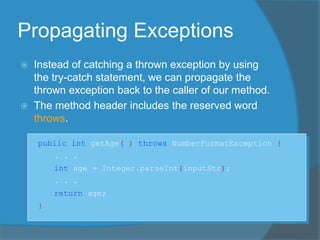
 Instead of catching a thrown exception by using
the try-catch statement, we can propagate the
thrown exception back to the caller of our method.
 The method header includes the reserved word
throws.
public int getAge( ) throws NumberFormatException {
. . .
int age = Integer.parseInt(inputStr);
. . .
return age;
}
Throwing Exceptions
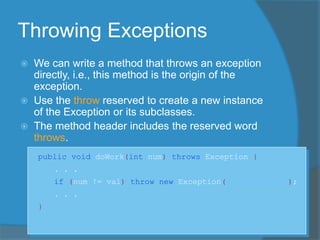
 We can write a method that throws an exception
directly, i.e., this method is the origin of the
exception.
 Use the throw reserved to create a new instance
of the Exception or its subclasses.
 The method header includes the reserved word
throws.
public void doWork(int num) throws Exception {
. . .
if (num != val) throw new Exception("Invalid val");
. . .
}
Exception Thrower
 When a method may throw an
exception, either directly or indirectly, we
call the method an exception thrower.
 Every exception thrower must be one of
two types:
 catcher.
 propagator.
Types of Exception
Throwers
 An exception catcher is an exception
thrower that includes a matching catch
block for the thrown exception.
 An exception propagator does not
contain a matching catch block.
 A method may be a catcher of one
exception and a propagator of another.
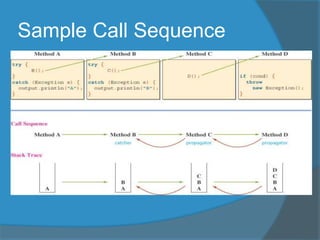
Sample Call Sequence

Chapter 9.3

  • 1.
  • 2.
    Propagating Exceptions  Insteadof catching a thrown exception by using the try-catch statement, we can propagate the thrown exception back to the caller of our method.  The method header includes the reserved word throws. public int getAge( ) throws NumberFormatException { . . . int age = Integer.parseInt(inputStr); . . . return age; }
  • 3.
    Throwing Exceptions  Wecan write a method that throws an exception directly, i.e., this method is the origin of the exception.  Use the throw reserved to create a new instance of the Exception or its subclasses.  The method header includes the reserved word throws. public void doWork(int num) throws Exception { . . . if (num != val) throw new Exception("Invalid val"); . . . }
  • 4.
    Exception Thrower  Whena method may throw an exception, either directly or indirectly, we call the method an exception thrower.  Every exception thrower must be one of two types:  catcher.  propagator.
  • 5.
    Types of Exception Throwers An exception catcher is an exception thrower that includes a matching catch block for the thrown exception.  An exception propagator does not contain a matching catch block.  A method may be a catcher of one exception and a propagator of another.
  • 6.