Continuing, Mit 👍
I’ll **continue seamlessly** from where we stopped and keep the **easy, exam-friendly language**.
---
#### Discrete-Time Signal
A discrete-time signal is defined only at specific, discrete time instants. These signals are usually obtained by sampling a continuous-time signal.
Example:
[
x[n] = \sin\left(\frac{\pi n}{4}\right)
]
Applications:
* Digital signal processing
* Computer-based systems
* Digital communication
---
### 3.2 Analog and Digital Signals
#### Analog Signal
An analog signal has **continuous amplitude** and **continuous time**. It can take infinite values within a range.
Examples:
* Microphone output voltage
* Temperature signal
* Radio signal
Advantages:
* Natural representation of physical quantities
Disadvantages:
* Sensitive to noise
* Difficult to store and process
#### Digital Signal
A digital signal has **discrete time** and **discrete amplitude** values.
Examples:
* Binary signals (0 and 1)
* Computer data
* Digital audio
Advantages:
* Noise immunity
* Easy storage and processing
* High reliability
---
### 3.3 Periodic and Aperiodic Signals
#### Periodic Signal
A signal is periodic if it repeats itself after a fixed interval of time (T).
Mathematically:
[
x(t) = x(t + T)
]
Examples:
* Sine wave
* Square wave
* Cosine wave
Applications:
* Power systems
* Communication systems
#### Aperiodic Signal
A signal that does not repeat itself is called aperiodic.
Examples:
* Speech signal
* ECG signal
* Transient signals
---
### 3.4 Even and Odd Signals
#### Even Signal
A signal is even if:
[
x(t) = x(-t)
]
Examples:
* Cosine function
* Symmetric signals
#### Odd Signal
A signal is odd if:
[
x(t) = -x(-t)
]
Examples:
* Sine function
Any signal can be represented as the sum of its even and odd components.
---
### 3.5 Energy and Power Signals
#### Energy Signal
A signal is an energy signal if it has finite energy.
Energy:
[
E = \int_{-\infty}^{\infty} |x(t)|^2 dt
]
Examples:
* Pulse signals
* Transient signals
#### Power Signal
A signal is a power signal if it has finite power.
Power:
[
P = \lim_{T \to \infty} \frac{1}{2T} \int_{-T}^{T} |x(t)|^2 dt
]
Examples:
* Sinusoidal signals
* Periodic signals
---
## 4. Basic Elementary Signals
Elementary signals are basic building blocks used to represent complex signals.
### 4.1 Unit Step Signal
The unit step signal is defined as:
[
u(t) =
\begin{cases}
1, & t \ge 0 \
0, & t < 0
\end{cases}
]
Applications:
* Switching systems
* Modeling sudden changes
---
### 4.2 Unit Impulse Signal
The unit impulse signal is denoted by ( \delta(t) ).
It has infinite amplitude at (t = 0) and zero elsewhere, with unit area.
Property:
[
\int_{-\infty}^{\infty} \delta(t) dt = 1
]
Applications:
* System analysis
* Sampling theory
---
### 4.3 Ramp Signal
The ramp signal is defined as:
[
r(t) = t u(t)
]
Applications:
* Motion control
* Modeling gradual changes
---
### 4.4 Exponential Signal
An exponential signal is of t

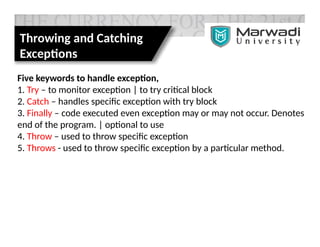
![Throwing and Catching
Exceptions
try-catch-finally keyword
class myExeption
{ public static void main(String s[]){
int i=5, j=0;
System.out.println("Try started");
try
{
int temp = i/j;
System.out.println("Inside try");
}
catch(Exception e)
{
System.out.println("Inside catch");
System.out.println("Divide by 0");
}
finally
{
System.out.println("Finally block");
} } }
Output: try started
Inside catch
Divide by 0
Finally block](https://image.slidesharecdn.com/unit5exceptionhandling1-251215113046-f9bfa7bc/85/Unit_5_Exception_Handling-1-pptxforyour-14-320.jpg)
![Throwing and Catching
Exceptions
Using Multiple Catch Clauses
To catch different types of exceptions multiple catch clause can be used.
Example:
public class TestMultipleCatchBlock{
public static void main(String args[]){
try{
int a[]=new int[5];
a[5]=30/0;
}
catch(ArithmeticException e){
System.out.println("task1 is completed");}
catch(ArrayIndexOutOfBoundsException e){
System.out.println("task 2 completed");}
catch(Exception e){
System.out.println("common task completed");}
System.out.println("rest of the code...");
} } Output:task1 completed
rest of the code...](https://image.slidesharecdn.com/unit5exceptionhandling1-251215113046-f9bfa7bc/85/Unit_5_Exception_Handling-1-pptxforyour-15-320.jpg)
![Throwing and Catching
Exceptions
Try block can be nested
A try, catch or finally block can contain another set of try catch and finally
sequence.
class Excep6{
public static void main(String args[]){
try{
try{
System.out.println("going to divide");
int b =39/0;
}catch(ArithmeticException e) {System.out.println(e);}
try{
int a[]=new int[5];
a[5]=4;
}catch(ArrayIndexOutOfBoundsException e) {System.out.println(e);}
System.out.println("other statement");
}catch(Exception e)
{System.out.println("handeled");} System.out.println("normal flow.."); }
Output:
going to divide
Java.lang. ArithmeticException: /by zero
Java.lang. ArrayIndexOutOfBoundsException: 5
Other statement
Normal flow..](https://image.slidesharecdn.com/unit5exceptionhandling1-251215113046-f9bfa7bc/85/Unit_5_Exception_Handling-1-pptxforyour-16-320.jpg)
![Methods to Print the
Exception Information
1. printStackTrace()
2. toString()
3. getMessage()
import java.io.*;
class Main {
public static void main (String[] args) {
int a=5;
int b=0;
try{
System.out.println(a/b);
}
catch(ArithmeticException e){
e.printStackTrace();
System.out.println(e.toString());
System.out.println(e.getMessage());
}
}
}](https://image.slidesharecdn.com/unit5exceptionhandling1-251215113046-f9bfa7bc/85/Unit_5_Exception_Handling-1-pptxforyour-17-320.jpg)
![Throwing and Catching
Exceptions
Using throw #UserDefined Exception #Explicit
public class Main
{
void checkAge(int age)
{ if(age<18)
throw new ArithmeticException("Not Eligible for voting"); //inside Method UserDefined
else
System.out.println("Eligible for voting");
}
public static void main(String args[])
{
Main obj = new Main();
obj.checkAge(13);
System.out.println("End Of Program");
}
}
Output:
Exception in thread "main"
java.lang.ArithmeticException:
Not Eligible for voting
at Example1.checkAge(Example1.java:4)
at Example1.main(Example1.java:10)](https://image.slidesharecdn.com/unit5exceptionhandling1-251215113046-f9bfa7bc/85/Unit_5_Exception_Handling-1-pptxforyour-18-320.jpg)
![Throwing and Catching
Exceptions
Example using throws
public class Example1
{
int division(int a, int b) throws ArithmeticException //Method signature, Supports Multiple Exception
{ int t = a/b;
return t;
}
public static void main(String args[])
{
Example1 obj = new Example1();
try{
System.out.println(obj.division(15,0));
}
catch(ArithmeticException e)
{
System.out.println("You shouldn't divide number by zero");
}
}
}
Output:
You shouldn't divide number by zero](https://image.slidesharecdn.com/unit5exceptionhandling1-251215113046-f9bfa7bc/85/Unit_5_Exception_Handling-1-pptxforyour-19-320.jpg)
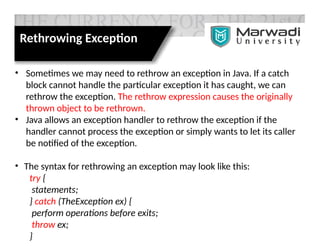
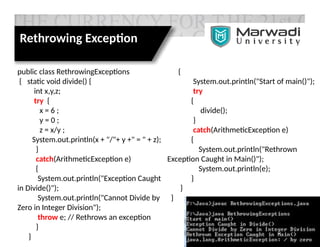
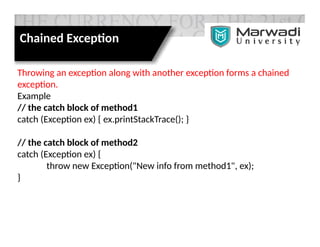
![public class Example {
public static void main(String[] args) {
try {
// creating an exception
ArithmeticException e = new ArithmeticException("Apparent cause");
// set the cause of an exception
e.initCause(new NullPointerException("Actual cause"));
// throwing the exception
throw e;
} catch(ArithmeticException e) {
// Getting the actual cause of the exception
System.out.println(e.getCause()); } } }
Chained Exception
Method Description
getCause() Returns the original cause of the exception
initCause(Throwable cause) Sets the cause for invoking the exception
The Throwable class has methods which support exception chaining −](https://image.slidesharecdn.com/unit5exceptionhandling1-251215113046-f9bfa7bc/85/Unit_5_Exception_Handling-1-pptxforyour-23-320.jpg)
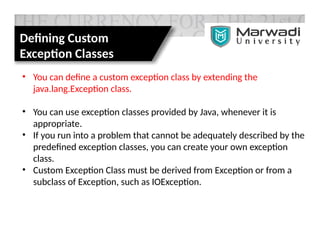
![Defining Custom
Exception Classes
class CustomException extends Exception {
String message;
CustomException(String str) {
message = str;
}
public String toString() {
return ("Custom Exception Occurred : " + message);
}
}
public class MainException {
public static void main(String args[]) {
try {
throw new CustomException(“Hello!! this my message”);
} catch(CustomException e) {
System.out.println(e); } } }](https://image.slidesharecdn.com/unit5exceptionhandling1-251215113046-f9bfa7bc/85/Unit_5_Exception_Handling-1-pptxforyour-25-320.jpg)