THROWING EXCEPTION AND
MULTIPLE CATCH BLOCK
Chapter 9.2:
Multiple catch Blocks
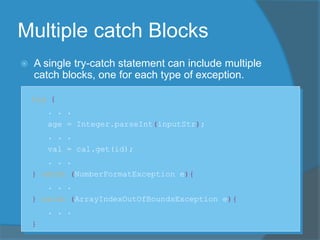
 A single try-catch statement can include multiple
catch blocks, one for each type of exception.
try {
. . .
age = Integer.parseInt(inputStr);
. . .
val = cal.get(id);
. . .
} catch (NumberFormatException e){
. . .
} catch (ArrayIndexOutOfBoundsException e){
. . .
}
Multiple catch Control Flow
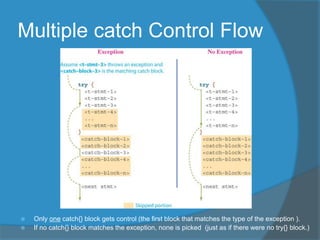
 Only one catch{} block gets control (the first block that matches the type of the exception ).
 If no catch{} block matches the exception, none is picked (just as if there were no try{} block.)
Multiple catch Control Flow
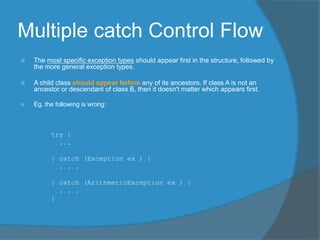
 The most specific exception types should appear first in the structure, followed by
the more general exception types.
 A child class should appear before any of its ancestors. If class A is not an
ancestor or descendant of class B, then it doesn't matter which appears first.
 Eg. the following is wrong:
try {
...
} catch (Exception ex ) {
. . .
} catch (ArithmeticException ex ) {
. . .
}
Multiple catch Control Flow
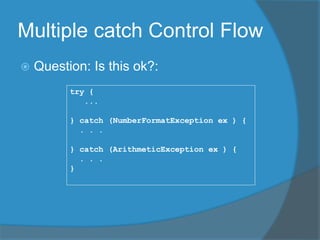
 Question: Is this ok?:
try {
...
} catch (NumberFormatException ex ) {
. . .
} catch (ArithmeticException ex ) {
. . .
}
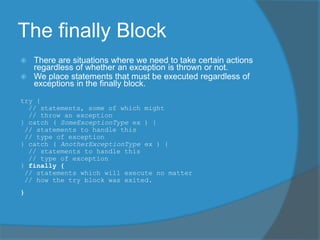
The finally Block
 There are situations where we need to take certain actions
regardless of whether an exception is thrown or not.
 We place statements that must be executed regardless of
exceptions in the finally block.
try {
// statements, some of which might
// throw an exception
} catch ( SomeExceptionType ex ) {
// statements to handle this
// type of exception
} catch ( AnotherExceptionType ex ) {
// statements to handle this
// type of exception
} finally {
// statements which will execute no matter
// how the try block was exited.
}
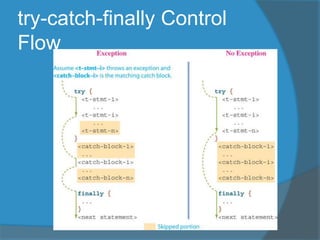
try-catch-finally Control
Flow

Chapter 9.2

  • 1.
    THROWING EXCEPTION AND MULTIPLECATCH BLOCK Chapter 9.2:
  • 2.
    Multiple catch Blocks A single try-catch statement can include multiple catch blocks, one for each type of exception. try { . . . age = Integer.parseInt(inputStr); . . . val = cal.get(id); . . . } catch (NumberFormatException e){ . . . } catch (ArrayIndexOutOfBoundsException e){ . . . }
  • 3.
    Multiple catch ControlFlow  Only one catch{} block gets control (the first block that matches the type of the exception ).  If no catch{} block matches the exception, none is picked (just as if there were no try{} block.)
  • 4.
    Multiple catch ControlFlow  The most specific exception types should appear first in the structure, followed by the more general exception types.  A child class should appear before any of its ancestors. If class A is not an ancestor or descendant of class B, then it doesn't matter which appears first.  Eg. the following is wrong: try { ... } catch (Exception ex ) { . . . } catch (ArithmeticException ex ) { . . . }
  • 5.
    Multiple catch ControlFlow  Question: Is this ok?: try { ... } catch (NumberFormatException ex ) { . . . } catch (ArithmeticException ex ) { . . . }
  • 6.
    The finally Block There are situations where we need to take certain actions regardless of whether an exception is thrown or not.  We place statements that must be executed regardless of exceptions in the finally block. try { // statements, some of which might // throw an exception } catch ( SomeExceptionType ex ) { // statements to handle this // type of exception } catch ( AnotherExceptionType ex ) { // statements to handle this // type of exception } finally { // statements which will execute no matter // how the try block was exited. }
  • 7.