

CHAPTER 8 Interview
Interview Agenda Determine what you want to find out about the interviewee Develop agenda Three parts Opening Body (Questions) Closing
Opening Introduce yourself Purpose of the interview Background of the communication issue Don’t forget to  dress to impress
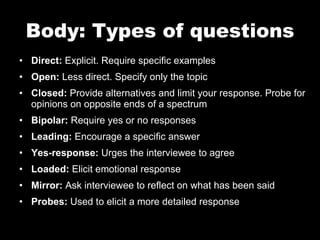
Body: Types of questions Direct:  Explicit. Require specific examples Open:  Less direct. Specify only the topic Closed:  Provide alternatives and limit your response. Probe for opinions on opposite ends of a spectrum Bipolar:  Require yes or no responses Leading:  Encourage a specific answer Yes-response:  Urges the interviewee to agree Loaded:  Elicit emotional response Mirror:  Ask interviewee to reflect on what has been said Probes:  Used to elicit a more detailed response
Closing Summarize Discuss next steps Give the interviewee a chance to ask you questions
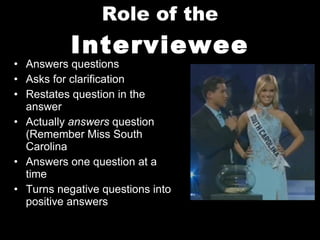
Role of the  Interviewee Answers questions Asks for clarification Restates question in the answer Actually  answers  question (Remember Miss South Carolina Answers one question at a time Turns negative questions into positive answers
Communication Problems in Business Marketing Communication Issues in Business Management Communication in Law Public Relations and Communication Dreaming Ideas in an Entrepreneurial Future Emergency Management
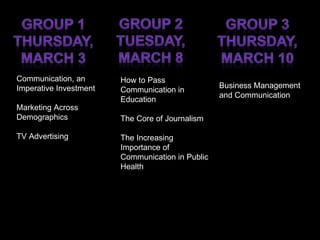
How to Pass Communication in Education The Core of Journalism The Increasing Importance of Communication in Public Health Communication, an Imperative Investment Marketing Across Demographics TV Advertising Business Management and Communication

Chapter 8: The Interview

  • 1.
  • 2.
    Interview Agenda Determinewhat you want to find out about the interviewee Develop agenda Three parts Opening Body (Questions) Closing
  • 3.
    Opening Introduce yourselfPurpose of the interview Background of the communication issue Don’t forget to dress to impress
  • 4.
    Body: Types ofquestions Direct: Explicit. Require specific examples Open: Less direct. Specify only the topic Closed: Provide alternatives and limit your response. Probe for opinions on opposite ends of a spectrum Bipolar: Require yes or no responses Leading: Encourage a specific answer Yes-response: Urges the interviewee to agree Loaded: Elicit emotional response Mirror: Ask interviewee to reflect on what has been said Probes: Used to elicit a more detailed response
  • 5.
    Closing Summarize Discussnext steps Give the interviewee a chance to ask you questions
  • 6.
    Role of the Interviewee Answers questions Asks for clarification Restates question in the answer Actually answers question (Remember Miss South Carolina Answers one question at a time Turns negative questions into positive answers
  • 7.
    Communication Problems inBusiness Marketing Communication Issues in Business Management Communication in Law Public Relations and Communication Dreaming Ideas in an Entrepreneurial Future Emergency Management
  • 8.
    How to PassCommunication in Education The Core of Journalism The Increasing Importance of Communication in Public Health Communication, an Imperative Investment Marketing Across Demographics TV Advertising Business Management and Communication