Media
Relations for
Employees
of Palm
Beach
County
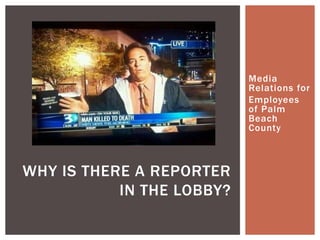
WHY IS THERE A REPORTER
IN THE LOBBY?
Media Relations
County Policies
The Ten Commandments
The Interview
MEDIA RELATIONS 101
How we as individuals and collectively as a
County interact with the media. Our daily
actions are accountable to the public. It is this
accountability the media pursue when reporting
our activities.
MEDIA RELATIONS DEFINED
One responsibility of government is to
communicate with residents about county
services and issues that may affect their lives.
One of the best ways to communicate is through
the media; therefore, an important role of
government is to establish working
relationships with the media that make
communication more efficient and effective. We
see media relations as a partnership.
GOOD MEDIA RELATIONS IS
GOOD BUSINESS
Keep it HOT!!!
Honest
Open
Timely
MEDIA RELATIONS…HOT!!!
Inform in times of crisis
Increase awareness of County services
Attract new residents/businesses
Provide understanding of County policy
Convey proactive image of the County
WHY WE NEED THE MEDIA
Employees at liberty to speak with media
Those who do speak represent the
County, not themselves
Information should reflect policy
Keep personal views personal
Follow up with email to staff and/or
Public Affairs and your supervisor
MEDIA GUIDELINES
County PPM CW-0-011
Purpose of County’s media relations policies and
program:
 Ensure the accuracy of the information released
 Assure no preferential treatment is given to
one reporter
 Avoid dissemination of conflicting information
 Minimize the adverse effects of rumors
COUNTY POLICY
We are responsive; we talk to the media
We are an open book
We tell the truth
We are polite
We correct mistakes
We do not “blacklist”
We do not go “off the record”
MEDIA RELATIONS PHILOSOPHY
We recognize the media is just one way to
talk to our community
We understand the value of free publicity
We can’t be perfect
What we give to one, we give to all
MEDIA RELATIONS PHILOSOPHY
I Mislead
II Lie
III Misrepresent
IV Break the confidence of the reporter
V Clutter the media with useless info
THE 10 COMMANDMENTS
THOU SHALL NOT…
VI Write or speak evasively
VII Give inaccurate information
VIII Hide when news is bad
IX Pester the media with your story
X Repeat the negative
THE 10 COMMANDMENTS
THOU SHALL NOT…
Informative
Educational
Timely
Significant
Unique
Interesting
Of human interest
Whatever you can convince a reporter it is
WHAT IS NEWS?
Press Release
– factual information
Photo Opportunity
– notification of visual event
Media Advisory
– notify the media of an immediate event
MEDIA TOOLS
Fact sheet
– attached to news release;
helpful when there are a lot of statistics
or complicated information.
News conference
– to announce significant or breaking news.
List speakers. Record questions that need
to be answered at a later time.
MEDIA TOOLS
Use a descriptive headline
-make your release stand out
-action oriented headline
-avoid over capitalization
Most important information first
-Who, What, Where (including
address),When, Why, How?
WRITING A NEWS RELEASE
Anticipate reporters’ questions
Minimize use of jargon
-attribute acronyms in first reference
When possible add a quote
Two pages or less
WRITING A NEWS RELEASE
Include contact information
-should be familiar with the release
and ready to answer questions
Proofread
- A.P. Stylebook (abbreviation,
punctuation, capitalization)
- verify spelling of names and verify
correct titles
WRITING A NEWS RELEASE
Timely, timely, timely
- for planned events, send a couple
of days before
- send the news the day it happens
Number pages, mark the end (###)
Marketing vs. News Release
WRITING A NEWS RELEASE
Publish a new product every single day
Driven by deadlines; relentless scramble against the
clock
Little time to research and check all the facts
Tough to represent all sides to a story
Size of news hole varies daily, advertising
dependant
UNIQUENESS OF NEWS
“News” is the FIRST word in the term news release
Volume of releases received daily – most discarded
Quality of releases – accuracy, simplicity and
clarity
Have listed information contacts
It will not necessarily appear exactly as written
THE NEWS RELEASE
County overstaffed and underworked
Well paid with 4 billion dollar budget
Nice, new working facilities
No more than 40 hour work week
Doing a good job or just meeting expectations
PUBLIC PERCEPTION VS PUBLIC REALITIES
Reporters are even more:
Cynical
Suspicious
Likely to have watchdog role
Likely to hold government accountable
PUBLIC PERCEPTION VS REPORTERS
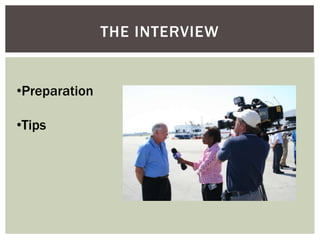
THE INTERVIEW
•Preparation
•Tips
 An interview is not a simple conversation
 Fact finding exercise to collect information,
insight, interesting viewpoint not commonly known
 Casual approach used to disarm…who?
 Reporter monitors everything said, unsaid
 Observes gestures, tone of voice
WHAT IS AN INTERVIEW?
 This is the most common of all question sequences for all
types of interviews.
 In this sequence, the interviewer begins with broad, open-
ended questions and moves to more narrow, closed-ended
questions.
 The interviewer may also begin with more general questions
and gradually ask more specific questions.
INTERVIEW APPROACHES: FUNNEL
 This question sequence is effective when an interviewee
needs help remembering something or to motivate an
interviewee to talk.
 In this sequence, the interviewer begins with narrow, closed-
ended questions and moves to more broad, open-ended
questions.
 The interviewer may also begin with more specific questions
and gradually ask more general questions.
INTERVIEW APPROACHES: INVERTED
FUNNEL
 The Diamond question sequence combines the Funnel and
Inverted Funnel sequences.
 Used when dealing with topics interviewees may find painful
or difficult and therefore are reluctant to discuss.
 Begin with specific, closed-ended questions about a situation
similar to the interviewee's, then ask general, open-ended
questions about the interview, and finally ask specific, closed-
ended questions.
INTERVIEW APPROACHES: DIAMOND
 In this sequence, all questions have the same degree of
openness.
 Also called the "string of beads" questions sequence, the
Tunnel sequence allows for little probing and variation in
question structure.
 It can be useful for simple, surface information
interviews, but not for in-depth interviews.
INTERVIEW APPROACHES: TUNNEL
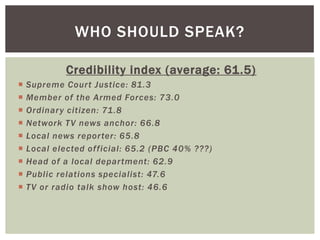
Credibility index (average: 61.5)
 Supreme Court Justice: 81.3
 Member of the Armed Forces: 73.0
 Ordinary citizen: 71.8
 Network TV news anchor: 66.8
 Local news reporter: 65.8
 Local elected official: 65.2 (PBC 40% ???)
 Head of a local department: 62.9
 Public relations specialist: 47.6
 TV or radio talk show host: 46.6
WHO SHOULD SPEAK?
Repeated question
Either/or
Hypothetical/What if…
False facts
Interruptions
Silence
Critics say…
REPORTER TECHNIQUES
Straight news
News feature
Profile
Investigative
TYPES OF INTERVIEW STORIES
What are the goals of the interview?
What will the tone be?
What are your key messages?
Do your homework!
Prepare background information
Rehearse…call staff
THE INTERVIEW: PREPARATION
Answer the question!
Share your message early and often
Avoid jargon
Remember: you are talking to residents
Be friendly & courteous
Silence is golden
THE INTERVIEW: TIPS
Keep your cool
Bridging
Don’t repeat the negative
Never “off the record”
Never “no comment”
THE INTERVIEW: TIPS
Listen – hear the whole question.
Understand it. Clarify if needed.
Pause – Select key points. Keep eyes up.
Present – Give direct answer first. Give
support explanation. Stop when you’ve
answered the question to your
satisfaction.
THE INTERVIEW: TIPS
If you fail to:
Take charge
Anticipate questions
Develop key messages
Stick to the facts
Keep calm
Take the interview seriously
THE INTERVIEW: FAILURES
Assume the camera is always running
Speak clearly, concisely
Look at the reporter, not the camera
Know your key messages
Dress conservatively
Avoid contrasts in color; no sunglasses
TV TIPS
Ask if the interview will be live or on tape
Use conversational tone
Speak concisely
Don’t ramble. Don’t try to fill “dead air”
RADIO TIPS
 Use media as a communications tool
 Use media to “straighten the record”
 If County is open and helpful, stories will be
more positive
 If County is not open, stories will be more
negative
 Reporters want access to people and information
TIPS FROM REPORTERS
The elements of news
Sometimes, just the facts
What’s not said
What you know right now
To scoop the competition
To get the story straight
To feed the beast
WHAT REPORTERS WANT
Is it important enough?
How damaging is the error?
Do nothing
Ask for a clarification, correction, etc.
Talk to the reporter
Talk to a supervisor
Go to the competition
TO CORRECT OR NOT CORRECT
 Correction: Usually a factual error. Your goal is
to have the correct information printed or aired.
 Clarification: Conflicting or confusing
information was originally presented and this
clears it up.
 Omission: Something relevant to the story
(usually a fact or name) was left out and is
now included.
 Retraction: To some media outlets, this is a legal
term. On advice of legal counsel, the outlet
admits an error and apologizes. This is usually done in a large
box marked “Retraction” placed where the original was.
TO CORRECT OR NOT CORRECT
If the media doesn’t get the
facts from you, they will get
the “story” from someone else.
ALWAYS REMEMBER…
If you help the media when
they call you, they will help
you when you call them.
AND…
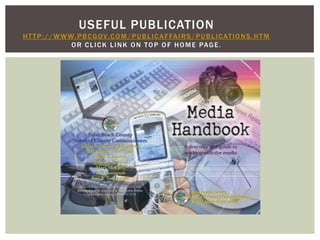
USEFUL PUBLICATION
HTTP://WWW.PBCGOV.COM/PUBLICAFFAIRS/PUBLICATIONS.HTM
OR CLICK LINK ON TOP OF HOME PAGE.
QUESTIONS

Media relationsclass (2013)

  • 1.
  • 2.
    Media Relations County Policies TheTen Commandments The Interview MEDIA RELATIONS 101
  • 3.
    How we asindividuals and collectively as a County interact with the media. Our daily actions are accountable to the public. It is this accountability the media pursue when reporting our activities. MEDIA RELATIONS DEFINED
  • 4.
    One responsibility ofgovernment is to communicate with residents about county services and issues that may affect their lives. One of the best ways to communicate is through the media; therefore, an important role of government is to establish working relationships with the media that make communication more efficient and effective. We see media relations as a partnership. GOOD MEDIA RELATIONS IS GOOD BUSINESS
  • 5.
  • 6.
    Inform in timesof crisis Increase awareness of County services Attract new residents/businesses Provide understanding of County policy Convey proactive image of the County WHY WE NEED THE MEDIA
  • 7.
    Employees at libertyto speak with media Those who do speak represent the County, not themselves Information should reflect policy Keep personal views personal Follow up with email to staff and/or Public Affairs and your supervisor MEDIA GUIDELINES
  • 8.
    County PPM CW-0-011 Purposeof County’s media relations policies and program:  Ensure the accuracy of the information released  Assure no preferential treatment is given to one reporter  Avoid dissemination of conflicting information  Minimize the adverse effects of rumors COUNTY POLICY
  • 9.
    We are responsive;we talk to the media We are an open book We tell the truth We are polite We correct mistakes We do not “blacklist” We do not go “off the record” MEDIA RELATIONS PHILOSOPHY
  • 10.
    We recognize themedia is just one way to talk to our community We understand the value of free publicity We can’t be perfect What we give to one, we give to all MEDIA RELATIONS PHILOSOPHY
  • 11.
    I Mislead II Lie IIIMisrepresent IV Break the confidence of the reporter V Clutter the media with useless info THE 10 COMMANDMENTS THOU SHALL NOT…
  • 12.
    VI Write orspeak evasively VII Give inaccurate information VIII Hide when news is bad IX Pester the media with your story X Repeat the negative THE 10 COMMANDMENTS THOU SHALL NOT…
  • 13.
  • 14.
    Press Release – factualinformation Photo Opportunity – notification of visual event Media Advisory – notify the media of an immediate event MEDIA TOOLS
  • 15.
    Fact sheet – attachedto news release; helpful when there are a lot of statistics or complicated information. News conference – to announce significant or breaking news. List speakers. Record questions that need to be answered at a later time. MEDIA TOOLS
  • 16.
    Use a descriptiveheadline -make your release stand out -action oriented headline -avoid over capitalization Most important information first -Who, What, Where (including address),When, Why, How? WRITING A NEWS RELEASE
  • 17.
    Anticipate reporters’ questions Minimizeuse of jargon -attribute acronyms in first reference When possible add a quote Two pages or less WRITING A NEWS RELEASE
  • 18.
    Include contact information -shouldbe familiar with the release and ready to answer questions Proofread - A.P. Stylebook (abbreviation, punctuation, capitalization) - verify spelling of names and verify correct titles WRITING A NEWS RELEASE
  • 19.
    Timely, timely, timely -for planned events, send a couple of days before - send the news the day it happens Number pages, mark the end (###) Marketing vs. News Release WRITING A NEWS RELEASE
  • 20.
    Publish a newproduct every single day Driven by deadlines; relentless scramble against the clock Little time to research and check all the facts Tough to represent all sides to a story Size of news hole varies daily, advertising dependant UNIQUENESS OF NEWS
  • 21.
    “News” is theFIRST word in the term news release Volume of releases received daily – most discarded Quality of releases – accuracy, simplicity and clarity Have listed information contacts It will not necessarily appear exactly as written THE NEWS RELEASE
  • 22.
    County overstaffed andunderworked Well paid with 4 billion dollar budget Nice, new working facilities No more than 40 hour work week Doing a good job or just meeting expectations PUBLIC PERCEPTION VS PUBLIC REALITIES
  • 23.
    Reporters are evenmore: Cynical Suspicious Likely to have watchdog role Likely to hold government accountable PUBLIC PERCEPTION VS REPORTERS
  • 24.
  • 25.
     An interviewis not a simple conversation  Fact finding exercise to collect information, insight, interesting viewpoint not commonly known  Casual approach used to disarm…who?  Reporter monitors everything said, unsaid  Observes gestures, tone of voice WHAT IS AN INTERVIEW?
  • 26.
     This isthe most common of all question sequences for all types of interviews.  In this sequence, the interviewer begins with broad, open- ended questions and moves to more narrow, closed-ended questions.  The interviewer may also begin with more general questions and gradually ask more specific questions. INTERVIEW APPROACHES: FUNNEL
  • 27.
     This questionsequence is effective when an interviewee needs help remembering something or to motivate an interviewee to talk.  In this sequence, the interviewer begins with narrow, closed- ended questions and moves to more broad, open-ended questions.  The interviewer may also begin with more specific questions and gradually ask more general questions. INTERVIEW APPROACHES: INVERTED FUNNEL
  • 28.
     The Diamondquestion sequence combines the Funnel and Inverted Funnel sequences.  Used when dealing with topics interviewees may find painful or difficult and therefore are reluctant to discuss.  Begin with specific, closed-ended questions about a situation similar to the interviewee's, then ask general, open-ended questions about the interview, and finally ask specific, closed- ended questions. INTERVIEW APPROACHES: DIAMOND
  • 29.
     In thissequence, all questions have the same degree of openness.  Also called the "string of beads" questions sequence, the Tunnel sequence allows for little probing and variation in question structure.  It can be useful for simple, surface information interviews, but not for in-depth interviews. INTERVIEW APPROACHES: TUNNEL
  • 30.
    Credibility index (average:61.5)  Supreme Court Justice: 81.3  Member of the Armed Forces: 73.0  Ordinary citizen: 71.8  Network TV news anchor: 66.8  Local news reporter: 65.8  Local elected official: 65.2 (PBC 40% ???)  Head of a local department: 62.9  Public relations specialist: 47.6  TV or radio talk show host: 46.6 WHO SHOULD SPEAK?
  • 31.
    Repeated question Either/or Hypothetical/What if… Falsefacts Interruptions Silence Critics say… REPORTER TECHNIQUES
  • 32.
  • 33.
    What are thegoals of the interview? What will the tone be? What are your key messages? Do your homework! Prepare background information Rehearse…call staff THE INTERVIEW: PREPARATION
  • 34.
    Answer the question! Shareyour message early and often Avoid jargon Remember: you are talking to residents Be friendly & courteous Silence is golden THE INTERVIEW: TIPS
  • 35.
    Keep your cool Bridging Don’trepeat the negative Never “off the record” Never “no comment” THE INTERVIEW: TIPS
  • 36.
    Listen – hearthe whole question. Understand it. Clarify if needed. Pause – Select key points. Keep eyes up. Present – Give direct answer first. Give support explanation. Stop when you’ve answered the question to your satisfaction. THE INTERVIEW: TIPS
  • 37.
    If you failto: Take charge Anticipate questions Develop key messages Stick to the facts Keep calm Take the interview seriously THE INTERVIEW: FAILURES
  • 38.
    Assume the camerais always running Speak clearly, concisely Look at the reporter, not the camera Know your key messages Dress conservatively Avoid contrasts in color; no sunglasses TV TIPS
  • 39.
    Ask if theinterview will be live or on tape Use conversational tone Speak concisely Don’t ramble. Don’t try to fill “dead air” RADIO TIPS
  • 40.
     Use mediaas a communications tool  Use media to “straighten the record”  If County is open and helpful, stories will be more positive  If County is not open, stories will be more negative  Reporters want access to people and information TIPS FROM REPORTERS
  • 41.
    The elements ofnews Sometimes, just the facts What’s not said What you know right now To scoop the competition To get the story straight To feed the beast WHAT REPORTERS WANT
  • 42.
    Is it importantenough? How damaging is the error? Do nothing Ask for a clarification, correction, etc. Talk to the reporter Talk to a supervisor Go to the competition TO CORRECT OR NOT CORRECT
  • 43.
     Correction: Usuallya factual error. Your goal is to have the correct information printed or aired.  Clarification: Conflicting or confusing information was originally presented and this clears it up.  Omission: Something relevant to the story (usually a fact or name) was left out and is now included.  Retraction: To some media outlets, this is a legal term. On advice of legal counsel, the outlet admits an error and apologizes. This is usually done in a large box marked “Retraction” placed where the original was. TO CORRECT OR NOT CORRECT
  • 44.
    If the mediadoesn’t get the facts from you, they will get the “story” from someone else. ALWAYS REMEMBER…
  • 45.
    If you helpthe media when they call you, they will help you when you call them. AND…
  • 46.
  • 47.