The Flow of Food: Service
Objectives:
By the end of this chapter, you should be able to identify the following:
 Guidelines for holding cold food and hot food
 When and how food can be held without temperature control
 How to prevent contamination when serving food and in self-serve areas
 How to prevent contamination and time-temperature abuse when serving
food off-site or through vending machines
7-2
Guidelines for Holding Food
Policies:
 Create policies about how long the operation
will hold food and when it will be thrown out
Food covers and sneeze guards:
 Cover food and install sneeze guards to protect
food from contaminants
 Covers protect food from contamination and
help maintain food temperatures
7-3
Guidelines for Holding Food
Temperature:
 Hold TCS food at the correct temperature:
o Hot food: 135˚F (57˚C) or higher
o Cold food: 41˚F (5˚C) or lower
Thermometer:
 Use a thermometer to check a food’s internal
temperature:
o NEVER use the temperature gauge on a
holding unit to check the food’s temperature.
7-4
Guidelines for Holding Food
Time:
 Make sure staff are monitoring holding
temperatures regularly.
 Check temperatures at least every four hours:
o Throw out food not at 41˚F (5˚C) or lower or
135˚F (57˚C) or higher.
o Optional: Check temperatures every two hours
to leave time for corrective action.
7-5
Guidelines for Holding Food
Reheating food:
 NEVER use hot-holding equipment to reheat
food unless it’s built to do so.
 Reheat food correctly, and then move it into a
holding unit.
7-6
Holding Food without Temperature Control
Cold ready-to-eat TCS food can be held
without temperature control for up to six
hours if:
 It was held at 41ºF (5ºC) or lower before
removing it from refrigeration
 It does not exceed 70ºF (21ºC) during service
o Throw out food that exceeds this temperature
 It has a label specifying:
o Time it was removed from refrigeration
o Time it must be thrown out
 It is sold, served, or thrown out within six hours
7-7
Holding Food without Temperature Control
Alternatives for holding cold ready-to-eat TCS food without
temperature control:
 If discarded within four hours, the food can be allowed to reach
any temperature
o The food must be held at 41°F (5°C) or lower before removing it from
temperature control
o The discard time must be four hours from the time it was removed
from temperature control
o The food must be sold, served, or thrown out within four hours
7-8
Holding Food without Temperature Control
Produce that becomes TCS when cut, chopped, or sliced
and hermetically sealed containers of food that become
TCS when opened:
 Can have an initial temperature of 70F (21C) or lower
o Must be discarded within four hours
o Cannot exceed 70F (21C) within the four-hour period
o Must be labeled with a discard time four hours from the time the
product became a TCS food
7-9
7-10
Holding Food without Temperature Control
Hot ready-to-eat TCS food can be held
without temperature control for up to four
hours if:
 It was held at 135ºF (57ºC) or higher before
removing it from temperature control
 It has a label specifying when the item must be
thrown out
 It is sold, served, or thrown out within four
hours
7-11
Holding Food without Temperature Control
To get regulatory approval:
 Prepare written procedures.
 Get written approval in advance.
 Maintain procedures.
 Make procedures available.
Kitchen Staff Guidelines for Serving Food
Prevent contamination when serving food:
 Avoid bare-hand contact with ready-to-eat food:
o Wear single-use gloves.
o Use spatulas, tongs, deli sheets, or other utensils.
 Use clean and sanitized utensils for serving:
o Use separate utensils for each food.
o Clean and sanitize utensils after each task.
o If using them continuously, clean and sanitize
them at least every four hours.
7-12
Kitchen Staff Guidelines for Serving Food
Prevent contamination when serving food:
 Store serving utensils correctly between uses:
o Leave them in the food with the handle
extended above the container rim.
o Place them on a clean and sanitized food-
contact surface.
o Optional: Store spoons or scoops under
running water or in a container of water at
least 135˚F (57˚C).
7-13
Kitchen Staff Guidelines for Serving Food
Prevent contamination when serving food:
 Take-home containers can be refilled only when the containers are:
o Designed for reuse
o Provided to guest by the operation
o Cleaned and sanitized correctly
7-14
Kitchen Staff Guidelines for Serving Food
Prevent contamination when serving food:
 Take-home beverage containers can be refilled if the:
o Beverage is not a TCS food.
o Container is refilled for the same guest.
o Container can be effectively cleaned.
o Container is rinsed with fresh, hot water under pressure before refilling.
o Container is refilled by staff in the operation or by the guest using a process
that prevents contamination.
7-15
Service Staff Guidelines for Serving Food
Handling dishes and glassware
Correct
Incorrect
7-16
Service Staff Guidelines for Serving Food
If you preset tableware:
 Wrap or cover the items to prevent
contamination.
Table settings do not need to be wrapped
or covered if extra settings are either:
 Removed when guests are seated.
 If left on the table, cleaned and sanitized
after guests have left.
7-17
Service Staff Guidelines for Serving Food
NEVER re-serve:
 Food returned by a guest
 Uncovered condiments
 Uneaten bread
 Plate garnishes
Generally, only unopened, prepackaged food in
good condition can be re-served:
 Condiment packets
 Wrapped crackers or breadsticks
7-18
Self-Service Areas
Prevent time-temperature abuse and
contamination:
 Use sneeze guards, display cases, or
packaging.
 Use labels to identify food items.
 Hold food at the correct temperature:
o Hot food: 135˚F (57˚C) or higher
o Cold food: 41˚F (5˚C) or lower
7-19
Self-Service Areas
Prevent time-temperature abuse and
contamination:
 Keep raw meat, fish, and poultry separate from
ready-to-eat food.
 Do NOT let customers refill dirty plates or use
dirty utensils at self-service areas.
 Stock displays with the correct utensils.
 NEVER use ice as an ingredient if it was used
to keep food or beverages cold.
7-20
Labeling Bulk Food in Self-Service Areas
Label bulk food in self-service areas:
 Make sure the label is in plain view of the customer.
 Include the manufacturer or processor label provided with the food.
o As an alternative, provide the information using a card, sign, or other labeling
method.
7-21
Labeling Bulk Food in Self-Service Areas
A label is not needed for bulk unpackaged food, such as bakery
products, if:
 The product makes no claim regarding health or nutrient content.
 No laws require the item to be labeled.
 The food is manufactured or prepared on the premises.
 The food is manufactured or prepared at another operation or processing
plant owned by the same person.
o The operation must also be regulated.
7-22
Off-Site Service
When transporting food off-site:
 Use insulated, food-grade containers designed
to keep food from mixing, leaking, and spilling.
 Label food with a use-by date and time, and
reheating and service instructions.
 Clean the inside of delivery vehicles regularly.
 Check internal food temperatures.
7-23
Off-Site Service
When transporting food off-site:
 Make sure the service site has the
correct utilities:
o Safe water for cooking, dishwashing,
and handwashing
o Garbage containers stored away from
food-prep, storage, and serving areas
 Store raw meat, poultry, and seafood separate
from ready-to-eat items.
7-24
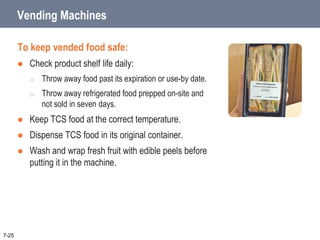
Vending Machines
To keep vended food safe:
 Check product shelf life daily:
o Throw away food past its expiration or use-by date.
o Throw away refrigerated food prepped on-site and
not sold in seven days.
 Keep TCS food at the correct temperature.
 Dispense TCS food in its original container.
 Wash and wrap fresh fruit with edible peels before
putting it in the machine.
7-25
8-2
Food Safety Management Systems
Objectives:
By the end of this chapter, you should be able to identify the following:
 What is a food safety management system
 What is active managerial control and how it can be applied
 What is a Hazard Analysis Critical Control point (HACCP) system
8-3
Food Safety Management Systems
Food safety management system:
 Group of practices and procedures intended to prevent foodborne illness
 Actively controls risks and hazards throughout the flow of food
Food Safety Programs
These are the foundation of a food safety management system:
Food safety
training program
Personal hygiene
program
Quality control and
assurance program
Supplier selection and
specification program
8-4
Food Safety Programs
These are the foundation of a food safety management system:
Standard operating
procedures (SOPs)
Cleaning and
sanitation program
Pest control program
Facility design and
equipment maintenance
program
8-5
Active Managerial Control
Focuses on controlling the five most common risk factors for
foodborne illness:
1. Purchasing food from unsafe sources
2. Failing to cook food adequately
3. Holding food at incorrect temperatures
4. Using contaminated equipment
5. Practicing poor personal hygiene
8-6
Active Managerial Control
There are many ways to achieve active managerial control in the
operation:
 Training programs
 Manager supervision
 Standard operating procedures (SOPs)
 HACCP
8-7
Active Managerial Control
Steps for implementing active managerial
control:
1. Identify and document potential risks and
ways to control or eliminate them.
2. Monitor critical activities.
3. Correct improper procedures or behaviors.
4. Verify that policies, procedures, and corrective
actions are followed.
5. Ensure employees are trained and retrained
as needed.
6. Periodically assess the system to make sure it
is working.
8-8
Active Managerial Control
The FDA public health interventions:
 Demonstration of knowledge
 Staff health controls
 Controlling hands as a vehicle of contamination
 Time and temperature parameters for
controlling pathogens
 Consumer advisories
8-9
Hazard Analysis Critical Control Point (HACCP)
HACCP program:
 Identifies significant hazards at points within a product’s flow through an
operation
o Biological, chemical, and physical hazards
 Identifies how to prevent, eliminate, or reduce hazards to safe levels
 Is documented in a written plan
o The plan is specific to the facility’s menu, customers, equipment, processes,
and operations.
8-10

Chapter 7 & 8.pptx

  • 2.
    The Flow ofFood: Service Objectives: By the end of this chapter, you should be able to identify the following:  Guidelines for holding cold food and hot food  When and how food can be held without temperature control  How to prevent contamination when serving food and in self-serve areas  How to prevent contamination and time-temperature abuse when serving food off-site or through vending machines 7-2
  • 3.
    Guidelines for HoldingFood Policies:  Create policies about how long the operation will hold food and when it will be thrown out Food covers and sneeze guards:  Cover food and install sneeze guards to protect food from contaminants  Covers protect food from contamination and help maintain food temperatures 7-3
  • 4.
    Guidelines for HoldingFood Temperature:  Hold TCS food at the correct temperature: o Hot food: 135˚F (57˚C) or higher o Cold food: 41˚F (5˚C) or lower Thermometer:  Use a thermometer to check a food’s internal temperature: o NEVER use the temperature gauge on a holding unit to check the food’s temperature. 7-4
  • 5.
    Guidelines for HoldingFood Time:  Make sure staff are monitoring holding temperatures regularly.  Check temperatures at least every four hours: o Throw out food not at 41˚F (5˚C) or lower or 135˚F (57˚C) or higher. o Optional: Check temperatures every two hours to leave time for corrective action. 7-5
  • 6.
    Guidelines for HoldingFood Reheating food:  NEVER use hot-holding equipment to reheat food unless it’s built to do so.  Reheat food correctly, and then move it into a holding unit. 7-6
  • 7.
    Holding Food withoutTemperature Control Cold ready-to-eat TCS food can be held without temperature control for up to six hours if:  It was held at 41ºF (5ºC) or lower before removing it from refrigeration  It does not exceed 70ºF (21ºC) during service o Throw out food that exceeds this temperature  It has a label specifying: o Time it was removed from refrigeration o Time it must be thrown out  It is sold, served, or thrown out within six hours 7-7
  • 8.
    Holding Food withoutTemperature Control Alternatives for holding cold ready-to-eat TCS food without temperature control:  If discarded within four hours, the food can be allowed to reach any temperature o The food must be held at 41°F (5°C) or lower before removing it from temperature control o The discard time must be four hours from the time it was removed from temperature control o The food must be sold, served, or thrown out within four hours 7-8
  • 9.
    Holding Food withoutTemperature Control Produce that becomes TCS when cut, chopped, or sliced and hermetically sealed containers of food that become TCS when opened:  Can have an initial temperature of 70F (21C) or lower o Must be discarded within four hours o Cannot exceed 70F (21C) within the four-hour period o Must be labeled with a discard time four hours from the time the product became a TCS food 7-9
  • 10.
    7-10 Holding Food withoutTemperature Control Hot ready-to-eat TCS food can be held without temperature control for up to four hours if:  It was held at 135ºF (57ºC) or higher before removing it from temperature control  It has a label specifying when the item must be thrown out  It is sold, served, or thrown out within four hours
  • 11.
    7-11 Holding Food withoutTemperature Control To get regulatory approval:  Prepare written procedures.  Get written approval in advance.  Maintain procedures.  Make procedures available.
  • 12.
    Kitchen Staff Guidelinesfor Serving Food Prevent contamination when serving food:  Avoid bare-hand contact with ready-to-eat food: o Wear single-use gloves. o Use spatulas, tongs, deli sheets, or other utensils.  Use clean and sanitized utensils for serving: o Use separate utensils for each food. o Clean and sanitize utensils after each task. o If using them continuously, clean and sanitize them at least every four hours. 7-12
  • 13.
    Kitchen Staff Guidelinesfor Serving Food Prevent contamination when serving food:  Store serving utensils correctly between uses: o Leave them in the food with the handle extended above the container rim. o Place them on a clean and sanitized food- contact surface. o Optional: Store spoons or scoops under running water or in a container of water at least 135˚F (57˚C). 7-13
  • 14.
    Kitchen Staff Guidelinesfor Serving Food Prevent contamination when serving food:  Take-home containers can be refilled only when the containers are: o Designed for reuse o Provided to guest by the operation o Cleaned and sanitized correctly 7-14
  • 15.
    Kitchen Staff Guidelinesfor Serving Food Prevent contamination when serving food:  Take-home beverage containers can be refilled if the: o Beverage is not a TCS food. o Container is refilled for the same guest. o Container can be effectively cleaned. o Container is rinsed with fresh, hot water under pressure before refilling. o Container is refilled by staff in the operation or by the guest using a process that prevents contamination. 7-15
  • 16.
    Service Staff Guidelinesfor Serving Food Handling dishes and glassware Correct Incorrect 7-16
  • 17.
    Service Staff Guidelinesfor Serving Food If you preset tableware:  Wrap or cover the items to prevent contamination. Table settings do not need to be wrapped or covered if extra settings are either:  Removed when guests are seated.  If left on the table, cleaned and sanitized after guests have left. 7-17
  • 18.
    Service Staff Guidelinesfor Serving Food NEVER re-serve:  Food returned by a guest  Uncovered condiments  Uneaten bread  Plate garnishes Generally, only unopened, prepackaged food in good condition can be re-served:  Condiment packets  Wrapped crackers or breadsticks 7-18
  • 19.
    Self-Service Areas Prevent time-temperatureabuse and contamination:  Use sneeze guards, display cases, or packaging.  Use labels to identify food items.  Hold food at the correct temperature: o Hot food: 135˚F (57˚C) or higher o Cold food: 41˚F (5˚C) or lower 7-19
  • 20.
    Self-Service Areas Prevent time-temperatureabuse and contamination:  Keep raw meat, fish, and poultry separate from ready-to-eat food.  Do NOT let customers refill dirty plates or use dirty utensils at self-service areas.  Stock displays with the correct utensils.  NEVER use ice as an ingredient if it was used to keep food or beverages cold. 7-20
  • 21.
    Labeling Bulk Foodin Self-Service Areas Label bulk food in self-service areas:  Make sure the label is in plain view of the customer.  Include the manufacturer or processor label provided with the food. o As an alternative, provide the information using a card, sign, or other labeling method. 7-21
  • 22.
    Labeling Bulk Foodin Self-Service Areas A label is not needed for bulk unpackaged food, such as bakery products, if:  The product makes no claim regarding health or nutrient content.  No laws require the item to be labeled.  The food is manufactured or prepared on the premises.  The food is manufactured or prepared at another operation or processing plant owned by the same person. o The operation must also be regulated. 7-22
  • 23.
    Off-Site Service When transportingfood off-site:  Use insulated, food-grade containers designed to keep food from mixing, leaking, and spilling.  Label food with a use-by date and time, and reheating and service instructions.  Clean the inside of delivery vehicles regularly.  Check internal food temperatures. 7-23
  • 24.
    Off-Site Service When transportingfood off-site:  Make sure the service site has the correct utilities: o Safe water for cooking, dishwashing, and handwashing o Garbage containers stored away from food-prep, storage, and serving areas  Store raw meat, poultry, and seafood separate from ready-to-eat items. 7-24
  • 25.
    Vending Machines To keepvended food safe:  Check product shelf life daily: o Throw away food past its expiration or use-by date. o Throw away refrigerated food prepped on-site and not sold in seven days.  Keep TCS food at the correct temperature.  Dispense TCS food in its original container.  Wash and wrap fresh fruit with edible peels before putting it in the machine. 7-25
  • 27.
    8-2 Food Safety ManagementSystems Objectives: By the end of this chapter, you should be able to identify the following:  What is a food safety management system  What is active managerial control and how it can be applied  What is a Hazard Analysis Critical Control point (HACCP) system
  • 28.
    8-3 Food Safety ManagementSystems Food safety management system:  Group of practices and procedures intended to prevent foodborne illness  Actively controls risks and hazards throughout the flow of food
  • 29.
    Food Safety Programs Theseare the foundation of a food safety management system: Food safety training program Personal hygiene program Quality control and assurance program Supplier selection and specification program 8-4
  • 30.
    Food Safety Programs Theseare the foundation of a food safety management system: Standard operating procedures (SOPs) Cleaning and sanitation program Pest control program Facility design and equipment maintenance program 8-5
  • 31.
    Active Managerial Control Focuseson controlling the five most common risk factors for foodborne illness: 1. Purchasing food from unsafe sources 2. Failing to cook food adequately 3. Holding food at incorrect temperatures 4. Using contaminated equipment 5. Practicing poor personal hygiene 8-6
  • 32.
    Active Managerial Control Thereare many ways to achieve active managerial control in the operation:  Training programs  Manager supervision  Standard operating procedures (SOPs)  HACCP 8-7
  • 33.
    Active Managerial Control Stepsfor implementing active managerial control: 1. Identify and document potential risks and ways to control or eliminate them. 2. Monitor critical activities. 3. Correct improper procedures or behaviors. 4. Verify that policies, procedures, and corrective actions are followed. 5. Ensure employees are trained and retrained as needed. 6. Periodically assess the system to make sure it is working. 8-8
  • 34.
    Active Managerial Control TheFDA public health interventions:  Demonstration of knowledge  Staff health controls  Controlling hands as a vehicle of contamination  Time and temperature parameters for controlling pathogens  Consumer advisories 8-9
  • 35.
    Hazard Analysis CriticalControl Point (HACCP) HACCP program:  Identifies significant hazards at points within a product’s flow through an operation o Biological, chemical, and physical hazards  Identifies how to prevent, eliminate, or reduce hazards to safe levels  Is documented in a written plan o The plan is specific to the facility’s menu, customers, equipment, processes, and operations. 8-10