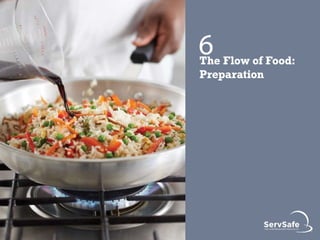
The Flow of Food: Preparation
Objectives:
By the end of this chapter, you should be able to identify the following:
 Ways to prevent cross-contamination and time-temperature abuse
 Ways to thaw food correctly
 Minimum internal temperatures for cooking food safely
 Ways to cool and reheat food correctly
6-2
General Preparation Practices
When prepping food:
 Make sure workstations, cutting boards, and
utensils are clean and sanitized.
 Only remove as much food from the cooler as
you can prep in a short period of time.
o This help prevent time-temperature abuse.
 Return prepped food to the cooler or cook it as
quickly as possible.
6-3
General Preparation Practices
Food and color additives:
 Only use additives approved by your local regulatory authority.
 NEVER use more additives than are allowed by law.
 NEVER use additives to alter the appearance of food.
 Do NOT sell produce treated with sulfites before it was received in the
operation.
 NEVER add sulfites to produce that will be eaten raw.
6-4
General Preparation Practices
Present food honestly:
 Do NOT use the following to misrepresent the appearance of food:
o Food additives or color additives
o Colored overwraps
o Lights
 Present food in the way it was described.
o For example, if a menu offers “Fried Perch,” another fish cannot be substituted.
 Food not presented honestly must be thrown out.
6-5
General Preparation Practices
Corrective actions:
 Food must be thrown out in the following situations:
o When it is handled by staff who have been restricted or excluded from the
operation due to illness
o When it is contaminated by hands or bodily fluids, such as from sneezing
o When it has exceeded the time and temperature requirements designed to
keep food safe
6-6
Thawing
General guidelines for TCS food:
 Thaw food in a cooler, keeping its temperature
at 41˚F (5˚C) or lower.
 Submerge food under running, drinkable water
at 70˚F (21˚C) or lower.
o Use a clean and sanitized food-prep sink.
o Use water flow strong enough to wash away
food bits.
o NEVER let the temperature of the food go
above 41˚F (5˚C) for longer than four hours.
6-7
Thawing
General guidelines for TCS food:
 Thaw food in a microwave.
o Cook it in conventional cooking equipment
immediately after thawing.
 Thaw food as part of the cooking process.
6-8
Thawing
ROP Fish:
 Frozen fish received in ROP packaging must
be thawed carefully.
 If the label states that the product must remain
frozen until use, then remove fish from
packaging:
o Before thawing under refrigeration
o Before or immediately after thawing under
running water
6-9
If packaging fish using a reduced-oxygen
packaging method the fish must:
 Be frozen before, during, or after packaging
 Include a label that states the fish must be
frozen until used
6-10
Prepping Specific Food
Produce:
 Make sure produce does not touch surfaces
exposed to raw meat, seafood, or poultry.
 Wash the produce thoroughly before cutting,
cooking, or combining it with other ingredients.
 To wash produce:
o Use running water a little warmer than the
produce.
o Pull apart leafy greens and rinse thoroughly.
 Certain chemicals may be used to wash produce.
6-11
Prepping Specific Food
Produce:
 When soaking or storing produce in standing
water or an ice-water slurry, do NOT mix:
o Different items
o Multiple batches of the same item
 Refrigerate and hold sliced melons,
cut tomatoes, and cut leafy greens at
41˚F (5˚C) or lower.
 Do NOT serve raw seed sprouts if primarily
serving a high-risk population
6-12
Prepping Specific Food
Eggs and egg mixtures:
 Handle pooled eggs (if allowed) with care:
o Cook promptly after mixing or store at
41˚F (5˚C) or lower.
o Clean and sanitize containers between batches.
 Consider using pasteurized shell eggs or egg
products when prepping dishes that need little
or no cooking.
6-13
Prepping Specific Food
Eggs and egg mixtures:
 Take special care when serving a high-risk
population:
o Use pasteurized eggs or egg products when
serving raw or undercooked dishes.
o Unpasteurized shell eggs can be used if the
dish will be cooked all the way through
(e.g., omelets, cakes).
o Use pasteurized shell eggs if eggs will
be pooled.
6-14
Prepping Specific Food
Salads containing TCS food:
 Only use leftover TCS food if it was cooked,
held, cooled, and stored correctly.
 Do NOT use leftover TCS food that has been
held for more than seven days.
6-15
Prepping Specific Food
Ice:
 Make ice from water that is safe to drink.
 NEVER use ice as an ingredient if it was used
to keep food cold.
 Use clean and sanitized containers and scoops:
o Store scoops outside of the ice machine in a
clean, protected location.
o NEVER hold ice in containers that held
chemicals or raw meat, seafood, or poultry.
o NEVER touch ice with hands or use a glass to
scoop ice.
6-16
Preparation Practices That Have Special Requirements
You need a variance if prepping food in
these ways:
 Packaging fresh juice on-site for sale at a later
time, unless the juice has a warning label
 Smoking food to preserve it but not to
enhance flavor
 Using food additives or components to
preserve or alter food so it no longer needs
time and temperature control for safety
 Curing food
6-17
Preparation Practices That Have Special Requirements
You need a variance if prepping food in
these ways:
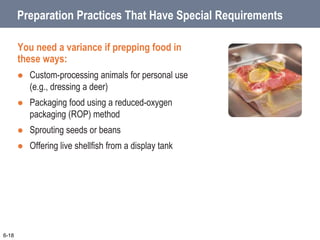
 Custom-processing animals for personal use
(e.g., dressing a deer)
 Packaging food using a reduced-oxygen
packaging (ROP) method
 Sprouting seeds or beans
 Offering live shellfish from a display tank
6-18
Preparation Practices That Have Special Requirements
A HACCP plan may be required when applying for a variance:
 The plan must account for food safety risks
 The establishment must comply with the plan and procedures
 All associated documents must be maintained and provided upon request
6-19
Preparation Practices That Have Special Requirements
Records must show that you:
 Have procedures for monitoring Critical Control Points
 Are regularly monitoring the Critical Control Points
 Are taking the necessary corrective actions if there is a failure at a Critical
Control Point
 Are verifying the effectiveness of the procedures or process
6-20
Cooking Food
When cooking TCS food, the internal portion
must:
 Reach the required minimum internal temperature
 Hold that temperature for a specific amount
of time
6-21
Cooking Food
When checking temperatures:
 Pick a thermometer with a probe that is the
correct size for the food.
 Check the temperature in the thickest part of
the food.
o Take at least two readings in different locations.
6-22
Cooking Requirements for Specific Food
Minimum internal cooking temperature:
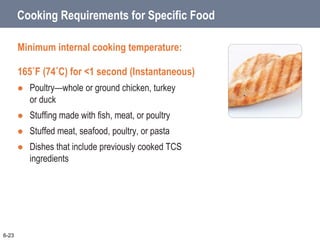
165˚F (74˚C) for <1 second (Instantaneous)
 Poultry—whole or ground chicken, turkey
or duck
 Stuffing made with fish, meat, or poultry
 Stuffed meat, seafood, poultry, or pasta
 Dishes that include previously cooked TCS
ingredients
6-23
Cooking Requirements for Specific Food
Minimum internal cooking temperature:
155˚F (68˚C) for 17 seconds
 Ground meat—beef, pork, and other meat
 Meat mechanically tenderized with needles or
blades or by injecting it with brine or flavors
(e.g. brined ham or flavor-injected roasts)
 Meat vacuum-tumbled with marinades or other
solutions
 Ground meat from game animals commercially
raised and inspected
6-24
Cooking Requirements for Specific Food
Minimum internal cooking temperature:
155˚F (68˚C) for 17 seconds
 Ratites—including ostrich and emu
 Ground seafood—including chopped or minced
seafood
 Shell eggs that will be hot-held for service
6-25
Cooking Requirements for Specific Food
Minimum internal cooking temperature:
145˚F (63˚C) for 15 seconds
 Seafood—including fish, shellfish, and
crustaceans
 Steaks/chops of pork, beef, veal, and lamb
 Commercially raised game
 Shell eggs that will be served immediately
6-26
Cooking Requirements for Specific Food
Minimum internal cooking temperature:
145˚F (63˚C) for four minutes
 Roasts of pork, beef, veal, and lamb
 Alternate cooking times/temperatures
o 130˚F (54˚C) 112 minutes
o 131˚F (55˚C) 89 minutes
o 133˚F (56˚C) 56 minutes
o 135˚F (57˚C) 36 minutes
o 136˚F (58˚C) 28 minutes
o 138˚F (59˚C) 18 minutes
o 140˚F (60˚C) 12 minutes
o 142˚F (61˚C) 8 minutes
o 144˚F (62˚C) 5 minutes
6-27
Cooking Requirements for Specific Food
Minimum internal cooking temperature:
135˚F (57˚C) (no minimum time)
 Food from plants, including fruits, vegetables,
grains (e.g., rice, pasta), and legumes (e.g.,
beans, refried beans) that will be
hot-held for service
6-28
Cooking TCS Food in a Microwave
Minimum internal cooking temperature:
165˚F (74˚C)
 Meat
 Seafood
 Poultry
 Eggs
6-29
Cooking Food
Cooking TCS food in the microwave oven:
 Cover the food to prevent drying.
 For even cooking:
o Rotate or stir food halfway through the cooking
process.
o Let the covered food stand for at least two
minutes after cooking.
 Check the temperature in at least two places.
6-30
Partial Cooking during Preparation
If partially cooking meat, seafood, poultry,
or eggs or dishes containing these items:
 NEVER cook the food longer than
60 minutes during initial cooking.
 Cool the food immediately after
initial cooking.
 Freeze or refrigerate the food after cooling it:
o If refrigerating, hold it at 41˚F (5˚C) or lower and
store it away from ready-to-eat food.
 Heat the food to its required minimum internal
temperature before selling or serving it.
 Cool the food if it will not be served
immediately or held for service.
6-31
Partial Cooking during Preparation
Procedures for partial cooking should
describe:
 How to monitor and document requirements
 Which corrective actions will be taken if
requirements are not met
 How parcooked items will be marked after
initial cooking
 How parcooked food will be stored separately
from ready-to-eat food
6-32
Consumer Advisories
Disclosure:
 Disclose any raw or undercooked TCS items
on the menu.
 Note it on the menu next to the items:
o An asterisk with a footnote can be used.
o The footnote must state that the item is raw or
undercooked, or contains raw or undercooked
ingredients.
6-33
Consumer Advisories
Reminder:
 Advise customers who order raw or
undercooked TCS food of the increased risk of
foodborne illness:
o Post a notice in the menu.
o Provide this information using brochures, table
tents, or signs.
6-34
Children’s Menus
The FDA advises against offering these
items on a children’s menu if they are raw
or undercooked:
 Meat
 Poultry
 Seafood
 Eggs
6-35
Operations That Mainly Serve High-Risk Populations
NEVER serve:
 Raw seed sprouts
 Raw or undercooked eggs (unpasteurized),
meat, or seafood
o Over-easy eggs
o Raw oysters on the half shell
o Rare hamburgers
 Unpasteurized milk or juice
6-36
6-37
Temperature Requirements for Cooling Food
1. Cool food from 135˚F to 70˚F (57˚C to 21˚C)
within two hours.
2. Cool it from 70˚F to 41˚F (21˚C to 5˚C) or
lower in the next four hours.
Temperature Requirements for Cooling Food
If you cool food from 135˚F to 70˚F (57˚C to 21˚C)
in less than two hours:
 The remaining time can be used to cool it to 41˚F (5˚C) or lower.
 The total cooling time cannot be longer than six hours.
Example:
 If you cool food from 135˚F to 70˚F (57˚C to 21˚C) in one hour.
 Then you have five hours to get the food to 41˚F (5˚C) or lower.
6-38
Cooling Food
Factors that affect cooling:
 Thickness or density of the food
 Size of the food
o Cut larger items into smaller pieces.
o Divide large containers of food into smaller
containers or shallow pans.
 Storage container
o Stainless steel transfers heat away from food
faster than plastic.
o Shallow pans let the heat from food disperse
faster than deep pans.
6-39
Cooling Food
Methods for cooling food:
 Place food in an ice-water bath.
 Place it in a blast chiller.
 Stir it with an ice paddle.
 Use ice or cold water as an ingredient.
6-40
Cooling Food
When storing food for further cooling:
 Loosely cover food containers before storing them.
 Food can be left uncovered if protected from contamination.
o Storing uncovered containers above other food, especially raw seafood,
meat, and poultry, will help prevent cross-contamination.
6-41
6-42
Reheating Food
Food reheated for immediate service:
 Can be reheated to any temperature if it was
cooked and cooled correctly
Food reheated for hot-holding:
 Must be reheated within two hours to an
internal temperature of 165˚F (74˚C) for
15 seconds
 Reheat commercially processed and packaged
ready-to-eat food to an internal temperature of
at least 135˚F (57˚C).

Chapter 6.pptx

  • 2.
    The Flow ofFood: Preparation Objectives: By the end of this chapter, you should be able to identify the following:  Ways to prevent cross-contamination and time-temperature abuse  Ways to thaw food correctly  Minimum internal temperatures for cooking food safely  Ways to cool and reheat food correctly 6-2
  • 3.
    General Preparation Practices Whenprepping food:  Make sure workstations, cutting boards, and utensils are clean and sanitized.  Only remove as much food from the cooler as you can prep in a short period of time. o This help prevent time-temperature abuse.  Return prepped food to the cooler or cook it as quickly as possible. 6-3
  • 4.
    General Preparation Practices Foodand color additives:  Only use additives approved by your local regulatory authority.  NEVER use more additives than are allowed by law.  NEVER use additives to alter the appearance of food.  Do NOT sell produce treated with sulfites before it was received in the operation.  NEVER add sulfites to produce that will be eaten raw. 6-4
  • 5.
    General Preparation Practices Presentfood honestly:  Do NOT use the following to misrepresent the appearance of food: o Food additives or color additives o Colored overwraps o Lights  Present food in the way it was described. o For example, if a menu offers “Fried Perch,” another fish cannot be substituted.  Food not presented honestly must be thrown out. 6-5
  • 6.
    General Preparation Practices Correctiveactions:  Food must be thrown out in the following situations: o When it is handled by staff who have been restricted or excluded from the operation due to illness o When it is contaminated by hands or bodily fluids, such as from sneezing o When it has exceeded the time and temperature requirements designed to keep food safe 6-6
  • 7.
    Thawing General guidelines forTCS food:  Thaw food in a cooler, keeping its temperature at 41˚F (5˚C) or lower.  Submerge food under running, drinkable water at 70˚F (21˚C) or lower. o Use a clean and sanitized food-prep sink. o Use water flow strong enough to wash away food bits. o NEVER let the temperature of the food go above 41˚F (5˚C) for longer than four hours. 6-7
  • 8.
    Thawing General guidelines forTCS food:  Thaw food in a microwave. o Cook it in conventional cooking equipment immediately after thawing.  Thaw food as part of the cooking process. 6-8
  • 9.
    Thawing ROP Fish:  Frozenfish received in ROP packaging must be thawed carefully.  If the label states that the product must remain frozen until use, then remove fish from packaging: o Before thawing under refrigeration o Before or immediately after thawing under running water 6-9
  • 10.
    If packaging fishusing a reduced-oxygen packaging method the fish must:  Be frozen before, during, or after packaging  Include a label that states the fish must be frozen until used 6-10 Prepping Specific Food
  • 11.
    Prepping Specific Food Produce: Make sure produce does not touch surfaces exposed to raw meat, seafood, or poultry.  Wash the produce thoroughly before cutting, cooking, or combining it with other ingredients.  To wash produce: o Use running water a little warmer than the produce. o Pull apart leafy greens and rinse thoroughly.  Certain chemicals may be used to wash produce. 6-11
  • 12.
    Prepping Specific Food Produce: When soaking or storing produce in standing water or an ice-water slurry, do NOT mix: o Different items o Multiple batches of the same item  Refrigerate and hold sliced melons, cut tomatoes, and cut leafy greens at 41˚F (5˚C) or lower.  Do NOT serve raw seed sprouts if primarily serving a high-risk population 6-12
  • 13.
    Prepping Specific Food Eggsand egg mixtures:  Handle pooled eggs (if allowed) with care: o Cook promptly after mixing or store at 41˚F (5˚C) or lower. o Clean and sanitize containers between batches.  Consider using pasteurized shell eggs or egg products when prepping dishes that need little or no cooking. 6-13
  • 14.
    Prepping Specific Food Eggsand egg mixtures:  Take special care when serving a high-risk population: o Use pasteurized eggs or egg products when serving raw or undercooked dishes. o Unpasteurized shell eggs can be used if the dish will be cooked all the way through (e.g., omelets, cakes). o Use pasteurized shell eggs if eggs will be pooled. 6-14
  • 15.
    Prepping Specific Food Saladscontaining TCS food:  Only use leftover TCS food if it was cooked, held, cooled, and stored correctly.  Do NOT use leftover TCS food that has been held for more than seven days. 6-15
  • 16.
    Prepping Specific Food Ice: Make ice from water that is safe to drink.  NEVER use ice as an ingredient if it was used to keep food cold.  Use clean and sanitized containers and scoops: o Store scoops outside of the ice machine in a clean, protected location. o NEVER hold ice in containers that held chemicals or raw meat, seafood, or poultry. o NEVER touch ice with hands or use a glass to scoop ice. 6-16
  • 17.
    Preparation Practices ThatHave Special Requirements You need a variance if prepping food in these ways:  Packaging fresh juice on-site for sale at a later time, unless the juice has a warning label  Smoking food to preserve it but not to enhance flavor  Using food additives or components to preserve or alter food so it no longer needs time and temperature control for safety  Curing food 6-17
  • 18.
    Preparation Practices ThatHave Special Requirements You need a variance if prepping food in these ways:  Custom-processing animals for personal use (e.g., dressing a deer)  Packaging food using a reduced-oxygen packaging (ROP) method  Sprouting seeds or beans  Offering live shellfish from a display tank 6-18
  • 19.
    Preparation Practices ThatHave Special Requirements A HACCP plan may be required when applying for a variance:  The plan must account for food safety risks  The establishment must comply with the plan and procedures  All associated documents must be maintained and provided upon request 6-19
  • 20.
    Preparation Practices ThatHave Special Requirements Records must show that you:  Have procedures for monitoring Critical Control Points  Are regularly monitoring the Critical Control Points  Are taking the necessary corrective actions if there is a failure at a Critical Control Point  Are verifying the effectiveness of the procedures or process 6-20
  • 21.
    Cooking Food When cookingTCS food, the internal portion must:  Reach the required minimum internal temperature  Hold that temperature for a specific amount of time 6-21
  • 22.
    Cooking Food When checkingtemperatures:  Pick a thermometer with a probe that is the correct size for the food.  Check the temperature in the thickest part of the food. o Take at least two readings in different locations. 6-22
  • 23.
    Cooking Requirements forSpecific Food Minimum internal cooking temperature: 165˚F (74˚C) for <1 second (Instantaneous)  Poultry—whole or ground chicken, turkey or duck  Stuffing made with fish, meat, or poultry  Stuffed meat, seafood, poultry, or pasta  Dishes that include previously cooked TCS ingredients 6-23
  • 24.
    Cooking Requirements forSpecific Food Minimum internal cooking temperature: 155˚F (68˚C) for 17 seconds  Ground meat—beef, pork, and other meat  Meat mechanically tenderized with needles or blades or by injecting it with brine or flavors (e.g. brined ham or flavor-injected roasts)  Meat vacuum-tumbled with marinades or other solutions  Ground meat from game animals commercially raised and inspected 6-24
  • 25.
    Cooking Requirements forSpecific Food Minimum internal cooking temperature: 155˚F (68˚C) for 17 seconds  Ratites—including ostrich and emu  Ground seafood—including chopped or minced seafood  Shell eggs that will be hot-held for service 6-25
  • 26.
    Cooking Requirements forSpecific Food Minimum internal cooking temperature: 145˚F (63˚C) for 15 seconds  Seafood—including fish, shellfish, and crustaceans  Steaks/chops of pork, beef, veal, and lamb  Commercially raised game  Shell eggs that will be served immediately 6-26
  • 27.
    Cooking Requirements forSpecific Food Minimum internal cooking temperature: 145˚F (63˚C) for four minutes  Roasts of pork, beef, veal, and lamb  Alternate cooking times/temperatures o 130˚F (54˚C) 112 minutes o 131˚F (55˚C) 89 minutes o 133˚F (56˚C) 56 minutes o 135˚F (57˚C) 36 minutes o 136˚F (58˚C) 28 minutes o 138˚F (59˚C) 18 minutes o 140˚F (60˚C) 12 minutes o 142˚F (61˚C) 8 minutes o 144˚F (62˚C) 5 minutes 6-27
  • 28.
    Cooking Requirements forSpecific Food Minimum internal cooking temperature: 135˚F (57˚C) (no minimum time)  Food from plants, including fruits, vegetables, grains (e.g., rice, pasta), and legumes (e.g., beans, refried beans) that will be hot-held for service 6-28
  • 29.
    Cooking TCS Foodin a Microwave Minimum internal cooking temperature: 165˚F (74˚C)  Meat  Seafood  Poultry  Eggs 6-29
  • 30.
    Cooking Food Cooking TCSfood in the microwave oven:  Cover the food to prevent drying.  For even cooking: o Rotate or stir food halfway through the cooking process. o Let the covered food stand for at least two minutes after cooking.  Check the temperature in at least two places. 6-30
  • 31.
    Partial Cooking duringPreparation If partially cooking meat, seafood, poultry, or eggs or dishes containing these items:  NEVER cook the food longer than 60 minutes during initial cooking.  Cool the food immediately after initial cooking.  Freeze or refrigerate the food after cooling it: o If refrigerating, hold it at 41˚F (5˚C) or lower and store it away from ready-to-eat food.  Heat the food to its required minimum internal temperature before selling or serving it.  Cool the food if it will not be served immediately or held for service. 6-31
  • 32.
    Partial Cooking duringPreparation Procedures for partial cooking should describe:  How to monitor and document requirements  Which corrective actions will be taken if requirements are not met  How parcooked items will be marked after initial cooking  How parcooked food will be stored separately from ready-to-eat food 6-32
  • 33.
    Consumer Advisories Disclosure:  Discloseany raw or undercooked TCS items on the menu.  Note it on the menu next to the items: o An asterisk with a footnote can be used. o The footnote must state that the item is raw or undercooked, or contains raw or undercooked ingredients. 6-33
  • 34.
    Consumer Advisories Reminder:  Advisecustomers who order raw or undercooked TCS food of the increased risk of foodborne illness: o Post a notice in the menu. o Provide this information using brochures, table tents, or signs. 6-34
  • 35.
    Children’s Menus The FDAadvises against offering these items on a children’s menu if they are raw or undercooked:  Meat  Poultry  Seafood  Eggs 6-35
  • 36.
    Operations That MainlyServe High-Risk Populations NEVER serve:  Raw seed sprouts  Raw or undercooked eggs (unpasteurized), meat, or seafood o Over-easy eggs o Raw oysters on the half shell o Rare hamburgers  Unpasteurized milk or juice 6-36
  • 37.
    6-37 Temperature Requirements forCooling Food 1. Cool food from 135˚F to 70˚F (57˚C to 21˚C) within two hours. 2. Cool it from 70˚F to 41˚F (21˚C to 5˚C) or lower in the next four hours.
  • 38.
    Temperature Requirements forCooling Food If you cool food from 135˚F to 70˚F (57˚C to 21˚C) in less than two hours:  The remaining time can be used to cool it to 41˚F (5˚C) or lower.  The total cooling time cannot be longer than six hours. Example:  If you cool food from 135˚F to 70˚F (57˚C to 21˚C) in one hour.  Then you have five hours to get the food to 41˚F (5˚C) or lower. 6-38
  • 39.
    Cooling Food Factors thataffect cooling:  Thickness or density of the food  Size of the food o Cut larger items into smaller pieces. o Divide large containers of food into smaller containers or shallow pans.  Storage container o Stainless steel transfers heat away from food faster than plastic. o Shallow pans let the heat from food disperse faster than deep pans. 6-39
  • 40.
    Cooling Food Methods forcooling food:  Place food in an ice-water bath.  Place it in a blast chiller.  Stir it with an ice paddle.  Use ice or cold water as an ingredient. 6-40
  • 41.
    Cooling Food When storingfood for further cooling:  Loosely cover food containers before storing them.  Food can be left uncovered if protected from contamination. o Storing uncovered containers above other food, especially raw seafood, meat, and poultry, will help prevent cross-contamination. 6-41
  • 42.
    6-42 Reheating Food Food reheatedfor immediate service:  Can be reheated to any temperature if it was cooked and cooled correctly Food reheated for hot-holding:  Must be reheated within two hours to an internal temperature of 165˚F (74˚C) for 15 seconds  Reheat commercially processed and packaged ready-to-eat food to an internal temperature of at least 135˚F (57˚C).