Objectives
Identify the following:
 Correct ways for prepping food to prevent cross-contamination and time-
temperature abuse
 Safe methods for thawing food
 The minimum internal cooking temperatures for TCS food
 The correct way to cook TCS food in a microwave oven
8-2
Objectives
Identify the following:
 The importance of informing consumers of risks when serving raw or
undercooked food
 Requirements for partially cooking TCS food
 Methods and time-temperature requirements for cooling TCS food
 Time and temperature requirements for reheating TCS food
8-3
General Preparation Practices
When prepping food:
 Make sure workstations, cutting boards, and
utensils are clean and sanitized.
 Only remove as much food from the cooler as
you can prep in a short period of time.
o This prevents time-temperature abuse.
 Return prepped food to the cooler or cook it as
quickly as possible.
8-4
General Preparation Practices
Food and color additives:
 Only use additives approved by your local regulatory authority.
 NEVER use more additives than are allowed by law.
 NEVER use additives to alter the appearance of food.
 Do NOT sell produce treated with sulfites before it was received in the
operation.
 Do NOT add sulfites to produce that will be eaten raw.
8-5
General Preparation Practices
Present food honestly:
 Do NOT use the following to misrepresent the appearance of food:
o Food additives or color additives
o Colored overwraps
o Lights
 Food must be presented in the way it was described.
o For example, if a menu offers “Fried Perch,” another fish cannot be substituted.
 Food not presented honestly must be thrown out.
8-6
General Preparation Practices
Corrective actions:
 Food must be thrown out in the following situations:
o When it is handled by staff who have been restricted or excluded from the
operation due to illness
o When it is contaminated by hands or bodily fluids from the nose or mouth
o When it has exceeded the time and temperature requirements designed to
keep food safe
8-7
Thawing
General guidelines for TCS food:
 Thaw food in a cooler, keeping its temperature
at 41˚F (5˚C) or lower.
 Submerge food under running, drinkable water
at 70˚F (21˚C) or lower:
o Use a clean and sanitized food-prep sink.
o Use water flow strong enough to wash away
food bits.
o Never let the temperature of the food go above
41˚F (5˚C) for longer than four hours.
8-8
Thawing
General guidelines for TCS food:
 Thaw food in a microwave.
o Cook it in conventional cooking equipment
immediately after thawing.
 Thaw food as part of the cooking process.
 Some foods may be slacked before cooking.
o Do not let the food get warmer than 41ºF (5ºC).
8-9
Thawing ROP Fish
 Frozen fish received in ROP packaging
must be thawed carefully.
 If the label states that the product must remain
frozen until use, then remove fish from
packaging:
o Before thawing under refrigeration
o Before or immediately after thawing
under running water
8-10
Prepping Specific Food
When prepping meat, seafood, poultry:
 Use clean and sanitized work areas, cutting boards, knives, and utensils.
 Prep raw meat, poultry, and seafood separately or at different times from
fresh produce.
 Remove only as much food as can be prepped at one time.
 Return raw meat to the cooler as quickly as possible after prepping it.
8-11
Prepping Specific Food
When prepping salads containing
TCS food:
 Prep the food in small batches.
 Only use leftover TCS ingredients (e.g.,
pasta, chicken, potatoes) that have been
handled safely:
o Cooked, held, and cooled correctly
o Stored for less than seven days at 41˚F
(5˚C) or lower
8-12
Prepping Specific Food
When prepping salads containing
TCS food:
 Consider chilling ingredients and utensils
before use.
 Leave food in the cooler until all ingredients
will be mixed.
8-13
Prepping Specific Food
When prepping eggs and egg mixtures:
 Handle pooled eggs (if allowed) with care:
o Cook promptly after mixing or store at 41˚F
(5˚C) or lower.
o Clean and sanitize containers between
batches.
 Consider using pasteurized shell eggs or egg
products for dishes that need little or no
cooking.
 Promptly clean and sanitize equipment used
to prep eggs.
8-14
Prepping Specific Food
When prepping eggs and egg mixtures:
 Take special care when serving a high-risk
population:
o Use pasteurized eggs or egg products when
serving raw or undercooked dishes.
o Unpasteurized shell eggs can be used if the
dish will be cooked all the way through (e.g.,
omelets, cakes).
o Use pasteurized shell eggs if eggs will be
pooled.
 Promptly clean and sanitize all equipment
and utensils used to prep eggs.
8-15
Prepping Specific Food
When prepping battered or breaded food:
 Prep batter in small batches.
 Store unused batter as quickly as possible.
 Throw out unused batter or breading after a
set amount of time.
 Cooke food thoroughly.
 When deep frying:
o Make sure the oil temperature recovers
before loading each batch.
o Do NOT overload fryer baskets.
o Monitor oil and food temperatures and
cooking times.
8-16
Prepping Specific Food
To package fresh juice for later sale:
 The juice must be treated
(e.g., pasteurized) according
to an approved HACCP plan.
 As an alternative, the juice can be labeled
with this warning:
Warning: This product has not been
pasteurized and, therefore, may contain
harmful bacteria that can cause serious
illness in children, the elderly, and people
with weakened immune systems.
8-17
Prepping Specific Food
Produce:
 Make sure produce does not touch surfaces
exposed to raw meat, seafood, or poultry.
 Wash the produce thoroughly before cutting,
cooking, or combining it with other ingredients.
 To wash produce:
o Use running water a little warmer than the
produce.
o Pull apart leafy greens and rinse thoroughly.
 Certain chemicals may be used to wash
produce.
8-18
Prepping Specific Food
Produce:
 When soaking or storing produce in standing
water or an ice-water slurry, do NOT mix:
o Different items
o Multiple batches of the same item
 Refrigerate and hold cut melons, cut tomatoes,
and cut leafy greens at 41˚F (5˚C) or lower.
 Do NOT serve raw seed sprouts if primarily
serving a high-risk population.
8-19
Prepping Specific Food
Ice:
 Make ice from water that is safe to drink.
 NEVER use ice as an ingredient if it was used
to keep food cold.
 Use clean and sanitized containers and scoops.
o Store scoops outside of the ice machine in a
clean, protected location.
o NEVER hold ice in containers that held
chemicals or raw meat, seafood, or poultry.
o NEVER touch ice with hands or use a glass to
scoop ice.
8-20
Preparation Practices That Have Special Requirements
You need a variance if prepping food in
these ways:
 Packaging fresh juice on-site for sale at a later
time, unless the juice has a warning label that
complies with local regulations
 Smoking food to preserve it (not to
enhance flavor)
 Using food additives or components to
preserve or alter food so it no longer needs
time and temperature control for safety
 Curing food
8-21
Preparation Practices That Have Special Requirements
You need a variance if prepping food in
these ways:
 Custom-processing animals for personal use
(e.g., dressing a deer)
 Packaging food using a reduced-oxygen
packaging (ROP) method
 Sprouting seeds or beans
 Offering live shellfish from a display tank
8-22
Cooking Food
Minimum internal cooking temperature:
165˚F (74˚C) for 15 seconds
 Poultry—whole or ground chicken, turkey, or
duck
 Stuffing made with fish, meat, or poultry
 Stuffed meat, seafood, poultry, or pasta
 Dishes that include previously cooked, TCS
ingredients
8-23
Cooking Food
Minimum internal cooking temperature:
155˚F (68˚C) for 15 seconds
 Ground meat—beef, pork, and other meat
 Injected meat—including brined ham and
flavor-injected roasts
 Mechanically tenderized meat
 Ratites—including ostrich and emu
 Ground seafood—including chopped or minced
seafood
 Shell eggs that will be hot-held for service
8-24
Cooking Food
Minimum internal cooking temperature:
145˚F (63˚C) for 15 seconds
 Seafood—including fish, shellfish, and
crustaceans
 Steaks/chops of pork, beef, veal, and lamb
 Commercially raised game
 Shell eggs that will be served immediately
8-25
Cooking Food
Minimum internal cooking temperature:
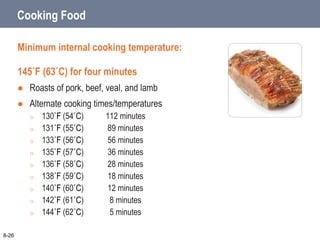
145˚F (63˚C) for four minutes
 Roasts of pork, beef, veal, and lamb
 Alternate cooking times/temperatures
o 130˚F (54˚C) 112 minutes
o 131˚F (55˚C) 89 minutes
o 133˚F (56˚C) 56 minutes
o 135˚F (57˚C) 36 minutes
o 136˚F (58˚C) 28 minutes
o 138˚F (59˚C) 18 minutes
o 140˚F (60˚C) 12 minutes
o 142˚F (61˚C) 8 minutes
o 144˚F (62˚C) 5 minutes
8-26
Cooking Food
Minimum internal cooking temperature:
135˚F (57˚C)
 Fruit, vegetables, grains (rice, pasta), and
legumes (beans, refried beans) that will be
hot-held for service
8-27
Cooking Food
Minimum internal cooking temperature:
175˚F (80˚C)
 Tea
8-28
Automatic iced tea and automatic
coffee machine equipment:
 Tea leaves should have contact with the
water for at least one minute.
Traditional steeping method:
 Tea leaves should be exposed to the
water for about five minutes.
Cooking Food
Cooking TCS food in the microwave oven:
Minimum internal cooking temperature:
165˚F (74˚C)
 Meat
 Seafood
 Poultry
 Eggs
8-29
Cooking Food
Cooking TCS food in the microwave oven:
 Cover the food to prevent drying.
 For even cooking:
o Rotate or stir food halfway through the cooking
process.
o Let the covered food stand for at least two
minutes after cooking.
 Check the temperature in at least two places.
8-30
Cooking Food
General cooking guidelines:
 Specify the cooking time and minimum internal
temperature in all recipes.
 Use thermometers correctly:
o Correct probe
o Thickest part of the food
o At least two readings in different locations
 Avoid overloading cooking equipment.
 Let the temperature of cooking equipment
recover between batches.
8-31
Consumer Advisories
Disclosure:
 Disclose any raw or undercooked TCS items
on the menu.
 Note it on the menu next to the items:
o An asterisk with a footnote can be used.
o The footnote must state that the item is raw or
undercooked, or contains raw or undercooked
ingredients.
8-32
Disclosure
Reminder
Consumer Advisories
Reminder:
 Advise customers who order raw or
undercooked TCS food of the increased risk of
foodborne illness:
o Post a notice in the menu.
o Provide this information using brochures, table
tents, or signs.
8-33
Disclosure
Reminder
Children’s Menus
The FDA advises against offering these
items on a children’s menu if they are raw
or undercooked:
 Meat
 Poultry
 Seafood
 Eggs
8-34
Operations That Mainly Serve High-Risk Populations
NEVER serve:
 Raw seed sprouts
 Raw or undercooked eggs (unpasteurized),
meat, or seafood
o Over-easy eggs
o Raw oysters on the half shell
o Rare hamburgers
 Unpasteurized milk or juice
8-35
Partial Cooking During Preparation
If partially cooking meat, seafood, poultry,
or eggs or dishes containing these items:
 NEVER cook the food longer than 60 minutes
during initial cooking.
 Cool the food immediately after initial cooking.
 Freeze or refrigerate the food after cooling it.
o If refrigerating, hold it at 41ºF (5ºC) or lower and
store it away from ready-to-eat food.
 Heat the food to its required minimum internal
temperature before selling or serving it.
 Cool the food if it will not be served
immediately or held for service.
8-36
Partial Cooking During Preparation
Procedures for partial cooking should describe:
 How to monitor and document requirements
 Which corrective actions will be taken if
requirements are not met
 How parcooked items will be marked after
initial cooking
 How parcooked food will be stored separately from
ready-to-eat food
8-37
8-38
Temperature Requirements for Cooling Food
1. Cool food from 135ºF to 70ºF
(57ºC to 21ºC) within two hours.
2. Cool it from 70ºF to 41ºF (21ºC to 5ºC)
or lower in the next four hours.
Temperature Requirements for Cooling Food
If you cool food from 135˚F to 70˚F (57˚C to 21˚C)
in less than two hours:
 The remaining time can be used to cool it to 41˚F (5˚C) or lower.
 The total cooling time cannot be longer than six hours.
Example: If you cool food from 135˚F to 70˚F (57˚C to 21˚C) in one
hour, then you have five hours to get the food to 41˚F (5˚C) or lower.
8-39
Cooling Food
Factors that affect cooling:
 Thickness or density of the food
 Size of the food
o Cut larger items into smaller pieces.
o Divide large containers of food into smaller
containers or shallow pans.
 Storage container
o Stainless steel transfers heat away from food
faster than plastic.
o Shallow pans let the heat from food disperse
faster than deep pans.
8-40
Cooling Food
Methods for cooling food:
 Place food in an ice-water bath.
 Place it in a blast chiller.
 Stir it with an ice paddle.
 Use ice or cold water as an ingredient.
8-41
8-42
Cooling Food
When storing food for further cooling:
 Loosely cover food containers before storing them.
 Food can be left uncovered if protected from contamination.
o Storing uncovered containers above other food, especially raw seafood, meat,
and poultry, will help prevent cross-contamination.
8-43
Reheating Food
Food reheated for immediate service:
 Can be reheated to any temperature if it was
cooked and cooled correctly.
Food reheated for hot-holding:
 Must be reheated within two hours to an internal
temperature of 165˚F (74˚C) for 15 seconds.
 Reheat commercially processed and packaged
ready-to-eat food to an internal temperature of at
least 135˚F (57˚C).

Chapter 8 (College HIA)

  • 2.
    Objectives Identify the following: Correct ways for prepping food to prevent cross-contamination and time- temperature abuse  Safe methods for thawing food  The minimum internal cooking temperatures for TCS food  The correct way to cook TCS food in a microwave oven 8-2
  • 3.
    Objectives Identify the following: The importance of informing consumers of risks when serving raw or undercooked food  Requirements for partially cooking TCS food  Methods and time-temperature requirements for cooling TCS food  Time and temperature requirements for reheating TCS food 8-3
  • 4.
    General Preparation Practices Whenprepping food:  Make sure workstations, cutting boards, and utensils are clean and sanitized.  Only remove as much food from the cooler as you can prep in a short period of time. o This prevents time-temperature abuse.  Return prepped food to the cooler or cook it as quickly as possible. 8-4
  • 5.
    General Preparation Practices Foodand color additives:  Only use additives approved by your local regulatory authority.  NEVER use more additives than are allowed by law.  NEVER use additives to alter the appearance of food.  Do NOT sell produce treated with sulfites before it was received in the operation.  Do NOT add sulfites to produce that will be eaten raw. 8-5
  • 6.
    General Preparation Practices Presentfood honestly:  Do NOT use the following to misrepresent the appearance of food: o Food additives or color additives o Colored overwraps o Lights  Food must be presented in the way it was described. o For example, if a menu offers “Fried Perch,” another fish cannot be substituted.  Food not presented honestly must be thrown out. 8-6
  • 7.
    General Preparation Practices Correctiveactions:  Food must be thrown out in the following situations: o When it is handled by staff who have been restricted or excluded from the operation due to illness o When it is contaminated by hands or bodily fluids from the nose or mouth o When it has exceeded the time and temperature requirements designed to keep food safe 8-7
  • 8.
    Thawing General guidelines forTCS food:  Thaw food in a cooler, keeping its temperature at 41˚F (5˚C) or lower.  Submerge food under running, drinkable water at 70˚F (21˚C) or lower: o Use a clean and sanitized food-prep sink. o Use water flow strong enough to wash away food bits. o Never let the temperature of the food go above 41˚F (5˚C) for longer than four hours. 8-8
  • 9.
    Thawing General guidelines forTCS food:  Thaw food in a microwave. o Cook it in conventional cooking equipment immediately after thawing.  Thaw food as part of the cooking process.  Some foods may be slacked before cooking. o Do not let the food get warmer than 41ºF (5ºC). 8-9
  • 10.
    Thawing ROP Fish Frozen fish received in ROP packaging must be thawed carefully.  If the label states that the product must remain frozen until use, then remove fish from packaging: o Before thawing under refrigeration o Before or immediately after thawing under running water 8-10
  • 11.
    Prepping Specific Food Whenprepping meat, seafood, poultry:  Use clean and sanitized work areas, cutting boards, knives, and utensils.  Prep raw meat, poultry, and seafood separately or at different times from fresh produce.  Remove only as much food as can be prepped at one time.  Return raw meat to the cooler as quickly as possible after prepping it. 8-11
  • 12.
    Prepping Specific Food Whenprepping salads containing TCS food:  Prep the food in small batches.  Only use leftover TCS ingredients (e.g., pasta, chicken, potatoes) that have been handled safely: o Cooked, held, and cooled correctly o Stored for less than seven days at 41˚F (5˚C) or lower 8-12
  • 13.
    Prepping Specific Food Whenprepping salads containing TCS food:  Consider chilling ingredients and utensils before use.  Leave food in the cooler until all ingredients will be mixed. 8-13
  • 14.
    Prepping Specific Food Whenprepping eggs and egg mixtures:  Handle pooled eggs (if allowed) with care: o Cook promptly after mixing or store at 41˚F (5˚C) or lower. o Clean and sanitize containers between batches.  Consider using pasteurized shell eggs or egg products for dishes that need little or no cooking.  Promptly clean and sanitize equipment used to prep eggs. 8-14
  • 15.
    Prepping Specific Food Whenprepping eggs and egg mixtures:  Take special care when serving a high-risk population: o Use pasteurized eggs or egg products when serving raw or undercooked dishes. o Unpasteurized shell eggs can be used if the dish will be cooked all the way through (e.g., omelets, cakes). o Use pasteurized shell eggs if eggs will be pooled.  Promptly clean and sanitize all equipment and utensils used to prep eggs. 8-15
  • 16.
    Prepping Specific Food Whenprepping battered or breaded food:  Prep batter in small batches.  Store unused batter as quickly as possible.  Throw out unused batter or breading after a set amount of time.  Cooke food thoroughly.  When deep frying: o Make sure the oil temperature recovers before loading each batch. o Do NOT overload fryer baskets. o Monitor oil and food temperatures and cooking times. 8-16
  • 17.
    Prepping Specific Food Topackage fresh juice for later sale:  The juice must be treated (e.g., pasteurized) according to an approved HACCP plan.  As an alternative, the juice can be labeled with this warning: Warning: This product has not been pasteurized and, therefore, may contain harmful bacteria that can cause serious illness in children, the elderly, and people with weakened immune systems. 8-17
  • 18.
    Prepping Specific Food Produce: Make sure produce does not touch surfaces exposed to raw meat, seafood, or poultry.  Wash the produce thoroughly before cutting, cooking, or combining it with other ingredients.  To wash produce: o Use running water a little warmer than the produce. o Pull apart leafy greens and rinse thoroughly.  Certain chemicals may be used to wash produce. 8-18
  • 19.
    Prepping Specific Food Produce: When soaking or storing produce in standing water or an ice-water slurry, do NOT mix: o Different items o Multiple batches of the same item  Refrigerate and hold cut melons, cut tomatoes, and cut leafy greens at 41˚F (5˚C) or lower.  Do NOT serve raw seed sprouts if primarily serving a high-risk population. 8-19
  • 20.
    Prepping Specific Food Ice: Make ice from water that is safe to drink.  NEVER use ice as an ingredient if it was used to keep food cold.  Use clean and sanitized containers and scoops. o Store scoops outside of the ice machine in a clean, protected location. o NEVER hold ice in containers that held chemicals or raw meat, seafood, or poultry. o NEVER touch ice with hands or use a glass to scoop ice. 8-20
  • 21.
    Preparation Practices ThatHave Special Requirements You need a variance if prepping food in these ways:  Packaging fresh juice on-site for sale at a later time, unless the juice has a warning label that complies with local regulations  Smoking food to preserve it (not to enhance flavor)  Using food additives or components to preserve or alter food so it no longer needs time and temperature control for safety  Curing food 8-21
  • 22.
    Preparation Practices ThatHave Special Requirements You need a variance if prepping food in these ways:  Custom-processing animals for personal use (e.g., dressing a deer)  Packaging food using a reduced-oxygen packaging (ROP) method  Sprouting seeds or beans  Offering live shellfish from a display tank 8-22
  • 23.
    Cooking Food Minimum internalcooking temperature: 165˚F (74˚C) for 15 seconds  Poultry—whole or ground chicken, turkey, or duck  Stuffing made with fish, meat, or poultry  Stuffed meat, seafood, poultry, or pasta  Dishes that include previously cooked, TCS ingredients 8-23
  • 24.
    Cooking Food Minimum internalcooking temperature: 155˚F (68˚C) for 15 seconds  Ground meat—beef, pork, and other meat  Injected meat—including brined ham and flavor-injected roasts  Mechanically tenderized meat  Ratites—including ostrich and emu  Ground seafood—including chopped or minced seafood  Shell eggs that will be hot-held for service 8-24
  • 25.
    Cooking Food Minimum internalcooking temperature: 145˚F (63˚C) for 15 seconds  Seafood—including fish, shellfish, and crustaceans  Steaks/chops of pork, beef, veal, and lamb  Commercially raised game  Shell eggs that will be served immediately 8-25
  • 26.
    Cooking Food Minimum internalcooking temperature: 145˚F (63˚C) for four minutes  Roasts of pork, beef, veal, and lamb  Alternate cooking times/temperatures o 130˚F (54˚C) 112 minutes o 131˚F (55˚C) 89 minutes o 133˚F (56˚C) 56 minutes o 135˚F (57˚C) 36 minutes o 136˚F (58˚C) 28 minutes o 138˚F (59˚C) 18 minutes o 140˚F (60˚C) 12 minutes o 142˚F (61˚C) 8 minutes o 144˚F (62˚C) 5 minutes 8-26
  • 27.
    Cooking Food Minimum internalcooking temperature: 135˚F (57˚C)  Fruit, vegetables, grains (rice, pasta), and legumes (beans, refried beans) that will be hot-held for service 8-27
  • 28.
    Cooking Food Minimum internalcooking temperature: 175˚F (80˚C)  Tea 8-28 Automatic iced tea and automatic coffee machine equipment:  Tea leaves should have contact with the water for at least one minute. Traditional steeping method:  Tea leaves should be exposed to the water for about five minutes.
  • 29.
    Cooking Food Cooking TCSfood in the microwave oven: Minimum internal cooking temperature: 165˚F (74˚C)  Meat  Seafood  Poultry  Eggs 8-29
  • 30.
    Cooking Food Cooking TCSfood in the microwave oven:  Cover the food to prevent drying.  For even cooking: o Rotate or stir food halfway through the cooking process. o Let the covered food stand for at least two minutes after cooking.  Check the temperature in at least two places. 8-30
  • 31.
    Cooking Food General cookingguidelines:  Specify the cooking time and minimum internal temperature in all recipes.  Use thermometers correctly: o Correct probe o Thickest part of the food o At least two readings in different locations  Avoid overloading cooking equipment.  Let the temperature of cooking equipment recover between batches. 8-31
  • 32.
    Consumer Advisories Disclosure:  Discloseany raw or undercooked TCS items on the menu.  Note it on the menu next to the items: o An asterisk with a footnote can be used. o The footnote must state that the item is raw or undercooked, or contains raw or undercooked ingredients. 8-32 Disclosure Reminder
  • 33.
    Consumer Advisories Reminder:  Advisecustomers who order raw or undercooked TCS food of the increased risk of foodborne illness: o Post a notice in the menu. o Provide this information using brochures, table tents, or signs. 8-33 Disclosure Reminder
  • 34.
    Children’s Menus The FDAadvises against offering these items on a children’s menu if they are raw or undercooked:  Meat  Poultry  Seafood  Eggs 8-34
  • 35.
    Operations That MainlyServe High-Risk Populations NEVER serve:  Raw seed sprouts  Raw or undercooked eggs (unpasteurized), meat, or seafood o Over-easy eggs o Raw oysters on the half shell o Rare hamburgers  Unpasteurized milk or juice 8-35
  • 36.
    Partial Cooking DuringPreparation If partially cooking meat, seafood, poultry, or eggs or dishes containing these items:  NEVER cook the food longer than 60 minutes during initial cooking.  Cool the food immediately after initial cooking.  Freeze or refrigerate the food after cooling it. o If refrigerating, hold it at 41ºF (5ºC) or lower and store it away from ready-to-eat food.  Heat the food to its required minimum internal temperature before selling or serving it.  Cool the food if it will not be served immediately or held for service. 8-36
  • 37.
    Partial Cooking DuringPreparation Procedures for partial cooking should describe:  How to monitor and document requirements  Which corrective actions will be taken if requirements are not met  How parcooked items will be marked after initial cooking  How parcooked food will be stored separately from ready-to-eat food 8-37
  • 38.
    8-38 Temperature Requirements forCooling Food 1. Cool food from 135ºF to 70ºF (57ºC to 21ºC) within two hours. 2. Cool it from 70ºF to 41ºF (21ºC to 5ºC) or lower in the next four hours.
  • 39.
    Temperature Requirements forCooling Food If you cool food from 135˚F to 70˚F (57˚C to 21˚C) in less than two hours:  The remaining time can be used to cool it to 41˚F (5˚C) or lower.  The total cooling time cannot be longer than six hours. Example: If you cool food from 135˚F to 70˚F (57˚C to 21˚C) in one hour, then you have five hours to get the food to 41˚F (5˚C) or lower. 8-39
  • 40.
    Cooling Food Factors thataffect cooling:  Thickness or density of the food  Size of the food o Cut larger items into smaller pieces. o Divide large containers of food into smaller containers or shallow pans.  Storage container o Stainless steel transfers heat away from food faster than plastic. o Shallow pans let the heat from food disperse faster than deep pans. 8-40
  • 41.
    Cooling Food Methods forcooling food:  Place food in an ice-water bath.  Place it in a blast chiller.  Stir it with an ice paddle.  Use ice or cold water as an ingredient. 8-41
  • 42.
    8-42 Cooling Food When storingfood for further cooling:  Loosely cover food containers before storing them.  Food can be left uncovered if protected from contamination. o Storing uncovered containers above other food, especially raw seafood, meat, and poultry, will help prevent cross-contamination.
  • 43.
    8-43 Reheating Food Food reheatedfor immediate service:  Can be reheated to any temperature if it was cooked and cooled correctly. Food reheated for hot-holding:  Must be reheated within two hours to an internal temperature of 165˚F (74˚C) for 15 seconds.  Reheat commercially processed and packaged ready-to-eat food to an internal temperature of at least 135˚F (57˚C).