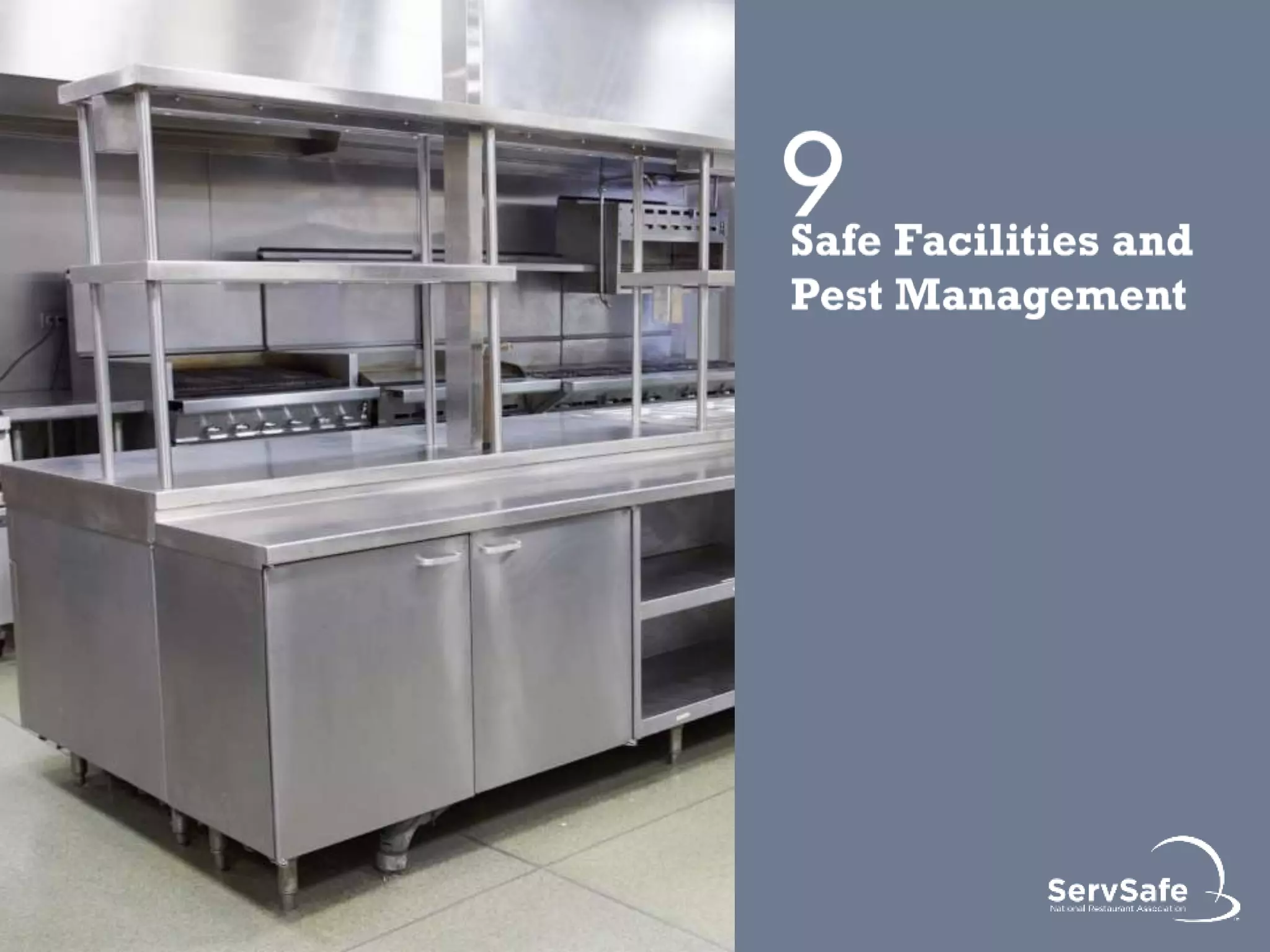
Safe Facilities and Pest Management
Objectives:
By the end of this chapter, you should be able to identify the following:
 How to pick materials and equipment that are safe for use in foodservice
operations
 Ways to install and maintain equipment
 Ways to avoid food safety hazards caused by utilities
 Ways to maintain your facility
 Best ways to handle emergencies
 Ways to prevent and control pests
9-2
Interior Requirements for a Safe Operation
Floors, walls, and ceilings:
 Made from smooth and durable materials for easier cleaning
 Maintained regularly
 Have coving where the floors and walls meet
 Promptly cleared of any standing water
9-3
Equipment Selection
Food equipment must be:
 Smooth
 Easy to clean
 Durable
 Resistant to damage
9-4
Some organizations:
 Develop standards for sanitary design and
construction of equipment
 Certify equipment meeting these standards
 Must be accredited by ANSI
Other organizations:
 Classify equipment meeting standards
developed by others
 Must be accredited by ANSI
9-5
Equipment Selection
When purchasing equipment look for the:
 NSF mark
 UL EPH classified mark
 ETL sanitation mark
9-6
Equipment Selection
Interior Requirements for a Safe Operation
9-7
Installing equipment:
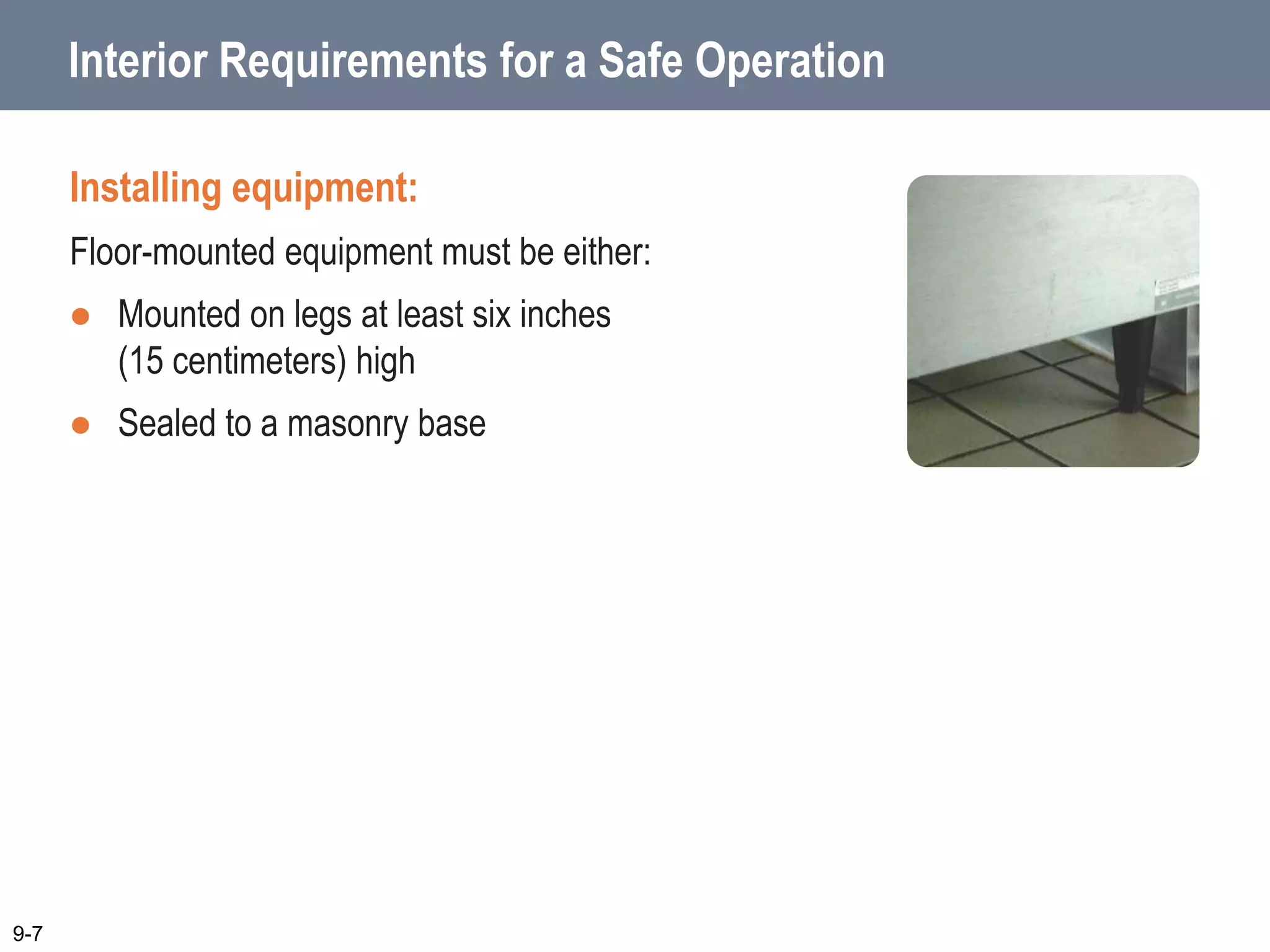
Floor-mounted equipment must be either:
 Mounted on legs at least six inches
(15 centimeters) high
 Sealed to a masonry base
Interior Requirements for a Safe Operation
9-8
Installing equipment:
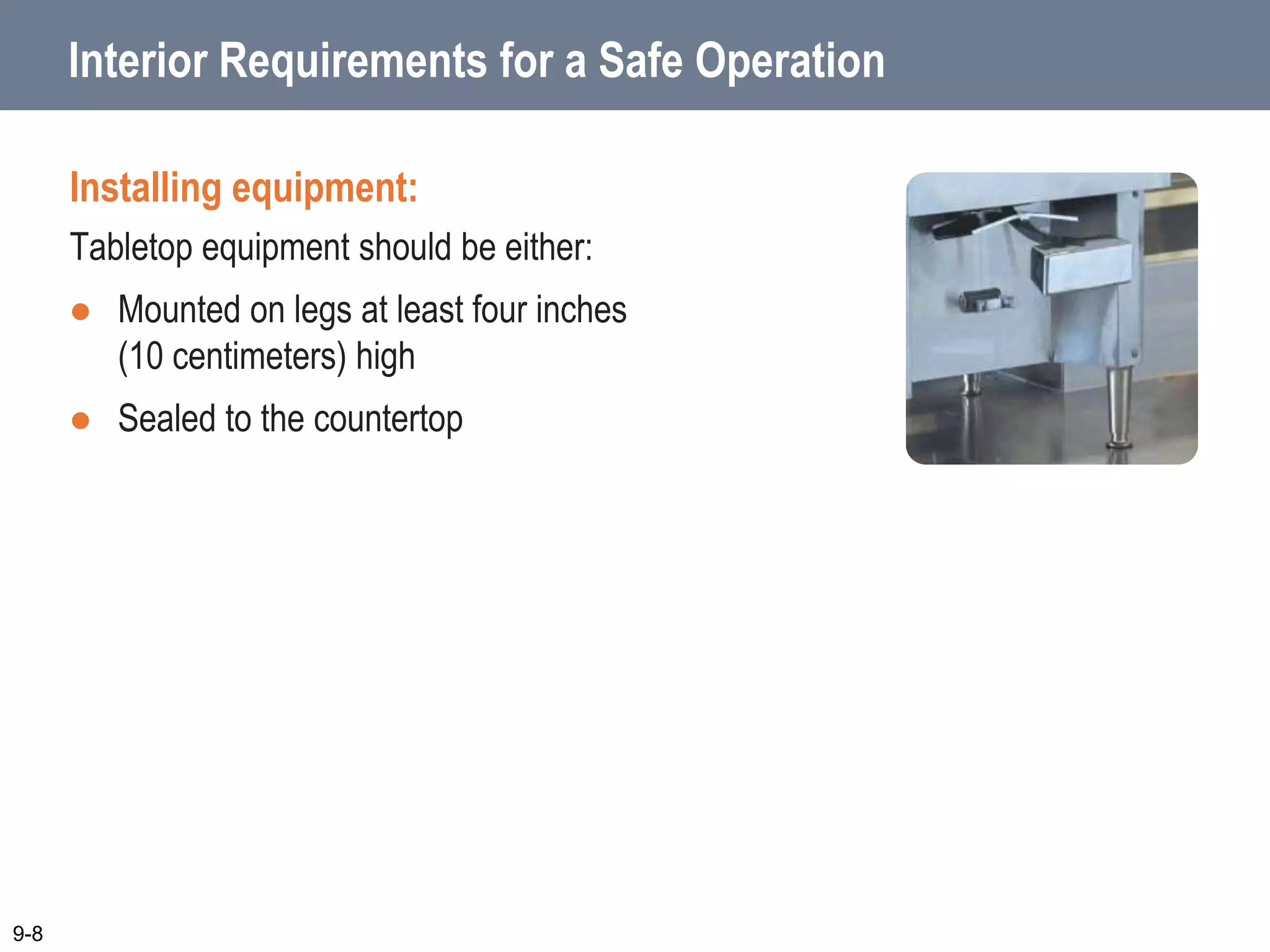
Tabletop equipment should be either:
 Mounted on legs at least four inches
(10 centimeters) high
 Sealed to the countertop
Interior Requirements for a Safe Operation
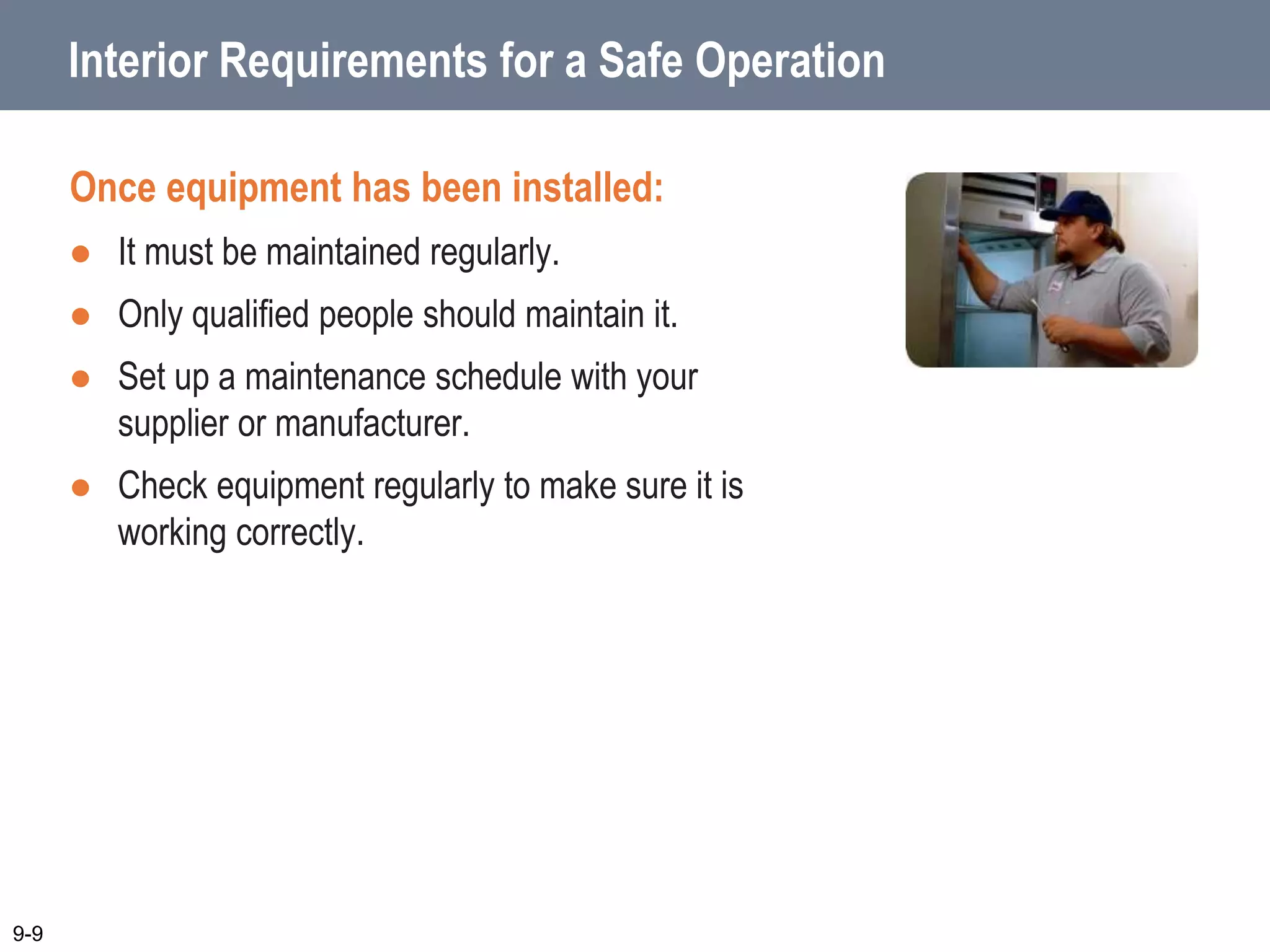
Once equipment has been installed:
 It must be maintained regularly.
 Only qualified people should maintain it.
 Set up a maintenance schedule with your
supplier or manufacturer.
 Check equipment regularly to make sure it is
working correctly.
9-9
Dishwashing Machines
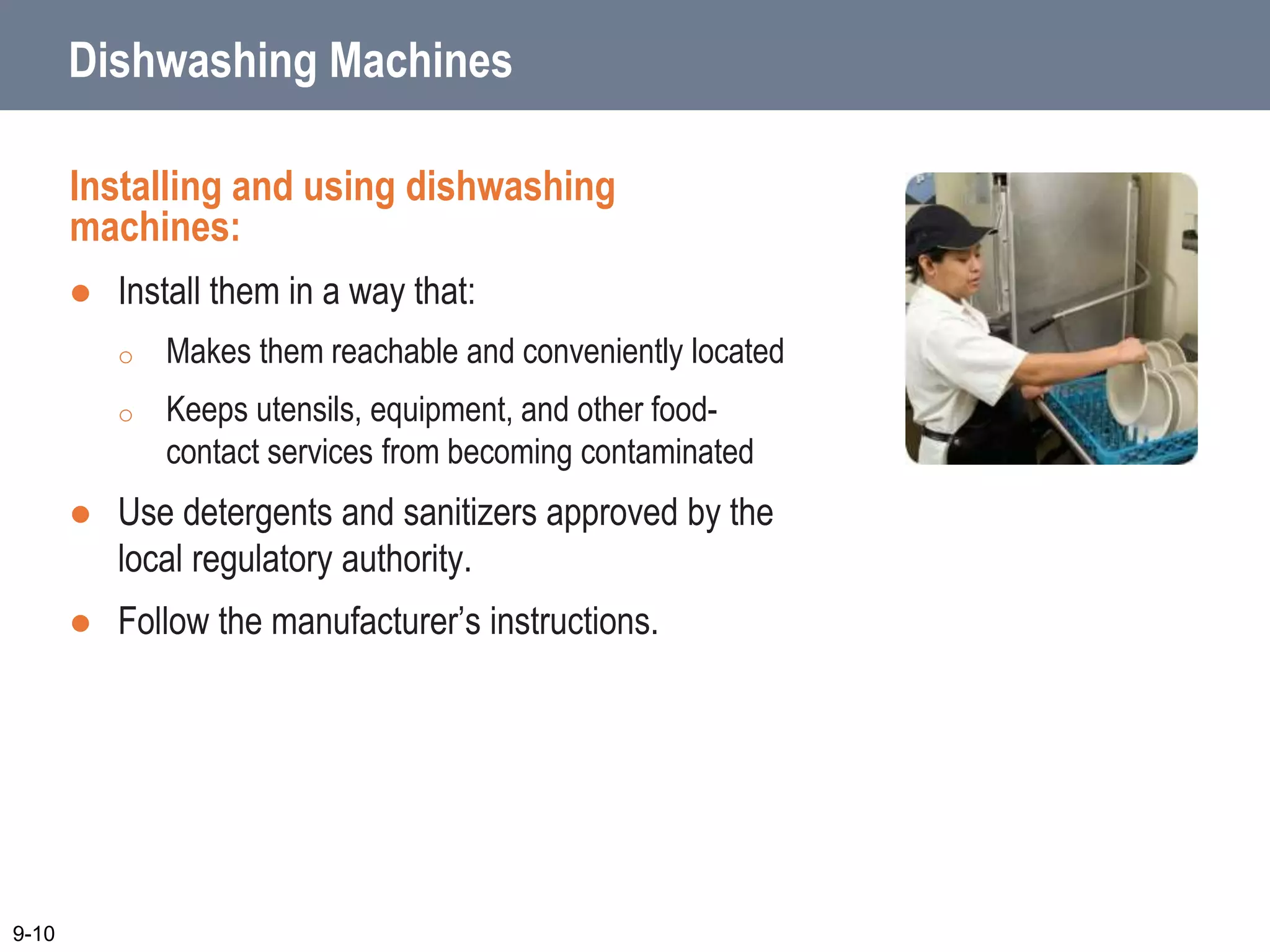
Installing and using dishwashing
machines:
 Install them in a way that:
o Makes them reachable and conveniently located
o Keeps utensils, equipment, and other food-
contact services from becoming contaminated
 Use detergents and sanitizers approved by the
local regulatory authority.
 Follow the manufacturer’s instructions.
9-10
Dishwashing Machines
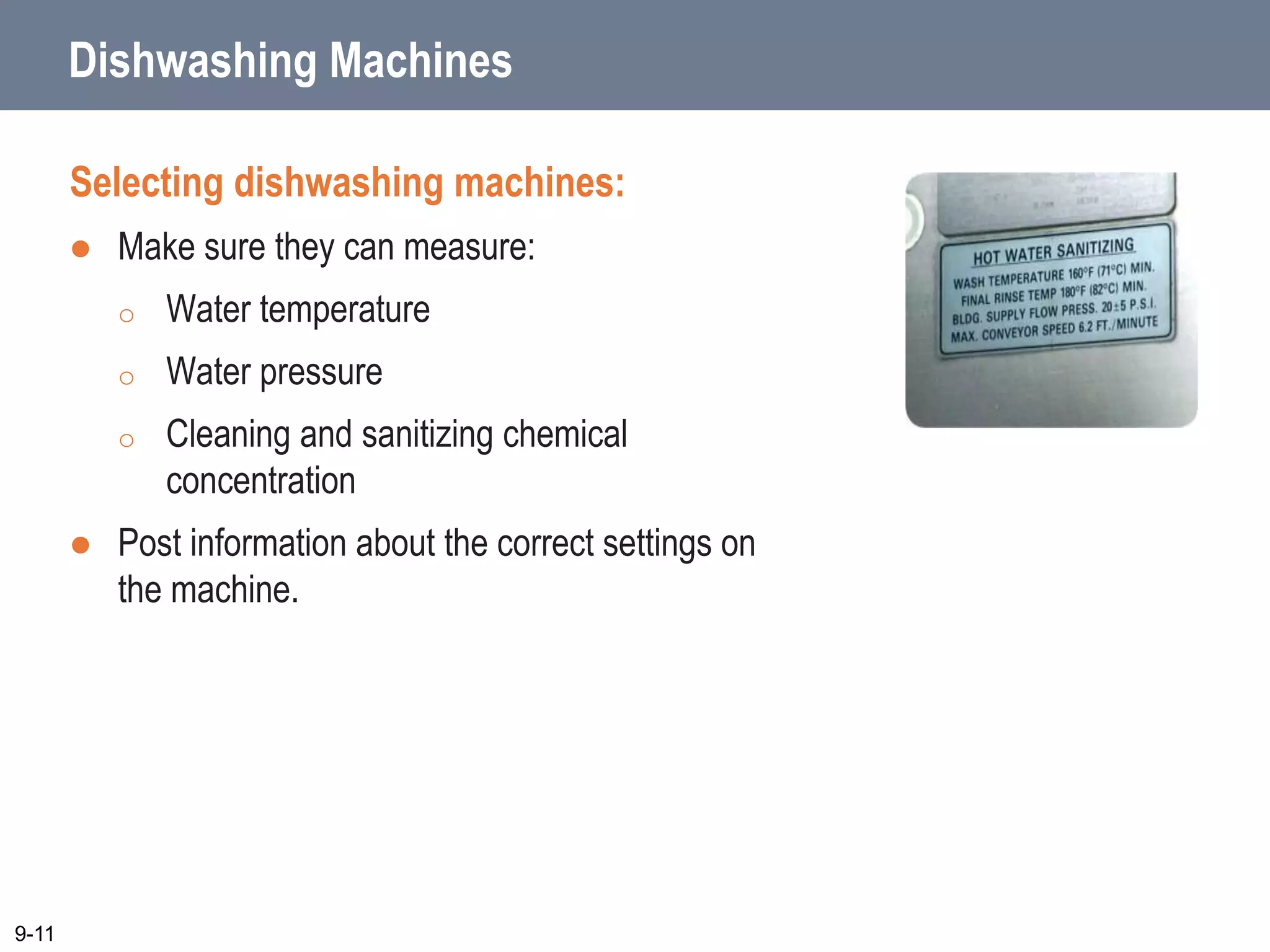
Selecting dishwashing machines:
 Make sure they can measure:
o Water temperature
o Water pressure
o Cleaning and sanitizing chemical
concentration
 Post information about the correct settings on
the machine.
9-11
Dishwashing Machines
Cleaning dishwashing machines:
 Clean them as often as necessary.
 Follow manufacturer’s recommendations.
 Follow local regulatory requirements.
9-12
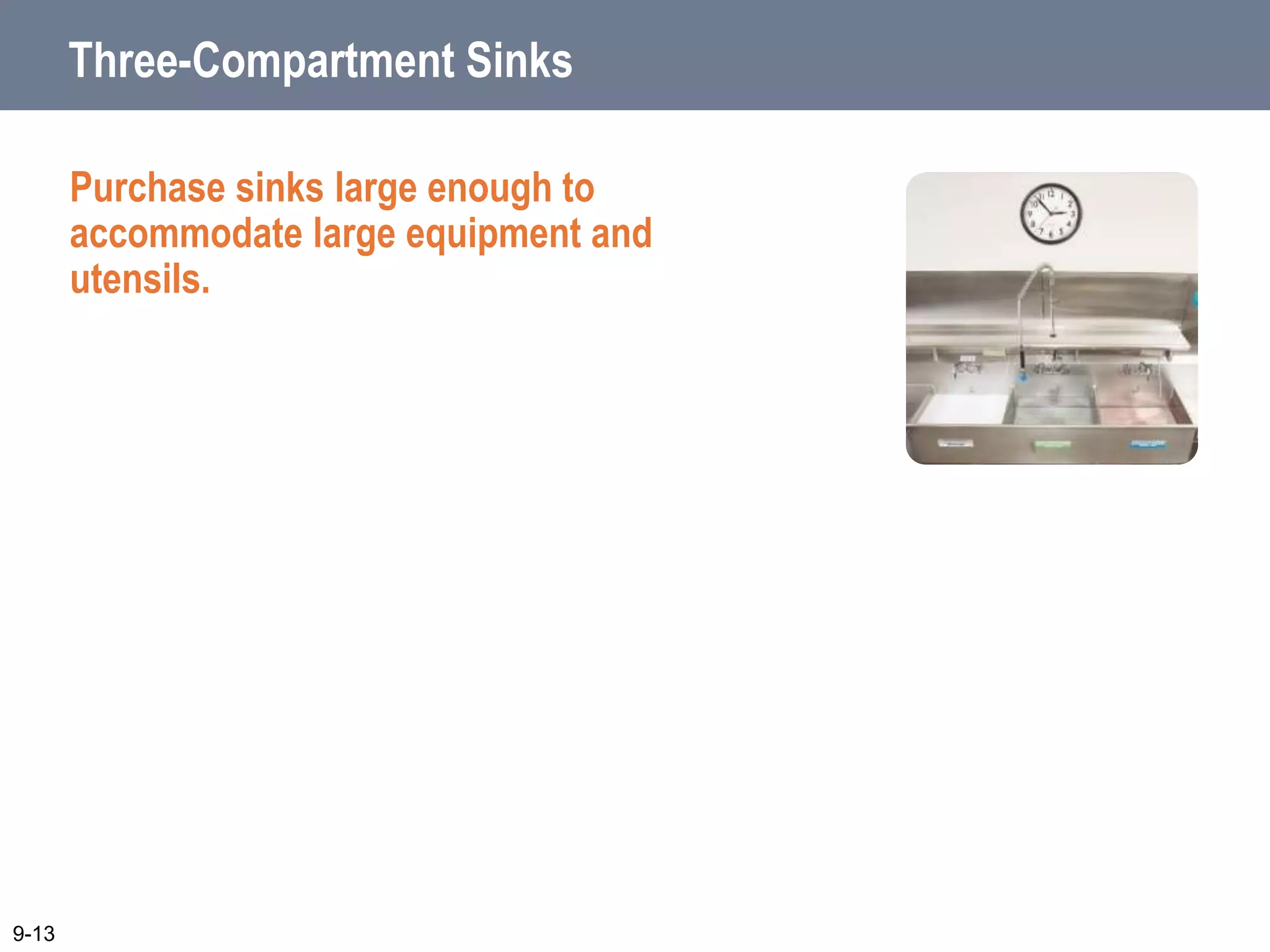
Three-Compartment Sinks
Purchase sinks large enough to
accommodate large equipment and
utensils.
9-13
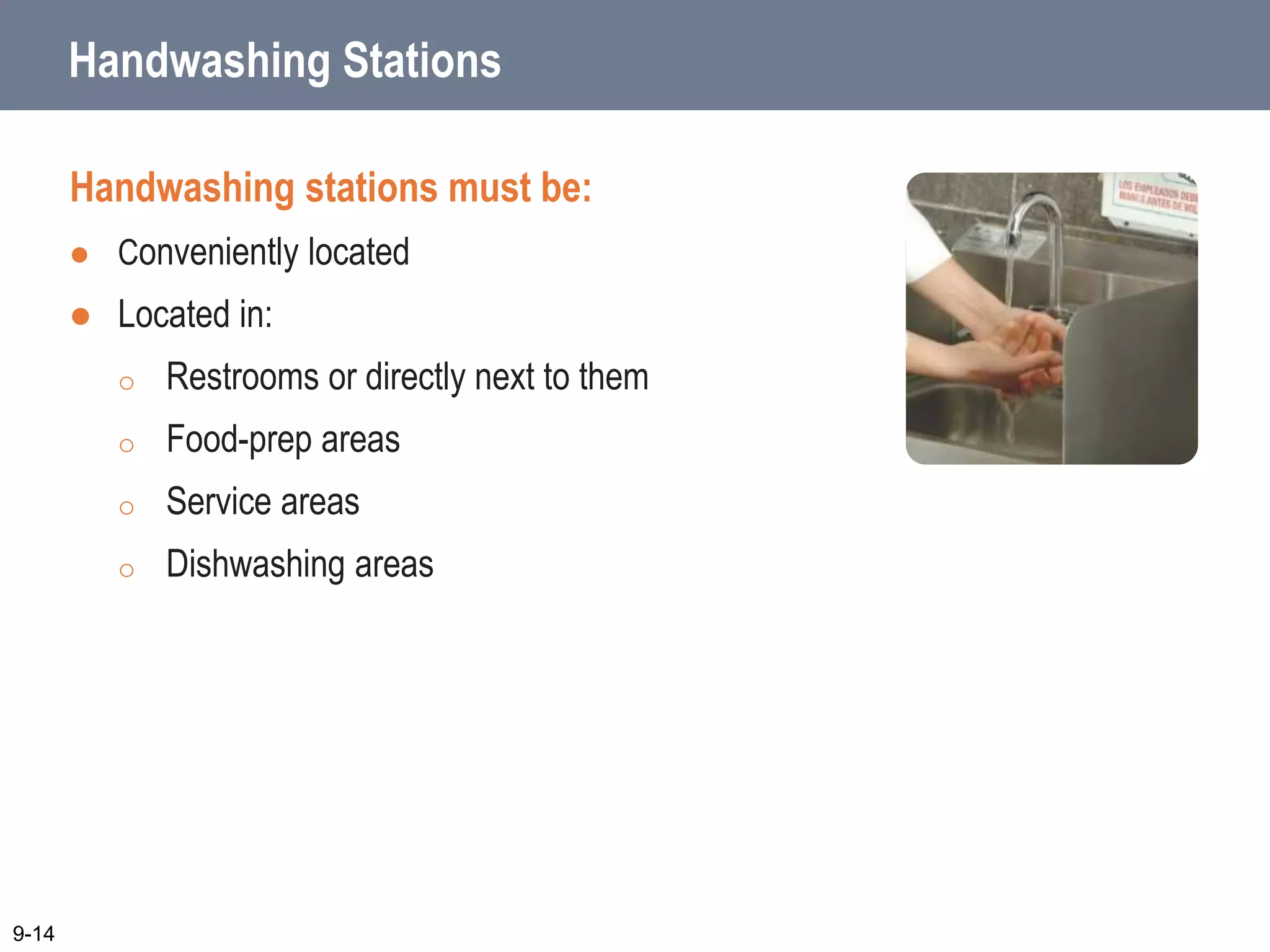
Handwashing Stations
Handwashing stations must be:
 Conveniently located
 Located in:
o Restrooms or directly next to them
o Food-prep areas
o Service areas
o Dishwashing areas
9-14
Handwashing Stations
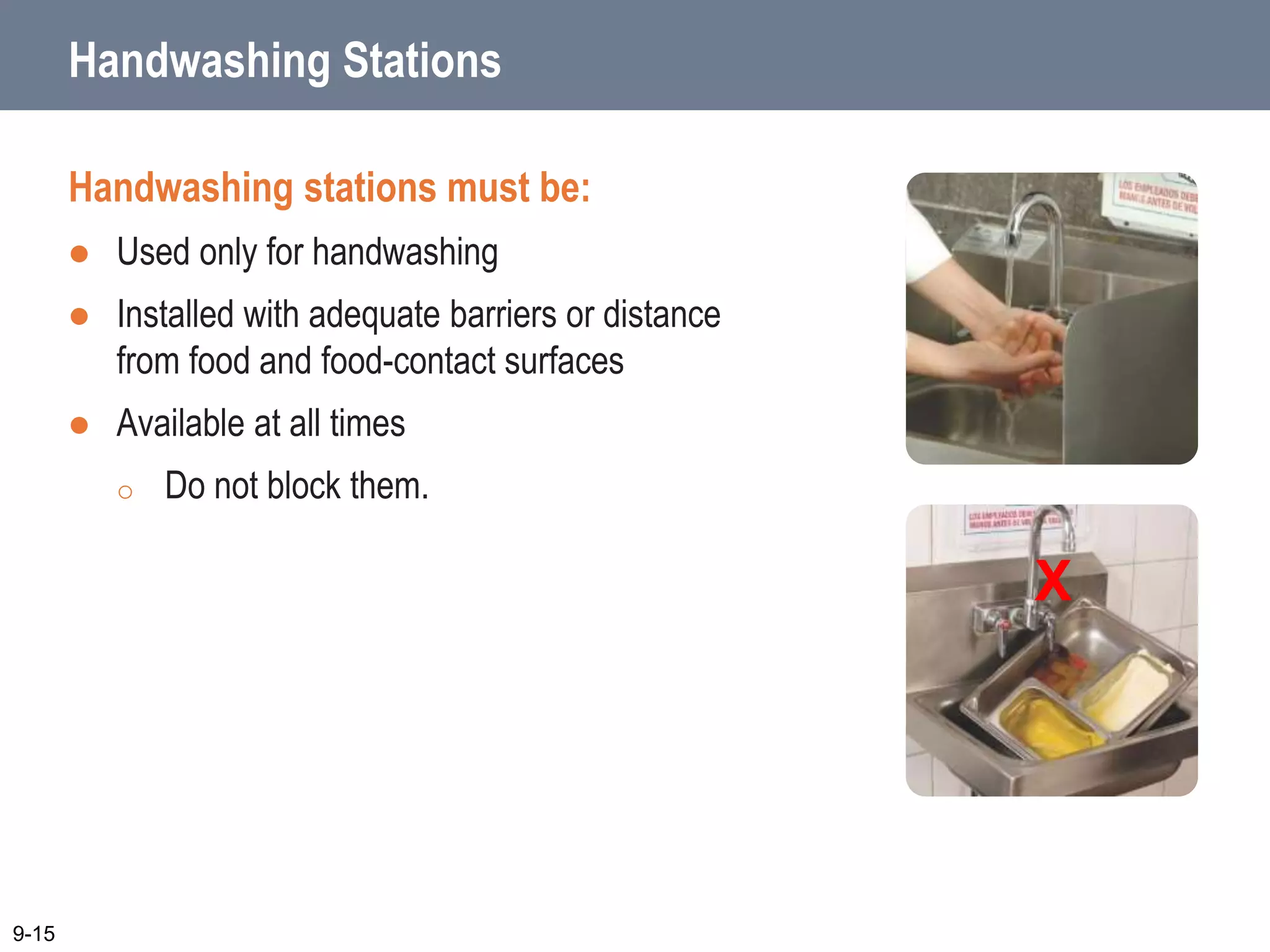
Handwashing stations must be:
 Used only for handwashing
 Installed with adequate barriers or distance
from food and food-contact surfaces
 Available at all times
o Do not block them.
9-15
X
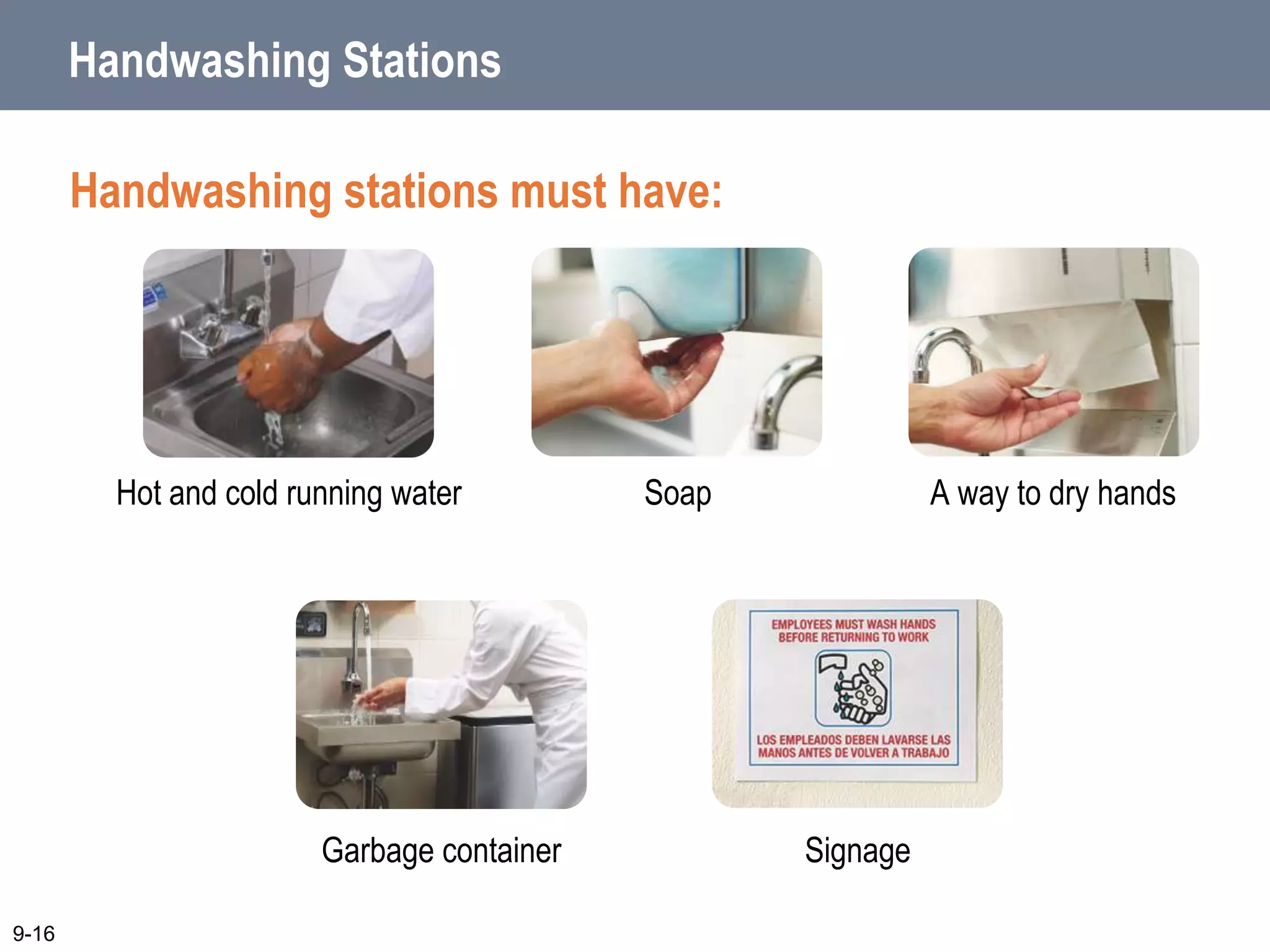
Signage
Garbage container
A way to dry hands
Soap
Hot and cold running water
Handwashing Stations
Handwashing stations must have:
9-16
Water and Plumbing
Acceptable sources of drinkable (potable)
water:
 Approved public water mains
 Regularly tested and maintained private
sources
 Closed, portable water containers
 Water transport vehicles
9-17
Water and Plumbing
Installation and maintenance:
 If using an on-site septic system, make sure it
is properly tested and maintained
 Only licensed plumbers should work on the
plumbing
9-18
9-19
Water and Plumbing
Cross-connection:
 Physical link between safe water and dirty water from
o Drains
o Sewers
o Other wastewater sources
Water and Plumbing
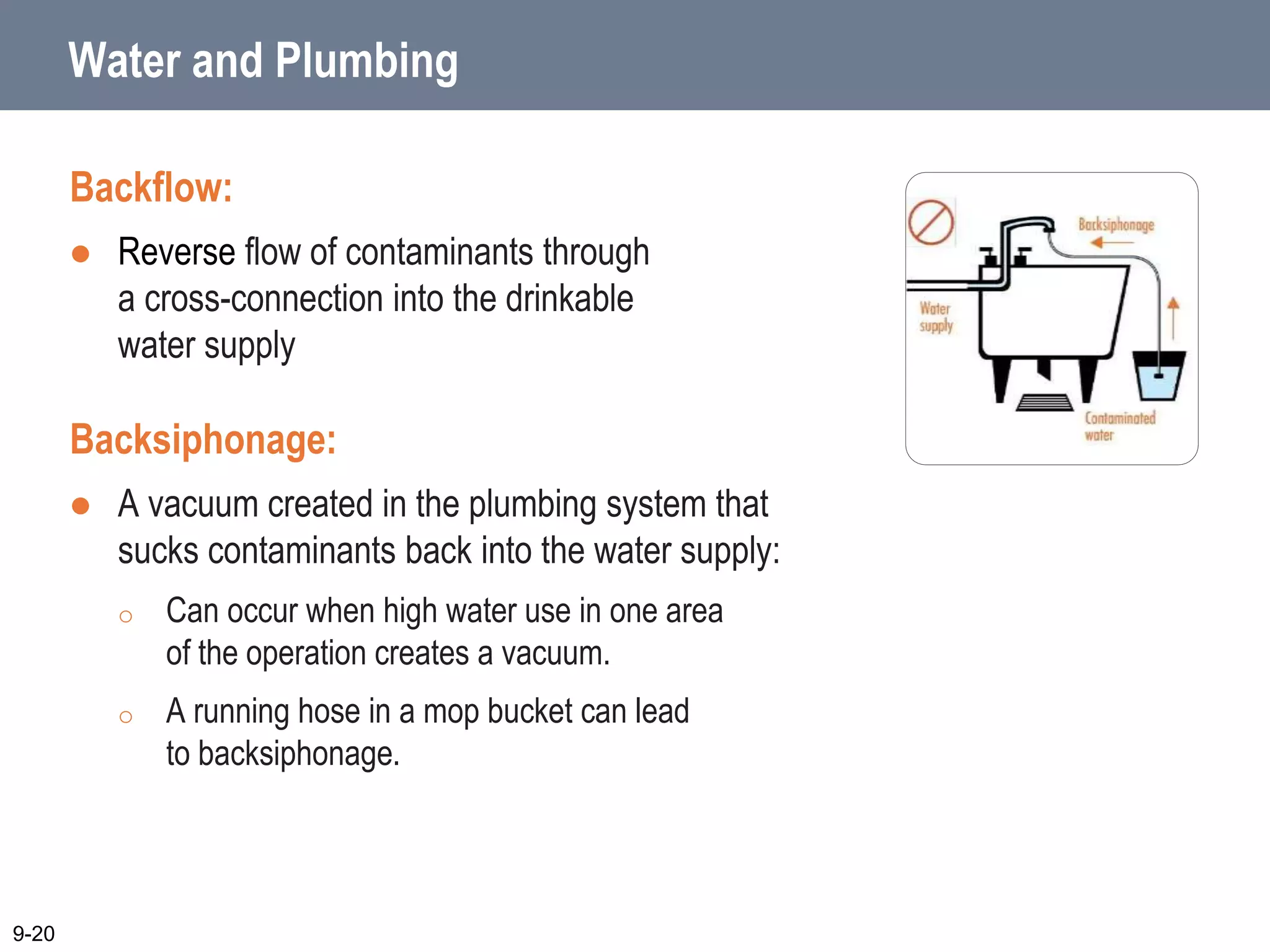
Backflow:
 Reverse flow of contaminants through
a cross-connection into the drinkable
water supply
Backsiphonage:
 A vacuum created in the plumbing system that
sucks contaminants back into the water supply:
o Can occur when high water use in one area
of the operation creates a vacuum.
o A running hose in a mop bucket can lead
to backsiphonage.
9-20
9-21
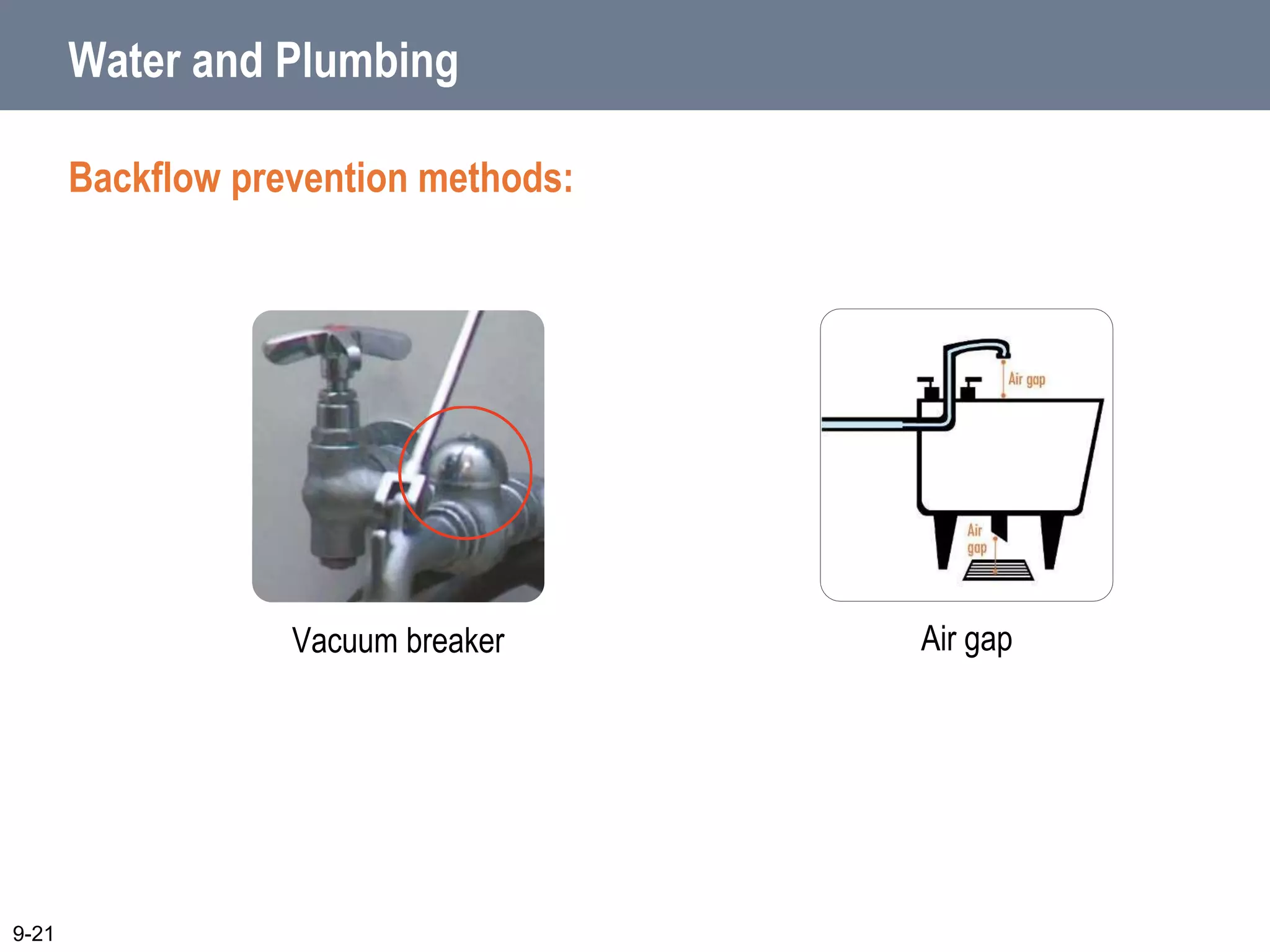
Air gap
Vacuum breaker
Water and Plumbing
Backflow prevention methods:
Water and Plumbing
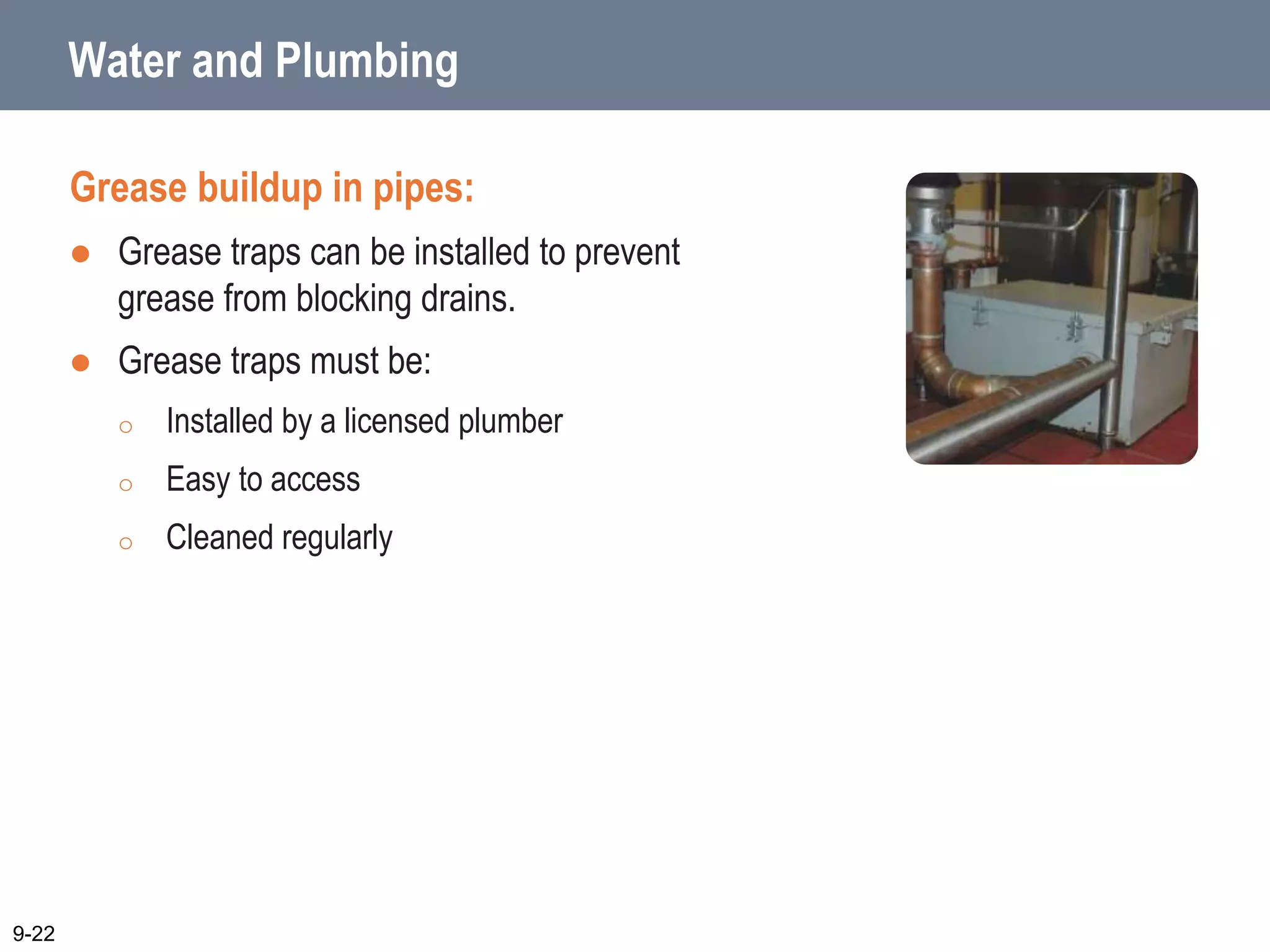
Grease buildup in pipes:
 Grease traps can be installed to prevent
grease from blocking drains.
 Grease traps must be:
o Installed by a licensed plumber
o Easy to access
o Cleaned regularly
9-22
Lighting
Consider the following when installing and
maintaining lighting:
 Different areas of the facility have different
lighting intensity requirements.
 Local jurisdictions usually require prep areas to
be brighter than other areas.
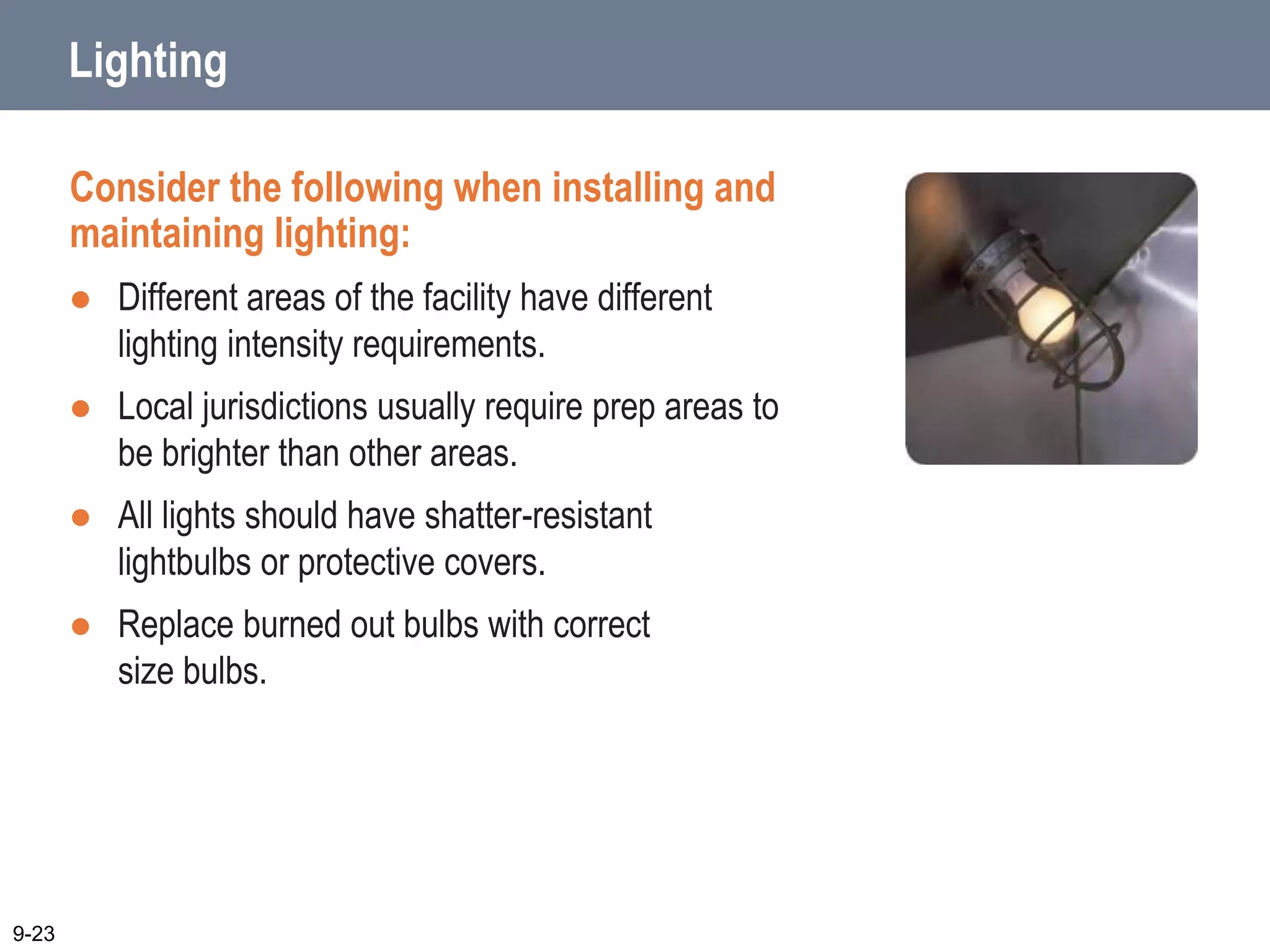
 All lights should have shatter-resistant
lightbulbs or protective covers.
 Replace burned out bulbs with correct
size bulbs.
9-23
Ventilation
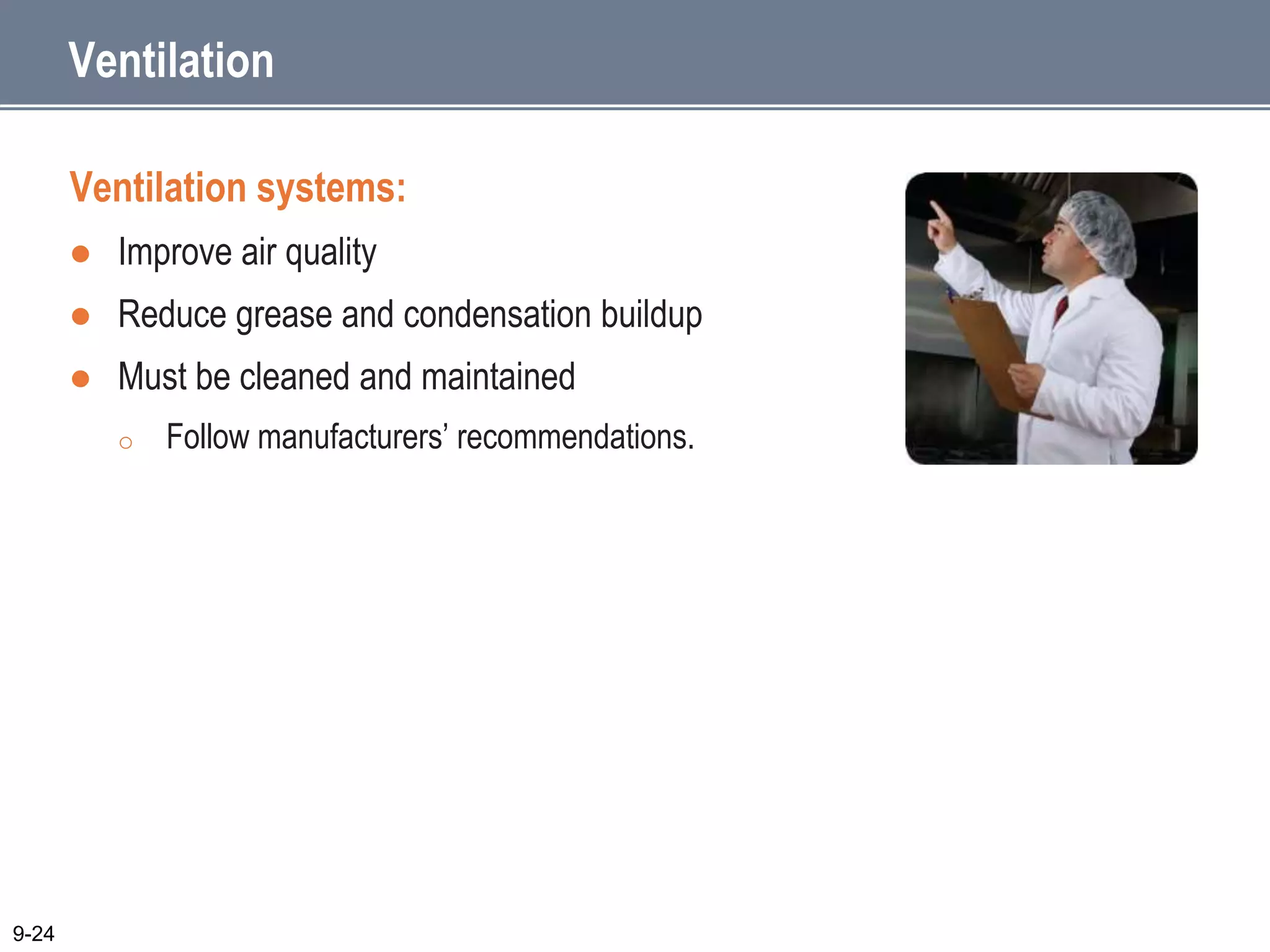
Ventilation systems:
 Improve air quality
 Reduce grease and condensation buildup
 Must be cleaned and maintained
o Follow manufacturers’ recommendations.
9-24
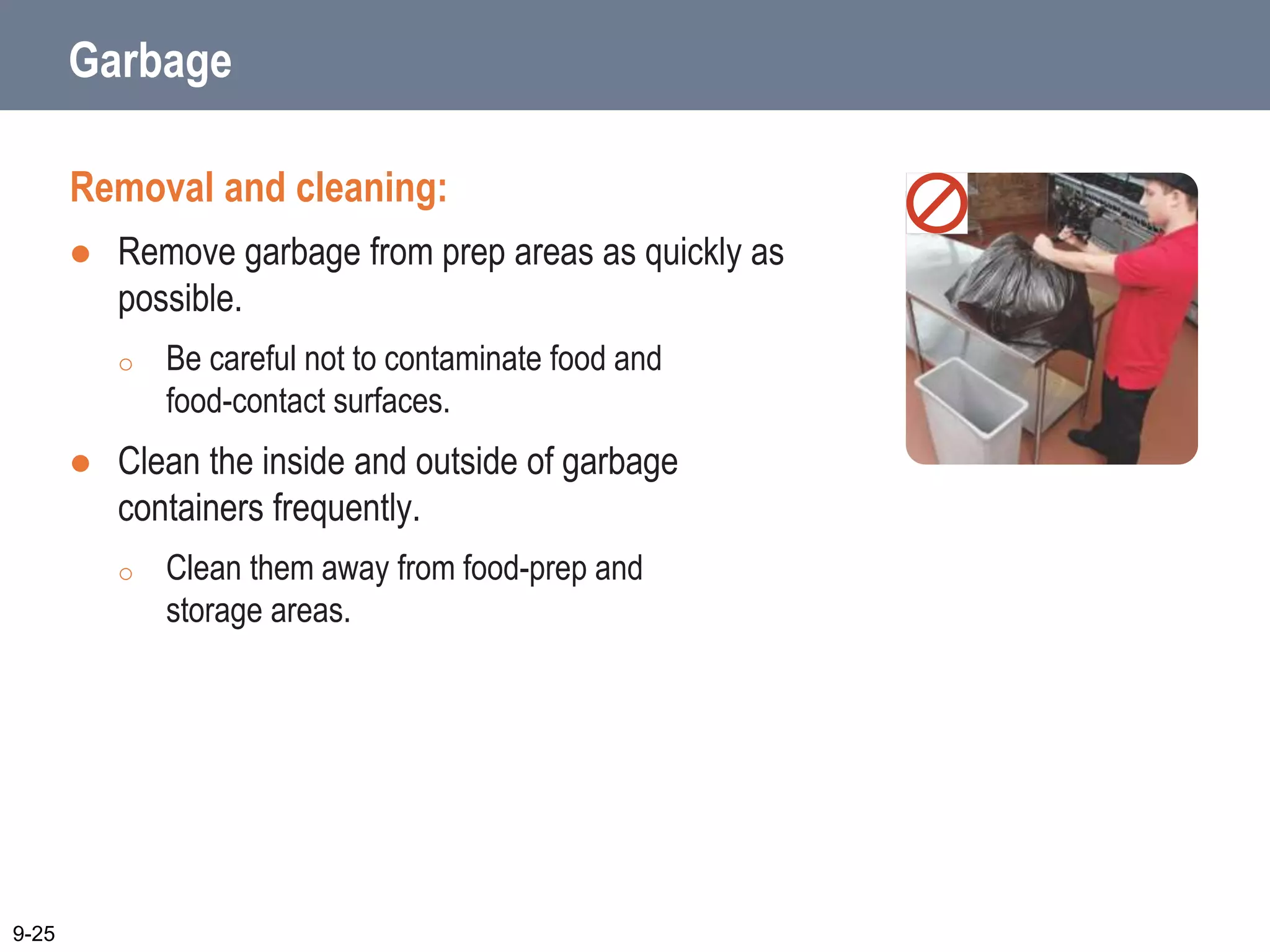
Garbage
Removal and cleaning:
 Remove garbage from prep areas as quickly as
possible.
o Be careful not to contaminate food and
food-contact surfaces.
 Clean the inside and outside of garbage
containers frequently.
o Clean them away from food-prep and
storage areas.
9-25
Garbage
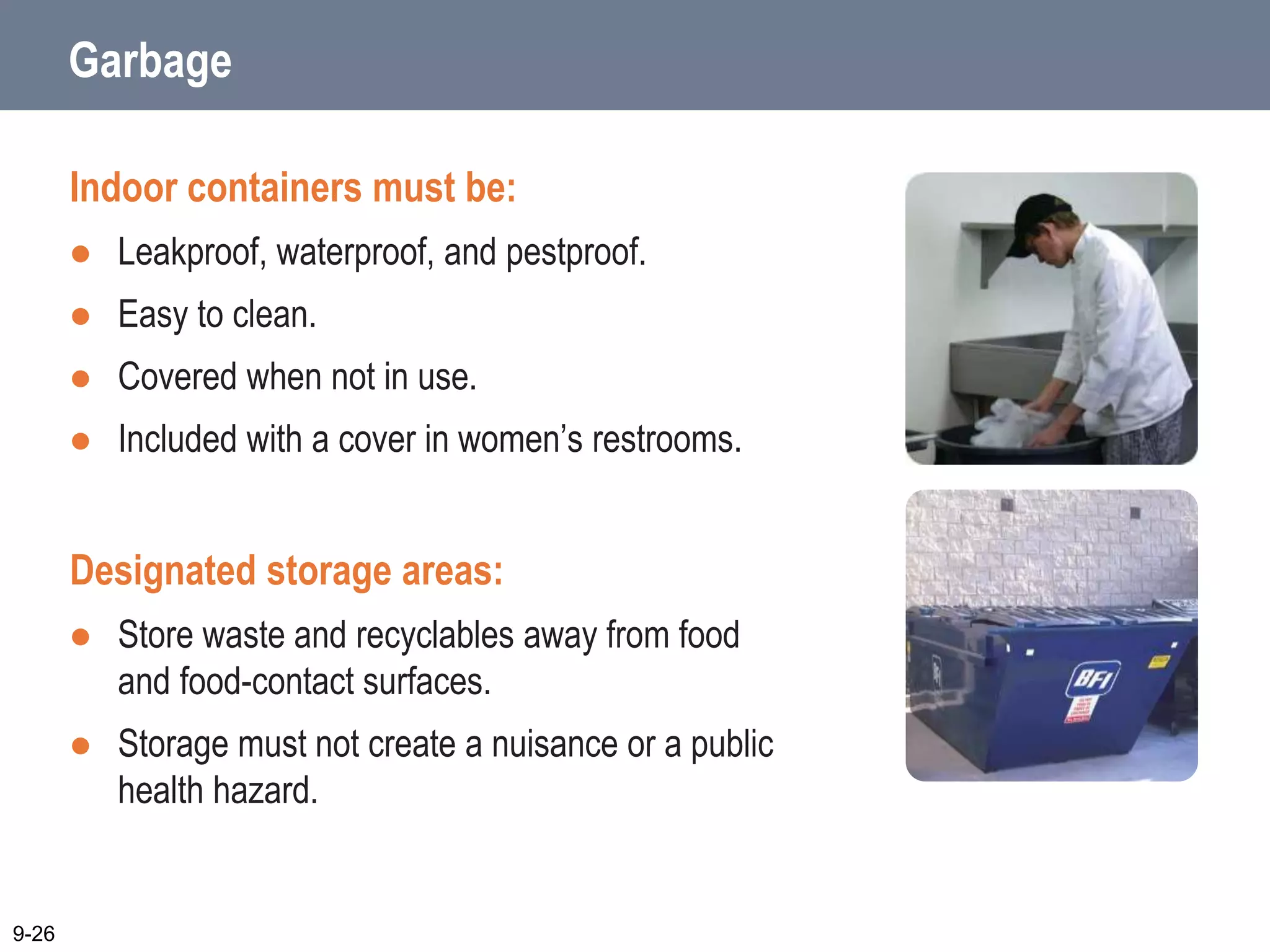
Indoor containers must be:
 Leakproof, waterproof, and pestproof.
 Easy to clean.
 Covered when not in use.
 Included with a cover in women’s restrooms.
Designated storage areas:
 Store waste and recyclables away from food
and food-contact surfaces.
 Storage must not create a nuisance or a public
health hazard.
9-26
Garbage
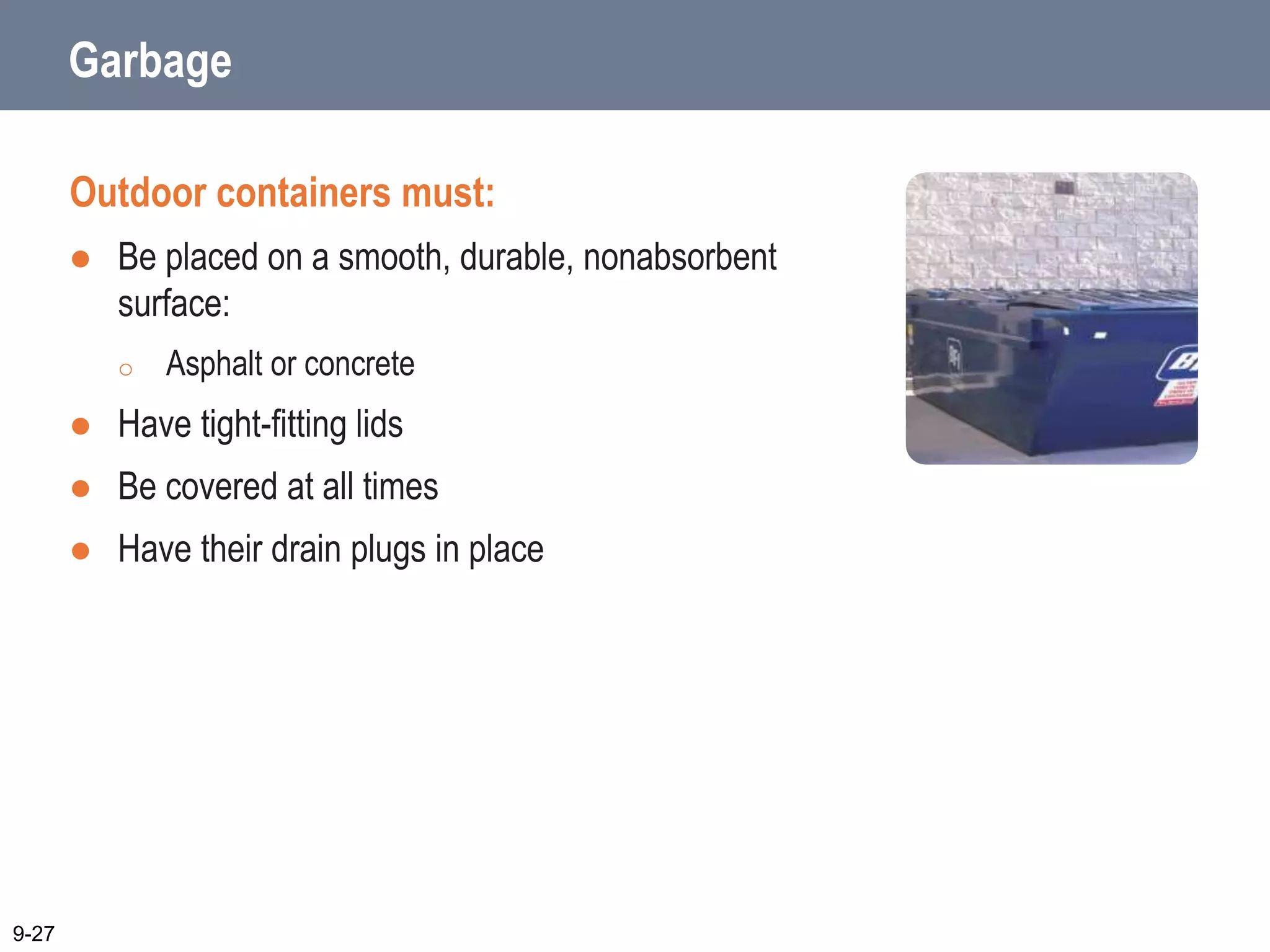
Outdoor containers must:
 Be placed on a smooth, durable, nonabsorbent
surface:
o Asphalt or concrete
 Have tight-fitting lids
 Be covered at all times
 Have their drain plugs in place
9-27
Maintaining the Facility
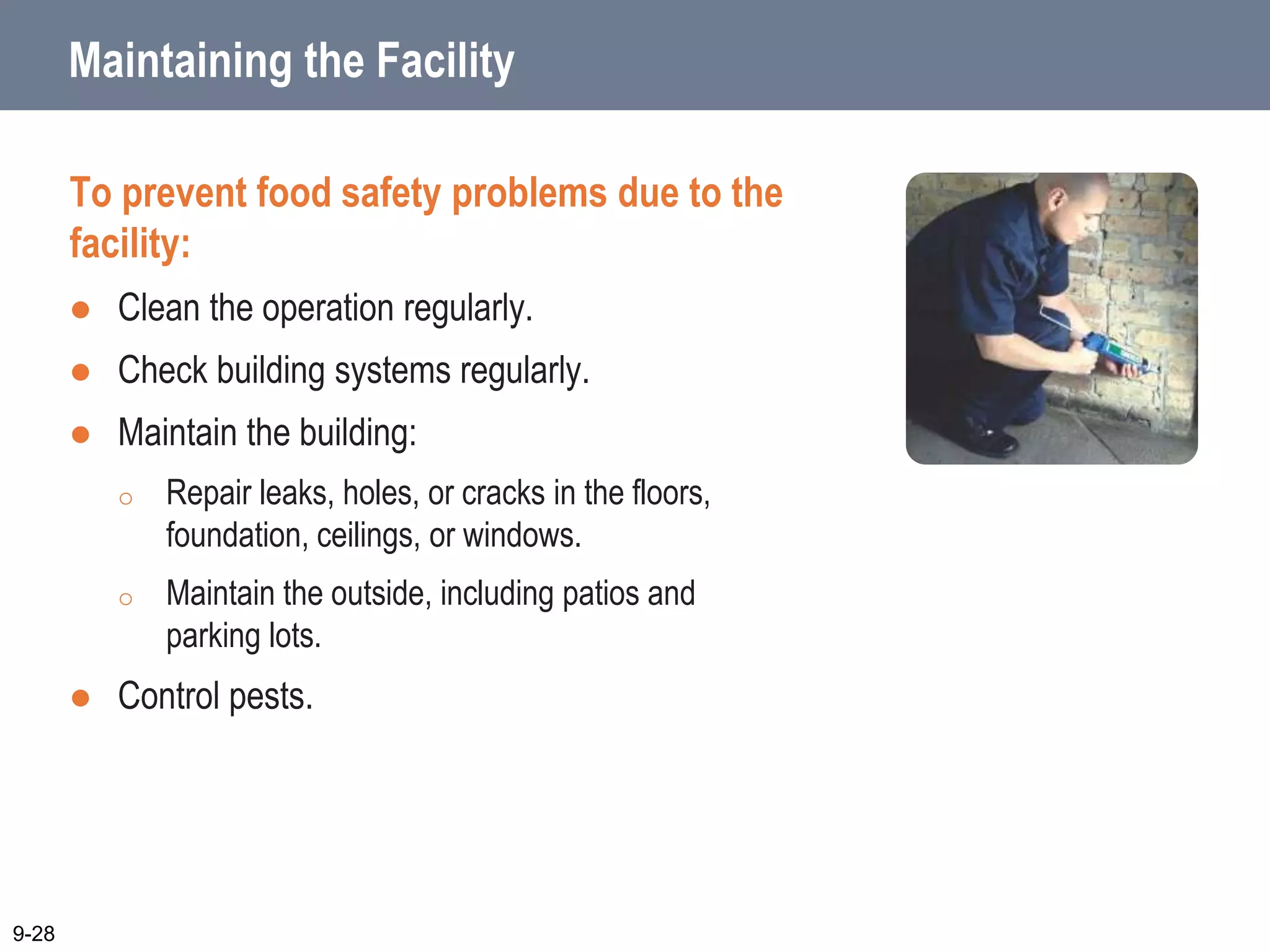
To prevent food safety problems due to the
facility:
 Clean the operation regularly.
 Check building systems regularly.
 Maintain the building:
o Repair leaks, holes, or cracks in the floors,
foundation, ceilings, or windows.
o Maintain the outside, including patios and
parking lots.
 Control pests.
9-28
Emergencies That Affect the Facility
Imminent health hazard:
 A significant threat or danger to health
 Requires immediate correction or closure to prevent injury
Possible imminent health hazards:
 Power outages and refrigeration failures
 Security issues
 Fires
 Water supply problems
 Floods and sewage backups
9-29
Emergencies That Affect the Facility
How to respond to a crisis affecting the facility:
 Determine if there is a significant risk to the safety or security of your food.
 If the risk is significant:
o Stop service.
o Notify the local regulatory authority.
 Throw away contaminated food and food in damaged packaging.
9-30
Emergencies That Affect the Facility
How to respond to a crisis affecting the facility:
 Decide how to correct the problem:
o Establish time-temperature control.
o Clean and sanitize surfaces.
o Reestablish physical security of the facility.
o Verify water is drinkable.
9-31
Emergencies That Affect the Facility
Service may be allowed after water/electrical interruptions if the
operation:
 Has a pre-approved written emergency operating plan
 Takes immediate corrective action
 Notifies the regulatory authority when the plan is implemented
9-32
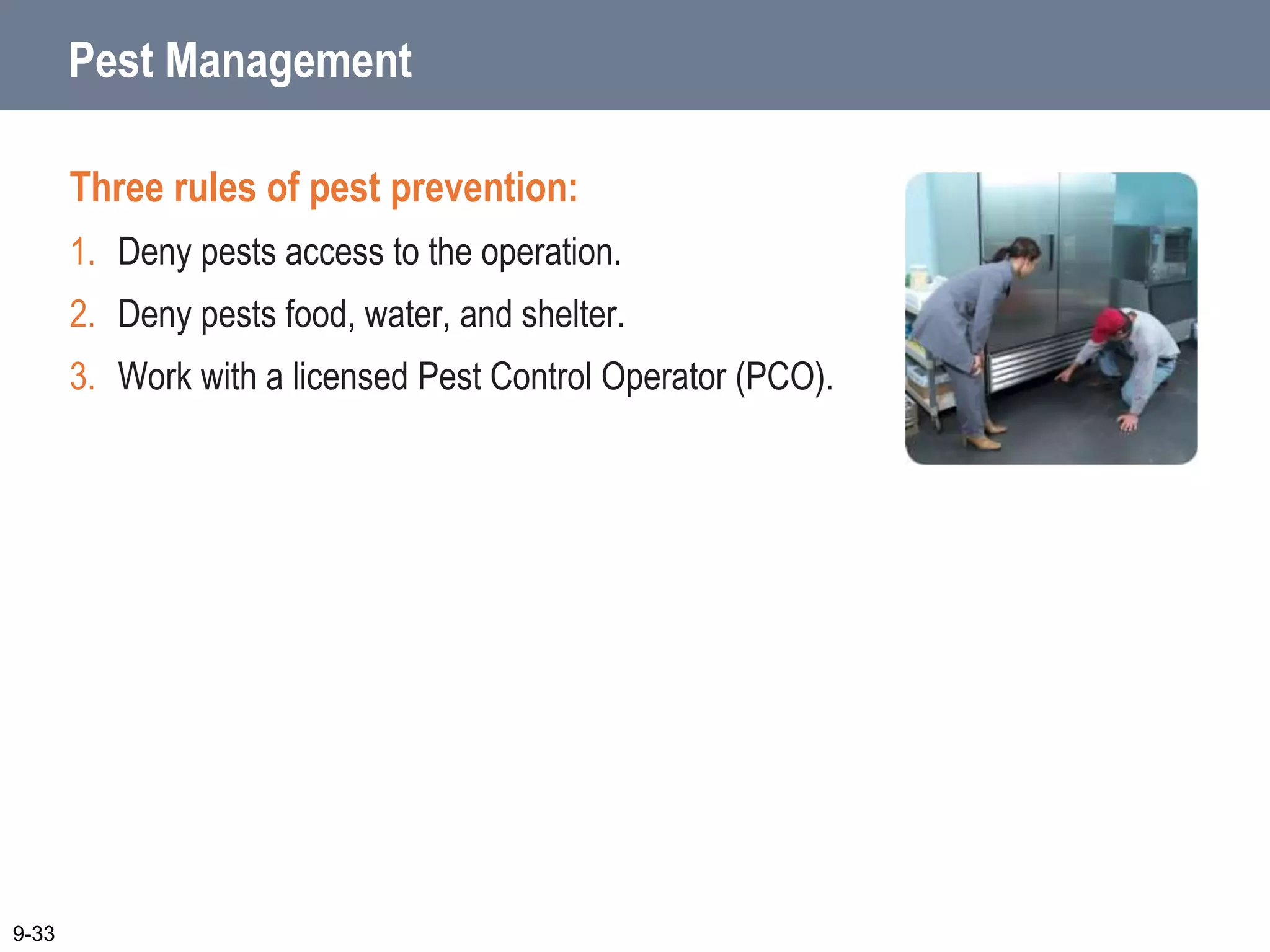
Pest Management
Three rules of pest prevention:
1. Deny pests access to the operation.
2. Deny pests food, water, and shelter.
3. Work with a licensed Pest Control Operator (PCO).
9-33
Pest Prevention
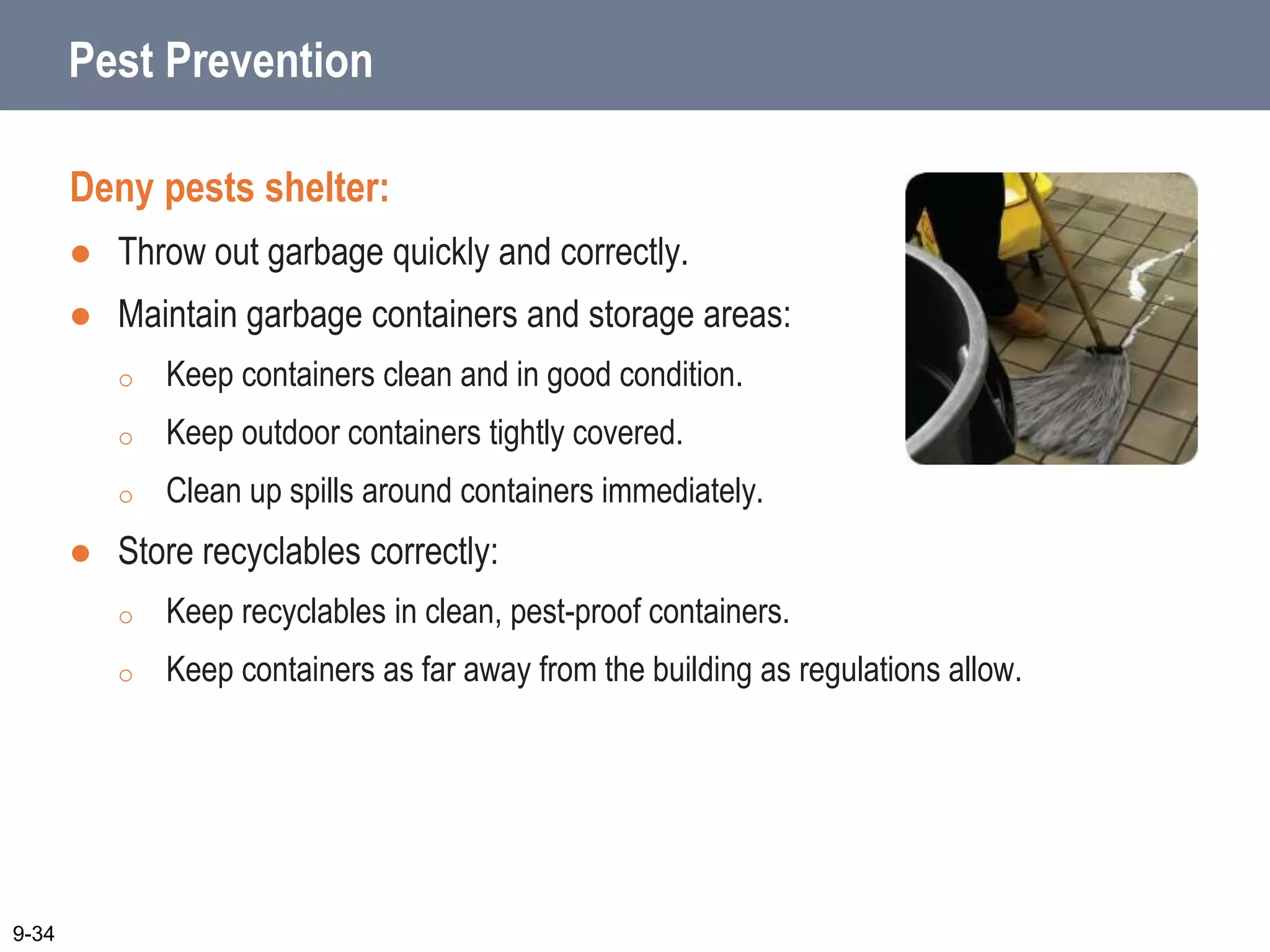
Deny pests shelter:
 Throw out garbage quickly and correctly.
 Maintain garbage containers and storage areas:
o Keep containers clean and in good condition.
o Keep outdoor containers tightly covered.
o Clean up spills around containers immediately.
 Store recyclables correctly:
o Keep recyclables in clean, pest-proof containers.
o Keep containers as far away from the building as regulations allow.
9-34
Pest Prevention
Deny pests shelter:
 Store food and supplies quickly and correctly.
o Keep them away from walls and at least six inches (15 cm) off the floor.
o Rotate products (FIFO) so pests cannot settle and breed.
 Clean up food and beverage spills immediately.
9-35
Pest Prevention
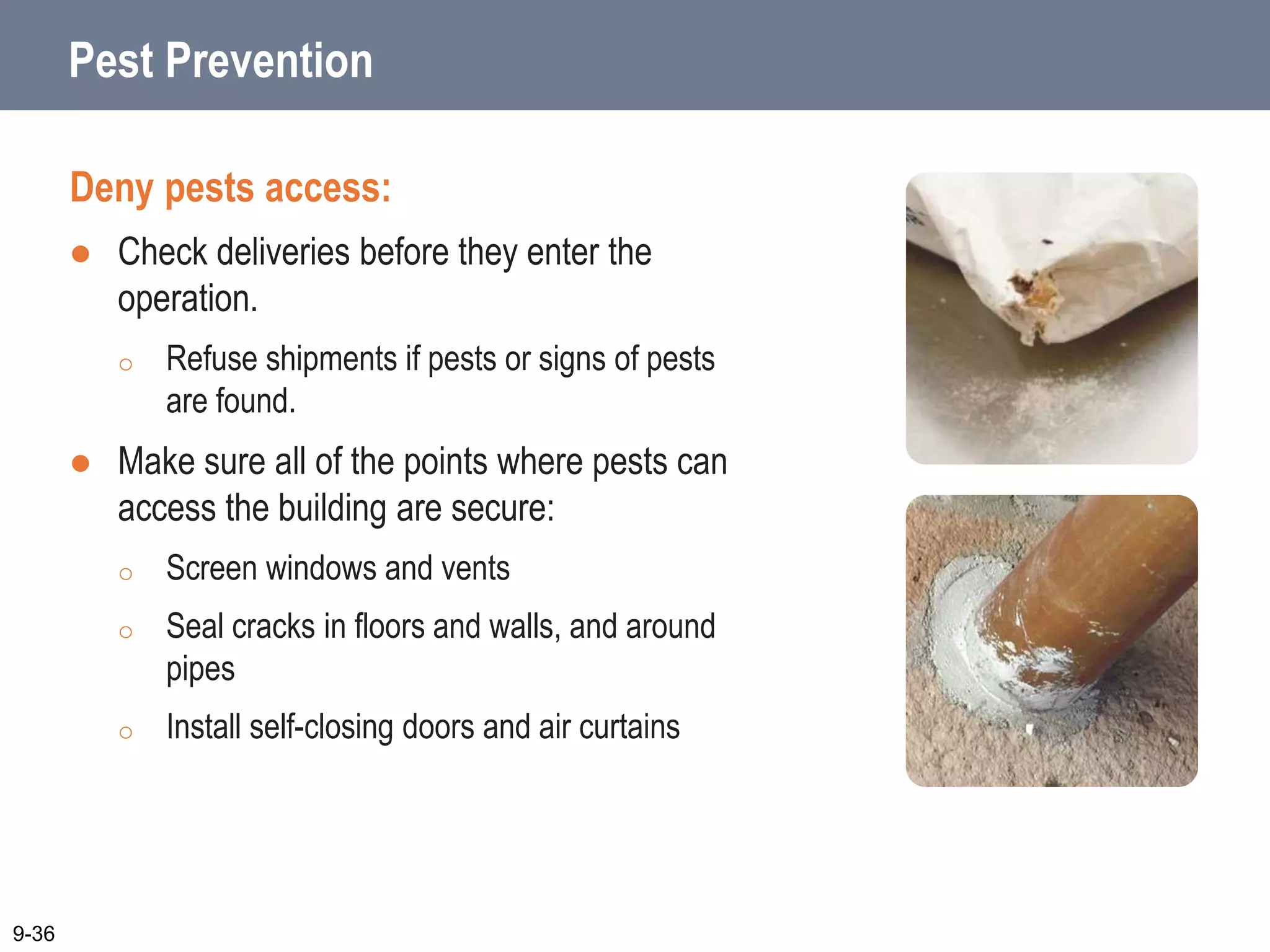
Deny pests access:
 Check deliveries before they enter the
operation.
o Refuse shipments if pests or signs of pests
are found.
 Make sure all of the points where pests can
access the building are secure:
o Screen windows and vents
o Seal cracks in floors and walls, and around
pipes
o Install self-closing doors and air curtains
9-36
Pest Control
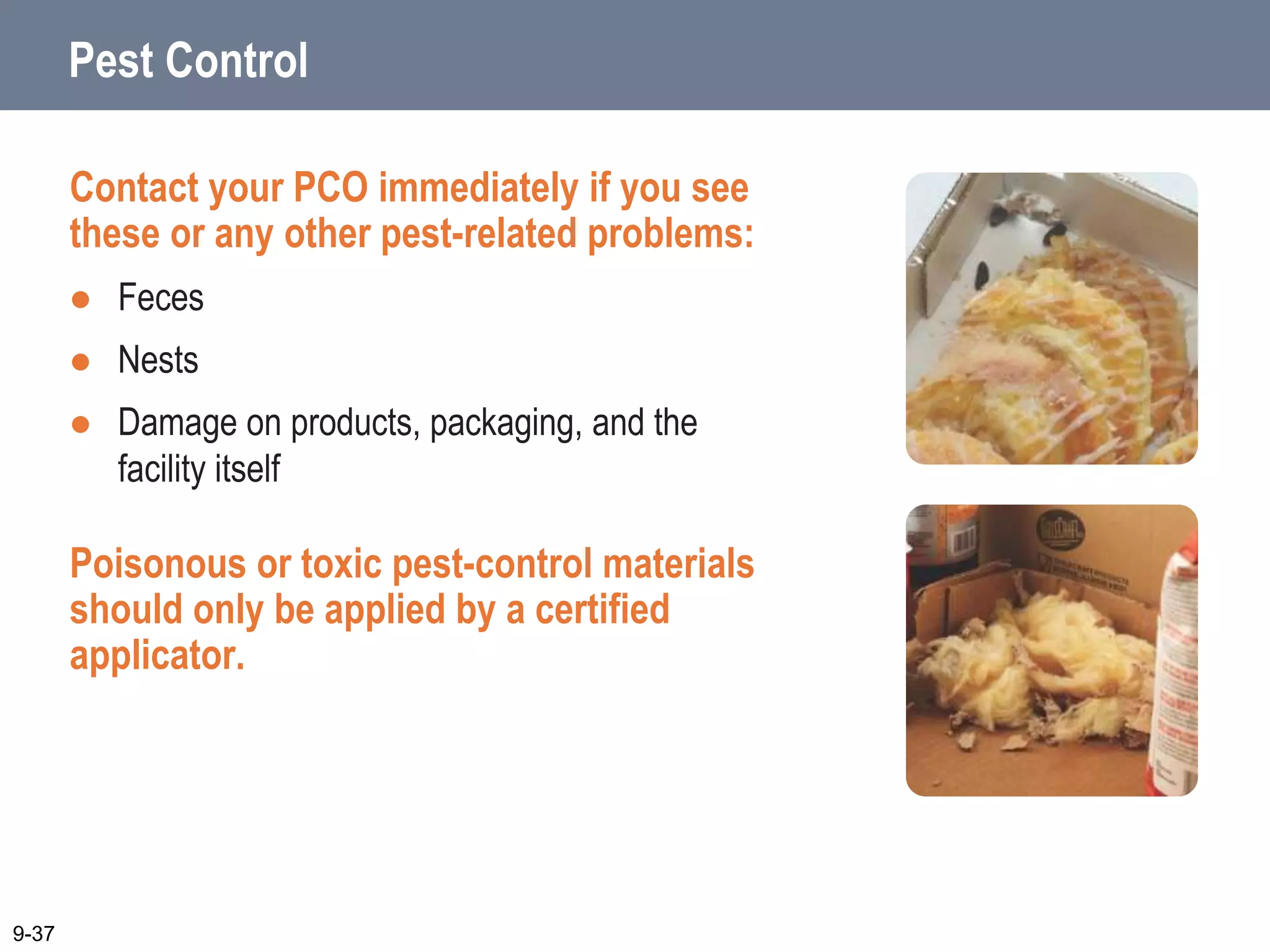
Contact your PCO immediately if you see
these or any other pest-related problems:
 Feces
 Nests
 Damage on products, packaging, and the
facility itself
Poisonous or toxic pest-control materials
should only be applied by a certified
applicator.
9-37

Chapter 9.pptx

  • 2.
    Safe Facilities andPest Management Objectives: By the end of this chapter, you should be able to identify the following:  How to pick materials and equipment that are safe for use in foodservice operations  Ways to install and maintain equipment  Ways to avoid food safety hazards caused by utilities  Ways to maintain your facility  Best ways to handle emergencies  Ways to prevent and control pests 9-2
  • 3.
    Interior Requirements fora Safe Operation Floors, walls, and ceilings:  Made from smooth and durable materials for easier cleaning  Maintained regularly  Have coving where the floors and walls meet  Promptly cleared of any standing water 9-3
  • 4.
    Equipment Selection Food equipmentmust be:  Smooth  Easy to clean  Durable  Resistant to damage 9-4
  • 5.
    Some organizations:  Developstandards for sanitary design and construction of equipment  Certify equipment meeting these standards  Must be accredited by ANSI Other organizations:  Classify equipment meeting standards developed by others  Must be accredited by ANSI 9-5 Equipment Selection
  • 6.
    When purchasing equipmentlook for the:  NSF mark  UL EPH classified mark  ETL sanitation mark 9-6 Equipment Selection
  • 7.
    Interior Requirements fora Safe Operation 9-7 Installing equipment: Floor-mounted equipment must be either:  Mounted on legs at least six inches (15 centimeters) high  Sealed to a masonry base
  • 8.
    Interior Requirements fora Safe Operation 9-8 Installing equipment: Tabletop equipment should be either:  Mounted on legs at least four inches (10 centimeters) high  Sealed to the countertop
  • 9.
    Interior Requirements fora Safe Operation Once equipment has been installed:  It must be maintained regularly.  Only qualified people should maintain it.  Set up a maintenance schedule with your supplier or manufacturer.  Check equipment regularly to make sure it is working correctly. 9-9
  • 10.
    Dishwashing Machines Installing andusing dishwashing machines:  Install them in a way that: o Makes them reachable and conveniently located o Keeps utensils, equipment, and other food- contact services from becoming contaminated  Use detergents and sanitizers approved by the local regulatory authority.  Follow the manufacturer’s instructions. 9-10
  • 11.
    Dishwashing Machines Selecting dishwashingmachines:  Make sure they can measure: o Water temperature o Water pressure o Cleaning and sanitizing chemical concentration  Post information about the correct settings on the machine. 9-11
  • 12.
    Dishwashing Machines Cleaning dishwashingmachines:  Clean them as often as necessary.  Follow manufacturer’s recommendations.  Follow local regulatory requirements. 9-12
  • 13.
    Three-Compartment Sinks Purchase sinkslarge enough to accommodate large equipment and utensils. 9-13
  • 14.
    Handwashing Stations Handwashing stationsmust be:  Conveniently located  Located in: o Restrooms or directly next to them o Food-prep areas o Service areas o Dishwashing areas 9-14
  • 15.
    Handwashing Stations Handwashing stationsmust be:  Used only for handwashing  Installed with adequate barriers or distance from food and food-contact surfaces  Available at all times o Do not block them. 9-15 X
  • 16.
    Signage Garbage container A wayto dry hands Soap Hot and cold running water Handwashing Stations Handwashing stations must have: 9-16
  • 17.
    Water and Plumbing Acceptablesources of drinkable (potable) water:  Approved public water mains  Regularly tested and maintained private sources  Closed, portable water containers  Water transport vehicles 9-17
  • 18.
    Water and Plumbing Installationand maintenance:  If using an on-site septic system, make sure it is properly tested and maintained  Only licensed plumbers should work on the plumbing 9-18
  • 19.
    9-19 Water and Plumbing Cross-connection: Physical link between safe water and dirty water from o Drains o Sewers o Other wastewater sources
  • 20.
    Water and Plumbing Backflow: Reverse flow of contaminants through a cross-connection into the drinkable water supply Backsiphonage:  A vacuum created in the plumbing system that sucks contaminants back into the water supply: o Can occur when high water use in one area of the operation creates a vacuum. o A running hose in a mop bucket can lead to backsiphonage. 9-20
  • 21.
    9-21 Air gap Vacuum breaker Waterand Plumbing Backflow prevention methods:
  • 22.
    Water and Plumbing Greasebuildup in pipes:  Grease traps can be installed to prevent grease from blocking drains.  Grease traps must be: o Installed by a licensed plumber o Easy to access o Cleaned regularly 9-22
  • 23.
    Lighting Consider the followingwhen installing and maintaining lighting:  Different areas of the facility have different lighting intensity requirements.  Local jurisdictions usually require prep areas to be brighter than other areas.  All lights should have shatter-resistant lightbulbs or protective covers.  Replace burned out bulbs with correct size bulbs. 9-23
  • 24.
    Ventilation Ventilation systems:  Improveair quality  Reduce grease and condensation buildup  Must be cleaned and maintained o Follow manufacturers’ recommendations. 9-24
  • 25.
    Garbage Removal and cleaning: Remove garbage from prep areas as quickly as possible. o Be careful not to contaminate food and food-contact surfaces.  Clean the inside and outside of garbage containers frequently. o Clean them away from food-prep and storage areas. 9-25
  • 26.
    Garbage Indoor containers mustbe:  Leakproof, waterproof, and pestproof.  Easy to clean.  Covered when not in use.  Included with a cover in women’s restrooms. Designated storage areas:  Store waste and recyclables away from food and food-contact surfaces.  Storage must not create a nuisance or a public health hazard. 9-26
  • 27.
    Garbage Outdoor containers must: Be placed on a smooth, durable, nonabsorbent surface: o Asphalt or concrete  Have tight-fitting lids  Be covered at all times  Have their drain plugs in place 9-27
  • 28.
    Maintaining the Facility Toprevent food safety problems due to the facility:  Clean the operation regularly.  Check building systems regularly.  Maintain the building: o Repair leaks, holes, or cracks in the floors, foundation, ceilings, or windows. o Maintain the outside, including patios and parking lots.  Control pests. 9-28
  • 29.
    Emergencies That Affectthe Facility Imminent health hazard:  A significant threat or danger to health  Requires immediate correction or closure to prevent injury Possible imminent health hazards:  Power outages and refrigeration failures  Security issues  Fires  Water supply problems  Floods and sewage backups 9-29
  • 30.
    Emergencies That Affectthe Facility How to respond to a crisis affecting the facility:  Determine if there is a significant risk to the safety or security of your food.  If the risk is significant: o Stop service. o Notify the local regulatory authority.  Throw away contaminated food and food in damaged packaging. 9-30
  • 31.
    Emergencies That Affectthe Facility How to respond to a crisis affecting the facility:  Decide how to correct the problem: o Establish time-temperature control. o Clean and sanitize surfaces. o Reestablish physical security of the facility. o Verify water is drinkable. 9-31
  • 32.
    Emergencies That Affectthe Facility Service may be allowed after water/electrical interruptions if the operation:  Has a pre-approved written emergency operating plan  Takes immediate corrective action  Notifies the regulatory authority when the plan is implemented 9-32
  • 33.
    Pest Management Three rulesof pest prevention: 1. Deny pests access to the operation. 2. Deny pests food, water, and shelter. 3. Work with a licensed Pest Control Operator (PCO). 9-33
  • 34.
    Pest Prevention Deny pestsshelter:  Throw out garbage quickly and correctly.  Maintain garbage containers and storage areas: o Keep containers clean and in good condition. o Keep outdoor containers tightly covered. o Clean up spills around containers immediately.  Store recyclables correctly: o Keep recyclables in clean, pest-proof containers. o Keep containers as far away from the building as regulations allow. 9-34
  • 35.
    Pest Prevention Deny pestsshelter:  Store food and supplies quickly and correctly. o Keep them away from walls and at least six inches (15 cm) off the floor. o Rotate products (FIFO) so pests cannot settle and breed.  Clean up food and beverage spills immediately. 9-35
  • 36.
    Pest Prevention Deny pestsaccess:  Check deliveries before they enter the operation. o Refuse shipments if pests or signs of pests are found.  Make sure all of the points where pests can access the building are secure: o Screen windows and vents o Seal cracks in floors and walls, and around pipes o Install self-closing doors and air curtains 9-36
  • 37.
    Pest Control Contact yourPCO immediately if you see these or any other pest-related problems:  Feces  Nests  Damage on products, packaging, and the facility itself Poisonous or toxic pest-control materials should only be applied by a certified applicator. 9-37