•Objectives:
• Purchase food from approved, reputable suppliers
• Use criteria to accept or reject food during receiving
• Label and date food
• Store food and nonfood items to prevent time-
temperature abuse and contamination
5-2
The Flow of Food: Purchasing, Receiving,
and Storage
•Purchase food from approved, reputable suppliers:
• Have been inspected
• Meet all applicable local, state, and federal laws
•Arrange deliveries so they arrive:
• When staff has enough time to do inspections
• When they can be correctly received
5-3
General Purchasing and Receiving
Principles
Receiving principles:
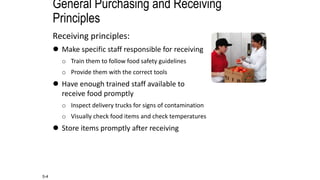
 Make specific staff responsible for receiving
o Train them to follow food safety guidelines
o Provide them with the correct tools
 Have enough trained staff available to
receive food promptly
o Inspect delivery trucks for signs of contamination
o Visually check food items and check temperatures
 Store items promptly after receiving
5-4
General Purchasing and Receiving
Principles
•Key drop deliveries:
• Supplier is given after-hour access to the operation
to make deliveries
• Deliveries must meet the following criteria
• Be inspected upon arrival at the operation
• Be from an approved source
• Have been placed in the correct storage location to
maintain the required temperature
• Have been protected from contamination in storage
• Is NOT contaminated
• Is honestly presented
5-5
Receiving and Inspecting
•Rejecting deliveries:
• Separate rejected items from accepted items
• Tell the delivery person what is wrong with the item
• Get a signed adjustment or credit slip before giving
the rejected item to the delivery person
• Log the incident on the invoice or receiving document
5-6
Receiving and Inspecting
•Recalls:
• Identify the recalled food items
• Remove the item from inventory, and place it in a
secure and appropriate location
• Store the item separately from food, utensils,
equipment, linens, and single-use items
• Label the item in a way that will prevent it from being
placed back in inventory
• Inform staff not to use the product
• Refer to the vendor’s notification or recall notice to
determine what to do with the item
5-7
Receiving and Inspecting
5-8
Receiving and Inspecting
Checking the temperature of meat, poultry,
and fish:
 Insert the thermometer stem or probe into the
thickest part of the food (usually the center)
5-9
Receiving and Inspecting
Checking the temperature of ROP Food
(MAP, vacuum-packed, and sous vide food):
 Insert the thermometer stem or probe between
two packages
 As an alternative, fold packaging around the
thermometer stem or probe
5-10
Receiving and Inspecting
Checking the temperature of other
packaged food:
 Open the package and insert the
thermometer stem or probe into the food
•Temperature criteria for deliveries:
• Cold TCS food: Receive at 41˚F (5˚C) or
lower, unless otherwise specified
• Live shellfish: Receive oysters, mussels,
clams, and scallops at an air temperature
of 45˚F (7˚C) and an internal temperature
no greater than
50˚F (10˚C)
• Once received, the shellfish must be cooled
to 41˚F (5˚C) or lower in four hours
• Shucked shellfish: Receive at 45˚F
(7˚C)
or lower
• Cool the shellfish to 41˚F (5˚F) or lower in
four hours
5-11
Receiving and Inspecting
•Temperature criteria for deliveries:
• Shell eggs: Receive at an air temperature
of 45˚F (7˚C) or lower
• Milk: Receive at 45˚F (7˚C) or lower
• Cool the milk to 41˚F (5˚C) or lower in four hours
• Hot TCS food: Receive at 135˚F (57˚C) or
higher
• Frozen food: Receive frozen solid
5-12
Receiving and Inspecting
•Temperature criteria for deliveries:
• Reject frozen food if there is evidence
of thawing and refreezing
• Fluids or water stains in case bottoms or
on packaging
• Ice crystals or frozen liquids on the food
or packaging
5-13
Receiving and Inspecting
•Reject packaged items with:
• Tears, holes, or punctures in packaging; reject
cans with swollen ends, rust, or dents
• Bloating or leaking (ROP food)
• Broken cartons or seals
• Dirty and discolored packaging
• Leaks, dampness, or water stains
• Signs of pests or pest damage
• Expired use-by/expiration dates
• Evidence of tampering
5-14
Receiving and Inspecting
•Required documents:
• Shellfish must be received with
shellstock identification tags
• Tags indicate when and where the shellfish
were harvested
• Must be kept on file for 90 days from the date
the last shellfish was used from its delivery
container
5-15
Receiving and Inspecting
•Required documents:
• Fish that will be eaten raw or partially cooked
• Documentation must show the fish was correctly frozen before being received
• Keep documents for 90 days from the sale of the fish
• Farm raised fish
• Must have documentation stating the fish was raised to FDA standards
• Keep documents for 90 days from the sale of the fish
5-16
Receiving and Inspecting
•Assessing food quality:
• Appearance: Reject food that is moldy or
has an abnormal color
• Texture: Reject meat, fish, or poultry if
• It is slimy, sticky, or dry
• It has soft flesh that leaves an imprint when
touched
• Odor: Reject food with an abnormal or
unpleasant odor
5-17
Receiving and Inspecting
•Labeling food for use on-site:
• All items not in their original containers
must be labeled
• Food labels should include the common
name of the food or a statement that
clearly and accurately identifies it
• It is not necessary to label food if it
clearly will not be mistaken for another
item
5-18
Storage
•Labeling food packaged on-site for retail sale:
• Common name of the food or a statement clearly identifying
it
• Quantity of the food
• If the item contains two or more ingredients, list the
ingredients
and sub ingredients in descending order by weight
• List of artificial colors and flavors in the food, including
chemical preservatives
• Name and place of business of the manufacturer, packer,
or distributor
• Source of each major food allergen contained in the food
5-19
Storage
Date marking:
 Ready-to-eat TCS food must be
marked if held for longer than 24
hours
o Date mark must indicate when the food
must be sold, eaten, or thrown out
5-20
Storage
•Date marking:
• Ready-to-eat TCS food can be stored
for only seven days if it is held at 41˚F
(5˚C)
or lower
• The count begins on the day that the food
was prepared or a commercial container
was opened
• For example, potato salad prepared and
stored on October 1 would have a discard
date of October 7 on the label
• Some operations write the day or date the
food was prepared on the label. Others write
the use-by day or date on the label
•.
5-21
Storage
Date marking:
If:
 A commercially processed food has a use-by date that is less
than seven days from the date the container was opened
Then:
 The container should be marked with this use-by date
as long as the date is based on food safety
5-22
Storage
Date marking:
 When combining food in a dish with
different
use-by dates, the discard date of the dish
should be based on the earliest prepared
food
 Consider a shrimp and sausage jambalaya
prepared on December 4
o The shrimp has a use-by date of December 8
o The sausage has a use-by date of December 10
o The use-by date of the jambalaya is December
8
5-23
Storage
•Temperatures:
• Store TCS food at an internal
temperature
of 41˚F (5˚C) or lower or 135˚F (57˚C)
or higher
• Store frozen food at temperatures that
keep it frozen
• Make sure storage units have at least
one air temperature measuring
device. It must be accurate to +/- 3˚F
or +/- 1.5˚C
• Place the device in the warmest part
of refrigerated units, and the coldest
part of hot-holding units
5-24
Storage
•Temperatures:
• Do NOT overload coolers or freezers
• Prevents airflow
• Makes unit work harder
• Frequent opening of the cooler lets warm
air inside, which can affect food safety
• Use open shelving
• Lining shelving restricts circulation
• Monitor food temperatures regularly
• Randomly sample food temperatures
5-25
Storage
•Rotate food to use the oldest inventory first:
• One way to rotate products is to follow FIFO
1. Identify the food item’s use-by or expiration date
2. Store items with the earliest use-by or expiration dates
in front of items with later dates
3. Once shelved, use those items stored in front first
4. Throw out food that has passed its manufacturer’s
use-by or expiration date
5-26
Storage
•Preventing cross-contamination:
• Store all items in designated storage areas
• Store items away from walls and at least
six inches (15 centimeters) off the floor
• Store single-use items (e.g., sleeve of
single-use cups, single-use gloves) in
original packaging
5-27
Storage
•Preventing cross-contamination:
• Store food in containers intended for
food
• Use containers that are durable, leak
proof, and able to be sealed or
covered
• NEVER use empty food containers to
store chemicals; NEVER put food in
empty chemical containers
5-29
Storage
•Preventing cross-contamination:
• Keep all storage areas clean and dry
• Clean up spills and leaks immediately
• Clean dollies, carts, transporters, and
trays often
• Store food in containers that have
been cleaned and sanitized
• Store dirty linens in clean,
nonabsorbent containers or washable
laundry bags
5-30
Storage
5-31
Storage
Preventing cross-contamination:
 Wrap or cover food
 Store raw meat, poultry, and seafood
separately from ready-to-eat food
o If this is not possible, store ready-to-eat
food above raw meat, poultry, and
seafood
o This will prevent juices from raw food
from dripping onto ready-to-eat food
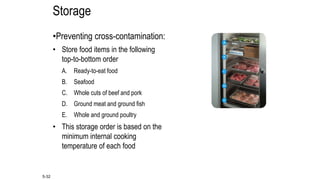
•Preventing cross-contamination:
• Store food items in the following
top-to-bottom order
A. Ready-to-eat food
B. Seafood
C. Whole cuts of beef and pork
D. Ground meat and ground fish
E. Whole and ground poultry
• This storage order is based on the
minimum internal cooking
temperature of each food
5-32
Storage
•Food should be stored in a clean, dry location away
from dust and other contaminants:
• To prevent contamination, NEVER store food in these areas
• Locker rooms or dressing rooms
• Restrooms or garbage rooms
• Mechanical rooms
• Under unshielded sewer lines or leaking water lines
• Under stairwells
5-33
Storage

ch 5.pptx

  • 2.
    •Objectives: • Purchase foodfrom approved, reputable suppliers • Use criteria to accept or reject food during receiving • Label and date food • Store food and nonfood items to prevent time- temperature abuse and contamination 5-2 The Flow of Food: Purchasing, Receiving, and Storage
  • 3.
    •Purchase food fromapproved, reputable suppliers: • Have been inspected • Meet all applicable local, state, and federal laws •Arrange deliveries so they arrive: • When staff has enough time to do inspections • When they can be correctly received 5-3 General Purchasing and Receiving Principles
  • 4.
    Receiving principles:  Makespecific staff responsible for receiving o Train them to follow food safety guidelines o Provide them with the correct tools  Have enough trained staff available to receive food promptly o Inspect delivery trucks for signs of contamination o Visually check food items and check temperatures  Store items promptly after receiving 5-4 General Purchasing and Receiving Principles
  • 5.
    •Key drop deliveries: •Supplier is given after-hour access to the operation to make deliveries • Deliveries must meet the following criteria • Be inspected upon arrival at the operation • Be from an approved source • Have been placed in the correct storage location to maintain the required temperature • Have been protected from contamination in storage • Is NOT contaminated • Is honestly presented 5-5 Receiving and Inspecting
  • 6.
    •Rejecting deliveries: • Separaterejected items from accepted items • Tell the delivery person what is wrong with the item • Get a signed adjustment or credit slip before giving the rejected item to the delivery person • Log the incident on the invoice or receiving document 5-6 Receiving and Inspecting
  • 7.
    •Recalls: • Identify therecalled food items • Remove the item from inventory, and place it in a secure and appropriate location • Store the item separately from food, utensils, equipment, linens, and single-use items • Label the item in a way that will prevent it from being placed back in inventory • Inform staff not to use the product • Refer to the vendor’s notification or recall notice to determine what to do with the item 5-7 Receiving and Inspecting
  • 8.
    5-8 Receiving and Inspecting Checkingthe temperature of meat, poultry, and fish:  Insert the thermometer stem or probe into the thickest part of the food (usually the center)
  • 9.
    5-9 Receiving and Inspecting Checkingthe temperature of ROP Food (MAP, vacuum-packed, and sous vide food):  Insert the thermometer stem or probe between two packages  As an alternative, fold packaging around the thermometer stem or probe
  • 10.
    5-10 Receiving and Inspecting Checkingthe temperature of other packaged food:  Open the package and insert the thermometer stem or probe into the food
  • 11.
    •Temperature criteria fordeliveries: • Cold TCS food: Receive at 41˚F (5˚C) or lower, unless otherwise specified • Live shellfish: Receive oysters, mussels, clams, and scallops at an air temperature of 45˚F (7˚C) and an internal temperature no greater than 50˚F (10˚C) • Once received, the shellfish must be cooled to 41˚F (5˚C) or lower in four hours • Shucked shellfish: Receive at 45˚F (7˚C) or lower • Cool the shellfish to 41˚F (5˚F) or lower in four hours 5-11 Receiving and Inspecting
  • 12.
    •Temperature criteria fordeliveries: • Shell eggs: Receive at an air temperature of 45˚F (7˚C) or lower • Milk: Receive at 45˚F (7˚C) or lower • Cool the milk to 41˚F (5˚C) or lower in four hours • Hot TCS food: Receive at 135˚F (57˚C) or higher • Frozen food: Receive frozen solid 5-12 Receiving and Inspecting
  • 13.
    •Temperature criteria fordeliveries: • Reject frozen food if there is evidence of thawing and refreezing • Fluids or water stains in case bottoms or on packaging • Ice crystals or frozen liquids on the food or packaging 5-13 Receiving and Inspecting
  • 14.
    •Reject packaged itemswith: • Tears, holes, or punctures in packaging; reject cans with swollen ends, rust, or dents • Bloating or leaking (ROP food) • Broken cartons or seals • Dirty and discolored packaging • Leaks, dampness, or water stains • Signs of pests or pest damage • Expired use-by/expiration dates • Evidence of tampering 5-14 Receiving and Inspecting
  • 15.
    •Required documents: • Shellfishmust be received with shellstock identification tags • Tags indicate when and where the shellfish were harvested • Must be kept on file for 90 days from the date the last shellfish was used from its delivery container 5-15 Receiving and Inspecting
  • 16.
    •Required documents: • Fishthat will be eaten raw or partially cooked • Documentation must show the fish was correctly frozen before being received • Keep documents for 90 days from the sale of the fish • Farm raised fish • Must have documentation stating the fish was raised to FDA standards • Keep documents for 90 days from the sale of the fish 5-16 Receiving and Inspecting
  • 17.
    •Assessing food quality: •Appearance: Reject food that is moldy or has an abnormal color • Texture: Reject meat, fish, or poultry if • It is slimy, sticky, or dry • It has soft flesh that leaves an imprint when touched • Odor: Reject food with an abnormal or unpleasant odor 5-17 Receiving and Inspecting
  • 18.
    •Labeling food foruse on-site: • All items not in their original containers must be labeled • Food labels should include the common name of the food or a statement that clearly and accurately identifies it • It is not necessary to label food if it clearly will not be mistaken for another item 5-18 Storage
  • 19.
    •Labeling food packagedon-site for retail sale: • Common name of the food or a statement clearly identifying it • Quantity of the food • If the item contains two or more ingredients, list the ingredients and sub ingredients in descending order by weight • List of artificial colors and flavors in the food, including chemical preservatives • Name and place of business of the manufacturer, packer, or distributor • Source of each major food allergen contained in the food 5-19 Storage
  • 20.
    Date marking:  Ready-to-eatTCS food must be marked if held for longer than 24 hours o Date mark must indicate when the food must be sold, eaten, or thrown out 5-20 Storage
  • 21.
    •Date marking: • Ready-to-eatTCS food can be stored for only seven days if it is held at 41˚F (5˚C) or lower • The count begins on the day that the food was prepared or a commercial container was opened • For example, potato salad prepared and stored on October 1 would have a discard date of October 7 on the label • Some operations write the day or date the food was prepared on the label. Others write the use-by day or date on the label •. 5-21 Storage
  • 22.
    Date marking: If:  Acommercially processed food has a use-by date that is less than seven days from the date the container was opened Then:  The container should be marked with this use-by date as long as the date is based on food safety 5-22 Storage
  • 23.
    Date marking:  Whencombining food in a dish with different use-by dates, the discard date of the dish should be based on the earliest prepared food  Consider a shrimp and sausage jambalaya prepared on December 4 o The shrimp has a use-by date of December 8 o The sausage has a use-by date of December 10 o The use-by date of the jambalaya is December 8 5-23 Storage
  • 24.
    •Temperatures: • Store TCSfood at an internal temperature of 41˚F (5˚C) or lower or 135˚F (57˚C) or higher • Store frozen food at temperatures that keep it frozen • Make sure storage units have at least one air temperature measuring device. It must be accurate to +/- 3˚F or +/- 1.5˚C • Place the device in the warmest part of refrigerated units, and the coldest part of hot-holding units 5-24 Storage
  • 25.
    •Temperatures: • Do NOToverload coolers or freezers • Prevents airflow • Makes unit work harder • Frequent opening of the cooler lets warm air inside, which can affect food safety • Use open shelving • Lining shelving restricts circulation • Monitor food temperatures regularly • Randomly sample food temperatures 5-25 Storage
  • 26.
    •Rotate food touse the oldest inventory first: • One way to rotate products is to follow FIFO 1. Identify the food item’s use-by or expiration date 2. Store items with the earliest use-by or expiration dates in front of items with later dates 3. Once shelved, use those items stored in front first 4. Throw out food that has passed its manufacturer’s use-by or expiration date 5-26 Storage
  • 27.
    •Preventing cross-contamination: • Storeall items in designated storage areas • Store items away from walls and at least six inches (15 centimeters) off the floor • Store single-use items (e.g., sleeve of single-use cups, single-use gloves) in original packaging 5-27 Storage
  • 28.
    •Preventing cross-contamination: • Storefood in containers intended for food • Use containers that are durable, leak proof, and able to be sealed or covered • NEVER use empty food containers to store chemicals; NEVER put food in empty chemical containers 5-29 Storage
  • 29.
    •Preventing cross-contamination: • Keepall storage areas clean and dry • Clean up spills and leaks immediately • Clean dollies, carts, transporters, and trays often • Store food in containers that have been cleaned and sanitized • Store dirty linens in clean, nonabsorbent containers or washable laundry bags 5-30 Storage
  • 30.
    5-31 Storage Preventing cross-contamination:  Wrapor cover food  Store raw meat, poultry, and seafood separately from ready-to-eat food o If this is not possible, store ready-to-eat food above raw meat, poultry, and seafood o This will prevent juices from raw food from dripping onto ready-to-eat food
  • 31.
    •Preventing cross-contamination: • Storefood items in the following top-to-bottom order A. Ready-to-eat food B. Seafood C. Whole cuts of beef and pork D. Ground meat and ground fish E. Whole and ground poultry • This storage order is based on the minimum internal cooking temperature of each food 5-32 Storage
  • 32.
    •Food should bestored in a clean, dry location away from dust and other contaminants: • To prevent contamination, NEVER store food in these areas • Locker rooms or dressing rooms • Restrooms or garbage rooms • Mechanical rooms • Under unshielded sewer lines or leaking water lines • Under stairwells 5-33 Storage