Chapter: 6
SOLIDS
Naveed Mallana
Introduction
6.3
1.Anisotropy
2. Isomorphism
3. Polymorphism
4.Allotropy
5. Transition Temperature
6.4 Crystal Lattice
6.4.1 Unit Cell & Shape of NaCl
6.5.2 Lattice energy
6.5 Types of Crystalline Solids
6.5.1 Ionic Solids
6.5.2 Covalent Solids
6.5.5 Molecular and metallic Solids
ReducedSyllabusfor2021
Solids have definite
shape
Strong inter-
molecular forces
between the
molecules
Little affected by
temperature and
pressure
Solids which have
complete regular
atomic and
molecular structure
are called crystals
IntroductionofSolids
6 . 3 : P r o p e r t i e s o f C r y s t a l l i n e S o l i d s
Transition
Temperature
Allotropy:
Polymorphism:
Isomorphism:
Anisotropy:
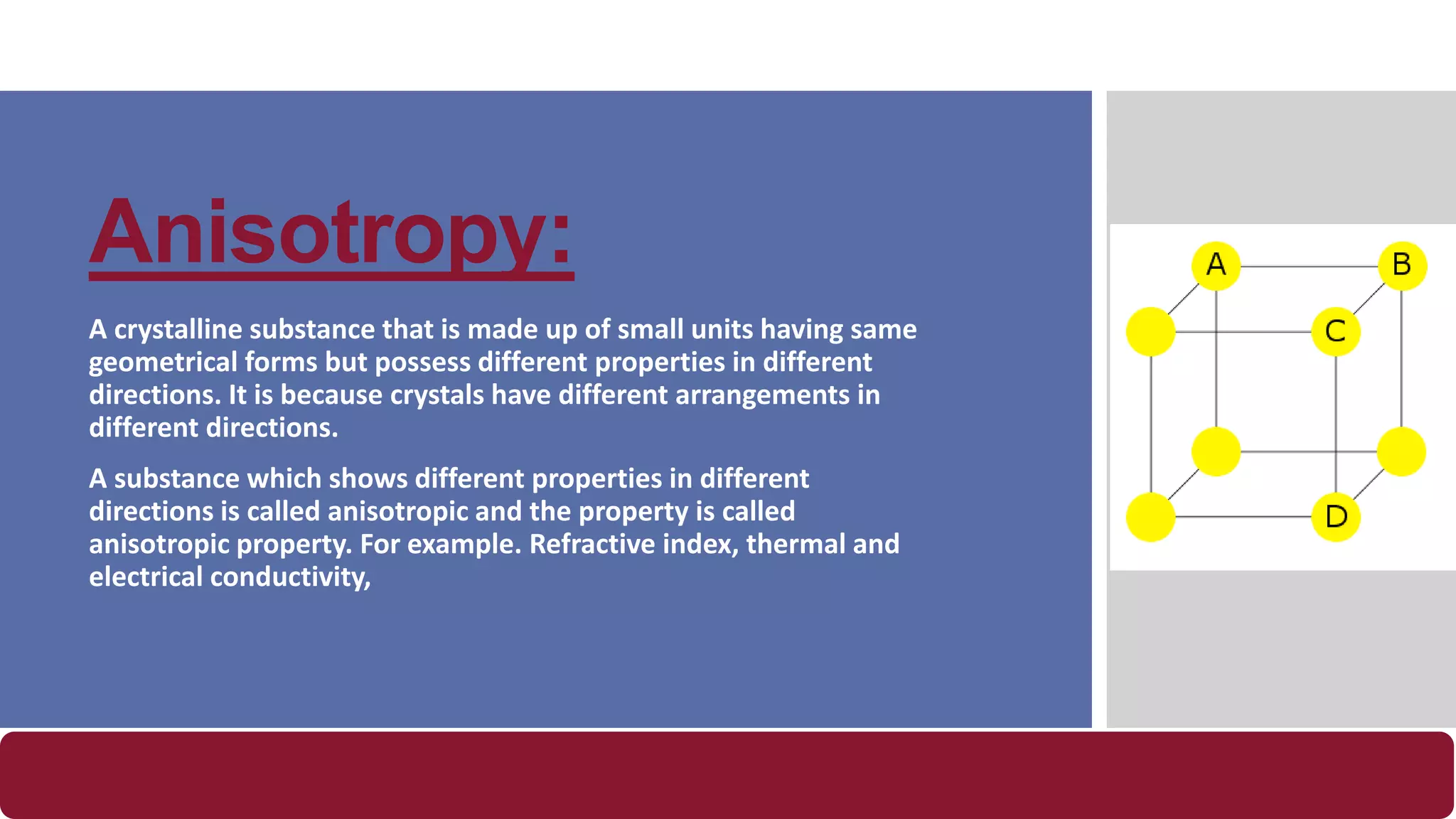
Anisotropy:
A crystalline substance that is made up of small units having same
geometrical forms but possess different properties in different
directions. It is because crystals have different arrangements in
different directions.
A substance which shows different properties in different
directions is called anisotropic and the property is called
anisotropic property. For example. Refractive index, thermal and
electrical conductivity,
Isomorphism:
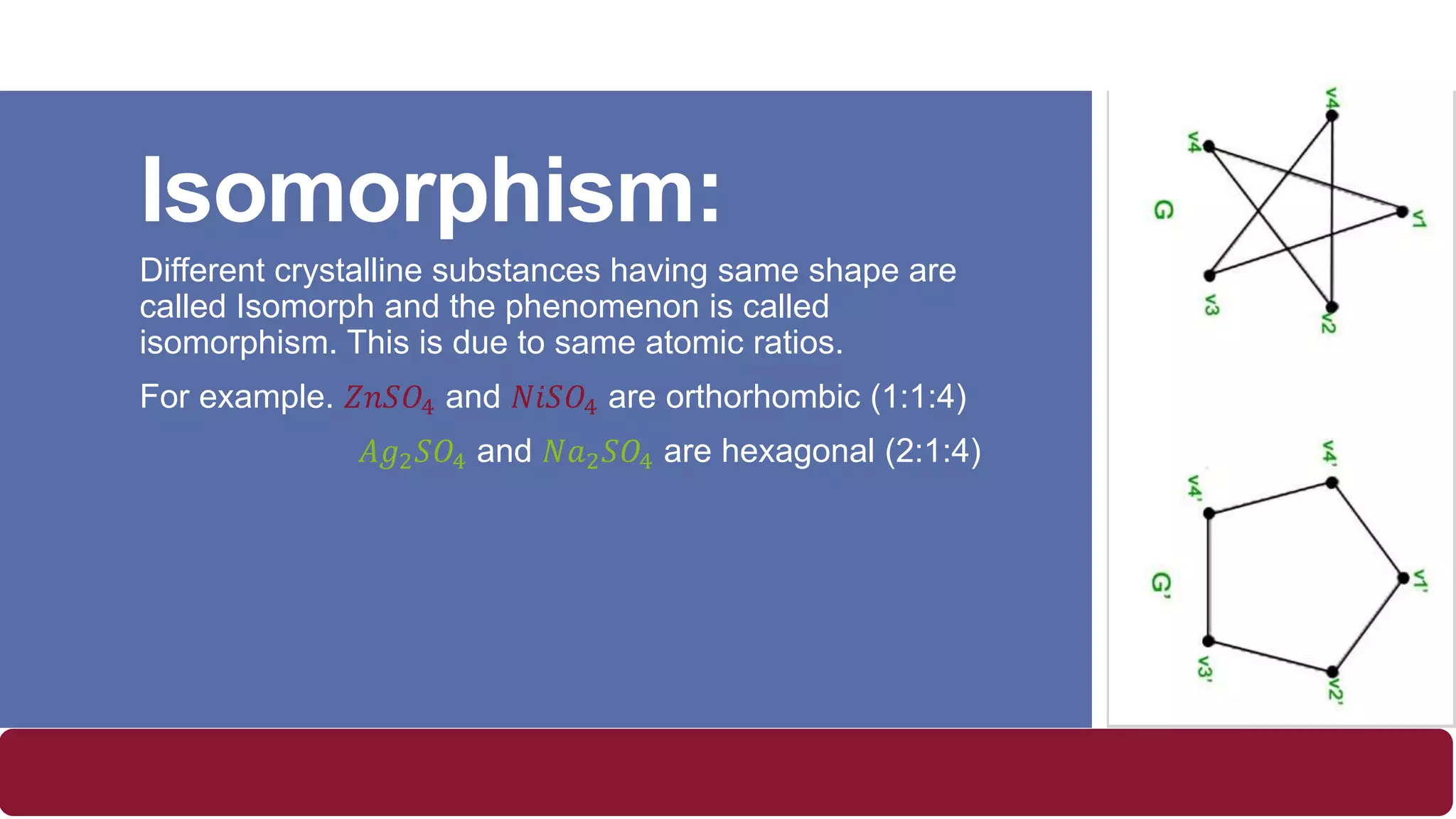
Different crystalline substances having same shape are
called Isomorph and the phenomenon is called
isomorphism. This is due to same atomic ratios.
For example. 𝑍𝑛𝑆𝑂4 and 𝑁𝑖𝑆𝑂4 are orthorhombic (1:1:4)
𝐴𝑔2 𝑆𝑂4 and 𝑁𝑎2 𝑆𝑂4 are hexagonal (2:1:4)
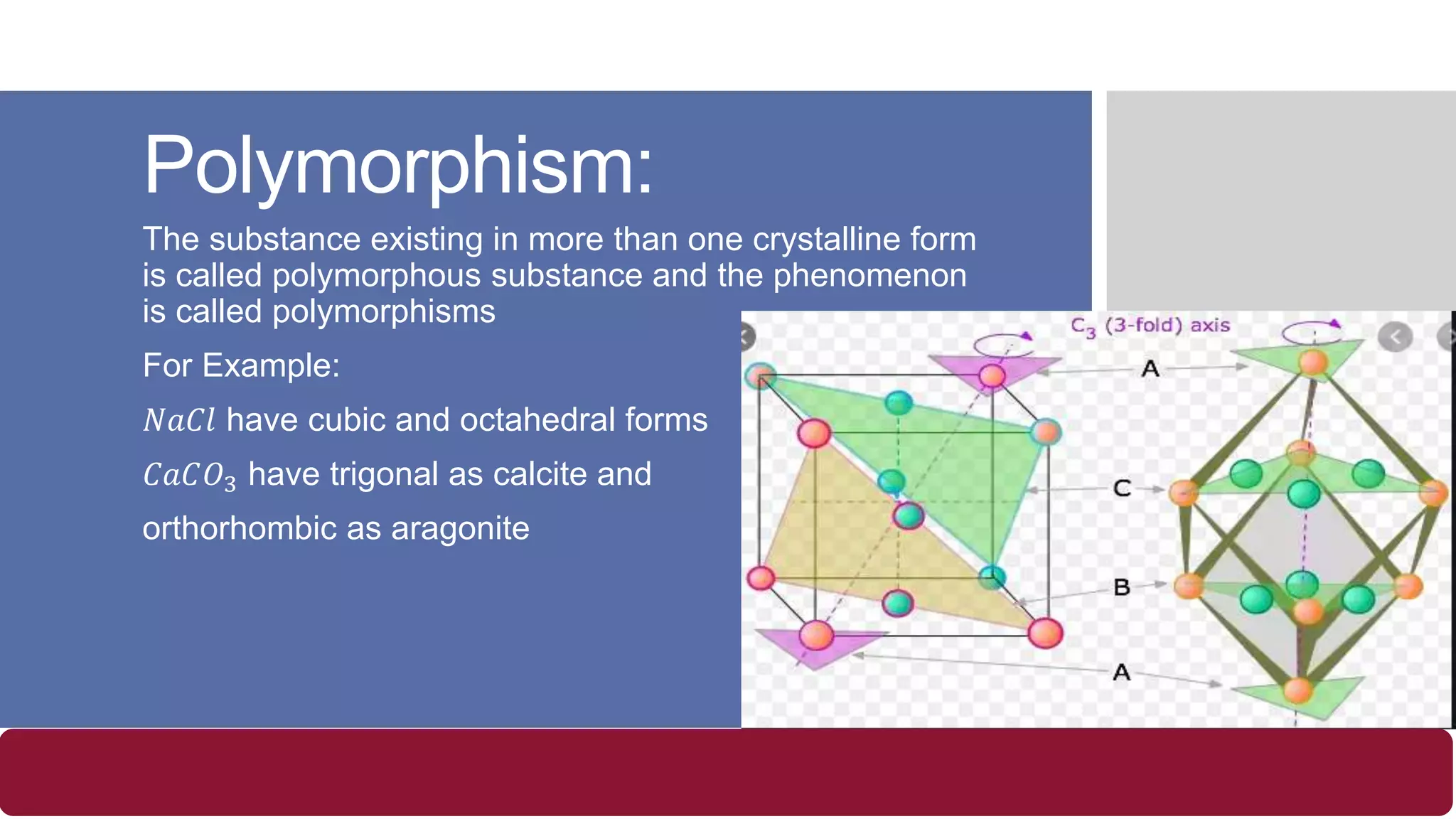
Polymorphism:
The substance existing in more than one crystalline form
is called polymorphous substance and the phenomenon
is called polymorphisms
For Example:
𝑁𝑎𝐶𝑙 have cubic and octahedral forms
𝐶𝑎𝐶𝑂3 have trigonal as calcite and
orthorhombic as aragonite
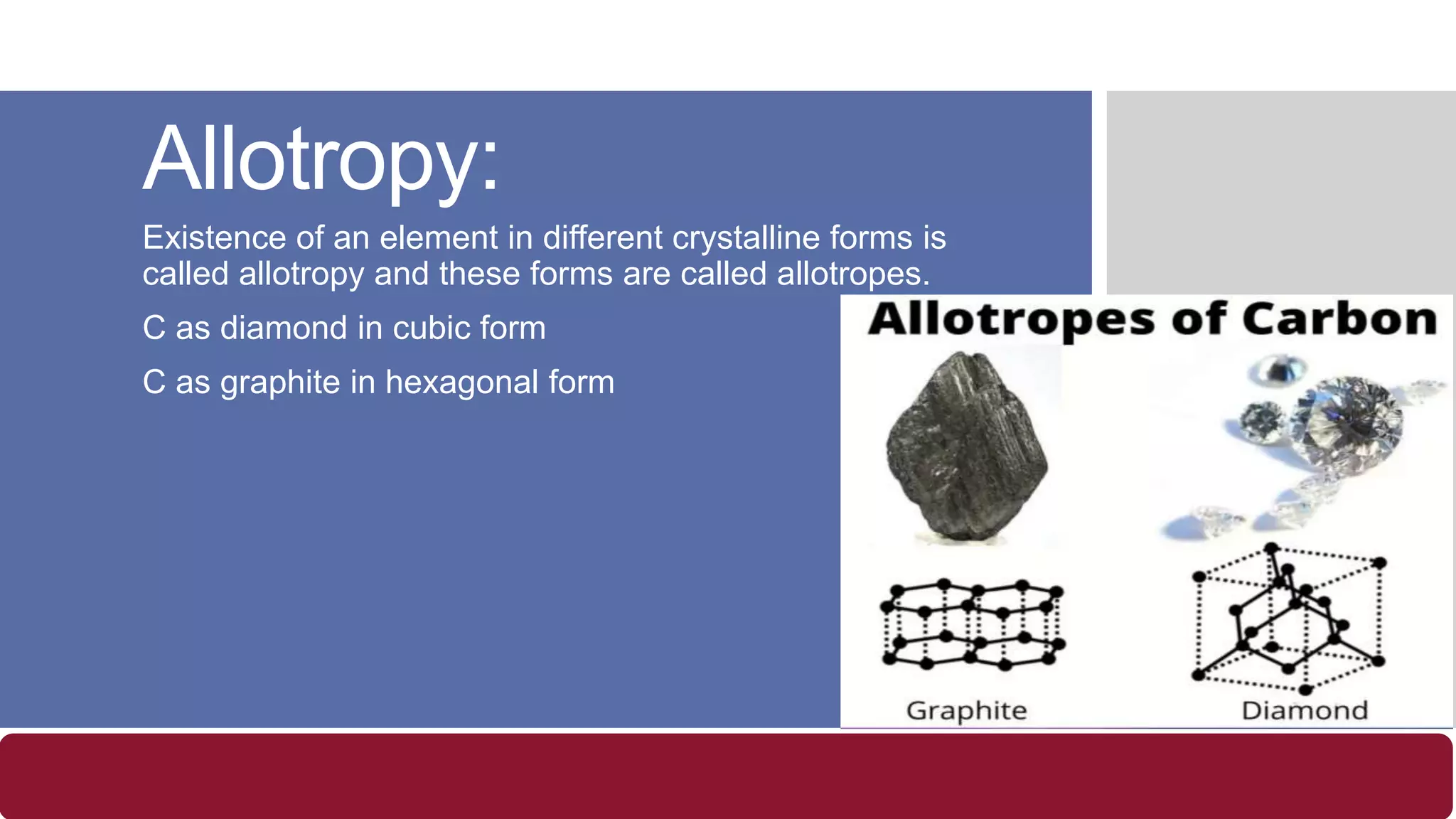
Allotropy:
Existence of an element in different crystalline forms is
called allotropy and these forms are called allotropes.
C as diamond in cubic form
C as graphite in hexagonal form
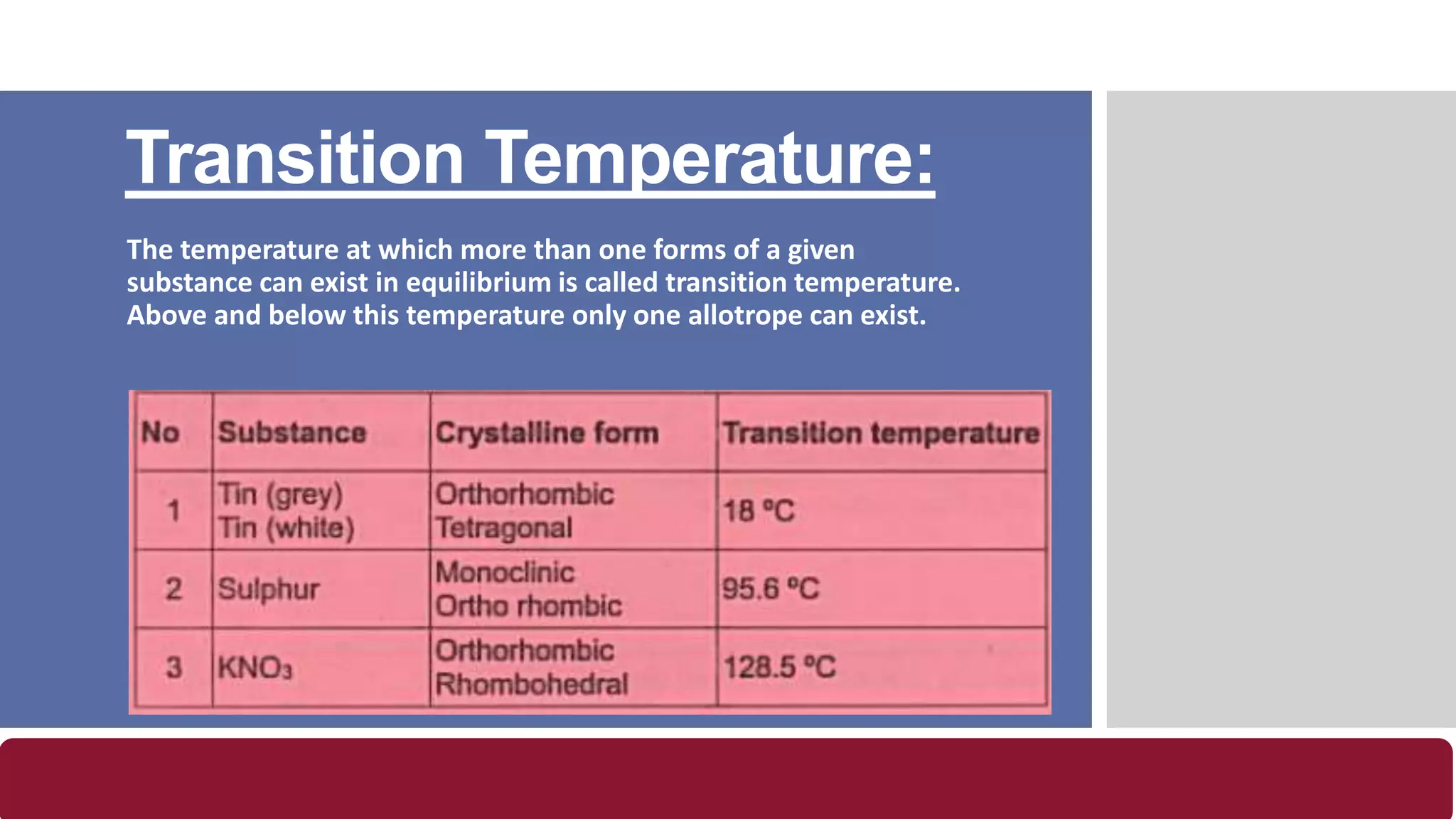
Transition Temperature:
The temperature at which more than one forms of a given
substance can exist in equilibrium is called transition temperature.
Above and below this temperature only one allotrope can exist.
Crystal:
A solid having special
geometric shape in which
atoms, molecules, or ions
have a characteristic,
regular and three
dimensional arrangement
is called crystalline solid or
simply a crystal.
6 . 4 : C r y s t a l L a t t i c e
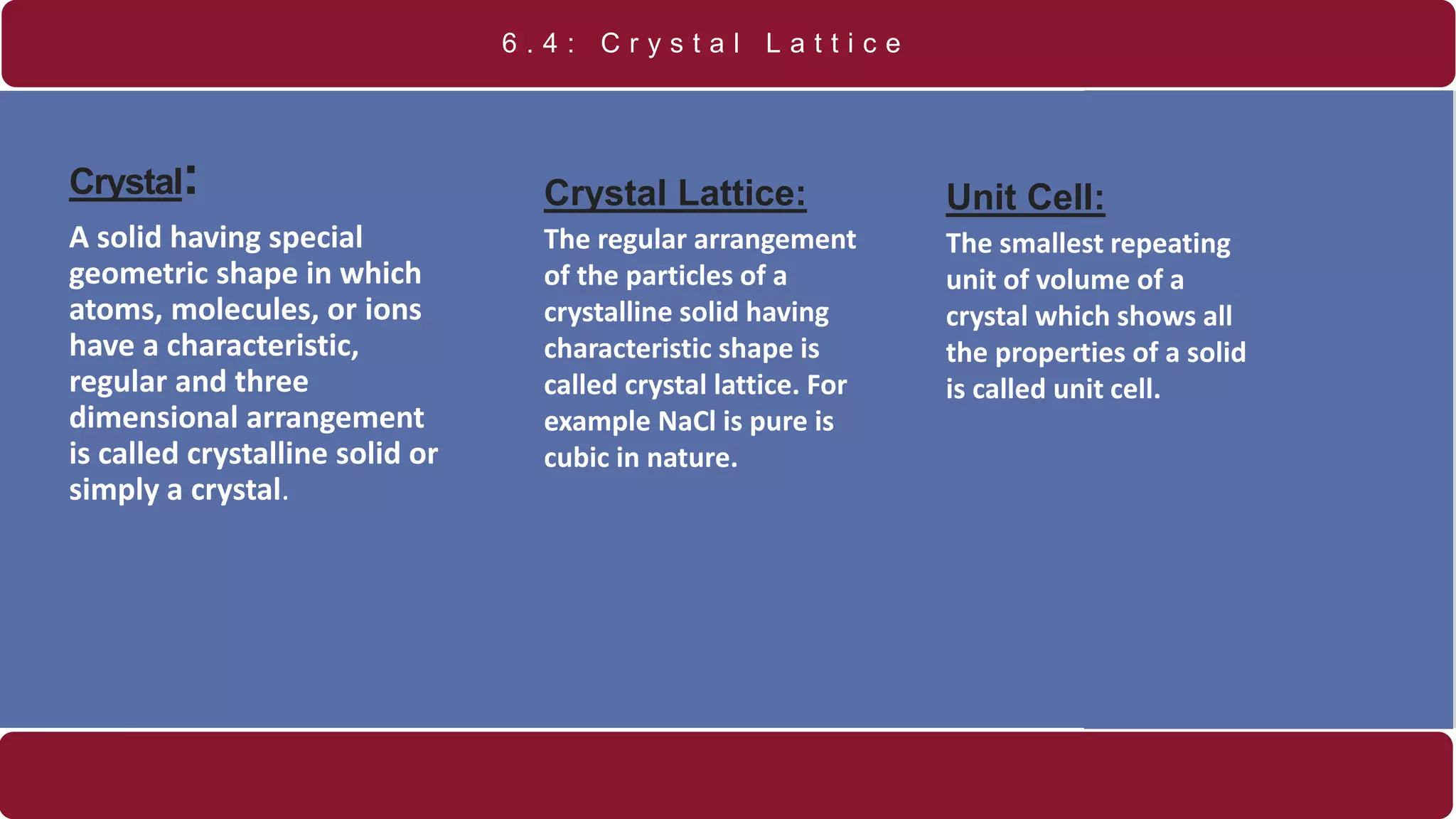
Crystal Lattice:
The regular arrangement
of the particles of a
crystalline solid having
characteristic shape is
called crystal lattice. For
example NaCl is pure is
cubic in nature.
Unit Cell:
The smallest repeating
unit of volume of a
crystal which shows all
the properties of a solid
is called unit cell.
6 . 4 . 1 : U n i t C e l l a n d S h a p e o f N a C l
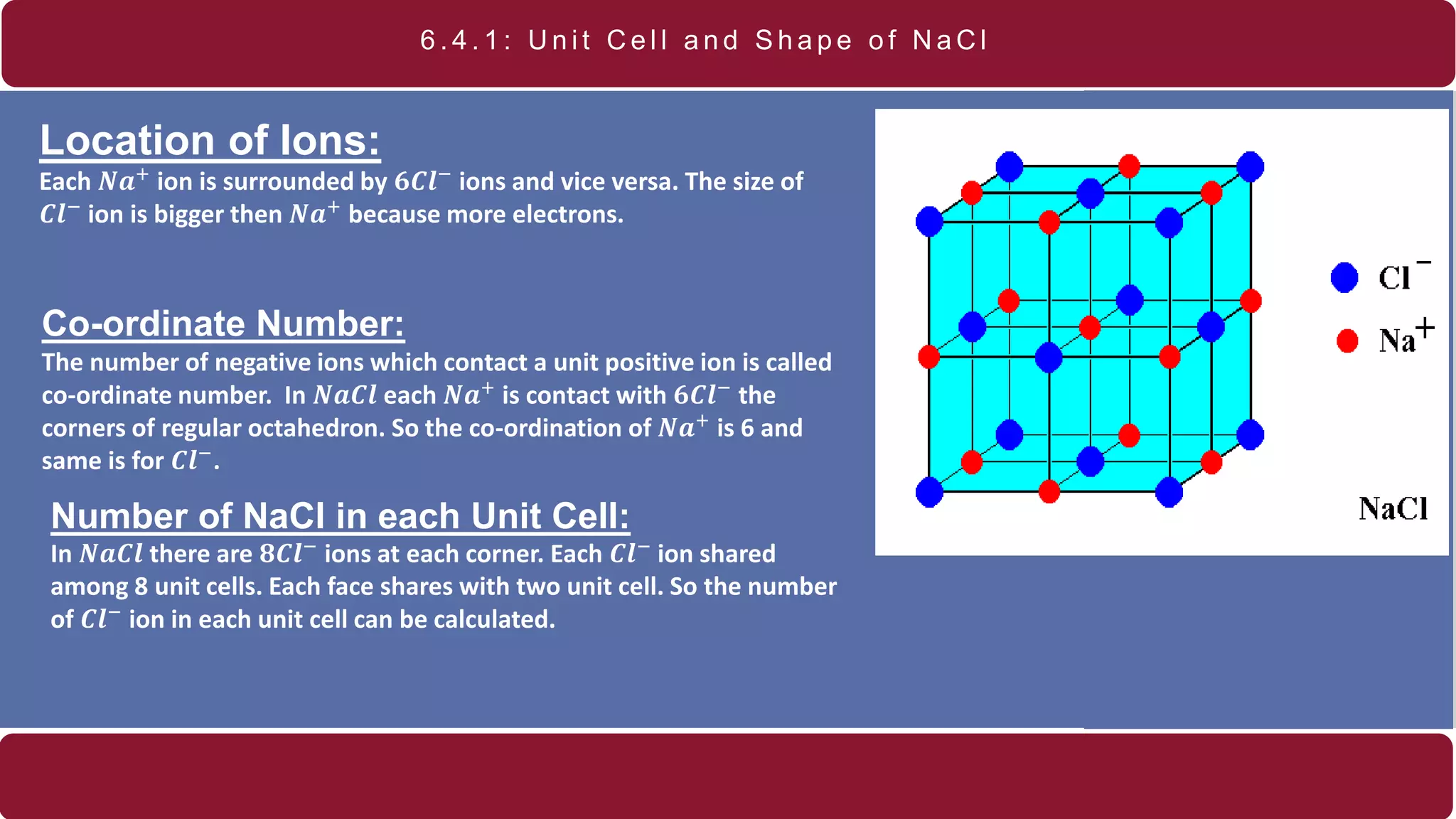
Location of Ions:
Each 𝑵𝒂+ ion is surrounded by 𝟔𝑪𝒍− ions and vice versa. The size of
𝑪𝒍−
ion is bigger then 𝑵𝒂+
because more electrons.
Co-ordinate Number:
The number of negative ions which contact a unit positive ion is called
co-ordinate number. In 𝑵𝒂𝑪𝒍 each 𝑵𝒂+
is contact with 𝟔𝑪𝒍−
the
corners of regular octahedron. So the co-ordination of 𝑵𝒂+ is 6 and
same is for 𝑪𝒍−
.
Number of NaCl in each Unit Cell:
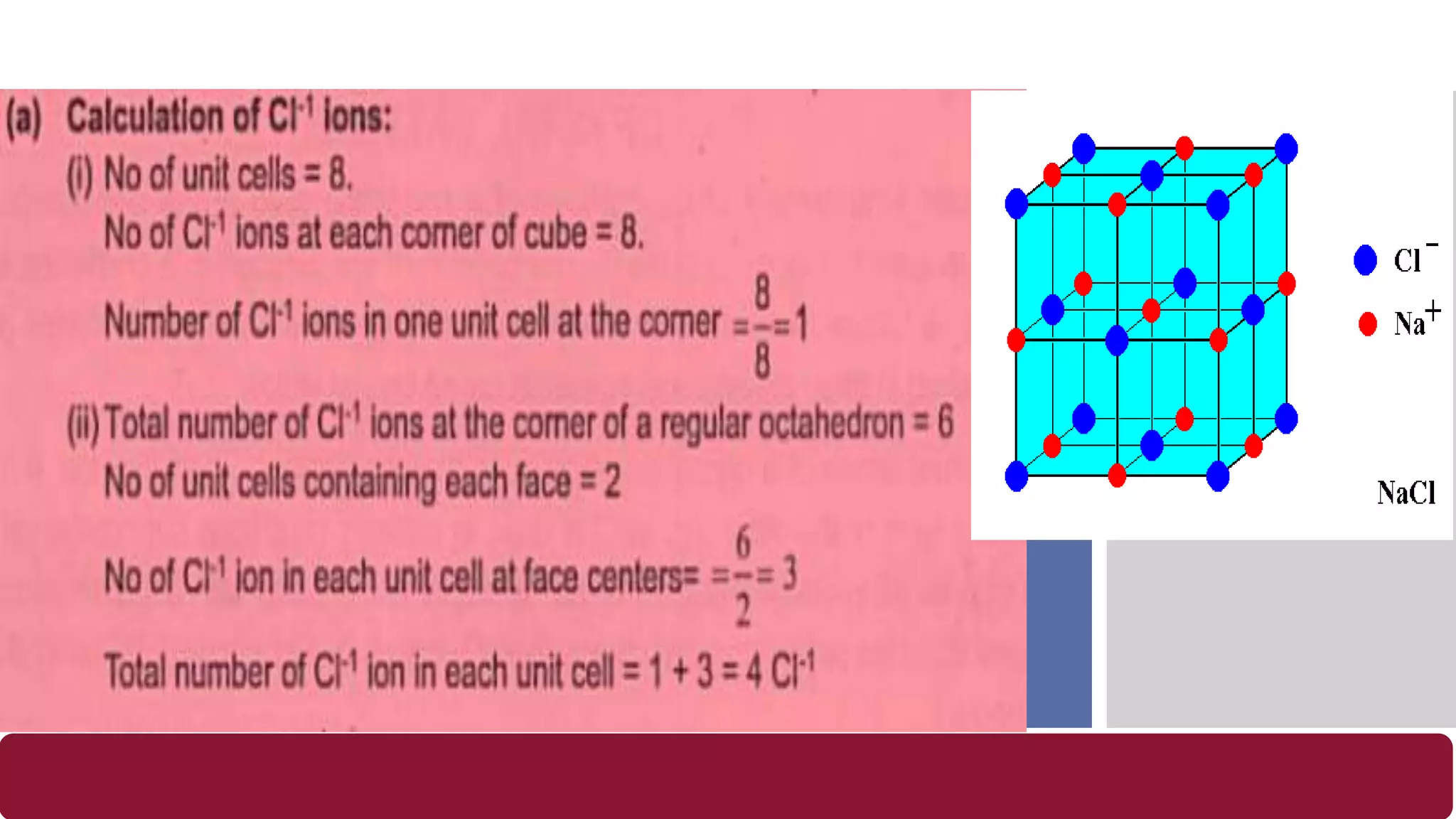
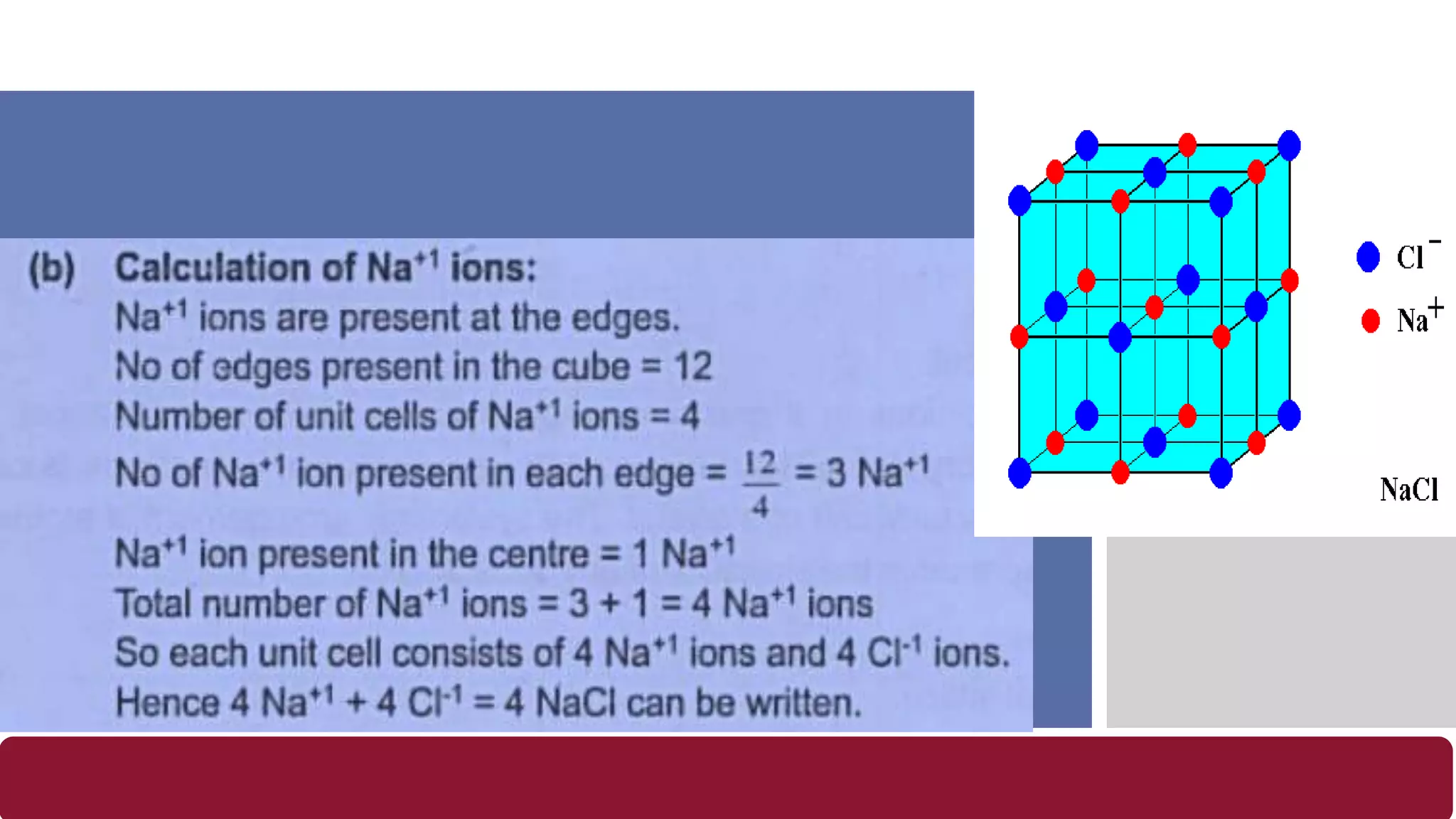
In 𝑵𝒂𝑪𝒍 there are 𝟖𝑪𝒍− ions at each corner. Each 𝑪𝒍− ion shared
among 8 unit cells. Each face shares with two unit cell. So the number
of 𝑪𝒍−
ion in each unit cell can be calculated.
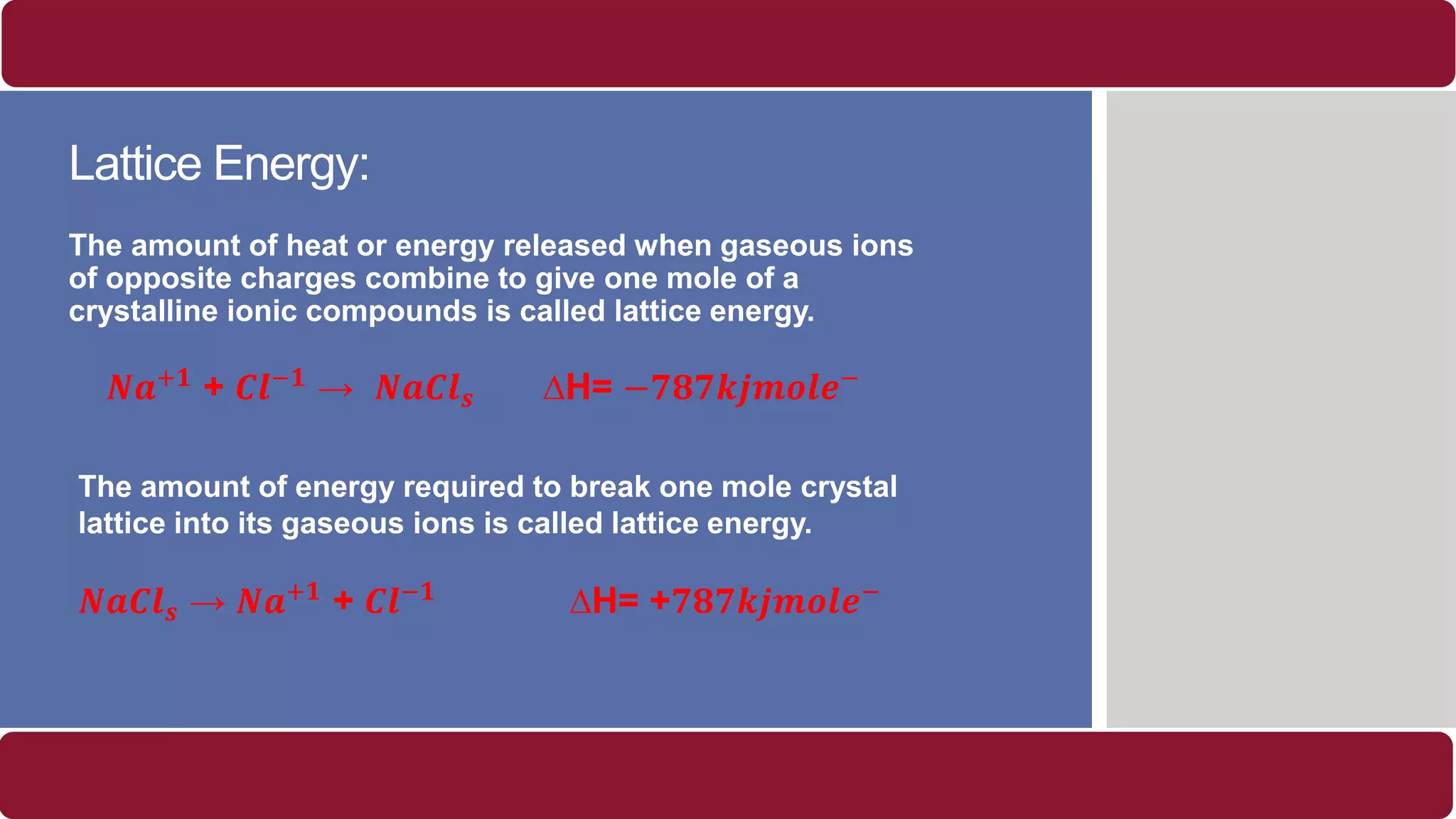
Lattice Energy:
The amount of heat or energy released when gaseous ions
of opposite charges combine to give one mole of a
crystalline ionic compounds is called lattice energy.
𝑵𝒂+𝟏 + 𝑪𝒍−𝟏 → 𝑵𝒂𝑪𝒍 𝒔 ∆H= −𝟕𝟖𝟕𝒌𝒋𝒎𝒐𝒍𝒆−
The amount of energy required to break one mole crystal
lattice into its gaseous ions is called lattice energy.
𝑵𝒂𝑪𝒍 𝒔 → 𝑵𝒂+𝟏 + 𝑪𝒍−𝟏 ∆H= +𝟕𝟖𝟕𝒌𝒋𝒎𝒐𝒍𝒆−
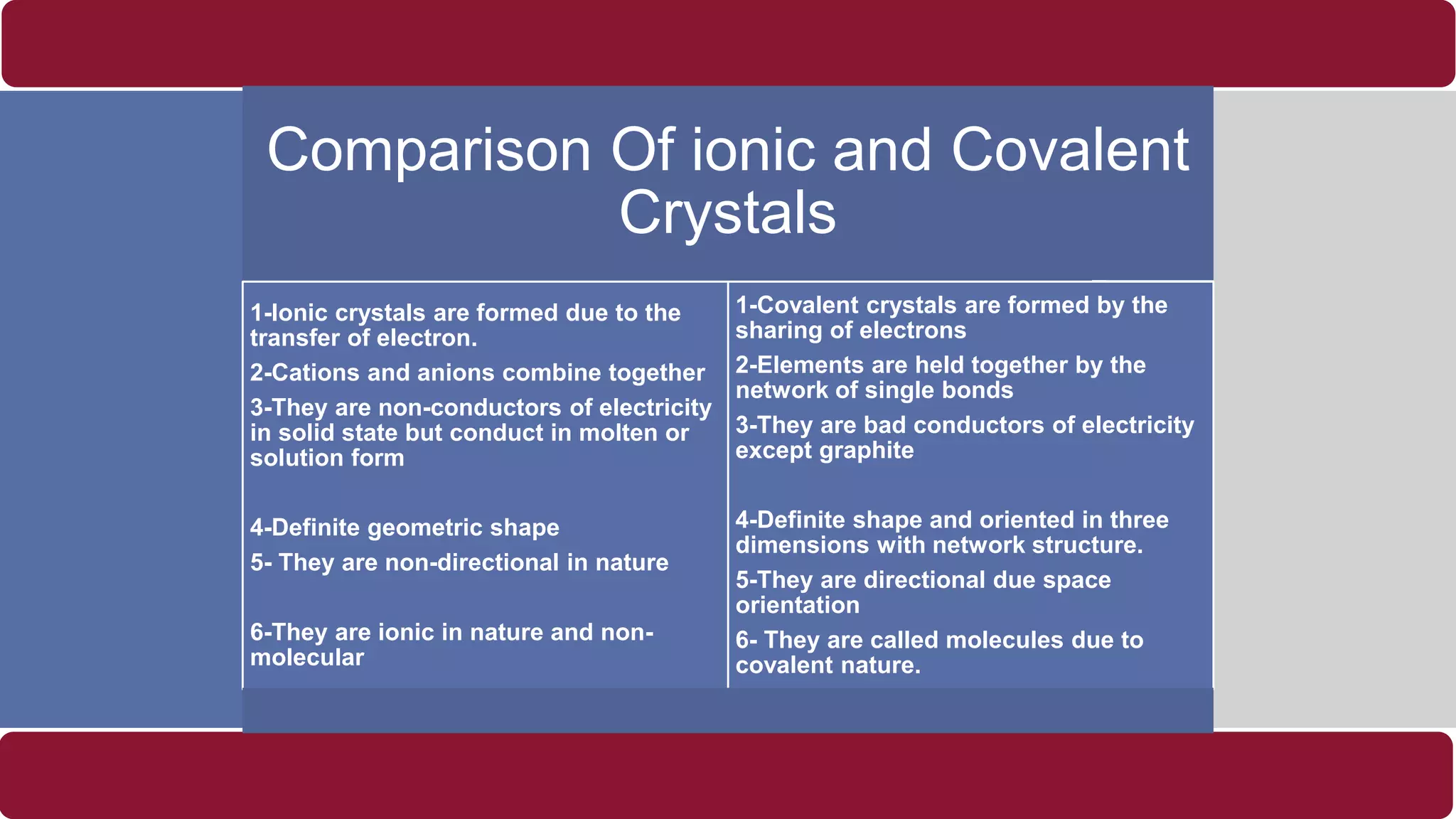
Comparison Of ionic and Covalent
Crystals
1-Ionic crystals are formed due to the
transfer of electron.
2-Cations and anions combine together
3-They are non-conductors of electricity
in solid state but conduct in molten or
solution form
4-Definite geometric shape
5- They are non-directional in nature
6-They are ionic in nature and non-
molecular
1-Covalent crystals are formed by the
sharing of electrons
2-Elements are held together by the
network of single bonds
3-They are bad conductors of electricity
except graphite
4-Definite shape and oriented in three
dimensions with network structure.
5-They are directional due space
orientation
6- They are called molecules due to
covalent nature.
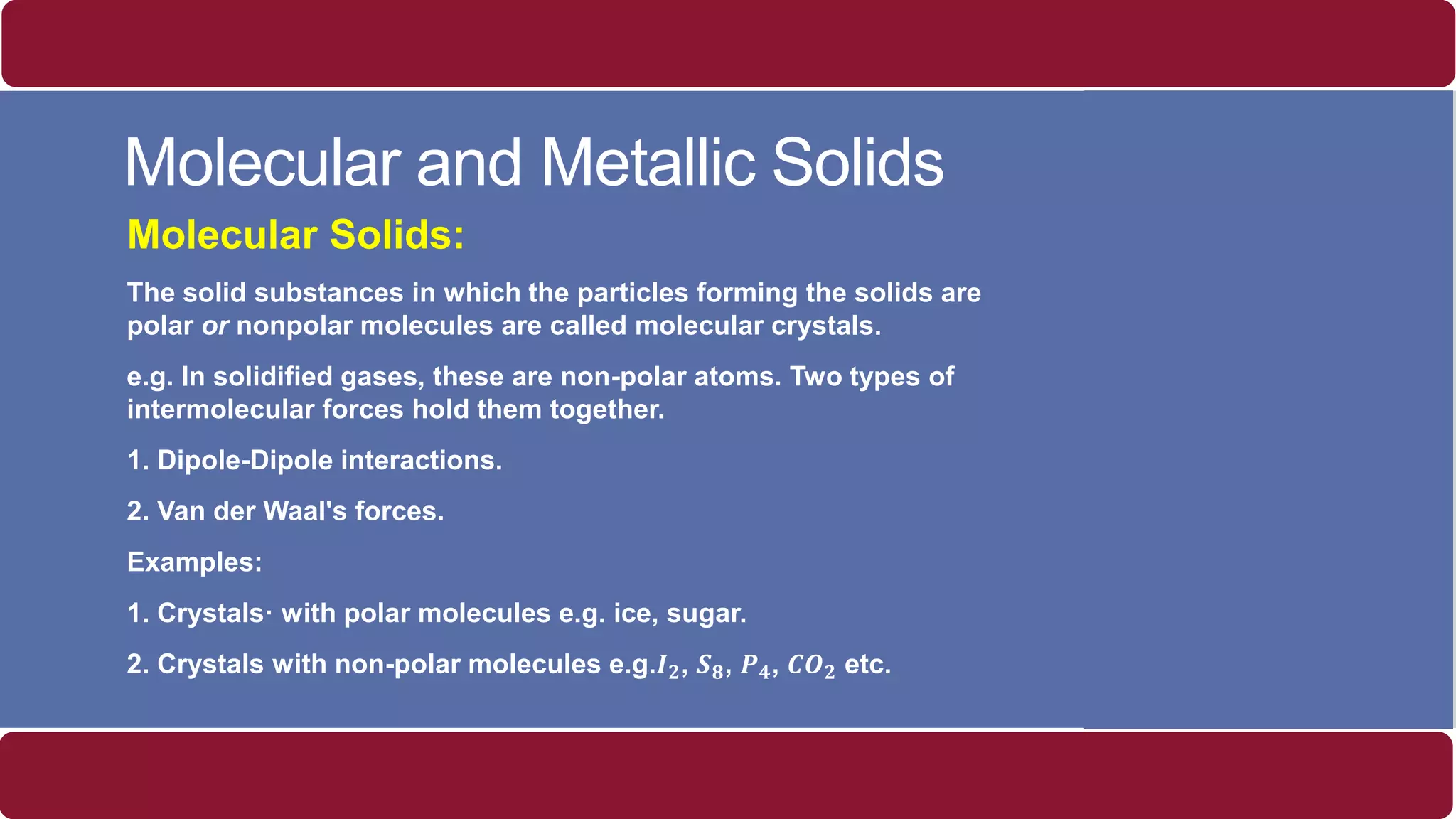
Molecular and Metallic Solids
Molecular Solids:
The solid substances in which the particles forming the solids are
polar or nonpolar molecules are called molecular crystals.
e.g. In solidified gases, these are non-polar atoms. Two types of
intermolecular forces hold them together.
1. Dipole-Dipole interactions.
2. Van der Waal's forces.
Examples:
1. Crystals· with polar molecules e.g. ice, sugar.
2. Crystals with non-polar molecules e.g.𝑰 𝟐, 𝑺 𝟖, 𝑷 𝟒, 𝑪𝑶 𝟐 etc.
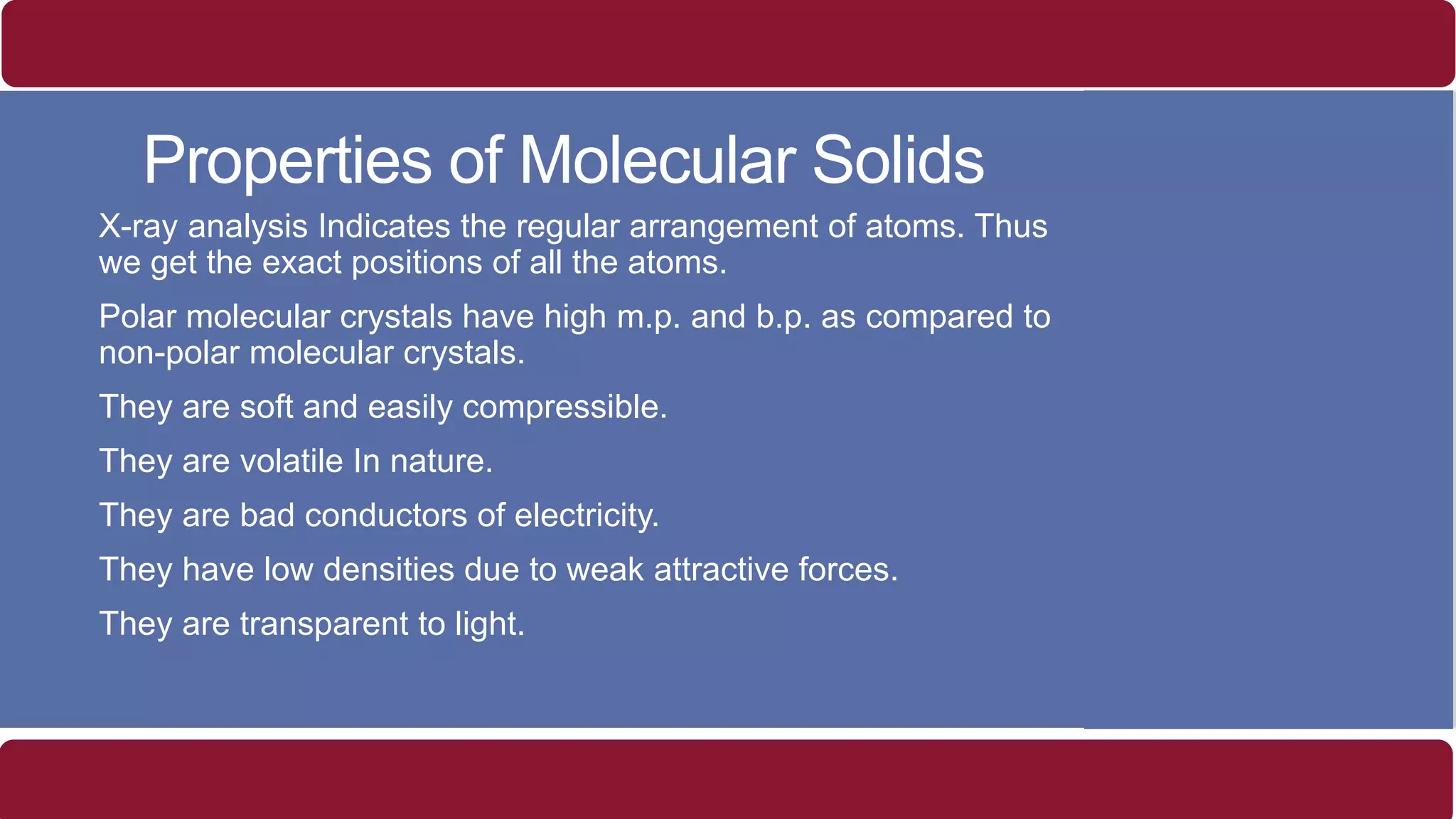
Properties of Molecular Solids
o X-ray analysis Indicates the regular arrangement of atoms. Thus
we get the exact positions of all the atoms.
o Polar molecular crystals have high m.p. and b.p. as compared to
non-polar molecular crystals.
o They are soft and easily compressible.
o They are volatile In nature.
o They are bad conductors of electricity.
o They have low densities due to weak attractive forces.
o They are transparent to light.
Metallic SolidsThe crystalline solids in which metal atoms are held together by metallic
bonds are known as metallic solid e.g. Na, Cu etc.
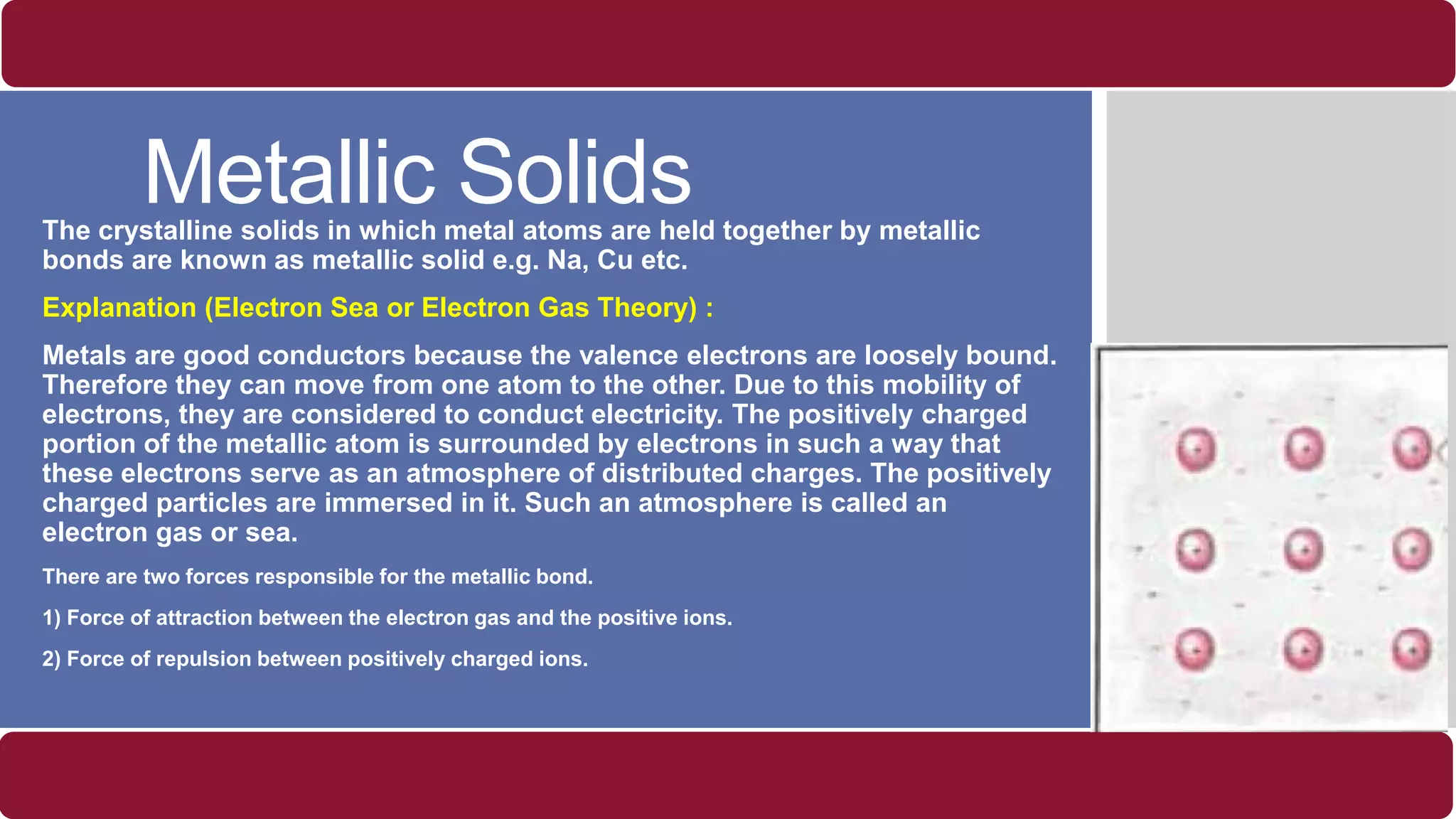
Explanation (Electron Sea or Electron Gas Theory) :
Metals are good conductors because the valence electrons are loosely bound.
Therefore they can move from one atom to the other. Due to this mobility of
electrons, they are considered to conduct electricity. The positively charged
portion of the metallic atom is surrounded by electrons in such a way that
these electrons serve as an atmosphere of distributed charges. The positively
charged particles are immersed in it. Such an atmosphere is called an
electron gas or sea.
There are two forces responsible for the metallic bond.
1) Force of attraction between the electron gas and the positive ions.
2) Force of repulsion between positively charged ions.
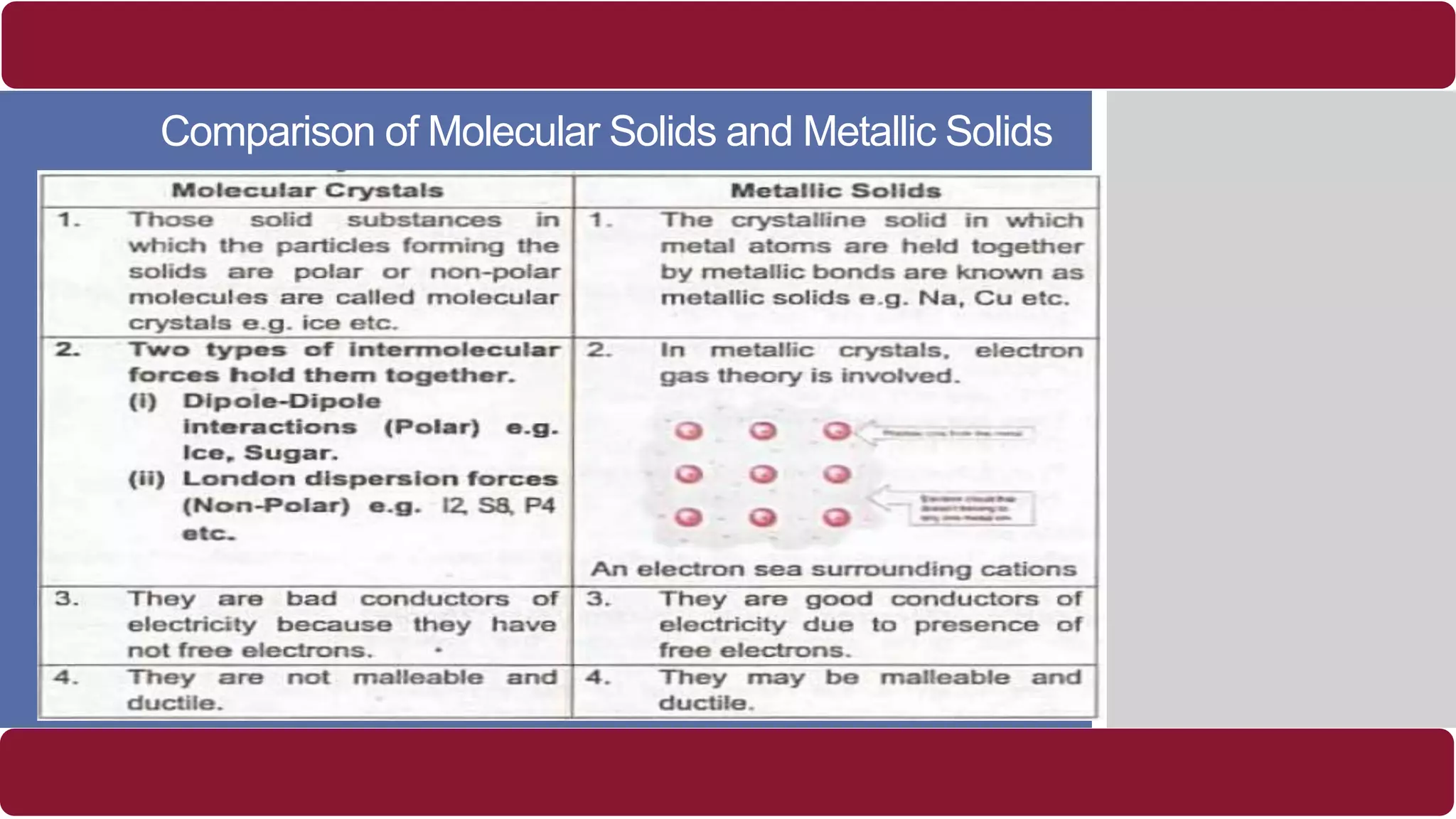
Comparison of Molecular Solids and Metallic Solids

Chapter 6 solids

  • 1.
  • 2.
    Introduction 6.3 1.Anisotropy 2. Isomorphism 3. Polymorphism 4.Allotropy 5.Transition Temperature 6.4 Crystal Lattice 6.4.1 Unit Cell & Shape of NaCl 6.5.2 Lattice energy 6.5 Types of Crystalline Solids 6.5.1 Ionic Solids 6.5.2 Covalent Solids 6.5.5 Molecular and metallic Solids ReducedSyllabusfor2021
  • 3.
    Solids have definite shape Stronginter- molecular forces between the molecules Little affected by temperature and pressure Solids which have complete regular atomic and molecular structure are called crystals IntroductionofSolids
  • 4.
    6 . 3: P r o p e r t i e s o f C r y s t a l l i n e S o l i d s Transition Temperature Allotropy: Polymorphism: Isomorphism: Anisotropy:
  • 5.
    Anisotropy: A crystalline substancethat is made up of small units having same geometrical forms but possess different properties in different directions. It is because crystals have different arrangements in different directions. A substance which shows different properties in different directions is called anisotropic and the property is called anisotropic property. For example. Refractive index, thermal and electrical conductivity,
  • 6.
    Isomorphism: Different crystalline substanceshaving same shape are called Isomorph and the phenomenon is called isomorphism. This is due to same atomic ratios. For example. 𝑍𝑛𝑆𝑂4 and 𝑁𝑖𝑆𝑂4 are orthorhombic (1:1:4) 𝐴𝑔2 𝑆𝑂4 and 𝑁𝑎2 𝑆𝑂4 are hexagonal (2:1:4)
  • 7.
    Polymorphism: The substance existingin more than one crystalline form is called polymorphous substance and the phenomenon is called polymorphisms For Example: 𝑁𝑎𝐶𝑙 have cubic and octahedral forms 𝐶𝑎𝐶𝑂3 have trigonal as calcite and orthorhombic as aragonite
  • 8.
    Allotropy: Existence of anelement in different crystalline forms is called allotropy and these forms are called allotropes. C as diamond in cubic form C as graphite in hexagonal form
  • 9.
    Transition Temperature: The temperatureat which more than one forms of a given substance can exist in equilibrium is called transition temperature. Above and below this temperature only one allotrope can exist.
  • 10.
    Crystal: A solid havingspecial geometric shape in which atoms, molecules, or ions have a characteristic, regular and three dimensional arrangement is called crystalline solid or simply a crystal. 6 . 4 : C r y s t a l L a t t i c e Crystal Lattice: The regular arrangement of the particles of a crystalline solid having characteristic shape is called crystal lattice. For example NaCl is pure is cubic in nature. Unit Cell: The smallest repeating unit of volume of a crystal which shows all the properties of a solid is called unit cell.
  • 11.
    6 . 4. 1 : U n i t C e l l a n d S h a p e o f N a C l Location of Ions: Each 𝑵𝒂+ ion is surrounded by 𝟔𝑪𝒍− ions and vice versa. The size of 𝑪𝒍− ion is bigger then 𝑵𝒂+ because more electrons. Co-ordinate Number: The number of negative ions which contact a unit positive ion is called co-ordinate number. In 𝑵𝒂𝑪𝒍 each 𝑵𝒂+ is contact with 𝟔𝑪𝒍− the corners of regular octahedron. So the co-ordination of 𝑵𝒂+ is 6 and same is for 𝑪𝒍− . Number of NaCl in each Unit Cell: In 𝑵𝒂𝑪𝒍 there are 𝟖𝑪𝒍− ions at each corner. Each 𝑪𝒍− ion shared among 8 unit cells. Each face shares with two unit cell. So the number of 𝑪𝒍− ion in each unit cell can be calculated.
  • 14.
    Lattice Energy: The amountof heat or energy released when gaseous ions of opposite charges combine to give one mole of a crystalline ionic compounds is called lattice energy. 𝑵𝒂+𝟏 + 𝑪𝒍−𝟏 → 𝑵𝒂𝑪𝒍 𝒔 ∆H= −𝟕𝟖𝟕𝒌𝒋𝒎𝒐𝒍𝒆− The amount of energy required to break one mole crystal lattice into its gaseous ions is called lattice energy. 𝑵𝒂𝑪𝒍 𝒔 → 𝑵𝒂+𝟏 + 𝑪𝒍−𝟏 ∆H= +𝟕𝟖𝟕𝒌𝒋𝒎𝒐𝒍𝒆−
  • 15.
    Comparison Of ionicand Covalent Crystals 1-Ionic crystals are formed due to the transfer of electron. 2-Cations and anions combine together 3-They are non-conductors of electricity in solid state but conduct in molten or solution form 4-Definite geometric shape 5- They are non-directional in nature 6-They are ionic in nature and non- molecular 1-Covalent crystals are formed by the sharing of electrons 2-Elements are held together by the network of single bonds 3-They are bad conductors of electricity except graphite 4-Definite shape and oriented in three dimensions with network structure. 5-They are directional due space orientation 6- They are called molecules due to covalent nature.
  • 16.
    Molecular and MetallicSolids Molecular Solids: The solid substances in which the particles forming the solids are polar or nonpolar molecules are called molecular crystals. e.g. In solidified gases, these are non-polar atoms. Two types of intermolecular forces hold them together. 1. Dipole-Dipole interactions. 2. Van der Waal's forces. Examples: 1. Crystals· with polar molecules e.g. ice, sugar. 2. Crystals with non-polar molecules e.g.𝑰 𝟐, 𝑺 𝟖, 𝑷 𝟒, 𝑪𝑶 𝟐 etc.
  • 17.
    Properties of MolecularSolids o X-ray analysis Indicates the regular arrangement of atoms. Thus we get the exact positions of all the atoms. o Polar molecular crystals have high m.p. and b.p. as compared to non-polar molecular crystals. o They are soft and easily compressible. o They are volatile In nature. o They are bad conductors of electricity. o They have low densities due to weak attractive forces. o They are transparent to light.
  • 18.
    Metallic SolidsThe crystallinesolids in which metal atoms are held together by metallic bonds are known as metallic solid e.g. Na, Cu etc. Explanation (Electron Sea or Electron Gas Theory) : Metals are good conductors because the valence electrons are loosely bound. Therefore they can move from one atom to the other. Due to this mobility of electrons, they are considered to conduct electricity. The positively charged portion of the metallic atom is surrounded by electrons in such a way that these electrons serve as an atmosphere of distributed charges. The positively charged particles are immersed in it. Such an atmosphere is called an electron gas or sea. There are two forces responsible for the metallic bond. 1) Force of attraction between the electron gas and the positive ions. 2) Force of repulsion between positively charged ions.
  • 19.
    Comparison of MolecularSolids and Metallic Solids