Chapter 6
CRM in Various
Industries
Chapter 6 – CRM in Various Industries 1
Learning Objective
To understand the application of CRM in various
Industries
To understand the relevance of CRM across
industry verticals
2Chapter 6 – CRM in Various Industries
Introduction
• Increasing competition and decreasing customer
loyalty have led to the emergence of concepts that
focus on the nurturing of relationships to customers.
• CRM has emerged as an amalgamation of hard ware,
software, process, applications and provide analytical
capabilities
3Chapter 6 – CRM in Various Industries
CRM in Hospitality
• CRM in Hotels and Resorts determine which
customers patronise the same hospitality brand on a
regular basis.
• Catering to valuable guests
• Better customer data yields benefits
• New directions online
4Chapter 6 – CRM in Various Industries
Catering to valuable Guests
• Not all frequents guests are alike and some are much
more valuable than others in terms of profitability
• The key to identify frequent customers who book
premium high profit accommodations and who
patronize other profit generating resources
• The CRM technology can reveal frequent customers
who provide the maximum potential
5Chapter 6 – CRM in Various Industries
Better customer data yields benefits
• A well grounded CRM program should be built on
generating high quality consumer information for
designing promotion activities
• An enhanced reward program may need to be
supplemented with other CRM tools and projects
6Chapter 6 – CRM in Various Industries
New Directions online
• Direct websites are highly cost efficient and allow
hotels to establish and build relationships directly with
their guests
• Hospitality providers have begun to increasingly value
the online marketing channel
• Equally important is realising the full potential of CRM
programs in the sector is the need to substantially
improve the use of customer data and analytics
7Chapter 6 – CRM in Various Industries
CRM in Telecom
• The beneficiaries of the competition being consumers
the telecom players in today’s environment are
required to design and deploy customer centric
strategies not only to grab a share in the market but
also to sustain in the market in the long run.
8Chapter 6 – CRM in Various Industries
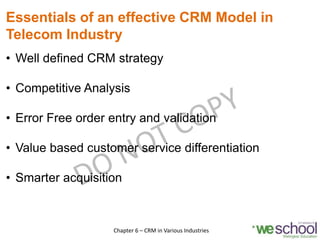
Essentials of an effective CRM Model in
Telecom Industry
• Well defined CRM strategy
• Competitive Analysis
• Error Free order entry and validation
• Value based customer service differentiation
• Smarter acquisition
9Chapter 6 – CRM in Various Industries
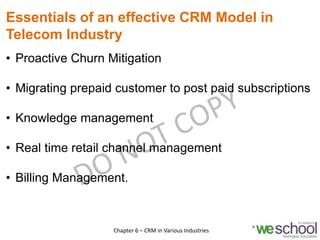
Essentials of an effective CRM Model in
Telecom Industry
• Proactive Churn Mitigation
• Migrating prepaid customer to post paid subscriptions
• Knowledge management
• Real time retail channel management
• Billing Management.
10Chapter 6 – CRM in Various Industries
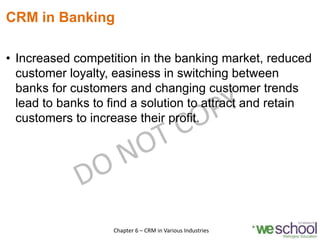
CRM in Banking
• Increased competition in the banking market, reduced
customer loyalty, easiness in switching between
banks for customers and changing customer trends
lead to banks to find a solution to attract and retain
customers to increase their profit.
11Chapter 6 – CRM in Various Industries
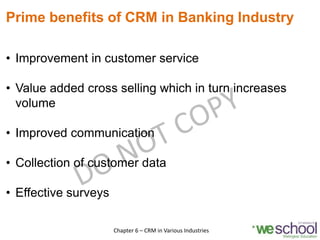
Prime benefits of CRM in Banking Industry
• Improvement in customer service
• Value added cross selling which in turn increases
volume
• Improved communication
• Collection of customer data
• Effective surveys
12Chapter 6 – CRM in Various Industries
CRM in Insurance
• To maintain competitive edge and viability, insurance
companies are focussing intently on delivering
superior customer service. Key aspects which an
insurance industry needs to include are-
• Providing a unified enterprise customer view
• Retaining customers with great services
• Controlling costs as the insurance company in
question expands
13Chapter 6 – CRM in Various Industries
Predicting customer behaviour for improved
sales efforts
• Profiling – Building an appropriate profile of the
customer
• Modelling – Using data mining on the profile
information and conduct analysis
• Scoring – Use of predictive analytics to score the
existing customers
14Chapter 6 – CRM in Various Industries
CRM in Airlines Industry
• Airlines success heavily depends on its ability to
intelligently manage sales, marketing and service
processes and to draw mutual advantages from
understanding of airline’s customers
15Chapter 6 – CRM in Various Industries
Airline e-CRM model should consider
• Understanding of customer behaviour
• Single view of customers across the enterprises
• Directly connect airlines and passengers
• Suppress time and space limits
• Be profitable and achieve sustainable revenue growth
16Chapter 6 – CRM in Various Industries
CRM in Automobile Industry
• CRM in automobile industry must consider two vital
principles
• Understanding purchase cycle intimacy
• Analyse ownership experience
• Web enables systems also make it easily possible to
capture crucial customer insights in the midst of the
buying process
17Chapter 6 – CRM in Various Industries
Summary
• The Future of CRM strives towards greater
implication of intelligent technology, the increasing
influence of organisational knowledge, sophisticated
data collection methods and the involvement of the
customers, suppliers and partners in the process of
building a CRM organisation.
• CRM has become available and necessary with the
development of electronic commerce and it is
supported by web applications and the enormous
growth of the internet
18Chapter 6 – CRM in Various Industries
Summary
• Modern organisations use every interaction with the
customer as an opportunity to collect relevant data
• Hence today, with various implicit and explicit
methods, organisations learn much more about the
customers than what rigid purchasing code of
conduct tells them
19Chapter 6 – CRM in Various Industries

Chapter 6 crm in various industries

  • 1.
    Chapter 6 CRM inVarious Industries Chapter 6 – CRM in Various Industries 1
  • 2.
    Learning Objective To understandthe application of CRM in various Industries To understand the relevance of CRM across industry verticals 2Chapter 6 – CRM in Various Industries
  • 3.
    Introduction • Increasing competitionand decreasing customer loyalty have led to the emergence of concepts that focus on the nurturing of relationships to customers. • CRM has emerged as an amalgamation of hard ware, software, process, applications and provide analytical capabilities 3Chapter 6 – CRM in Various Industries
  • 4.
    CRM in Hospitality •CRM in Hotels and Resorts determine which customers patronise the same hospitality brand on a regular basis. • Catering to valuable guests • Better customer data yields benefits • New directions online 4Chapter 6 – CRM in Various Industries
  • 5.
    Catering to valuableGuests • Not all frequents guests are alike and some are much more valuable than others in terms of profitability • The key to identify frequent customers who book premium high profit accommodations and who patronize other profit generating resources • The CRM technology can reveal frequent customers who provide the maximum potential 5Chapter 6 – CRM in Various Industries
  • 6.
    Better customer datayields benefits • A well grounded CRM program should be built on generating high quality consumer information for designing promotion activities • An enhanced reward program may need to be supplemented with other CRM tools and projects 6Chapter 6 – CRM in Various Industries
  • 7.
    New Directions online •Direct websites are highly cost efficient and allow hotels to establish and build relationships directly with their guests • Hospitality providers have begun to increasingly value the online marketing channel • Equally important is realising the full potential of CRM programs in the sector is the need to substantially improve the use of customer data and analytics 7Chapter 6 – CRM in Various Industries
  • 8.
    CRM in Telecom •The beneficiaries of the competition being consumers the telecom players in today’s environment are required to design and deploy customer centric strategies not only to grab a share in the market but also to sustain in the market in the long run. 8Chapter 6 – CRM in Various Industries
  • 9.
    Essentials of aneffective CRM Model in Telecom Industry • Well defined CRM strategy • Competitive Analysis • Error Free order entry and validation • Value based customer service differentiation • Smarter acquisition 9Chapter 6 – CRM in Various Industries
  • 10.
    Essentials of aneffective CRM Model in Telecom Industry • Proactive Churn Mitigation • Migrating prepaid customer to post paid subscriptions • Knowledge management • Real time retail channel management • Billing Management. 10Chapter 6 – CRM in Various Industries
  • 11.
    CRM in Banking •Increased competition in the banking market, reduced customer loyalty, easiness in switching between banks for customers and changing customer trends lead to banks to find a solution to attract and retain customers to increase their profit. 11Chapter 6 – CRM in Various Industries
  • 12.
    Prime benefits ofCRM in Banking Industry • Improvement in customer service • Value added cross selling which in turn increases volume • Improved communication • Collection of customer data • Effective surveys 12Chapter 6 – CRM in Various Industries
  • 13.
    CRM in Insurance •To maintain competitive edge and viability, insurance companies are focussing intently on delivering superior customer service. Key aspects which an insurance industry needs to include are- • Providing a unified enterprise customer view • Retaining customers with great services • Controlling costs as the insurance company in question expands 13Chapter 6 – CRM in Various Industries
  • 14.
    Predicting customer behaviourfor improved sales efforts • Profiling – Building an appropriate profile of the customer • Modelling – Using data mining on the profile information and conduct analysis • Scoring – Use of predictive analytics to score the existing customers 14Chapter 6 – CRM in Various Industries
  • 15.
    CRM in AirlinesIndustry • Airlines success heavily depends on its ability to intelligently manage sales, marketing and service processes and to draw mutual advantages from understanding of airline’s customers 15Chapter 6 – CRM in Various Industries
  • 16.
    Airline e-CRM modelshould consider • Understanding of customer behaviour • Single view of customers across the enterprises • Directly connect airlines and passengers • Suppress time and space limits • Be profitable and achieve sustainable revenue growth 16Chapter 6 – CRM in Various Industries
  • 17.
    CRM in AutomobileIndustry • CRM in automobile industry must consider two vital principles • Understanding purchase cycle intimacy • Analyse ownership experience • Web enables systems also make it easily possible to capture crucial customer insights in the midst of the buying process 17Chapter 6 – CRM in Various Industries
  • 18.
    Summary • The Futureof CRM strives towards greater implication of intelligent technology, the increasing influence of organisational knowledge, sophisticated data collection methods and the involvement of the customers, suppliers and partners in the process of building a CRM organisation. • CRM has become available and necessary with the development of electronic commerce and it is supported by web applications and the enormous growth of the internet 18Chapter 6 – CRM in Various Industries
  • 19.
    Summary • Modern organisationsuse every interaction with the customer as an opportunity to collect relevant data • Hence today, with various implicit and explicit methods, organisations learn much more about the customers than what rigid purchasing code of conduct tells them 19Chapter 6 – CRM in Various Industries