Ch. 6-1
Strategic Management
Concepts & Cases
15th
edition
Fred R. David
Chapter 6:
Strategy Analysis &
Choice
Ch. 6-2
Comprehensive Strategic Management ModelComprehensive Strategic Management Model
Vision
&
Mission
Statements
Chapter 2
External
Audit
Chapter 3
Internal
Audit
Chapter 4
Strategies
In
Action
Chapter 5
Strategy
Analysis
&
Choice
Chapter 6
Implement
Strategies:
Mgmt Issues
Chapter 7
Implement
Strategies:
Marketing,
Fin/Acct,
R&D, CIS
Chapter 8
Measure &
Evaluate
Performance
Chapter 9
Ch. 6-3
Strategy Analysis &Strategy Analysis &
ChoiceChoice
“Strategic management is not a box of tricks or a
bundle of techniques. It is analytical thinking
and commitment of resources to action. But
quantification alone is not planning. Some of
the most important issues in strategic
management cannot be quantified at all.”
—Peter Drucker—
Ch. 6-4
Strategy Analysis &Strategy Analysis &
ChoiceChoice
“Whether it’s broke or not, fix it—make it
better. Not just products, but the whole
company if necessary.”
—Bill Saporito—
Ch. 6-5
Strategy Analysis &Strategy Analysis &
ChoiceChoice
“Planning is often doomed before it ever
starts, either because too much is
expected of it or because not enough is
put into it.”
—T. J. Cartwright—
Ch. 6-6
Strategy Analysis &Strategy Analysis &
ChoiceChoice
Strategic Analysis and Choice:
Making subjective decisions based on
objective information
Ch. 6-7
Strategy Analysis &Strategy Analysis &
ChoiceChoice
Strategic Analysis and Choice:
• Generate feasible alternatives
• Evaluate alternatives
• Select specific course of action
Ch. 6-8
Strategy Analysis &Strategy Analysis &
ChoiceChoice
Generating & Selecting Strategies
 Develop set of most attractive alternative
strategies
 Determine for the set
• Advantages
• Disadvantages
• Trade-offs
• Costs
• Benefits
Ch. 6-9
Strategy Analysis &Strategy Analysis &
ChoiceChoice
Generating & Selecting Strategies
 Involve a broad mix of personnel
• Representation from each department/function
• Provides opportunity to gain understanding of
firm’s direction
• Provides vehicle to develop commitment to
attainment of organizational objectives
Ch. 6-10
Strategy Analysis &Strategy Analysis &
ChoiceChoice
Generating & Selecting Strategies
 Evaluate each alternative
• Internal and external audit information
• Firm’s mission statement
• Listed in writing
• Ranked in order of attractiveness
Ch. 6-11
Strategy-Formulation Analytical Framework
Stage 1: The Input StageStage 1: The Input Stage
Stage 2: The Matching StageStage 2: The Matching Stage
Stage 3: The Decision StageStage 3: The Decision Stage
Ch. 6-12
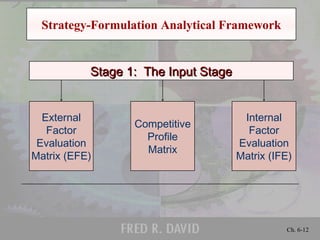
Strategy-Formulation Analytical Framework
Stage 1: The Input StageStage 1: The Input Stage
External
Factor
Evaluation
Matrix (EFE)
Competitive
Profile
Matrix
Internal
Factor
Evaluation
Matrix (IFE)
Ch. 6-13
Strategy-Formulation Analytical Framework
Stage 2: The Matching StageStage 2: The Matching Stage
Threats
Opportunities
Weaknesses
Strengths
(TOWS)
Strategic
Position &
Action
Evaluation
(SPACE)
Boston
Consulting
Group
Matrix
(BCG)
Internal-
External
Matrix
(IE)
Grand
Strategy
Matrix
Ch. 6-14
Strategy-Formulation Analytical Framework
Stage 3: The Decision StageStage 3: The Decision Stage
Quantitative Strategic
Planning Matrix
(QSPM)
Ch. 6-15
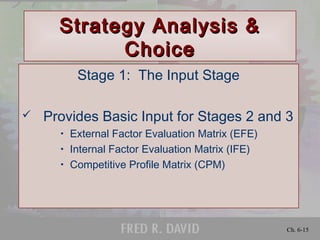
Strategy Analysis &Strategy Analysis &
ChoiceChoice
Stage 1: The Input Stage
 Provides Basic Input for Stages 2 and 3
• External Factor Evaluation Matrix (EFE)
• Internal Factor Evaluation Matrix (IFE)
• Competitive Profile Matrix (CPM)
Ch. 6-16
Strategy Analysis &Strategy Analysis &
ChoiceChoice
Stage 2: The Matching Stage
 Strategy is characterized by the
organizational match between
• Internal resources and skills
• Opportunities & risks created by external
factors
Ch. 6-17
Matching Key FactorsMatching Key Factors
Resultant StrategyKey External FactorKey Internal Factor
Develop a new
employee benefits
package
=Strong union
activity (threat)
+
Poor employee
morale (weakness)
Develop new products
for older adults
=
Decreasing
numbers of young
adults (threat)
+Strong R&D (strength)
Pursue horizontal
integration by buying
competitor's facilities
=
Exit of two major
foreign competitors
form the industry
(opportunity)
+
Insufficient capacity
(weakness)
Acquire Visioncable,
Inc.
=
20% annual growth
in the cablevision
industry
(opportunity)
+
Excess working
capacity (strength)
Ch. 6-18
Four Types of StrategiesFour Types of Strategies
WT
Strategies
ST
Strategies
WO
Strategies
SO
Strategies
Strengths
Weaknesses
Opportunities
Threats
(SWOT)
Ch. 6-19
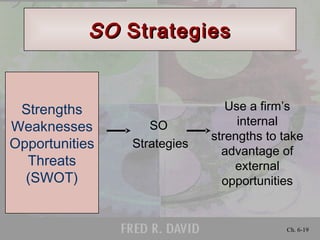
SOSO StrategiesStrategies
SO
Strategies
Use a firm’s
internal
strengths to take
advantage of
external
opportunities
Strengths
Weaknesses
Opportunities
Threats
(SWOT)
Ch. 6-20
WOWO StrategiesStrategies
WO
Strategies
Improving
internal
weaknesses by
taking
advantage of
external
opportunities
Strengths
Weaknesses
Opportunities
Threats
(SWOT)
Ch. 6-21
STST StrategiesStrategies
ST
Strategies
Using firm’s
strengths to
avoid or reduce
the impact of
external threats.
Strengths
Weaknesses
Opportunities
Threats
(SWOT)
Ch. 6-22
WTWT StrategiesStrategies
WT
Strategies
Defensive
tactics aimed at
reducing internal
weaknesses
and avoiding
environmental
threats.
Strengths
Weaknesses
Opportunities
Threats
(SWOT)
Ch. 6-23
Strategy Analysis &Strategy Analysis &
ChoiceChoice
The SWOT Matrix
• List the firm’s key external opportunities
• List the firm’s key external threats
• List the firm’s key internal strengths
• List the firm’s key internal weaknesses
Ch. 6-24
Strategy Analysis &Strategy Analysis &
ChoiceChoice
The SWOT Matrix
• Match internal strengths with external opportunities
and record the resultant SO Strategies
• Match internal weaknesses with external
opportunities and record the resultant WO Strategies
• Match internal strengths with external threats and
record the resultant ST Strategies
• Match internal weaknesses with external threats and
record the resultant WT Strategies
Ch. 6-25
SWOT MatrixSWOT Matrix
WT Strategies
Minimize weaknesses
and avoid threats
ST Strategies
Use strengths to avoid
threats
Threats-T
List Threats
WO Strategies
Overcome
weaknesses by taking
advantage of
opportunities
SO Strategies
Use strengths to take
advantage of
opportunities
Opportunities-
O
List Opportunities
Weaknesses-W
List Weaknesses
Strengths-S
List Strengths
Leave Blank
Ch. 6-26
Ch. 6-27
Ch. 6-28
Strategy Analysis &Strategy Analysis &
ChoiceChoice
Strategic Position & Action
Evaluation Matrix (SPACE)
• Four quadrant framework
• Determines appropriate strategies
 Aggressive
 Conservative
 Defensive
 Competitive
Ch. 6-29
Strategy Analysis &Strategy Analysis &
ChoiceChoice
Strategic Position & Action
Evaluation Matrix (SPACE)
• Two Internal Dimensions
 Financial Position [FP]
 Competitive Position [CP]
• Two External Dimensions
 Stability Position [SP]
 Industry Position [IP]
Ch. 6-30
Strategy Analysis &Strategy Analysis &
ChoiceChoice
Strategic Position & Action
Evaluation Matrix (SPACE)
Overall Strategic position determined by:
• Financial Position [FP]
• Competitive Position [CP]
• Stability Position [SP]
• Industry Position [IP]
Ch. 6-31
Strategy Analysis &Strategy Analysis &
ChoiceChoice
Strategic Position & Action
Evaluation Matrix (SPACE)
Developing the SPACE Matrix:
• EFE Matrix
• IFE Matrix
• Financial Position
• Competitive Position
• Stability Position
• Industry Position
Ch. 6-32
Strategy Analysis &Strategy Analysis &
ChoiceChoice
The SPACE Matrix
• Select variables to define FP, CP, SP, & IP
• Assign numerical ranking from +1 (worst) to
+7 (best) for FP and IP; Assign numerical
ranking from –1 (best) to –7 (worst) for SP
and CP.
• Compute average score for FP, CP, SP, & IP
Ch. 6-33
Strategy Analysis &Strategy Analysis &
ChoiceChoice
The SPACE Matrix
• Plot the average scores on the Matrix
• Add the two scores on the x-axis and plot
point on X. Add the scores on the y-axis and
plot Y. Plot the intersection of the new xy
point.
• Draw a directional vector from origin through
the new intersection point.
Ch. 6-34
SPACE FactorsSPACE Factors
Environmental Stability (ES)
Technological changes
Rate of inflation
Demand variability
Price range of competing
products
Barriers to entry
Competitive pressure
Price elasticity of demand
Financial Strength (FS)
Return on investment
Leverage
Liquidity
Working capital
Cash flow
Ease of exit from market
Risk involved in business
External Strategic Position
Internal Strategic
Position
Ch. 6-35
SPACE FactorsSPACE Factors
Industry Strength (IS)
Growth potential
Profit potential
Financial stability
Technological know-how
Resource utilization
Capital intensify
Ease of entry into market
Productivity, capacity
utilization
Competitive Advantage CA
Market share
Product quality
Product life cycle
Customer loyalty
Competition’s capacity utilization
Technological know-how
Control over suppliers &
distributors
External Strategic
Position
Internal Strategic Position
Ch. 6-36
SPACE MatrixSPACE Matrix
FP
+6
+1
+5
+4
+3
+2
-6
-5
-4
-3
-2
-1-6 -5 -4 -3 -2 -1 +1 +2 +3 +4 +5 +6
SP
CP IP
Conservative Aggressive
Defensive Competitive
Ch. 6-37
Ch. 6-38
Strategy Analysis &Strategy Analysis &
ChoiceChoice
Boston Consulting Group Matrix
(BCG)
• Enhances multidivisional firms’ efforts to
formulate strategies
• Autonomous divisions (or profit centers)
constitute the business portfolio
• Firm’s divisions may compete in different
industries requiring separate strategy
Ch. 6-39
Strategy Analysis &Strategy Analysis &
ChoiceChoice
Boston Consulting Group Matrix
(BCG)
• Graphically portrays differences among
divisions
• Focuses on market share position and
industry growth rate
• Manage business portfolio through relative
market share position and industry growth
rate
Ch. 6-40
Strategy Analysis &Strategy Analysis &
ChoiceChoice
Boston Consulting Group Matrix
(BCG)
• Relative market share position defined:
 Ratio of a division’s own market share in a
particular industry to the market share held by the
largest rival firm in that industry.
Ch. 6-41
BCG MatrixBCG Matrix
DogsDogs
IVIV
Cash CowsCash Cows
IIIIII
Question MarksQuestion Marks
II
StarsStars
IIII
Relative Market Share Position
High
1.0
Medium
.50
Low
0.0
Industr
High
+20
Low
-20
Medium
0
Ch. 6-42
Strategy Analysis &Strategy Analysis &
ChoiceChoice
BCG Matrix
• Question Marks
• Stars
• Cash Cows
• Dogs
Ch. 6-43
Strategy Analysis &Strategy Analysis &
ChoiceChoice
BCG Matrix
• Question Marks
Low relative market share position yet
compete in high-growth industry.
 Cash needs are high
 Case generation is low
Decision to strengthen (intensive
strategies) or divest
Ch. 6-44
Strategy Analysis &Strategy Analysis &
ChoiceChoice
BCG Matrix
• Stars
High relative market share and high
industry growth rate.
 Best long-run opportunities for growth and
profitability
Substantial investment to maintain or
strengthen dominant position
 Integration strategies, intensive strategies, joint
ventures
Ch. 6-45
Strategy Analysis &Strategy Analysis &
ChoiceChoice
BCG Matrix
• Cash Cows
High relative market share position, but
compete in low-growth industry
 Generate cash in excess of their needs
 Milked for other purposes
Maintain strong position as long as
possible
 Product development, concentric diversification
 If becomes weak—retrenchment or divestiture
Ch. 6-46
Strategy Analysis &Strategy Analysis &
ChoiceChoice
BCG Matrix
• Dogs
Low relative market share position and
compete in slow or no market growth
 Weak internal and external position
Decision to liquidate, divest, retrenchment
Internal-External (IE) MatrixInternal-External (IE) Matrix
• It is an important strategic tool which comes
under the portfolio management considered
much similar to BCG matrix.
• The Internal-External (IE) Matrix positions an
organization’s various divisions in a nine-cell
diagram.
Ch. 6-47
Ch. 6-48
Ch. 6-49
Strategy Analysis &Strategy Analysis &
ChoiceChoice
Grand Strategy Matrix
• Popular tool for formulating alternative
strategies
• All organizations can be positioned in one of
the Grand Strategy Matrix’s four strategy
quadrants.
• Based on two evaluative dimensions
 Competitive position
 Market growth
Ch. 6-50
Grand StrategyGrand Strategy
MatrixMatrix
Quadrant IV
• Concentric diversification
• Horizontal diversification
• Joint ventures
Quadrant III
• Retrenchment
• Concentric diversification
• Horizontal diversification
• Liquidation
Quadrant I
• Market development
• Market penetration
• Product development
• Forward integration
• Backward integration
• Horizontal integration
• Concentric diversification
Quadrant II
• Market development
• Market penetration
• Product development
• Horizontal integration
• Divestiture
• Liquidation
RAPID MARKET GROWTH
SLOW MARKET GROWTH
WEAK
COMPETITIVE
POSITION
STRONG
COMPETITIVE
POSITION
Ch. 6-51
Strategy Analysis &Strategy Analysis &
ChoiceChoice
Grand Strategy Matrix
• Quadrant I
 Excellent strategic position
 Concentration on current markets and products
 Take risks aggressively when necessary
Ch. 6-52
Strategy Analysis &Strategy Analysis &
ChoiceChoice
Grand Strategy Matrix
• Quadrant II
 Evaluate present approach seriously
 How to change to improve competitiveness
 Rapid market growth requires intensive strategy
Ch. 6-53
Strategy Analysis &Strategy Analysis &
ChoiceChoice
Grand Strategy Matrix
• Quadrant III
 Compete in slow-growth industries
 Weak competitive position
 Drastic changes quickly
 Cost and asset reduction indicated (retrenchment)
Ch. 6-54
Strategy Analysis &Strategy Analysis &
ChoiceChoice
Grand Strategy Matrix
• Quadrant IV
 Strong competitive position
 Slow-growth industry
 Diversification indicated to more promising growth
areas
Ch. 6-55
Strategy Analysis &Strategy Analysis &
ChoiceChoice
Quantitative Strategic Planning
Matrix (QSPM)
• Comprises Stage 3 of the analytical
framework
• Analytical technique designed to determine
the relative attractiveness of feasible
alternative actions.
• Uses input from Stage 1 and Stage 2
Ch. 6-56
Strategy Analysis &Strategy Analysis &
ChoiceChoice
Quantitative Strategic Planning
Matrix (QSPM)
• Tool for objective evaluation of alternative
strategies
• Based on identified external and internal
crucial success factors
• Requires good intuitive judgment
Ch. 6-57
QSPMQSPM
Key Internal Factors
Management
Marketing
Finance/Accounting
Production/Operations
Research and Development
Computer Information
Systems
Strategy 3Strategy 2Strategy 1WeightKey External Factors
Economy
Political/Legal/Governmental
Social/Cultural/Demographic/
Environmental
Technological
Competitive
Strategic Alternatives
Ch. 6-58
Strategy Analysis &Strategy Analysis &
ChoiceChoice
QSPM
• List the firm’s key external opportunities
& threats; list the firm’s key internal
strengths and weaknesses
• Assign weights to each external and
internal critical success factor
Ch. 6-59
Strategy Analysis &Strategy Analysis &
ChoiceChoice
QSPM
• Examine the Stage 2 (matching)
matrices and identify alternative
strategies that the organization should
consider implementing
• Determine the Attractiveness Scores
(AS)
Ch. 6-60
Strategy Analysis &Strategy Analysis &
ChoiceChoice
QSPM
• Compute the total Attractiveness
Scores
• Compute the Sum Total Attractiveness
Score
Ch. 6-61
Ch. 6-62
Ch. 6-63
Strategy Analysis &Strategy Analysis &
ChoiceChoice
QSPM
Positives:
• Sets of strategies examined
simultaneously or sequentially
• Requires the integration of pertinent
external and internal factors in the
decision-making process
Ch. 6-64
Strategy Analysis &Strategy Analysis &
ChoiceChoice
QSPM
Limitations:
• Requires intuitive judgments and
educated assumptions
• Only as good as the prerequisite
inputs
Ch. 6-65
Key Terms & ConceptsKey Terms & Concepts
• Aggressive quadrant
• Attractiveness Scores
(AS)
• Board of Directors
• Boston Consulting
Group (BCG) Matrix
• Business portfolio
• Cash cows
• Champions
• Competitive Advantage
(CA)
• Competitive quadrant
• Conservative quadrant
• Culture
• Decision stage
• Defensive quadrant
• Directional vector
• Dogs
• Environmental Stability
(ES)
• Financial Strength (FS)
Ch. 6-66
Key Terms & ConceptsKey Terms & Concepts
• Grand Strategy Matrix
• Halo error
• Industry Strength (IS)
• Input stage
• Internal-External (IE)
Matrix
• Long-term objectives
• Matching
• Matching stage
• Quantitative Strategic
Planning Matrix
(QSPM)
• Question marks
• Relative market share
position
• SO strategies
• ST strategies
• Stars
• Strategic Position and
Action Evaluation
(SPACE) Matrix
• Strategy-formulation
framework
Ch. 6-67
Key Terms & ConceptsKey Terms & Concepts
• Sum total attractiveness
scores
• Threats-Opportunities-
Weaknesses-Strengths
(TOWS) Matrix
• Total Attractiveness
Scores (TAS)
• WO strategies
• WT strategies

Chapter 6

  • 1.
    Ch. 6-1 Strategic Management Concepts& Cases 15th edition Fred R. David Chapter 6: Strategy Analysis & Choice
  • 2.
    Ch. 6-2 Comprehensive StrategicManagement ModelComprehensive Strategic Management Model Vision & Mission Statements Chapter 2 External Audit Chapter 3 Internal Audit Chapter 4 Strategies In Action Chapter 5 Strategy Analysis & Choice Chapter 6 Implement Strategies: Mgmt Issues Chapter 7 Implement Strategies: Marketing, Fin/Acct, R&D, CIS Chapter 8 Measure & Evaluate Performance Chapter 9
  • 3.
    Ch. 6-3 Strategy Analysis&Strategy Analysis & ChoiceChoice “Strategic management is not a box of tricks or a bundle of techniques. It is analytical thinking and commitment of resources to action. But quantification alone is not planning. Some of the most important issues in strategic management cannot be quantified at all.” —Peter Drucker—
  • 4.
    Ch. 6-4 Strategy Analysis&Strategy Analysis & ChoiceChoice “Whether it’s broke or not, fix it—make it better. Not just products, but the whole company if necessary.” —Bill Saporito—
  • 5.
    Ch. 6-5 Strategy Analysis&Strategy Analysis & ChoiceChoice “Planning is often doomed before it ever starts, either because too much is expected of it or because not enough is put into it.” —T. J. Cartwright—
  • 6.
    Ch. 6-6 Strategy Analysis&Strategy Analysis & ChoiceChoice Strategic Analysis and Choice: Making subjective decisions based on objective information
  • 7.
    Ch. 6-7 Strategy Analysis&Strategy Analysis & ChoiceChoice Strategic Analysis and Choice: • Generate feasible alternatives • Evaluate alternatives • Select specific course of action
  • 8.
    Ch. 6-8 Strategy Analysis&Strategy Analysis & ChoiceChoice Generating & Selecting Strategies  Develop set of most attractive alternative strategies  Determine for the set • Advantages • Disadvantages • Trade-offs • Costs • Benefits
  • 9.
    Ch. 6-9 Strategy Analysis&Strategy Analysis & ChoiceChoice Generating & Selecting Strategies  Involve a broad mix of personnel • Representation from each department/function • Provides opportunity to gain understanding of firm’s direction • Provides vehicle to develop commitment to attainment of organizational objectives
  • 10.
    Ch. 6-10 Strategy Analysis&Strategy Analysis & ChoiceChoice Generating & Selecting Strategies  Evaluate each alternative • Internal and external audit information • Firm’s mission statement • Listed in writing • Ranked in order of attractiveness
  • 11.
    Ch. 6-11 Strategy-Formulation AnalyticalFramework Stage 1: The Input StageStage 1: The Input Stage Stage 2: The Matching StageStage 2: The Matching Stage Stage 3: The Decision StageStage 3: The Decision Stage
  • 12.
    Ch. 6-12 Strategy-Formulation AnalyticalFramework Stage 1: The Input StageStage 1: The Input Stage External Factor Evaluation Matrix (EFE) Competitive Profile Matrix Internal Factor Evaluation Matrix (IFE)
  • 13.
    Ch. 6-13 Strategy-Formulation AnalyticalFramework Stage 2: The Matching StageStage 2: The Matching Stage Threats Opportunities Weaknesses Strengths (TOWS) Strategic Position & Action Evaluation (SPACE) Boston Consulting Group Matrix (BCG) Internal- External Matrix (IE) Grand Strategy Matrix
  • 14.
    Ch. 6-14 Strategy-Formulation AnalyticalFramework Stage 3: The Decision StageStage 3: The Decision Stage Quantitative Strategic Planning Matrix (QSPM)
  • 15.
    Ch. 6-15 Strategy Analysis&Strategy Analysis & ChoiceChoice Stage 1: The Input Stage  Provides Basic Input for Stages 2 and 3 • External Factor Evaluation Matrix (EFE) • Internal Factor Evaluation Matrix (IFE) • Competitive Profile Matrix (CPM)
  • 16.
    Ch. 6-16 Strategy Analysis&Strategy Analysis & ChoiceChoice Stage 2: The Matching Stage  Strategy is characterized by the organizational match between • Internal resources and skills • Opportunities & risks created by external factors
  • 17.
    Ch. 6-17 Matching KeyFactorsMatching Key Factors Resultant StrategyKey External FactorKey Internal Factor Develop a new employee benefits package =Strong union activity (threat) + Poor employee morale (weakness) Develop new products for older adults = Decreasing numbers of young adults (threat) +Strong R&D (strength) Pursue horizontal integration by buying competitor's facilities = Exit of two major foreign competitors form the industry (opportunity) + Insufficient capacity (weakness) Acquire Visioncable, Inc. = 20% annual growth in the cablevision industry (opportunity) + Excess working capacity (strength)
  • 18.
    Ch. 6-18 Four Typesof StrategiesFour Types of Strategies WT Strategies ST Strategies WO Strategies SO Strategies Strengths Weaknesses Opportunities Threats (SWOT)
  • 19.
    Ch. 6-19 SOSO StrategiesStrategies SO Strategies Usea firm’s internal strengths to take advantage of external opportunities Strengths Weaknesses Opportunities Threats (SWOT)
  • 20.
    Ch. 6-20 WOWO StrategiesStrategies WO Strategies Improving internal weaknessesby taking advantage of external opportunities Strengths Weaknesses Opportunities Threats (SWOT)
  • 21.
    Ch. 6-21 STST StrategiesStrategies ST Strategies Usingfirm’s strengths to avoid or reduce the impact of external threats. Strengths Weaknesses Opportunities Threats (SWOT)
  • 22.
    Ch. 6-22 WTWT StrategiesStrategies WT Strategies Defensive tacticsaimed at reducing internal weaknesses and avoiding environmental threats. Strengths Weaknesses Opportunities Threats (SWOT)
  • 23.
    Ch. 6-23 Strategy Analysis&Strategy Analysis & ChoiceChoice The SWOT Matrix • List the firm’s key external opportunities • List the firm’s key external threats • List the firm’s key internal strengths • List the firm’s key internal weaknesses
  • 24.
    Ch. 6-24 Strategy Analysis&Strategy Analysis & ChoiceChoice The SWOT Matrix • Match internal strengths with external opportunities and record the resultant SO Strategies • Match internal weaknesses with external opportunities and record the resultant WO Strategies • Match internal strengths with external threats and record the resultant ST Strategies • Match internal weaknesses with external threats and record the resultant WT Strategies
  • 25.
    Ch. 6-25 SWOT MatrixSWOTMatrix WT Strategies Minimize weaknesses and avoid threats ST Strategies Use strengths to avoid threats Threats-T List Threats WO Strategies Overcome weaknesses by taking advantage of opportunities SO Strategies Use strengths to take advantage of opportunities Opportunities- O List Opportunities Weaknesses-W List Weaknesses Strengths-S List Strengths Leave Blank
  • 26.
  • 27.
  • 28.
    Ch. 6-28 Strategy Analysis&Strategy Analysis & ChoiceChoice Strategic Position & Action Evaluation Matrix (SPACE) • Four quadrant framework • Determines appropriate strategies  Aggressive  Conservative  Defensive  Competitive
  • 29.
    Ch. 6-29 Strategy Analysis&Strategy Analysis & ChoiceChoice Strategic Position & Action Evaluation Matrix (SPACE) • Two Internal Dimensions  Financial Position [FP]  Competitive Position [CP] • Two External Dimensions  Stability Position [SP]  Industry Position [IP]
  • 30.
    Ch. 6-30 Strategy Analysis&Strategy Analysis & ChoiceChoice Strategic Position & Action Evaluation Matrix (SPACE) Overall Strategic position determined by: • Financial Position [FP] • Competitive Position [CP] • Stability Position [SP] • Industry Position [IP]
  • 31.
    Ch. 6-31 Strategy Analysis&Strategy Analysis & ChoiceChoice Strategic Position & Action Evaluation Matrix (SPACE) Developing the SPACE Matrix: • EFE Matrix • IFE Matrix • Financial Position • Competitive Position • Stability Position • Industry Position
  • 32.
    Ch. 6-32 Strategy Analysis&Strategy Analysis & ChoiceChoice The SPACE Matrix • Select variables to define FP, CP, SP, & IP • Assign numerical ranking from +1 (worst) to +7 (best) for FP and IP; Assign numerical ranking from –1 (best) to –7 (worst) for SP and CP. • Compute average score for FP, CP, SP, & IP
  • 33.
    Ch. 6-33 Strategy Analysis&Strategy Analysis & ChoiceChoice The SPACE Matrix • Plot the average scores on the Matrix • Add the two scores on the x-axis and plot point on X. Add the scores on the y-axis and plot Y. Plot the intersection of the new xy point. • Draw a directional vector from origin through the new intersection point.
  • 34.
    Ch. 6-34 SPACE FactorsSPACEFactors Environmental Stability (ES) Technological changes Rate of inflation Demand variability Price range of competing products Barriers to entry Competitive pressure Price elasticity of demand Financial Strength (FS) Return on investment Leverage Liquidity Working capital Cash flow Ease of exit from market Risk involved in business External Strategic Position Internal Strategic Position
  • 35.
    Ch. 6-35 SPACE FactorsSPACEFactors Industry Strength (IS) Growth potential Profit potential Financial stability Technological know-how Resource utilization Capital intensify Ease of entry into market Productivity, capacity utilization Competitive Advantage CA Market share Product quality Product life cycle Customer loyalty Competition’s capacity utilization Technological know-how Control over suppliers & distributors External Strategic Position Internal Strategic Position
  • 36.
    Ch. 6-36 SPACE MatrixSPACEMatrix FP +6 +1 +5 +4 +3 +2 -6 -5 -4 -3 -2 -1-6 -5 -4 -3 -2 -1 +1 +2 +3 +4 +5 +6 SP CP IP Conservative Aggressive Defensive Competitive
  • 37.
  • 38.
    Ch. 6-38 Strategy Analysis&Strategy Analysis & ChoiceChoice Boston Consulting Group Matrix (BCG) • Enhances multidivisional firms’ efforts to formulate strategies • Autonomous divisions (or profit centers) constitute the business portfolio • Firm’s divisions may compete in different industries requiring separate strategy
  • 39.
    Ch. 6-39 Strategy Analysis&Strategy Analysis & ChoiceChoice Boston Consulting Group Matrix (BCG) • Graphically portrays differences among divisions • Focuses on market share position and industry growth rate • Manage business portfolio through relative market share position and industry growth rate
  • 40.
    Ch. 6-40 Strategy Analysis&Strategy Analysis & ChoiceChoice Boston Consulting Group Matrix (BCG) • Relative market share position defined:  Ratio of a division’s own market share in a particular industry to the market share held by the largest rival firm in that industry.
  • 41.
    Ch. 6-41 BCG MatrixBCGMatrix DogsDogs IVIV Cash CowsCash Cows IIIIII Question MarksQuestion Marks II StarsStars IIII Relative Market Share Position High 1.0 Medium .50 Low 0.0 Industr High +20 Low -20 Medium 0
  • 42.
    Ch. 6-42 Strategy Analysis&Strategy Analysis & ChoiceChoice BCG Matrix • Question Marks • Stars • Cash Cows • Dogs
  • 43.
    Ch. 6-43 Strategy Analysis&Strategy Analysis & ChoiceChoice BCG Matrix • Question Marks Low relative market share position yet compete in high-growth industry.  Cash needs are high  Case generation is low Decision to strengthen (intensive strategies) or divest
  • 44.
    Ch. 6-44 Strategy Analysis&Strategy Analysis & ChoiceChoice BCG Matrix • Stars High relative market share and high industry growth rate.  Best long-run opportunities for growth and profitability Substantial investment to maintain or strengthen dominant position  Integration strategies, intensive strategies, joint ventures
  • 45.
    Ch. 6-45 Strategy Analysis&Strategy Analysis & ChoiceChoice BCG Matrix • Cash Cows High relative market share position, but compete in low-growth industry  Generate cash in excess of their needs  Milked for other purposes Maintain strong position as long as possible  Product development, concentric diversification  If becomes weak—retrenchment or divestiture
  • 46.
    Ch. 6-46 Strategy Analysis&Strategy Analysis & ChoiceChoice BCG Matrix • Dogs Low relative market share position and compete in slow or no market growth  Weak internal and external position Decision to liquidate, divest, retrenchment
  • 47.
    Internal-External (IE) MatrixInternal-External(IE) Matrix • It is an important strategic tool which comes under the portfolio management considered much similar to BCG matrix. • The Internal-External (IE) Matrix positions an organization’s various divisions in a nine-cell diagram. Ch. 6-47
  • 48.
  • 49.
    Ch. 6-49 Strategy Analysis&Strategy Analysis & ChoiceChoice Grand Strategy Matrix • Popular tool for formulating alternative strategies • All organizations can be positioned in one of the Grand Strategy Matrix’s four strategy quadrants. • Based on two evaluative dimensions  Competitive position  Market growth
  • 50.
    Ch. 6-50 Grand StrategyGrandStrategy MatrixMatrix Quadrant IV • Concentric diversification • Horizontal diversification • Joint ventures Quadrant III • Retrenchment • Concentric diversification • Horizontal diversification • Liquidation Quadrant I • Market development • Market penetration • Product development • Forward integration • Backward integration • Horizontal integration • Concentric diversification Quadrant II • Market development • Market penetration • Product development • Horizontal integration • Divestiture • Liquidation RAPID MARKET GROWTH SLOW MARKET GROWTH WEAK COMPETITIVE POSITION STRONG COMPETITIVE POSITION
  • 51.
    Ch. 6-51 Strategy Analysis&Strategy Analysis & ChoiceChoice Grand Strategy Matrix • Quadrant I  Excellent strategic position  Concentration on current markets and products  Take risks aggressively when necessary
  • 52.
    Ch. 6-52 Strategy Analysis&Strategy Analysis & ChoiceChoice Grand Strategy Matrix • Quadrant II  Evaluate present approach seriously  How to change to improve competitiveness  Rapid market growth requires intensive strategy
  • 53.
    Ch. 6-53 Strategy Analysis&Strategy Analysis & ChoiceChoice Grand Strategy Matrix • Quadrant III  Compete in slow-growth industries  Weak competitive position  Drastic changes quickly  Cost and asset reduction indicated (retrenchment)
  • 54.
    Ch. 6-54 Strategy Analysis&Strategy Analysis & ChoiceChoice Grand Strategy Matrix • Quadrant IV  Strong competitive position  Slow-growth industry  Diversification indicated to more promising growth areas
  • 55.
    Ch. 6-55 Strategy Analysis&Strategy Analysis & ChoiceChoice Quantitative Strategic Planning Matrix (QSPM) • Comprises Stage 3 of the analytical framework • Analytical technique designed to determine the relative attractiveness of feasible alternative actions. • Uses input from Stage 1 and Stage 2
  • 56.
    Ch. 6-56 Strategy Analysis&Strategy Analysis & ChoiceChoice Quantitative Strategic Planning Matrix (QSPM) • Tool for objective evaluation of alternative strategies • Based on identified external and internal crucial success factors • Requires good intuitive judgment
  • 57.
    Ch. 6-57 QSPMQSPM Key InternalFactors Management Marketing Finance/Accounting Production/Operations Research and Development Computer Information Systems Strategy 3Strategy 2Strategy 1WeightKey External Factors Economy Political/Legal/Governmental Social/Cultural/Demographic/ Environmental Technological Competitive Strategic Alternatives
  • 58.
    Ch. 6-58 Strategy Analysis&Strategy Analysis & ChoiceChoice QSPM • List the firm’s key external opportunities & threats; list the firm’s key internal strengths and weaknesses • Assign weights to each external and internal critical success factor
  • 59.
    Ch. 6-59 Strategy Analysis&Strategy Analysis & ChoiceChoice QSPM • Examine the Stage 2 (matching) matrices and identify alternative strategies that the organization should consider implementing • Determine the Attractiveness Scores (AS)
  • 60.
    Ch. 6-60 Strategy Analysis&Strategy Analysis & ChoiceChoice QSPM • Compute the total Attractiveness Scores • Compute the Sum Total Attractiveness Score
  • 61.
  • 62.
  • 63.
    Ch. 6-63 Strategy Analysis&Strategy Analysis & ChoiceChoice QSPM Positives: • Sets of strategies examined simultaneously or sequentially • Requires the integration of pertinent external and internal factors in the decision-making process
  • 64.
    Ch. 6-64 Strategy Analysis&Strategy Analysis & ChoiceChoice QSPM Limitations: • Requires intuitive judgments and educated assumptions • Only as good as the prerequisite inputs
  • 65.
    Ch. 6-65 Key Terms& ConceptsKey Terms & Concepts • Aggressive quadrant • Attractiveness Scores (AS) • Board of Directors • Boston Consulting Group (BCG) Matrix • Business portfolio • Cash cows • Champions • Competitive Advantage (CA) • Competitive quadrant • Conservative quadrant • Culture • Decision stage • Defensive quadrant • Directional vector • Dogs • Environmental Stability (ES) • Financial Strength (FS)
  • 66.
    Ch. 6-66 Key Terms& ConceptsKey Terms & Concepts • Grand Strategy Matrix • Halo error • Industry Strength (IS) • Input stage • Internal-External (IE) Matrix • Long-term objectives • Matching • Matching stage • Quantitative Strategic Planning Matrix (QSPM) • Question marks • Relative market share position • SO strategies • ST strategies • Stars • Strategic Position and Action Evaluation (SPACE) Matrix • Strategy-formulation framework
  • 67.
    Ch. 6-67 Key Terms& ConceptsKey Terms & Concepts • Sum total attractiveness scores • Threats-Opportunities- Weaknesses-Strengths (TOWS) Matrix • Total Attractiveness Scores (TAS) • WO strategies • WT strategies