COMPILED BY TSEGAY BERHE (MSc.IN PRODUCTION ENGINEERING AND MANAGEMENT) 1
TRANSPORTATION PROBLEM
Introduction
A special class of linear programming problem is Transportation Problem, where the objective
is to minimize the cost of distributing a product from a number of sources (e.g. factories) to a
number of destinations (e.g. warehouses) while satisfying both the supply limits and the demand
requirement. Because of the special structure of the Transportation Problem the Simplex Method
of solving is unsuitable for the Transportation Problem. The model assumes that the distributing
cost on a given rout is directly proportional to the number of units distributed on that route.
Generally, the transportation model can be extended to areas other than the direct
transportation of a commodity, including among others, inventory control, employment
scheduling, and personnel assignment.
Mathematical Formulation of Transportation problem
Mathematically a transportation problem is nothing but a special linear programming problem
in which the objective function is to minimize the cost of transportation subjected to the demand
and supply constraints.
The transportation problem applies to situations where a single commodity is to be transported
from various sources of supply (origins) to various demands (destinations). Let there
be m sources of supply S1, S2, .…..............Sm having ai ( i = 1,2,......m) units of supplies
respectively to be transported among n destinations d1, d2………dn with bj ( j = 1,2…..n) units of
requirements respectively.
Let Cij be the cost for shipping one unit of the commodity from source i, to destination j for each
route. If Xij represents the units shipped per route from source i, to destination j, then the
problem is to determine the transportation schedule which minimizes the total transportation
cost of satisfying supply and demand conditions.
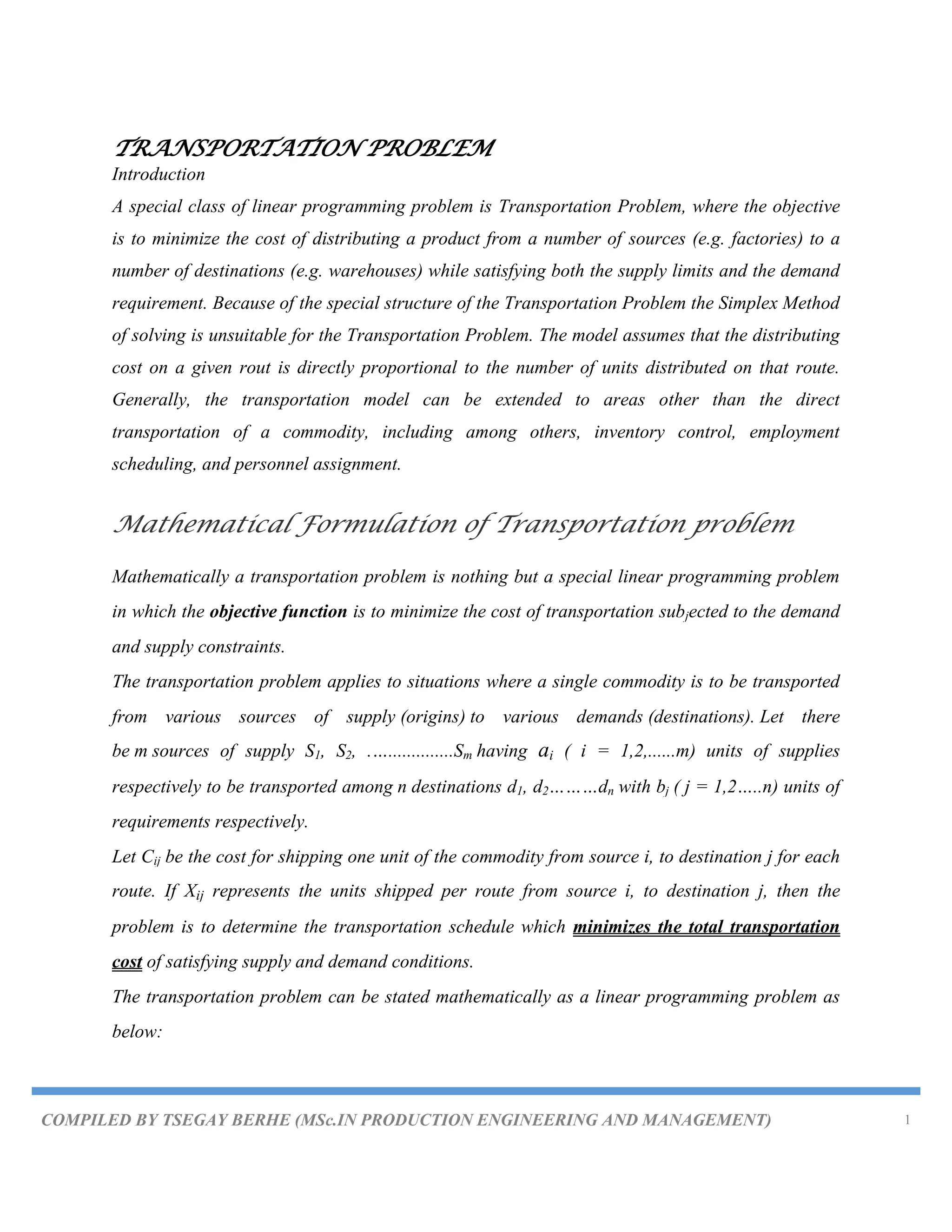
The transportation problem can be stated mathematically as a linear programming problem as
below:
COMPILED BY TSEGAY BERHE (MSc.IN PRODUCTION ENGINEERING AND MANAGEMENT) 2
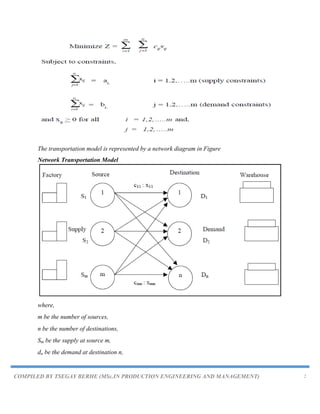
The transportation model is represented by a network diagram in Figure
Network Transportation Model
where,
m be the number of sources,
n be the number of destinations,
Sm be the supply at source m,
dn be the demand at destination n,
COMPILED BY TSEGAY BERHE (MSc.IN PRODUCTION ENGINEERING AND MANAGEMENT) 3
Cij be the cost of transportation from source i to destination j, and
Xij be the number of units to be shipped from source i to destination j.
The objective is to minimize the total transportation cost by determining the unknown Xij, i.e., the
number of units to be shipped from the sources and the destinations while satisfying all the
supply and demand requirements.
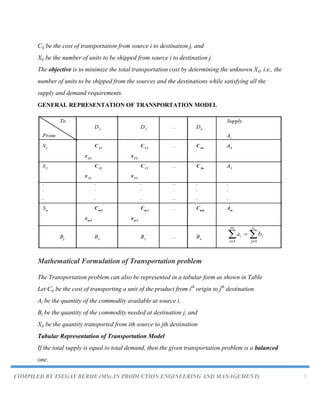
GENERAL REPRESENTATION OF TRANSPORTATION MODEL
Mathematical Formulation of Transportation problem
The Transportation problem can also be represented in a tabular form as shown in Table
Let Cij be the cost of transporting a unit of the product from ith
origin to jth
destination.
Ai be the quantity of the commodity available at source i,
Bj be the quantity of the commodity needed at destination j, and
Xij be the quantity transported from ith source to jth destination
Tabular Representation of Transportation Model
If the total supply is equal to total demand, then the given transportation problem is a balanced
one.
COMPILED BY TSEGAY BERHE (MSc.IN PRODUCTION ENGINEERING AND MANAGEMENT) 4
The transportation problem special feature is illustrated here with the help of following
Example.
Example 1:
Suppose MOHA soft drink company owns three factories (sources) and distribute his products to
five different retail agencies (destinations). The following table shows the capacities of the three
factories, the quantity of products required by the various retail agencies and the cost of
shipping one unit of the product from each of the three factories to each of the five retail
agencies.
Retail agency
Factories 1 2 3 4 5 Capacity
1 12 13 15 15 9 500
2 13 12 9 10 12 1000
3 14 15 10 13 9 1500
Requirement 700 600 500 700 500 3000
Solution
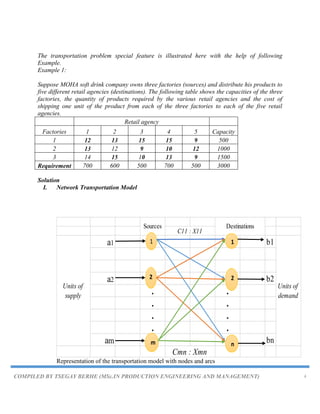
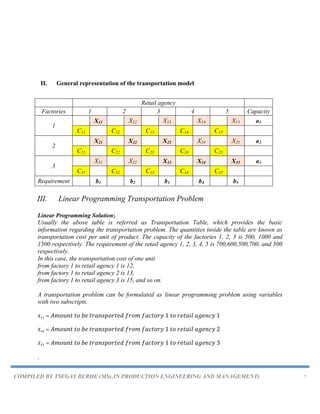
I. Network Transportation Model
Representation of the transportation model with nodes and arcs
a1 b1
a2 b2
. .
. .
. .
. .
am bn
Cmn : Xmn
Units of
supply
Units of
demand
Sources Destinations
C11 : X11
1
2
m
1
2
n
COMPILED BY TSEGAY BERHE (MSc.IN PRODUCTION ENGINEERING AND MANAGEMENT) 5
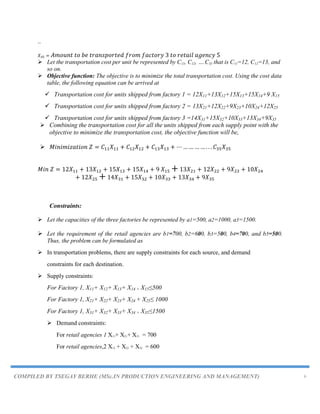
II. General representation of the transportation model
Retail agency
Factories 1 2 3 4 5 Capacity
1
X11 X12 X13 X14 X15 a1
C11 C12 C13 C14 C15
2
X21 X22 X23 X24 X25 a2
C21 C22 C23 C24 C25
3
X31 X32 X33 X34 X35 a3
C31 C32 C33 C34 C35
Requirement b1 b2 b3 b4 b5
III. Linear Programming Transportation Problem
Linear Programming Solution;
Usually the above table is referred as Transportation Table, which provides the basic
information regarding the transportation problem. The quantities inside the table are known as
transportation cost per unit of product. The capacity of the factories 1, 2, 3 is 500, 1000 and
1500 respectively. The requirement of the retail agency 1, 2, 3, 4, 5 is 700,600,500,700, and 500
respectively.
In this case, the transportation cost of one unit
from factory 1 to retail agency 1 is 12,
from factory 1 to retail agency 2 is 13,
from factory 1 to retail agency 3 is 15, and so on.
A transportation problem can be formulated as linear programming problem using variables
with two subscripts.
.
COMPILED BY TSEGAY BERHE (MSc.IN PRODUCTION ENGINEERING AND MANAGEMENT) 6
..
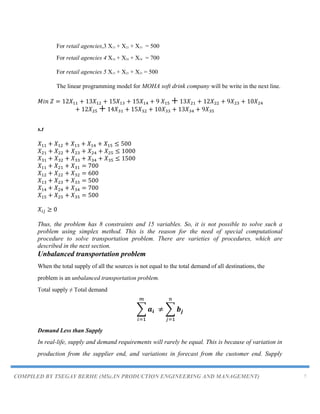
 Let the transportation cost per unit be represented by C11, C12, ….C35 that is C11=12, C12=13, and
so on.
 Objective function: The objective is to minimize the total transportation cost. Using the cost data
table, the following equation can be arrived at
 Transportation cost for units shipped from factory 1 = 12X11+13X12+15X13+15X14+9 X15
 Transportation cost for units shipped from factory 2 = 13X21+12X22+9X23+10X24+12X25
 Transportation cost for units shipped from factory 3 =14X31+15X32+10X33+13X34+9X35
 Combining the transportation cost for all the units shipped from each supply point with the
objective to minimize the transportation cost, the objective function will be,

Constraints:
 Let the capacities of the three factories be represented by a1=500, a2=1000, a3=1500.
 Let the requirement of the retail agencies are b1=700, b2=600, b3=500, b4=700, and b5=500.
Thus, the problem can be formulated as
 In transportation problems, there are supply constraints for each source, and demand
constraints for each destination.
 Supply constraints:
For Factory 1, X11+ X12+ X13+ X14 + X15≤500
For Factory 1, X21+ X22+ X23+ X24 + X25≤ 1000
For Factory 1, X31+ X32+ X33+ X34 + X35≤1500
 Demand constraints:
For retail agencies 1 X11+ X21+ X31 = 700
For retail agencies,2 X12 + X22 + X32 = 600
COMPILED BY TSEGAY BERHE (MSc.IN PRODUCTION ENGINEERING AND MANAGEMENT) 7
For retail agencies,3 X13 + X23 + X33 = 500
For retail agencies 4 X14 + X24 + X34 = 700
For retail agencies 5 X15 + X25 + X35 = 500
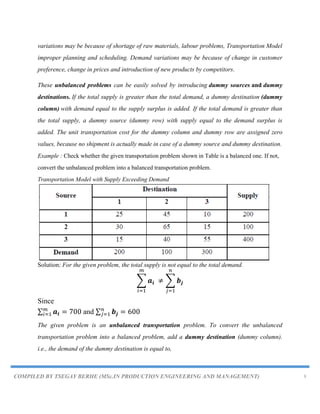
The linear programming model for MOHA soft drink company will be write in the next line.
s.t
Thus, the problem has 8 constraints and 15 variables. So, it is not possible to solve such a
problem using simplex method. This is the reason for the need of special computational
procedure to solve transportation problem. There are varieties of procedures, which are
described in the next section.
Unbalanced transportation problem
When the total supply of all the sources is not equal to the total demand of all destinations, the
problem is an unbalanced transportation problem.
Total supply ≠ Total demand
∑ ∑
Demand Less than Supply
In real-life, supply and demand requirements will rarely be equal. This is because of variation in
production from the supplier end, and variations in forecast from the customer end. Supply
COMPILED BY TSEGAY BERHE (MSc.IN PRODUCTION ENGINEERING AND MANAGEMENT) 8
variations may be because of shortage of raw materials, labour problems, Transportation Model
improper planning and scheduling. Demand variations may be because of change in customer
preference, change in prices and introduction of new products by competitors.
These unbalanced problems can be easily solved by introducing dummy sources and dummy
destinations. If the total supply is greater than the total demand, a dummy destination (dummy
column) with demand equal to the supply surplus is added. If the total demand is greater than
the total supply, a dummy source (dummy row) with supply equal to the demand surplus is
added. The unit transportation cost for the dummy column and dummy row are assigned zero
values, because no shipment is actually made in case of a dummy source and dummy destination.
Example : Check whether the given transportation problem shown in Table is a balanced one. If not,
convert the unbalanced problem into a balanced transportation problem.
Transportation Model with Supply Exceeding Demand
Solution: For the given problem, the total supply is not equal to the total demand.
∑ ∑
Since
∑ and ∑
The given problem is an unbalanced transportation problem. To convert the unbalanced
transportation problem into a balanced problem, add a dummy destination (dummy column).
i.e., the demand of the dummy destination is equal to,
COMPILED BY TSEGAY BERHE (MSc.IN PRODUCTION ENGINEERING AND MANAGEMENT) 9
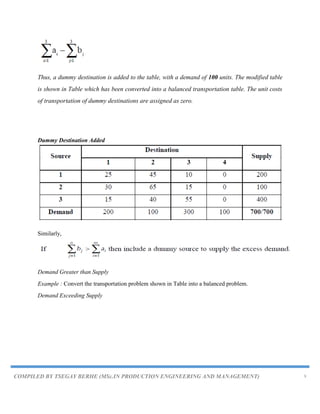
Thus, a dummy destination is added to the table, with a demand of 100 units. The modified table
is shown in Table which has been converted into a balanced transportation table. The unit costs
of transportation of dummy destinations are assigned as zero.
Dummy Destination Added
Similarly,
Demand Greater than Supply
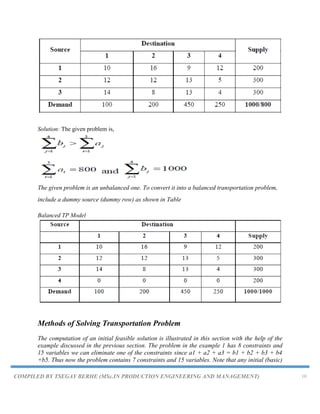
Example : Convert the transportation problem shown in Table into a balanced problem.
Demand Exceeding Supply
COMPILED BY TSEGAY BERHE (MSc.IN PRODUCTION ENGINEERING AND MANAGEMENT) 10
Solution: The given problem is,
The given problem is an unbalanced one. To convert it into a balanced transportation problem,
include a dummy source (dummy row) as shown in Table
Balanced TP Model
Methods of Solving Transportation Problem
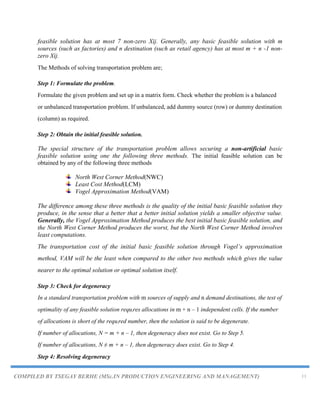
The computation of an initial feasible solution is illustrated in this section with the help of the
example discussed in the previous section. The problem in the example 1 has 8 constraints and
15 variables we can eliminate one of the constraints since a1 + a2 + a3 = b1 + b2 + b3 + b4
+b5. Thus now the problem contains 7 constraints and 15 variables. Note that any initial (basic)
COMPILED BY TSEGAY BERHE (MSc.IN PRODUCTION ENGINEERING AND MANAGEMENT) 11
feasible solution has at most 7 non-zero Xij. Generally, any basic feasible solution with m
sources (such as factories) and n destination (such as retail agency) has at most m + n -1 non-
zero Xij.
The Methods of solving transportation problem are;
Step 1: Formulate the problem.
Formulate the given problem and set up in a matrix form. Check whether the problem is a balanced
or unbalanced transportation problem. If unbalanced, add dummy source (row) or dummy destination
(column) as required.
Step 2: Obtain the initial feasible solution.
The special structure of the transportation problem allows securing a non-artificial basic
feasible solution using one the following three methods. The initial feasible solution can be
obtained by any of the following three methods
North West Corner Method(NWC)
Least Cost Method(LCM)
Vogel Approximation Method(VAM)
The difference among these three methods is the quality of the initial basic feasible solution they
produce, in the sense that a better that a better initial solution yields a smaller objective value.
Generally, the Vogel Approximation Method produces the best initial basic feasible solution, and
the North West Corner Method produces the worst, but the North West Corner Method involves
least computations.
The transportation cost of the initial basic feasible solution through Vogel‟s approximation
method, VAM will be the least when compared to the other two methods which gives the value
nearer to the optimal solution or optimal solution itself.
Step 3: Check for degeneracy
In a standard transportation problem with m sources of supply and n demand destinations, the test of
optimality of any feasible solution requires allocations in m + n – 1 independent cells. If the number
of allocations is short of the required number, then the solution is said to be degenerate.
If number of allocations, N = m + n – 1, then degeneracy does not exist. Go to Step 5.
If number of allocations, N ≠ m + n – 1, then degeneracy does exist. Go to Step 4.
Step 4: Resolving degeneracy
COMPILED BY TSEGAY BERHE (MSc.IN PRODUCTION ENGINEERING AND MANAGEMENT) 12
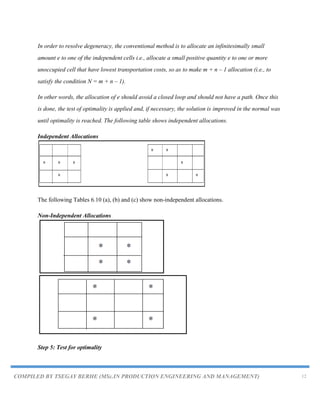
In order to resolve degeneracy, the conventional method is to allocate an infinitesimally small
amount e to one of the independent cells i.e., allocate a small positive quantity e to one or more
unoccupied cell that have lowest transportation costs, so as to make m + n – 1 allocation (i.e., to
satisfy the condition N = m + n – 1).
In other words, the allocation of e should avoid a closed loop and should not have a path. Once this
is done, the test of optimality is applied and, if necessary, the solution is improved in the normal was
until optimality is reached. The following table shows independent allocations.
Independent Allocations
The following Tables 6.10 (a), (b) and (c) show non-independent allocations.
Non-Independent Allocations
Step 5: Test for optimality
COMPILED BY TSEGAY BERHE (MSc.IN PRODUCTION ENGINEERING AND MANAGEMENT) 13
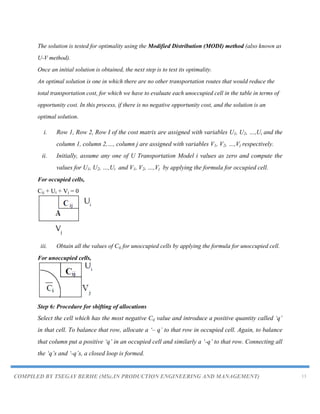
The solution is tested for optimality using the Modified Distribution (MODI) method (also known as
U-V method).
Once an initial solution is obtained, the next step is to test its optimality.
An optimal solution is one in which there are no other transportation routes that would reduce the
total transportation cost, for which we have to evaluate each unoccupied cell in the table in terms of
opportunity cost. In this process, if there is no negative opportunity cost, and the solution is an
optimal solution.
i. Row 1, Row 2, Row I of the cost matrix are assigned with variables U1, U2, …,Ui and the
column 1, column 2,…, column j are assigned with variables V1, V2, …,Vj respectively.
ii. Initially, assume any one of U Transportation Model i values as zero and compute the
values for U1, U2, …,Ui and V1, V2, …,Vj by applying the formula for occupied cell.
For occupied cells,
Cij + Ui + Vj = 0
iii. Obtain all the values of Cij for unoccupied cells by applying the formula for unoccupied cell.
For unoccupied cells,
Step 6: Procedure for shifting of allocations
Select the cell which has the most negative Cij value and introduce a positive quantity called „q‟
in that cell. To balance that row, allocate a „– q‟ to that row in occupied cell. Again, to balance
that column put a positive „q‟ in an occupied cell and similarly a „-q‟ to that row. Connecting all
the „q‟s and „-q‟s, a closed loop is formed.
COMPILED BY TSEGAY BERHE (MSc.IN PRODUCTION ENGINEERING AND MANAGEMENT) 14
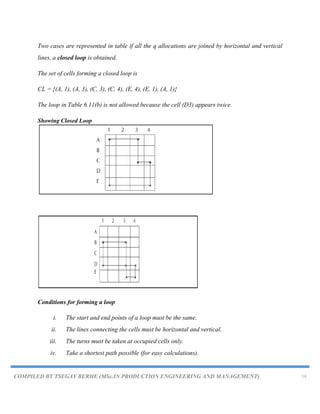
Two cases are represented in table if all the q allocations are joined by horizontal and vertical
lines, a closed loop is obtained.
The set of cells forming a closed loop is
CL = {(A, 1), (A, 3), (C, 3), (C, 4), (E, 4), (E, 1), (A, 1)}
The loop in Table 6.11(b) is not allowed because the cell (D3) appears twice.
Showing Closed Loop
Conditions for forming a loop
i. The start and end points of a loop must be the same.
ii. The lines connecting the cells must be horizontal and vertical.
iii. The turns must be taken at occupied cells only.
iv. Take a shortest path possible (for easy calculations).
COMPILED BY TSEGAY BERHE (MSc.IN PRODUCTION ENGINEERING AND MANAGEMENT) 15
Remarks on forming a loop
i. Every loop has an even number of cells and at least four cells
ii. Each row or column should have only one „+‟ and „–‟ sign.
iii. Closed loop may or may not be square in shape. It can also be a rectangle or a stepped
shape.
iv. It doesn‟t matter whether the loop is traced in a clockwise or anticlockwise direction.
Take the most negative '– q' value, and shift the allocated cells accordingly by adding the value in
positive cells and subtracting it in the negative cells. This gives a new improved table. Then go to
step 5 to test for optimality.
Step 7: Calculate the Total Transportation Cost.
Since all the Cij values are positive, optimality is reached and hence the present allocations are the
optimum allocations. Calculate the total transportation cost by summing the product of allocated
units and unit costs.
COMPILED BY TSEGAY BERHE (MSc.IN PRODUCTION ENGINEERING AND MANAGEMENT) 16
Example 2: The cost of transportation per unit from three sources[Factories] and five
destinations [Retail agency] are given in the following table Obtain the initial basic feasible
solutions using the following methods.
(i) North-west corner method
(ii) Least cost method
(iii) Vogel‟s approximation method
Retail agency
Factories 1 2 3 4 5 Capacity
1 12 13 15 15 9 500
2 13 12 9 10 12 1000
3 14 15 10 13 9 1500
Requirement 700 600 500 700 500 3000
Algorithms for all the three methods to find the initial basic feasible solution are given.
Algorithm for North-West Corner Method (NWC)
North West Corner Method:
In the northwest corner method, the largest possible allocation is made to the cell in the upper
left-hand corner of the tableau, followed by allocations to adjacent feasible cells.
The method starts at the North West (upper left) corner cell of the tableau (variable X11). With
the northwest corner method, an initial allocation is made to the cell in the upper left-hand
corner of the tableau (i.e., the “northwest corner”). The amount allocated is the most possible,
subject to the supply and demand constraints for that cell.
i. Select the North-west (i.e., upper left) corner cell of the table and allocate the
maximum possible units between the supply and demand requirements. During
allocation, the transportation cost is completely discarded (not taken into
consideration).
ii. Delete that row or column which has no values (fully exhausted) for supply or
demand.
iii. Now, with the new reduced table, again select the North-west corner cell and
allocate the available values.
iv. Repeat steps (ii) and (iii) until all the supply and demand values are zero.
v. Obtain the initial basic feasible solution.
Example 2.1: Consider the problem discussed in the above Example to illustrate the North West
Corner Method of determining basic feasible solution.
COMPILED BY TSEGAY BERHE (MSc.IN PRODUCTION ENGINEERING AND MANAGEMENT) 17
Retail agency
Factories 1 2 3 4 5 Capacity
1 12 13 15 15 9 500
2 13 12 9 10 12 1000
3 14 15 10 13 9 1500
Requirement 700 600 500 700 500 3000
Solution
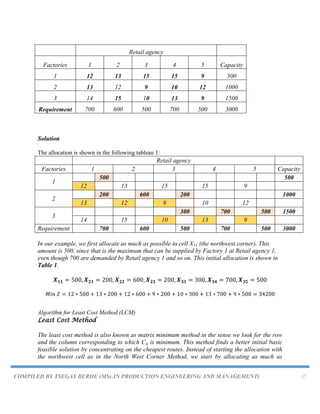
The allocation is shown in the following tableau 1:
Retail agency
Factories 1 2 3 4 5 Capacity
1
500 500
12 13 15 15 9
2
200 600 200 1000
13 12 9 10 12
3
300 700 500 1500
14 15 10 13 9
Requirement 700 600 500 700 500 3000
In our example, we first allocate as much as possible to cell X11 (the northwest corner). This
amount is 500, since that is the maximum that can be supplied by Factory 1 at Retail agency 1,
even though 700 are demanded by Retail agency 1 and so on. This initial allocation is shown in
Table 1.
Algorithm for Least Cost Method (LCM)
Least Cost Method
The least cost method is also known as matrix minimum method in the sense we look for the row
and the column corresponding to which Cij is minimum. This method finds a better initial basic
feasible solution by concentrating on the cheapest routes. Instead of starting the allocation with
the northwest cell as in the North West Corner Method, we start by allocating as much as
COMPILED BY TSEGAY BERHE (MSc.IN PRODUCTION ENGINEERING AND MANAGEMENT) 18
possible to the cell with the smallest unit cost. If there are two or more minimum costs, then we
should select the row and the column corresponding to the lower numbered row. If they appear
in the same row, we should select the lower numbered column. We then cross out the satisfied
row or column, and adjust the amounts of capacity and requirement accordingly. If both a row
and a column is satisfied simultaneously, only one is crossed out. Next, we look for the
uncrossed-out cell with the smallest unit cost and repeat the process until we are left at the end
with exactly one uncrossed-out row or column.
i. Select the smallest transportation cost cell available in the entire table and
allocate the supply and demand.
ii. Delete that row/column which has exhausted. The deleted row/column must not
be considered for further allocation.
iii. Again select the smallest cost cell in the existing table and allocate. (Note: In
case, if there are more than one smallest costs, select the cells where maximum
allocation can be made)
iv. Obtain the initial basic feasible solution.
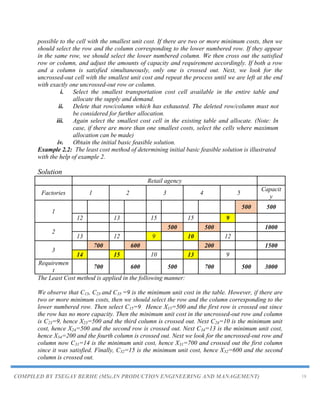
Example 2.2: The least cost method of determining initial basic feasible solution is illustrated
with the help of example 2.
Solution
Retail agency
Factories 1 2 3 4 5
Capacit
y
1
500 500
12 13 15 15 9
2
500 500 1000
13 12 9 10 12
3
700 600 200 1500
14 15 10 13 9
Requiremen
t
700 600 500 700 500 3000
The Least Cost method is applied in the following manner:
We observe that C15, C23 and C35 =9 is the minimum unit cost in the table. However, if there are
two or more minimum costs, then we should select the row and the column corresponding to the
lower numbered row. Then select C15=9. Hence X15=500 and the first row is crossed out since
the row has no more capacity. Then the minimum unit cost in the uncrossed-out row and column
is C23=9, hence X23=500 and the third column is crossed out. Next C24=10 is the minimum unit
cost, hence X24=500 and the second row is crossed out. Next C34=13 is the minimum unit cost,
hence X34=200 and the fourth column is crossed out. Next we look for the uncrossed-out row and
column now C31=14 is the minimum unit cost, hence X31=700 and crossed out the first column
since it was satisfied. Finally, C32=15 is the minimum unit cost, hence X32=600 and the second
column is crossed out.
COMPILED BY TSEGAY BERHE (MSc.IN PRODUCTION ENGINEERING AND MANAGEMENT) 19
So that the basic feasible solution developed by the Least Cost Method has transportation cost is
Algorithm for Vogel’s Approximation Method (VAM)
Vogel Approximation Method (VAM):
The third method for determining an initial solution, Vogel‟s approximation model (also called
VAM), is based on the concept of penalty cost or regret. If a decision maker incorrectly chooses
from several alternative courses of action, a penalty may be suffered (and the decision maker may
regret the decision that was made). In a transportation problem, the courses of action are the
alternative routes, and a wrong decision is allocating to a cell that does not contain the lowest
cost.
VAM is an improved version of the least cost method that generally produces better solutions.
The steps involved in this method are:
Step 1. For each row (column) with strictly positive capacity (requirement), determine a
penalty by subtracting the smallest unit cost element in the row (column) from the
next smallest unit cost element in the same row (column). If there are two smallest
costs, then the penalty is zero.
Step 2. Identify the row or column with the largest penalty among all the rows and
columns make allocation in the cell having the least cost in the selected row/column.
If the penalties corresponding to two or more rows or columns are equal, we select
the top most row and the extreme left column. If two or more equal penalties exist,
select one where a row/column contains minimum unit cost. If there is again a tie,
select one where maximum allocation can be made.
Step 3. We select Xij as a basic variable if Cij is the minimum cost in the row or column
with largest penalty. We choose the numerical value of Xij as high as possible subject
to the row and the column constraints. Depending upon whether ai or bj is the smaller
of the two ith row or jth column is crossed out [Delete the row/column, which has
satisfied the supply and demand.]
Step 4. The Step 2 is now performed on the uncrossed-out rows and columns until all the
basic variables have been satisfied [ Repeat steps (i) and (ii) until the entire supply
and demands are satisfied.]
Step 5. Obtain the initial basic feasible solution.
Remarks: The initial solution obtained by any of the three methods must satisfy the following
conditions:
a. The solution must be feasible, i.e., the supply and demand constraints must be satisfied (also
known as rim conditions).
COMPILED BY TSEGAY BERHE (MSc.IN PRODUCTION ENGINEERING AND MANAGEMENT) 20
b. The number of positive allocations, N must be equal to m+n-1, where m is the number of rows
and n is the number of columns.
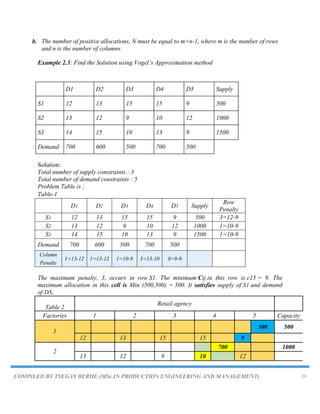
Example 2.3: Find the Solution using Vogel‟s Approximation method
D1 D2 D3 D4 D5 Supply
S1 12 13 15 15 9 500
S2 13 12 9 10 12 1000
S3 14 15 10 13 9 1500
Demand 700 600 500 700 500
Solution:
Total number of supply constraints : 3
Total number of demand constraints : 5
Problem Table is ;
Table-1
D1 D2 D3 D4 D5 Supply
Row
Penalty
S1 12 13 15 15 9 500 3=12-9
S2 13 12 9 10 12 1000 1=10-9
S3 14 15 10 13 9 1500 1=10-9
Demand 700 600 500 700 500
Column
1=13-12 1=13-12 1=10-9 3=13-10 0=9-9
Penalty
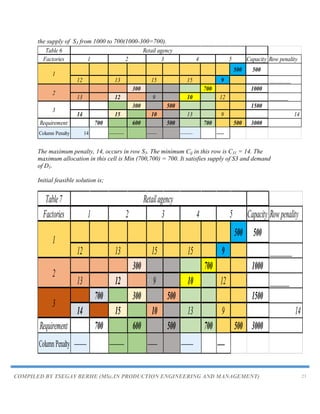
The maximum penalty, 3, occurs in row S1. The minimum Cij in this row is c15 = 9. The
maximum allocation in this cell is Min (500,500) = 500. It satisfies supply of S1 and demand
of D5.
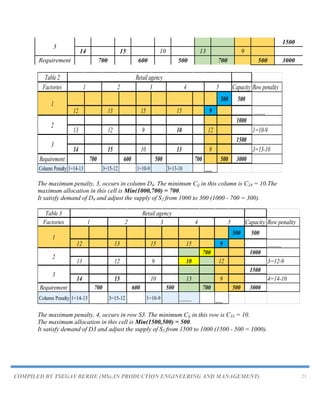
Table 2
Retail agency
Factories 1 2 3 4 5 Capacity
1
500 500
12 13 15 15 9
2
700 1000
13 12 9 10 12
COMPILED BY TSEGAY BERHE (MSc.IN PRODUCTION ENGINEERING AND MANAGEMENT) 21
3
1500
14 15 10 13 9
Requirement 700 600 500 700 500 3000
The maximum penalty, 3, occurs in column D4. The minimum Cij in this column is C24 = 10.The
maximum allocation in this cell is Min(1000,700) = 700.
It satisfy demand of D4 and adjust the supply of S2 from 1000 to 300 (1000 - 700 = 300).
The maximum penalty, 4, occurs in row S3. The minimum Cij in this row is C33 = 10.
The maximum allocation in this cell is Min(1500,500) = 500.
It satisfy demand of D3 and adjust the supply of S3 from 1500 to 1000 (1500 - 500 = 1000).
Table 2
Factories Capacity Row penality
500 500
12 13 15 15 9 _____
1000
13 12 9 10 12 1=10-9
1500
14 15 10 13 9 3=13-10
Requirement 700 600 500 700 500 3000
Column Penalty 1=14-13 3=15-12 1=10-9 3=13-10 ___
1
2
3
Retail agency
1 2 3 4 5
Table 3
Factories Capacity Row penality
500 500
12 13 15 15 9 _____
700 1000
13 12 9 10 12 3=12-9
1500
14 15 10 13 9 4=14-10
Requirement 700 600 500 700 500 3000
Column Penalty 1=14-13 3=15-12 1=10-9 _____ ___
2
3
1 2 3 4 5
1
Retail agency
COMPILED BY TSEGAY BERHE (MSc.IN PRODUCTION ENGINEERING AND MANAGEMENT) 22
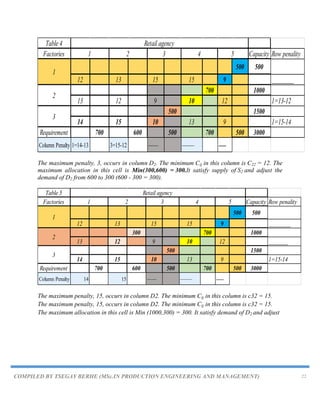
The maximum penalty, 3, occurs in column D2. The minimum Cij in this column is C22 = 12. The
maximum allocation in this cell is Min(300,600) = 300.It satisfy supply of S2 and adjust the
demand of D2 from 600 to 300 (600 - 300 = 300).
The maximum penalty, 15, occurs in column D2. The minimum Cij in this column is c32 = 15.
The maximum allocation in this cell is Min (1000,300) = 300. It satisfy demand of D2 and adjust
Table 4
Factories Capacity Row penality
500 500
12 13 15 15 9 ________
700 1000
13 12 9 10 12 1=13-12
500 1500
14 15 10 13 9 1=15-14
Requirement 700 600 500 700 500 3000
Column Penalty 1=14-13 3=15-12 ____ _____ ___
2
3
1 2 3 4 5
1
Retail agency
Table 5
Factories Capacity Row penality
500 500
12 13 15 15 9 ________
300 700 1000
13 12 9 10 12 _______
500 1500
14 15 10 13 9 1=15-14
Requirement 700 600 500 700 500 3000
Column Penalty 14 15 ____ _____ ___
1
2
3
Retail agency
1 2 3 4 5
COMPILED BY TSEGAY BERHE (MSc.IN PRODUCTION ENGINEERING AND MANAGEMENT) 23
the supply of S3 from 1000 to 700(1000-300=700).
The maximum penalty, 14, occurs in row S3. The minimum Cij in this row is C31 = 14. The
maximum allocation in this cell is Min (700,700) = 700. It satisfies supply of S3 and demand
of D1.
Initial feasible solution is;
Table 6
Factories Capacity Row penality
500 500
12 13 15 15 9 ________
300 700 1000
13 12 9 10 12 _______
300 500 1500
14 15 10 13 9 14
Requirement 700 600 500 700 500 3000
Column Penalty 14 ______ ____ _____ ___
1
2
3
Retail agency
1 2 3 4 5
Table7
Factories Capacity Rowpenality
500 500
12 13 15 15 9 ________
300 700 1000
13 12 9 10 12 _______
700 300 500 1500
14 15 10 13 9 14
Requirement 700 600 500 700 500 3000
ColumnPenalty _____ ______ ____ _____ ___
1
2
3
Retailagency
1 2 3 4 5
COMPILED BY TSEGAY BERHE (MSc.IN PRODUCTION ENGINEERING AND MANAGEMENT) 24
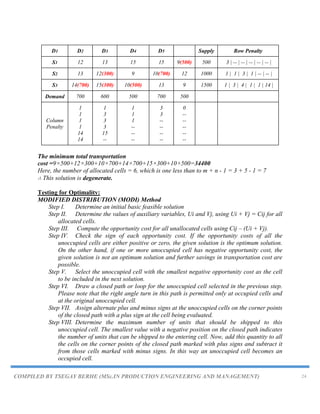
D1 D2 D3 D4 D5 Supply Row Penalty
S1 12 13 15 15 9(500) 500 3 | -- | -- | -- | -- | -- |
S2 13 12(300) 9 10(700) 12 1000 1 | 1 | 3 | 1 | -- | -- |
S3 14(700) 15(300) 10(500) 13 9 1500 1 | 3 | 4 | 1 | 1 | 14 |
Demand 700 600 500 700 500
Column
Penalty
1
1
1
1
14
14
1
3
3
3
15
--
1
1
1
--
--
--
3
3
--
--
--
--
0
--
--
--
--
--
The minimum total transportation
cost =9×500+12×300+10×700+14×700+15×300+10×500=34400
Here, the number of allocated cells = 6, which is one less than to m + n - 1 = 3 + 5 - 1 = 7
∴ This solution is degenerate.
Testing for Optimality:
MODIFIED DISTRIBUTION (MODI) Method
Step I. Determine an initial basic feasible solution
Step II. Determine the values of auxiliary variables, Ui and Vj, using Ui + Vj = Cij for all
allocated cells.
Step III. Compute the opportunity cost for all unallocated cells using Cij – (Ui + Vj).
Step IV. Check the sign of each opportunity cost. If the opportunity costs of all the
unoccupied cells are either positive or zero, the given solution is the optimum solution.
On the other hand, if one or more unoccupied cell has negative opportunity cost, the
given solution is not an optimum solution and further savings in transportation cost are
possible.
Step V. Select the unoccupied cell with the smallest negative opportunity cost as the cell
to be included in the next solution.
Step VI. Draw a closed path or loop for the unoccupied cell selected in the previous step.
Please note that the right angle turn in this path is permitted only at occupied cells and
at the original unoccupied cell.
Step VII. Assign alternate plus and minus signs at the unoccupied cells on the corner points
of the closed path with a plus sign at the cell being evaluated.
Step VIII. Determine the maximum number of units that should be shipped to this
unoccupied cell. The smallest value with a negative position on the closed path indicates
the number of units that can be shipped to the entering cell. Now, add this quantity to all
the cells on the corner points of the closed path marked with plus signs and subtract it
from those cells marked with minus signs. In this way an unoccupied cell becomes an
occupied cell.
COMPILED BY TSEGAY BERHE (MSc.IN PRODUCTION ENGINEERING AND MANAGEMENT) 25
Step IX. Repeat the whole procedure until an optimum solution is obtained.
Example
Find the optimal solution using modi method [using initial basic solution of Least Cost method].
D1 D2 D3 Supply
S1 16 20 12 200
S2 14 8 18 160
S3 26 24 16 90
Demand 180 120 150
initial basic solution by using Least Cost method
D1 D2 D3 Supply
S1 16 (50) 20 12 (150) 200
S2 14 (40) 8 (120) 18 160
S3 26 (90) 24 16 90
Demand 180 120 150
The minimum total transportation cost =16×50+12×150+14×40+8×120+26×90=6460
Here, the number of allocated cells = 5 is equal to m + n - 1 = 3 + 3 - 1 = 5
∴ This solution is non- degenerate
Optimality test using modi method...
Allocation Table is;
D1 D2 D3 Supply
S1 16 (50) 20 12 (150) 200
S2 14 (40) 8 (120) 18 160
S3 26 (90) 24 16 90
Demand 180 120 150
Iteration-1 of optimality test
Step I.Find Ui and Vj for all occupied cells (i, j), where Cij=Ui+Vj
Let substituting, V1=0, we get
COMPILED BY TSEGAY BERHE (MSc.IN PRODUCTION ENGINEERING AND MANAGEMENT) 26
C11=U1+V1⇒U1=C11-V1⇒U1=16-0 ⇒U1=16
C13=U1+V3⇒V3=C13-U1⇒V3=12-16 ⇒V3=-4
C21=U2+V1⇒U2=C21-V1⇒U2=14-0 ⇒U2=14
C22=U2+V2⇒V2=C22-U2⇒V2=8-14 ⇒V2=-6
C31=U3+V1⇒U3=C31-V1⇒U3=26-0 ⇒U3=26
D1 D2 D3 Supply Ui
S1 16 (50) 20 12 (150) 200 U1=16
S2 14 (40) 8 (120) 18 160 U2=14
S3 26 (90) 24 16 90 U3=26
Demand 180 120 150
Vj V1=0 V2=-6 V3=-4
Step II.Find dij for all unoccupied cells (i, j), where dij=Cij-(Ui+Vj)
 d12=C12-(U1+V2) =20-(16-6) =10
 d23=C23-(U2+V3) =18-(14-4) =8
 d32=C32-(U3+V2) =24-(26-6) =4
 d33=C33-(U3+V3) =16-(26-4) =-6
D1 D2 D3 Supply ui
S1 16 (50) 20 [10] 12 (150) 200 U1=16
S2 14 (40) 8 (120) 18 [8] 160 U2=14
S3 26 (90) 24 [4] 16 [-6] 90 U3=26
Demand 180 120 150
Vj V1=0 V2=-6 V3=-4
Step III. Now choose the minimum negative value from all dij (opportunity cost) = d33 = [-6]
and draw a closed path from S3D3
Now choose the minimum negative value from all dij (opportunity cost) = d33 = [-6] and draw
a closed path from S3D3.
Closed path is S3D3→S3D1→S1D1→S1D3
Closed path and plus/minus sign allocation.
COMPILED BY TSEGAY BERHE (MSc.IN PRODUCTION ENGINEERING AND MANAGEMENT) 27
D1 D2 D3 Supply Ui
S1 16 (50)
(+)
20 [10] 12 (150)
(-)
200 U1=16
S2 14 (40) 8 (120) 18 [8] 160 U2=14
S3 26 (90)
(-)
24 [4] 16 [-6]
(+)
90 U3=26
Demand 180 120 150
Vj V1=0 V2=-6 V3=-4
Step IV.Minimum allocated value among all negative position (-) on closed path = 90.
Substract 90 from all (-) and Add it to all (+)
D1 D2 D3 Supply
S1 16 (140) 20 12 (60) 200
S2 14 (40) 8 (120) 18 160
S3 26 24 16 (90) 90
Demand 180 120 150
Step V.Repeat the step 1 to 4, until an optimal solution is obtained
Iteration-2 of optimality test
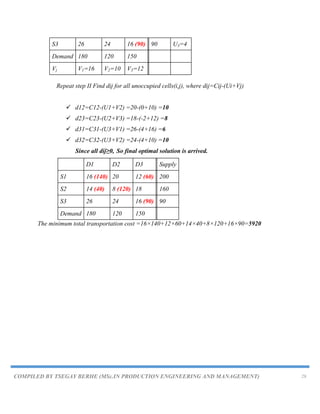
Find Ui and Vj for all occupied cells(i,j), where Cij=Ui+Vj
Let substituting, U1=0, we get
C11=U1+V1⇒V1=C11-U1⇒V1=16-0 ⇒V1=16
C21=U2+V1⇒U2=C21-V1⇒U2=14-16 ⇒U2=-2
C22=U2+V2⇒V2=C22-U2⇒V2=8+2 ⇒V2=10
C13=U1+V3⇒V3=C13-U1⇒V3=12-0 ⇒V3=12
C33=U3+V3⇒U3=C33-V3⇒U3=16-12 ⇒U3=4
D1 D2 D3 Supply Ui
S1 16 (140) 20 12 (60) 200 U1=0
S2 14 (40) 8 (120) 18 160 U2=-2
COMPILED BY TSEGAY BERHE (MSc.IN PRODUCTION ENGINEERING AND MANAGEMENT) 28
S3 26 24 16 (90) 90 U3=4
Demand 180 120 150
Vj V1=16 V2=10 V3=12
Repeat step II Find dij for all unoccupied cells(i,j), where dij=Cij-(Ui+Vj)
 d12=C12-(U1+V2) =20-(0+10) =10
 d23=C23-(U2+V3) =18-(-2+12) =8
 d31=C31-(U3+V1) =26-(4+16) =6
 d32=C32-(U3+V2) =24-(4+10) =10
Since all dij≥0, So final optimal solution is arrived.
D1 D2 D3 Supply
S1 16 (140) 20 12 (60) 200
S2 14 (40) 8 (120) 18 160
S3 26 24 16 (90) 90
Demand 180 120 150
The minimum total transportation cost =16×140+12×60+14×40+8×120+16×90=5920
COMPILED BY TSEGAY BERHE (MSc.IN PRODUCTION ENGINEERING AND MANAGEMENT) 29
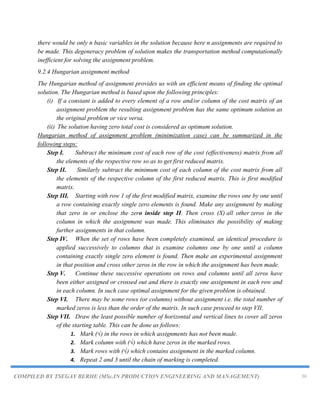
ASSIGNMENT TRANSPORTATION METHOD
Introduction
Although assignment problem can be solved either by using the techniques of Linear
Programming or by the transportation method yet the assignment method developed by
D. Konig, a Hungarian mathematician known as the Hungarian method of assignment problem
is much faster and efficient. In order to use this method, one needs to know only the cost of
making all the possible assignments. Each assignment problem has a matrix (table) associated
with it. Normally, the objects (or people) one wishes to assign are expressed in rows, whereas
the columns represent the tasks (or things) assigned to them. The number in the table would then
be the costs associated with each particular assignment. It may be noted that the assignment
problem is a variation of transportation problem with two characteristics firstly the cost matrix
is a square matrix and secondly the optimum solution for the problem would be such that there
would be only one assignment in a row or column of the cost matrix.
Solution of Assignment Problem
The assignment problem can be solved by the following four methods:
a) Complete enumeration method
b) Simplex Method
c) Transportation method
d) Hungarian method
a. Complete enumeration method
In this method, a list of all possible assignments among the given resources and activities is
prepared. Then an assignment involving the minimum cost, time or distance or maximum profits
is selected. If two or more assignments have the same minimum cost, time or distance, the
problem has multiple optimal solutions. This method can be used only if the number of
assignments is less. It becomes unsuitable for manual calculations if number of assignments is
large.
b. Simplex method
This can be solved as a linear programming problem as discussed in section 8.1.3 of the last
lesson and as such can be solved by the simplex algorithm.
c. Transportation method
As assignment is a special case of transportation problem, it can also be solved using
transportation model discussed in module 3. The solution obtained by applying this method
would be degenerate. This is because the optimality test in the transportation method requires
that there must be m+n-1= (2n-1) basic variables. For an assignment problem of order n x n
COMPILED BY TSEGAY BERHE (MSc.IN PRODUCTION ENGINEERING AND MANAGEMENT) 30
there would be only n basic variables in the solution because here n assignments are required to
be made. This degeneracy problem of solution makes the transportation method computationally
inefficient for solving the assignment problem.
9.2.4 Hungarian assignment method
The Hungarian method of assignment provides us with an efficient means of finding the optimal
solution. The Hungarian method is based upon the following principles:
(i) If a constant is added to every element of a row and/or column of the cost matrix of an
assignment problem the resulting assignment problem has the same optimum solution as
the original problem or vice versa.
(ii) The solution having zero total cost is considered as optimum solution.
Hungarian method of assignment problem (minimization case) can be summarized in the
following steps:
Step I. Subtract the minimum cost of each row of the cost (effectiveness) matrix from all
the elements of the respective row so as to get first reduced matrix.
Step II. Similarly subtract the minimum cost of each column of the cost matrix from all
the elements of the respective column of the first reduced matrix. This is first modified
matrix.
Step III. Starting with row 1 of the first modified matrix, examine the rows one by one until
a row containing exactly single zero elements is found. Make any assignment by making
that zero in or enclose the zero inside step II. Then cross (X) all other zeros in the
column in which the assignment was made. This eliminates the possibility of making
further assignments in that column.
Step IV. When the set of rows have been completely examined, an identical procedure is
applied successively to columns that is examine columns one by one until a column
containing exactly single zero element is found. Then make an experimental assignment
in that position and cross other zeros in the row in which the assignment has been made.
Step V. Continue these successive operations on rows and columns until all zeros have
been either assigned or crossed out and there is exactly one assignment in each row and
in each column. In such case optimal assignment for the given problem is obtained.
Step VI. There may be some rows (or columns) without assignment i.e. the total number of
marked zeros is less than the order of the matrix. In such case proceed to step VII.
Step VII. Draw the least possible number of horizontal and vertical lines to cover all zeros
of the starting table. This can be done as follows:
1. Mark (√) in the rows in which assignments has not been made.
2. Mark column with (√) which have zeros in the marked rows.
3. Mark rows with (√) which contains assignment in the marked column.
4. Repeat 2 and 3 until the chain of marking is completed.
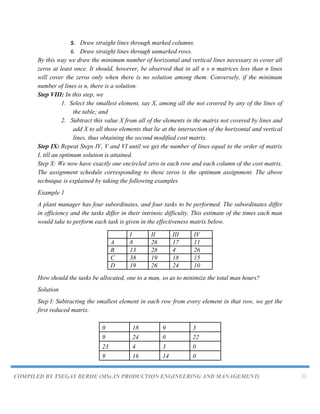
COMPILED BY TSEGAY BERHE (MSc.IN PRODUCTION ENGINEERING AND MANAGEMENT) 31
5. Draw straight lines through marked columns.
6. Draw straight lines through unmarked rows.
By this way we draw the minimum number of horizontal and vertical lines necessary to cover all
zeros at least once. It should, however, be observed that in all n x n matrices less than n lines
will cover the zeros only when there is no solution among them. Conversely, if the minimum
number of lines is n, there is a solution.
Step VIII: In this step, we
1. Select the smallest element, say X, among all the not covered by any of the lines of
the table; and
2. Subtract this value X from all of the elements in the matrix not covered by lines and
add X to all those elements that lie at the intersection of the horizontal and vertical
lines, thus obtaining the second modified cost matrix.
Step IX: Repeat Steps IV, V and VI until we get the number of lines equal to the order of matrix
I, till an optimum solution is attained.
Step X: We now have exactly one encircled zero in each row and each column of the cost matrix.
The assignment schedule corresponding to these zeros is the optimum assignment. The above
technique is explained by taking the following examples
Example 1
A plant manager has four subordinates, and four tasks to be performed. The subordinates differ
in efficiency and the tasks differ in their intrinsic difficulty. This estimate of the times each man
would take to perform each task is given in the effectiveness matrix below.
I II III IV
A 8 26 17 11
B 13 28 4 26
C 38 19 18 15
D 19 26 24 10
How should the tasks be allocated, one to a man, so as to minimize the total man hours?
Solution
Step I: Subtracting the smallest element in each row from every element in that row, we get the
first reduced matrix.
0 18 9 3
9 24 0 22
23 4 3 0
9 16 14 0
COMPILED BY TSEGAY BERHE (MSc.IN PRODUCTION ENGINEERING AND MANAGEMENT) 32
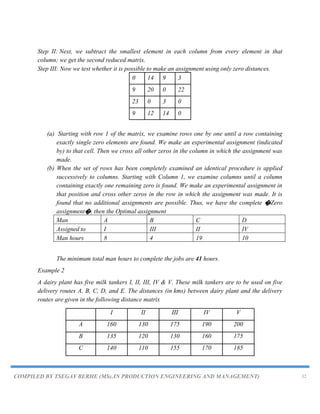
Step II: Next, we subtract the smallest element in each column from every element in that
column; we get the second reduced matrix.
Step III: Now we test whether it is possible to make an assignment using only zero distances.
0 14 9 3
9 20 0 22
23 0 3 0
9 12 14 0
(a) Starting with row 1 of the matrix, we examine rows one by one until a row containing
exactly single zero elements are found. We make an experimental assignment (indicated
by) to that cell. Then we cross all other zeros in the column in which the assignment was
made.
(b) When the set of rows has been completely examined an identical procedure is applied
successively to columns. Starting with Column 1, we examine columns until a column
containing exactly one remaining zero is found. We make an experimental assignment in
that position and cross other zeros in the row in which the assignment was made. It is
found that no additional assignments are possible. Thus, we have the complete �Zero
assignment�, then the Optimal assignment
Man A B C D
Assigned to I III II IV
Man hours 8 4 19 10
The minimum total man hours to complete the jobs are 41 hours.
Example 2
A dairy plant has five milk tankers I, II, III, IV & V. These milk tankers are to be used on five
delivery routes A, B, C, D, and E. The distances (in kms) between dairy plant and the delivery
routes are given in the following distance matrix
I II III IV V
A 160 130 175 190 200
B 135 120 130 160 175
C 140 110 155 170 185
COMPILED BY TSEGAY BERHE (MSc.IN PRODUCTION ENGINEERING AND MANAGEMENT) 33
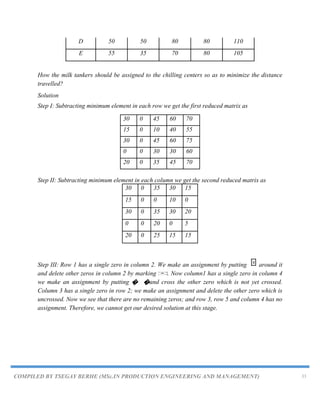
D 50 50 80 80 110
E 55 35 70 80 105
How the milk tankers should be assigned to the chilling centers so as to minimize the distance
travelled?
Solution
Step I: Subtracting minimum element in each row we get the first reduced matrix as
30 0 45 60 70
15 0 10 40 55
30 0 45 60 75
0 0 30 30 60
20 0 35 45 70
Step II: Subtracting minimum element in each column we get the second reduced matrix as
30 0 35 30 15
15 0 0 10 0
30 0 35 30 20
0 0 20 0 5
20 0 25 15 15
Step III: Row 1 has a single zero in column 2. We make an assignment by putting around it
and delete other zeros in column 2 by marking . Now column1 has a single zero in column 4
we make an assignment by putting � �and cross the other zero which is not yet crossed.
Column 3 has a single zero in row 2; we make an assignment and delete the other zero which is
uncrossed. Now we see that there are no remaining zeros; and row 3, row 5 and column 4 has no
assignment. Therefore, we cannot get our desired solution at this stage.
COMPILED BY TSEGAY BERHE (MSc.IN PRODUCTION ENGINEERING AND MANAGEMENT) 34
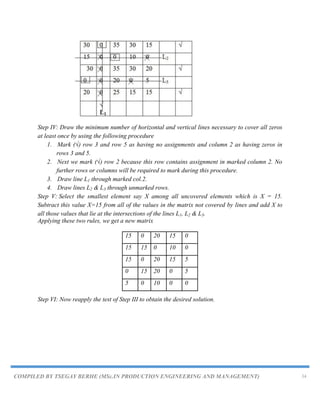
Step IV: Draw the minimum number of horizontal and vertical lines necessary to cover all zeros
at least once by using the following procedure
1. Mark (√) row 3 and row 5 as having no assignments and column 2 as having zeros in
rows 3 and 5.
2. Next we mark (√) row 2 because this row contains assignment in marked column 2. No
further rows or columns will be required to mark during this procedure.
3. Draw line L1 through marked col.2.
4. Draw lines L2 & L3 through unmarked rows.
Step V: Select the smallest element say X among all uncovered elements which is X = 15.
Subtract this value X=15 from all of the values in the matrix not covered by lines and add X to
all those values that lie at the intersections of the lines L1, L2 & L3.
Applying these two rules, we get a new matrix
15 0 20 15 0
15 15 0 10 0
15 0 20 15 5
0 15 20 0 5
5 0 10 0 0
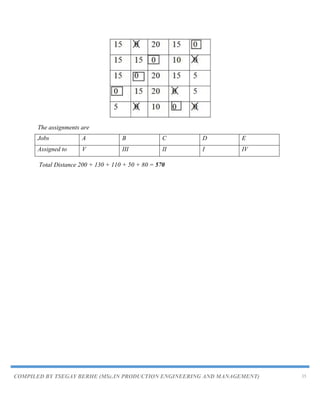
Step VI: Now reapply the test of Step III to obtain the desired solution.
COMPILED BY TSEGAY BERHE (MSc.IN PRODUCTION ENGINEERING AND MANAGEMENT) 35
The assignments are
Jobs A B C D E
Assigned to V III II I IV
Total Distance 200 + 130 + 110 + 50 + 80 = 570

Chapter 5.TRANSPORTATION PROBLEM.pdf

  • 1.
    COMPILED BY TSEGAYBERHE (MSc.IN PRODUCTION ENGINEERING AND MANAGEMENT) 1 TRANSPORTATION PROBLEM Introduction A special class of linear programming problem is Transportation Problem, where the objective is to minimize the cost of distributing a product from a number of sources (e.g. factories) to a number of destinations (e.g. warehouses) while satisfying both the supply limits and the demand requirement. Because of the special structure of the Transportation Problem the Simplex Method of solving is unsuitable for the Transportation Problem. The model assumes that the distributing cost on a given rout is directly proportional to the number of units distributed on that route. Generally, the transportation model can be extended to areas other than the direct transportation of a commodity, including among others, inventory control, employment scheduling, and personnel assignment. Mathematical Formulation of Transportation problem Mathematically a transportation problem is nothing but a special linear programming problem in which the objective function is to minimize the cost of transportation subjected to the demand and supply constraints. The transportation problem applies to situations where a single commodity is to be transported from various sources of supply (origins) to various demands (destinations). Let there be m sources of supply S1, S2, .…..............Sm having ai ( i = 1,2,......m) units of supplies respectively to be transported among n destinations d1, d2………dn with bj ( j = 1,2…..n) units of requirements respectively. Let Cij be the cost for shipping one unit of the commodity from source i, to destination j for each route. If Xij represents the units shipped per route from source i, to destination j, then the problem is to determine the transportation schedule which minimizes the total transportation cost of satisfying supply and demand conditions. The transportation problem can be stated mathematically as a linear programming problem as below:
  • 2.
    COMPILED BY TSEGAYBERHE (MSc.IN PRODUCTION ENGINEERING AND MANAGEMENT) 2 The transportation model is represented by a network diagram in Figure Network Transportation Model where, m be the number of sources, n be the number of destinations, Sm be the supply at source m, dn be the demand at destination n,
  • 3.
    COMPILED BY TSEGAYBERHE (MSc.IN PRODUCTION ENGINEERING AND MANAGEMENT) 3 Cij be the cost of transportation from source i to destination j, and Xij be the number of units to be shipped from source i to destination j. The objective is to minimize the total transportation cost by determining the unknown Xij, i.e., the number of units to be shipped from the sources and the destinations while satisfying all the supply and demand requirements. GENERAL REPRESENTATION OF TRANSPORTATION MODEL Mathematical Formulation of Transportation problem The Transportation problem can also be represented in a tabular form as shown in Table Let Cij be the cost of transporting a unit of the product from ith origin to jth destination. Ai be the quantity of the commodity available at source i, Bj be the quantity of the commodity needed at destination j, and Xij be the quantity transported from ith source to jth destination Tabular Representation of Transportation Model If the total supply is equal to total demand, then the given transportation problem is a balanced one.
  • 4.
    COMPILED BY TSEGAYBERHE (MSc.IN PRODUCTION ENGINEERING AND MANAGEMENT) 4 The transportation problem special feature is illustrated here with the help of following Example. Example 1: Suppose MOHA soft drink company owns three factories (sources) and distribute his products to five different retail agencies (destinations). The following table shows the capacities of the three factories, the quantity of products required by the various retail agencies and the cost of shipping one unit of the product from each of the three factories to each of the five retail agencies. Retail agency Factories 1 2 3 4 5 Capacity 1 12 13 15 15 9 500 2 13 12 9 10 12 1000 3 14 15 10 13 9 1500 Requirement 700 600 500 700 500 3000 Solution I. Network Transportation Model Representation of the transportation model with nodes and arcs a1 b1 a2 b2 . . . . . . . . am bn Cmn : Xmn Units of supply Units of demand Sources Destinations C11 : X11 1 2 m 1 2 n
  • 5.
    COMPILED BY TSEGAYBERHE (MSc.IN PRODUCTION ENGINEERING AND MANAGEMENT) 5 II. General representation of the transportation model Retail agency Factories 1 2 3 4 5 Capacity 1 X11 X12 X13 X14 X15 a1 C11 C12 C13 C14 C15 2 X21 X22 X23 X24 X25 a2 C21 C22 C23 C24 C25 3 X31 X32 X33 X34 X35 a3 C31 C32 C33 C34 C35 Requirement b1 b2 b3 b4 b5 III. Linear Programming Transportation Problem Linear Programming Solution; Usually the above table is referred as Transportation Table, which provides the basic information regarding the transportation problem. The quantities inside the table are known as transportation cost per unit of product. The capacity of the factories 1, 2, 3 is 500, 1000 and 1500 respectively. The requirement of the retail agency 1, 2, 3, 4, 5 is 700,600,500,700, and 500 respectively. In this case, the transportation cost of one unit from factory 1 to retail agency 1 is 12, from factory 1 to retail agency 2 is 13, from factory 1 to retail agency 3 is 15, and so on. A transportation problem can be formulated as linear programming problem using variables with two subscripts. .
  • 6.
    COMPILED BY TSEGAYBERHE (MSc.IN PRODUCTION ENGINEERING AND MANAGEMENT) 6 ..  Let the transportation cost per unit be represented by C11, C12, ….C35 that is C11=12, C12=13, and so on.  Objective function: The objective is to minimize the total transportation cost. Using the cost data table, the following equation can be arrived at  Transportation cost for units shipped from factory 1 = 12X11+13X12+15X13+15X14+9 X15  Transportation cost for units shipped from factory 2 = 13X21+12X22+9X23+10X24+12X25  Transportation cost for units shipped from factory 3 =14X31+15X32+10X33+13X34+9X35  Combining the transportation cost for all the units shipped from each supply point with the objective to minimize the transportation cost, the objective function will be,  Constraints:  Let the capacities of the three factories be represented by a1=500, a2=1000, a3=1500.  Let the requirement of the retail agencies are b1=700, b2=600, b3=500, b4=700, and b5=500. Thus, the problem can be formulated as  In transportation problems, there are supply constraints for each source, and demand constraints for each destination.  Supply constraints: For Factory 1, X11+ X12+ X13+ X14 + X15≤500 For Factory 1, X21+ X22+ X23+ X24 + X25≤ 1000 For Factory 1, X31+ X32+ X33+ X34 + X35≤1500  Demand constraints: For retail agencies 1 X11+ X21+ X31 = 700 For retail agencies,2 X12 + X22 + X32 = 600
  • 7.
    COMPILED BY TSEGAYBERHE (MSc.IN PRODUCTION ENGINEERING AND MANAGEMENT) 7 For retail agencies,3 X13 + X23 + X33 = 500 For retail agencies 4 X14 + X24 + X34 = 700 For retail agencies 5 X15 + X25 + X35 = 500 The linear programming model for MOHA soft drink company will be write in the next line. s.t Thus, the problem has 8 constraints and 15 variables. So, it is not possible to solve such a problem using simplex method. This is the reason for the need of special computational procedure to solve transportation problem. There are varieties of procedures, which are described in the next section. Unbalanced transportation problem When the total supply of all the sources is not equal to the total demand of all destinations, the problem is an unbalanced transportation problem. Total supply ≠ Total demand ∑ ∑ Demand Less than Supply In real-life, supply and demand requirements will rarely be equal. This is because of variation in production from the supplier end, and variations in forecast from the customer end. Supply
  • 8.
    COMPILED BY TSEGAYBERHE (MSc.IN PRODUCTION ENGINEERING AND MANAGEMENT) 8 variations may be because of shortage of raw materials, labour problems, Transportation Model improper planning and scheduling. Demand variations may be because of change in customer preference, change in prices and introduction of new products by competitors. These unbalanced problems can be easily solved by introducing dummy sources and dummy destinations. If the total supply is greater than the total demand, a dummy destination (dummy column) with demand equal to the supply surplus is added. If the total demand is greater than the total supply, a dummy source (dummy row) with supply equal to the demand surplus is added. The unit transportation cost for the dummy column and dummy row are assigned zero values, because no shipment is actually made in case of a dummy source and dummy destination. Example : Check whether the given transportation problem shown in Table is a balanced one. If not, convert the unbalanced problem into a balanced transportation problem. Transportation Model with Supply Exceeding Demand Solution: For the given problem, the total supply is not equal to the total demand. ∑ ∑ Since ∑ and ∑ The given problem is an unbalanced transportation problem. To convert the unbalanced transportation problem into a balanced problem, add a dummy destination (dummy column). i.e., the demand of the dummy destination is equal to,
  • 9.
    COMPILED BY TSEGAYBERHE (MSc.IN PRODUCTION ENGINEERING AND MANAGEMENT) 9 Thus, a dummy destination is added to the table, with a demand of 100 units. The modified table is shown in Table which has been converted into a balanced transportation table. The unit costs of transportation of dummy destinations are assigned as zero. Dummy Destination Added Similarly, Demand Greater than Supply Example : Convert the transportation problem shown in Table into a balanced problem. Demand Exceeding Supply
  • 10.
    COMPILED BY TSEGAYBERHE (MSc.IN PRODUCTION ENGINEERING AND MANAGEMENT) 10 Solution: The given problem is, The given problem is an unbalanced one. To convert it into a balanced transportation problem, include a dummy source (dummy row) as shown in Table Balanced TP Model Methods of Solving Transportation Problem The computation of an initial feasible solution is illustrated in this section with the help of the example discussed in the previous section. The problem in the example 1 has 8 constraints and 15 variables we can eliminate one of the constraints since a1 + a2 + a3 = b1 + b2 + b3 + b4 +b5. Thus now the problem contains 7 constraints and 15 variables. Note that any initial (basic)
  • 11.
    COMPILED BY TSEGAYBERHE (MSc.IN PRODUCTION ENGINEERING AND MANAGEMENT) 11 feasible solution has at most 7 non-zero Xij. Generally, any basic feasible solution with m sources (such as factories) and n destination (such as retail agency) has at most m + n -1 non- zero Xij. The Methods of solving transportation problem are; Step 1: Formulate the problem. Formulate the given problem and set up in a matrix form. Check whether the problem is a balanced or unbalanced transportation problem. If unbalanced, add dummy source (row) or dummy destination (column) as required. Step 2: Obtain the initial feasible solution. The special structure of the transportation problem allows securing a non-artificial basic feasible solution using one the following three methods. The initial feasible solution can be obtained by any of the following three methods North West Corner Method(NWC) Least Cost Method(LCM) Vogel Approximation Method(VAM) The difference among these three methods is the quality of the initial basic feasible solution they produce, in the sense that a better that a better initial solution yields a smaller objective value. Generally, the Vogel Approximation Method produces the best initial basic feasible solution, and the North West Corner Method produces the worst, but the North West Corner Method involves least computations. The transportation cost of the initial basic feasible solution through Vogel‟s approximation method, VAM will be the least when compared to the other two methods which gives the value nearer to the optimal solution or optimal solution itself. Step 3: Check for degeneracy In a standard transportation problem with m sources of supply and n demand destinations, the test of optimality of any feasible solution requires allocations in m + n – 1 independent cells. If the number of allocations is short of the required number, then the solution is said to be degenerate. If number of allocations, N = m + n – 1, then degeneracy does not exist. Go to Step 5. If number of allocations, N ≠ m + n – 1, then degeneracy does exist. Go to Step 4. Step 4: Resolving degeneracy
  • 12.
    COMPILED BY TSEGAYBERHE (MSc.IN PRODUCTION ENGINEERING AND MANAGEMENT) 12 In order to resolve degeneracy, the conventional method is to allocate an infinitesimally small amount e to one of the independent cells i.e., allocate a small positive quantity e to one or more unoccupied cell that have lowest transportation costs, so as to make m + n – 1 allocation (i.e., to satisfy the condition N = m + n – 1). In other words, the allocation of e should avoid a closed loop and should not have a path. Once this is done, the test of optimality is applied and, if necessary, the solution is improved in the normal was until optimality is reached. The following table shows independent allocations. Independent Allocations The following Tables 6.10 (a), (b) and (c) show non-independent allocations. Non-Independent Allocations Step 5: Test for optimality
  • 13.
    COMPILED BY TSEGAYBERHE (MSc.IN PRODUCTION ENGINEERING AND MANAGEMENT) 13 The solution is tested for optimality using the Modified Distribution (MODI) method (also known as U-V method). Once an initial solution is obtained, the next step is to test its optimality. An optimal solution is one in which there are no other transportation routes that would reduce the total transportation cost, for which we have to evaluate each unoccupied cell in the table in terms of opportunity cost. In this process, if there is no negative opportunity cost, and the solution is an optimal solution. i. Row 1, Row 2, Row I of the cost matrix are assigned with variables U1, U2, …,Ui and the column 1, column 2,…, column j are assigned with variables V1, V2, …,Vj respectively. ii. Initially, assume any one of U Transportation Model i values as zero and compute the values for U1, U2, …,Ui and V1, V2, …,Vj by applying the formula for occupied cell. For occupied cells, Cij + Ui + Vj = 0 iii. Obtain all the values of Cij for unoccupied cells by applying the formula for unoccupied cell. For unoccupied cells, Step 6: Procedure for shifting of allocations Select the cell which has the most negative Cij value and introduce a positive quantity called „q‟ in that cell. To balance that row, allocate a „– q‟ to that row in occupied cell. Again, to balance that column put a positive „q‟ in an occupied cell and similarly a „-q‟ to that row. Connecting all the „q‟s and „-q‟s, a closed loop is formed.
  • 14.
    COMPILED BY TSEGAYBERHE (MSc.IN PRODUCTION ENGINEERING AND MANAGEMENT) 14 Two cases are represented in table if all the q allocations are joined by horizontal and vertical lines, a closed loop is obtained. The set of cells forming a closed loop is CL = {(A, 1), (A, 3), (C, 3), (C, 4), (E, 4), (E, 1), (A, 1)} The loop in Table 6.11(b) is not allowed because the cell (D3) appears twice. Showing Closed Loop Conditions for forming a loop i. The start and end points of a loop must be the same. ii. The lines connecting the cells must be horizontal and vertical. iii. The turns must be taken at occupied cells only. iv. Take a shortest path possible (for easy calculations).
  • 15.
    COMPILED BY TSEGAYBERHE (MSc.IN PRODUCTION ENGINEERING AND MANAGEMENT) 15 Remarks on forming a loop i. Every loop has an even number of cells and at least four cells ii. Each row or column should have only one „+‟ and „–‟ sign. iii. Closed loop may or may not be square in shape. It can also be a rectangle or a stepped shape. iv. It doesn‟t matter whether the loop is traced in a clockwise or anticlockwise direction. Take the most negative '– q' value, and shift the allocated cells accordingly by adding the value in positive cells and subtracting it in the negative cells. This gives a new improved table. Then go to step 5 to test for optimality. Step 7: Calculate the Total Transportation Cost. Since all the Cij values are positive, optimality is reached and hence the present allocations are the optimum allocations. Calculate the total transportation cost by summing the product of allocated units and unit costs.
  • 16.
    COMPILED BY TSEGAYBERHE (MSc.IN PRODUCTION ENGINEERING AND MANAGEMENT) 16 Example 2: The cost of transportation per unit from three sources[Factories] and five destinations [Retail agency] are given in the following table Obtain the initial basic feasible solutions using the following methods. (i) North-west corner method (ii) Least cost method (iii) Vogel‟s approximation method Retail agency Factories 1 2 3 4 5 Capacity 1 12 13 15 15 9 500 2 13 12 9 10 12 1000 3 14 15 10 13 9 1500 Requirement 700 600 500 700 500 3000 Algorithms for all the three methods to find the initial basic feasible solution are given. Algorithm for North-West Corner Method (NWC) North West Corner Method: In the northwest corner method, the largest possible allocation is made to the cell in the upper left-hand corner of the tableau, followed by allocations to adjacent feasible cells. The method starts at the North West (upper left) corner cell of the tableau (variable X11). With the northwest corner method, an initial allocation is made to the cell in the upper left-hand corner of the tableau (i.e., the “northwest corner”). The amount allocated is the most possible, subject to the supply and demand constraints for that cell. i. Select the North-west (i.e., upper left) corner cell of the table and allocate the maximum possible units between the supply and demand requirements. During allocation, the transportation cost is completely discarded (not taken into consideration). ii. Delete that row or column which has no values (fully exhausted) for supply or demand. iii. Now, with the new reduced table, again select the North-west corner cell and allocate the available values. iv. Repeat steps (ii) and (iii) until all the supply and demand values are zero. v. Obtain the initial basic feasible solution. Example 2.1: Consider the problem discussed in the above Example to illustrate the North West Corner Method of determining basic feasible solution.
  • 17.
    COMPILED BY TSEGAYBERHE (MSc.IN PRODUCTION ENGINEERING AND MANAGEMENT) 17 Retail agency Factories 1 2 3 4 5 Capacity 1 12 13 15 15 9 500 2 13 12 9 10 12 1000 3 14 15 10 13 9 1500 Requirement 700 600 500 700 500 3000 Solution The allocation is shown in the following tableau 1: Retail agency Factories 1 2 3 4 5 Capacity 1 500 500 12 13 15 15 9 2 200 600 200 1000 13 12 9 10 12 3 300 700 500 1500 14 15 10 13 9 Requirement 700 600 500 700 500 3000 In our example, we first allocate as much as possible to cell X11 (the northwest corner). This amount is 500, since that is the maximum that can be supplied by Factory 1 at Retail agency 1, even though 700 are demanded by Retail agency 1 and so on. This initial allocation is shown in Table 1. Algorithm for Least Cost Method (LCM) Least Cost Method The least cost method is also known as matrix minimum method in the sense we look for the row and the column corresponding to which Cij is minimum. This method finds a better initial basic feasible solution by concentrating on the cheapest routes. Instead of starting the allocation with the northwest cell as in the North West Corner Method, we start by allocating as much as
  • 18.
    COMPILED BY TSEGAYBERHE (MSc.IN PRODUCTION ENGINEERING AND MANAGEMENT) 18 possible to the cell with the smallest unit cost. If there are two or more minimum costs, then we should select the row and the column corresponding to the lower numbered row. If they appear in the same row, we should select the lower numbered column. We then cross out the satisfied row or column, and adjust the amounts of capacity and requirement accordingly. If both a row and a column is satisfied simultaneously, only one is crossed out. Next, we look for the uncrossed-out cell with the smallest unit cost and repeat the process until we are left at the end with exactly one uncrossed-out row or column. i. Select the smallest transportation cost cell available in the entire table and allocate the supply and demand. ii. Delete that row/column which has exhausted. The deleted row/column must not be considered for further allocation. iii. Again select the smallest cost cell in the existing table and allocate. (Note: In case, if there are more than one smallest costs, select the cells where maximum allocation can be made) iv. Obtain the initial basic feasible solution. Example 2.2: The least cost method of determining initial basic feasible solution is illustrated with the help of example 2. Solution Retail agency Factories 1 2 3 4 5 Capacit y 1 500 500 12 13 15 15 9 2 500 500 1000 13 12 9 10 12 3 700 600 200 1500 14 15 10 13 9 Requiremen t 700 600 500 700 500 3000 The Least Cost method is applied in the following manner: We observe that C15, C23 and C35 =9 is the minimum unit cost in the table. However, if there are two or more minimum costs, then we should select the row and the column corresponding to the lower numbered row. Then select C15=9. Hence X15=500 and the first row is crossed out since the row has no more capacity. Then the minimum unit cost in the uncrossed-out row and column is C23=9, hence X23=500 and the third column is crossed out. Next C24=10 is the minimum unit cost, hence X24=500 and the second row is crossed out. Next C34=13 is the minimum unit cost, hence X34=200 and the fourth column is crossed out. Next we look for the uncrossed-out row and column now C31=14 is the minimum unit cost, hence X31=700 and crossed out the first column since it was satisfied. Finally, C32=15 is the minimum unit cost, hence X32=600 and the second column is crossed out.
  • 19.
    COMPILED BY TSEGAYBERHE (MSc.IN PRODUCTION ENGINEERING AND MANAGEMENT) 19 So that the basic feasible solution developed by the Least Cost Method has transportation cost is Algorithm for Vogel’s Approximation Method (VAM) Vogel Approximation Method (VAM): The third method for determining an initial solution, Vogel‟s approximation model (also called VAM), is based on the concept of penalty cost or regret. If a decision maker incorrectly chooses from several alternative courses of action, a penalty may be suffered (and the decision maker may regret the decision that was made). In a transportation problem, the courses of action are the alternative routes, and a wrong decision is allocating to a cell that does not contain the lowest cost. VAM is an improved version of the least cost method that generally produces better solutions. The steps involved in this method are: Step 1. For each row (column) with strictly positive capacity (requirement), determine a penalty by subtracting the smallest unit cost element in the row (column) from the next smallest unit cost element in the same row (column). If there are two smallest costs, then the penalty is zero. Step 2. Identify the row or column with the largest penalty among all the rows and columns make allocation in the cell having the least cost in the selected row/column. If the penalties corresponding to two or more rows or columns are equal, we select the top most row and the extreme left column. If two or more equal penalties exist, select one where a row/column contains minimum unit cost. If there is again a tie, select one where maximum allocation can be made. Step 3. We select Xij as a basic variable if Cij is the minimum cost in the row or column with largest penalty. We choose the numerical value of Xij as high as possible subject to the row and the column constraints. Depending upon whether ai or bj is the smaller of the two ith row or jth column is crossed out [Delete the row/column, which has satisfied the supply and demand.] Step 4. The Step 2 is now performed on the uncrossed-out rows and columns until all the basic variables have been satisfied [ Repeat steps (i) and (ii) until the entire supply and demands are satisfied.] Step 5. Obtain the initial basic feasible solution. Remarks: The initial solution obtained by any of the three methods must satisfy the following conditions: a. The solution must be feasible, i.e., the supply and demand constraints must be satisfied (also known as rim conditions).
  • 20.
    COMPILED BY TSEGAYBERHE (MSc.IN PRODUCTION ENGINEERING AND MANAGEMENT) 20 b. The number of positive allocations, N must be equal to m+n-1, where m is the number of rows and n is the number of columns. Example 2.3: Find the Solution using Vogel‟s Approximation method D1 D2 D3 D4 D5 Supply S1 12 13 15 15 9 500 S2 13 12 9 10 12 1000 S3 14 15 10 13 9 1500 Demand 700 600 500 700 500 Solution: Total number of supply constraints : 3 Total number of demand constraints : 5 Problem Table is ; Table-1 D1 D2 D3 D4 D5 Supply Row Penalty S1 12 13 15 15 9 500 3=12-9 S2 13 12 9 10 12 1000 1=10-9 S3 14 15 10 13 9 1500 1=10-9 Demand 700 600 500 700 500 Column 1=13-12 1=13-12 1=10-9 3=13-10 0=9-9 Penalty The maximum penalty, 3, occurs in row S1. The minimum Cij in this row is c15 = 9. The maximum allocation in this cell is Min (500,500) = 500. It satisfies supply of S1 and demand of D5. Table 2 Retail agency Factories 1 2 3 4 5 Capacity 1 500 500 12 13 15 15 9 2 700 1000 13 12 9 10 12
  • 21.
    COMPILED BY TSEGAYBERHE (MSc.IN PRODUCTION ENGINEERING AND MANAGEMENT) 21 3 1500 14 15 10 13 9 Requirement 700 600 500 700 500 3000 The maximum penalty, 3, occurs in column D4. The minimum Cij in this column is C24 = 10.The maximum allocation in this cell is Min(1000,700) = 700. It satisfy demand of D4 and adjust the supply of S2 from 1000 to 300 (1000 - 700 = 300). The maximum penalty, 4, occurs in row S3. The minimum Cij in this row is C33 = 10. The maximum allocation in this cell is Min(1500,500) = 500. It satisfy demand of D3 and adjust the supply of S3 from 1500 to 1000 (1500 - 500 = 1000). Table 2 Factories Capacity Row penality 500 500 12 13 15 15 9 _____ 1000 13 12 9 10 12 1=10-9 1500 14 15 10 13 9 3=13-10 Requirement 700 600 500 700 500 3000 Column Penalty 1=14-13 3=15-12 1=10-9 3=13-10 ___ 1 2 3 Retail agency 1 2 3 4 5 Table 3 Factories Capacity Row penality 500 500 12 13 15 15 9 _____ 700 1000 13 12 9 10 12 3=12-9 1500 14 15 10 13 9 4=14-10 Requirement 700 600 500 700 500 3000 Column Penalty 1=14-13 3=15-12 1=10-9 _____ ___ 2 3 1 2 3 4 5 1 Retail agency
  • 22.
    COMPILED BY TSEGAYBERHE (MSc.IN PRODUCTION ENGINEERING AND MANAGEMENT) 22 The maximum penalty, 3, occurs in column D2. The minimum Cij in this column is C22 = 12. The maximum allocation in this cell is Min(300,600) = 300.It satisfy supply of S2 and adjust the demand of D2 from 600 to 300 (600 - 300 = 300). The maximum penalty, 15, occurs in column D2. The minimum Cij in this column is c32 = 15. The maximum penalty, 15, occurs in column D2. The minimum Cij in this column is c32 = 15. The maximum allocation in this cell is Min (1000,300) = 300. It satisfy demand of D2 and adjust Table 4 Factories Capacity Row penality 500 500 12 13 15 15 9 ________ 700 1000 13 12 9 10 12 1=13-12 500 1500 14 15 10 13 9 1=15-14 Requirement 700 600 500 700 500 3000 Column Penalty 1=14-13 3=15-12 ____ _____ ___ 2 3 1 2 3 4 5 1 Retail agency Table 5 Factories Capacity Row penality 500 500 12 13 15 15 9 ________ 300 700 1000 13 12 9 10 12 _______ 500 1500 14 15 10 13 9 1=15-14 Requirement 700 600 500 700 500 3000 Column Penalty 14 15 ____ _____ ___ 1 2 3 Retail agency 1 2 3 4 5
  • 23.
    COMPILED BY TSEGAYBERHE (MSc.IN PRODUCTION ENGINEERING AND MANAGEMENT) 23 the supply of S3 from 1000 to 700(1000-300=700). The maximum penalty, 14, occurs in row S3. The minimum Cij in this row is C31 = 14. The maximum allocation in this cell is Min (700,700) = 700. It satisfies supply of S3 and demand of D1. Initial feasible solution is; Table 6 Factories Capacity Row penality 500 500 12 13 15 15 9 ________ 300 700 1000 13 12 9 10 12 _______ 300 500 1500 14 15 10 13 9 14 Requirement 700 600 500 700 500 3000 Column Penalty 14 ______ ____ _____ ___ 1 2 3 Retail agency 1 2 3 4 5 Table7 Factories Capacity Rowpenality 500 500 12 13 15 15 9 ________ 300 700 1000 13 12 9 10 12 _______ 700 300 500 1500 14 15 10 13 9 14 Requirement 700 600 500 700 500 3000 ColumnPenalty _____ ______ ____ _____ ___ 1 2 3 Retailagency 1 2 3 4 5
  • 24.
    COMPILED BY TSEGAYBERHE (MSc.IN PRODUCTION ENGINEERING AND MANAGEMENT) 24 D1 D2 D3 D4 D5 Supply Row Penalty S1 12 13 15 15 9(500) 500 3 | -- | -- | -- | -- | -- | S2 13 12(300) 9 10(700) 12 1000 1 | 1 | 3 | 1 | -- | -- | S3 14(700) 15(300) 10(500) 13 9 1500 1 | 3 | 4 | 1 | 1 | 14 | Demand 700 600 500 700 500 Column Penalty 1 1 1 1 14 14 1 3 3 3 15 -- 1 1 1 -- -- -- 3 3 -- -- -- -- 0 -- -- -- -- -- The minimum total transportation cost =9×500+12×300+10×700+14×700+15×300+10×500=34400 Here, the number of allocated cells = 6, which is one less than to m + n - 1 = 3 + 5 - 1 = 7 ∴ This solution is degenerate. Testing for Optimality: MODIFIED DISTRIBUTION (MODI) Method Step I. Determine an initial basic feasible solution Step II. Determine the values of auxiliary variables, Ui and Vj, using Ui + Vj = Cij for all allocated cells. Step III. Compute the opportunity cost for all unallocated cells using Cij – (Ui + Vj). Step IV. Check the sign of each opportunity cost. If the opportunity costs of all the unoccupied cells are either positive or zero, the given solution is the optimum solution. On the other hand, if one or more unoccupied cell has negative opportunity cost, the given solution is not an optimum solution and further savings in transportation cost are possible. Step V. Select the unoccupied cell with the smallest negative opportunity cost as the cell to be included in the next solution. Step VI. Draw a closed path or loop for the unoccupied cell selected in the previous step. Please note that the right angle turn in this path is permitted only at occupied cells and at the original unoccupied cell. Step VII. Assign alternate plus and minus signs at the unoccupied cells on the corner points of the closed path with a plus sign at the cell being evaluated. Step VIII. Determine the maximum number of units that should be shipped to this unoccupied cell. The smallest value with a negative position on the closed path indicates the number of units that can be shipped to the entering cell. Now, add this quantity to all the cells on the corner points of the closed path marked with plus signs and subtract it from those cells marked with minus signs. In this way an unoccupied cell becomes an occupied cell.
  • 25.
    COMPILED BY TSEGAYBERHE (MSc.IN PRODUCTION ENGINEERING AND MANAGEMENT) 25 Step IX. Repeat the whole procedure until an optimum solution is obtained. Example Find the optimal solution using modi method [using initial basic solution of Least Cost method]. D1 D2 D3 Supply S1 16 20 12 200 S2 14 8 18 160 S3 26 24 16 90 Demand 180 120 150 initial basic solution by using Least Cost method D1 D2 D3 Supply S1 16 (50) 20 12 (150) 200 S2 14 (40) 8 (120) 18 160 S3 26 (90) 24 16 90 Demand 180 120 150 The minimum total transportation cost =16×50+12×150+14×40+8×120+26×90=6460 Here, the number of allocated cells = 5 is equal to m + n - 1 = 3 + 3 - 1 = 5 ∴ This solution is non- degenerate Optimality test using modi method... Allocation Table is; D1 D2 D3 Supply S1 16 (50) 20 12 (150) 200 S2 14 (40) 8 (120) 18 160 S3 26 (90) 24 16 90 Demand 180 120 150 Iteration-1 of optimality test Step I.Find Ui and Vj for all occupied cells (i, j), where Cij=Ui+Vj Let substituting, V1=0, we get
  • 26.
    COMPILED BY TSEGAYBERHE (MSc.IN PRODUCTION ENGINEERING AND MANAGEMENT) 26 C11=U1+V1⇒U1=C11-V1⇒U1=16-0 ⇒U1=16 C13=U1+V3⇒V3=C13-U1⇒V3=12-16 ⇒V3=-4 C21=U2+V1⇒U2=C21-V1⇒U2=14-0 ⇒U2=14 C22=U2+V2⇒V2=C22-U2⇒V2=8-14 ⇒V2=-6 C31=U3+V1⇒U3=C31-V1⇒U3=26-0 ⇒U3=26 D1 D2 D3 Supply Ui S1 16 (50) 20 12 (150) 200 U1=16 S2 14 (40) 8 (120) 18 160 U2=14 S3 26 (90) 24 16 90 U3=26 Demand 180 120 150 Vj V1=0 V2=-6 V3=-4 Step II.Find dij for all unoccupied cells (i, j), where dij=Cij-(Ui+Vj)  d12=C12-(U1+V2) =20-(16-6) =10  d23=C23-(U2+V3) =18-(14-4) =8  d32=C32-(U3+V2) =24-(26-6) =4  d33=C33-(U3+V3) =16-(26-4) =-6 D1 D2 D3 Supply ui S1 16 (50) 20 [10] 12 (150) 200 U1=16 S2 14 (40) 8 (120) 18 [8] 160 U2=14 S3 26 (90) 24 [4] 16 [-6] 90 U3=26 Demand 180 120 150 Vj V1=0 V2=-6 V3=-4 Step III. Now choose the minimum negative value from all dij (opportunity cost) = d33 = [-6] and draw a closed path from S3D3 Now choose the minimum negative value from all dij (opportunity cost) = d33 = [-6] and draw a closed path from S3D3. Closed path is S3D3→S3D1→S1D1→S1D3 Closed path and plus/minus sign allocation.
  • 27.
    COMPILED BY TSEGAYBERHE (MSc.IN PRODUCTION ENGINEERING AND MANAGEMENT) 27 D1 D2 D3 Supply Ui S1 16 (50) (+) 20 [10] 12 (150) (-) 200 U1=16 S2 14 (40) 8 (120) 18 [8] 160 U2=14 S3 26 (90) (-) 24 [4] 16 [-6] (+) 90 U3=26 Demand 180 120 150 Vj V1=0 V2=-6 V3=-4 Step IV.Minimum allocated value among all negative position (-) on closed path = 90. Substract 90 from all (-) and Add it to all (+) D1 D2 D3 Supply S1 16 (140) 20 12 (60) 200 S2 14 (40) 8 (120) 18 160 S3 26 24 16 (90) 90 Demand 180 120 150 Step V.Repeat the step 1 to 4, until an optimal solution is obtained Iteration-2 of optimality test Find Ui and Vj for all occupied cells(i,j), where Cij=Ui+Vj Let substituting, U1=0, we get C11=U1+V1⇒V1=C11-U1⇒V1=16-0 ⇒V1=16 C21=U2+V1⇒U2=C21-V1⇒U2=14-16 ⇒U2=-2 C22=U2+V2⇒V2=C22-U2⇒V2=8+2 ⇒V2=10 C13=U1+V3⇒V3=C13-U1⇒V3=12-0 ⇒V3=12 C33=U3+V3⇒U3=C33-V3⇒U3=16-12 ⇒U3=4 D1 D2 D3 Supply Ui S1 16 (140) 20 12 (60) 200 U1=0 S2 14 (40) 8 (120) 18 160 U2=-2
  • 28.
    COMPILED BY TSEGAYBERHE (MSc.IN PRODUCTION ENGINEERING AND MANAGEMENT) 28 S3 26 24 16 (90) 90 U3=4 Demand 180 120 150 Vj V1=16 V2=10 V3=12 Repeat step II Find dij for all unoccupied cells(i,j), where dij=Cij-(Ui+Vj)  d12=C12-(U1+V2) =20-(0+10) =10  d23=C23-(U2+V3) =18-(-2+12) =8  d31=C31-(U3+V1) =26-(4+16) =6  d32=C32-(U3+V2) =24-(4+10) =10 Since all dij≥0, So final optimal solution is arrived. D1 D2 D3 Supply S1 16 (140) 20 12 (60) 200 S2 14 (40) 8 (120) 18 160 S3 26 24 16 (90) 90 Demand 180 120 150 The minimum total transportation cost =16×140+12×60+14×40+8×120+16×90=5920
  • 29.
    COMPILED BY TSEGAYBERHE (MSc.IN PRODUCTION ENGINEERING AND MANAGEMENT) 29 ASSIGNMENT TRANSPORTATION METHOD Introduction Although assignment problem can be solved either by using the techniques of Linear Programming or by the transportation method yet the assignment method developed by D. Konig, a Hungarian mathematician known as the Hungarian method of assignment problem is much faster and efficient. In order to use this method, one needs to know only the cost of making all the possible assignments. Each assignment problem has a matrix (table) associated with it. Normally, the objects (or people) one wishes to assign are expressed in rows, whereas the columns represent the tasks (or things) assigned to them. The number in the table would then be the costs associated with each particular assignment. It may be noted that the assignment problem is a variation of transportation problem with two characteristics firstly the cost matrix is a square matrix and secondly the optimum solution for the problem would be such that there would be only one assignment in a row or column of the cost matrix. Solution of Assignment Problem The assignment problem can be solved by the following four methods: a) Complete enumeration method b) Simplex Method c) Transportation method d) Hungarian method a. Complete enumeration method In this method, a list of all possible assignments among the given resources and activities is prepared. Then an assignment involving the minimum cost, time or distance or maximum profits is selected. If two or more assignments have the same minimum cost, time or distance, the problem has multiple optimal solutions. This method can be used only if the number of assignments is less. It becomes unsuitable for manual calculations if number of assignments is large. b. Simplex method This can be solved as a linear programming problem as discussed in section 8.1.3 of the last lesson and as such can be solved by the simplex algorithm. c. Transportation method As assignment is a special case of transportation problem, it can also be solved using transportation model discussed in module 3. The solution obtained by applying this method would be degenerate. This is because the optimality test in the transportation method requires that there must be m+n-1= (2n-1) basic variables. For an assignment problem of order n x n
  • 30.
    COMPILED BY TSEGAYBERHE (MSc.IN PRODUCTION ENGINEERING AND MANAGEMENT) 30 there would be only n basic variables in the solution because here n assignments are required to be made. This degeneracy problem of solution makes the transportation method computationally inefficient for solving the assignment problem. 9.2.4 Hungarian assignment method The Hungarian method of assignment provides us with an efficient means of finding the optimal solution. The Hungarian method is based upon the following principles: (i) If a constant is added to every element of a row and/or column of the cost matrix of an assignment problem the resulting assignment problem has the same optimum solution as the original problem or vice versa. (ii) The solution having zero total cost is considered as optimum solution. Hungarian method of assignment problem (minimization case) can be summarized in the following steps: Step I. Subtract the minimum cost of each row of the cost (effectiveness) matrix from all the elements of the respective row so as to get first reduced matrix. Step II. Similarly subtract the minimum cost of each column of the cost matrix from all the elements of the respective column of the first reduced matrix. This is first modified matrix. Step III. Starting with row 1 of the first modified matrix, examine the rows one by one until a row containing exactly single zero elements is found. Make any assignment by making that zero in or enclose the zero inside step II. Then cross (X) all other zeros in the column in which the assignment was made. This eliminates the possibility of making further assignments in that column. Step IV. When the set of rows have been completely examined, an identical procedure is applied successively to columns that is examine columns one by one until a column containing exactly single zero element is found. Then make an experimental assignment in that position and cross other zeros in the row in which the assignment has been made. Step V. Continue these successive operations on rows and columns until all zeros have been either assigned or crossed out and there is exactly one assignment in each row and in each column. In such case optimal assignment for the given problem is obtained. Step VI. There may be some rows (or columns) without assignment i.e. the total number of marked zeros is less than the order of the matrix. In such case proceed to step VII. Step VII. Draw the least possible number of horizontal and vertical lines to cover all zeros of the starting table. This can be done as follows: 1. Mark (√) in the rows in which assignments has not been made. 2. Mark column with (√) which have zeros in the marked rows. 3. Mark rows with (√) which contains assignment in the marked column. 4. Repeat 2 and 3 until the chain of marking is completed.
  • 31.
    COMPILED BY TSEGAYBERHE (MSc.IN PRODUCTION ENGINEERING AND MANAGEMENT) 31 5. Draw straight lines through marked columns. 6. Draw straight lines through unmarked rows. By this way we draw the minimum number of horizontal and vertical lines necessary to cover all zeros at least once. It should, however, be observed that in all n x n matrices less than n lines will cover the zeros only when there is no solution among them. Conversely, if the minimum number of lines is n, there is a solution. Step VIII: In this step, we 1. Select the smallest element, say X, among all the not covered by any of the lines of the table; and 2. Subtract this value X from all of the elements in the matrix not covered by lines and add X to all those elements that lie at the intersection of the horizontal and vertical lines, thus obtaining the second modified cost matrix. Step IX: Repeat Steps IV, V and VI until we get the number of lines equal to the order of matrix I, till an optimum solution is attained. Step X: We now have exactly one encircled zero in each row and each column of the cost matrix. The assignment schedule corresponding to these zeros is the optimum assignment. The above technique is explained by taking the following examples Example 1 A plant manager has four subordinates, and four tasks to be performed. The subordinates differ in efficiency and the tasks differ in their intrinsic difficulty. This estimate of the times each man would take to perform each task is given in the effectiveness matrix below. I II III IV A 8 26 17 11 B 13 28 4 26 C 38 19 18 15 D 19 26 24 10 How should the tasks be allocated, one to a man, so as to minimize the total man hours? Solution Step I: Subtracting the smallest element in each row from every element in that row, we get the first reduced matrix. 0 18 9 3 9 24 0 22 23 4 3 0 9 16 14 0
  • 32.
    COMPILED BY TSEGAYBERHE (MSc.IN PRODUCTION ENGINEERING AND MANAGEMENT) 32 Step II: Next, we subtract the smallest element in each column from every element in that column; we get the second reduced matrix. Step III: Now we test whether it is possible to make an assignment using only zero distances. 0 14 9 3 9 20 0 22 23 0 3 0 9 12 14 0 (a) Starting with row 1 of the matrix, we examine rows one by one until a row containing exactly single zero elements are found. We make an experimental assignment (indicated by) to that cell. Then we cross all other zeros in the column in which the assignment was made. (b) When the set of rows has been completely examined an identical procedure is applied successively to columns. Starting with Column 1, we examine columns until a column containing exactly one remaining zero is found. We make an experimental assignment in that position and cross other zeros in the row in which the assignment was made. It is found that no additional assignments are possible. Thus, we have the complete �Zero assignment�, then the Optimal assignment Man A B C D Assigned to I III II IV Man hours 8 4 19 10 The minimum total man hours to complete the jobs are 41 hours. Example 2 A dairy plant has five milk tankers I, II, III, IV & V. These milk tankers are to be used on five delivery routes A, B, C, D, and E. The distances (in kms) between dairy plant and the delivery routes are given in the following distance matrix I II III IV V A 160 130 175 190 200 B 135 120 130 160 175 C 140 110 155 170 185
  • 33.
    COMPILED BY TSEGAYBERHE (MSc.IN PRODUCTION ENGINEERING AND MANAGEMENT) 33 D 50 50 80 80 110 E 55 35 70 80 105 How the milk tankers should be assigned to the chilling centers so as to minimize the distance travelled? Solution Step I: Subtracting minimum element in each row we get the first reduced matrix as 30 0 45 60 70 15 0 10 40 55 30 0 45 60 75 0 0 30 30 60 20 0 35 45 70 Step II: Subtracting minimum element in each column we get the second reduced matrix as 30 0 35 30 15 15 0 0 10 0 30 0 35 30 20 0 0 20 0 5 20 0 25 15 15 Step III: Row 1 has a single zero in column 2. We make an assignment by putting around it and delete other zeros in column 2 by marking . Now column1 has a single zero in column 4 we make an assignment by putting � �and cross the other zero which is not yet crossed. Column 3 has a single zero in row 2; we make an assignment and delete the other zero which is uncrossed. Now we see that there are no remaining zeros; and row 3, row 5 and column 4 has no assignment. Therefore, we cannot get our desired solution at this stage.
  • 34.
    COMPILED BY TSEGAYBERHE (MSc.IN PRODUCTION ENGINEERING AND MANAGEMENT) 34 Step IV: Draw the minimum number of horizontal and vertical lines necessary to cover all zeros at least once by using the following procedure 1. Mark (√) row 3 and row 5 as having no assignments and column 2 as having zeros in rows 3 and 5. 2. Next we mark (√) row 2 because this row contains assignment in marked column 2. No further rows or columns will be required to mark during this procedure. 3. Draw line L1 through marked col.2. 4. Draw lines L2 & L3 through unmarked rows. Step V: Select the smallest element say X among all uncovered elements which is X = 15. Subtract this value X=15 from all of the values in the matrix not covered by lines and add X to all those values that lie at the intersections of the lines L1, L2 & L3. Applying these two rules, we get a new matrix 15 0 20 15 0 15 15 0 10 0 15 0 20 15 5 0 15 20 0 5 5 0 10 0 0 Step VI: Now reapply the test of Step III to obtain the desired solution.
  • 35.
    COMPILED BY TSEGAYBERHE (MSc.IN PRODUCTION ENGINEERING AND MANAGEMENT) 35 The assignments are Jobs A B C D E Assigned to V III II I IV Total Distance 200 + 130 + 110 + 50 + 80 = 570