Transportation Problem
Presented By: Auntor Khastagir Pujan
Roll: 1738
Semester: 4th
Presented To: Mrs Chandra Das
Assistant Professor and Head
Business Administration, USTC
WELCOME
Contents
• Introduction
• Types of Transportation Problem
• Objectives of the Transportation Problem
• Application of Transportation Problem
• Methods Used in Transportation Problem
• Conclusion
What is Transportation Problem
Types of Transportation Problem
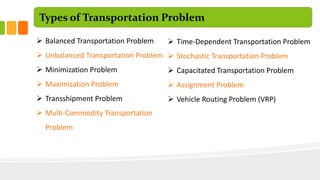
 Balanced Transportation Problem
 Unbalanced Transportation Problem
 Minimization Problem
 Maximization Problem
 Transshipment Problem
 Multi-Commodity Transportation
Problem
 Time-Dependent Transportation Problem
 Stochastic Transportation Problem
 Capacitated Transportation Problem
 Assignment Problem
 Vehicle Routing Problem (VRP)
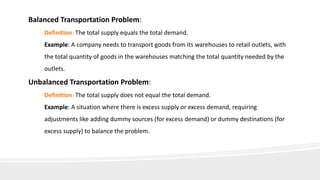
Balanced Transportation Problem:
Definition: The total supply equals the total demand.
Example: A company needs to transport goods from its warehouses to retail outlets, with
the total quantity of goods in the warehouses matching the total quantity needed by the
outlets.
Unbalanced Transportation Problem:
Definition: The total supply does not equal the total demand.
Example: A situation where there is excess supply or excess demand, requiring
adjustments like adding dummy sources (for excess demand) or dummy destinations (for
excess supply) to balance the problem.
Minimization Problem:
Definition: The objective is to minimize the total transportation cost.
Example: Finding the least expensive way to ship products from factories to various
distribution centers.
Maximization Problem:
Definition: The objective is to maximize a certain benefit, such as profit or efficiency.
Example: Allocating shipments to maximize profit margins, taking into account varying
costs and selling prices at different locations.
Transshipment Problem:
Definition: Involves intermediate points (transshipment points) where goods can be
temporarily stored before reaching their final destinations.
Example: Products shipped from factories to warehouses (transshipment points) and
then to retail stores.
Multi-Commodity Transportation Problem:
Definition: Deals with transporting multiple types of commodities simultaneously.
Example: A logistics company transporting food, electronics, and clothing from various
suppliers to various markets, considering the distinct requirements for each commodity.
Time-Dependent Transportation Problem:
Definition: The transportation costs or times vary depending on the time of day or other
temporal factors.
Example: Scheduling deliveries to avoid peak traffic hours to minimize transportation
time and costs.
Stochastic Transportation Problem:
Definition: Incorporates uncertainty in parameters like supply, demand, or
transportation costs.
Example: Planning shipments when future supply or demand levels are uncertain and
might fluctuate.
Capacitated Transportation Problem:
Definition: Includes constraints on the maximum amount that can be shipped along
each route.
Example: Delivery trucks with specific load capacities or limited storage capacity at the
destinations.
Assignment Problem:
Definition: A special case where the objective is to assign resources to tasks on a one-
to-one basis at minimal cost or maximum profit.
Example: Assigning a fleet of trucks to various delivery routes where each truck is
assigned to exactly one route.
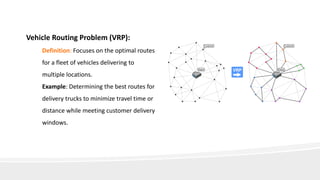
Vehicle Routing Problem (VRP):
Definition: Focuses on the optimal routes
for a fleet of vehicles delivering to
multiple locations.
Example: Determining the best routes for
delivery trucks to minimize travel time or
distance while meeting customer delivery
windows.
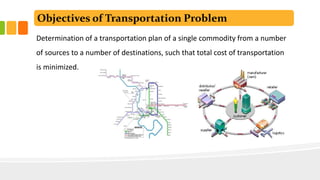
Objectives of Transportation Problem
Determination of a transportation plan of a single commodity from a number
of sources to a number of destinations, such that total cost of transportation
is minimized.
Application of Transportation Problem
• It is used to compute transportation routes in such a way as to minimize transportation cost for
finding out locations of warehouses.
• It is used to find out locations of transportation corporations depots where insignificant total
cost difference may not matter.
• Minimize shipping costs from factories to warehouses(or from warehouses to retail outlets).
• Determine lowest cost location for new factory, warehouse, office, or other oulet facility.
• Find minimum cost production schedule that satisfies firms demand and production limitations.
Methods Used in Transportation Problem
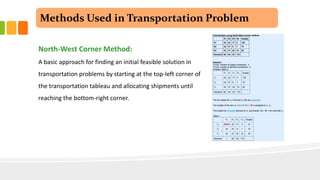
North-West Corner Method:
A basic approach for finding an initial feasible solution in
transportation problems by starting at the top-left corner of
the transportation tableau and allocating shipments until
reaching the bottom-right corner.
Methods Used in Transportation Problem
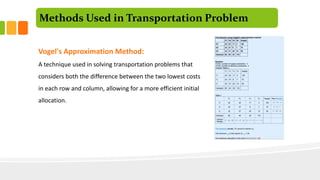
Vogel's Approximation Method:
A technique used in solving transportation problems that
considers both the difference between the two lowest costs
in each row and column, allowing for a more efficient initial
allocation.
Methods Used in Transportation Problem
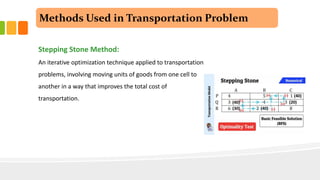
Stepping Stone Method:
An iterative optimization technique applied to transportation
problems, involving moving units of goods from one cell to
another in a way that improves the total cost of
transportation.
Methods Used in Transportation Problem
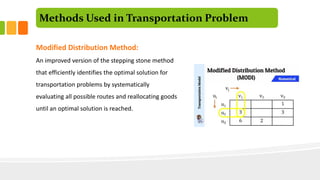
Modified Distribution Method:
An improved version of the stepping stone method
that efficiently identifies the optimal solution for
transportation problems by systematically
evaluating all possible routes and reallocating goods
until an optimal solution is reached.
Conclusion
The transportation problem is a pivotal topic within operations research, addressing the optimal distribution of goods
from multiple sources to multiple destinations. It encompasses various types, including balanced and unbalanced
transportation problems, each with distinct characteristics and challenges. The primary objective is to minimize the
total transportation cost while meeting supply and demand constraints effectively.
Applications of the transportation problem span across industries such as logistics, manufacturing, and supply chain
management, highlighting its practical relevance and significance. Methods like the Northwest Corner Rule, Least Cost
Method, and Vogel's Approximation Method provide systematic approaches to finding initial feasible solutions, while
optimization techniques like the Modified Distribution Method (MODI) further refine these solutions for cost
minimization.
In essence, understanding and solving transportation problems is crucial for efficient resource allocation and cost
management, offering significant benefits to businesses and economies by optimizing their logistical operations.
Transportation Problem

Transportation Problem

  • 1.
    Transportation Problem Presented By:Auntor Khastagir Pujan Roll: 1738 Semester: 4th Presented To: Mrs Chandra Das Assistant Professor and Head Business Administration, USTC WELCOME
  • 2.
    Contents • Introduction • Typesof Transportation Problem • Objectives of the Transportation Problem • Application of Transportation Problem • Methods Used in Transportation Problem • Conclusion
  • 3.
  • 4.
    Types of TransportationProblem  Balanced Transportation Problem  Unbalanced Transportation Problem  Minimization Problem  Maximization Problem  Transshipment Problem  Multi-Commodity Transportation Problem  Time-Dependent Transportation Problem  Stochastic Transportation Problem  Capacitated Transportation Problem  Assignment Problem  Vehicle Routing Problem (VRP)
  • 5.
    Balanced Transportation Problem: Definition:The total supply equals the total demand. Example: A company needs to transport goods from its warehouses to retail outlets, with the total quantity of goods in the warehouses matching the total quantity needed by the outlets. Unbalanced Transportation Problem: Definition: The total supply does not equal the total demand. Example: A situation where there is excess supply or excess demand, requiring adjustments like adding dummy sources (for excess demand) or dummy destinations (for excess supply) to balance the problem.
  • 6.
    Minimization Problem: Definition: Theobjective is to minimize the total transportation cost. Example: Finding the least expensive way to ship products from factories to various distribution centers. Maximization Problem: Definition: The objective is to maximize a certain benefit, such as profit or efficiency. Example: Allocating shipments to maximize profit margins, taking into account varying costs and selling prices at different locations.
  • 7.
    Transshipment Problem: Definition: Involvesintermediate points (transshipment points) where goods can be temporarily stored before reaching their final destinations. Example: Products shipped from factories to warehouses (transshipment points) and then to retail stores. Multi-Commodity Transportation Problem: Definition: Deals with transporting multiple types of commodities simultaneously. Example: A logistics company transporting food, electronics, and clothing from various suppliers to various markets, considering the distinct requirements for each commodity.
  • 8.
    Time-Dependent Transportation Problem: Definition:The transportation costs or times vary depending on the time of day or other temporal factors. Example: Scheduling deliveries to avoid peak traffic hours to minimize transportation time and costs. Stochastic Transportation Problem: Definition: Incorporates uncertainty in parameters like supply, demand, or transportation costs. Example: Planning shipments when future supply or demand levels are uncertain and might fluctuate.
  • 9.
    Capacitated Transportation Problem: Definition:Includes constraints on the maximum amount that can be shipped along each route. Example: Delivery trucks with specific load capacities or limited storage capacity at the destinations. Assignment Problem: Definition: A special case where the objective is to assign resources to tasks on a one- to-one basis at minimal cost or maximum profit. Example: Assigning a fleet of trucks to various delivery routes where each truck is assigned to exactly one route.
  • 10.
    Vehicle Routing Problem(VRP): Definition: Focuses on the optimal routes for a fleet of vehicles delivering to multiple locations. Example: Determining the best routes for delivery trucks to minimize travel time or distance while meeting customer delivery windows.
  • 11.
    Objectives of TransportationProblem Determination of a transportation plan of a single commodity from a number of sources to a number of destinations, such that total cost of transportation is minimized.
  • 12.
    Application of TransportationProblem • It is used to compute transportation routes in such a way as to minimize transportation cost for finding out locations of warehouses. • It is used to find out locations of transportation corporations depots where insignificant total cost difference may not matter. • Minimize shipping costs from factories to warehouses(or from warehouses to retail outlets). • Determine lowest cost location for new factory, warehouse, office, or other oulet facility. • Find minimum cost production schedule that satisfies firms demand and production limitations.
  • 13.
    Methods Used inTransportation Problem North-West Corner Method: A basic approach for finding an initial feasible solution in transportation problems by starting at the top-left corner of the transportation tableau and allocating shipments until reaching the bottom-right corner.
  • 14.
    Methods Used inTransportation Problem Vogel's Approximation Method: A technique used in solving transportation problems that considers both the difference between the two lowest costs in each row and column, allowing for a more efficient initial allocation.
  • 15.
    Methods Used inTransportation Problem Stepping Stone Method: An iterative optimization technique applied to transportation problems, involving moving units of goods from one cell to another in a way that improves the total cost of transportation.
  • 16.
    Methods Used inTransportation Problem Modified Distribution Method: An improved version of the stepping stone method that efficiently identifies the optimal solution for transportation problems by systematically evaluating all possible routes and reallocating goods until an optimal solution is reached.
  • 17.
    Conclusion The transportation problemis a pivotal topic within operations research, addressing the optimal distribution of goods from multiple sources to multiple destinations. It encompasses various types, including balanced and unbalanced transportation problems, each with distinct characteristics and challenges. The primary objective is to minimize the total transportation cost while meeting supply and demand constraints effectively. Applications of the transportation problem span across industries such as logistics, manufacturing, and supply chain management, highlighting its practical relevance and significance. Methods like the Northwest Corner Rule, Least Cost Method, and Vogel's Approximation Method provide systematic approaches to finding initial feasible solutions, while optimization techniques like the Modified Distribution Method (MODI) further refine these solutions for cost minimization. In essence, understanding and solving transportation problems is crucial for efficient resource allocation and cost management, offering significant benefits to businesses and economies by optimizing their logistical operations.