3
3
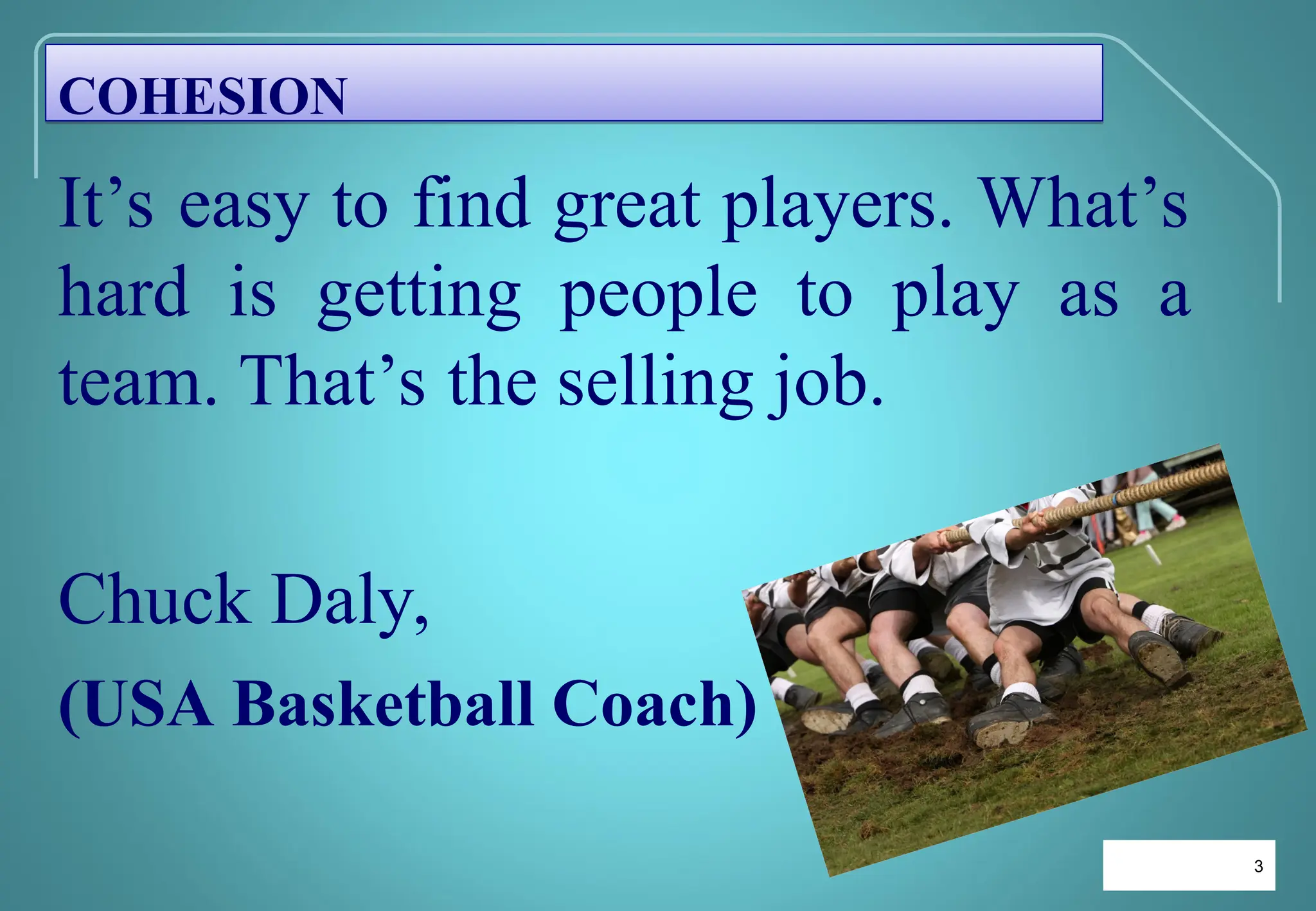
It’s easy tofind great players. What’s
hard is getting people to play as a
team. That’s the selling job.
Chuck Daly,
(USA Basketball Coach)
COHESION
4.
4
4
Cohesion is agroup property with
individual manifestations of feelings
of belongingness or attraction to the
group.
COHESION
5.
5
5
A process wherethe group stays
together in pursuit of a goal and/or
needs (Carron, 1999)
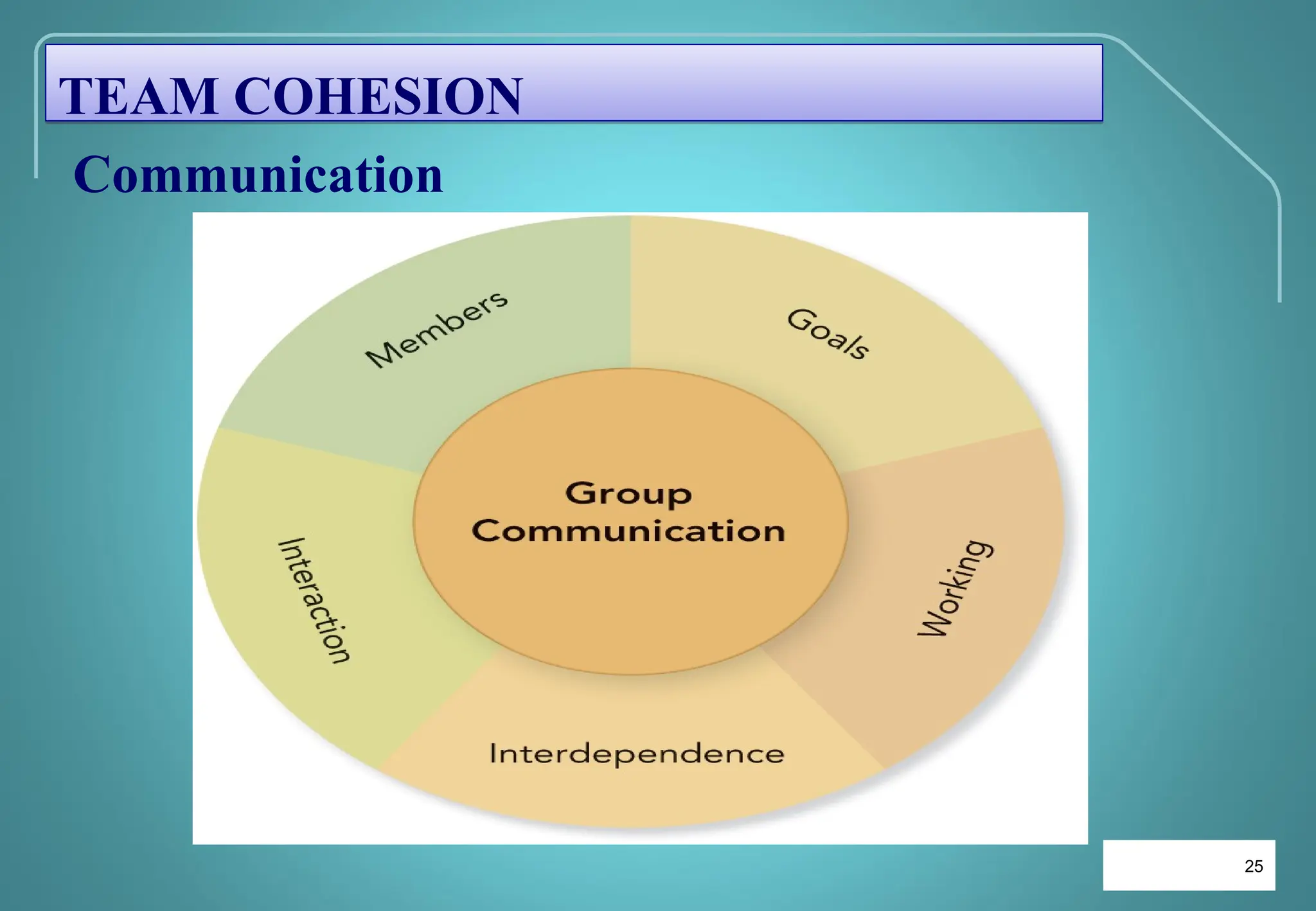
Defined by the way:
•Members interact
•Interdependency
•What activity they perform
COHESION
8
8
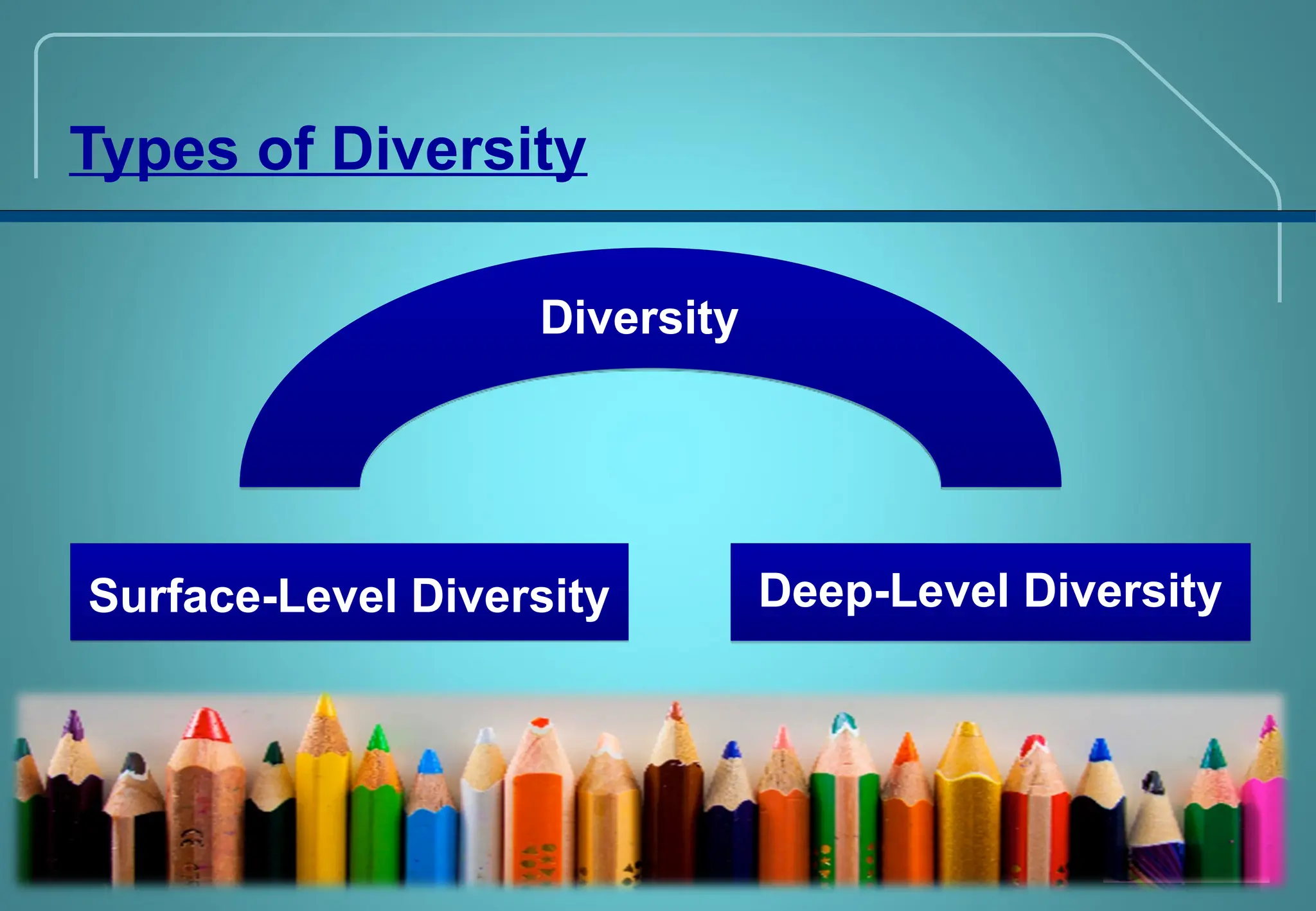
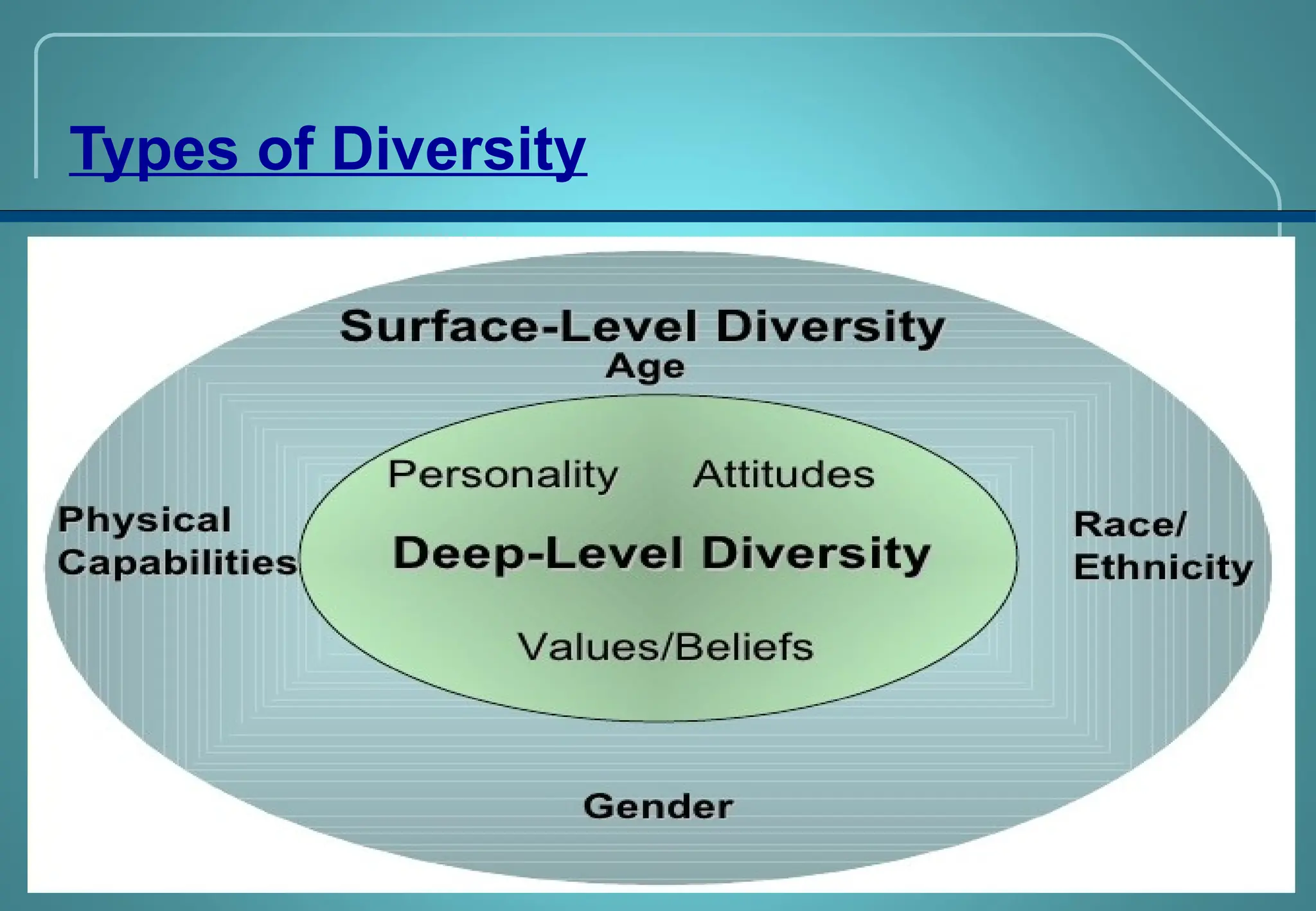
1. Team Composition- Diversity
• Surface-Level Diversity
• Deep-Level Diversity
TEAM COHESION
9.
9
2-9
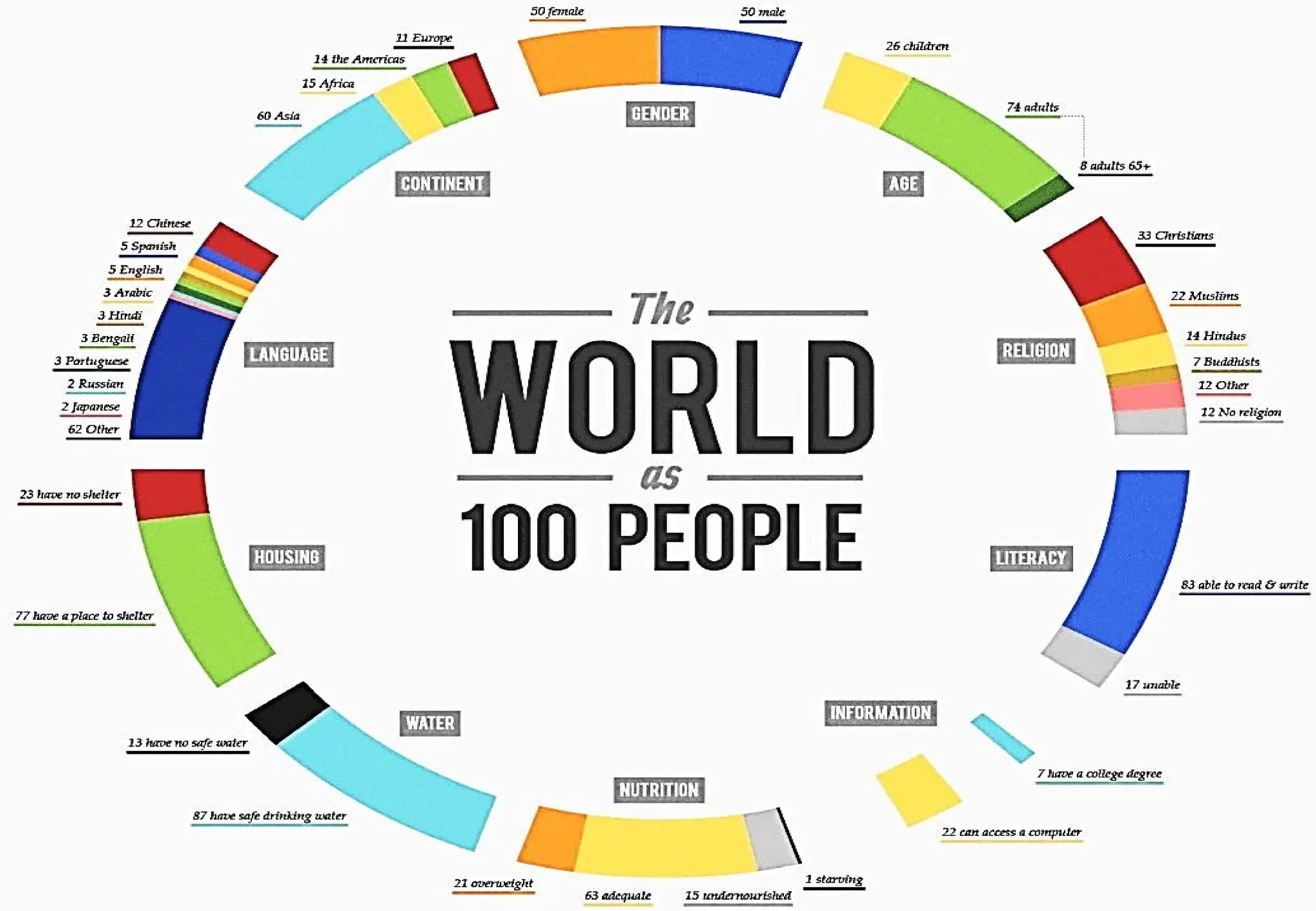
If we couldreduce the world's population
to a village of precisely 100 people, with
all existing human ratios remaining the
same, the demographics would look
something like this……..
If the world were a village of 100 people….
13
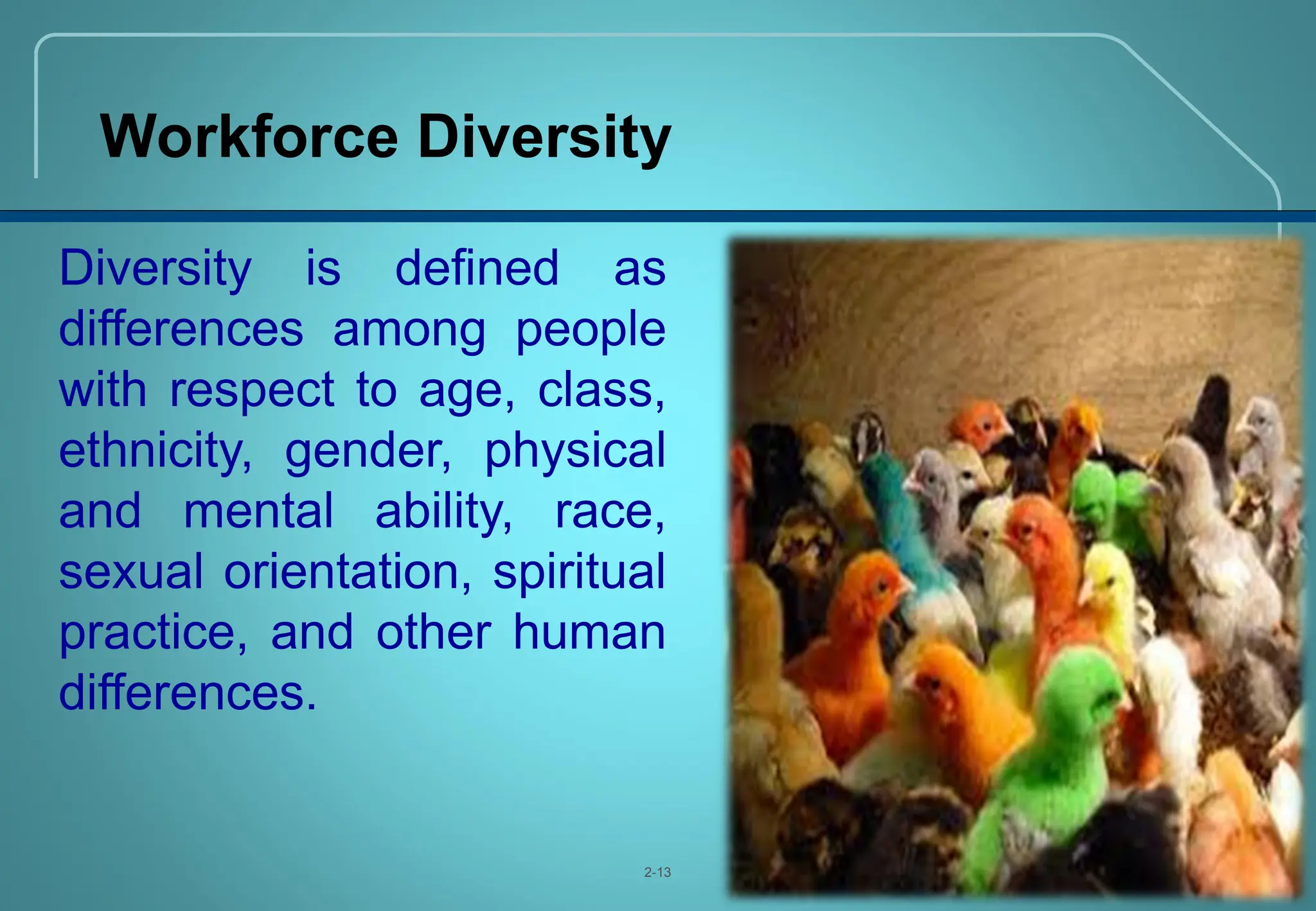
Diversity is definedas
differences among people
with respect to age, class,
ethnicity, gender, physical
and mental ability, race,
sexual orientation, spiritual
practice, and other human
differences.
2-13
Workforce Diversity
17
Surface Level Diversity
Age
•Performance does not decline with
age.
• Older employees hold wealth of
knowledge and experience and
show better judgment, and are less
likely to quit, show up late, or be
absent.
2-17
18.
18
Gender
• Debates, misconceptions,and unsupported
opinions than whether women perform as well on
jobs as men do.
• Important differences between men and women
affect job performance.
• Psychological studies have found women are
more agreeable and willing to conform to
authority, whereas men are more aggressive and
more likely to have expectations of success.
2-18
Surface Level Diversity
19.
19
Race and Ethnicity
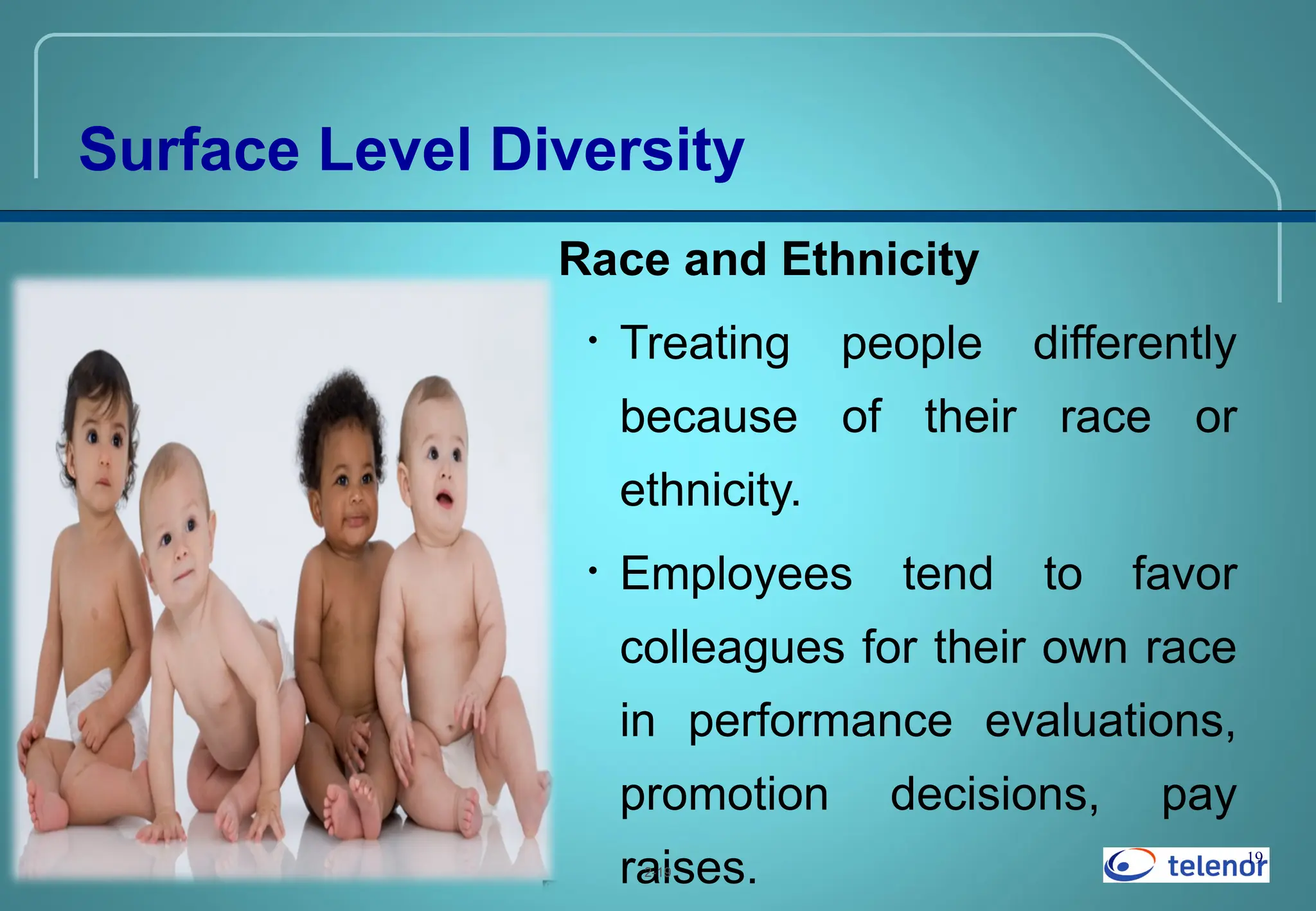
•Treating people differently
because of their race or
ethnicity.
• Employees tend to favor
colleagues for their own race
in performance evaluations,
promotion decisions, pay
raises.
2-19
Surface Level Diversity
20.
20
Disability (Mental andPhysical)
Disability is a mental or physical impairment
that substantially limits one or more major life
activities
•The “reasonable accommodation” is problematic
for employers.
•Strong biases exist against those with mental
impairment.
2-20
Surface Level Diversity
21.
21
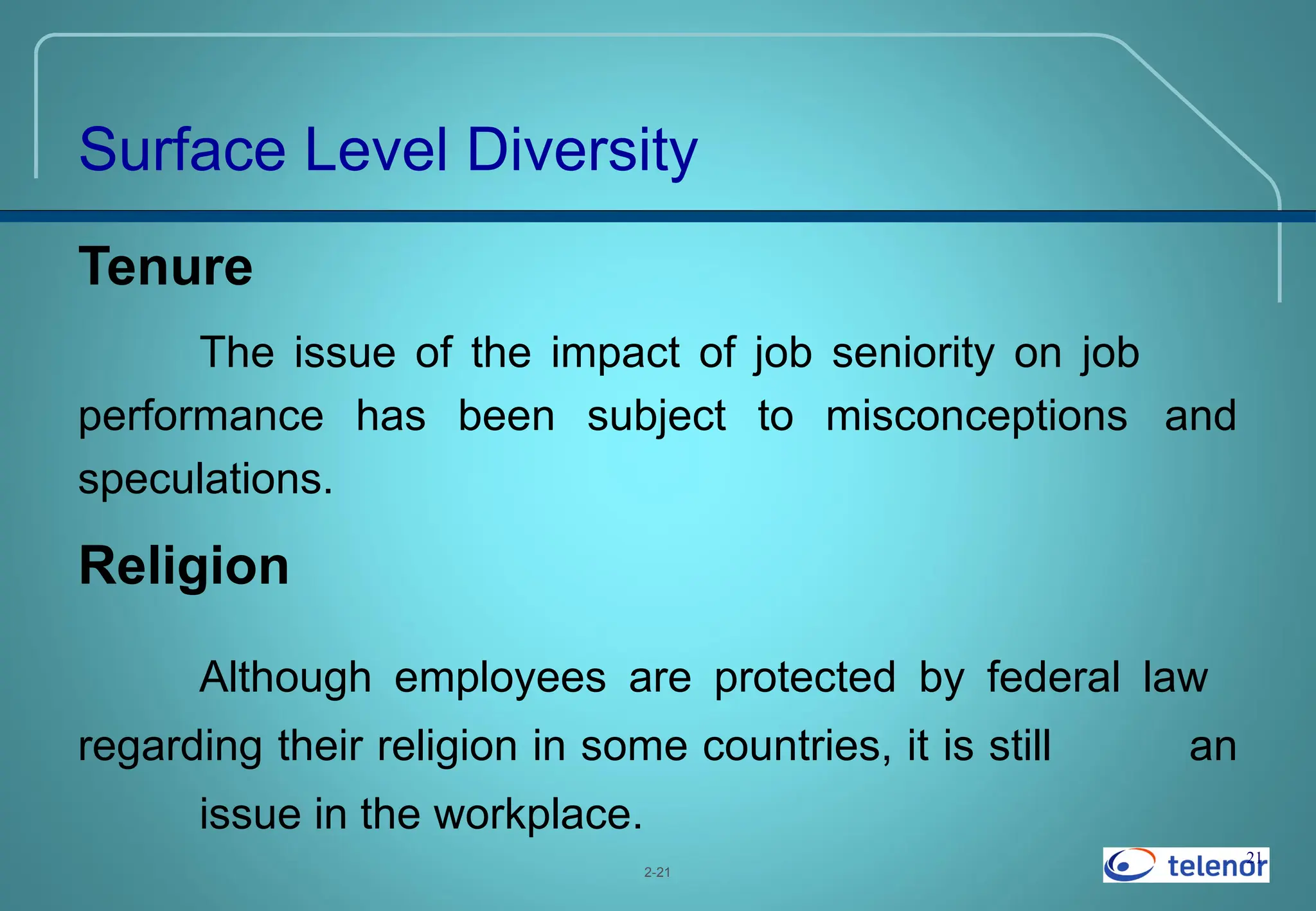
Tenure
The issue ofthe impact of job seniority on job
performance has been subject to misconceptions and
speculations.
Religion
Although employees are protected by federal law
regarding their religion in some countries, it is still an
issue in the workplace.
2-21
Surface Level Diversity
23
23
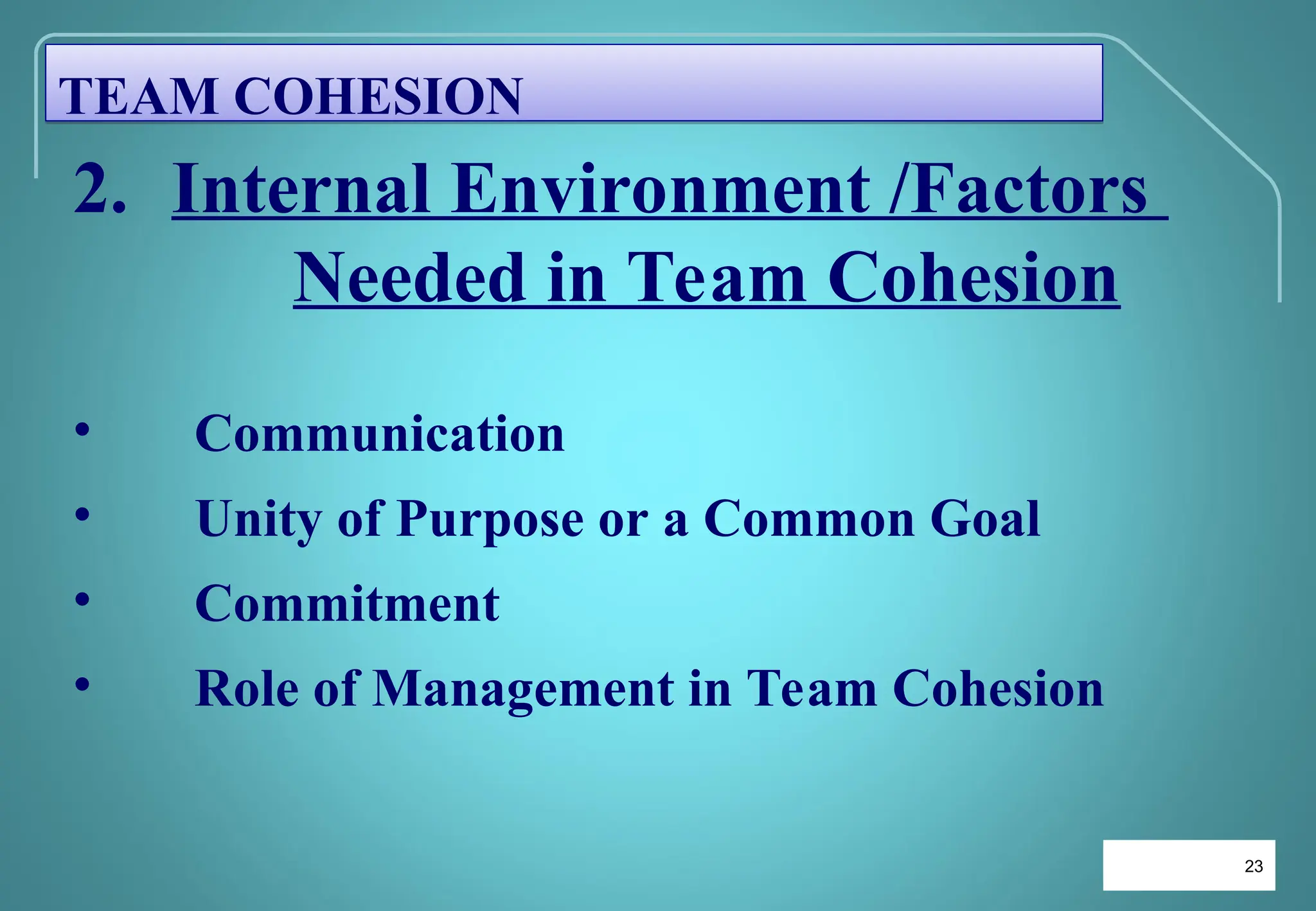
2. Internal Environment/Factors
Needed in Team Cohesion
• Communication
• Unity of Purpose or a Common Goal
• Commitment
• Role of Management in Team Cohesion
TEAM COHESION
26
26
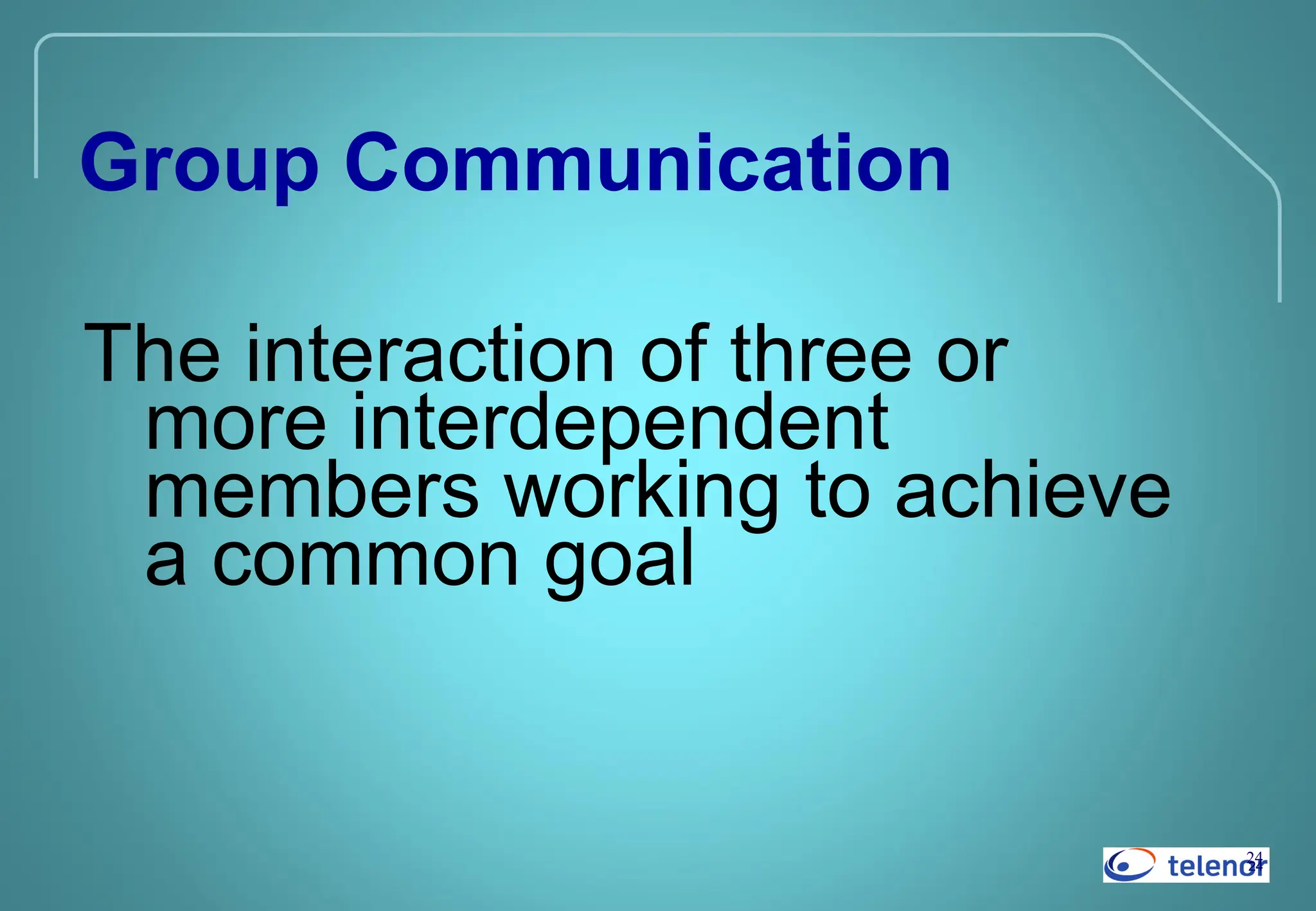
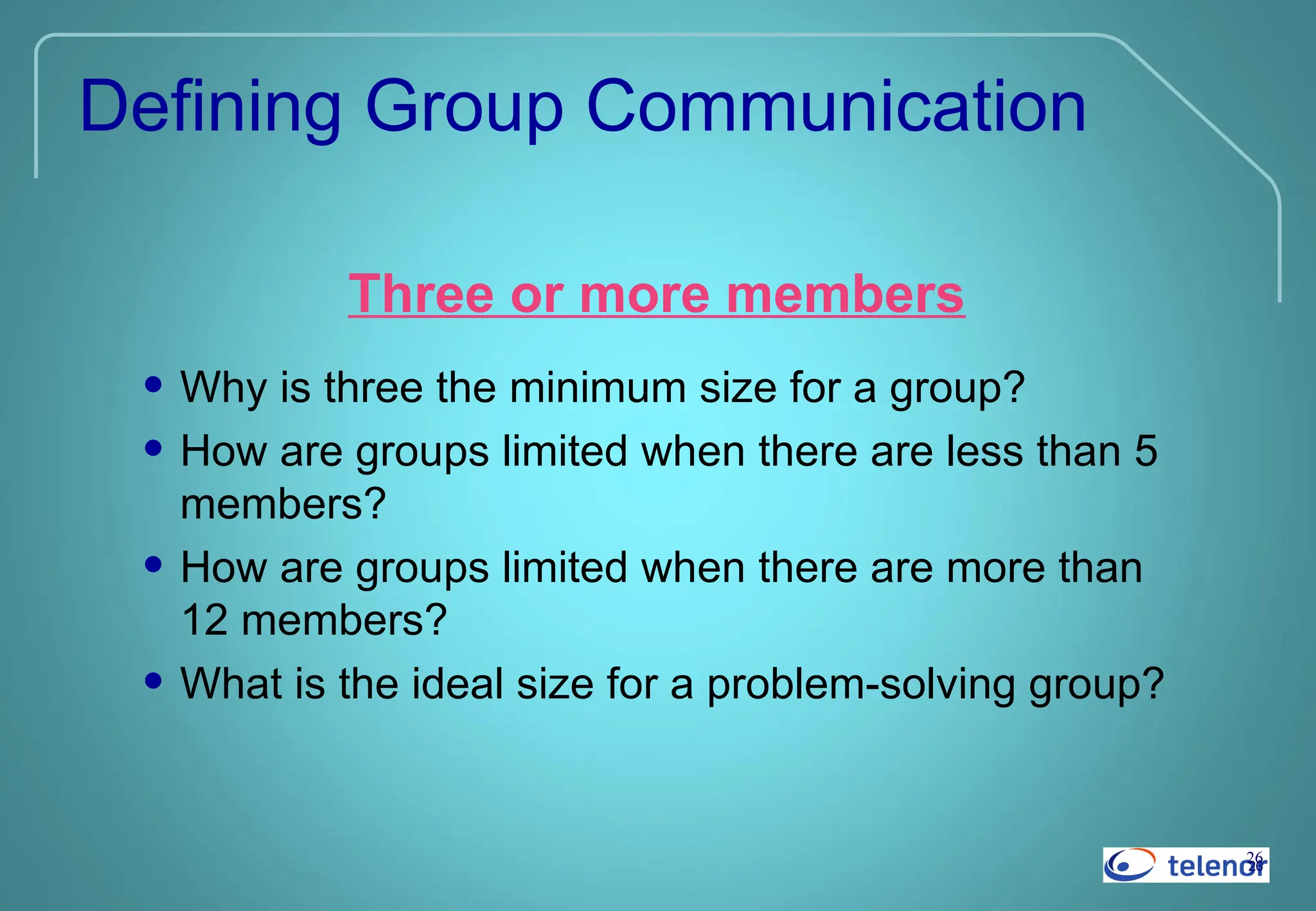
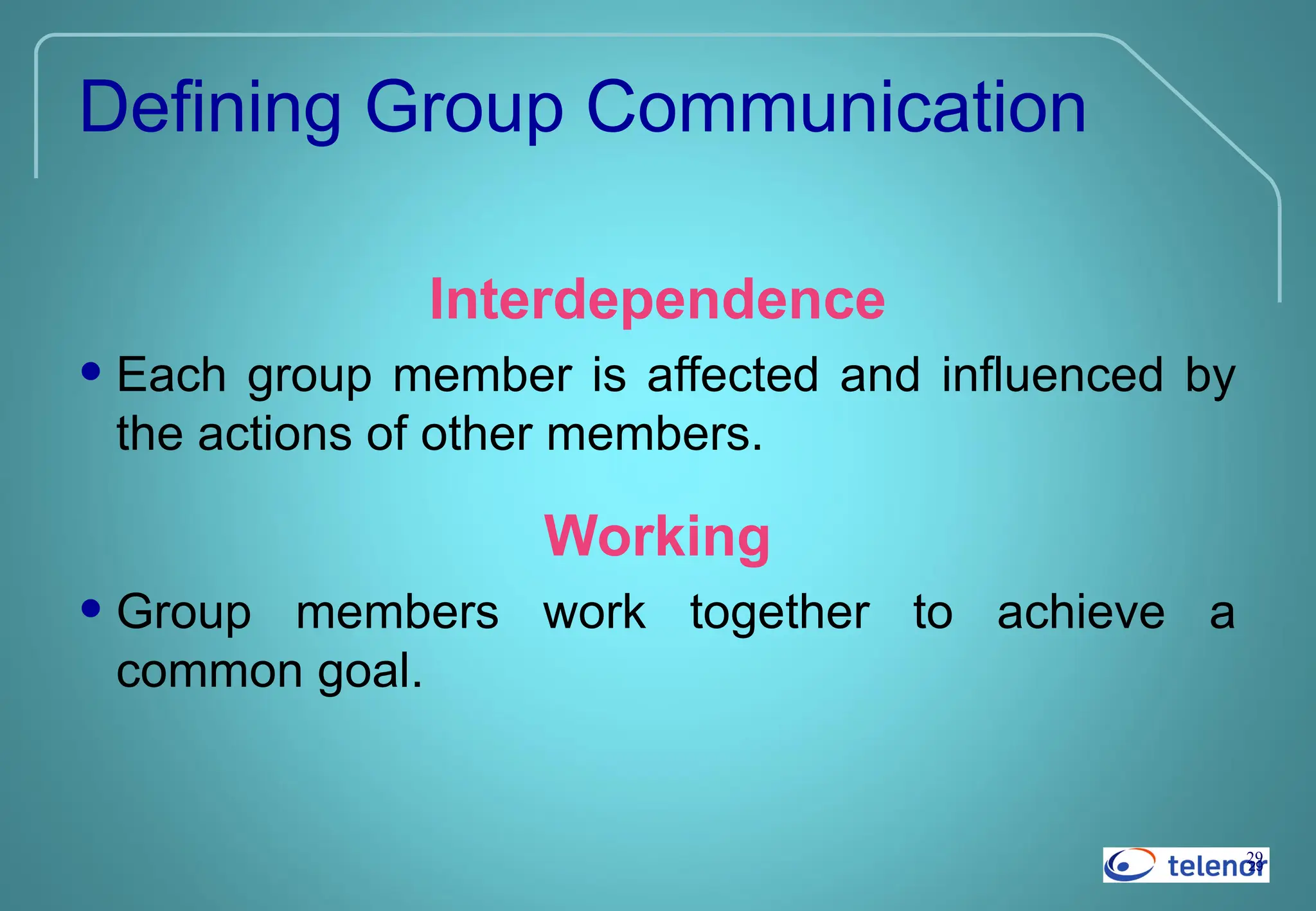
Defining Group Communication
Threeor more members
• Why is three the minimum size for a group?
• How are groups limited when there are less than 5
members?
• How are groups limited when there are more than
12 members?
• What is the ideal size for a problem-solving group?
28
28
Defining Group Communication
CommonGoal
• Defines and unifies a group
• Separates successful from unsuccessful groups
• guides action
• helps set standards
• helps resolve conflict
• motivates members
30
30
Quiz
Which of thefollowing situations best
represents group communication?
a) People talking about politics in an elevator
b) People discussing the weather in an airport
c) Parents cheering at a school soccer match
d) Jury members deliberating a court case
e) An audience listening to a concert
33
33
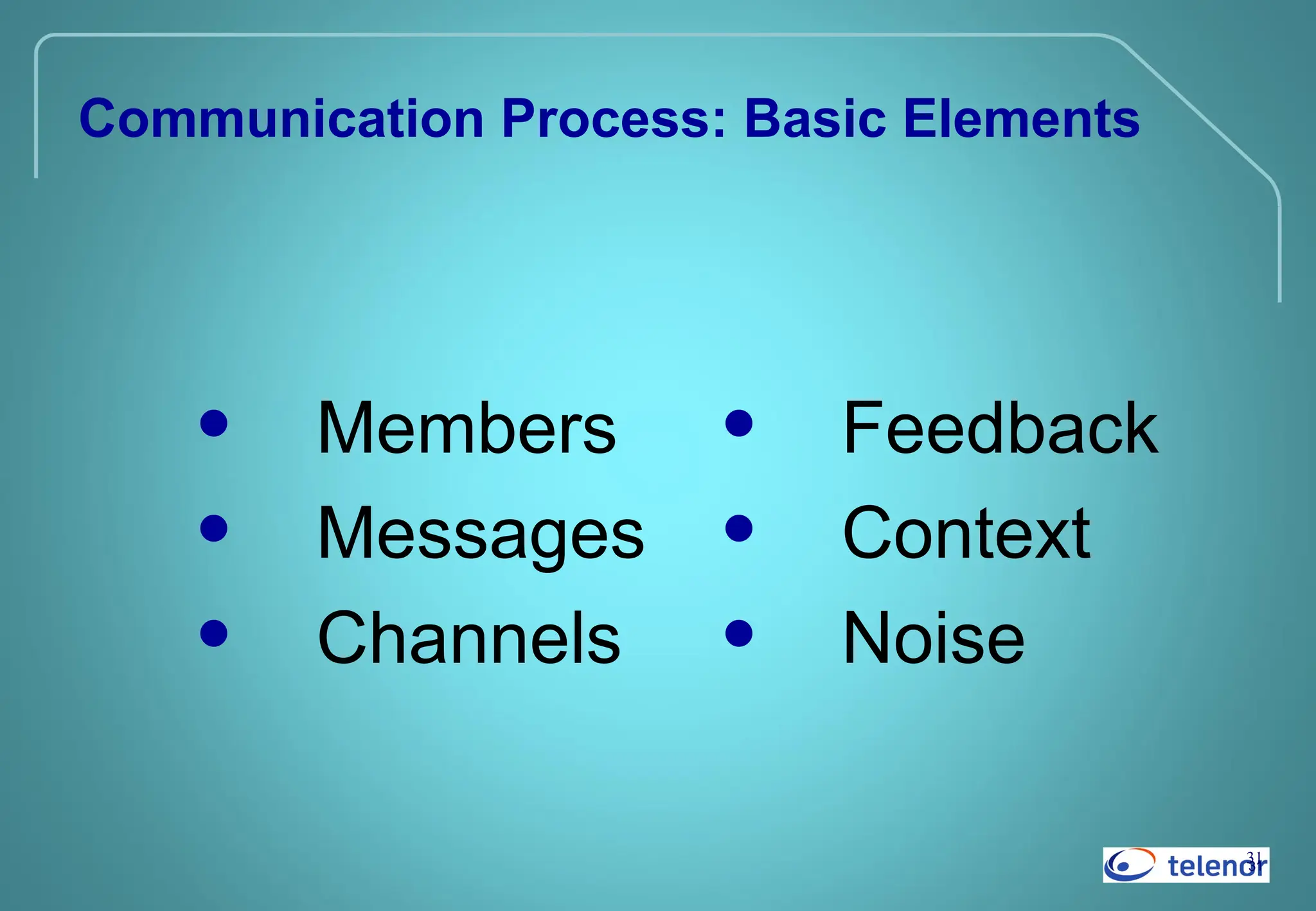
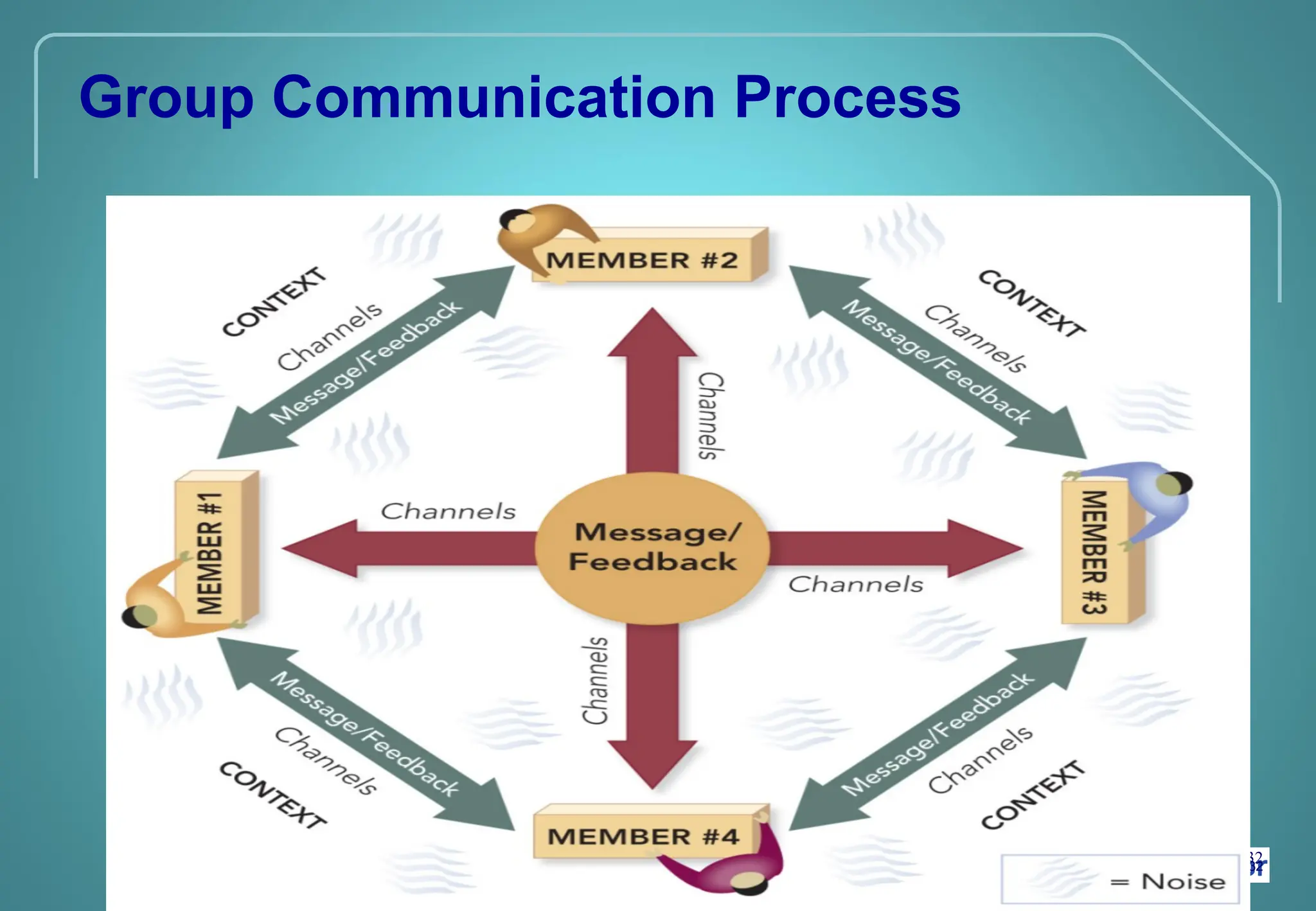
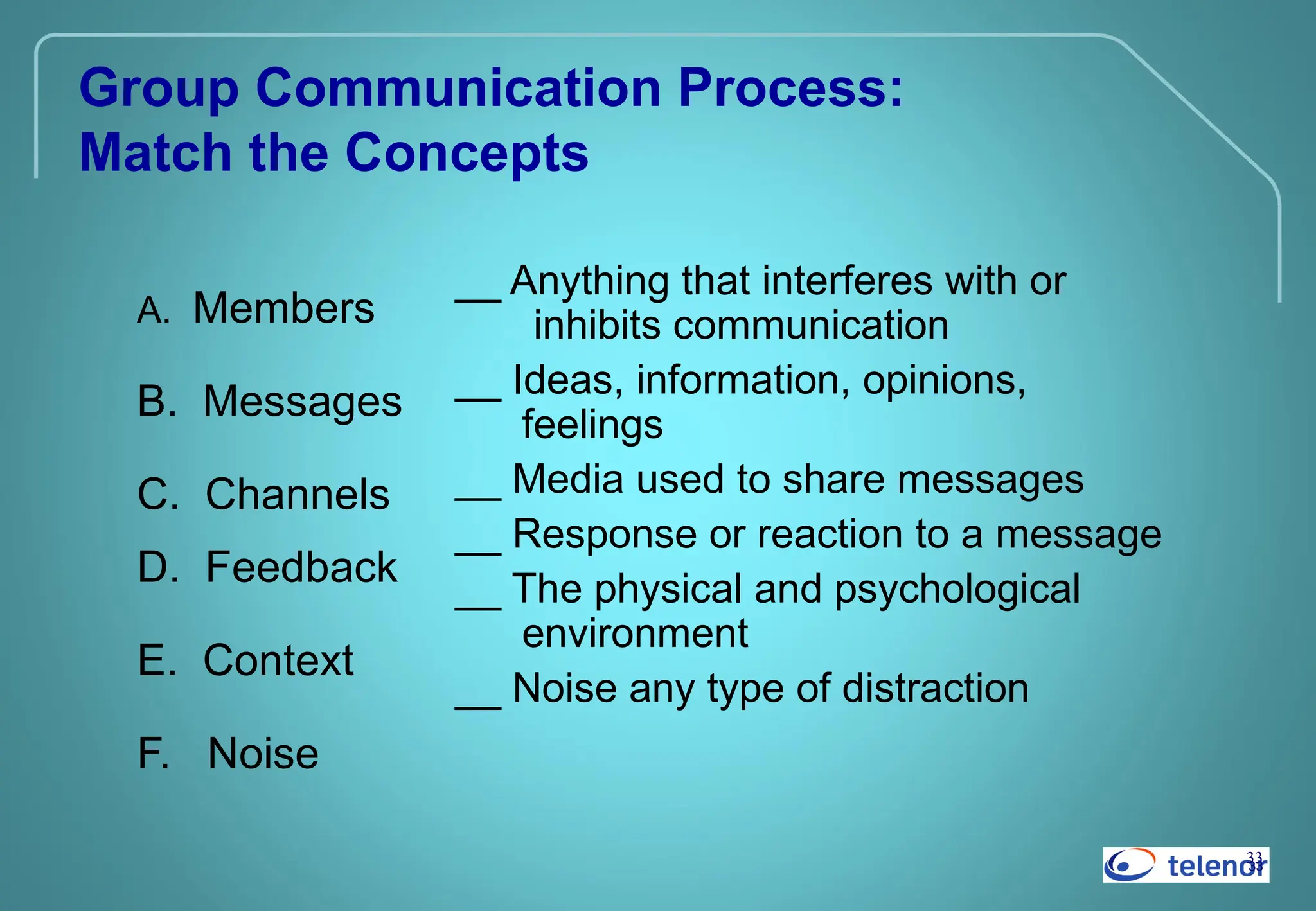
Group Communication Process:
Matchthe Concepts
A. Members
B. Messages
C. Channels
D. Feedback
E. Context
F. Noise
__ Anything that interferes with or
inhibits communication
__ Ideas, information, opinions,
feelings
__ Media used to share messages
__ Response or reaction to a message
__ The physical and psychological
environment
__ Noise any type of distraction
#9 That sounds simple, but diversity encompasses race, gender, ethnic group, age, personality, cognitive style, tenure, organizational function, education, background and more.
Today, the workforce comprises people who are different and share different attitudes, needs, desires, values and work behaviours.
#10 That sounds simple, but diversity encompasses race, gender, ethnic group, age, personality, cognitive style, tenure, organizational function, education, background and more.
Today, the workforce comprises people who are different and share different attitudes, needs, desires, values and work behaviours.
#13 That sounds simple, but diversity encompasses race, gender, ethnic group, age, personality, cognitive style, tenure, organizational function, education, background and more.
Today, the workforce comprises people who are different and share different attitudes, needs, desires, values and work behaviours.
#14 Everybody brings differences to an organization where they work. These differences can create energy and excitement in the workplace, but they can also cause conflict. So it is important that we have an understanding of how diversity works in organizations.
When we look at the workplace we can recognize two levels of diversity. Surface-level diversity represents the characteristics that are easily observed such as race, gender, age etc. Deep-level diversity represents the aspects that are more difficult to see at first sight such as values, personality, and work preferences.
#15 Everybody brings differences to an organization where they work. These differences can create energy and excitement in the workplace, but they can also cause conflict. So it is important that we have an understanding of how diversity works in organizations.
When we look at the workplace we can recognize two levels of diversity. Surface-level diversity represents the characteristics that are easily observed such as race, gender, age etc. Deep-level diversity represents the aspects that are more difficult to see at first glance such as values, personality, and work preferences.
The concept of “discrimination” is to note differences between things
#16 Biographical characteristics represent many of the surface-level aspects of diversity. These are characteristics that are very easy to identify. Biographical characteristics typically include age, gender, and race. They can also include tenure, religion, sexual orientation, and gender identity. Let’s look at the first, AGE.
Age is an increasingly relevant characteristic as the workforce is aging. Older workers bring with them a wealth of knowledge and experience, but the perception is that productivity often declines with age.
#17 Biographical characteristics represent many of the surface-level aspects of diversity. These are characteristics that are very easy to identify. Biographical characteristics typically include age, gender, and race. They can also include tenure, religion, sexual orientation, and gender identity. Let’s look at the first, AGE.
Age is an increasingly relevant characteristic as the workforce is aging. Older workers bring with them a wealth of knowledge and experience, but the perception is that productivity often declines with age.
#18 The second of the biological characteristics is sex. In studying gender in the workplace, it has been found that there are very few differences between men and women that impact job performance. However, women, especially those with pre-school age children, do prefer flexible work schedules and will seek an employer who offers options in their schedules.
#19 Race and Ethnicity offers little explanation for differentials in workplace outcomes. It has been shown, however, that people in the workplace do identify more with people like themselves so in some cases there may be opportunities given to people based on the fact that they are like their supervisor. In general, research has found no significant differences in race or ethnic backgrounds related to absence rates, applied social skills or accident rates.
#20 A person with a disability is one who has a physical or mental impairment that limits one or more major life activities. The Americans with Disabilities Act of 1990 requires employers to make “reasonable accommodation” for disabilities. Because of its vagueness, this provision is problematic for employers. The result is the existence of string biases against those with disabilities, particularly mental.
#21 Tenure refers to the length of time people have been on the job and is tied to seniority. Often, tenure is seen as a positive as it signifies that people are happy with their employment because they have remained in their job for a long period of time. Therefore, employees with long tenure tend to be more productive, call in sick less frequently, and don’t leave the organization as readily.
Religion may also impact work outcomes due to religious restrictions, such as dress and grooming. Schedules may also conflict with the way work is typically done, such as a Muslim worker adhering to the prayer schedule outlined in Islam.
Many Christians do not believe they should work on Sundays, and many conservative Jews believe they should not work on Saturdays. Religious individuals may also believe they have an obligation to express their beliefs in the workplace, and those who do not share those beliefs may object. Perhaps as a result of different perceptions of religion’s role in the workplace, religious discrimination claims have been a growing source of discrimination claims in the world.
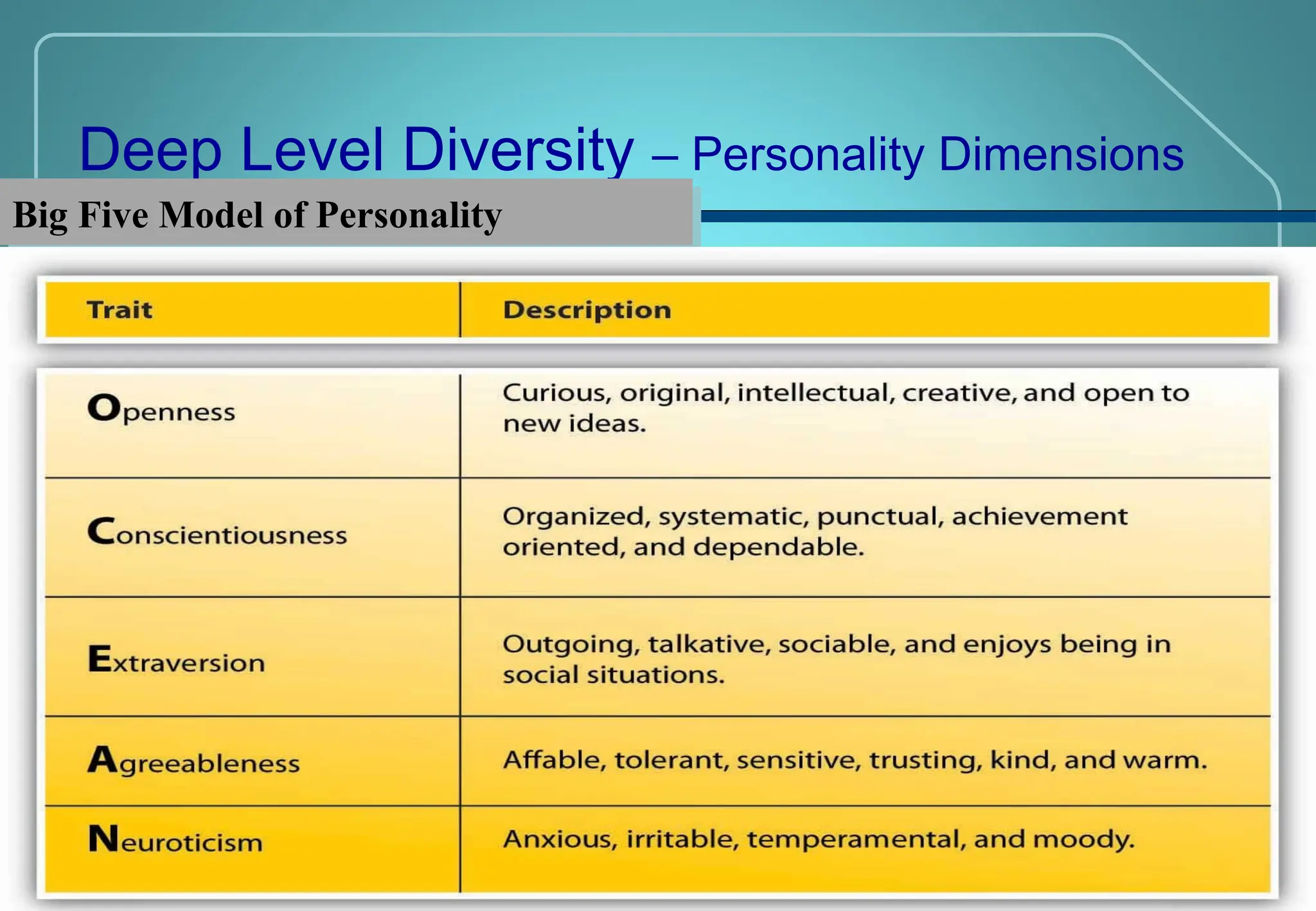
#22 Ernest Tupes and Raymond Christal - Air Force Personnel Laboratory in the late 1950 then Digman 1990 BFFM
Openness to experience: Appreciation for art, emotion, adventure, unusual ideas (gambling), curiosity, and variety of experience. Openness reflects the degree of intellectual curiosity, creativity and a preference for novelty and variety a person has. It is also described as the extent to which a person is imaginative or independent, and depicts a personal preference for a variety of activities over a strict routine. High openness can be perceived as unpredictability or lack of focus. Moreover, individuals with high openness are said to pursue self-actualization specifically by seeking out intense, euphoric experiences, such as skydiving, living abroad, gambling, etc. Conversely, those with low openness seek to gain fulfilment through perseverance, and are characterized as pragmatic and data-driven—sometimes even perceived to be dogmatic and closed-minded. Some disagreement remains about how to interpret and contextualize the openness factor.
Conscientiousness: A tendency to be organized and dependable, show self-discipline, act dutifully, aim for achievement, and prefer planned rather than spontaneous behavior. High conscientiousness are often perceived as stubborn and obsessive. Low conscientiousness are flexible and spontaneous, but can be perceived as sloppy and unreliable.
Extroversion: Energy, positive emotions, surgency, confidence, sociability and the tendency to seek stimulation in the company of others, and talkativeness. High extraversion is often perceived as attention-seeking, and domineering. Low extraversion causes a reserved, reflective personality, which can be perceived as aloof or self-absorbed.
Agreeableness: A tendency to be sympathetic and cooperative rather than suspicious and opposed towards others. It is also a measure of one's trusting and helpful nature, and whether a person is generally well-tempered or not. High agreeableness is often seen as innocent or obedient. Low agreeableness personalities are often competitive or challenging people, which can be seen as argumentative or untrustworthy.
Neuroticism: (Masoom - sensitive/nervous vs. secure/confident). The tendency to experience unpleasant emotions easily, such as anger, anxiety, depression, and vulnerability. Neuroticism also refers to the degree of emotional stability and impulse control and is sometimes referred to by its low pole, "emotional stability". A high need for stability manifests as a stable and calm personality, but can be seen as uninspiring and unconcerned. A low need for stability causes a reactive and excitable personality, often very dynamic individuals, but they can be perceived as unstable or insecure.
http://www.outofservice.com/bigfive/