Strategic Management
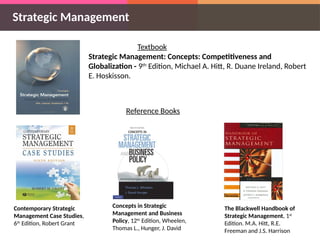
Textbook
Strategic Management:Concepts: Competitiveness and
Globalization - 9th
Edition, Michael A. Hitt, R. Duane Ireland, Robert
E. Hoskisson.
Contemporary Strategic
Management Case Studies,
6th
Edition, Robert Grant
Reference Books
Concepts in Strategic
Management and Business
Policy, 12th
Edition, Wheelen,
Thomas L., Hunger, J. David
The Blackwell Handbook of
Strategic Management, 1st
Edition. M.A. Hitt, R.E.
Freeman and J.S. Harrison
Strategic Management
STRATEGY INREAL WORLD
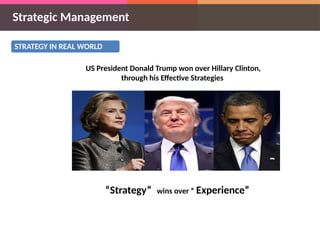
US President Donald Trump won over Hillary Clinton,
through his Effective Strategies
“Strategy” wins over “ Experience”
5.
Strategic Management
Strategic Management–An Overview
CEOs from the big three American automaker
asked the Congressional leaders for bailout monies, without showing up a clear
strategic plan. The CEOs were sent home with instructions to develop a clear
strategic plan for the future.
As Austan Goolsbee, one of President Obama’s top economic advisers, viewed it:
Asking for a bailout without a convincing business plan was crazy;
“If the three auto CEOs need a bridge, it’s got to be a bridge to
somewhere, not a bridge to nowhere.
In this Strategic Management course, we would expand our understanding on
how to develop a clear strategic plan and a bridge to somewhere rather than
nowhere.
6.
Strategic Management
Strategic Management–An Overview (Contd)
Doing Great in a Weak Economy
During the period of Global recession (2007-2008), most
firms were struggling (to survive, laying off employees,
closing restaurants, and reducing expansion plan).
Whereas, McDonald’s continued to increase its revenues
from $22.7 billion in 2007 to $23.5 billion in 2008.
McDonald’s net income nearly doubled during that time
from $2.4 billion to $4.3 billion.
Source: “McDonald’s Seeks Way to
Keep Sizzling,” Wall Street Journal
(March 10, 2009)
McDonald’s achieved this through:
Well planned strategies;
Offering low prices, expanded menu items, extending hours and improved drive-
through windows to increase sales, thus attracting millions of new customers;
Spent $2.1 billion to remodel many of its 32,000 restaurants and build new ones.
7.
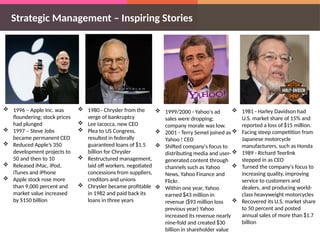
1996 –Apple Inc. was
floundering; stock prices
had plunged
1997 – Steve Jobs
became permanent CEO
Reduced Apple’s 350
development projects to
50 and then to 10
Released iMac, iPod,
iTunes and iPhone
Apple stock rose more
than 9,000 percent and
market value increased
by $150 billion
1980 - Chrysler from the
verge of bankruptcy
Lee Iacocca, new CEO
Plea to US Congress,
resulted in federally
guaranteed loans of $1.5
billion for Chrysler
Restructured management,
laid off workers, negotiated
concessions from suppliers,
creditors and unions
Chrysler became profitable
in 1982 and paid back its
loans in three years
1999/2000 - Yahoo's ad
sales were dropping;
company morale was low.
2001 - Terry Semel joined as
Yahoo ! CEO
Shifted company's focus to
distributing media and user-
generated content through
channels such as Yahoo
News, Yahoo Finance and
Flickr.
Within one year, Yahoo
earned $43 million in
revenue ($93 million loss
previous year) Yahoo
increased its revenue nearly
nine-fold and created $30
billion in shareholder value
1981 - Harley Davidson had
U.S. market share of 15% and
reported a loss of $15 million.
Facing steep competition from
Japanese motorcycle
manufacturers, such as Honda
1989 - Richard Teerlink
stepped in as CEO
Turned the company's focus to
increasing quality, improving
service to customers and
dealers, and producing world-
class heavyweight motorcycles
Recovered its U.S. market share
to 50 percent and posted
annual sales of more than $1.7
billion
Strategic Management – Inspiring Stories
8.
Strategic Management
STRATEGY DEFINED
•Strategy could be described as an expression of the intentions of the organization – what it means
to do and how the business means to ‘get from here to there’. Wickens (1987)
• Strategy is the determination of the basic long-term goals and objectives of an enterprise, and the
adoption of courses of action and the allocation of resources necessary for carrying out these
goals. (Chandler, 1962)
• Strategy involves the constant search for ways in which the firm’s unique resources can be
redeployed in changing circumstances. (Rumelt, 1984)
• Strategy is the direction and scope of an organization over the longer term, which matches its
resources to its changing environment, and in particular, to its markets, customers and clients to
meet stakeholder expectations. (Johnson and Scholes, 1993)
9.
Strategic Management
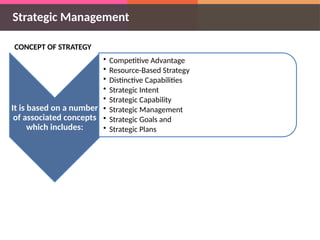
CONCEPT OFSTRATEGY
It is based on a number
of associated concepts
which includes:
• Competitive Advantage
• Resource-Based Strategy
• Distinctive Capabilities
• Strategic Intent
• Strategic Capability
• Strategic Management
• Strategic Goals and
• Strategic Plans
10.
Strategic Management
Competitive advantage
•Competitive advantage arises out when a firm creates value
for its customers. Firms select markets in which they can excel
and become a moving target to their competitors by
continually improving their position.
Michael Porter (1985)
• Importance of differentiation offers a product or service ‘that
is perceived industry-wise as being unique’, and focus – seeing
a particular buyer group or product market ‘more effectively
or efficiently than competitors who compete more broadly’.
• Well-known framework of three generic strategies includes
innovation, quality and cost leadership. Organizations use
these to gain competitive advantage.
• Competitive advantage stems in the long term. Firms build ‘core competences’ which are
superior to its rivals, when it learns faster and applies its learning more effectively than its
competitors.
11.
Strategic Management
Distinctive capabilities
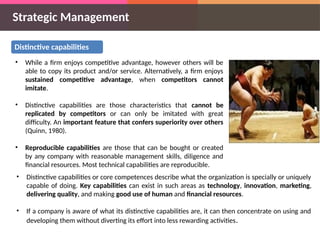
•While a firm enjoys competitive advantage, however others will be
able to copy its product and/or service. Alternatively, a firm enjoys
sustained competitive advantage, when competitors cannot
imitate.
• Distinctive capabilities are those characteristics that cannot be
replicated by competitors or can only be imitated with great
difficulty. An important feature that confers superiority over others
(Quinn, 1980).
• Reproducible capabilities are those that can be bought or created
by any company with reasonable management skills, diligence and
financial resources. Most technical capabilities are reproducible.
• Distinctive capabilities or core competences describe what the organization is specially or uniquely
capable of doing. Key capabilities can exist in such areas as technology, innovation, marketing,
delivering quality, and making good use of human and financial resources.
• If a company is aware of what its distinctive capabilities are, it can then concentrate on using and
developing them without diverting its effort into less rewarding activities.
12.
Strategic Management
Distinctive capabilities(Contd)
• Most distinctive capability is represented by the knowledge, skills, expertise and
commitment of the employees of the organization. This provides the basis for the
philosophy of strategic human resource management and human capital
management.
• Four criteria have been proposed by for deciding whether a resource can be
regarded as a distinctive capability or competency:
• value creation for the customer,
• rarity compared to the competition,
• non-imitability and
• non-substitutability.
Barney (1991)
13.
Strategic Management
Strategic intent
Thestrategic intent sequence has been defined as:
1. a broad vision of what the organization should be;
2. the organization’s mission;
3. specific goals, which are operationalized as:
4. strategic objectives.
Miller and Dess (1996)
• The leadership position the organization wants to attain and establish a clear
criterion on how progress towards achievement will be measured.
Hamel and Prahalad (1989)
• It could be a very broad statement of vision or mission and/or it could more
specifically spell out the goals and objectives to be attained over the longer term.